A ghost is not a haunted house, and the difference matters more than most reading lists admit.
A haunted house novel is about a building with intentions. There may be a dead person somewhere in the history, but the antagonist is architecture, and what it wants is usually unclear and possibly nothing. A ghost novel is about a specific dead individual who has not finished. They have a grievance, or an unpaid debt, or a message, or a person they will not leave alone.
That split is the reason these ghost books are listed separately from the haunted house ones, and it’s why The Haunting of Hill House and House of Leaves aren’t here. Those are buildings. The books below are all about somebody who died and stayed.
This is the novel-length tradition. The short ghost story is a different form with a different set of masters, and it has its own guide. Almost everything in that one is public domain and free; almost nothing here is.
Two of these I’ve read. I’ve said which.
Fiction by René Rehn


The Nineteenth Century
A Christmas Carol (1843)

The most-adapted ghost story in the language and the culture has sanded the horror off it.
Marley’s face in the door knocker is a horror image. So is the chain he forged in life, made of cash-boxes, keys, padlocks, ledgers and deeds, which he has been dragging for seven years and which is described by length. So is the arm that comes out from under the third spirit’s robe, and what is clinging to it.
Dickens wrote it in six weeks in the autumn of 1843, self-published it because his sales were declining and he needed money, and insisted on gilt edges and color plates, which meant it sold six thousand copies and made him almost nothing.
The ghosts are also structurally interesting. Marley is a conventional revenant with an unfinished grievance, and the three that follow are not ghosts of anybody. They are functions.
The December tradition itself is partly his invention: as editor of All the Year Round he bought ghost stories for every Christmas number, at good rates, and built the market the Victorians then filled.
The Turn of the Screw (1898)

A governess is hired to look after two orphaned children at a remote house on one condition, which is that she never contact their guardian about anything whatever happens.
She becomes convinced they are being visited by two dead servants, Peter Quint and Miss Jessel, who corrupted them in life.
The ghosts are the most argued-about in fiction because James rigged the two accounts never to separate: dead servants working on living children, or a living woman working on them herself, and no line of text will pick a side.
Her intelligence is the load-bearing wall. She runs the sanity question on herself, dismisses it with visible care, and hands you the verdict.
Her position is doing the other half: young, poor, employed, isolated, forbidden to appeal to anybody, and in love with a man she met once.
Late James does the rest, sentences dense enough that grammar and ghost share the blame.
The Twentieth Century
Beloved (1987)
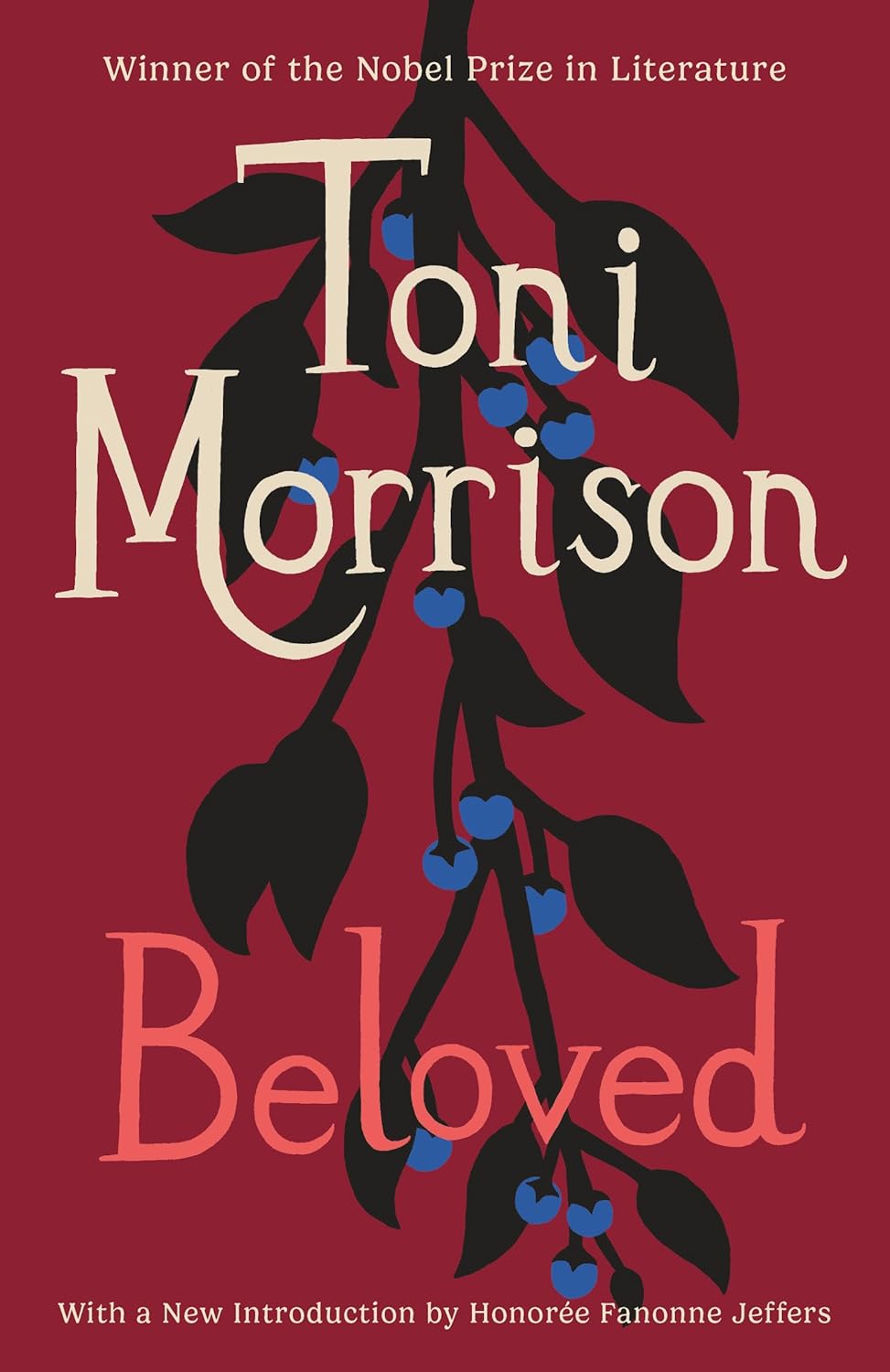
The most important ghost novel in American literature, and the ghost is a specific dead person with a specific claim.
124 Bluestone Road is haunted. Something in it breaks mirrors, leaves handprints in cake and moves furniture, and Sethe and her daughter Denver simply live around it, the two boys having fled long since. Then Paul D shows up and forces the presence out, and within days there’s a young woman on the stump out front, drenched, with skin like a newborn’s, no past she’ll give, and a name lifted off a headstone.
Morrison’s ghost is not atmosphere or ambiguity. Beloved is present, physical, eats, sleeps, and grows more demanding, and the novel treats her as literally there.
What she wants is the whole question. She was owed a life and did not get one, and the debt cannot be paid, and the more Sethe tries the less of Sethe there is.
Drawn from the case of Margaret Garner. Pulitzer Prize, and Morrison won the Nobel five years later.
Ghost Story (1979)

The Chowder Society is four old men of Milburn, New York, who gather on a schedule to trade frightening tales. There used to be five. What never comes up at those gatherings is the thing they did as young men, fifty years back, to a woman named Eva Galli.
Straub’s ghost is the best in modern American fiction and what makes her extraordinary is that she is not a ghost in any sense the tradition recognizes. She has three names across three periods, appears as three different women, and Straub refuses to say which is original or whether any of them are.
The opening half is magnificent: a snowbound upstate town, old friends circling the single unsayable subject, and tale-telling that functions as confession with the names filed off.
Readers stall in the swollen middle, and that reputation is earned.
It demonstrated that literary ambition and horror could share a spine without draining the blood out, and King has credited it openly for decades.
The Woman in Black (1983)

The best classical ghost story written since the war, and Hill wrote it in 1983 as a deliberate exercise in a form everybody assumed was finished.
Arthur Kipps, a young solicitor, is sent to Eel Marsh House on a tidal causeway to sort the papers of a dead recluse. There is a woman in black at the funeral who is not one of the mourners. The locals will not discuss her. The causeway floods twice a day and cuts the house off entirely, and out on the marsh in the fog there is a sound that Kipps hears once and then cannot stop hearing.
The ghost is the most vindictive in modern fiction. She lost a child and what she does about it is aimed at other people’s, and the rule governing her appearances is stated late and is genuinely horrible.
The stage version softens the ending considerably. The novel does not.
The 1989 television film is the frightening one. The 2012 Radcliffe film is the famous one and much less effective.
The Green Mile (1996)

Cold Mountain Penitentiary, 1932, and the ghost in it is the narrator himself.
Paul Edgecombe is a hundred and four years old, in a nursing home, writing down what happened on E Block the year John Coffey was executed for the murder of two little girls. Coffey is enormous, gentle, terrified of the dark, and can heal by touch, and everybody who works the block works out fairly quickly that he did not do it and that this will not matter.
The supernatural is Coffey’s ability and what it costs him, and King is precise about the mechanism: he takes the sickness into himself and has to expel it.
What earns the entry is the ending, and specifically what has happened to Paul. He is a hundred and four, and the reason he is a hundred and four is one of the bleakest ideas King has had.
It arrived in six slim monthly volumes across 1996, Dickens’s delivery method revived on purpose.
More on the best Stephen King books.
Bag of Bones (1998)

Mike Noonan’s wife dies suddenly of an aneurysm in a pharmacy car park, and he discovers afterwards that she was pregnant and had not told him, and that she had been researching something at their summer house in Maine.
He goes there, four years later, unable to write since her death, and Sara Laughs is occupied.
King’s ghosts here are plural and in conflict. Jo is present and trying to warn him. Sara Tidwell, a blues singer who was murdered in the town in 1901 along with her son, is present and is not benign, and what was done to her by the grandfathers of the current townspeople is the engine of the book.
The custody plot with Mattie and Kyra is the strongest human material he had written in years.
It is also his most explicit engagement with Daphne du Maurier, and the opening deliberately echoes Rebecca.
Won the Bram Stoker Award. It is late-period King and one of the better ones.
The Modern Wave
The Lovely Bones (2002)

Susie Salmon is fourteen when a neighbor murders her, and she narrates the novel from somewhere afterwards, watching her family for the next decade.
The ghost premise is the entire structure and it is doing something unusual. Susie is not haunting anybody in the traditional sense and she cannot intervene. She observes, and the horror is that she has to watch her family fail to recover, her father become obsessed, her mother leave, and her sister grow up into the space she left.
The murder is described in the opening chapter, briefly and without evasion, and Sebold does not return to it.
What she is honest about is that the family does not heal and does not get justice in any satisfying form.
The one section readers argue about is near the end and involves Susie briefly returning, and it is either the payoff or a betrayal of everything preceding it.
It sold enormously and was a book-club phenomenon in a way that has slightly obscured how bleak it is.
The Little Stranger (2009)

Hundreds Hall, Warwickshire, just after the war. Dr. Faraday, a rural GP, grew up knowing the Georgian pile from below stairs, his mother served there as a nursemaid, and a house call pulls him back into the orbit of the family decaying inside it, where he makes himself steadily indispensable.
Then the incidents begin: scrawls appearing on plaster, the family dog turning on a party guest’s child, a fire behind a locked door, a call bell sounding from an empty room. Every one arrives carefully staged, and every one comes with a rational reading attached.
The reason it belongs on a ghost list rather than a haunted house one is that the novel names a candidate. The question is not what is in the house but who, and Waters supplies the answer in the last line and in the title, and the majority of first readers sail past both.
Faraday tells all of it, decent, careful, indispensable, hiding nothing from us. The concealment happens one layer up, from himself.
Booker shortlisted. The 2018 film kept faith with the book and found no audience.
Her Fearful Symmetry (2009)

American twins Julia and Valentina inherit a flat in London from an aunt they never met, on the edge of Highgate Cemetery, on condition that they live in it for a year and that their mother never enters.
The aunt is still there.
Niffenegger’s ghost is unusually well thought through. Elspeth is initially only present as movement in dust, then learns to write, then to move small objects, then more, and the novel tracks her acquiring capability like somebody recovering from a stroke, which is a genuinely fresh idea.
Highgate is real and Niffenegger was a tour guide there while writing, and the cemetery material, the Victorian graves, the restoration work, the geography of the western section, is the best part.
The twins are the problem. Their relationship is pathologically close by design and readers find them difficult company.
And the last act involves a decision that a great many readers consider indefensible, which appears to be intentional and is the reason the book divides so sharply.
Lincoln in the Bardo (2017)

February 1862. Willie Lincoln, aged eleven, dies of typhoid, and his father visits the crypt at night to hold the body.
The bardo is the Tibetan term for the transitional state between death and rebirth, and Saunders populates a Georgetown cemetery with dozens of the dead who have refused to move on, all of whom insist they are not dead but merely sick, and who refer to their coffins as sick-boxes.
The form carries it, and nothing else reads like it. The novel is assembled entirely from short attributed fragments: the ghosts speaking in turn, interleaved with quotations from historical sources about the Lincolns, some real and some invented, and several of the real ones contradict each other about basic facts like whether there was a moon.
The ghosts are comic, garrulous and desperately sad, and each is stuck in the shape of whatever they could not let go of.
Won the Booker. The audiobook has a hundred and sixty-six narrators, which is not a gimmick.
The Hollow Places (2020)

Fresh from a divorce, Kara takes a room at her uncle’s North Carolina roadside museum of oddities, earns her keep helping out, and one day discovers that behind a taxidermied deer, the wall has a hole in it.
Past the hole runs a corridor, and past the corridor spreads a country of willow-covered islands standing in unmoving water, one island carrying a concrete bunker, the bunker carrying a message left by someone who came through earlier.
This is Blackwood’s “The Willows” rebuilt, a debt Kingfisher declares openly and builds on rather than hides. Willows that stir against the wind, peril that scales with attention. Her own addition, the one that makes the book hers, is what stands on some of those islands: forms that used to be people, and aren’t finished changing.
Simon from the coffee shop next door comes with her, and he’s genuinely funny, the standard Kingfisher construction: banter keeping the surface intact while the dread climbs beneath it.
Nothing else she has written matches the bunker sequence.
A Head Full of Ghosts (2015)

Marjorie Barrett is fourteen and may be possessed, may be schizophrenic, and is definitely being filmed for a reality television series.
The ghosts of the title are plural and mostly not supernatural. The family is haunted by unemployment, by the father’s new religion, by the production company paying the mortgage, and by a diagnosis that would end the contract.
Merry narrates at eight and again at twenty-three, being interviewed for a book, and threaded between the two run a horror blogger’s episode recaps, Tremblay reviewing his own novel’s genre furniture from inside it.
Marjorie is the reason it works. She is clever, funny, angry, entirely aware of what is happening around her, and has worked out exactly what she can do with it, and the scenes where she tells her sister stories are the most frightening in the book.
The last chapter turns the whole book over in your hands. It took the Stoker.
Mexican Gothic (2020)

In 1950, a letter arrives in Mexico City from a newly married cousin, disturbing enough that the family dispatches Noemí Taboada, socialite and reluctant emissary, up to High Place in the mountains.
The dead here are specific, named and countable, which is why it sits on a ghost list. The Doyle family have been working a silver mine since the previous century and it killed local workers by the hundreds, and there is a cemetery of English dead on the grounds and a mausoleum, and the house knows precisely who is in both.
What the family have been doing with the dead is the reveal and it is genuinely strange, and it lands in the final act with a register-shift the earlier chapters never telegraph.
The bloodline talk arrives over dinner, undisguised, and the point beneath it is the one Moreno-Garcia has made her signature: colonial extraction built these houses, and the genre kept the receipts hidden.
The Locus win followed, and so did the commercial wave the gothic revival has been riding since.
More on the gothic fiction page.
Where to Start
If you want the best book, read Beloved, and know going in that it is not a comfortable one.
Read Ghost Story or The Woman in Black, if you want the most enjoyable.
If you want to be genuinely unsettled by something quiet, read The Little Stranger and then read the last page twice.
And if you’d rather have the short form, which is where the ghost story was really perfected, that’s the ghost stories guide. If it’s the building rather than the dead you’re after, try haunted house books.
The whole shelf is ranked on my best horror books list. The short form does it better, and my ghost stories list has those.