The best haunted house books are not about ghosts.
That’s the distinction the whole subgenre turns on, and Shirley Jackson stated it in the first paragraph she ever wrote about Hill House: the house was not sane. Not haunted, not occupied, and not troubled by a previous owner. The building itself is wrong, and it has been wrong since it was built, and nobody died there to make it that way.

That’s the version that works, and it’s the standard the best haunted house books are held to. A house with a dead person in it is a ghost story with an address. A house that is itself the antagonist is something considerably stranger, because there’s nothing to appease, no history to uncover, and no grievance to settle. It simply doesn’t want you there, or worse, it does.
What’s on this page. Novels where the building is the threat. If the entity is a specific dead individual with unfinished business, that’s a different tradition and it’s covered under ghost books. Short fiction has its own guide too.
One of these I’ve read. I’ve said which.
Fiction by René Rehn


The Ancestors
The Fall of the House of Usher (1839)

The house that established the rule everything on this page follows, which is that the building and the family are the same organism.
Poe states it directly. The narrator arrives and observes that the phrase House of Usher covers both the family and the mansion, and that the line has never branched, and that the estate has passed directly from father to son for centuries with no collateral inheritance.
Roderick is convinced the house is sentient and that the arrangement of the stones and the fungi on them has produced an atmosphere that has determined the family’s fate. The narrator considers this a symptom.
The fissure is the detail. It runs from the roof to the tarn, barely visible, and the narrator notes it on the first page and Poe does not mention it again until the last paragraph.
And Madeline is buried in a vault beneath the house rather than in the family ground, temporarily, because Roderick is worried about the physicians.
Twelve pages, and the opening paragraph is the best-built page of dread in English.
The House on the Borderland (1908)

A ruined house above a chasm in the west of Ireland, and a manuscript found in the rubble by two men on a fishing holiday.
The house is the strangest on this page because it is a boundary rather than a haunting. The Recluse who wrote the manuscript establishes early that the building corresponds to something else, that there is a version of it standing on a plain in another place surrounded by enormous seated figures of the old gods, and that the two are connected.
From the pit beneath the cellar the swine-things rise to besiege the house, and Hodgson plays it as plain defense, rifle plus boarded windows, effective to this day.
Then the book abandons all of it. Time slips its gears around the Recluse in his chair, centuries pour past, the sun bloats and gutters, the solar system closes down, and all of it sits on a 1908 copyright page.
Broken structure, difficult prose, and a second half without any parallel in the period.
The Canon
The Haunting of Hill House (1959)

The best haunted house novel anybody has produced, by a margin that embarrasses the field.
The house is architecturally wrong on purpose. Hugh Crain built every angle a degree or two off true, so doors swing shut on their own because nothing is plumb, and the rooms are nested one inside another so reaching the library means passing through three others. Jackson establishes all of that in the first chapter as carpentry rather than haunting, and never mentions it again.
The incident log is short: one cold patch, some night hammering, a single sentence on a wall.
What she does instead is watch Eleanor: eleven years spent nursing a mother now dead, a borrowed cot in a sister’s nursery for a home, and a sister’s car, taken without asking, aimed at Hill House. She arrives starving to belong and is the focus of every event.
More on the Shirley Jackson page.
Hell House (1971)

Richard Matheson’s answer to Hill House, and deliberately so: a physicist, his wife, a mental medium and a physical medium who survived the house once before are paid to spend a week in the Belasco house and determine whether an afterlife exists.
Where Jackson withholds, Matheson shows you everything, and this is the most divisive book on the page as a result.
The case for it is that it’s the most influential haunted house novel after Hill House, that the Belasco house has a genuinely nasty history, and that Matheson commits to explicitness in a way nobody had before.
The case against is substantial and worth knowing. The house’s backstory arrives as one long expository conversation early on rather than emerging. The middle drags. And the sexual content, which includes necrophilia and a great deal of what reads now as leering, strikes plenty of readers as gratuitous rather than transgressive, particularly in its treatment of the two women.
The sharpest criticism of it draws a distinction worth borrowing: terror is implicit and made from atmosphere, horror is explicit and made from detail, and horror works best sprinkled rather than poured. Hill House is terror. Hell House is horror at full volume, and how you feel about it depends entirely on which you came for.
Burnt Offerings (1973)

Robert Marasco’s novel of a family who rent a decaying summer estate at an absurdly low price on one condition: they leave meals outside a locked room for the elderly mother who never comes out.
The house begins repairing itself. Slowly, room by room, as the family declines. It’s the most elegant single idea in the subgenre and Marasco never over-explains it.
King has named it, together with Hill House, as the parentage of The Shining, which puts it among the two or three most consequential books the subgenre owns.
And it did something neither of them did. Grady Hendrix has made the class point about this book better than anyone: Hill House and Hell House are both staffed by paid investigators who chose to be there. The Rolfes are tenants. They took the place because it was cheap and they are stuck with it, and every haunted house novel since that is really about property rather than about ghosts starts here.
What makes it unbearable is the tariff. Every repair bills somebody. A pane heals over and the cost lands on one of the residents, and Ben, Marian and young David are drawn down at their own separate speeds. Marian is first, and she volunteers, and Marasco understands precisely how a house that needs looking after can court a woman whose life has been all work, while her husband reads her absorption as contentment far past the point he should.
The scene readers carry out of it is the pool: a father roughhousing with his son until the roughhousing becomes something else, and from that page on, no one mistakes this for a story about a lease.
Marasco deserves the biographical note because there’s so little else to point to. A Latin teacher at a Manhattan Jesuit school, he wrote for Broadway before novels, Child’s Play, a thriller set in a Catholic boys’ school which won Tonys for its cast and director in 1970. Burnt Offerings was his first novel. He published one more, Parlor Games, in 1979, and then stopped writing entirely. He died in 1998.
Filmed by Dan Curtis in 1976 with Karen Black, Oliver Reed and Bette Davis, and the chauffeur is the thing people remember from it.
The Shining (1977)

Alone on this page, the Overlook is a functioning business.
There’s a season and a payroll, a guest ledger going back decades, a scrapbook down in the basement, a chain of owners with mob money in it, and a boiler that needs bleeding on schedule. Nothing about it is ruined or left to rot. It shuts for the winter, and come May it opens again.
And that’s the engine. Jack signs a contract; no trap is needed, and no overpowering either. What the hotel extends is standing, authority, an audience, material for his book, and eventually a drink, and Jack finds all of it congenial, and King charts exactly how small a push suffices when a man already carries the conviction that life has cheated him.
Danny’s shine is the fuel line the building has been waiting for, and the passages where the boy comprehends more than his vocabulary can carry are the finest writing King had done to that point.
See the film anyway; its Jack was born lost, where King’s goes down swinging.
More on the best Stephen King books.
The House Next Door (1978)

Anne Rivers Siddons wrote the smartest variation anyone has managed, and it’s the deep cut of this list.
The house is brand new. It’s beautiful, it’s modernist, it was designed by a gifted young architect, and it is being built next door to the narrator’s home in an affluent Atlanta suburb. Three families move in across the novel and each one is destroyed in a different way, and the horror has nothing to do with anything that happened on the land.
It removes the one thing every other book here relies on, which is history, and it works anyway. King wrote about it admiringly in Danse Macabre, and it remains the most quietly radical of the haunted house books.
What the house does is the part reviewers skip past. No apparitions, no noises after midnight. Its method is exposure. Whatever a resident most needs hidden, the house drags into daylight, before the neighbors, mid-party, staged for maximum humiliation. One family’s infidelity. A lost pregnancy. What a father learns about his boy. Fear never enters into it; the instrument is disgrace, and on a wealthy Atlanta street in 1978, disgrace cuts deeper.
Colquitt Kennedy carries the whole thing. She’s settled, popular, childless because she chose to be, and deeply invested in her street’s opinion, and most of her narration is spent managing appearances. So the real novel is a woman weighing her standing against what she knows, and Siddons treats that weighing as genuinely hard, which it is.
Siddons never returned to horror. It was her second novel, and the rest of the career went to mainstream Southern fiction, Peachtree Road, Colony, Outer Banks, published to large sales and no genre attention at all. She had been an advertising copywriter and a magazine editor in Atlanta, which shows in how precisely she renders a certain kind of social circle. She died in 2019.
One book, and it is better than most writers manage in thirty.
The Amityville Horror (1977)

The book is presented as a true account and it is not, and that is the reason to read it rather than a reason to skip it.
In November 1974 Ronald DeFeo Jr. killed six members of his family in the house. That happened. Thirteen months later the Lutz family bought the house, moved in, and left after twenty-eight days.
Everything else is disputed. William Weber, DeFeo’s defense attorney, later stated publicly that he and the Lutzes invented the haunting over several bottles of wine, and litigation followed in several directions. The priest’s account changed. The physical evidence did not exist.
What the book demonstrates is how a haunted house story gets built, and Anson’s version is a compendium of every element the genre had accumulated by 1977: the cold spots, the flies, the red room, the green slime, the voice, the hooded figure, the claim about Shinnecock land.
It sold ten million copies and produced a franchise. Read it as a document of the genre rather than of anything else.
The Elementals (1981)

Beldame is three Victorians on a Gulf Coast spit, reachable only over the beach at low tide: no road, no telephone, no neighbors. Two houses answer to the Savages and the McCrays. The third has no owner anybody can name, and sand owns it instead, in through the top windows years back, the upper floor gone under, the staircase going now.
That image sells the book from hand to hand, and McDowell refuses to rush it. Through most of the page count, the sand just sits, a presence at the edge of what is otherwise a novel about a family in the weeks after a burial.
His second trick is affection: you’re made to love these people before anything touches them. Luker and his thirteen-year-old India trade profanity as flat equals, and the book’s first half earns real laughs.
King’s finest-paperback-writer-in-America line was coined with McDowell in mind, and this novel was the evidence.
More on the southern gothic page.
The Modern Wave
House of Leaves (2000)

I’ve read this one. Nothing else on this page attempts a tenth of what it attempts.
A family moves into a Virginia house whose interior outmeasures its exterior by a fraction of an inch. Then a door appears in a wall where there is no room beyond it, and behind it is a hallway, and then a corridor, and then a lightless space of shifting proportions with a staircase going down.
No attack occurs anywhere in it. The house’s only act is to hold dimensions that contradict each other, and the dread is arithmetical from start to finish: tape measures, torches, rope, a man calling out figures that cannot both be true.
Nobody has written interior space better than the expedition chapters do it: procedural, cold, built from echo and footage and distance, with no monster on the payroll. Of every house on this page, this is the one without a single line of history, and it frightens more than any of them. More on the Mark Z. Danielewski page.
LINK /books-and-media/horror-literature/house-of-leaves/ A first-timer’s guide to House of Leaves: the layers, the footnotes, and the full-color edition.
Slade House (2015)

A house that appears once every nine years, at the end of an alley off a road called Slade Alley, behind a small black iron door that is not there the rest of the time.
Mitchell’s structure carries everything. Five sections, dated 1979, 1988, 1997, 2006 and 2015, each narrated by a different person who receives an invitation, walks down the alley, finds the door, and is taken. Each section is a self-contained story and each ends the same way, and the reader learns the mechanism a little more each time while the narrators never do.
The house is not a building. It is an orison, a constructed illusion maintained by twins who have been alive since the nineteenth century and who require a particular kind of soul every nine years to continue.
It began as a Twitter story Mitchell wrote in 2014, and it connects to The Bone Clocks, though it works entirely alone.
Two hundred and forty pages and it moves.
Wylding Hall (2015)

Early seventies: an English acid-folk band holes up in a sprawling Hampshire manor to cut a second album. The record they make is extraordinary. Their singer walks out of the house and out of existence.
The house is the reason it belongs here. It has rooms that do not appear on any plan, a library nobody catalogd, a wing that is older than the rest by centuries, and a bird problem, and the band treat all of it as atmosphere because they are twenty and stoned.
Form does the heavy lifting. Decades on, interviews with the surviving members, the manager and a journalist have been assembled into an oral history in which no one lies and no two memories match. A girl in the house, says one. A room later missing, says another. A third declines the subject entirely.
With everything reaching you as memory strained through forty years, no single event ever solidifies enough to hold.
Won the Shirley Jackson Award for best novella.
The Grip of It (2017)

To put James’s gambling behind them, Julie and James take a suspiciously cheap house wedged between forest and lake. Next door, a neighbor never stops watching.
Stains bloom on the walls and change their measurements. Rooms turn up that no survey recorded. A hum runs in the walls that reaches each spouse as a different sound. Mold takes the water. And on Julie’s skin, bruises repeat the stains, shape for shape.
That is the novel. The domestic abuse reading is available on every page and never confirmed, and Jemc refuses to arbitrate between the house doing it, James doing it, and Julie doing it to herself.
The construction does the deepest work. Alternating chapters contract as the marriage contracts, down to traded fragments by the end, the book’s own structure giving out in time with the couple while the surface plot keeps insisting the trouble is the walls.
Two-hundred and eighty pages and it is one of the best of the modern ones.
Home Before Dark (2020)
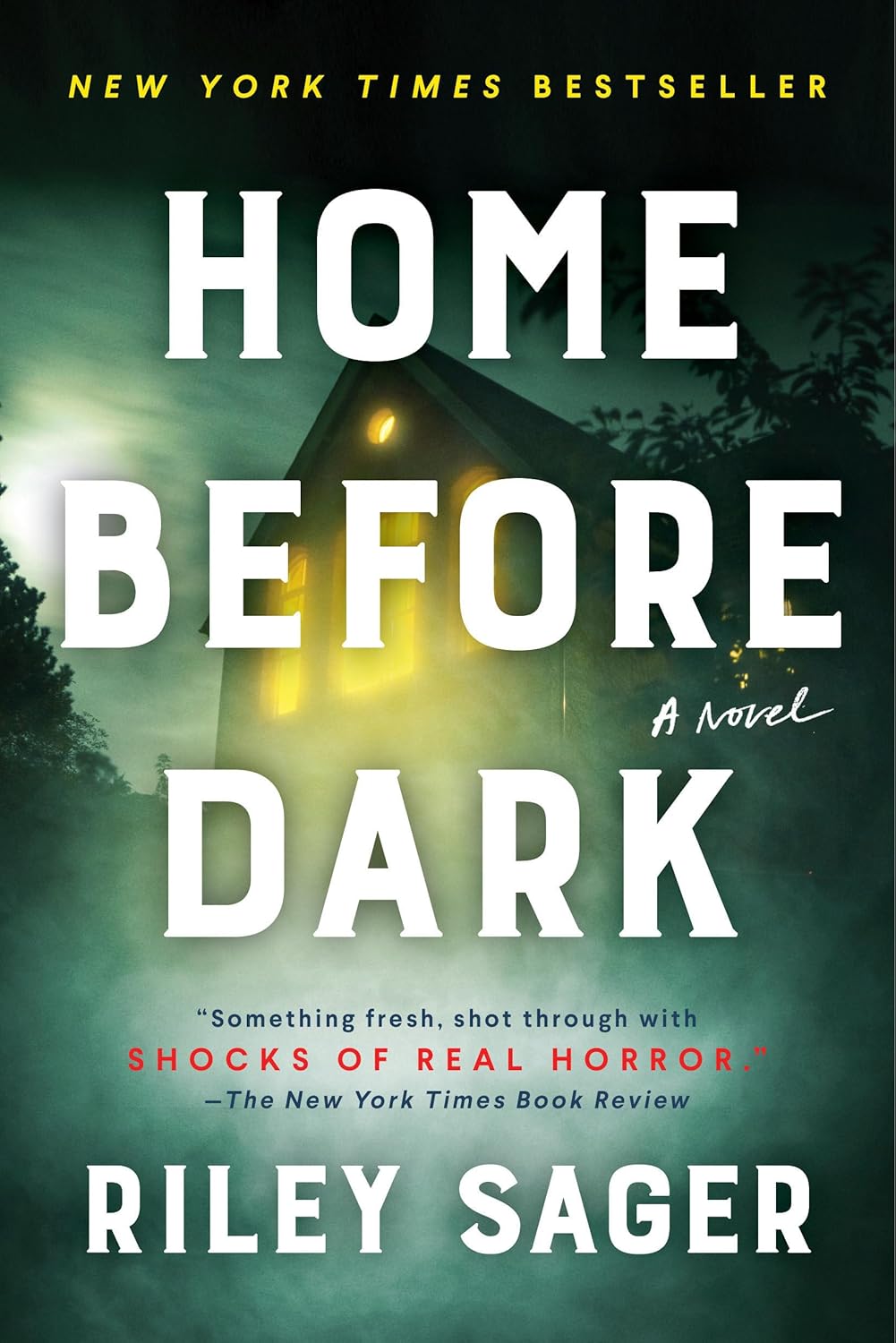
Maggie Holt’s father wrote a bestselling book about the twenty days the family spent at Baneberry Hall in 1975 before fleeing in the middle of the night. She was five. She remembers none of it and she has spent her adult life being asked about it.
He always maintained every word was true. She has always assumed he made it up. Then he dies and leaves her the house, which he never sold.
Sager’s structure is the pleasure. The novel alternates between Maggie’s present-day renovation and chapters of her father’s book, House of Horrors, printed as itself, so you get the haunted house account and the woman disproving it in parallel.
The Amityville debt is explicit and Sager is doing something with it rather than borrowing: the question is what a man would have to be covering up to invent a haunting and stick to it for twenty-five years.
It is a thriller rather than a horror novel and the resolution is a solution rather than a haunting.
Nothing But Blackened Teeth (2021)

An abandoned Heian-era mansion in Japan, its foundations holding a bride who was buried, so the story runs, to wait for a groom who never arrived, with a girl added every year since for company.
Five friends rent it for a wedding. They are all in their late twenties, they have known each other since school, and most of them should not be in a room together.
The house is the best-realized thing in the novella. Khaw is exact about the architecture, the tatami, the corridors, the shrine, and the folklore is specific rather than generic, and the ohaguro-bettari, the smiling woman with blackened teeth and no other features, is genuinely well used.
The honest note is the company. The five friends resent each other for a large share of the page count before the house stirs, and readers arriving for the haunting alone tend to feel cornered by them.
Finalist for the Bram Stoker, Shirley Jackson, World Fantasy and August Derleth Awards.
Devil House (2022)

Gage Chandler writes true crime for a living, and his method is to move into the houses where the killings happened.
He did it for the Milpitas case and it produced a bestseller and a film. Now his publisher has sent him to a former adult bookstore in Milpitas, California, where two people were killed in 1986 in what the press called a satanic ritual, and he moves in and starts working.
The house is not haunted. Darnielle is doing something considerably more uncomfortable than that, which is asking what it means to make a living from other people’s worst days, and whether the genre Gage works in is a form of desecration.
The novel is structured as several documents: Gage’s account, a chapter written in deliberate pastiche of true crime prose, a long section in Middle English, and a letter from the mother of a victim in an earlier book that undoes everything Gage has told himself.
That letter is what the whole novel was built to deliver, and it’s devastating.
The Last House on Needless Street (2021)

Washington state, the last lot on a dead-end road, a wood behind it, plywood over every window.
Ted lives there alone with the windows nailed over, a daughter he says is visiting, a cat called Olivia who reads the Bible and narrates chapters, and a Bible of his own. The street keeps an eye on him. Years back, when a girl vanished from a nearby lake, the police talked to him, and the talking led nowhere.
The house is sealed from the inside, which is the inversion the page needs. Everything else here is about a building that will not let people leave, and this is about somebody who has boarded the windows himself and is keeping something in.
The opening fifty pages resist you on purpose, and every confusion in them settles in full, which is exactly why the book resists discussion.
Arrive blank, and let no one near you mention the cat.
Three August Derleth Awards sit on Ward’s shelf, a count nobody else has reached.
Where to Start
Read The Haunting of Hill House, in as few sittings as you can manage. It works by accumulation and it loses power if you leave it for a week.
If you want to be frightened rather than unsettled, read Hell House, and go in knowing it is explicit in ways that have not aged evenly.
If you’ve read the famous ones, read The House Next Door and The Elementals. Those two are the reason this page isn’t the same as everybody else’s, and Siddons in particular did something nobody has repeated.
And if what you’re actually after is a specific dead person rather than a building, that’s ghost books. For the short form, try the ghost stories guide.
The older end of the shelf is on my horror classics page. When the house is incidental and the dead are the point, my ghost books list takes over.