Jason Pargin wrote the most-read horror novel of the last twenty years by giving it away for free on the internet, one chapter at a time, starting in 2001.
John Dies at the End was a webserial. He was writing it under the pen name David Wong while running a humor site called Pointless Waste of Time, which was later absorbed into Cracked.com, where he became executive editor and stayed until 2020. An estimated seventy thousand people read the free version before it came down in 2008. It got an edited manuscript release in 2004, a Permuted Press paperback in 2007, and a film in 2012.
It’s comic Lovecraftian horror, which sounds like a contradiction and is the most accurate three-word description available. Two slackers in a Midwestern town take a drug called soy sauce, start perceiving things that were always there, and become the people the town calls when something inexplicable happens. The jokes are constant and the cosmology underneath them is entirely serious.
He retired the David Wong name in 2020 and the Jason Pargin books were all reissued under his own. If you own an older paperback with a different name on the spine, it is the same book.
And he is one of very few novelists whose career was rescued by TikTok. He has been making short-form videos since 2022, has around seven hundred thousand followers, and has said plainly that it is what has kept him writing full time. That is worth knowing because it explains why a writer with four horror novels has the reach he does.
I haven’t read these. What follows is the critical consensus.
Fiction by René Rehn


The Short Version
Read John Dies at the End. It is the famous one, it is genuinely funny, and it is much stranger than its reputation as a comedy suggests.
Then This Book Is Full of Spiders, which most readers consider the better novel.
The Zoey Ashe books are not horror and are worth knowing about.
The John Dies at the End Series
Four books, and the core of the Jason Pargin books for horror readers. They are loosely connected, they can be read in order or nearly at random, and the narrator is unreliable in a way that is a running joke and also load-bearing.
John Dies at the End (2007)

David Wong, the narrator, and his friend John encounter a drug called soy sauce, which is not a drug and is not from here. Anyone who takes it can see across dimensions, which is the problem, because the things on the other side can now see back.
The structure is deliberately broken. It reads as a set of connected incidents rather than a plot, which is a consequence of having been written serially, and Pargin has never pretended otherwise. Some readers find it shapeless. Others find that the shapelessness is the funniest thing about it, since the narrator keeps promising to explain and then not explaining.
The comedy is the delivery mechanism rather than the point. Underneath it is a straight cosmic horror premise about an intelligence called Korrok, and the moments where the jokes stop are considerably more effective for the contrast.
Don Coscarelli, who made Phantasm and Bubba Ho-Tep, filmed it in 2012 with Paul Giamatti, Clancy Brown, Doug Jones and Angus Scrimm. It premiered at Sundance, it is very good, and it made about a hundred and forty thousand dollars at the box office, which makes it a cult film rather than a hit. Coscarelli’s blurb, calling Pargin a mash-up of Douglas Adams and Stephen King, is on most editions and is the best short description of him anybody has managed.
More on Lovecraftian fiction.
This Book Is Full of Spiders (2012)

The sequel, and the better-constructed book of the two.
Something is getting into people through their mouths while they sleep, replacing them, and the infected are not obviously different until they are. The town is quarantined by a private security contractor, a camp is set up, and the response becomes considerably worse than the parasite.
The structure is tighter than John Dies at the End because Pargin was writing a novel rather than assembling a serial. The chapters alternate between David, John and Amy, and Amy is given real weight for the first time.
What lifts it is the argument. The novel is about how quickly a frightened population will accept internment, informing on neighbors and summary violence, provided the threat is framed correctly, and Pargin is writing about that rather than about spiders.
It is also very funny, and the title is a genuine warning about the contents.
What the Hell Did I Just Read (2017)

The third, subtitled a novel of cosmic horror, and the most emotionally serious of the four.
A little girl has been taken by something and the town believes a man has done it, and David, John and Amy investigate while the police pursue the human explanation.
The device is the reason it works. The novel is narrated three times, in three sections, by David then John then Amy, and each of them gives a different account of the same events, and the discrepancies are not comic. David is an unreliable narrator who has been protecting the reader from things, and Amy’s section reveals what he has been leaving out about himself.
The monster material involves an entity that replaces children and the parents who cannot tell.
Pargin has said it’s the book where he stopped writing gags and started writing about David’s depression, and it’s where the series starts being about something.
If This Book Exists, You’re in the Wrong Universe (2022)

The fourth, and the one where Pargin turns the series on itself.
An object appears that grants wishes and shows people a version of the world they would prefer, and a cult forms around it, and the plot involves a device that may be capable of ending everything.
The satire is about online radicalization and conspiracy communities, and Pargin knows that territory better than almost any novelist because he spent fifteen years running Cracked and watching the internet change.
Most readers rank it the weakest of the four, with an argument more interesting than the plot carrying it.
What it does well is David, John and Amy as adults with jobs and a mortgage and a dog, still doing this, and the fatigue is genuine.
A fifth was announced and Pargin has since said the series is on hold indefinitely.
The Zoey Ashe Books

A separate series, three books so far, and it is science fiction rather than horror.
Zoey Ashe is a broke young woman working in a diner who inherits an enormous criminal fortune from a father she never met, along with his staff, his enemies and his city. Tabula Ra\$a is a lawless privately owned metropolis in Utah where everything is legal and everything is filmed.
The premise is a competence fantasy inverted. Zoey is not good at any of this, everybody around her is a specialist, and the plots turn on her being underestimated.
Pargin’s actual subject is spectacle and the economics of attention. Everything in the city is streamed, the population votes on outcomes in real time, and reputation is currency.
Futuristic Violence and Fancy Suits, Zoey Punches the Future in the Dick and Zoey Is Too Drunk for This Dystopia.
The titles are doing the books no favors and they are considerably smarter than they look.
The Standalone
I’m Starting to Worry About This Black Box of Doom (2024)
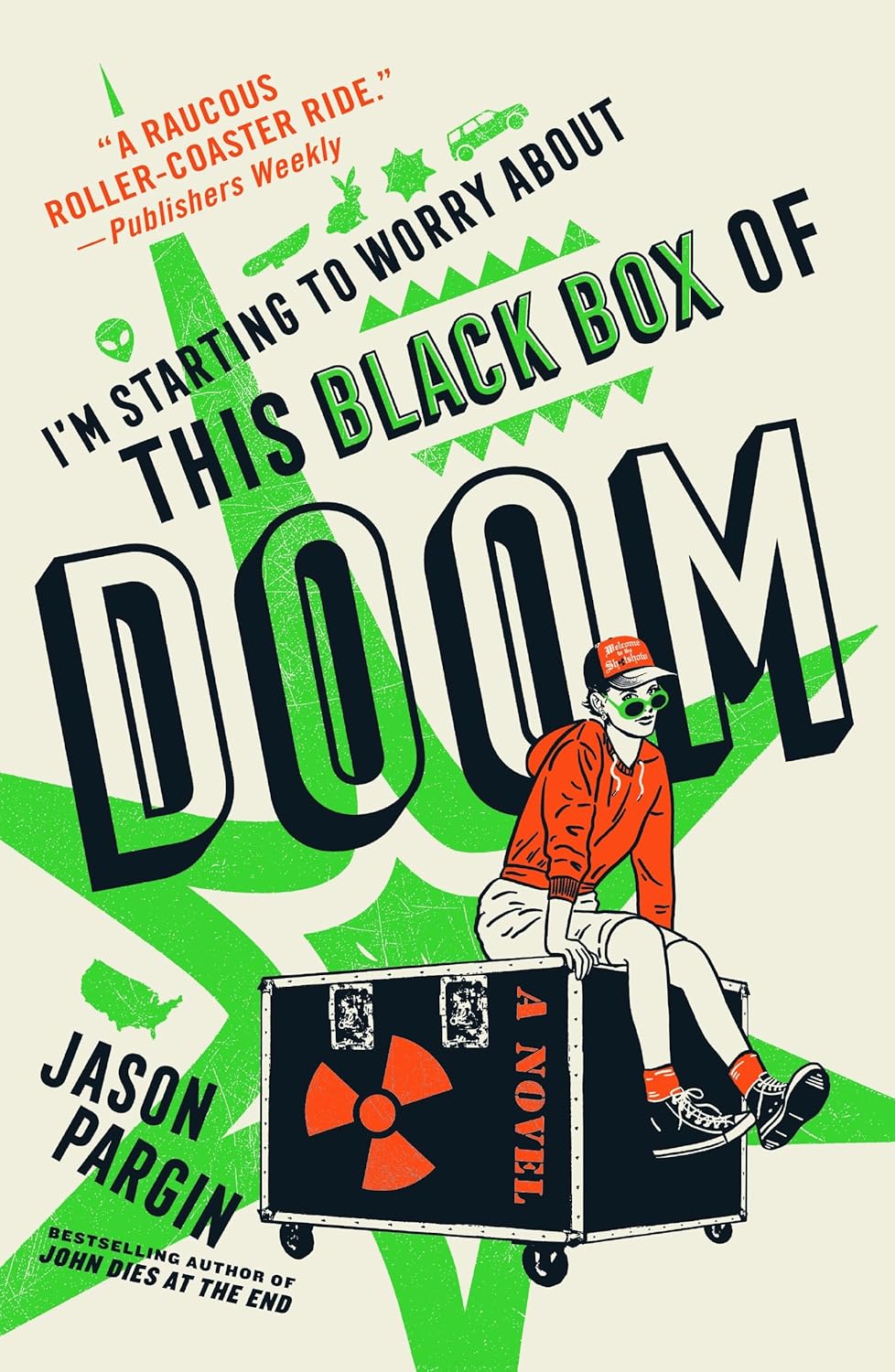
His most recent novel, published under his own name, and the first without a supernatural element.
A young woman agrees to drive a man across the country with a large locked case in the back, having answered an online listing. He will not say what is in it. Neither will she, because she does not know.
Meanwhile the internet has decided the case contains a bomb and that he is a terrorist, and a manhunt is being conducted in real time by people who have never met either of them and who are certain.
The argument is the same one Pargin has been making for a decade, which is that the online reconstruction of an event is a separate object from the event and that it is considerably more powerful.
The road novel underneath is genuinely warm, and the two leads are the best characters he has written.
It’s his most accessible book, and the one to hand somebody who would never pick up John Dies at the End.
Where to Start
Read John Dies at the End, and go in knowing it was a webserial, because the episodic shape makes considerably more sense once you do.
If it works, read This Book Is Full of Spiders next, which is the better novel and the one most readers end up recommending.
If the comedy is what you want without the cosmic horror, read I’m Starting to Worry About This Black Box of Doom.
And read the Zoey Ashe books if you want to see what the Jason Pargin books look like when he is not being funny about tentacles, because that is where the writing is tightest.
The whole shelf is ranked on my best horror books list. The cosmic material he is joking about is on my Lovecraftian fiction list.