Mary Shelley wrote the most famous horror novel in the English language when she was eighteen, and then spent thirty more years writing books almost nobody reads. horror classics
That’s the standard summary and it’s badly unfair. She wrote seven novels, and one of them invented the modern apocalyptic story. Another was suppressed by her own father and stayed unpublished for a hundred and thirty-nine years. She also edited and annotated her dead husband’s poetry into the shape it still holds today, which is most of the reason Percy Shelley has the reputation he has.
But there’s no getting around the fact that most people arriving at the Mary Shelley books want Frankenstein, horror books so this guide starts there, including the thing about Frankenstein that almost nobody knows before they buy a copy.
I haven’t read these. What follows is the critical consensus rather than my own verdict.
Fiction by René Rehn


The Short Version
Read Frankenstein, and read the 1818 text, not the 1831 revision most editions print. That’s not a pedantic distinction and I’ll explain why below.
Then read The Last Man if you want the other important book, which is a plague novel written in 1826 and the ancestor of everything from I Am Legend to Station Eleven.
Then Mathilda, which is short, was buried for over a century, and is the strangest thing she wrote.
Frankenstein (1818)

You know the story, or you think you do, and the odds are good that what you know came from the 1931 Boris Karloff film rather than the novel. There’s no lightning, no hunchbacked assistant, no laboratory of the kind you’re picturing. The creature is not a lumbering mute. He is articulate, self-educated, and by some distance the most persuasive speaker in the book.
The frame is a ship’s captain in the Arctic writing to his sister. gothic fiction He picks up a half-dead man off the ice, and that man tells him a story, and inside that story the creature tells his own. Three narrators, each nested inside the last, and the innermost one is the monster explaining precisely how he was made and then abandoned.
The point that gets lost. Victor’s crime is not making the creature. It’s what he does about ninety seconds afterwards, which is to look at what he’s made, recoil, and walk out of the room. Everything that follows proceeds from an act of abandonment rather than an act of creation. Written by a woman who had lost a baby two years earlier and whose own mother died eleven days after giving birth to her.
The edition question, which matters more than you’d think
There are two versions of this novel and most editions print the wrong one.
The 1818 was published anonymously, with a preface written by Percy Shelley, which led plenty of readers to assume he’d written it. The 1831 was published under Mary Shelley’s name, with a new introduction of her own that tells the famous Villa Diodati story: the wet summer, Byron’s challenge, the nightmare.
Between the two, she revised heavily, and she was a different person by then. Three of her children had died. Percy had drowned. She was poor, and she had spent a decade being judged.
The 1831 version lets Victor off the hook. It adds a fatalism that isn’t in the original, framing his obsession as something like destiny, a pull he couldn’t resist. In 1818, he has full autonomy and therefore full culpability. Abandoning the creature is a choice. Refusing to make him a companion is a choice. Failing to take responsibility is the entire horror of the book.
Other changes point the same way. Elizabeth stops being Victor’s cousin and becomes an adopted orphan, which removes a detail some readers had found distasteful. Justine’s speech before her execution changes from a furious attack on the injustice of retribution, exactly what you’d expect from William Godwin’s daughter, into meek submission to the will of Heaven. And where the 1818 text lets Elizabeth’s reaction stand on its own, the 1831 makes the moment about Victor.
Scholars overwhelmingly hold that 1818 is the book she meant. Buy an edition that says 1818 on the copyright page. The Norton Critical and the Oxford World’s Classics both use it. Most cheap paperbacks and most public-domain ebooks use 1831, because it’s the text that entered common circulation.
The Other Novels
She wrote six after Frankenstein and almost nobody reads any of them, which is a genuine loss in at least two cases. The Mary Shelley books below are what a professional novelist produced across thirty years while raising a son alone.
The Last Man (1826)
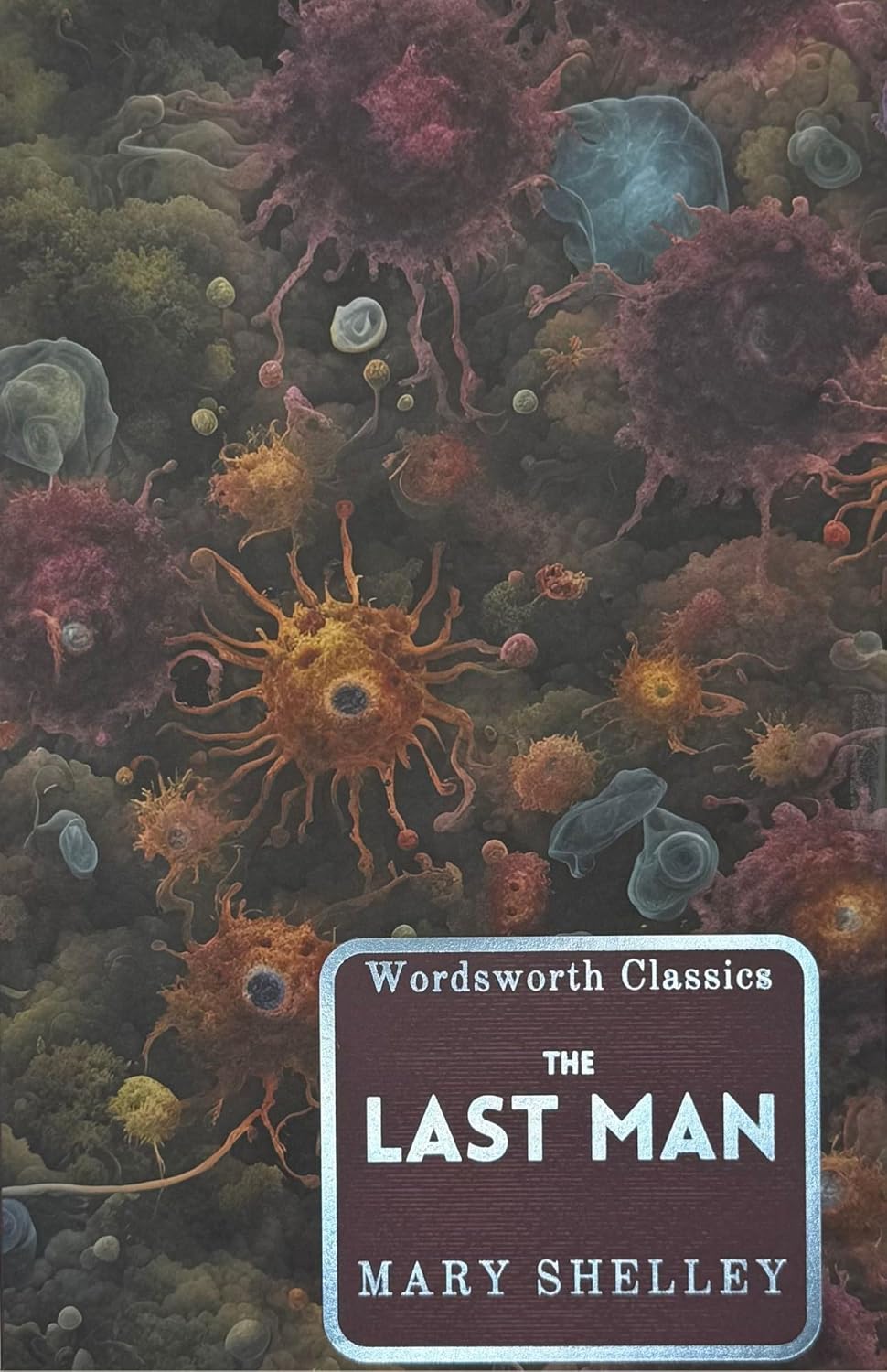
The one that should be famous, and increasingly is.
It’s set at the end of the twenty-first century, in a republican England, and it follows Lionel Verney through the arrival and spread of a plague that gradually removes the human species. It’s a slow apocalypse rather than a fast one: politics carrying on for a while, borders closing, institutions failing quietly, populations moving, and eventually nobody left to move.
It was savaged on publication and went out of print for well over a century. It was recovered in the 1960s and has been climbing ever since, for the obvious reason that it turns out to be the first modern pandemic novel and the template for a form nobody else attempted for another eighty years. post-apocalyptic and dystopian books
It’s also a roman à clef. The Byron figure and the Percy figure are both in there and both die, which makes it, among other things, a book about being the last survivor of a particular group of friends. She was.
Long, slow and worth it. The consensus warning is that the first volume is heavy going and the last is extraordinary.
Mathilda (written 1819, published 1959)

A hundred pages, and the reason it took a hundred and forty years to reach print is the subject.
A dying young woman writes an account of her life for a friend. Her mother died at her birth. Her father left, returned when she was sixteen, and confessed a sexual obsession with her, after which everything falls apart.
Mary Shelley sent the manuscript to her father, William Godwin, and asked him to arrange publication. He kept it. He never returned it and never submitted it, and it stayed in his papers, and it was not published until 1959.
Reading it as autobiography is tempting and probably too simple, but it was written in the months after her son William died, and the grief in it is not fictional. It is the rawest of the Mary Shelley books and the one that changes how the others read.
Valperga (1823)

Her historical novel, set in fourteenth-century Italy, and the one that shows how much reading she had done.
Castruccio Castracani is a real figure, a Ghibelline warlord who took Lucca and made himself its ruler, and Shelley researched him properly in Italian sources while living in Italy.
The novel is about what political ambition does to him, and the two women who see it happen. Euthanasia is the Countess of Valperga, educated, republican, and in love with him, and she has to decide between the man and the free city he intends to take. Beatrice is a young prophet who believes she is divinely inspired, is destroyed by the Inquisition, and whose sections are the strangest thing Shelley wrote.
It is a political novel about tyranny written by somebody whose father was William Godwin and whose mother was Mary Wollstonecraft, and it argues that a republic is worth more than a great man.
Godwin edited it heavily before publication and cut it, which she resented.
Lodore (1835) and Falkner (1837)

The last two novels, both domestic, and both considerably better than their reputation as the books where she gave up.
Lodore follows a man who takes his daughter to the American wilderness after a scandal and raises her in isolation to be entirely dependent on him, and then dies, leaving her to survive in a society she has never seen. The critique of that upbringing is explicit and it is aimed at exactly the kind of Romantic idealism her circle practiced.
Falkner is her last, and it is about a girl raised by the man who ruined her family and destroyed her mother, who has to choose between him and the truth when it emerges.
Both are about fathers and daughters, both are about men who damage women while believing themselves principled, and Shelley had by then buried three children and a husband.
Neither is horror and neither is a masterpiece. They are the work of a professional novelist paying the bills and settling something.
The Fortunes of Perkin Warbeck (1830)

Her other historical novel, and the premise is a good one badly served by the execution.
Perkin Warbeck was a pretender who claimed to be Richard of Shrewsbury, the younger of the Princes in the Tower, and led rebellions against Henry VII before being executed in 1499. Historians have largely settled on impostor from Tournai.
Shelley’s novel takes the position that he was telling the truth, that he was the prince, and that he survived the Tower and grew up in exile.
That is a defensible reading of a genuinely unresolved case, and she researched it thoroughly, and the result is her longest and least read book.
The problem is the shape. It is three volumes of court politics and military campaigning in a period she had not lived in and could not make vivid the way she made Italy vivid.
Read it only if the Wars of the Roses interest you independently.
Print editions are rare, unfortunately. You can also find it on Project Gutenberg, or as part of the above collection.
Everything Else
She was a working professional writer for thirty years and the novels are a small part of it.
The short fiction runs to about two dozen stories, written mostly for annuals and gift books, and several are genuinely strange. “The Mortal Immortal” is a man who drank an elixir at twenty-three and is now three hundred and twenty-three and watched his wife age and die while he did not. “Transformation” is a body swap with a dwarf. “Roger Dodsworth” concerns a man thawed out after being frozen for a hundred and fifty years, published in 1826.
She also edited Percy’s poetry after his death, with extensive notes that established his reputation almost single-handedly and that shaped how he was read for a century.
And she wrote travel books. Rambles in Germany and Italy was her last published work.
The Journals of Mary Shelley and her letters are both available and are the primary sources for almost everything anybody knows about that circle.
Where to Start
Frankenstein, in the 1818 text. If you’ve read it before in a school edition, it’s worth reading again in the original, because it’s a harsher and better book than the one most people were assigned.
Then The Last Man, which is the other genuinely important thing she wrote and the one most likely to surprise you.
Then Mathilda if you want to understand her, and Valperga if you want to know what she actually wanted to be writing.
Everything else among the Mary Shelley books is for completists, and there’s no shame in stopping after three.