R. F. Kuang books arrive as arguments, and knowing that going in is most of choosing your door. No comparable career covers this much ground this fast: a military fantasy trilogy soaked in twentieth-century Chinese history, then Babel, the dark-academia phenomenon that made her a household name in the genre, then a venomous publishing satire with no magic in it at all, then a descent into Hell, and now a quiet literary novel about one summer in Taipei. Five lanes in eight years, from an author who was drafting her debut while most writers are still workshopping short stories.
Every one of those books started a fight somewhere, by design, because Kuang writes thesis-forward fiction and has never pretended otherwise. Readers who want their themes ambient bounce off her. Readers who want a book that grabs the lectern tend to become devoted. There is no version of this guide that pretends the splits away, so it won’t: where a book divides its readership, you’ll get both camps and enough information to guess which one you’re joining.
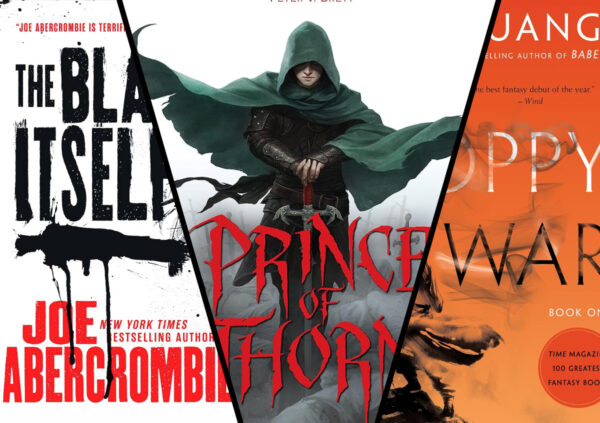
The Poppy War already fights on three of my lists, the best fantasy books pillar, the grimdark list, and the Chinese fantasy novels page. What follows is the map of the whole author: every novel in order, where to start, and what each of the R. F. Kuang books is actually arguing about.
Fiction by René Rehn


The Short Version
Pick by appetite. Babel if you want the phenomenon and the big ideas about empire and language. The Poppy War if you want the war, taken straight and unsweetened, read in trilogy order. Yellowface if you don’t even like fantasy, because it isn’t one. Katabasis is best saved until you already know whether Kuang’s register works on you, and Taipei Story, the newest, drops the genre apparatus entirely for a short literary novel. Apart from the trilogy, the R. F. Kuang books all stand alone, and there’s no required order.
R. F. Kuang Books in Order
Every R. F. Kuang book so far, in order of first publication. Only the Poppy War volumes form a series and need their order kept.
| Year | Title | Series or type | Notes |
| 2018 | The Poppy War | The Poppy War trilogy, book 1 | Compton Crook and Crawford awards |
| 2019 | The Dragon Republic | The Poppy War trilogy, book 2 | |
| 2020 | The Burning God | The Poppy War trilogy, book 3 | |
| 2020 | The Drowning Faith | Companion episodes | Nezha’s point of view, no standalone edition |
| 2022 | Babel | Standalone novel | Nebula and Locus awards |
| 2023 | Yellowface | Standalone novel | Literary satire, no fantasy |
| 2023 | The Best American Science Fiction and Fantasy 2023 | Anthology | Guest editor |
| 2025 | Katabasis | Standalone novel | |
| 2026 | Taipei Story | Standalone novel | Literary fiction |
Where to Start With R. F. Kuang
Match the door to the appetite, because the R. F. Kuang books are different experiences lane to lane. Babel is the broadest entry: a standalone, the most decorated, and the clearest statement of what she does with ideas. The Poppy War is the entry for readers who already live in military fantasy and grimdark, with the content warning in its entry taken seriously first. Yellowface is the door for people who don’t read fantasy at all, since it contains none.
The two I’d hold back are Katabasis and Taipei Story. Katabasis is the love-or-hate one even by Kuang standards, and it lands best once you already know how her books argue. Taipei Story is quiet, internal literary fiction, closer to a coda than a door, and it will mean more once you’ve seen the scholar’s career that feeds everything else she writes.
One more orientation point: if what draws you is the big-canvas tradition the trilogy fights with, the epic fantasy guide maps where military fantasy like hers sits against Tolkien’s descendants. Kuang’s war books are a deliberate answer to that tradition, not a continuation of it.
Kuang’s Life, Briefly
Rebecca F. Kuang was born in Guangzhou in 1996 and moved to the United States with her family at four, growing up in Dallas. She studied history at Georgetown and drafted The Poppy War along the way, beginning it, by her own account, while still a teenager. The book came out in 2018, the same year she graduated. A Marshall Scholarship then took her to England for two graduate degrees in Chinese studies, an MPhil at Cambridge and an MSc at Oxford, which is why the university worlds of Babel and Katabasis are drawn from the inside.
Since fall 2020 she has been a PhD student at Yale in East Asian languages and literatures, with research interests in Sinophone and Asian American literature, and in 2026 the College of the Holy Cross named her its inaugural Millard Distinguished Writer in Residence. She won the Astounding Award for best new writer in 2020, two books into the trilogy. The scholarship is not a side note to the fiction: every novel she has written runs on it, from the military history underneath The Poppy War to the translation theory that powers Babel.
The Poppy War Trilogy
The trilogy is the debut lane and the most brutal thing on the shelf: The Poppy War (2018), The Dragon Republic (2019), The Burning God (2020), three books in three years, read strictly in order. The whole arc transposes twentieth-century Chinese history into fantasy dress and hides none of its sources, which is exactly why its placement gets argued on my grimdark books list: this is military fantasy where the atrocities come from the historical record with the names changed. A short companion, The Drowning Faith, retold events from Nezha’s point of view in three episodes in 2020. It has no standalone edition and is strictly for finishers.
The Poppy War (2018)

The Poppy War is the ferocious debut, and of all the R. F. Kuang books it’s still the one with the hardest edge. Rin is a war orphan from the southern provinces who aces the empire-wide examination into Sinegard, the elite military academy in the capital, out of spite and two years of punishing study, and discovers there that she has access to a vengeful god of fire with a price attached. Then the Third Poppy War begins, and the school story becomes a war story with the safety off.
The history underneath is the Second Sino-Japanese War, and the book does not soften it: a long stretch of the second half depicts an atrocity modeled on the Nanjing Massacre, at close range, and readers should know that going in. Kuang has also been open about the other design choice. In interviews around the launch she framed the question driving Rin as how someone goes from roots like Mao’s, and Rin’s, to holding unimaginable power and causing enormous suffering. That reframes the usual chosen-one arc into something far more disturbing, a heroine the books ask you to follow and then to fear.
The genre noticed immediately. The book won the Compton Crook and Crawford awards in 2019 and was a finalist for the Nebula and World Fantasy awards, a debut haul very few first novels match. It’s for readers who want their military fantasy serious about what war actually is, and who can take the book at the pitch it sets.
The Dragon Republic (2019)

The Dragon Republic is the steadier and more political middle book, and a common pick for the trilogy’s strongest. Rin comes out of the first book’s ending in pieces, hunted by the Empress and at war with her own god, and signs on with the Dragon Warlord, who means to tear the empire down and build a republic in its place. The school story is long gone: this is a civil war novel, fought fleet by fleet and province by province, with foreign backers whose help never comes free.
What elevates it is the widening frame. The first book asked what Rin would do with power, and this one asks who gets to rebuild a country afterward and on whose terms, which turns every victory ambiguous while it’s still being won. Readers who found the debut’s academy half slow tend to rate this one higher, and the naval campaigns give Kuang’s battle writing its best canvas in the trilogy.
The Burning God (2020)

The Burning God closes the trilogy at full pitch. Rin returns to the rural south she came from and raises the peasants the empire has spent the whole series feeding into its wars, while every power from the earlier books converges for the endgame. It is the angriest of the three, the one where the historical machinery underneath stops being subtext, and it drives its heroine’s arc to the conclusion the Mao framing promised from the start.
The consensus shape of the trilogy settled quickly: a ferocious debut, a steadier second book, and a finale whose ending divides its readership right down the middle, which by then feels entirely in character. You can tell how seriously the field took the trilogy as a whole: it was a Hugo finalist for best series in 2021. Among Kuang books it’s the ending readers argue about longest, and saying any more than that would rob you of the argument.
The Standalone Novels
After the trilogy, Kuang never wrote the same book twice. Each of these Kuang books changed lane, register, and in two cases genre entirely, and each one landed as an event: bestseller lists, award ballots, and a fresh controversy. They share no setting and can be read in any order.
Babel (2022)

Babel is the phenomenon, the biggest of the R. F. Kuang books by every measure, and the argument about it is part of the experience. The full title is Babel, or the Necessity of Violence: An Arcane History of the Oxford Translators’ Revolution, which tells you the book has a thesis and isn’t sorry. Robin Swift is orphaned in Canton and raised in England by a cold professor for one purpose: Oxford’s Royal Institute of Translation, the tower called Babel, where the empire’s power is literally manufactured.
The magic system is the best conceit-as-argument of its decade. Engrave a matched pair of words on a silver bar, and whatever meaning is lost between the two languages becomes real, working force in the world. That means the empire’s engine burns the mother tongues of the colonized as fuel, stocked by students like Robin, imported precisely to mine their own first languages. A secret society called Hermes offers him the other side of the ledger, and the subtitle tells you what question the book is prepared to ask.
The reception made genre history. It debuted at number one on the New York Times hardcover fiction list, won the Nebula and Locus awards and the British Book Award for fiction, and was Blackwell’s fiction book of the year.
The split is just as real: Natasha Pulley in the Guardian called it a scholarly book by a superb scholar, its characters pretentious and vulnerable at once, while Publishers Weekly found the same book didactic and unsubtle. Both camps are describing it accurately, and the first fifty pages will tell you which reader you are. Readers coming from Jonathan Strange & Mr Norrell, the scholarly-footnote fantasy it is most often measured against, can approach that lineage from the other end in my Susanna Clarke guide.
Yellowface (2023)

Yellowface is the lane change nobody saw coming: no magic, all teeth. June Hayward watches her frenemy, literary darling Athena Liu, die in a freak accident, walks out with Athena’s unpublished manuscript, and publishes it as her own under a newly ambiguous author photo and the name Juniper Song. What follows is a first-person spiral through publishing, social media, guilt, and self-justification, narrated by one of the most watchable unreliable narrators in recent fiction, a woman explaining herself to you in real time while the hole deepens.
It became an instant bestseller and her biggest crossover hit, winning the British Book Award for fiction book of the year in 2024 and the Goodreads Choice award for fiction.
The reception split along honest lines. Admirers, Amal El-Mohtar in the New York Times among them, found it viciously satisfying while conceding it is blunt. Detractors, loudest in the Washington Post, found June too shallow a vessel and the publishing-industry material thinner than the premise promises. The case for the bluntness is that satire this close to its target doesn’t benefit from a softer knife. It’s the Kuang book to hand anyone who claims they don’t read fantasy, since it isn’t in it, and it’s very funny in the way a paper cut is precise.
Katabasis (2025)

Katabasis sends two graduate students into Hell, and it’s about academia, which is the joke and the thesis at once. In a late-twentieth-century Cambridge where Magick is a proper academic discipline, Alice Law’s advisor, the brilliant and monstrous Professor Grimes, is blown apart in a classroom accident that may be her fault. She descends into Hell to retrieve his soul, mostly because she still needs his letter of recommendation, and her rival Peter Murdoch comes too. Hell is organized like a campus, its Eight Courts running on logic and paradox, and the whole thing plays as dark academia crossed with a dungeon crawl, with a romance simmering underneath.
It arrived as her biggest launch yet, debuting at number one on the New York Times hardcover fiction list and holding there for two weeks, and the reception split harder than anything since Babel. The Guardian praised it as a celebration of the acrobatics of thought, and Kirkus and Library Journal starred it, while the Washington Post dismissed it as bloated and tedious and Slate argued that character is her abiding weakness as a novelist. Almost nobody lands in the middle ground, which is why it belongs late in your Kuang reading rather than first. It was a Nebula finalist for 2025 and a Locus finalist the following year, so the admirers clearly include the field’s voters.
Taipei Story (2026)

Taipei Story is the newest and quietest of the Kuang books, a short literary novel published in September 2026 with no fantasy in it at all. Lily Chen, a college freshman, spends a summer in Taipei at an intensive language program, trying to reclaim a language she last spoke as a baby. The classes are brutal, the roommate is difficult, a trip to the hot springs sparks gossip, and when her grandfather dies mid-summer, the book turns toward grief and a family history her relatives would rather not hand over.
The early trade reception has been warm, with Kirkus calling it “a visceral exploration of language as a bridge and a barrier,” and early readers note how directly it speaks to second-generation immigrants caught between too American and too other. It is also deliberately small: internal, one summer, one voice, and some first-wave readers find the supporting cast thin and the close abrupt. Weeks after release, the honest status is that the settled verdict doesn’t exist yet. Read it as the scholar’s memoir-shaped fiction it is, after you know the louder books.
R. F. Kuang: Deep Dive and FAQ
What Runs Through R. F. Kuang’s Books
The constant is the argument. Every Kuang novel is built around a thesis, stated nearly out loud, about power and who pays for it: the cost of war in the trilogy, empire and language in Babel, race and commerce in publishing in Yellowface, what academia does to the people inside it in Katabasis and again, stripped of magic, in Taipei Story. She would rather risk the lecture than the shrug, and your tolerance for that trade is, more than anything else, your tolerance for Kuang.
The second thread is the academy itself. Sinegard, Oxford, Cambridge, a Taipei language program: nearly every book begins in a classroom, because classrooms are where her characters learn what the institution actually wants from them. And the third is the protagonist she keeps writing, hungry, wronged, gifted, and willing to go much further than you want them to. Rin, Robin, June, Alice: none of them are built to be liked, all of them are built to be understood, and the discomfort of understanding them is the point.
Prizes and Honors
The haul is remarkable for a career this young. The Poppy War won the Compton Crook and Crawford awards in 2019 and was a Nebula and World Fantasy finalist, Kuang won the Astounding Award for best new writer in 2020, and the finished trilogy was a Hugo finalist for best series in 2021.
Babel won the Nebula Award for best novel, the 2022 award presented in 2023, plus the 2023 Locus Award for fantasy novel, the British Book Award for fiction, and Blackwell’s fiction book of the year for 2022, and in 2026 it added Japan’s Seiun Award for translated novel. Yellowface took the British Book Award for fiction book of the year in 2024, the Goodreads Choice award for fiction, and an American Book Award. Katabasis was a Nebula finalist for 2025.
One award story needs telling straight. At the 2023 Hugo Awards, held at the Chengdu Worldcon, Babel was ruled ineligible despite drawing the third-most nominations in its category, and the administrators gave no explanation. Kuang said publicly that no reason had been given to her or her team. Nomination statistics and internal emails that surfaced in early 2024 showed administrators had vetted nominated works for content they feared would be politically sensitive in China, a scandal that consumed the awards for a year. Babel never got its Hugo ballot spot, and the record now shows why.
Which R. F. Kuang Editions to Buy
The R. F. Kuang books are an easy catalog to shop: everything is in print in the United States through HarperCollins, with Harper Voyager carrying the trilogy, Babel, and Katabasis, and Taipei Story arriving under William Morrow. The trilogy reads best in the matching Harper Voyager paperbacks, and there’s no omnibus to wait for. For Babel specifically I’d push print over audio: the book argues partly through footnotes, and footnotes belong on a page. Yellowface and Taipei Story work in any format, and Yellowface in particular has a strong reputation in audio, where the narrator’s self-justifying voice does half the work. The Drowning Faith has no standalone edition, so completists shouldn’t go hunting for one.
R. F. Kuang on Screen
None of the R. F. Kuang books has reached a screen yet, but almost everything is spoken for. Starlight Media bought television rights to the Poppy War trilogy in December 2020, and that project has shown no production movement since. Babel was optioned in 2024 by wiip, with Temple Hill Entertainment producing. Yellowface went to Lionsgate Television in late 2024, with Karyn Kusama attached to direct a potential limited series. And Katabasis sold to Amazon MGM Studios for a television series with Angela Kang, of The Walking Dead, as writer and showrunner. As of October 2026, all four remain in development, with no casting, dates, or greenlights announced. Treat every one as a maybe.
Questions About R. F. Kuang
What Order Should I Read R. F. Kuang’s Books In?
Only the Poppy War trilogy has a required order: The Poppy War, The Dragon Republic, The Burning God. Everything else stands alone. The common advice is to start with Babel or Yellowface depending on whether you want fantasy, save Katabasis until you know her style works for you, and treat Taipei Story as the quiet late addition.
Is Yellowface a Fantasy Novel?
No. Yellowface is a contemporary satire of the publishing industry with no fantastical elements at all, narrated by a white author who steals a dead rival’s manuscript. It’s Kuang’s biggest crossover hit precisely because it asks nothing of readers who avoid the genre, and it won the British Book Award for fiction book of the year in 2024.
How Violent Is the Poppy War?
Very, and knowingly. The war scenes draw on the Second Sino-Japanese War, and one extended sequence depicts an atrocity modeled on the Nanjing Massacre at close range. The book treats that material gravely rather than as spectacle, but readers sensitive to depictions of wartime atrocity, self-harm, and addiction should go in informed.
Why Wasn’t Babel on the 2023 Hugo Ballot?
The award administrators at the Chengdu Worldcon ruled it ineligible despite its drawing the third-most nominations in its category, and gave no explanation. Kuang stated publicly that no reason was provided to her or her team. Emails that surfaced in early 2024 showed organizers had vetted works for content they feared would be politically sensitive in China.
Is the Poppy War Trilogy Finished?
Yes. The trilogy completed with The Burning God in 2020 and tells a closed story, and the finished series was a Hugo finalist for best series in 2021. The only extra material is The Drowning Faith, a short 2020 companion from Nezha’s point of view, which has no standalone edition and is only for readers who have finished the trilogy.
Will There Be a Poppy War TV Show?
Rights were bought by Starlight Media in December 2020, and as of October 2026 no production has been announced, so the honest answer is not any time soon. Her other books are moving on paper too: Babel at wiip, Yellowface at Lionsgate with Karyn Kusama attached, and Katabasis at Amazon MGM with Angela Kang as showrunner, all still in development.
What Is R. F. Kuang’s Newest Book?
Taipei Story, published in September 2026, a short literary novel about a college student’s summer at an intensive language program in Taipei. It contains no fantasy. Kuang reportedly has more books under contract with HarperCollins, including a historical novel and a fantasy announced in 2023, but no titles or dates have been confirmed for those.
Where to Go Next
The natural next shelf depends on which Kuang you liked. If the trilogy’s historical machinery is what gripped you, the Chinese fantasy novels page puts The Poppy War beside the wuxia, xianxia, and historical fantasy it’s in conversation with. If it was the brutality taken seriously, the dark fantasy books list runs that register across the whole genre.
And if what you want is another author whose books win the big awards while starting arguments on purpose, N. K. Jemisin is the closest living parallel, and the N. K. Jemisin guide covers a career that reshaped the field’s idea of what a fantasy novel is allowed to be about.