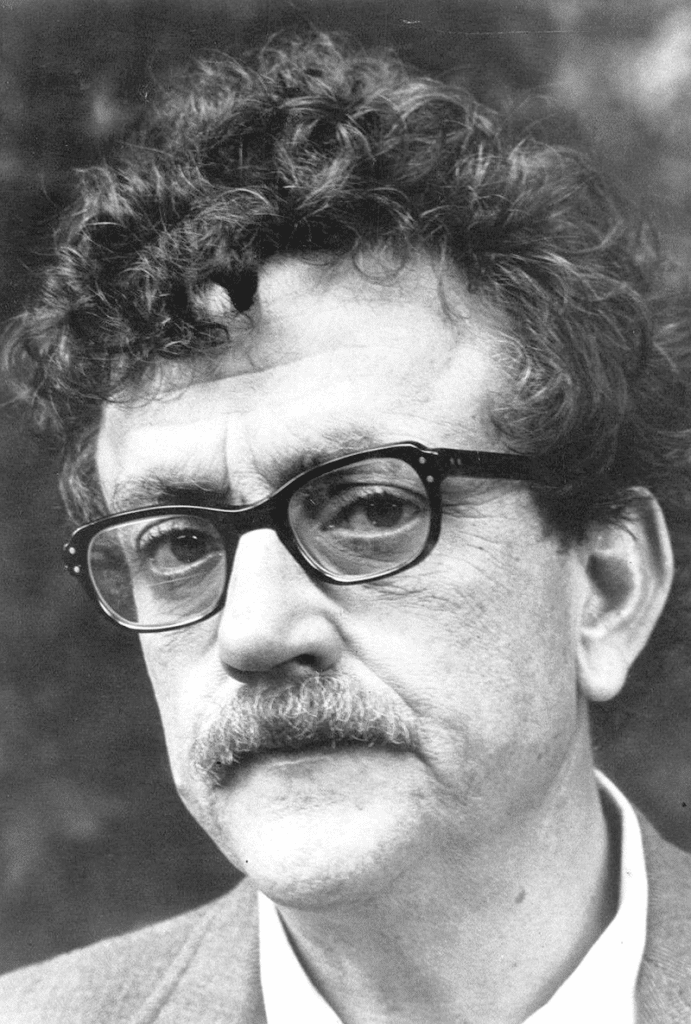
Kurt Vonnegut’s one of the most celebrated American writers of the 20th century. He was an extremely prolific writer with a career spanning over 50 years who’s published 14 novels, countless short stories, essays and a variety of other works.
The best Kurt Vonnegut Books are almost always satirical. They use dark wit and black comedy to shed light on a variety of serious issues such as war, death and environmental destruction. They are, however, always entertaining.
What propelled Kurt Vonnegut to fame was his sixth novel, Slaughterhouse Five.
Nowadays, Kurt Vonnegut is regarded as one of the most influential and popular American writers of all time and a pioneer of postmodern literature.
Fiction by René Rehn


Best Kurt Vonnegut Books – Discovering Kurt Vonnegut
I first learned of Kurt Vonnegut back in 2010. Back then, I was relatively new, not only to American literature, but serious literature.
I made the plunge and got myself a few select books that were highly regarded. One of those books was Slaughterhouse-Five by Kurt Vonnegut. The novel’s description had caught my eyes, especially since I’m from Dresden in Germany.
Reading it was quite an experience, as those of you who’ve read it can imagine. It’s a non-linear, anti-war novel which jumps from place to place and event to event without rhyme or reason.
The moment I’d finished it, I’d become a full-blooded fan of Kurt Vonnegut.
Over the years, I’ve read almost all of his novels and quite a few of his other works, but my appreciation for him has only grown.
Best Kurt Vonnegut Books – Why You Should Read Kurt Vonnegut
There are a lot of things about the best Kurt Vonnegut books I can’t help but love.
He’s amongst the most profound American writers and he’s shed light on a lot of important issues while always remaining funny and entertaining.
His works are also easily accessible, which I still find interesting, given he’s a pioneer of postmodern literature. Whenever I think about postmodernism, the first names that come to my mind are Thomas Pynchon and David Foster Wallace. Both are writers who are infamous for how inaccessible their works can be to the normal reader.
What makes Kurt Vonnegut so interesting is his special style. He creates a certain closeness between himself and the reader. Reading one of the best Kurt Vonnegut books often feels like listening to a story told to you by an old friend.
This closeness is often supported by his many meta-fictional elements, which he uses to address the reader personally. It’s quite fascinating.
Mostly, however, I think it’s his timeless with and the many words of wisdom he shares with his readers. While his work is satirical and comical, it’s often full of deep and profound insight.
“And I urge you to please notice when you are happy, and exclaim or murmur or think at some point, ‘If this isn’t nice, I don’t know what is.’”
For this article, I want to focus not only on his novels but also include some of his other works I deem important. If you’re looking for more recommendations, check out my list on the best Hemingway books and the best Mark Twain books.
Here’s my list of the best Kurt Vonnegut books.
Player Piano

Player Piano is Kurt Vonnegut’s first novel, but also one of the best Kurt Vonnegut books. It depicts a dystopia set in a post-World War Three America.
It’s different from many of Kurt Vonnegut’s other later novels, namely that it follows a straight-forward narrative.
In Player Piano, society has been restructured. All factories, manual labor and other jobs have been replaced by machines. This robotic workforce results in devaluing human participants and human workers have become almost entirely obsolete.
The novel’s plot centers on Dr. Paul Proteus, who manages a factory and a religious leader from a faraway land. After their meeting, Paul realizes that he’s not managing machines, but that he’s just another cog in the machine.
Before long, Paul radicalizes himself and rebels against this purposeless system.
Player Piano, like many other best Kurt Vonnegut books, is still relevant today and feels even more so in our high-tech society. It explores and showcases the dark side of modern technology.
Even though it’s Kurt Vonnegut’s first novel, one can already see his genius. It’s full of societal observations and asks the various questions we know from Kurt Vonnegut.
The only problem I have with Player Piano is that it’s a bit too similar to Aldous Huxley’s Brave new World, which is, in my opinion, the superior of the two books.
Jailbird

Jailbird is Kurt Vonnegut’s novel about Watergate. It’s a departure from Kurt Vonnegut’s usual science-fiction themes in favor of a more realistic story.
This one of the best Kurt Vonnegut books is written as a fictional memoir by Walter F. Starbuck, who was released from a minimum-security prison for his role as Watergates ‘least-known-co-conspirator.’
The novel outlines twenty-four hours of Starbuck’s life. The man’s nothing but a drone, but gets caught up in the scandal. He never quite knows what’s going on and what to make of the nonsensical events taking place around him.
It’s Kurt Vonnegut’s most explicitly political novel and also his most cynical. It explores the incompetence of bumbling government officials in a highly comical way but doesn’t fail to showcase how profoundly dangerous they can be. Yet it also focuses on such topics as economical greed, exploitation of political power, changing cultural values and how easily empathy and compassion can be lost.
While it might sound like Jailbird’s a dense, political thriller, it’s the opposite. It’s an incredibly hilarious and fast-paced satire, one which is perfectly on target and a great addition to this list of the best Kurt Vonnegut books.
Kurt Vonnegut: Letters

This is the most recently published book on the list, but also one of the best Kurt Vonnegut books.
While Kurt Vonnegut’s always put autobiographical elements in his fiction, this is probably the closest we ever come to a true autobiography of the man.
As the name states, this is a collection of letters from throughout Kurt Vonnegut’s life. It contains a multitude of letters from before he was famous.
Some are from when he served in the war, some during his time as a prisoner of war and others are letters to colleagues, friends and family. There are even letters of protest to certain school boards who had his books banned.
The ones I came to enjoy the most, however, were those about his profession, about the craft of writing.
Kurt Vonnegut: Letters is a book for those who are more interested in the man behind the typewriter.
It’s a book full of love, compassion, but also societal comments and, of course, his timeless wisdom. It’s a fantastic, insightful read.
Welcome to the Monkey House

Welcome to the Monkey House is one of the best Kurt Vonnegut books and also his best-known short story collection. It’s a kaleidoscope of wonder and weirdness.
Many of the twenty-five short stories in this collection were published during Kurt Vonnegut’s earlier career. While many of them are science-fiction stories, the collection also contains short stories of other genres, such as comedy.
The themes of the stories differ. They explore topics such as over-population, capitalism and over-consumption, the sexual revolution, technology and, of course, the ever-enlarging role of governments in society.
We encounter dystopian despots, love-poem writing computers, people who’ve reversed aging and even a ‘Handicapper General.’
The last of these is featured in my favorite story of the collection, the fantastic ‘Harrison Bergeron.’ Set in a dystopian future, the government imposes handicaps on all citizens to ensure that no one’s smarter, stronger or better looking than anyone else.
While some stories can be dated and a bit too weird, they are all enjoyable. Those who stand out, however, are amongst the best short fiction I’ve ever read and make this one of the best Kurt Vonnegut books.
Mother Night

Mother Night is one of Kurt Vonnegut’s lesser known novels, but I still regard it as one of the best Kurt Vonnegut books.
It’s written as yet another fictional memoir by one Howard W. Campbell Jr. He’s an American who lives in Germany during the 1930s. While he’s strictly apolitical, he joins the Nazi party and becomes a well-known Nazi propagandist.
Unbeknownst to the Nazis, however, he passes coded messages to the U.S. War Department via his radio program.
The novel offers an interesting glimpse into the propaganda machines so common during World War II. Yet, the central question is a much simpler one: can you do good while you pretend to do evil? It’s a question of moral, one whose answer is neither black nor white, but nothing but shades of grey.
Yet, as always, the novel’s full of Kurt Vonnegut’s dark sense of humor. It’s a thought-provoking examination of the absurdities of war and the lies we tell ourselves to justify them.
Mother night is not a straightforward novel, however. It’s a piece of metafiction in which Kurt Vonnegut himself plays the role of the memoir’s editor.
What makes it even more interesting is that it’s a prime example of the unreliable narrator. You never know if any part of Campbell’s tale is true. The more complex the story becomes, the more difficult it is to even determine if he’s guilty and what he might be guilty of.
Another interesting note about this novel is that both Kurt Vonnegut’s parents spoke German, but chose not to educate their son in the language or any German traditions. The reason was simple: the anti-German sentiment of the interwar years.
One can clearly see the parallels between Campbell and Kurt Vonnegut, namely those of cultural dislocation and restlessness.
Mother night can be seen as a predecessor of Slaughterhouse-Five, which I’ll talk about later on this list of the best Kurt Vonnegut books. It, too, is an examination of the complexities of war, but also gives us insight into the internal struggle of the ‘bad guys.’
A Man Without a Country

This collection of essays is the last thing Kurt Vonnegut published before his death and a worthy addition to this list of the best Kurt Vonnegut books.
It’s another work that comes close to an autobiography, and each essay contains a small memoir from his own life.
As with all his other works, these essays are full of humor and wit. It shares Kurt Vonnegut’s thoughts and comments on his own life, but also other topics such as the country, art and many other topics. It’s a profound read, one full of timeless wisdom and life’s many ironies.
Kurt Vonnegut addresses such topics as war, climate change, and even talks about what he presumes is our impending planetary destruction. He sheds light on the human condition and shares what he presumes are the dangers of political and religious leaders whose teachings and advice often ignore fact and foresight.
Yet, it’s not a work that’s solely apocalyptical. It’s also full of enthusiasm and sums up life in all its horrors and glories. We are messed up species, but for all our foolishness we’re loveable and precious.
God Bless You, Mr. Rosewater

God Bless You, Mr. Rosewater, is another one of Kurt Vonnegut’s novels not set in the realm of science-fiction. Instead, it’s a more down to Earth story.
It’s also the first novel that features Kurt Vonnegut’s in-literature alter-ego Kilgore Trout. He should become a regular in his novels and always serves as Kurt Vonnegut’s mouthpiece to share his own thoughts on the issues at play.
The novel tells the story of Eliot Rosewater, a man who’s never sober, but who’s also insanely rich. He’s a trust fund millionaire who develops a conscience, realizes the errors of his ways and leaves New York City for his hometown of Rosewater. There he sets up the Rosewater Foundation to share his unlimited amount of love and money with anyone who comes to his office.
Yet, the people of Rosewater barely deserve it and resent Eliot, who dispenses his money, advice and unwanted help.
The novel doesn’t shine so much for its plot, but for its observation and criticism of capitalism. It’s a highly comical ride through the world of extreme riches, corporate greed and extreme, even comical, family wealth.
Once again, Kurt Vonnegut’s novel proves relevant in today’s day and age given both massive wealth disparity and the idea of universal basic income.
At the end, however, there’s only one simple truth the novel mentions: regardless of who we are, we’re all human.
Breakfast of Champions

Breakfast of Champions is one of Kurt Vonnegut’s most iconic and influential novels and, in my opinion, one of the best Kurt Vonnegut books out there. It’s also his darkest and most complex one. It’s a postmodernist satire that feels as relevant today as when it was published.
The novel focuses on a variety of issues, such as suicide, free will, mental illness, racism and economic inequality, amongst other things. It’s a book that showcases just how close one can get to the edge of suicide.
Breakfast of Champions is yet another novel that focuses heavily on Kurt Vonnegut’s alter-ego, Kilgore Trout. He’s an aging science-fiction writer with little recognition and even less appreciation.
Yet there’s also Dwayne Hoover, a wealthy automobile dealer who’s on the verge of going insane. Dwayne becomes enamored with one of Trout’s novels, takes it as gospel and a message from the creator of the universe. This message entails that he’s the only person on Earth with free will. This sends him over the edge and he attacks those around him, for he takes them as nothing but robots.
It’s also an interesting novel to read from a writer’s perspective. Our protagonists, both Dwayne and Trout, might very well be two sides of Kurt Vonnegut himself. One is the writer trying to find appreciation and recognition, the other the part of him that fears going insane.
The focus of Breakfast of Champions is clearly on the question of free will, what it means to be human and our blind fate in fiction rather than fact.
While the plethora of issues tackled in this novel might make it appear dense, one couldn’t be more wrong. It’s a fantastic read, one of the best Kurt Vonnegut books and proofs as insightful as it is amusing.
The Sirens of Titan

The Sirens of Titan is by some called Kurt Vonnegut’s most creative and weirdest novel. It’s a postmodern epic, a thrilling space opera.
While it might not be amongst his most famous works, it’s definitely one of the best Kurt Vonnegut books.
The story follows Malachi Constant, the richest man on Earth on a mission to Mars to take part in an interstellar war. On his way, he collides with a ‘chrono-synclastic infundibulum.’ As a result, he’s converted into pure energy, and, amongst other things, gets to know everything that has ever happened and will happen.
The Sires of Titan is an adventurous ride through space and time. Many of the characters introduced here are featured in his later works. The most notable amongst them is the alien race from Tralfamadore, who should also be featured in Slaughterhouse-Five.
The novel’s themes are manifold, but once more they center on Kurt Vonnegut’s major ones: the negative impact of organized religion, the question of free will and the purpose of man.
As it turns out, however, man’s nothing but a giant Rube Goldberg machine created by no other than the Tralfamadorians to get a spare part for a stranded intergalactic messenger.
In The Sirens of Titan, Kurt Vonnegut conjures up a universe that’s deeply meaningless, but one that’s full of compassion and sympathy.
It’s a novel as hilarious as Kurt Vonnegut’s other works, but it proves to be much more bizarre.
Slaughterhouse-Five

“So it goes.”
It’s a line so simple, yet it completely encompasses the theme of this novel.
Slaughterhouse-Five is Kurt Vonnegut’s most popular novel, the one which caused his breakthrough and led to his commercial success.
It’s hailed as the best Kurt Vonnegut book, and one of the greatest anti-war books ever written. It showcases that not only was World War II not a good war, but that no war can ever be seen as good.
While it’s full of Kurt Vonnegut’s usual slapstick humor and black satire, it also packs a serious emotional punch. It’s an exceptional novel, one that shows optimism and cynicism, as well as compassion and disgust for humanity.
The novel’s protagonist, Billy Pilgrim, an American soldier, becomes ‘unstuck in time’ and moves uncontrollably back and forth through his life. We witness him as a young man, as a prisoner of war, but also in the future when he’s captured by the Tralfamadorians and placed in a zoo on their planet.
What’s most interesting about Slaughterhouse-Five is the non-linear narrative, which unfolds as a consequence of Billy’s condition. While it might sound confusing, it’s fantastically executed and makes the novel a hallmark of postmodernist literature.
Yet, there’s more to this structure than a mere literary gimmick. It’s often discussed as a representation of the thinking patterns of those who have PTSD. Even more so, it might represent Kurt Vonnegut’s own struggles to come to terms with the wartime atrocities he witnessed during the bombing of Dresden.
This focus on Dresden’s bombing gives us a visceral and devastating portrayal of war’s ugly side.
When the novel was first released in 1969, during the height of the Vietnam War, it received much praise, but also much criticism for its anti-war sentiment.
Either way, Slaughterhouse-Five is not only one of the most popular but also the best Kurt Vonnegut books for a reason. It’s a fantastic read and I highly recommend it to anyone.
Cat’s Cradle

Cat’s Cradle is in my opinion the best Kurt Vonnegut book, even eclipsing Slaughterhouse-Five.
Even though its prose is simple and easily digestible, it’s a postmodern masterpiece.
It was written during a time of tension between the United States and the Soviet Union when there was an uneasy sense of the world ending.
What’s interesting about Cat’s Cradle is that it’s much more accessible because its structure is straightforward as opposed to the nonlinear narrative of Slaughterhouse-Five.
Our narrator John embarks to write a book he calls ‘The Day the World Ended.’ It’s about the invention of the atomic bomb and aims to capture their lives on the day Hiroshima was obliterated.
He eventually meets the family of one of the inventors, a man named Felix Hoenikker. Central to the plot is a form of water known as ice-nine. It was developed by Hoenikker and freezes solid at much higher temperatures. It also transforms any regular water it comes into contact with into ice-nine. Nothing can go wrong with that, right?
As you can probably tell, it’s a novel about an apocalyptic event, one which unfortunately seems horrifyingly plausible. As funny and hilarious as the book is, there’s a deep sense of dread lingering below it.
Cat’s Cradle has a cast of fantastic characters and an unforgettable location. For most of the book takes place on the Caribbean island of San Lorenzo, which is ruled by a president-dictator.
The most interesting part about the island, however, is the religion of Bokononism, a religion Kurt Vonnegut created specifically for the novel. It even comes with an entire vocabulary of nonsense words. Now, this is, of course, a Kurt Vonnegut novel, so it’s not a serious religion. It’s entirely satirical, full of nonsensical ideas and lies. Yet, it showcases, however, the idea of creating a utopian society based on religion.
It’s through Bokononism that Kurt Vonnegut unmasks the grand scheme of many religions to prod those people to motivation who otherwise have none. Yet, it also shows how fantasy, however odd and unbelievable, can often be preferable to the truth.
Cat’s Cradle is a hilariously comical satire that touches on a variety of serious topics, such as weapons of war, the arms race, religion and many others. As with many other novels, it’s also full of Kurt Vonnegut’s typical dark humor and societal commentary.
Cat’s Cradle is a short book, but an outstanding one. It’s not only the best Kurt Vonnegut book out there but also one of the best books ever written.


