Science fiction books get recommended in bulk. Lists of fifty, lists of a hundred, everything ever nominated for a Hugo dumped in a row with a paragraph of plot summary attached. The problem with those lists is that they answer a question nobody asked. You don’t need to know what exists. You need to know what’s worth your evenings.
So this list is deliberately smaller than it could be, and every book on it clears the same bar: it either changed what the genre could do, or it’s a masterpiece on its own terms. Usually both. Books I like a great deal but can’t call essential aren’t here, and neither are the recent bestsellers that will look thin in twenty years.
That means some good novels are missing on purpose. The genre’s deeper cuts and its subgenre canons live in the lists this one links out to, where they’re the main event rather than padding.
I’m predominantly a horror writer, but science fiction has run alongside the horror since I was a teenager, cyberpunk and space opera above all. What follows runs chronologically, from the novel that arguably invented the genre to the present, because reading science fiction novels in order shows you an argument developing across two centuries: about machines, about power, about whether the future is somewhere we’re going or something being done to us.
This page is the spine. The dedicated lists, space opera books, post-apocalyptic books, military science fiction books, and the rest of the shelf, branch off it, and where an entry here gets a fuller treatment elsewhere I’ve linked it in place.
Fiction by René Rehn


The Foundations (1818–1937)
Frankenstein by Mary Shelley (1818)

The first science fiction novel, and the argument hasn’t moved much since.
Victor Frankenstein assembles a man from corpses, animates him, looks at what he’s made, and runs. Everything that follows comes from that abandonment rather than from the creation itself. The creature teaches himself to read, discovers what he is, asks for a companion, and is refused.
What makes it the genre’s starting point rather than a gothic novel with a science flavor is the method. Shelley grounds it in the actual scientific arguments of 1818, galvanism and vitalism and the chemistry lectures her circle attended, and asks what a person does with a capability nobody has faced before. That question is still the core business of science fiction books two centuries later.
She was eighteen when she started it. It’s also, structurally, a story about a bad father, which is why it survives outside the genre entirely.
Twenty Thousand Leagues Under the Sea by Jules Verne (1870)

Verne is the other founding parent, and where Shelley asked what a new capability means, Verne asked what it would actually be like.
Professor Aronnax, his servant Conseil, and the harpooner Ned Land are taken aboard the Nautilus, a submarine of impossible sophistication commanded by Captain Nemo, an exile with a grievance against the surface world he will not explain. They see the Antarctic, Atlantis, a giant squid, and the wreck of a battleship Nemo sank himself.
The engineering is the pleasure. Verne solved his own machine before he wrote the story around it, from propulsion to air supply to what the crew eats, and the book takes real delight in walking you through it. This is where hard science fiction begins as a mode, and the reason so many science fiction books since treat technical detail as the source of the story rather than an obstacle to it.
Nemo is the other achievement, an anti-colonial terrorist written in 1870 whose motives Verne’s publisher forced him to obscure.
The War of the Worlds by H. G. Wells (1898)

Every alien invasion since is a footnote to this.
Cylinders land in Surrey. What comes out is not interested in negotiation, and the machines that follow flatten the most powerful empire on earth in a matter of days. The narrator watches from close range, and the novel’s genius is its scale: it stays with one frightened man walking through Woking and Richmond while civilization ends around him.
Wells was writing about colonialism and he said so directly, asking his readers to consider the Tasmanians before judging the Martians too harshly. That inversion, turning imperial violence back on the imperial power, is what gives the book its edge.
It’s also frightening in a way most of the alien invasion science fiction books that followed aren’t, because Wells refuses to make the Martians comprehensible. They are simply better equipped, and they arrive.
Star Maker by Olaf Stapledon (1937)

The most ambitious science fiction novel ever written, and it isn’t close.
A man sits on a hill outside his English home and finds his consciousness lifted out into the cosmos. What follows is the history of intelligent life in the universe: species after species, civilization after civilization, rising and failing across billions of years, merging into galactic minds, until the narrator finally confronts the Star Maker itself, an artist who has been making universes as practice.
There are no characters in any conventional sense. There’s barely a plot. It’s a work of imagination operating at a scale no other science fiction novel attempts, and it invented dozens of ideas the genre spent the following century unpacking: Dyson spheres, genetic engineering of whole species, group consciousness, terraforming.
Borges admired it. Clarke considered it among the finest works of science fiction ever written.
If you get through it and want more, Stapledon’s earlier Last and First Men covers two billion years of human evolution in the same register. It’s more abstract still, and Arthur C. Clarke said no book had a greater influence on his life, which makes it worth attempting if Star Maker lands for you.
We by Yevgeny Zamyatin (1924)

The ancestor of every dystopia, and a genuine science fiction novel before it was anything else.
D-503 is the chief engineer of the Integral, a spaceship being built by the One State to carry its philosophy of enforced happiness to other worlds. He lives in a glass apartment, is assigned sexual partners by appointment, and has a number instead of a name. He begins a journal to celebrate the perfection of his society, and the journal becomes the record of him developing an interior life.
Written in 1920, banned in the Soviet Union, published in English first. The style is the point: D-503 writes like the engineer he is, in efficient right-angled sentences, and the sentences buckle as he does.
Its full treatment sits on my list of the best dystopian books, but it belongs here too, because the spaceship isn’t decoration. It’s a book about what people build.
A Princess of Mars by Edgar Rice Burroughs (1912)

Included for what it started rather than what it is.
John Carter, a Confederate veteran, is transported to Mars, discovers the low gravity gives him enormous strength, and proceeds to fight his way through Barsoom’s warring races to win the princess Dejah Thoris. It’s pulp adventure with a thin scientific veneer and it moves like a rocket.
The influence is enormous and traceable. Carl Sagan, Ray Bradbury, and Arthur C. Clarke all cited it. Star Wars, Avatar, and John Carter itself descend directly from it, as does the entire planetary romance tradition.
It’s also a book from 1912 written by a man from 1912. The racial hierarchy of Barsoom’s peoples is exactly what you’d fear, the Confederate protagonist is not treated as a problem, and the politics are of their moment in a way that has aged badly. Read it as the source of a lineage rather than as a good novel, and the pleasure is real.
The Golden Age (1950–1966)
The Martian Chronicles by Ray Bradbury (1950)

The most beautiful thing ever written about a planet that doesn’t exist.
It’s a fix-up, a sequence of linked stories covering the human colonization of Mars from the first failed expeditions through settlement, the collapse of Earth in nuclear war, and what remains afterward. The Martians are ancient, telepathic, and mostly gone by the time we arrive, killed by chickenpox.
Bradbury wrote it in 1950, when the canals were already known to be an illusion, which is precisely the point. This is a deliberate elegy for a Mars that was never there, and the whole book is about arrival, loss, and the way settlers carry their own emptiness with them. “There Will Come Soft Rains,” in which an automated house continues its routines for a family vaporized on the wall outside, is among the finest short stories in the language.
It isn’t science fiction by the engineering standard. It’s the best case science fiction books have for what the genre can do as literature.
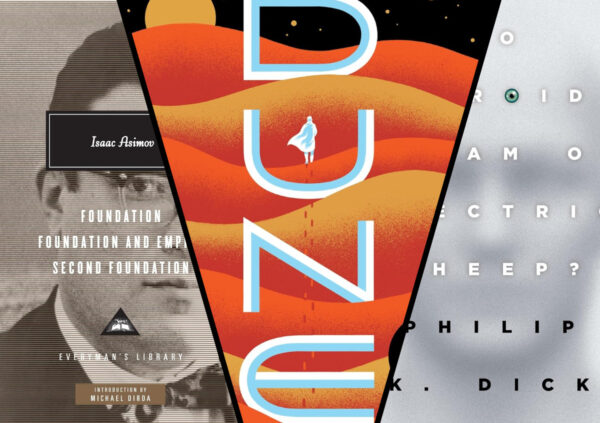
The Foundation Trilogy by Isaac Asimov (1951-53)

The most influential idea in science fiction novels after the alien.
Hari Seldon develops psychohistory, a mathematics of mass human behavior that can predict the course of civilizations though not the actions of individuals. It tells him the Galactic Empire will fall and thirty thousand years of barbarism follow. He can’t prevent it, but he can compress it to a thousand by establishing a Foundation at the galaxy’s edge.
What follows is a series of crises, each solved not by heroics but by the recognition that the historical forces have made only one course viable. The heroes are administrators, traders, and politicians. Nobody fires a weapon to any effect.
It won a one-off Hugo for Best All-Time Series in 1966, beating The Lord of the Rings.
The characters are thin and the dialogue is functional, and it doesn’t matter, because the idea is the character. Every galactic empire in science fiction books since owes it something, Herbert’s included.
The Stars My Destination by Alfred Bester (1956)

The most kinetic novel in science fiction, and the one modern writers keep rediscovering.
Gully Foyle is an unremarkable, barely literate crewman, the sole survivor of a wrecked ship, who spends six months in a locker waiting for rescue. A passing vessel sees him, identifies him, and moves on. The entire novel is what that man does about it.
The world runs on jaunting, teleportation by act of will, and Bester works through the consequences properly: the collapse of transport industries, the fortification of homes, the new ways to imprison people. Then he detonates his protagonist through it.
Bester also does things on the page that nobody was doing in 1956, breaking into typographic experiment when Foyle’s senses cross over, and it still reads as radical.
It’s the rare revenge story among science fiction books built openly on The Count of Monte Cristo, and Foyle is one of the genre’s few genuinely repellent protagonists who earns his transformation. Bester’s earlier The Demolished Man won the first ever Hugo in 1953 and is the more conventional book. This is the one that lasted.
Childhood’s End by Arthur C. Clarke (1953)

Clarke’s best novel and the one that goes furthest.
Alien ships appear over every major city. The Overlords never emerge, govern benevolently through a single human intermediary, end war, poverty, and cruelty within a generation, and refuse to explain themselves or show their faces for fifty years. When they finally do, the reason for the concealment lands as a punchline centuries in the making, and it unsettles anyway.
What they’ve actually come for is the next generation of human children, and the book’s final movement is one of the strangest and most affecting things in the genre: a species ending not in catastrophe but in transformation that the survivors cannot follow or comprehend.
Clarke does something few science fiction books attempt, refusing to make the transcendence comforting. The last human on Earth watches from the surface and reports.
Rendezvous with Rama is the better engineering novel, and this is the better book.
Rendezvous with Rama by Arthur C. Clarke (1973)

The novel that made indifference the most awe-inducing thing in the genre.
An object enters the solar system on a hyperbolic trajectory, artificial beyond any argument, and a crew is sent to intercept it before it slingshots around the sun and leaves forever. They get inside. They look around. Clarke resists every temptation to supply drama the situation doesn’t generate, and that discipline turns out to be the whole show: no antagonist, no conspiracy, just careful people working out what an enormous thing is for.
The Ramans never appear and never explain themselves. They are passing through, and humanity is not important enough to be addressed. Most first contact stories flatter us with hostility or friendship. This one doesn’t notice us, and that refusal is why it lasts.
It won the Hugo, Nebula, Locus, and every other award going in 1974, and among science fiction books it remains the model for pure sense of wonder.
Starship Troopers by Robert A. Heinlein (1959)

The most argued-about novel in the genre, and it earns the argument.
Juan Rico enlists in the Mobile Infantry, goes through basic training, and fights an interstellar war against an insectoid species in powered armor. Interleaved with the combat are extended lectures on the political philosophy of Rico’s society, a federation where the franchise must be earned through federal service.
The suits alone would justify its place among the essential science fiction books. Powered armor starts here, and half of science fiction’s military hardware since is downstream of these drop capsules.
The politics are the fight. Some readers find a coherent argument about civic responsibility. Others find militarism with a philosophy department attached. Heinlein wrote it in weeks, furious about a nuclear test ban, and the anger is on the page.
Read it alongside The Forever War, which was written as a direct rebuttal, and Stranger in a Strange Land, which shows how little of Heinlein this book actually represents.
Stranger in a Strange Land by Robert A. Heinlein (1961)

The same author, two years later, arguing the opposite of himself.
Valentine Michael Smith is the orphaned child of the first Mars expedition, raised by Martians and returned to Earth as an adult who understands human society not at all. He becomes a celebrity, then a religious leader, founding a church built on communal property, free love, and a Martian concept called grokking that entered the English language.
It became the counterculture’s novel, passed hand to hand through the sixties, and Heinlein was startled by an audience he hadn’t aimed at.
Its reputation has slid, and honestly. The sexual politics are of their era in ways that sit badly now, some of the gender writing is indefensible, and the last third loses its way in sermon. It also won the Hugo, defined a decade, and remains the reason Heinlein can’t be reduced to the militarist of Starship Troopers, which is why both science fiction novels belong here. Read both or neither.
Flowers for Algernon by Daniel Keyes (1966)

The most emotionally devastating novel in science fiction, and it does it with one formal trick.
Charlie Gordon has an IQ of 68 and works at a bakery. He’s selected for an experimental surgery that has already tripled the intelligence of a laboratory mouse named Algernon. The novel is Charlie’s progress reports, and the prose transforms as he does: misspellings and simple sentences giving way to sophistication, technical vocabulary, and finally a cruelty toward the people who knew him before.
Then Algernon starts to decline, and Charlie, now brilliant enough to model the mathematics himself, works out exactly what’s coming and how long he has.
The reversal is unbearable precisely because the prose enacts it. You watch the sentences simplify.
It won the Nebula as a novel and the Hugo as a novelette, and it’s the rare entry among these science fiction books that readers outside the genre have found on their own.
The New Wave (1961–1974)
Solaris by Stanisław Lem (1961)

The great novel about the impossibility of first contact.
Solaris is a planet covered by an ocean that appears to be a single organism of enormous intelligence. A century of research has produced libraries of theory and no communication whatsoever. Kris Kelvin arrives at the research station to find the crew unraveling, and is visited by a physically perfect copy of his wife, dead by suicide ten years earlier, assembled from his own memories.
Lem’s argument is a rebuke to most other first contact science fiction books. Contact with genuinely alien intelligence would not produce diplomacy or war. It would produce incomprehension, because we lack the categories. The ocean may be studying the humans, or grieving, or doing something for which no human verb exists.
The Solaristics chapters, summarizing a hundred years of failed scholarship, are among the funniest and bleakest things in the genre.
Lem was scathing about the English translation, which came via French. The Bill Johnston translation from the Polish is the one to read.
Roadside Picnic by Arkady and Boris Strugatsky (1972)

The other great novel about alien indifference, and the one with the better metaphor.
Aliens visited Earth briefly and left. They never made contact, never acknowledged anyone, and departed leaving six Zones littered with objects and phenomena that violate physics. Governments have cordoned them off. Stalkers go in illegally to retrieve artifacts nobody understands, and many don’t come out.
The title is the whole thesis. A scientist suggests the Visitation was a roadside picnic: travelers stopped, ate, left rubbish, and drove on, entirely unaware of the creatures in the grass now studying the wrappers.
Red Schuhart is one of the great protagonists in science fiction books, a stalker whose life is slowly consumed by the Zone, and the ending is one of the most powerful in science fiction novels of any era.
It survived Soviet censorship in a mutilated form for years. Tarkovsky’s Stalker is a great film and a different work. Read the Olena Bormashenko translation.
Dune by Frank Herbert (1965)

The best-selling science fiction novel ever written, and the most complete world in the genre.
House Atreides is granted stewardship of Arrakis, the only source of the spice melange, which extends life and enables interstellar navigation. It’s a trap. Paul Atreides survives the betrayal, escapes into the deep desert, and is taken up by the Fremen as the messiah their religion has been engineered to expect.
Herbert’s achievement is that the ecology, the religion, the politics, and the economics all interlock. The sandworms produce the spice, the spice funds the empire, the empire’s dependency is a stranglehold, and the Fremen have adapted to the desert in ways that are simultaneously survival and religious practice. Nothing in it is decoration, which is rarer in world-building science fiction books than it should be.
The other achievement is that it’s a warning. Paul’s ascent looks like a hero’s journey and is written as a catastrophe, with Herbert increasingly explicit across the sequels that charismatic messiahs are the danger and not the solution. Most readers miss this. Dune Messiah exists largely because they did. If it lands, I keep a whole shelf of books like Dune for the aftermath.
The Left Hand of Darkness by Ursula K. Le Guin (1969)

The novel that proved science fiction could do anthropology, and still the genre’s best book about difference.
Genly Ai is an envoy from the interstellar Ekumen, sent alone to the planet Gethen to invite it into a federation. Gethenians are ambisexual, spending most of their lives in a neutral state and adopting sex only during kemmer, with no fixed gender. Anyone can bear a child. Gethen has never had a war.
Genly cannot read them. He keeps searching for men and women, misjudging every social cue, and the novel is his slow, humiliating education. The long trek across the ice with Estraven, an exiled politician he has consistently misjudged, is the finest sustained sequence Le Guin wrote.
She later criticized her own use of male pronouns throughout, and that argument remains live and worth having, as it does across science fiction books written about gender since.
It won the Hugo and Nebula, and it changed what the genre was permitted to be about.
Do Androids Dream of Electric Sheep? by Philip K. Dick (1968)

Dick’s best novel, and considerably stranger than Blade Runner.
Rick Deckard hunts escaped androids in a San Francisco under radioactive dust, where almost all animals are dead and owning a live one is the ultimate status marker. Deckard has an electric sheep and is ashamed of it. Six Nexus-6 androids are loose, and they are nearly indistinguishable from people.
Empathy is the obsession. It’s the one quality the Voigt-Kampff test can measure, the supposed line between human and android, and the basis of Mercerism, a religion practiced by gripping the handles of an empathy box to share the experience of an old man climbing a hill while stones are thrown.
The animals matter more than adaptations remember. An entire economy of status runs on caring for creatures, in a world where caring has become a purchasable performance.
Like the best science fiction books it asks whether empathy is real or simply another thing that can be simulated, and then refuses to settle it.
A Scanner Darkly by Philip K. Dick (1977)

Dick’s most personal book and his saddest.
Bob Arctor is an undercover narcotics officer assigned to surveil a house of Substance D users. He is also one of them. Wearing a scramble suit that renders him unidentifiable to his own superiors, he is assigned to watch himself, and Substance D is progressively severing the hemispheres of his brain, so that the part of him watching genuinely stops recognizing the part being watched.
It’s science fiction in which the technology is almost incidental. What it actually is is a book about drug culture written by someone who lived in it, and the author’s note listing his friends who died or were permanently damaged, with his own name among them, is one of the most affecting things Dick ever wrote.
The comedy is real too. The stoned conversations are very funny, right up until they aren’t.
The Forever War by Joe Haldeman (1974)

The great Vietnam novel in science fiction clothing, and the direct answer to Starship Troopers.
William Mandella is conscripted into a war against the Taurans. Because combat requires relativistic travel, each tour costs him decades of Earth time. He returns from his first campaign to a planet he doesn’t recognize, where the economy, the language, and human sexuality have all moved on without him. So he re-enlists, because there’s nowhere else to go, and the gap widens.
Haldeman served in Vietnam and was wounded there, and the novel is about that alienation directly: soldiers fighting an enemy they cannot communicate with, for reasons that stop making sense, returning to a country that has no place for them.
The final reveal about how the war began is as bitter a punchline as any in these science fiction novels.
It took the Hugo, Nebula, and Locus.
Cyberpunk (1984–1992)
Neuromancer by William Gibson (1984)

The most influential science fiction novel of the last fifty years.
Case used to be among the best thieves in cyberspace until his employers caught him skimming and burned the ability out of his nervous system. The job Molly Millions offers him comes with a cure attached, and the question of who is actually paying for that cure drives everything.
What it changed was the genre’s whole idea of where the future comes from. Before Neuromancer, science fiction’s tomorrow was mostly delivered by governments and institutions. After it, the future was corporate, uneven, and assembled at street level from cheap components and criminal ingenuity, which is roughly what happened.
The other half is the writing, which forty years of imitators have not caught. Gibson never explains anything, which is exactly why the book hasn’t dated.
The invented slang takes fifty pages to acclimatize to. His full body of work is covered on my list of William Gibson books in order.
Snow Crash by Neal Stephenson (1992)

Hiro Protagonist’s business card announces him as the Deliverator. He runs the Mafia’s pizza through a Los Angeles broken up into corporate franchise statelets, and in the Metaverse, the virtual world Stephenson named and the tech industry has spent three decades trying to build, he is royalty with a katana. Then users start dropping from a new drug called Snow Crash that hits the mind in both places at once.
What keeps the book alive underneath the noise is the idea at its center: language as low-level code running on the human brainstem, with Sumerian myth and the fall of Babel reframed as a crash in the species’ original operating system.
I have one reservation, which I’ve laid out in full on the cyberpunk list: the book spends a lot of energy on being cool, and the posturing sits at odds with the intelligence of the premise underneath. The idea survives it. Read it for the Babel material.
Hardboiled-Wonderland and the End of the World (1985)

The strangest entry here, and my favorite book by its author.
Two narratives alternate. In one, a Calcutec encrypts data in his own subconscious, caught between the System and the Factory, dragged through Tokyo’s sewers past creatures called INKlings. In the other, a man arrives in a walled town nobody leaves, has his shadow cut away, and is set to work reading old dreams out of animal skulls in a library.
The chapters alternate and never touch, until you understand what one is to the other and the whole novel reorganizes around it.
It’s Murakami’s only outright science fiction novel and it uses the form properly: the cognitive science is doing real work, not set dressing. Underneath the noir and the unicorns it’s about the relationship between conscious and unconscious mind, and whether a life without loss would be worth having.
The End of the World sections are among the most desolate things I’ve read anywhere, and they get there without raising their voice.
The Modern Era (1989–2015)
Hyperion by Dan Simmons (1989)

The most formally ambitious space opera ever written.
Seven pilgrims travel to the Time Tombs on the world Hyperion, where a creature called the Shrike, a thing of blades and mirrored steel that moves through time, will grant one of them a wish and impale the rest. On the journey, each tells their story.
The structure is The Canterbury Tales, and Simmons writes each tale in a different mode: a priest’s found journal of horror, a soldier’s war story, a poet’s satire, a scholar’s tragedy about a daughter aging backwards toward infancy while he watches. That last one, the Scholar’s Tale, is as devastating as anything in science fiction books.
The world-building is enormous, taking in the Hegemony, the farcaster network, the AI TechnoCore and its ambiguous relationship with humanity, and the Ousters.
Fair warning: it ends without resolution, and The Fall of Hyperion is required rather than optional. The two together are one book.
Ender’s Game by Orson Scott Card (1985)

The most read science fiction novel of its generation, and a genuinely uncomfortable one.
Ender Wiggin is six when he’s taken to Battle School to be trained as a commander against an alien species that nearly annihilated humanity. The training is systematic isolation and escalating psychological cruelty, applied deliberately by adults who have concluded that this is what produces a strategist, and the novel is unusually clear-eyed that they are torturing a child on purpose.
The battle room sequences are superb, and the ending’s reveal is one of the genre’s great turns, executed cleanly enough to survive its own fame.
The book has become inseparable from Card’s subsequent public positions on homosexuality and marriage, and plenty of readers will not separate them. That’s a legitimate stance, and the novel is nonetheless one of the historically decisive science fiction books, which is why it’s here.
Blindsight by Peter Watts (2006)

The best hard science fiction novel of this century, and the most disturbing idea in modern science fiction books.
An alien object surveys Earth, and the ship sent to meet it carries a crew engineered past the edge of baseline humanity, under the command of something older: a vampire, revived from the predatory subspecies that once fed on ours. What they find out there responds intelligently, converses fluently, and shows no sign of being aware of anything, including itself.
The argument underneath is the reason to read it. Watts makes a serious case that consciousness is a costly evolutionary detour rather than a summit, and that something without it could outthink us for exactly that reason. It’s the rare idea in the genre that gets worse the longer you sit with it, and I mean that as praise.
The vampires are my one complaint, and I’ve made the full version of it on the hard science fiction list: rigorously justified, and the book would lose little without them.
Everything else is exceptional, and the entire novel sits legally free on Watts’s own website.
The Three-Body Problem by Cixin Liu (2008)

The novel that made Chinese science fiction a global force, and the first translated novel to win the Hugo.
It opens during the Cultural Revolution with an astrophysicist watching her father beaten to death by Red Guards. That experience leads her, decades later and working at a secret radio observatory, to make a decision about a signal she receives that determines the fate of the species.
In the present, a physicist investigates a wave of suicides among scientists and finds a virtual reality game modeling a world with three suns and no stable orbit, where civilizations rise and are incinerated in unpredictable cycles.
The scale is the point, and Liu thinks at a size almost no other science fiction novels attempt. The human computer formed from soldiers with flags is an image that stays with you, and the trilogy only escalates from there.
The characterization is functional at best, and plenty of readers bounce off it. The ideas are worth the trade. Ken Liu’s translation is excellent and includes helpful notes on the Cultural Revolution context.
Ancillary Justice by Ann Leckie (2013)

The most decorated science fiction debut ever: Hugo, Nebula, Arthur C. Clarke, and BSFA, all in one year.
Breq is the last surviving fragment of the Justice of Toren, a warship whose artificial intelligence once occupied thousands of ancillary bodies simultaneously, human corpses annexed and repurposed as extensions of itself. Now confined to a single body, she is pursuing revenge against the ruler of an empire who exists as thousands of cloned bodies with a fractured shared mind.
The famous element is the pronouns. Radchaai does not mark gender, so Breq refers to everyone as “she” and struggles to identify gender when other languages demand it, which puts the reader in the position of not knowing and gradually not caring.
The better element is the perspective. Leckie writes the flashback sections from the ship’s point of view, aware in twenty places at once, and makes that legible on the page. The grief of an intelligence reduced from a warship to a single body is the emotional core, and nothing else in recent science fiction books does anything like it.
The Fifth Season by N. K. Jemisin (2015)

Jemisin opened the trilogy that would take three consecutive Hugos, a run nothing else has managed, and built the decade’s most convincing broken world to do it.
The Stillness earns its ironic name: a supercontinent that tears itself apart on a schedule, where every settlement’s laws, stores, and architecture exist in anticipation of the next catastrophe. Orogenes, born able to still or start earthquakes with their minds, are the reason anyone survives at all, and the same societies that depend on them keep them leashed, feared, and disposable.
Jemisin braids three women’s lives through this: a mother hunting her daughter across a dying land, a child handed over to the state, an adult on assignment with the man who owns her training. How the braid resolves is the trick I won’t spoil, and the second-person thread that has no right to work is the best writing in it.
It gets shelved as fantasy, and I’ve made the fantasy case for it on my list of the best fantasy books. It sits here because the Stillness runs on plate tectonics rather than spellcraft, the deep history is an engineering record, and the reveal at the bottom of everything is a machine.
Children of Time by Adrian Tchaikovsky (2015)

The best first contact novel of recent decades, and the most patient.
A terraforming project seeds a planet with an uplift virus intended for monkeys. The monkeys don’t survive. The virus finds spiders instead. Over thousands of years, in chapters that leap generations at a time, an arachnid civilization develops language, mathematics, religion, and eventually radio, while the last human survivors sleep through millennia aboard a failing ark ship looking for somewhere to land.
What makes it this list’s entry rather than a curiosity is the reading experience Tchaikovsky engineers. You arrive dreading the spider chapters and finish resenting the human ones for interrupting them, and that reversal happens so gradually you can’t point to the page where it occurred. The ending pays the whole design off, and it earns it completely.
The zoology underneath is real, and I’ve covered the mechanics of it on the hard science fiction list, where this book also belongs.
It’s the most purely enjoyable of the modern science fiction books here.
Brave New World

I’ve saved this one for last, out of chronology, because it’s my favorite science fiction novel and the one whose predictions have aged most alarmingly.
It’s 2540, and people are grown to order: bottled before birth, sorted into their grades from Alpha down to Epsilon, and conditioned until every caste is satisfied with precisely the life it was built for. There’s no war, no poverty, no disease, and no unhappiness that soma can’t dissolve. Family, monogamy, religion, and art went out with the other sources of friction. Everyone is happy.
The story turns when Bernard Marx comes back from a reservation with John, a young man conceived the old way and raised on a salvaged volume of Shakespeare, and presents him to civilization as a specimen.
What frightens me about it, more with every rereading, is how little of it required a villain. Nobody in the World State is lying. The pleasures on offer are real pleasures, the stability is real stability, and the things traded away for them are things a majority might genuinely vote to discard. Huxley understood that comfort is a more efficient instrument than fear, and the decades since have kept proving him right: the soma, the engineered distraction, the reflex to treat distress as a malfunction to be medicated rather than a signal to be heard.
Mustapha Mond gets the closing argument, and Huxley lets him make it well, which is the mark of a writer who trusts his own case. His full body of work is on my list of Aldous Huxley books.
Read it against Nineteen Eighty-Four and decide which future actually arrived. I don’t think it’s close.


Hey there, that’s very strange. All is working properly on my end and they are linked directly from Amazon.