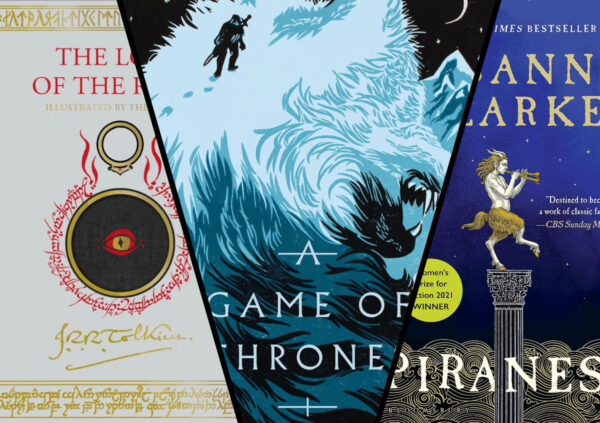
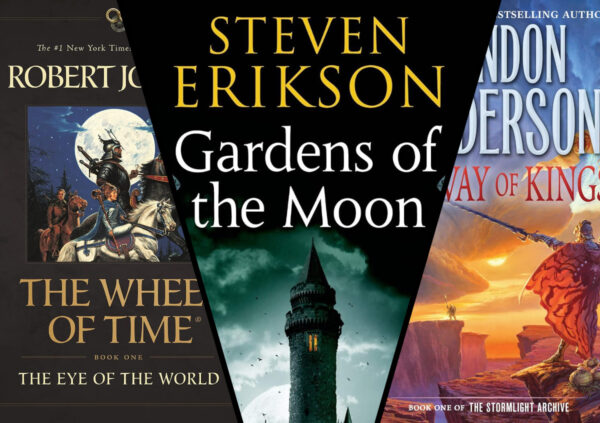
Epic fantasy books are the long line of novels that grew out of The Lord of the Rings: invented worlds with their own maps and histories, a threat to the whole of that world, a cast big enough to need a list of names at the back, and usually more than one volume to tell it. This page follows that line book by book, from the pre-Tolkien romance Tolkien himself read, through the 1977 paperback boom, the 1980s heirs, Robert Jordan’s The Wheel of Time, George R. R. Martin, Steven Erikson and Brandon Sanderson, to the epic fantasy of the 2010s and 2020s, which widened the map well beyond medieval Europe.
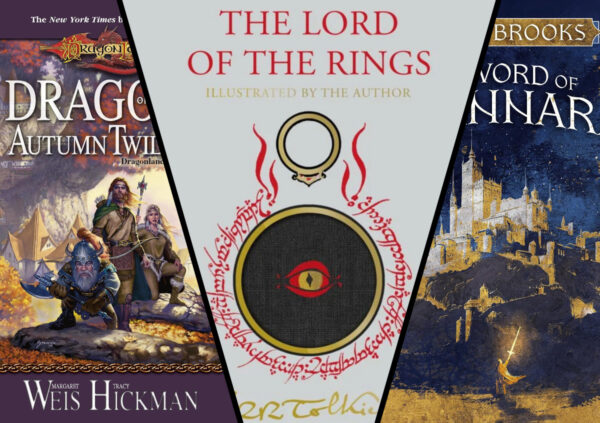
The entries aren’t ranked. Each one says where the book sits in the tradition: what it took from the books before it, what it changed, and what came after because of it. The order is the order of publication, so reading down the page is reading the history of the subgenre. Every entry ends with the book to buy, and the at-a-glance table below has the whole line in one view.
What epic fantasy is gets its own section below, and so does the older name for the same shelf, high fantasy. The question of which long series are worth committing a reading year to belongs to the site’s best fantasy series page, and the section on epic fantasy series points there. The pillar list of the best fantasy books ranks the whole genre, epic and otherwise. This page is about one tradition inside it.
Fiction by René Rehn


The Best Epic Fantasy Books to Start With, by What a Reader Wants
The best epic fantasy book for one reader is the wrong one for another, so this section sorts the line below by what readers usually come asking for, using facts about the books rather than a ranking.
For the source, start with The Lord of the Rings. Everything else on this page is in conversation with it, and the later books read differently once it’s familiar. For a complete story in a single book, there are two: Tigana (1990) and The Priory of the Orange Tree (2019). If you want a finished long series, The Wheel of Time and the Malazan Book of the Fallen are both complete, the first far more welcoming at the start, the second far more demanding. For a finished trilogy, the Broken Earth books and Memory, Sorrow, and Thorn are both done.
For readers who want politics and history over prophecy, A Game of Thrones is the obvious place, with the publication status noted plainly in its entry. If you’re looking for a single character’s life at the center of an epic, Assassin’s Apprentice. For a magic system with rules and a hopeful frame, The Way of Kings, or Sanderson’s shorter Mistborn trilogy first. For epic fantasy set outside the European Middle Ages, The Fifth Season, Black Sun and The Jasmine Throne. And for the history of the form itself, read The Worm Ouroboros, The Sword of Shannara and Lord Foul’s Bane side by side and watch the tradition argue with itself.
Epic Fantasy at a Glance
Here is the whole line in one view, ordered by first publication, which is also the order of the page.
| Year | Title | Author |
| 1922 | The Worm Ouroboros | E. R. Eddison |
| 1954-1955 | The Lord of the Rings | J. R. R. Tolkien |
| 1977 | The Silmarillion | J. R. R. Tolkien |
| 1977 | The Sword of Shannara | Terry Brooks |
| 1977 | Lord Foul’s Bane | Stephen R. Donaldson |
| 1982 | Magician | Raymond E. Feist |
| 1984 | Legend | David Gemmell |
| 1984-1985 | Dragonlance Chronicles | Margaret Weis and Tracy Hickman |
| 1988 | The Dragonbone Chair | Tad Williams |
| 1990 | The Eye of the World | Robert Jordan |
| 1990 | Tigana | Guy Gavriel Kay |
| 1995 | Assassin’s Apprentice | Robin Hobb |
| 1996 | A Game of Thrones | George R. R. Martin |
| 1999 | Gardens of the Moon | Steven Erikson |
| 2003 | Eragon | Christopher Paolini |
| 2007 | The Name of the Wind | Patrick Rothfuss |
| 2010 | The Way of Kings | Brandon Sanderson |
| 2012 | Malice | John Gwynne |
| 2015 | The Fifth Season | N. K. Jemisin |
| 2019 | The Priory of the Orange Tree | Samantha Shannon |
| 2020 | Black Sun | Rebecca Roanhorse |
| 2021 | The Jasmine Throne | Tasha Suri |
What Makes a Book Epic Fantasy
The standard reference definition is short: high fantasy, or epic fantasy, is fantasy defined by the epic nature of its setting or by the epic stature of its characters, themes or plot. In practice four things show up together often enough to count as the marks of the form.
The first is a secondary world. Epic fantasy is set in an invented world with its own geography, history and rules, rather than in ours with magic leaking in. The map in the front of the book is the visible sign of it. The second is scale. The stakes are a kingdom, a continent or the world, and the story follows armies, dynasties and gods as well as the people caught up in them. The third is history: the world has a deep past that keeps returning, as lost kingdoms, old wars, prophecies and buried weapons.
The fourth is a struggle that’s framed, at least at first, as a war between something like good and something like evil. That last mark is the one reference works use to separate epic fantasy from sword and sorcery, where the hero is out for himself and the world isn’t at stake.
Length follows from the scale. Epic fantasy books are long, and they come in series, because a world-sized story told from many points of view takes thousands of pages. Much of the tradition’s history is a history of how publishers learned to sell that length.
Two neighboring shelves overlap with this one. Grimdark, the bleak and morally gray fantasy associated with Glen Cook and Joe Abercrombie, often uses epic scale but rejects the good-and-evil frame, and the site covers it separately. Romantasy, the romance-led fantasy of the 2020s, sometimes borrows epic settings but puts the love story at the center, and it’s a separate subject.
High Fantasy Books: The Same Shelf Under an Older Name
“High fantasy” is the older of the two names. The term was coined by the American children’s author Lloyd Alexander, in an essay called “High Fantasy and Heroic Romance,” first given as a talk to the New England Round Table of Children’s Librarians in October 1969 and published in 1971. Alexander’s own Chronicles of Prydain are high fantasy for younger readers.
High fantasy is defined against low fantasy. Low fantasy is set on Earth, the rational primary world, with the supernatural intruding into it. High fantasy is set in a secondary world, internally consistent but different from ours. The early examples reference works give are William Morris’s The Well at the World’s End, E. R. Eddison’s The Worm Ouroboros and The Lord of the Rings.
For a reader looking for high fantasy books, the practical answer is that the two labels describe the same books, and the major reference works treat them as one term. Where readers do draw a line, “high” tends to describe the setting, an invented world, and “epic” the scale, a world-sized war told across many volumes. So a short secondary-world novel such as A Wizard of Earthsea, by Ursula K. Le Guin, is often called high fantasy and less often epic, while Jordan’s fourteen volumes are both. Every book on this page is high fantasy in Alexander’s sense, and the entries below are the epic end of it.
Most lists of high fantasy books also carry secondary-world books that are shorter, younger or narrower than the epics below. They don’t get entries here, but they belong on the same shelf:
Ursula K. Le Guin, A Wizard of Earthsea (1968). The young mage Ged, at a school for wizards, looses a shadow in a duel and has to face it. It won the Boston Globe-Horn Book Award in 1969, and her wider shelf is mapped on the Ursula K. Le Guin guide.
Lloyd Alexander, The Chronicles of Prydain (1964-68). Five books, from The Book of Three to The High King, built on names from the Welsh Mabinogion. The High King won the Newbery Medal.
Garth Nix, Sabriel (1995). An eighteen-year-old inherits the role of the Abhorsen, a necromancer who lays the dead to rest, in the first Old Kingdom book. It took two of Australia’s genre prizes for 1995, as best young-adult novel and best fantasy novel.
Megan Whalen Turner, The Thief (1996). A prisoner is offered his freedom by the king’s magus if he’ll steal a legendary artifact. It opened the Queen’s Thief series and was a Newbery Honor book in 1997.
Tomi Adeyemi, Children of Blood and Bone (2018). A young woman sets out to restore magic to her people in Orïsha, a kingdom built from Yoruba culture and West African myth. Its debut topped the New York Times young-adult list.
Brian Staveley, The Emperor’s Blades (2014). Three children of a murdered emperor, a monk, a soldier and a politician, chase the conspiracy behind his death, in the first of the three Chronicles of the Unhewn Throne.
Before Tolkien: The Romance He Read
The epic fantasy line doesn’t begin with Tolkien, but it runs through him. A handful of British writers between the 1850s and the 1920s had already built invented worlds for long heroic stories, and one of them is the book that sits closest to The Lord of the Rings in ambition.
The Worm Ouroboros by E. R. Eddison (1922)

Published by Jonathan Cape in 1922, The Worm Ouroboros is a war between two kingdoms, Demonland and Witchland, told on an epic scale and almost entirely in seventeenth-century English. A short framing story sends an Englishman named Lessingham to the planet Mercury, where he watches the conflict, and then the frame is dropped and the war takes over. The heroes are the four lords of Demonland, the brothers Juss, Spitfire and Goldry Bluszco and their cousin Brandoch Daha. The enemy is King Gorice XII of Witchland, a sorcerer, with Corund and Corinius among his warlords.
Its place in the line is as a pre-Tolkien model of the form: an invented world, a war for its fate, a large cast of nobles and soldiers, and a prose style that deliberately sounds older than its century. What it doesn’t have is the moral frame later epic fantasy books take for granted. Eddison’s heroes fight because fighting is glorious. The title is the tail-eating serpent, and it describes the shape of the book.
Tolkien read it and praised it in print, though in a 1957 letter he wrote that Eddison had come to admire arrogance and cruelty more and more. The two books make a useful pair for that reason. The Lord of the Rings takes over the scale and the invented history and puts a moral argument at the center. The fantasy writers Karl Edward Wagner and Clive Barker have both named The Worm Ouroboros as an influence. The archaic English takes some pages to settle into.
Tolkien and the Template
Nearly every later book on this page can be read as imitation of Tolkien, reaction to him, or both. The two books below are the template and the deep history behind it.
The Lord of the Rings by J. R. R. Tolkien (1954-1955)

The Lord of the Rings was published by Allen & Unwin in three volumes: The Fellowship of the Ring came first, on July 29, 1954, The Two Towers followed that November 11, and The Return of the King completed it on October 20, 1955. The three-volume split, which made it look like a trilogy, was an economic decision: the book was expensive to produce and its sales were uncertain, so the publisher spread the risk. Tolkien thought of it as a single book.
It sits at the head of the line, the origin of nearly everything after. It established the shape of the form: a secondary world with a mapped geography and thousands of years of history behind the story, a small company sent out on a quest while armies gather, a Dark Lord, an evil artifact, and a fellowship of different peoples.
The commercial story matters as much as the literary one. In 1965 Ace Books issued an unlicensed American paperback. Tolkien let his readers know he objected, the pressure from fans forced Ace to withdraw it, and the authorized Ballantine paperback sold a quarter of a million copies within ten months, with Barbara Remington’s cover art becoming a fixture on American campuses. The genre flowered on the back of that success, and worldwide sales estimates long ago passed 150 million copies.
Peter Jackson’s three films (2001-03) ended with The Return of the King winning eleven Oscars, including Best Picture. Amazon’s The Rings of Power, set in the Second Age, premiered in September 2022, and its third season is scheduled for November 2026. The full shelf, posthumous volumes sorted, gets its own Tolkien reading guide.
The Silmarillion by J. R. R. Tolkien (1977)

The Silmarillion is the mythology Tolkien worked on for most of his life and never finished. Tolkien died in 1973, and his son Christopher edited, partly wrote and published it on September 15, 1977, with the help of a young Canadian named Guy Gavriel Kay, who later became a fantasy novelist himself and turns up further down this page.
The book has five parts: the Ainulindalë, the creation of the world, the Valaquenta, on its gods, the Quenta Silmarillion, the history of the First Age and the war over the three jewels that give the book its title, the Akallabêth, which recounts the downfall of Númenor, and Of the Rings of Power and the Third Age, which leads up to the events of The Lord of the Rings.
Its importance to the line is twofold. As a book, it’s the deep history the whole tradition imitates, the reason so many epic fantasy books come with appendices, chronologies and invented languages. Critics in 1977 were mostly unkind to it, and it still climbed to the top of the New York Times fiction list within weeks, then took the 1978 Locus Award for best fantasy novel. As a date, 1977 is the hinge. The same year saw the two debut novels in the next section, both sold to readers who’d finished Tolkien and wanted more.
It’s also the book that shows an epic fantasy reader what “worldbuilding” meant before the word was common: not a setting designed for a plot, but a history the plot happens to fall inside. Ted Nasmith’s illustrated edition is the one to look for if you want the paintings to match the scale.
1977 and the Heirs of the 1980s
In 1977 a new imprint and a new kind of bestseller arrived together, and the next decade filled the shelves with long, quest-shaped fantasy written for readers who’d grown up on Tolkien. The era’s signature plot was the farm boy with a destiny, and its most frictionless version was David Eddings’s five-book Belgariad (1982-1984), the comfortable epic built on banter, a likable traveling party and a Prophecy that speaks directly to its chosen boy. That series is the template at its smoothest, the version a later generation of writers set out to subvert, and its DNA is all over the decade. The six books below are the ones that defined what epic fantasy looked like in the paperback era.
The Sword of Shannara by Terry Brooks (1977)

The Sword of Shannara was the book Lester del Rey used to launch Ballantine’s new Del Rey imprint, and it became the first fantasy novel ever to crack the New York Times trade paperback list. Its hero is Shea Ohmsford, a half-elven young man in a quiet valley who turns out to be the last descendant of the Shannara line, the only one who can wield the sword against the Warlock Lord.
Its job in this history is commercial proof. Brooks showed that a Tolkien-shaped story could sell to a mass audience as a new book rather than as a classic, and Del Rey spent the following years building a list on that discovery. The resemblance to The Lord of the Rings was obvious from the start, and the fantasy editor Lin Carter attacked it in print as a wholesale copy of another book. Readers kept buying, and the success of that first volume did more than any review to make epic fantasy a publishing category of its own.
What’s easy to miss now is that Brooks’s world is a far-future Earth, long after a catastrophe ended our civilization, a detail the later Shannara books make explicit. Brooks carried the setting forward and backward through dozens of novels, the books reached television as MTV’s The Shannara Chronicles in January 2016, and in March 2025 he announced he was handing the series’ primary writing to Delilah S. Dawson. The whole handoff story is told in the Terry Brooks reading guide. The Sword of Shannara is where to see the template become a formula, and to judge for yourself how much that matters.
Lord Foul’s Bane by Stephen R. Donaldson (1977)

Lord Foul’s Bane, the same year’s other debut, took the template and turned it against itself. Thomas Covenant is a writer in the modern world whose life has been upended by a diagnosis of leprosy. He wakes in a classic fantasy world called the Land, where he’s drawn into the struggle against Lord Foul the Despiser. Covenant refuses to believe any of it. He calls himself the Unbeliever, and he treats the Land as a delusion that he must not give in to.
Where Brooks reproduced the quest, Donaldson asked what would happen if the person summoned to save the fantasy world didn’t want to be there and wasn’t a good man. Early in the book Covenant, overwhelmed by his sudden return to health and convinced none of it is real, rapes a young woman of the Land, and the rest of the trilogy is shaped by that act and its consequences. It’s the reason the books divide readers sharply, and the reason they matter to the history of the form: they put guilt and moral failure inside the hero of an epic fantasy long before grimdark.
The manuscript was rejected 47 times before Lester del Rey bought the whole trilogy and published all three volumes in 1977, and The Ultimate Encyclopedia of Fantasy later called it “more original and interesting” than The Sword of Shannara. Two more series followed, the Second Chronicles and the four-volume Last Chronicles, all mapped, warning up front, in the Thomas Covenant guide. The prose is dense and Latinate.
Magician by Raymond E. Feist (1982)

Magician was published by Doubleday in 1982. It follows two boys from the same castle, Pug and Tomas, as their world, Midkemia, is invaded through magical rifts by the Tsurani, an army from another world called Kelewan. The war lasts years and takes in kings, dukes, elves and dwarves on one side and an alien empire on the other.
Magician’s slot in the tradition is the epic fantasy born out of role-playing games. Midkemia was invented by Feist and his friends at university as a world for their games, and the book has the texture of a long campaign: a mapped world, factions, careers and a war seen from both sides. The invaders’ world, with its rigid honor culture, gave the 1980s epic something it often lacked, a second civilization treated as seriously as the first.
The book was long enough that the American market split it into two volumes, Magician: Apprentice and Magician: Master. In 1992, for its tenth anniversary, Feist published the Author’s Preferred Edition, which restored scenes cut from the original, and that’s the text to look for. The Riftwar Cycle that grew out of it, written partly with collaborators, closed at thirty books with Magician’s End in 2013, and a new saga begun in 2024 is stitching his two worlds back together, as the Raymond E. Feist guide lays out.
Legend by David Gemmell (1984)

Legend, published by Century in April 1984, is the counterweight on the same shelf: the whole war for a nation’s survival compressed into one fortress. Dros Delnoch, a six-walled stronghold, is the last barrier between the Drenai and an invading Nadir horde under the warlord Ulric, and the only hope of holding it is Druss, a hero out of the ballads now in his sixties, who comes down from his mountain for one last wall. Where the decade’s epics sprawled across trilogies and five-book sagas, Gemmell delivered the form’s oldest promise, ordinary people deciding what they’ll die for, at a single siege.
The story behind it belongs in the history. Gemmell wrote the first draft in 1976, in about two weeks, while waiting on tests for a suspected cancer, and he refused to settle the ending in advance, resolving that the fortress would stand or fall with his own test results. The diagnosis was wrong, the manuscript sat in a drawer until a friend pushed him to revise it, and the book that resulted carried British heroic fantasy through the epic boom.
Its mark on the line runs through the later entries here: the fan-voted award that bore his name went to The Way of Kings in 2011, and its debut prize went to Malice. The viewpoint is old-fashioned omniscient and the prose is meat and bone rather than filigree, which stops mattering once the horde reaches the first wall. Of the epic fantasy books on this page, it’s the shortest route to the tradition’s stakes, and the David Gemmell guide covers everything behind it.
Dragonlance Chronicles by Margaret Weis and Tracy Hickman (1984-1985)

Dragons of Autumn Twilight (November 1984), Dragons of Winter Night (July 1985) and Dragons of Spring Dawning (September 1985) were written by Margaret Weis and Tracy Hickman as the novels of a series of Dungeons & Dragons game modules. A group of old friends, the Heroes of the Lance, reunite at an inn in the world of Krynn as an invading army and the return of dragons threaten everything they know.
In the line it stands as the tie-in that became a tradition. Where Magician came from a home campaign, Dragonlance was designed by a game company as a world for players and readers at once, and it showed that epic fantasy could be built as a shared setting, with novels, modules and maps feeding one another. The mix of characters, a cynical, sickly mage among them, gives it an ensemble feel.
Dozens of novels by many hands followed in the same world. Dragons of Autumn Twilight was adapted as an animated film released in January 2008. Trace the line through the Chronicles and you reach the point where epic fantasy and gaming became one ecosystem, which is where much of it has stayed.
The Dragonbone Chair by Tad Williams (1988)

The Dragonbone Chair (1988) opened Memory, Sorrow, and Thorn, completed by Stone of Farewell (1990) and To Green Angel Tower (1993). Simon is a kitchen scullion at the Hayholt, the great castle of the continent of Osten Ard, apprenticed to an old scholar, when the death of the old king sets off a civil war and the return of an ancient enemy tied to the Sithi, the elf-like immortals who held the land before humans.
It stands as the bridge between the 1980s and the 1990s. Williams used the familiar pieces, the humble boy, the magic swords, the dark lord, and then slowed everything down and complicated it: a hero who’s often foolish and passive, immortals with their own grievances, and a long, deliberate opening in the castle that tests patience before it pays off.
Its influence is on record. George R. R. Martin has said the series inspired him to write A Song of Ice and Fire, which is reason enough for a reader of Martin to go back to it. Osten Ard has kept growing since: the sequel, The Last King of Osten Ard, ran four volumes from 2017 to 2024, and a new trilogy opened with The Splintered Sun in October 2026, all of it placed in the Tad Williams guide.
The 1990s: Jordan, Martin and the Doorstopper
The 1990s made epic fantasy bigger in every sense: longer books, longer series, bigger casts and bigger sales. The decade also produced serious attempts to change what the form was about from the inside.
The Eye of the World by Robert Jordan (1990)

Tor published The Eye of the World in January 1990. Rand al’Thor is a young shepherd from a remote district called the Two Rivers. When servants of the Dark One come looking for one of three young men from his village, an Aes Sedai named Moiraine leads them out into the world, and the question of which of them is the Dragon Reborn, the hero prophesied to save and break the world, drives everything after.
This is the model for the modern doorstopper series. Jordan wrote the opening chapters to evoke Tolkien’s Shire on purpose, and he then built something much larger: a world with a cyclical cosmology, a magic system split into male and female halves, dozens of nations and a cast in the hundreds. The Wheel of Time ran to fourteen volumes plus a prequel, and the sales figure usually cited now is north of 90 million copies.
Jordan died in 2007 while working on what he planned as the last book. His widow and editor, Harriet McDougal, chose Brandon Sanderson to finish it from Jordan’s extensive notes, partly for his novels and partly for a eulogy he’d written for Jordan, and the last book became three: The Gathering Storm (2009), Towers of Midnight (2010) and, in 2013, A Memory of Light. In 2014 the completed series was a Hugo finalist for Best Novel as a single work. Amazon’s television adaptation ran for three seasons, 2021 to 2025, and was canceled in May 2025, with the animated projects announced since still undated. The volume-by-volume map, slow middle flagged honestly, lives on the Robert Jordan guide.
Tigana by Guy Gavriel Kay (1990)

Published by Penguin Canada in August 1990, Tigana is set on the Peninsula of the Palm, a land that resembles Renaissance Italy and is split between two conquering sorcerers. One of them, Brandin, lost a son in the conquest of the province of Tigana and in revenge used his magic to remove its name and history from the minds of everyone not born there. The novel follows a small group of exiles from Tigana who are working to bring him down.
In this history, Tigana is the standalone epic and the historical turn. Kay, who helped Christopher Tolkien edit The Silmarillion, wrote one Tolkien-shaped trilogy, The Fionavar Tapestry, and then moved away from it, toward single-volume novels set in lightly fantasized versions of real places and periods. Tigana is where that method arrived. The magic is sparse, the villain is given real grief and real reasons, and the stakes are memory and identity rather than the end of the world.
It was shortlisted for the World Fantasy Award in 1991 and took the Aurora Award. If ten-volume commitments have worn you out, Tigana is the proof that epic fantasy books can be complete in one volume, and his later books, The Lions of Al-Rassan among them, repeat the trick, as the Guy Gavriel Kay guide traces.
Assassin’s Apprentice by Robin Hobb (1995)

Assassin’s Apprentice was published in 1995 by Spectra in the United States and by Voyager in Britain, the first book Margaret Lindholm Ogden wrote under the name Robin Hobb after years of publishing as Megan Lindholm. Its narrator, FitzChivalry Farseer, is a prince’s illegitimate son, raised in the stables of the royal castle of the Six Duchies and secretly trained as the king’s assassin. Two bloodline magics pull at him, the royal Skill and the animal-bonding Wit the court despises, while Outislander raiders, the Red-Ship Raiders, attack the coast and leave behind people stripped of their humanity, the Forged.
Hobb’s gift to the line is the inward turn. Where Jordan widened the epic, Hobb narrowed it to one man’s memory, told in the first person by an older Fitz looking back, so that the war, the politics and the magic all reach the reader through a single life. Battles happen offstage, and the cost of the kingdom’s survival is measured in what it does to him.
The Farseer trilogy grew into the sixteen books of the Realm of the Elderlings, with Fitz’s story carried on through the Tawny Man and Fitz and the Fool trilogies, and the whole saga has been complete since 2017. The first book is a short, clean entry to the sequence, which the Robin Hobb guide maps end to end.
A Game of Thrones by George R. R. Martin (1996)

A Game of Thrones opens on a continent called Westeros, where summers and winters last for years, as the great houses maneuver for the Iron Throne while an ancient threat gathers in the far north and an exiled princess comes of age across the sea. The story is told in chapters that alternate among eight point-of-view characters. Bantam’s American edition came out in August 1996, with HarperCollins Voyager publishing in Britain.
The book marks the line’s turn toward history. Several scholars have noted the resemblance of the Starks and Lannisters to the houses of York and Lancaster, and Martin built his epic on the politics of the Wars of the Roses rather than on a war of light and dark. Magic belongs to a lost past that most characters treat as superstition. The multiple-viewpoint structure lets every side of a conflict have its own case.
It took the 1997 Locus Award for best fantasy novel. HBO’s Game of Thrones (2011-19) made the books a mass phenomenon, and the screen version of Westeros has kept going: A Knight of the Seven Kingdoms, from Martin’s Dunk and Egg novellas, premiered on HBO in January 2026, with a second season, from “The Sworn Sword”, due in 2027.
As of October 2026, five of the seven planned volumes of A Song of Ice and Fire have been published, the most recent in 2011, and Martin said in a January 2026 interview that he was still working on the sixth. That’s a publication fact readers need before they start, and the George R. R. Martin guide weighs it honestly.
Gardens of the Moon by Steven Erikson (1999)

The first of the Malazan Book of the Fallen’s ten novels, which The Crippled God completed in 2011, Gardens of the Moon arrived in April 1999 from Bantam in Britain, with Tor bringing the series to the United States, and it picked up a World Fantasy Award nomination. Its story is the Malazan Empire’s campaign to conquer the city of Darujhistan, seen through soldiers of a battered elite unit, the Bridgeburners, imperial agents, mages and gods.
Malazan is the maximal epic. Erikson, trained as an archaeologist and anthropologist, created the world with Ian C. Esslemont in 1982 for the tabletop campaigns they ran together, and he has called those games the ground the Malazan Empire was built on. The result is a world with an immensely deep history, dozens of species and civilizations, and gods who walk into the plot. The novels start in the middle of things and don’t explain, which makes the first book hard going for new readers.
The reward, for readers who get past it, is a series that treats epic fantasy as history writing, full of the people big stories usually step over. The shelf is still growing: the Kharkanas prequels stand at two of three books, and the sequel series, the Tales of Witness, reached its third volume in October 2026 with a fourth planned. The honest route in, brutal opening and all, is laid out in the Steven Erikson guide.
The 2000s and 2010s: Sanderson and the Revival
The new century split epic fantasy two ways. Grimdark took Martin’s bleakness further. Another line went back to wonder, rule-bound magic and the classic shape, and that’s where the biggest commercial success of the period came from.
The decade’s most unlikely heir arrived first. Christopher Paolini began Eragon at fifteen. His family self-published it in 2002, and Knopf reissued it in August 2003. Critics noted how closely its story followed Star Wars and The Lord of the Rings, with Common Sense Media calling the plot “straight out of Star Wars” by way of Tolkien.
Readers didn’t mind: it stayed on the New York Times children’s list for 121 weeks, the Inheritance Cycle grew to four books, and the 2023 sequel Murtagh brought the world back for its grown-up first readers, with a Disney+ series in development. It’s the Tolkien template handed on to a reader who grew up inside it, and it gets the adult-eyes treatment in the Christopher Paolini guide.
The Name of the Wind by Patrick Rothfuss (2007)

DAW published The Name of the Wind on March 27, 2007. A legendary hero named Kvothe is hiding as Kote, the keeper of a country inn, when a wandering scribe known as Chronicler tracks him down and asks for his true story. Kvothe agrees and says it will take three days, one day for each planned volume. The first day takes him from a childhood with a troupe of traveling players, through the destruction of that life by the mysterious beings called the Chandrian, to the University and its Archives, where he hopes to learn the truth about them.
This is the tradition’s memoir epic. Rothfuss kept the familiar elements, the destined hero, the ancient evil, the school of magic, but told them as a first-person life story inside a third-person frame, with the gap between the young hero and the broken innkeeper as the book’s central question. The book won the Quill Award in 2007.
The Wise Man’s Fear arrived on March 1, 2011. As of October 2026, the third volume, The Doors of Stone, has no announced date, a wait the Patrick Rothfuss guide reckons with before you commit. The frame tale is the key to reading it: the story of how the hero became an innkeeper is the real subject.
The Way of Kings by Brandon Sanderson (2010)

Tor published The Way of Kings on August 31, 2010, a first-edition hardcover of 1,007 pages, and its first week put it seventh on the New York Times list, with the Gemmell Legend Award following the next year. Its world, Roshar, is scoured by highstorms, hurricane-force storms charged with the “stormlight” that powers its magic. Kaladin is a soldier made a slave, Shallan a young noblewoman from a ruined house, and Dalinar a highprince at war, haunted by visions of the Knights Radiant, the legendary order whose Shardblades can cut through anything.
Its role in the line is the revival of the classic epic. Sanderson had already completed the Mistborn trilogy and taken over The Wheel of Time after Jordan’s death, and The Way of Kings is his answer to both: Jordan’s scale with a rigorously worked-out magic system, a hopeful moral frame, and big set pieces built on rules the reader can follow. It sits inside his larger shared universe, the Cosmere, which connects most of his adult novels.
The Stormlight Archive is planned as ten books in two halves, and Wind and Truth (December 6, 2024) closed the first half. Sanderson has said the next Mistborn era comes before Stormlight resumes, which puts book six years out. Where to start with all of it, and in what order, is the job of the Brandon Sanderson guide.
Malice by John Gwynne (2012)

Malice, John Gwynne’s debut, was published in 2012 and won the David Gemmell Morningstar Award for best debut in 2013. It opens The Faithful and the Fallen, completed by Valour (2014), Ruin (2015) and Wrath (2016). In the Banished Lands, human kingdoms and the scattered descendants of giants live on the ruins of an ancient war, and a prophecy speaks of a coming war between angels and demons fought through mortal champions.
What it brings to the line is the unashamed return of good and evil. Writing after a decade of grimdark, Gwynne kept the hard edges, the violence, the betrayals, the deaths of characters readers love, and put them back inside an explicit struggle between light and dark. The books are built on clear moral stakes, loyalty and courage, and on long battle sequences, epic fantasy in its traditional shape without its old innocence.
Gwynne studied and later lectured at the University of Brighton before writing full time. He followed the series with the Of Blood and Bone trilogy and then the Bloodsworn Saga, which begins with The Shadow of the Gods (2021), draws on Norse myth and the Viking age, and was completed in 2024, with a new era, The Wolves of War, due in November 2026. The whole catalog is sorted on the John Gwynne guide.
The Fifth Season by N. K. Jemisin (2015)

The Fifth Season (Orbit, 2015) is set on a single supercontinent called the Stillness, where every few centuries a “Fifth Season” of catastrophic climate change threatens to wipe out life. Orogenes, people who can control the energy of the earth, are both necessary and feared, and the book follows women whose lives are shaped by that power and by the institution built to control it. Some of its chapters are written in the second person, in the present tense.
The Fifth Season’s role here is the redefinition. Jemisin kept the scale of epic fantasy, a whole world at stake and deep history buried under it, and replaced the medieval kingdom and the war of good and evil with geology, oppression and survival. The secondary world is built from the ground up, literally, and the story is about who pays for a civilization’s stability.
The Broken Earth trilogy, The Fifth Season, The Obelisk Gate and The Stone Sky, took the Hugo for Best Novel three times, in 2016, 2017 and 2018. No author had won it three years running before, and no trilogy had taken it for every volume. For a reader asking where epic fantasy books went after Sanderson and Martin, it’s a finished trilogy that answers the question, and the rest of her shelf waits on the N. K. Jemisin guide.
The 2020s: Widening the Map
The epic fantasy of the late 2010s and 2020s kept the scale and the secondary worlds and moved them, deliberately, away from the medieval Europe of the Tolkien tradition. Television widened the audience at the same time, with The Wheel of Time and The Rings of Power both arriving on Amazon. The three books below are positional markers for that decade.
The Priory of the Orange Tree by Samantha Shannon (2019)

The Priory of the Orange Tree is a standalone novel of 880 pages, which Bloomsbury brought out on February 26, 2019. The queendom of Inys is ruled by Queen Sabran the Ninth, whose line is believed to keep an ancient evil, the fire-breathing wyrm called the Nameless One, imprisoned, and whose power is fragile because she has no heir. Ead Duryan is an outsider from the South serving at court as a lady-in-waiting and secretly as Sabran’s protector. Far to the East, where dragons are revered rather than feared, Tané has trained all her life to ride one.
Here the tradition gets its single-volume epic for a new readership. Shannon described it as a “feminist retelling of Saint George and the Dragon,” and it reverses several of the tradition’s defaults at once: a world-threatening dragon war told through women, a West that fears dragons set against an East that worships them, and a romance inside the epic rather than in place of it. The whole story fits in one book, and it has sold more than a million copies.
The standalone prequel A Day of Fallen Night followed in February 2023, and a shorter prequel tale, Among the Burning Flowers, arrived in 2025. For readers who want the scale of epic fantasy without a ten-book commitment, Priory and Tigana are the two standalones on this page, thirty years apart.
Black Sun by Rebecca Roanhorse (2020)

Black Sun was published on October 13, 2020, the first book of Between Earth and Sky, an epic fantasy series inspired by various pre-Columbian American cultures. Its center is the city of Tova, on the eve of a rare eclipse that a priesthood and a prophecy have made dangerous, and its four point-of-view characters are Serapio, a young man shaped for a destiny he didn’t choose, Xiala, a disgraced ship’s captain, Okoa, a warrior returning home, and Naranpa, the head of the priesthood.
In the line, it marks the move off the European map. Roanhorse kept the classic machinery of the epic, the prophecy, the converging journeys, the political city, and set it in a world built from the Americas before Columbus, with its own sea routes, clans, priesthoods and gods. The result reads like the tradition with its assumptions moved rather than abandoned.
Black Sun won the 2021 Alex Award and the 2021 Ignyte Award for Best Adult Novel, and it was a finalist for the Hugo, the Nebula and the Locus Award. Fevered Star (2022) and Mirrored Heavens (2024) completed the trilogy, and the whole series won the Hugo Award for Best Series in 2025.
The Jasmine Throne by Tasha Suri (2021)

Orbit published The Jasmine Throne in June 2021, the first volume of the Burning Kingdoms trilogy. Its world is inspired by ancient India. Malini, the sister of the emperor of Parijatdvipa, has been imprisoned in a remote temple for refusing his will. Priya, a maidservant in that temple, hides her own past as a temple child, connected to the yaksa, the nature spirits of the old faith. A disease called the rot is spreading through the land, making plants grow out of the bodies of the sick.
Its place in the line is the epic rebuilt on other sources. Suri took the conventions of the form, the empire, the hidden power, the war for a throne, and grounded them in the religious and political world of ancient South Asia, with a central relationship between two women whose ambitions pull against each other. The empire’s cruelty and the old magic’s danger are both real, which keeps the book from settling into a simple good-and-evil frame.
The 2022 World Fantasy Award for Best Novel went to it, The Oleander Sword (2022) and The Lotus Empire (2024) completed the trilogy, and the finished series was a 2025 Hugo finalist for Best Series. With Black Sun and The Priory of the Orange Tree, it marks where the tradition of Eddison and Tolkien had reached a century after The Worm Ouroboros.
Epic Fantasy Series: Where the Commitment Question Lives
Most of the books above open long series, and the first question many readers ask isn’t which one is best but which one they should commit a year of their reading life to. Is it finished? How long is it? Is there a place to stop? That question has its own page on the site, and this one hands it over rather than answering it twice.
The short version, as publication facts as of October 2026: The Lord of the Rings is complete. The Wheel of Time is complete in fourteen volumes and a prequel, finished in 2013. The ten-volume Malazan Book of the Fallen was completed in 2011. Memory, Sorrow, and Thorn is done, and so is its sequel saga. The Broken Earth, Between Earth and Sky and Burning Kingdoms trilogies are complete, and Gwynne’s Faithful and the Fallen is complete in four.
The Stormlight Archive has published half of its planned ten volumes, with a deliberate pause at the end of the first arc. A Song of Ice and Fire has five of its seven planned volumes, and Rothfuss’s Kingkiller Chronicle two of three. Page counts, finished-or-not warnings and safe stopping points for most of them are on the best fantasy series page.
Questions About Epic Fantasy Books
What Is the Difference Between Epic Fantasy and High Fantasy?
Mostly none. Reference works treat the two names as one subgenre: fantasy set in an invented secondary world, on an epic scale. Where readers do separate them, “high fantasy” describes the setting and “epic fantasy” the size of the story, so a short secondary-world novel is high fantasy and a ten-volume war is both. The term “high fantasy” comes from Lloyd Alexander’s 1971 essay.
What Was the First Epic Fantasy Book?
There’s no single first. William Morris’s The Well at the World’s End and E. R. Eddison’s The Worm Ouroboros (1922) built invented worlds for heroic stories before Tolkien, and both are usually listed as early high fantasy. The Lord of the Rings (1954-1955) set the template the tradition followed, and The Sword of Shannara (1977) made it a bestselling category in paperback.
How Long Are Epic Fantasy Books?
Long. The first edition of The Way of Kings ran to 1,007 pages, and even the standalone The Priory of the Orange Tree is 880. The series are longer still: The Wheel of Time is fourteen volumes and a prequel, and the Malazan Book of the Fallen ten. Tigana, Legend, Assassin’s Apprentice and The Fifth Season are the more manageable entries on this page.
Is Grimdark the Same as Epic Fantasy?
No, though they overlap. Grimdark keeps the scale and the invented worlds and drops the good-and-evil frame, and the site treats it on a page of its own.
What Is the Best Epic Fantasy Series?
There’s no consensus winner, only a consensus shortlist. The Lord of the Rings is the source, The Wheel of Time and the Malazan Book of the Fallen are the two great finished monuments, and A Song of Ice and Fire, still unfinished, is the one most readers name first. Which of them deserves a year of your reading life depends on what you want from it, and that question gets its own treatment on the series page pointed to above.
Where Should Someone New to Epic Fantasy Start?
With The Lord of the Rings for the source, or with a modern book that’s complete or has a clear stopping point: Tigana, The Priory of the Orange Tree, The Fifth Season or Sanderson’s Mistborn trilogy. The section near the top of this page sorts the line by what a reader wants.
Where to Go Next
If the template itself is what you love, the closest heirs to Tolkien have a list of their own, sorted by how much of his spirit they actually carry rather than just his furniture. If the bleaker end of the scale pulled at you, from Donaldson through Martin, the dark fantasy books list follows that shade all the way down.
Readers who want the roots have the classic fantasy books list, sorted by how hard the old books are to start, Eddison included. And when you just want the genre’s best regardless of tradition, the ranked pillar of the best fantasy books is the place to argue with.