Steven Erikson books carry the most honest reputation in epic fantasy: the hardest series to get into, and the one that pays out most for getting in. Both halves are true, and I say that having read all ten volumes of the Malazan Book of the Fallen, the series that swept me off my feet harder than anything else the genre has handed me.
So this guide runs on full disclosure. The first book really is the weakest by a wide margin, for a documented historical reason I’ll get to, and the opening chapters really will make you feel like you missed a previous volume. That’s the toll.
On the other side of it sits a ten-book structure with more great battles, more devastating losses, and more actual philosophy than any comparable epic, written by an archaeologist and anthropologist whose ruins have real dirt on them, and finished, ten fat volumes in twelve years, by a writer who never once blinked. Over a million copies sold by 2012, a World Fantasy Award shortlist for the debut everyone bounces off, and a fandom that treats the whole thing less like a series than a site you excavate.
Malazan turns up all over my lists, from the best fantasy books and the best fantasy series to the grimdark books list, where it sits among the series everyone calls grimdark that aren’t. Consider this the guide to the author, all of him this time, from the ten-book main sequence to the prequels, the sequels, the novellas, the Star Trek parodies and the early books he published under his real name, and to getting past the front door.
A note on the verdicts: I’ve read all ten novels of the Malazan Book of the Fallen, so those entries are mine to stand behind, favorites, gripes and all. I haven’t read the Kharkanas prequels or the Witness sequels yet, and I say so where they come up. For those, and for everything else on Erikson’s shelf here, the novellas, the science fiction and the early literary work, I’m relaying how critics and readers have judged the books rather than giving a personal verdict.
Fiction by René Rehn


The Short Version
Read the Malazan Book of the Fallen in publication order, starting with Gardens of the Moon, and give yourself permission to be lost. The confusion is the design, not a failure of it. If book one wobbles you, hold on for Deadhouse Gates, because that’s where the series announces what it actually is, and nobody who reaches the end of book two asks whether to continue. The prequels and sequels come after, and only after.
The facts to know going in: the ten books came out between 1999 and 2011, they run to more than three million words, and the series is finished. The Kharkanas Trilogy, a prequel set in the deep past, has two of its three books, and the third has no date. The Tales of Witness, a sequel series built around Karsa Orlong, reached its third book in October 2026 with a fourth planned. Ian C. Esslemont, who co-created the world, wrote Malazan novels of his own, and they’re optional. Outside the main sequence, the Steven Erikson books worth knowing are the Bauchelain and Korbal Broach novellas, the Willful Child parodies and a few standalones.
Steven Erikson Books in Order
The table runs by first publication, with British dates for the Malazan books, which Bantam published first and Tor brought to the United States from 2004.
| Year | Title | Series or type | Notes |
| 1991 | A Ruin of Feathers | Linked stories | Under his real name |
| 1994 | Stolen Voices | Short novel | Under his real name, 3-Day Novel Contest co-winner |
| 1998 | This River Awakens | Novel | Under his real name, revised 2012 |
| 1998 | Revolvo and Other Canadian Tales | Collection | Under his real name |
| 1999 | Gardens of the Moon | Malazan Book of the Fallen, book 1 | World Fantasy Award nominee |
| 2000 | Deadhouse Gates | Malazan Book of the Fallen, book 2 | |
| 2001 | Memories of Ice | Malazan Book of the Fallen, book 3 | |
| 2002 | House of Chains | Malazan Book of the Fallen, book 4 | |
| 2002 | Blood Follows | Bauchelain and Korbal Broach, novella 1 | |
| 2004 | Midnight Tides | Malazan Book of the Fallen, book 5 | |
| 2004 | The Healthy Dead | Bauchelain and Korbal Broach, novella 2 | |
| 2004 | When She’s Gone | Comic fiction | Under his real name |
| 2006 | The Bonehunters | Malazan Book of the Fallen, book 6 | |
| 2007 | Reaper’s Gale | Malazan Book of the Fallen, book 7 | |
| 2007 | The Lees of Laughter’s End | Bauchelain and Korbal Broach, novella 3 | |
| 2007 | Bauchelain and Korbal Broach: Volume One | Collection | Novellas 1-3 |
| 2008 | Toll the Hounds | Malazan Book of the Fallen, book 8 | |
| 2009 | Dust of Dreams | Malazan Book of the Fallen, book 9 | |
| 2009 | Crack’d Pot Trail | Bauchelain and Korbal Broach, novella 4 | |
| 2011 | The Crippled God | Malazan Book of the Fallen, book 10 | |
| 2012 | The Devil Delivered and Other Tales | Collection | Three novellas |
| 2012 | Forge of Darkness | The Kharkanas Trilogy, book 1 | |
| 2012 | The Wurms of Blearmouth | Bauchelain and Korbal Broach, novella 5 | |
| 2014 | Willful Child | Willful Child, book 1 | Star Trek parody |
| 2016 | Fall of Light | The Kharkanas Trilogy, book 2 | Book 3 not yet scheduled |
| 2016 | The Fiends of Nightmaria | Bauchelain and Korbal Broach, novella 6 | |
| 2016 | Willful Child: Wrath of Betty | Willful Child, book 2 | |
| 2018 | The Second Collected Tales of Bauchelain and Korbal Broach | Collection | Novellas 4-6 |
| 2018 | Rejoice, A Knife to the Heart | Novel | First contact |
| 2018 | Willful Child: The Search for Spark | Willful Child, book 3 | |
| 2021 | The God Is Not Willing | The Tales of Witness, book 1 | |
| 2021 | Upon a Dark of Evil Overlords | Bauchelain and Korbal Broach, novella 7 | |
| 2025 | No Life Forsaken | The Tales of Witness, book 2 | |
| 2026 | Legacies of Betrayal | The Tales of Witness, book 3 | October 2026 |
Where to Start With Steven Erikson
Start with Gardens of the Moon, in publication order, with the door-warning taken seriously and the map put down. Some readers preach the heresy of starting at Deadhouse Gates and circling back, and I understand the impulse, but you’d meet Fiddler, Kalam and the threads they carry over from book one without the weight that makes them land, and weight is the entire currency here.
Commit to two books before you judge. If the Chain of Dogs doesn’t take you, this isn’t your series, and that’s a fair outcome. If it does, you have eight more volumes, a finished ending, a sequel series in motion, and the deepest excavation in modern fantasy ahead of you. I envy the first read. I’m already planning the second.
Readers who want to test the prose before committing a year of their reading life have shorter doors into the Steven Erikson books. The first Bauchelain and Korbal Broach volume is three Malazan novellas of black comedy that don’t ask you to learn a continent, though they’re funnier once you know the epic manner they send up. Willful Child, the first of his Star Trek parodies, stands on its own with Erikson at his silliest, and This River Awakens, the literary novel he published before the fantasy, has no magic in it at all.
The prequels and the sequels wait until the main ten are done: Kharkanas assumes you know what its ancient names become, and Witness is built on a legend you watch being made in House of Chains.
Steven Erikson’s Life, Briefly
Steven Erikson is the pen name of Steve Rune Lundin, born in Toronto on October 7, 1959, and raised in Winnipeg. He trained and worked as an archaeologist and anthropologist, and the training shows on every page of Malazan. He also graduated from the Iowa Writers’ Workshop, where his thesis was a cycle of stories about an archaeologist in Central America, published in 1991 by TSAR, a small Toronto press, as A Ruin of Feathers.
His first four books came out under his real name, none of them epic fantasy. Besides A Ruin of Feathers there was Stolen Voices, his co-winning entry in the International 3-Day Novel Contest run by Vancouver’s Anvil Press, which published it, then Revolvo and Other Canadian Tales, and This River Awakens, a coming-of-age novel he sold to Hodder and Stoughton after moving to England.
Malazan began at a game table. Erikson and Ian Cameron Esslemont created the world in 1982 as the setting for a tabletop role-playing campaign, played first with a modified Advanced Dungeons & Dragons and later with GURPS, and Erikson has called those games the fundament of the Malazan Empire. In 1991 the two wrote a film script set in the world, titled Gardens of the Moon, that never sold. Erikson reworked it into a novel, finished around 1991-92, and after almost a decade of rejection Transworld’s Bantam imprint bought it along with nine more volumes, in a deal reportedly worth £675,000.
Gardens of the Moon came out in April 1999 and was nominated for the World Fantasy Award. The other nine followed at a steady clip, ending with The Crippled God in February 2011, and sales passed a million copies by 2012. Since then he has added the prequels, the sequels, more novellas and a run of science fiction.
The Malazan Book of the Fallen
The Malazan Book of the Fallen is ten novels published between 1999 and 2011, and the only sane order is the one they came out in. The books rotate between fronts rather than following one plot in a straight line. Gardens of the Moon, Memories of Ice and Toll the Hounds work the continent of Genabackis. Deadhouse Gates, House of Chains and The Bonehunters work Seven Cities. Midnight Tides opens a third front on another continent entirely, Reaper’s Gale joins it to the rest, and Dust of Dreams and The Crippled God bring everything together for the finale.
Deadhouse Gates and Memories of Ice are the twin peaks, where the series becomes itself, and from House of Chains to Reaper’s Gale the world triples in size. Expect a cast that runs into the hundreds, timelines that overlap rather than march in sequence, and characters who vanish for a book or two and walk back in when you’ve half forgotten them. The two standard pieces of advice are both right: keep the dramatis personae at the front of each book close at hand, and don’t worry about catching everything the first time. These Malazan books are written to be reread, and they reward it.
Gardens of the Moon (1999)

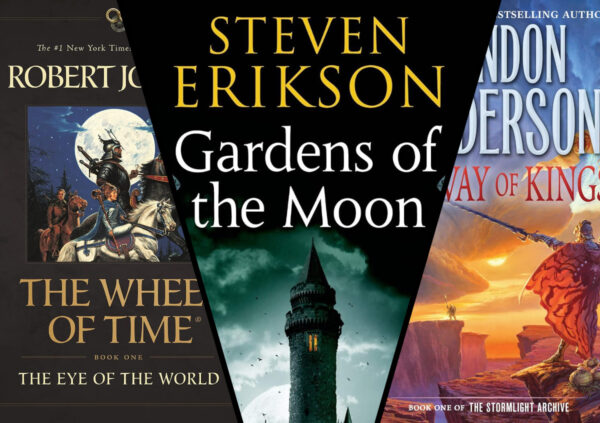
Gardens of the Moon is the first Malazan book, the weakest by a margin, still good, and historically explainable. The famous problem first. Gardens of the Moon opens in the middle of a military campaign, at the Siege of Pale, with Anomander Rake’s floating fortress hanging over the city, and explains nothing. You’re handed dozens of characters, an imperial command structure, competing gods, several nonhuman races, a magic system nobody pauses to describe, and then the story moves to Darujhistan and adds an entire second web of factions, assassins’ guilds, and scheming alchemists.
The story follows the empire’s campaign through a young noble officer, Ganoes Paran, the mage Tattersail and the Bridgeburners, a battered elite company whose sergeant, Whiskeyjack, anchors the soldiers’ side of the book. Readers bounce because they can’t tell what matters yet, and the honest answer is that Erikson trusts you to swim, on the theory that soldiers in a war don’t get an orientation lecture either.
There’s also a simpler reason the book reads differently from the rest: it was written years before them. Erikson drafted it in 1991-92, the manuscript spent nearly a decade being rejected, and when it finally sold and came out in 1999, the remaining nine followed with a decade more craft in his hands. The seam shows.
Here’s the thing though: it’s still a good book. Lost is not the same as bad, the Bridgeburners are worth meeting properly, and everything you push through here pays interest later. It’s the front door to the Steven Erikson books for a reason. The weakest volume of this series would be a strong volume of most others, which tells you something about the ceiling.
Deadhouse Gates (2000)

Deadhouse Gates is where you decide, and for me it’s among the best things Erikson has written. The story moves to Seven Cities, an imperial possession on the edge of a prophesied uprising called the Whirlwind, where a Wickan warleader named Coltaine takes command of the Seventh Army. Its spine is the Chain of Dogs: a Malazan army escorting tens of thousands of refugees across a continent in open rebellion, told largely through Duiker, an imperial historian recording a march he knows the empire will mythologize and misunderstand.
Around the march run two more threads. Fiddler and Kalam, carried over from the first book, cross the desert on a dangerous errand of their own, and a young noblewoman caught in a purge at home is shipped to the empire’s slave mines. It is punishingly bleak, it contains some of the finest battle writing in modern fantasy, and it’s the first place you feel the series’ true subject, which is what history costs the people who have to be in it. It’s also where Fiddler, the sapper who slowly becomes the closest thing this series has to a main character, starts carrying weight.
After a first book that asked so much, Deadhouse Gates moves to a new continent with a largely new cast, and some readers resent being made to start over, while the mine chapters are as hard to read as anything in the series. Push through both. If you’re deciding whether the Malazan Book of the Fallen is for you, this is the real test, and the reason the series has the reputation it does.
Memories of Ice (2001)

Memories of Ice is the consensus pick for the best book in the series, and it earns the title. The story returns to Genabackis, where a new empire, the Pannion Domin, is spreading under a prophet called the Pannion Seer, and old enemies have to make common cause against it: the renegade Malazan army of Dujek Onearm and the Bridgeburners, alongside the warlord Caladan Brood and Anomander Rake’s Tiste Andii. Their road runs toward the besieged city of Capustan, where a caravan guard named Gruntle has picked a bad season to take a contract.
The Pannion Domin remains one of the most terrifying factions I’ve met anywhere in the genre: an entire nation starved into madness and remade as an army that consumes, literally eats, the cities it conquers. The siege is one of the great sustained sequences in epic fantasy, and around it Erikson builds the most ambitious book of the first half of the series, with the undead armies of the T’lan Imass answering an old summons and a long, uneasy alliance between people who spent the first book trying to kill each other. And the closing battle is, for me, one of the best and most brutal in the whole series. I won’t say a word more about it than that.
It’s also long, the longest of the first five books, well over a thousand pages in British paperback, and the opening third spends a long time getting armies into position. Its admirers wouldn’t cut a page, but it is a commitment inside a commitment. For readers who came through Deadhouse Gates and want to know whether the series can sustain that level, Memories of Ice is the answer, and it’s the volume most often named the best of all the Steven Erikson books.
House of Chains (2002)

House of Chains gets called a weaker entry, and I half agree, but its opening quarter is anything but: a single unbroken stretch following Karsa Orlong, a young barbarian warrior whose raid goes catastrophically wrong, into slavery and across half a world, brutal and great in equal measure. Karsa walks into the series here and never really leaves it.
The main story then returns to Seven Cities, where the Adjunct Tavore Paran arrives with the Fourteenth Army, mostly raw recruits, to march on the rebellion’s stronghold in the Holy Desert of Raraku, and the book introduces Trull Sengar, a Tiste Edur warrior with a long story to tell. It’s also where the Bonehunters form and Fiddler steps up for good.
The rest of the book, the rebellion’s camp and the long march, splits readers, and plenty of what feels like sideplot turns out to be load-bearing. That middle stretch is the book’s real weakness, slower and more scattered than the Karsa chapters promise. Its defenders have numbers on their side, though: SF Site’s readers made it the winner of their annual poll in 2003. Karsa alone makes it essential.
Midnight Tides (2004)

Midnight Tides does the boldest thing in the series: it drops the story you’ve been following entirely and starts over on another continent, cold. In the north, the Tiste Edur tribes have finally been united under a Warlock King, and the Sengar brothers, Trull among them, are sent to recover a sword he wants. To the south lies the kingdom of Lether, a mercantile empire that weaponizes debt the way others weaponize armies, which gives the book the sharpest political satire in the series. A treaty meeting between the two peoples is coming, and nobody expects it to go well.
Some readers call it the best book in the series, and they’re nearly right. It also has, in Tehol Beddict and his manservant Bugg, the funniest double act Erikson ever wrote and one of the best characters in the whole ten books. Trull Sengar, met in House of Chains, gets his own past here. And it’s a book that works differently on a reread, for reasons I won’t state.
After four books of momentum, a new cast on a new continent is a lot to ask, and the Lether storyline doesn’t take center stage again until Reaper’s Gale, two books later. Readers who love political satire and gallows comedy tend to rank it near the top of the Malazan books anyway. It’s the volume to point to when someone says Erikson can’t be funny.
The Bonehunters (2006)

The Bonehunters is the book that brings the threads back together, and it has one statement to make above all others: Y’Ghatan. The story takes the Fourteenth Army on a long campaign across Seven Cities toward Y’Ghatan, an ancient fortress city with a bad history for the empire, while a plague spreads through the region, Ganoes Paran crosses from Genabackis with business of his own, and the gods start choosing sides in earnest.
The siege that anchors this book might be the single best battle sequence in the series, which for this series is saying something enormous. Erikson writes it from inside the ranks, through Fiddler’s squad and the marines around them, and the soldiers’ gallows humor carries you through some of the hardest chapters in the ten books. Around it, the larger shape of the series finally comes into focus, and threads from every earlier book start pulling in the same direction.
With Seven Cities, Genabackis and the gods all in play, the book sprawls, its plot lines tangle and spread, and it asks you to hold a great many threads at once just as Y’Ghatan has raised the stakes. Anyone who has been waiting since Deadhouse Gates for Seven Cities to pay off gets the payoff here, and Y’Ghatan is the reason people who finish the ten books still talk about this one.
Reaper’s Gale (2007)

Reaper’s Gale is the seventh Malazan book, the one where the Lether storyline of Midnight Tides and the soldiers of the Seven Cities books finally share a page. The Fourteenth Army lands on the coast of Lether, Karsa Orlong arrives with purposes of his own, and the threads Midnight Tides left hanging pull tight around the capital, Letheras.
It sheds harsh light on invaders and invaded alike, and it hands its heart to Beak, a gentle, simple soul of a mage who walks off with the entire novel and proves, if the point still needed proving, that Erikson’s monsters share the page with real tenderness. The marines’ war in the Letherii interior is some of the best soldiering in the series.
It’s also dense, a book of a great many characters, ambushes, hidden schemes and quarreling gods, and its first half moves slowly while the pieces get into position, so it plays best for readers already fully invested. It’s the book for readers who’ve come to care about the ordinary soldiers more than the gods.
Toll the Hounds (2008)

Toll the Hounds is the eighth Malazan book and my favorite, and I know that’s not the consensus. It’s the slow one, the sad one, the one that reads like a meditation wearing an epic’s armor. Much of it returns to Darujhistan, the city of Gardens of the Moon, and it’s told in large part through Kruppe, the city’s most florid schemer, whose voice Erikson had planned for this book since early in the series.
Old friends drift back into the city and old grudges with them, Karsa Orlong and Samar Dev cross the plains toward a meeting neither of them expects, the Tiste Andii have business of their own, and elsewhere a cult gathers around something called the Dying God. For long stretches the book is content to grieve, digress, and philosophize.
The honest flaw is the very thing I’m defending it for. Kruppe’s digressions and the long philosophical passages are exactly what divides readers, plenty of people who love the series rank this one low, and if the pace of Memories of Ice tested you, this will test you harder. It has its critical defenders, The Wertzone among them, which called it the most thematically developed book in the series, and for readers who value what the Malazan Book of the Fallen thinks as much as what it fights, those slow stretches are the point.
Then the finale arrives, escalates for hundreds of pages, and simply does not stop. It’s the best sustained ending in the series for my money, and it lands the way it does precisely because the book made you sit still for so long first. If Deadhouse Gates is where the series proves its power, this is where it proves its depth, and it’s the volume I find myself defending most and rereading first.
Dust of Dreams (2009)

Dust of Dreams is the ninth Malazan book and the first half of the finale, and Erikson has said he thinks of it and The Crippled God as two halves of a single concluding book. The story gathers the Fourteenth Army in Lether for a march east into the Wastelands, toward a purpose its commander won’t explain to anyone, while the Barghast clans hunt for a war, a band of starving children crosses a desert of glass, and the K’Chain Che’Malle, an ancient reptilian race, wake to a crisis of their own.
The finale is a single story split across two books, and it moves like a landslide once it gets going. Armies and races converge, the soldiers’ voices are as sharp as they’ve ever been, and the threads Erikson has been laying since the first book start to bear real weight. The children’s crossing is told with a patience that makes it hard to read and harder to forget.
It doesn’t end so much as stop, on purpose, and its first half is a long setup that introduces new peoples and new threads at the point where most readers want resolution. For anyone who has made it this far through the Malazan Book of the Fallen, there’s no question of stopping, and the back half is as gripping as anything in the series. Have The Crippled God within reach before you finish.
The Crippled God (2011)

The Crippled God closes the Malazan Book of the Fallen, and it’s one of the great endings in epic fantasy, delivered on time by a writer who never made his readers wait. The story picks up straight from Dust of Dreams, with the Fourteenth Army deep in the wastelands on the long march toward Kolanse and the Forkrul Assail, the self-appointed arbiters of justice who rule there.
The war against the Forkrul Assail is everything ten books earned. The soldiers stay at the center to the last, which is exactly where the series always said they belonged. For anyone weighing whether to start a ten-book series, the fact that this one is complete is one of the strongest arguments for the Steven Erikson books there is.
Honesty about the seams: The Crippled God carries a second front, a battle at the Shore against the Tiste Liosan that even admirers admit reads like its own separate novel for most of its length, magnificent on its own terms, with one of the series’ most jaw-dropping feats of arms, but loosely stitched to the whole until late. It’s the one structural complaint I share. It costs the finale a little and changes the verdict not at all.
The Kharkanas Trilogy
The prequels and the sequels come next, and I haven’t read either yet, so here’s the honest state of them. The Kharkanas Trilogy is deep prehistory, the tragedy of the Tiste races hundreds of thousands of years before the main series, written in a denser, more formal register. It goes back to the Tiste before they split into the Andii, the Liosan and the Edur the main books know. Forge of Darkness (2012) and Fall of Light (2016) are out, and they should be read in that order, after the main ten.
The third book, Walk in Shadow, was set aside in 2017 when Erikson turned to the Karsa Orlong books, with lower-than-expected sales of the first two among the reasons, and he later pointed to the creative toll of the trilogy’s style as well. He has said he means to finish it, but as of October 2026 it has no publication date, so anyone starting Kharkanas now is starting a story that stops two-thirds of the way through.
Forge of Darkness (2012)

Forge of Darkness is the first Kharkanas book, a prequel that wants to be read as tragedy rather than adventure, written in a declamatory register unlike anything in the main sequence. The story is framed as one poet telling it to another, and it follows the Tiste of Kharkanas as civil war gathers around Mother Dark and her consort Draconus, around Anomander, the future Anomander Rake of the main series, and his brothers, while the Jaghut and the Azathanai work their own threads at the edges.
Erikson has described the main sequence as a critique of epic fantasy and Kharkanas as closer to homage, and the shift shows in the ceremony of the prose and the scale of the tragedy. Readers who know the main books get the dramatic irony of watching names they already know take their first steps toward what they become.
Reviewers praised its scope and its thinking but faulted the pacing, since its characters spend a great deal of time inside their own heads. Those are exactly the things Toll the Hounds gets praised and blamed for, philosophical digression and a patient pace, which, given everything I wrote above, tells you exactly where I expect to land when I get there. The unfinished state of the trilogy is a real consideration before you commit. It belongs after the ten, when you want the oldest layer of the dig, and it’s the Steven Erikson book to read last rather than first.
The Tales of Witness
The Tales of Witness is the sequel series, set about a decade after the main sequence and built around Karsa Orlong and his legacy. It runs The God Is Not Willing (2021), No Life Forsaken (2025) and Legacies of Betrayal, published in October 2026, with a fourth book to come: Erikson planned a trilogy and announced in 2024 that it would run to four books, after the second turned out in the writing to be two novels. Read them in order, after the main ten. As with Kharkanas, I haven’t read them yet, so what follows is the state of the series and its reception rather than a verdict.
The God Is Not Willing (2021)

The God Is Not Willing opens the Tales of Witness, and it sits at the very top of my own reading pile. The story follows a company of Malazan marines sent to the remote north of Genabackis, near the town of Silver Lake, where the northern tribes have kept out of the southern lands for years while the legend of Karsa Orlong has only grown. Farther north, something is driving whole peoples south, with a single company of marines standing in their path.
It’s built around the aftermath of Karsa Orlong, which is all anyone needed to tell me. The reviews describe a leaner, more focused book than the main sequence, marine-forward and tightly built: Bill Capossere, reviewing it for Tor.com, called it lean and sharply honed, and Publishers Weekly gave it a starred review. It is, of course, a sequel built on a legend the main series made, and it means most to readers who watched Karsa walk into House of Chains.
For readers who finished the Malazan Book of the Fallen and want more of the soldiers’ series it always was underneath, this is the next step, with No Life Forsaken and Legacies of Betrayal already waiting behind it. I’ll leave the verdicts to the people who’ve read them, and I intend to join them shortly.
Bauchelain and Korbal Broach
The Bauchelain and Korbal Broach novellas are Erikson’s black-comedy side dish: two courteous monsters (a pair of necromancers) and their long-suffering manservant, Emancipor Reese, touring the world’s misfortunes. Six appeared as short books from PS Publishing between 2002 and 2016, and the two collected volumes of three novellas each are the practical way to read them now, so those get the entries here. A seventh novella, Upon a Dark of Evil Overlords, followed from PS Publishing in 2021 and sits outside both collections. The stories stand alone, though they’re best sampled once you know the register they’re lampooning.
Bauchelain and Korbal Broach: Volume One (2007)

Bauchelain and Korbal Broach: Volume One gathers the first three novellas, and it’s the easiest of the Steven Erikson books to sample without committing to ten doorstoppers. Blood Follows opens in the port city of Lamentable Moll, where a killer is loose and two well-mannered strangers are looking for a manservant, and Emancipor Reese, out of work and fond of a drink, takes the job. The Healthy Dead takes the trio to the city of Quaint, where a zeal for goodness has become its own kind of tyranny, and The Lees of Laughter’s End puts them aboard the ship Suncurl with something terrible waking in the hold.
The joke throughout is that the monsters are the most polite people in every room, and the comedy is mean, quick and very Malazan in its view of human folly. The Lees of Laughter’s End placed in the Locus Awards’ novella poll for its year. The humor is grim and occasionally gross, though, and three stories of the same double act back to back can feel repetitive to readers who came for grandeur. Sword-and-sorcery fans who like a body count with their jokes should start here.
The Second Collected Tales of Bauchelain and Korbal Broach (2018)

The Second Collected Tales of Bauchelain and Korbal Broach gathers novellas four to six, and it opens with Crack’d Pot Trail, the one that turned the series into a satire of art itself. In Crack’d Pot Trail a company of pilgrims, hunters and competing artists crosses a wasteland on the trail of the two necromancers with too little food to go around, and the poets in the party have to keep their audience entertained for reasons that become very practical very quickly.
The Wurms of Blearmouth strands the trio in a wreckers’ village on a miserable stretch of coast ruled by a petty tyrant, and The Fiends of Nightmaria finds Bauchelain on the throne of the kingdom of Farrog, with the city’s artists mostly executed and an ambassador from the mysterious land of Nightmaria demanding an audience. The satire gets more pointed and more self-referential as it goes, and Crack’d Pot Trail in particular is as much an argument about artists, audiences and critics as it is a story, which delights some readers more than others. Readers who enjoyed the first volume will find the same trio here with the satire turned up.
The Other Steven Erikson Books
Erikson’s shelf outside the Malazan world is small and odd: a literary coming-of-age novel from before the fantasy, a collection of novellas that runs from climate catastrophe to art-world satire, a trilogy of Star Trek parodies, and a first-contact novel built around a moral argument. None of them has the reach of the main sequence, and together they show a writer who was never only a fantasy writer.
This River Awakens (1998)

This River Awakens is Erikson’s first novel, published in 1998 under his real name, and it has no fantasy in it at all. The story follows twelve-year-old Owen Brand, whose family moves to the riverside town of Middlecross in the spring of 1971 to escape poverty. Owen falls in with three local boys and grows close to Jennifer, a rebellious girl with a violent, alcoholic father, while two adults, a kindly old watchman at the yacht club and a farmer haunted by his past, shadow the year. Then the boys find a body on the riverbank.
Erikson’s announcement of the 2012 edition calls it “a lyrical, tender and disturbing portrayal of a rite of passage”, and that’s the register: slow, seasonal and heavy, with the attention to place and to overlooked people that Malazan readers will recognize. He revised it for that 2012 Bantam hardcover, which is the version to read, and Tor brought the book out in the United States in 2013. Readers looking for more of the Malazan books will find nothing of the kind here. Readers of literary coming-of-age fiction will find a quiet, serious novel instead, and completists working through the Steven Erikson books will see where the novelist came from.
The Devil Delivered and Other Tales (2012)

The Devil Delivered and Other Tales gathers three novellas previously published as small-press books by PS Publishing, and it’s the quickest tour of his range outside Malazan. The title story follows a lone anthropologist through a breakaway Lakota Nation under a vast ozone hole, gathering notes that could threaten the world’s powers, in a near future of climate catastrophe and ecological collapse. Revolvo, the title story of his 1998 collection, is an art-world satire set in an alternate Canada, and Fishin’ with Grandma Matchie turns a boy’s school writing assignment into a showcase for his grandmother’s tall tales.
Library Journal praised Erikson’s “sheer talent for storytelling and his prodigious imagination” here, while warning that the book is not for every taste, and that’s a fair summary: the three pieces have little in common beyond their author, so it reads as a sampler rather than a book. The Devil Delivered is the heavyweight, an ambitious jostle of science fiction, fantasy and horror tropes, and Fishin’ with Grandma Matchie placed in the Locus Awards’ novella poll for 2006. Anyone who knows the Steven Erikson books only through Malazan will meet a different writer here.
Willful Child (2014)

Willful Child is Erikson’s Star Trek parody and the first of three comic science fiction novels, and it’s about as far from Malazan as the Steven Erikson books ever travel. The story follows Captain Hadrian Sawback, a swaggering commander in the Kirk mold, and the crew of the starship Willful Child on a mission of exploration that goes sideways at every opportunity, especially once a rogue AI named Tammy commandeers the ship’s computers.
The target is the original series of the 1960s, and The Encyclopedia of Science Fiction says that “like almost any successful parody it is done with love”. Not everyone was charmed: Publishers Weekly called it a “heavy-handed Star Trek parody” and thought it arrived very late to the party. It’s for Star Trek fans with a high tolerance for broad, deliberately juvenile humor. Two sequels followed in the same key, Willful Child: Wrath of Betty (2016) and Willful Child: The Search for Spark (2018), so try the first before you buy the set.
Rejoice, A Knife to the Heart (2018)

Rejoice, A Knife to the Heart is Erikson’s first-contact novel, and it’s a novel of ideas first and a story second. The story follows Samantha August, a Canadian science fiction writer abducted by an alien presence that speaks to her only through an artificial intelligence called Adam, while on Earth the visitors simply switch off humanity’s worst habits, from oil extraction to warlords to domestic abuse.
Quill & Quire’s Alice McMurtry wrote that “it succeeds in turning the first-contact novel on its head”, and the satire of billionaires, televangelists and politicians has real bite. Publishers Weekly called it a “talky novel of first contact with reluctant alien overlords”, and the description fits: long stretches are Socratic argument rather than plot, so readers who want a story engine will find it in low gear. The argument is the attraction, and on what humanity might do if it were simply made to stop, Erikson has plenty to say.
Ian C. Esslemont’s Malazan Novels
Ian C. Esslemont co-created this world with Erikson decades ago, and his own sequences are canon, covering events the main series only gestures at. The Novels of the Malazan Empire run six books, from Night of Knives (2004) through Return of the Crimson Guard, Stonewielder, Orb Sceptre Throne and Blood and Bone to Assail (2014), and the Path to Ascendancy prequels, starting with Dancer’s Lament (2016), go back to the early adventures of Dancer and Kellanved, the pair who founded the empire, on its home continent of Quon Tali.
Read them after a few mainline books, not before. Night of Knives is a prequel, and Return of the Crimson Guard is set shortly after The Bonehunters, which makes after book six the natural point to start mixing them in. They’re Esslemont’s books rather than Erikson’s, so they get no entries on this page, but for readers who can’t get enough of the world, they’re part of the same excavation.
Steven Erikson: Deep Dive and FAQ
What Runs Through Steven Erikson’s Books
Erikson writes fantasy like an archaeologist. His world is layered the way real ground is, civilizations stacked on civilizations, gods who used to be people, myths that turn out to be garbled accounts of things that happened, and the books keep asking who gets remembered and who gets left in the dirt. That’s the deepest thread in the Steven Erikson books, and it’s why the main sequence is the Book of the Fallen: the series is about the people history steps over, and about the duty to witness them, a word he later made the name of his sequel series.
He has been clear about where he stands in the tradition. In a 2012 essay for The New York Review of Science Fiction, he wrote that he sidestepped Tolkien as a young reader in favor of Robert E. Howard, Edgar Rice Burroughs and Fritz Leiber, met epic fantasy’s furniture first through Dungeons & Dragons rather than books, and counted Stephen R. Donaldson’s Thomas Covenant and Glen Cook’s Black Company and Dread Empire books among the post-Tolkien fantasy that shaped him. He has described the main sequence as a critique of epic fantasy, and the soldiers’ eye view, the gallows humor and the refusal to explain owe a lot to that lineage.
The third thread is compassion, and it’s why the series is darker than most fantasy without being nihilistic. Kindness is expensive in these books and suffering is everywhere, but the series keeps insisting that both matter. Erikson and Esslemont also agreed to build societies that never knew sexism or gender-based hierarchies of power, which is why the female soldiers, mages and commanders never read as exceptions. Readers who want Malazan’s neighbors in tone should look at my dark fantasy books list, where it sits comfortably.
Prizes and Honors
Gardens of the Moon was a nominee for the World Fantasy Award for best novel in 2000 and placed in that year’s Locus Award poll for first novels. SF Site’s annual readers’ poll was the series’ most loyal scoreboard: House of Chains won it in 2003, and Midnight Tides, The Bonehunters, Reaper’s Gale, Toll the Hounds and The Crippled God all finished in its top five in their years.
In 2017 the Malazan Book of the Fallen was a nominee in the Aurora Awards’ Best of the Decade category, alongside Robert J. Sawyer’s The Neanderthal Parallax, which won, and books by William Gibson, Guy Gavriel Kay, Charles de Lint and Robert Charles Wilson. On the shorter side, The Lees of Laughter’s End, Fishin’ with Grandma Matchie and the Malazan story “Goats of Glory” all placed in Locus Award polls.
Which Steven Erikson Editions to Buy
The ten Malazan books are in print on both sides of the Atlantic, from Bantam in Britain, part of Transworld and now of Penguin Random House, and from Tor in the United States, in paperback and ebook, and either set is fine to read from. The British editions came first, the American ones followed from 2004, and the cover art differs between them, which matters only if you want a matching shelf. Both publishers issued a tenth-anniversary hardcover of Gardens of the Moon in 2009, worth finding if you want the first book in hardcover.
The Bauchelain and Korbal Broach novellas first came out as small-press books from PS Publishing, and the collected volumes are the practical buy: Tor’s Bauchelain and Korbal Broach: Volume One (2009) in the United States, and Bantam’s First and Second Collected Tales in Britain. This River Awakens is best read in the revised text Erikson prepared for the 2012 Bantam edition. Rejoice, A Knife to the Heart exists in two versions, since the Gollancz edition in Britain and the Promontory Press edition in Canada order the last two chapters differently, and the Gollancz order is the one Erikson prefers.
The Witness books are newest in hardcover, from Tor in the United States and Bantam in Britain, and No Life Forsaken reached British paperback in August 2026. Legacies of Betrayal came out in hardcover and audio in October 2026, and Tor’s American paperback is scheduled for July 2027.
Questions About Steven Erikson
What Order Should I Read the Malazan Books In?
Publication order: Gardens of the Moon, Deadhouse Gates, Memories of Ice, House of Chains, Midnight Tides, The Bonehunters, Reaper’s Gale, Toll the Hounds, Dust of Dreams and The Crippled God. After the ten, read the Tales of Witness for the sequel story and the Kharkanas books for the deep past, and mix in Ian C. Esslemont’s novels whenever you want more, ideally from The Bonehunters onward.
Is the Malazan Book of the Fallen Finished?
Yes. The ten-book main sequence was completed with The Crippled God in 2011, after a steady run of releases that began in 1999. What’s unfinished is around it: the Kharkanas prequel trilogy has two of its three books, with no date for the third, and the Tales of Witness sequel series has three of a planned four, the latest being Legacies of Betrayal in October 2026.
What Is the Best Steven Erikson Book?
Memories of Ice is the usual answer, and it’s a good one. Deadhouse Gates is where the series hooks people, and for me it’s among the best things Erikson has written. My own favorite is Toll the Hounds, the slow, philosophical eighth book, and I know that puts me in the minority. Beyond the main sequence, the two Bauchelain and Korbal Broach collections are the easiest recommendation.
Can I Skip Gardens of the Moon and Start With Deadhouse Gates?
You can, and some readers swear by it, but I wouldn’t. Deadhouse Gates picks up characters and threads from book one, and you’d meet them without the weight that makes their stories land. Read Gardens of the Moon knowing it’s the weakest of the ten and that it was written years before the rest, then judge the series on book two.
Do I Need to Read Ian C. Esslemont’s Malazan Books?
No. Esslemont co-created the world and his novels are canon, filling in events the main sequence only mentions, but Erikson’s ten books are complete without them. A natural point to start adding them is after The Bonehunters, since Return of the Crimson Guard is set shortly after it, and his Path to Ascendancy prequels can wait until you’ve finished the main series.
Is Malazan Grimdark?
It gets shelved there constantly, and I think it’s misfiled. The series is brutal, but it’s built on compassion and on the duty to witness suffering rather than on the idea that nothing matters, and that difference is the whole argument. My grimdark books list explains the distinction and files Malazan with the series everyone calls grimdark that aren’t.
Is There a Malazan TV Show or Movie?
No Malazan film or television series has been made. As far as anything has been announced, the closest the world has come to a screen is its own origin story: in 1991 Erikson and Ian C. Esslemont wrote a film script called Gardens of the Moon, and when it didn’t sell, Erikson turned it into the novel that started the series, which is the best thing that could have happened to it.
When Is the Next Witness Book Coming?
The third, Legacies of Betrayal, came out in October 2026, so the next is the planned fourth Tale of Witness, which has no title or date yet. Erikson expanded the series from three books to four in 2024. Walk in Shadow, the long-delayed end of the Kharkanas Trilogy, also has no publication date yet, so for now the Witness books are where the Malazan story is moving.
Where to Go Next
If the Steven Erikson books have you hooked on soldiers’ fantasy, the direct ancestor is Glen Cook’s Black Company, the grunt’s-eye mercenary saga Erikson has named among the post-Tolkien books that shaped him, and my Glen Cook books guide tells that story from the ancestor’s side. Cook, for his part, has called the series a masterwork of the imagination that may be the high-water mark of epic fantasy.
The other series Erikson named, Stephen R. Donaldson’s Thomas Covenant, is a very different argument with Tolkien, and my Thomas Covenant guide covers it with the warning up front. For the whole epic tradition around Malazan, from Tolkien through Jordan and Martin to Sanderson, the epic fantasy books page places each book in the line. And if what you want next is another giant on the same scale, the George R. R. Martin books guide is the obvious neighbor on the shelf.