Tad Williams books sit at the center of the strangest injustice in modern fantasy: the man taught the doorstopper era how to work, sold more than seventeen million copies of his books, directly inspired the writers who now outrank him in every casual conversation, and somehow became the genre’s best-kept open secret. I read Memory, Sorrow, and Thorn in its entirety, and I love it without reservation, so consider this page both a map and a small act of justice.
The influence claim isn’t fan exaggeration, it’s printed on the covers: DAW sells the Osten Ard sequels under George R. R. Martin’s own words that the series “inspired me to write my own seven-book trilogy,” and Christopher Paolini has called it one of the great fantasy epics of all time. My George R. R. Martin guide covers what got built on this foundation. Memory, Sorrow, and Thorn already appears on three of my lists at once, the best fantasy books pillar, the best fantasy series ranking, and the books like Lord of the Rings page, which made him the most-shelved author in this cluster without a page of his own. Fixed, as of now.
The timing could hardly be better, because Osten Ard is wide awake. The sequel saga wrapped in November 2024 with The Navigator’s Children, and this very month, October 2026, Williams opened a brand-new trilogy there with The Splintered Sun. Forty years into his career, he is publishing some of the biggest fantasy of his life to far too little noise. This page covers all of it: every series, every standalone, every collection worth your shelf space.
A note on the verdicts before we start. Memory, Sorrow, and Thorn I’ve read in full. Otherland I read as a teenager and loved every volume. The War of the Flowers and Tailchaser’s Song are mine too, and I read the first Shadowmarch book years ago. Those judgments I stand behind personally. For everything else on this page, the sequel saga included, I’m relaying how readers and critics have judged it, and I say so where it matters.
Fiction by René Rehn


The Short Version
Start with The Dragonbone Chair and take the famous slow opening on faith: roughly two hundred pages of castle boyhood before the plot ignites, and every one of them pays interest later. Memory, Sorrow, and Thorn is complete in three volumes, its sequel saga The Last King of Osten Ard has been complete since November 2024, and the two together are one continuous story with a thirty-year gap inside it and a twenty-four-year gap outside it. Otherland is the separate science fiction epic, four volumes, finished, enormous. The Splintered Sun, new this October, begins a fresh Osten Ard trilogy set three hundred years before everything above. Everything else is dessert, and some of the dessert is very good.
Tad Williams Books in Order
The table runs by first book publication. The Osten Ard books read in their own internal order, which the series sections below sort out.
| Year | Title | Series or type | Notes |
| 1985 | Tailchaser’s Song | Standalone | His debut |
| 1988 | The Dragonbone Chair | Memory, Sorrow, and Thorn, book 1 | |
| 1990 | Stone of Farewell | Memory, Sorrow, and Thorn, book 2 | |
| 1992 | Child of an Ancient City | Standalone | With Nina Kiriki Hoffman |
| 1993 | To Green Angel Tower | Memory, Sorrow, and Thorn, book 3 | One novel, split in paperback |
| 1994 | Caliban’s Hour | Standalone | |
| 1996 | City of Golden Shadow | Otherland, book 1 | |
| 1998 | River of Blue Fire | Otherland, book 2 | |
| 1999 | Mountain of Black Glass | Otherland, book 3 | |
| 2001 | Sea of Silver Light | Otherland, book 4 | |
| 2003 | The War of the Flowers | Standalone | |
| 2004 | Shadowmarch | Shadowmarch, book 1 | Began as an online serial |
| 2006 | Rite: Short Work | Collection | Small press, now scarce |
| 2007 | Shadowplay | Shadowmarch, book 2 | |
| 2009 | The Dragons of Ordinary Farm | Ordinary Farm, book 1 | With Deborah Beale |
| 2010 | Shadowrise | Shadowmarch, book 3 | |
| 2010 | Shadowheart | Shadowmarch, book 4 | |
| 2011 | The Secrets of Ordinary Farm | Ordinary Farm, book 2 | With Deborah Beale |
| 2011 | A Stark and Wormy Knight | Collection | Print edition 2012 |
| 2012 | The Dirty Streets of Heaven | Bobby Dollar, book 1 | |
| 2013 | Happy Hour in Hell | Bobby Dollar, book 2 | |
| 2014 | Sleeping Late on Judgement Day | Bobby Dollar, book 3 | |
| 2014 | The Very Best of Tad Williams | Collection | |
| 2017 | The Heart of What Was Lost | Osten Ard bridge novel | Set directly after the trilogy |
| 2017 | The Witchwood Crown | The Last King of Osten Ard, book 1 | |
| 2019 | Empire of Grass | The Last King of Osten Ard, book 2 | |
| 2021 | Brothers of the Wind | Osten Ard prequel novel | |
| 2022 | Into the Narrowdark | The Last King of Osten Ard, book 3 | |
| 2024 | The Navigator’s Children | The Last King of Osten Ard, book 4 | |
| 2026 | The Splintered Sun | The Splintered Sun, book 1 | New prequel trilogy |
Where to Start With Tad Williams
The Dragonbone Chair, with the slow start embraced as the foundation pour it is, and the knowledge that the road now runs unbroken through eight more Osten Ard volumes to a finished, satisfying end. That is the main door, and for most readers it should be the only serious candidate. A whole stretch of the epic fantasy tradition between Tolkien and Martin routes through this book, and reading it first is the best way to feel why.
Science fiction readers can enter through Otherland instead, which asks nothing of Osten Ard and gives you Williams at full imaginative throttle. Readers who want a one-volume commitment should take The War of the Flowers, the most underrated single thing he has written. And if you want to know what the fuss is about in a weekend, you can’t, which is sort of the point: Williams is a long-form writer the way some people are marathon runners, and the Tad Williams books that matter most are the ones that take a season of your life.
What I would not do is start with the sequels or with The Splintered Sun just because it’s new. The sequel saga assumes you love these people already, and the new book, though set three hundred years earlier, rewards knowing the world it’s a history of. Start at the kitchen, trust the castle, and let Osten Ard take its time. It taught everyone else how.
Williams’s Life, Briefly
Robert Paul Williams was born on March 14, 1957, in San Jose, California, and grew up in Palo Alto. The nickname came from his mother, after Tad the tadpole in Walt Kelly’s Pogo comic strip, which may be the most storybook origin any epic fantasist has for a pen name that isn’t one. Before the books worked out he ran through a catalog of jobs that reads like a picaresque: delivering newspapers, selling shoes, food service, hosting on college radio station KFJC, managing a branch for a financial institution, drawing military manuals, theater work, and a stretch as a technical writer at Apple in the late 1980s.
DAW Books took Tailchaser’s Song in 1985, and he has stayed with the publisher his whole career, four decades and counting. The Dragonbone Chair arrived in 1988 and changed the shape of commercial fantasy, and by the mid-1990s he was an international bestseller, nowhere more devotedly read than in Germany, where his books run through multiple editions and full audio productions. He also spent the early 1990s chasing interactive television a decade too early, co-founding a company whose experimental show aired on Bay Area TV in 1992 and 1993, an experience you can feel feeding straight into Otherland.
He lives in Northern California with his wife and sometime co-author Deborah Beale, their two children, and a large population of pets, and he has kept producing major work on a steady clock well into his sixties. Whatever the sales counters say the day you check, the number still undersells how far downstream his influence travels.
Memory, Sorrow, and Thorn
The home series, the masterpiece, and the reason this page exists. The Dragonbone Chair (1988), Stone of Farewell (1990) and To Green Angel Tower (1993) are one continuous story: read them in order, and know that the third is a single novel that paperback printing split in two.
This is the series George R. R. Martin meant when he said, in a statement his publishers have been quoting ever since, that The Dragonbone Chair and the rest of Tad’s “famous four-book trilogy” had helped inspire him to write his “own seven-book trilogy.” He also tucked a House Willum into A Game of Thrones as a nod. The debt is real, acknowledged, and strangely absent from most conversations about where modern fantasy came from.
Every first-person judgment in this section is mine. I read all three volumes, I love them without reservation, and I’ve been pointing people at them for years.
The Dragonbone Chair (1988)

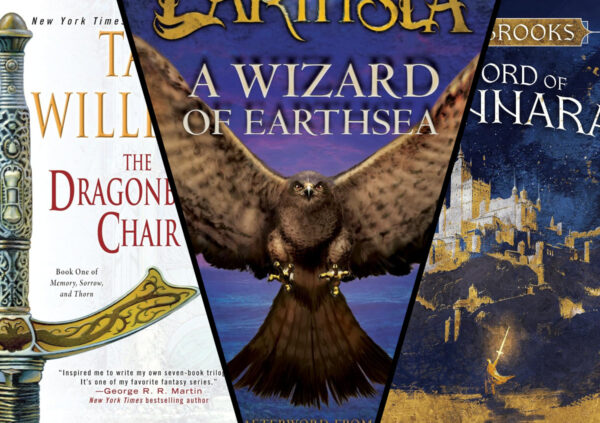
The Dragonbone Chair is the foundation stone of modern epic fantasy, and it announces itself by refusing to hurry. Simon is a kitchen boy in the Hayholt, a human castle built on the bones of an older, immortal people’s home, mooning through chores and half-hearted lessons while the great King Prester John dies upstairs.
The realm passes to one prince, the other prince objects, and beneath the human quarrel something far older moves: the Storm King, a dead prince of the Sithi burning with a five-century grudge, whose bargain with the living requires three legendary swords, a lot of winter, and the end of everything. Simon falls out of the bottom of the castle and into the middle of all of it.
I said love without reservation, and here’s its shape. The slow start is real and it’s load-bearing: because the book spends so long teaching you the Hayholt’s kitchens and turrets, the moment it all breaks sends you into exile as homesick as Simon is, and the whole trilogy runs on that ache. The moral shading was a genuine hinge for the genre, sympathetic viewpoints inside the wrong armies, heroes who bungle things, costs that stay paid, the connective tissue between Tolkien’s certainties and Martin’s knives.
And the villain is my favorite proof. Pryrates, the red priest, is the thing I point people at: a scholar who opened one door too many, radiating a wrongness that has nothing to do with armies and everything to do with appetite, written decades before that flavor of villainy was fashionable. Michael Whelan’s covers, for the readers who collect such things, are their own era of the genre’s art.
Stone of Farewell (1990)

Stone of Farewell is the exile volume, and the one where the trilogy’s scale stops being a promise and becomes the book you’re holding. The survivors of the first volume are scattered across a freezing Osten Ard, Simon traveling through the ancient world of the Sithi, the resistance limping toward the rock that gives the book its name, and winter arriving like a siege weapon. Middle volumes of big fantasy series have a reputation for marking time. This one deepens instead, trading the first book’s single castle for an entire continent of cultures that all feel lived in rather than toured.
Locus called it an epic fantasy “you can get lost in for days, not just hours,” which is exactly the register of its pleasures. The homesickness the first book built pays compound interest here, because now you know precisely what everyone has lost. It’s the quietest of the three Williams books in the trilogy and, for readers who love the texture of his world more than any single plot turn, often the secret favorite.
To Green Angel Tower (1993)

To Green Angel Tower is the finale, and a publishing legend in its own right: one novel, so large that the paperback had to be split into two volumes, which is why you’ll see it sold in halves and why some people miscount the trilogy as four books. It is one book. Buy it as one if your format allows, read the halves back to back if it doesn’t.
By the time Williams wrote it, the story had grown so large that every thread of two fat volumes converges here, on a tower, a prophecy that doesn’t behave, and a last stretch that gets genuinely frightening before it gets anything else. The ending repays all three thousand pages, and I don’t say that lightly in a genre where finales are the most common point of failure.
It spent time on the New York Times bestseller list and placed third in the Locus poll for fantasy novel in its year, which is the kind of almost-honor that defines this man’s entire trophy case. One of the trilogy’s own lines warns that anyone who thinks he knows how things end before they have properly begun has killed his own sense of wonder. The book never makes that mistake.
The Last King of Osten Ard
More than two decades after finishing the trilogy, Williams went home. The Last King of Osten Ard picks up three decades later, with Simon and Miriamele long married, ruling, and grieving, their grandson Prince Morgan very much unready for what’s coming, and the old enemies proving less finished than everyone hoped. What was announced as a trilogy grew in the telling into four full volumes, published from 2017 to 2024, plus two shorter Osten Ard novels that orbit it.
Reading order for the whole run: the original trilogy, then The Heart of What Was Lost, then the four sequels in order, with Brothers of the Wind slotted wherever you like after the originals. I haven’t read the sequels yet, so the verdicts in this section are the consensus ones, and the consensus is unusually warm: this is that rarest thing, a decades-later return that readers largely agree earned its existence. Each volume gets its own entry here, because each is a real decision point for a reader working through the saga.
The Heart of What Was Lost (2017)

The Heart of What Was Lost is the short bridge novel that reopened Osten Ard after twenty-four years, and the right second purchase for anyone who finishes the trilogy wanting more. It picks up in the immediate aftermath of To Green Angel Tower and follows the war’s grimmest unfinished business north, into the mountain country of the Norns, the ice-white immortals who served as the trilogy’s most implacable foes.
Its structural trick became the sequel saga’s signature: for the first time, the Norns get real interiority, soldiers and believers with names and griefs rather than a wall of pale menace. At under three hundred pages it’s the shortest adult Osten Ard book by far, and the consensus treats it as a small, hard, surprisingly mournful war story rather than a victory lap. Readers planning the full return should not skip it: the sequels assume its events.
The Witchwood Crown (2017)
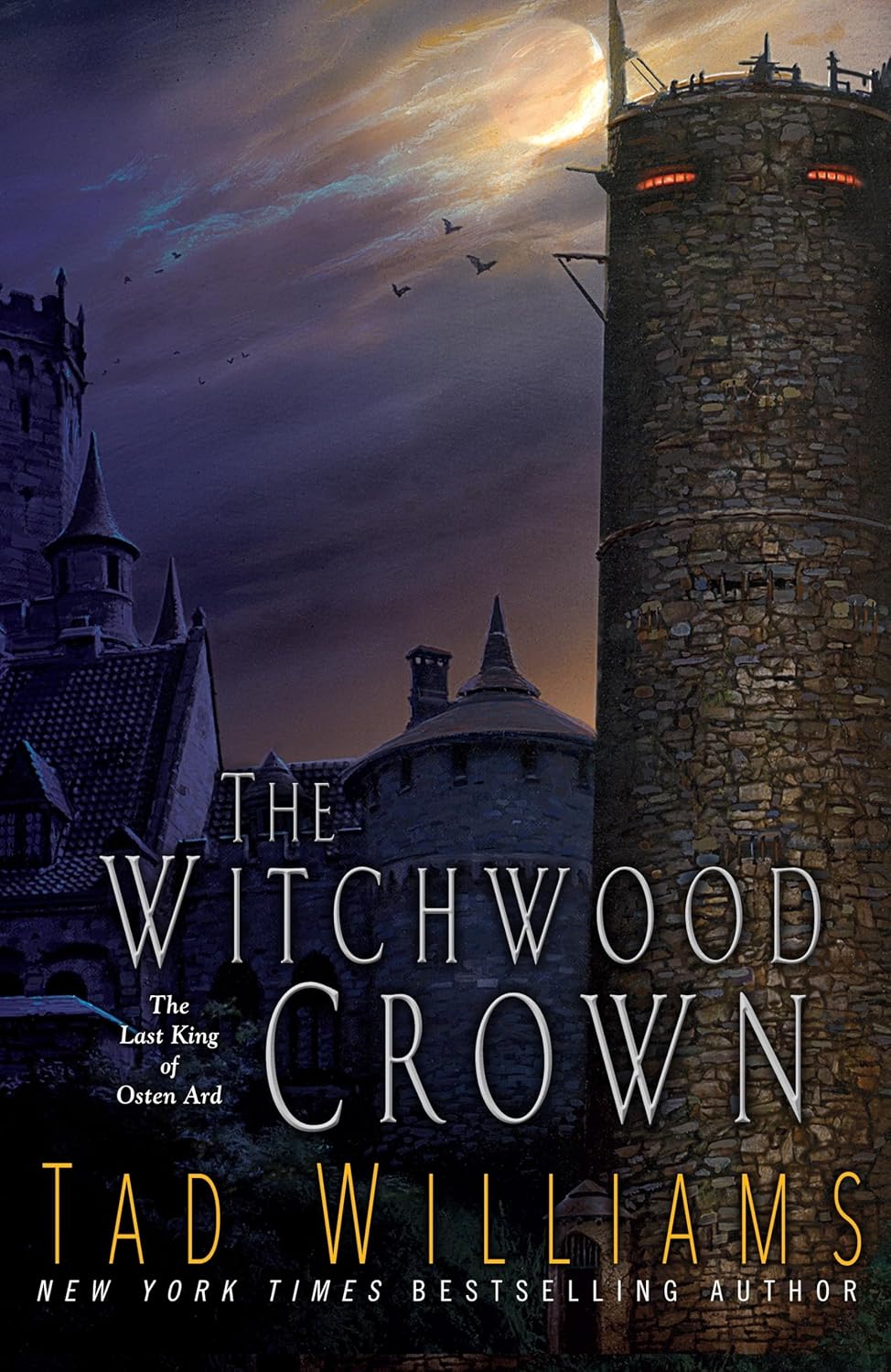
The Witchwood Crown opens the sequel saga proper, thirty-some years after the trilogy, and its bravest choice is letting everyone age for real. Simon and Miriamele rule a peace that is quietly coming apart, grief has moved into the family, grandson Morgan is a drinking, drifting disappointment with a long road ahead, and in the far north the Norns are stirring again. Kirkus gave it a starred review and called it “flawless epic fantasy,” and the warmth of its critical reception did a lot to settle nerves about whether a return this late could work.
The move most praised by readers is one the originals never attempted: full Norn viewpoint chapters, warriors and builders and true believers with interior lives, which turns the old war’s remnant into people and the new war into tragedy. It’s a slow burn even by Williams standards, the consensus says so plainly, and the payoff structure is the same one Dragonbone Chair taught a generation to trust.
Empire of Grass (2019)

Empire of Grass is the saga’s middle expanse, and the title names its best idea: much of the book moves into the Thrithings, the grassland clan country the original trilogy only skirted, and builds it into a full culture with its own politics, resentments and rising storm. The cast scatters across the whole map, the Norn chapters deepen, and threads that looked decorative in the first volume start pulling tight.
The common verdict is that it’s the volume where the sequel saga stops being a reunion and becomes its own war story, with the usual middle-book caveat that almost nothing resolves and nobody should read it with long gaps before the next volume. Readers who love the Williams books for their patience tend to name this one as proof the method still works at full scale.
Into the Narrowdark (2022)

Into the Narrowdark is the third volume and the shortest of the four, the penultimate tightening where every army, exile and schemer in Osten Ard converges toward a hidden valley whose secret has been glinting at the series’ edges since the beginning. It reportedly began life as half of a larger final volume that outgrew its binding, which would explain both its pace and where it stops.
That stop is the thing readers warn each other about: it ends mid-stride, on held breath, and the common advice is to have The Navigator’s Children on hand before you open it. Taken as designed, as the first half of a single enormous finale, it’s the fastest-moving stretch of the sequel saga, with the Norn material and Morgan’s long transformation both paying off at speed.
The Navigator’s Children (2024)

The Navigator’s Children, published in November 2024, closes The Last King of Osten Ard, and with it a story Williams had been telling across two series and nearly forty years. Endings matter double for a writer whose whole method is deferred payoff, and the reception matters double for a reader deciding whether to commit to four thick volumes, so here is where the consensus actually stands: by most accounts it landed, with longtime readers broadly calling it a worthy close rather than a stumble, which is more than most decades-spanning sagas get.
Without spoiling a line of it, the finale gathers the human and Norn threads into one reckoning, answers questions the original trilogy left deliberately fogged, and gives the series’ oldest characters the kind of farewell that rereads the earlier books behind you. If the trilogy meant anything to you, the road now runs all the way to a finished end, and that alone puts the sequel saga high among Tad Williams books worth your time.
Brothers of the Wind (2021)

Brothers of the Wind is the deep-history novel, a short book set a thousand years before The Dragonbone Chair, and you can read it any time after the original trilogy. Two princes of the immortal Sithi, one golden and beloved, one proud and burning, ride out against a monstrous black dragon, and the story of what that hunt costs is narrated by Pamon Kes, the elder brother’s devoted servant, an outsider among immortals watching his masters make history and mistake it for glory.
The consensus prizes it as the most elegiac thing in the Osten Ard shelf, closer to a tragedy in the old sense than to an adventure, and readers of the trilogy will understand exactly which legends they are watching get made. It stands properly alone, a distinct story rather than a footnote to the saga around it.
The Splintered Sun and What Comes Next
Osten Ard did not close with the sequel saga. A brand-new trilogy is now underway, and its first volume is in stores as of this month.
The Splintered Sun (2026)

The Splintered Sun, published in October 2026, opens a new Osten Ard trilogy set roughly three hundred years before The Dragonbone Chair, and Williams has described the follow-ups, The Crooked Tower and The Holly Ring, as already in motion. The pitch is a swashbuckler rather than a doorstopper epic: two fugitive children, Vedra and Daley, are taken in by Flann’s Crows, an outlaw band that gets drawn into a deadly plot around the throne of Hernystir, with an immortal exile offering the kind of alliance that history says you should refuse.
It’s too new for a settled verdict, and I haven’t read it yet, so file this entry under news rather than judgment: the Hernystir setting digs into a corner of the map the other Williams books mostly waved at, and a leaner, faster Osten Ard story is exactly the on-ramp this world has never had. For completists it’s essential by definition. For everyone else it’s the first time in decades you can watch an Osten Ard series begin in real time.
Otherland (1996-2001)
Between the two Osten Ard eras sits an entirely different monument, and this one I can vouch for personally: I read Otherland as a teenager, twenty-some years ago, and loved every volume. Great characters, a great central mystery, and a scale nothing else on the virtual-reality shelf was attempting. Scholarship mostly files it as science fiction, but I shelve it as cyberpunk and say so, and the tradition it runs closest to has its own map on my cyberpunk books page. Custody note, same as the Lewis and Wolfe cases on this site: it lives here with its author.
Two practical things before the entries. First, this is one novel in four volumes, not four novels: the breaks are logistics, and you should plan to read straight through. Second, its afterlife is its own story. Germany embraced the series with particular devotion, with hardcover and paperback editions, full audiobook productions, and even a Blind Guardian song named after it, and a long-troubled MMO based on the books ran until its servers finally went dark in 2021.
City of Golden Shadow (1996)

City of Golden Shadow is the opening volume, and the one that did the hooking. Renie Sulaweyo, a South African researcher, watches her little brother fall into a coma somehow linked to the Net, the full-immersion virtual world the late twenty-first century lives half its life inside, and her search leads toward a hidden network the impossibly rich have built themselves as a private eternity. Around her gathers one of Williams’s best casts: !Xabbu, Orlando the dying boy who is a barbarian hero online, and a conspiracy with genuinely unsettling machinery behind it.
The best thing in it, for my money, are the Paul Jonas chapters: a man adrift through a string of dreamlike worlds built from early twentieth-century books, folklore, and battlefields, the looking-glass country, the mud of the Great War, with no memory of how he got there, and pursued from world to world by two figures called Finch and Mullet who supply the series’ genuine horror. Fair warning that the Williams slow build applies at full strength, and the volume ends as a beginning. It’s the price of admission to the biggest swing the virtual-reality shelf ever took.
River of Blue Fire (1998)

River of Blue Fire is where the series becomes a tour of infinite worlds, and where Williams’s imagination gets to show off hardest. The travelers are inside the network now, hopping between simulations built as playgrounds for the richest people alive, and the invention rate per hundred pages is absurd: worlds out of children’s books, worlds out of war, one unforgettable stretch at insect scale. The Paul Jonas thread keeps its dream-logic dread, and the villainy sharpens considerably.
Some story beats do run loose across these very fat volumes, a drift that marks the whole middle of the series, and readers who need every excursion to advance the master plot will feel it here most. The excursions are the point, though, and readers who take the book on those terms rarely complain. It’s still the volume where the series asks for your trust the way Dragonbone Chair asks for patience.
Mountain of Black Glass (1999)

Mountain of Black Glass is the volume people remember scenes from decades later, because its centerpiece is the series’ single best idea executed at full length: a complete simulation of Homer’s Troy, with the protagonists wearing the skins of legend while very real stakes play out underneath. An Egypt of living gods gets nearly as much room, and the mythological worlds let Williams do openly what the whole series does quietly, which is ask what stories are for and what they cost the people inside them.
By this point the central mystery is paying out real answers, the separated casts begin converging, and the book closes on the series’ highest cliff. Of the four Otherland volumes it’s the one readers most often call the peak, and I wouldn’t argue.
Sea of Silver Light (2001)

Sea of Silver Light brings the whole four-volume machine in to land, and when the antagonist Dread steps fully forward he proves one of the era’s most frightening creations, a human darkness that outclasses the system-level mystery around him. The finale answers the big questions, gives its enormous cast genuine endings, and confirms how far ahead of its time the series’ thinking about virtual lives really was.
Caveats, honestly held. The ending’s reveals underwhelm a share of readers, and there’s one philosophical door the books walk straight past: the endgame fills with virtual copies of real people, and to my reading the series never truly opens the question its own premise begs, whether a copy is the person. Telling, maybe, that Williams later circled back to poke at exactly that in “The Happiest Dead Boy in the World,” a story set after the series that he published in the Legends II anthology. None of it dents the whole. Among Tad Williams books this is the conclusion that connected hardest of all in Germany, where a generation of readers met him through these four volumes first.
Shadowmarch (2004-2010)
Shadowmarch has the strangest origin of any Williams series: he conceived it as a film, then as a television show, pitched somewhere between Hill Street Blues, Babylon 5 and The Lord of the Rings, and when neither sold he serialized it online from 2001 to 2002, charging a one-time fee in an experiment that ran a decade ahead of its infrastructure. Too few readers paid, the serial stopped, and the story became four novels instead: Shadowmarch (2004), Shadowplay (2007), Shadowrise (2010) and Shadowheart (2010), a complete epic read strictly in that order.
The quartet gets one entry here, anchored on book one, with the reading order above covering the rest.
Shadowmarch (2004)

Shadowmarch opens with twin royal siblings holding a haunted northern castle above a border no one crosses: Barrick and Briony Eddon, left to rule Southmarch far too young, with their father imprisoned abroad, their court full of knives, and the Shadowline to the north, beyond which the fairy-folk their ancestors defeated have been waiting for a very long time. Gods stir beneath a southern mountain too, and in the strand that stayed with me from reading the first book years ago, a young woman named Qinnitan is drawn into the Autarch’s Seclusion, the sealed inner world of the southern god-king’s wives, which was easily the most intriguing thing in it.
Book one intrigued me and the details have since gone soft, so the wider verdict here is the consensus one: a complete four-volume epic ranked a rung below Osten Ard, solid rather than essential, and best saved for when both main sagas are behind you and you want the register at lower voltage. Readers who do go on tend to say the back half, once the siege tightens and the gods’ history surfaces, is where the Williams books’ usual slow-build contract pays out again.
The Bobby Dollar Books (2012-2014)
The Bobby Dollar trilogy is his urban fantasy lark, complete in three: The Dirty Streets of Heaven (2012), Happy Hour in Hell (2013) and Sleeping Late on Judgement Day (2014), read in order.
The Dirty Streets of Heaven (2012)

The Dirty Streets of Heaven introduces Bobby Dollar, an angel who works as an advocate for freshly dead souls in a noir, invented Bay Area city, arguing each case against a demon counterpart while the bureaucracies of Heaven and Hell grind on around him like rival corporations. Then souls start going missing before judgment, neither side admits to holding them, and Bobby lands in the middle of the kind of trouble that gets angels unmade. It’s breezy and profane, a deliberate palate cleanse after decades of epic scale, with chapter-level banter standing in for the usual hundred-page vistas.
The consensus take is fair: a fun, fast hardboiled riff with a cleverly built afterlife system, a step below the major Williams books in ambition and intended that way. The sequels send Bobby somewhere much worse than San Judas and finish the arc cleanly, and a seasonal novella, “God Rest Ye Merry, Gentlepig,” tags along for the devoted. For readers who want to know what this author sounds like at three hundred pages and full speed, it’s the answer.
The Standalones
Four books stand alone on the Williams shelf, and they bracket his whole range: a cat epic, an Arabian Nights vampire tale, a Shakespeare retelling, and the best single-volume fantasy nobody talks about.
Tailchaser’s Song (1985)

Tailchaser’s Song is the 1985 debut that started everything, a feline quest fantasy about a young tom named Fritti Tailchaser who sets out to find a vanished friend and walks into his species’ oldest mythology. DAW took a chance on it, it earned Williams finalist nods for the Crawford Award and the Campbell for best new writer, and an animated film announced back in 2011 has, as far as anyone can tell, never appeared, which by now counts as a tradition for this author.
I can size this one exactly, having read it: an adorably cute book with some genuinely lovely cat moments and two honest caveats. Nearly the entire second half plays out underground in the villain’s lair and drags for it, and the Watership Down comparisons flatter it in the wrong direction, because these are really people doing people things in cat shapes, where Adams’s rabbits stayed rabbits to the bone. As a debut, charming. As a cat epic, sweeter than it is wild.
Child of an Ancient City (1992)

Child of an Ancient City is the short one, a slim illustrated novel written with Nina Kiriki Hoffman and grown from a story Williams published in 1988. A caravan out of Baghdad is stalked through the northern mountains by a vampyr, and the survivors’ best weapon turns out to be narrative itself: the creature is lonely enough to be talked to, and the climax is a storytelling contest with lives on the table, a Thousand and One Nights engine running a horror premise.
The consensus places it as a graceful miniature rather than a major work, and at this length it can’t be anything else. But it’s the clearest early proof of the theme that runs through all the Williams books, stories as survival equipment, and it reads in an evening. A minor key on the Williams shelf, and a pleasant one to visit.
Caliban’s Hour (1994)

Caliban’s Hour is the Shakespeare book, a short novel that gives The Tempest to its monster. Twenty years after the island, Caliban has crossed the sea to Naples and found Miranda, and over the course of one night he makes her listen to the whole story again from underneath: the island before the magician, the education that was also a colonization, the love that curdled, the exile’s view of everyone else’s happy ending.
It may be the angriest thing Williams has written, and it’s certainly among the most controlled, a monologue novel that lives or dies on voice and mostly lives. It sits far from the epics in every way, which is exactly its value on this shelf: proof the man can do small, bitter and literary when he chooses to. Completists and Shakespeare readers first, but it has a quiet cult for a reason.
The War of the Flowers (2003)

The War of the Flowers is the standalone, and better than its obscurity has any right to allow. Theo Vilmos, a thirty-something singer in a going-nowhere band, gets pulled out of his unraveling life into Faerie, and the Faerie he finds is the book’s whole argument: a fantasy world that went through its own industrial revolution. The great fairy houses run power plants and boardrooms, the wild old magic has been rationalized into industry, and the small beings of folklore have become what human beings were in the early factory age, commodities, fuel, labor with wings.
I’ve read it, it’s legit good, and it deserves far more company than it gets: a single-volume Williams with a real idea in the engine and no sequel homework attached. If the length of the sagas is what’s kept you from the Tad Williams books, this is the one-book counterargument, and I’d put its central conceit up against any urban fantasy of its decade.
With Deborah Beale: The Ordinary Farm Books
Williams writes one series in partnership with his wife, the publisher and editor Deborah Beale, and it’s the family-friendly corner of the shelf, aimed younger than anything else he has published.
The Dragons of Ordinary Farm (2009)

The Dragons of Ordinary Farm sends siblings Tyler and Lucinda to spend a summer with a great-uncle they’ve never met, on a California farm where the livestock turns out to be the stuff of legend, dragons included, and the adults are keeping secrets considerably older than the property line. A sequel, The Secrets of Ordinary Farm, followed in 2011, and the authors’ long-promised third book remains a work in progress with no date attached.
The fair reading is that these are middle-grade adventures with flashes of the full Williams imagination, written for a younger shelf than everything else here and best given to an actual young reader rather than bought for yourself. They complete the picture of his range, which is why they earn their place on this page at all.
The Short Fiction
Williams is a novelist first, but the short work rewards attention, not least because it’s where he lets himself be funny. Three collections exist. Rite: Short Work, a 2006 small-press gathering from Subterranean, has grown scarce enough that I’d only chase it as a collector. The two below are the practical buys.
A Stark and Wormy Knight (2011)

A Stark and Wormy Knight collects a dozen-ish stories with the dial turned toward play, led by a title story that tells a dragon bedtime tale in gleefully tangled storybook language. The range underneath is wider than the title suggests, running from outright comedy to much darker turns, with several pieces that read like a big-canvas novelist stretching happily in a small room. First released as an ebook in 2011 with a Subterranean print edition the following year, it’s the lighter and looser of the two available collections.
Nothing here will change anyone’s estimate of Williams, and it doesn’t need to. It’s the shelf’s dessert tray, for after you know the novels and want the voice in small servings.
The Very Best of Tad Williams (2014)

The Very Best of Tad Williams is the one-volume case for him as a short story writer, seventeen pieces published by Tachyon in 2014, and the obvious first buy of the three collections. The headliners earn the title: “Child of an Ancient City” in its original story form, “The Boy Detective of Oz,” which returns to the Otherland network for a noir romp, and “And Ministers of Grace,” a hard-edged science fiction piece about a holy assassin that shows a colder register the novels rarely use.
What the collection proves is range. Dragons played for comedy, cyberspace played for grief, fairy tales played straight, all from a writer the market filed under a single enormous subgenre. If you buy one collection of Tad Williams short fiction, buy this one.
Tad Williams: Deep Dive and FAQ
What Runs Through Tad Williams’s Books
The clearest thread is patience as a storytelling ethic. Every major Williams work spends its opening act building the ordinary world it intends to break, kitchens before wars, families before conspiracies, and the payoff structure depends on you having lived somewhere before you lose it. It’s the least fashionable virtue in commercial fiction and the one his best readers prize most, and it’s why his books reread so well: the slow parts were never padding, they were the mortgage.
The second thread is worlds built on older worlds. The Hayholt is a human castle on an immortal foundation, Otherland is a universe built on top of other people’s stolen dreams, Southmarch stands on land the fairies remember owning, and the Faerie of The War of the Flowers industrialized its own mythology. Williams writes the layer underneath, and his stories are about what happens when it shifts.
The third thread follows from it: sympathy for the people history happened to. Kitchen boys, servants of legends, the enemy’s foot soldiers, the monster who finally gets to tell Miranda his version. The Norn chapters of the sequel saga are the fullest expression of an instinct that was there from the start, and it’s the quality that separates Memory, Sorrow, and Thorn from the certainties it grew out of.
Prizes and Honors
Here is where the injustice gets quantifiable: the major awards shelf is nearly empty, and it shouldn’t be. Williams was a finalist for the Campbell Award for best new writer in 1986 and for the Crawford Award in 1987 on the strength of Tailchaser’s Song, and the big books have piled up Locus poll placements for decades, with To Green Angel Tower reaching third for fantasy novel in 1994, but the Hugo, Nebula and World Fantasy wins that decorate his peers never came. Germany, characteristically, paid closer attention: his work has been shortlisted there for the Phantastik Preis more than once.
What he has instead is the kind of honor that doesn’t fit on a cover: bestseller lists on both sides of the Atlantic, more than seventeen million copies sold, and the explicit, quotable gratitude of the writers who built on him. Martin’s blurb sits on the Osten Ard sequels, and Christopher Paolini wrote the introduction for a recent collector’s edition of City of Golden Shadow. Influence turned out to be his award.
Which Tad Williams Editions to Buy
For the Osten Ard books, current DAW paperbacks and ebooks are the straightforward buy in the US, with Hodder handling the UK, and the one real trap is To Green Angel Tower: in mass-market paperback it comes split in two, so either buy both halves knowingly or take the single-volume ebook or trade edition. The vintage hardcovers and paperbacks with Michael Whelan’s cover art are worth seeking out for collectors, since those paintings are part of the series’ identity.
The catalog is also getting a prestige refresh. DAW published a deluxe hardcover of The Dragonbone Chair this fall, Grim Oak Press has a limited City of Golden Shadow with art by Donato Giancola and an introduction by Christopher Paolini, and Graphic Audio has begun releasing full-cast audio productions of the Osten Ard novels. German readers are spoiled as usual, with the classic Klett-Cotta and Heyne editions of Otherland and full German audio productions of all four volumes.
Tad Williams on Screen
There is no Tad Williams screen adaptation, which given this page’s running theme will not surprise you. The near-misses make a respectable list: Warner Bros. picked up film rights to Otherland in 2012 with producer Dan Lin attached and nothing emerged, a fresh report in late 2023 had the series in development for television with no visible movement since, and the Tailchaser’s Song animated film announced in 2011 never surfaced. Shadowmarch, remember, was a TV pitch before it was a book, and the Otherland MMO that finally launched in 2015 shut its servers in 2021.
For now the closest thing to an adaptation is audio, where the Graphic Audio full-cast productions are rolling out, and the famous debt itself: if you want to see Memory, Sorrow, and Thorn on screen, the honest answer is that you already watched a show built from its blueprint.
Questions About Tad Williams
In What Order Should I Read the Tad Williams Books?
For Osten Ard: the Memory, Sorrow, and Thorn trilogy first, then The Heart of What Was Lost, then the four Last King of Osten Ard volumes in order, with Brothers of the Wind slotted anywhere after the originals and The Splintered Sun whenever you like once you know the world, ideally after the original trilogy. Otherland, Shadowmarch and Bobby Dollar are separate and read in internal order.
Did Memory, Sorrow, and Thorn Really Inspire Game of Thrones?
Yes, by Martin’s own account. He has said the series was one of the inspirations behind his “own seven-book trilogy” and calls it one of his favorite fantasy series, and A Game of Thrones carries a House Willum as a nod. The debt is documented, not fan legend.
Is Memory, Sorrow, and Thorn Finished?
Completely. The original trilogy wrapped in 1993, and the sequel saga The Last King of Osten Ard finished in November 2024 with The Navigator’s Children. Unlike several of his famous peers, Williams delivers endings, and the full Osten Ard story now reads start to finish without a single missing volume.
Is to Green Angel Tower One Book or Two?
One novel. The mass-market paperback was split into two volumes purely for binding reasons, which is why secondhand listings and some reading lists count four books in the trilogy. Read the halves back to back, or buy an edition that keeps it whole.
What Is the Best Tad Williams Book?
The consensus answer is Memory, Sorrow, and Thorn taken whole, with To Green Angel Tower as the payoff. Mine too. Otherland is the pick for science fiction readers, and The War of the Flowers is the best single-volume door into his work.
Is Otherland Fantasy or Science Fiction?
Science fiction, and I’d go further and shelve it as cyberpunk: virtual worlds, network conspiracies and body-hopping identity, wearing fantasy costumes inside the simulations. It shares no setting with Osten Ard, and it’s the Williams series to hand a reader who thinks epic fantasy isn’t for them.
What Is the Newest Tad Williams Book?
The Splintered Sun, published in October 2026, which opens a new trilogy set three hundred years before The Dragonbone Chair. Williams has named the planned follow-ups as The Crooked Tower and The Holly Ring. A third Ordinary Farm book, co-written with Deborah Beale, also remains in progress.
Is There a Memory, Sorrow, and Thorn TV Series?
No, and none is in production. Otherland has come closest, with film rights sold in 2012 and a reported TV development effort in 2023 that has produced nothing public since. For now the only performed versions of his work are audio productions.
Where to Go Next
The natural next shelf is Robin Hobb, the other great patient builder of the 1990s, whose Realm of the Elderlings asks for the same long commitment and pays the same compound interest, and whose readers overlap with Williams’s readers almost one to one. The obvious second stop is George R. R. Martin, to see exactly what A Song of Ice and Fire took from Osten Ard and what it sharpened.
And for the full context of where Williams sits in the tradition, from Tolkien through Jordan and Martin to the present, the epic fantasy books guide maps the whole lineage his work quietly reorganized.