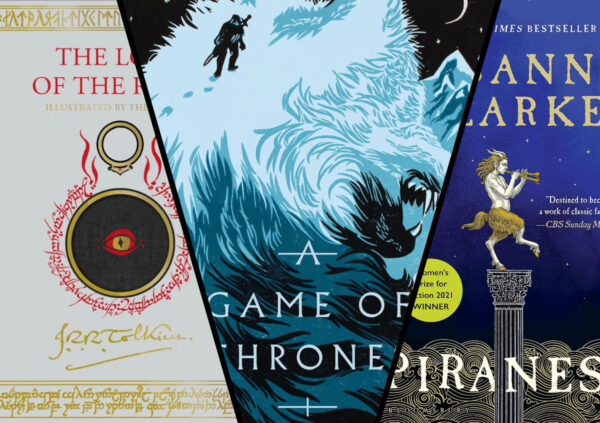
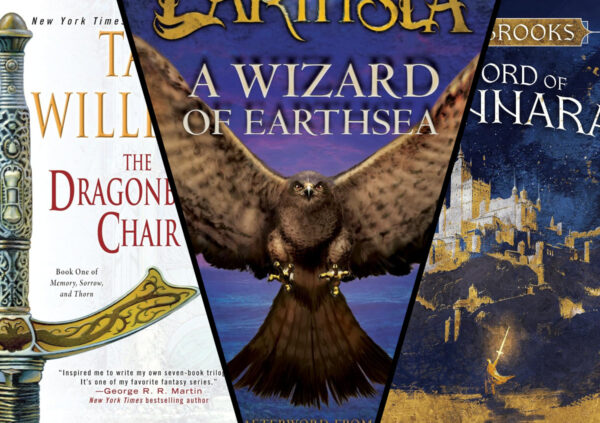
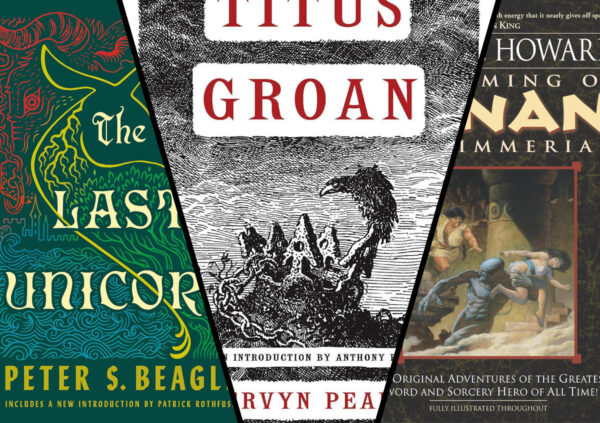
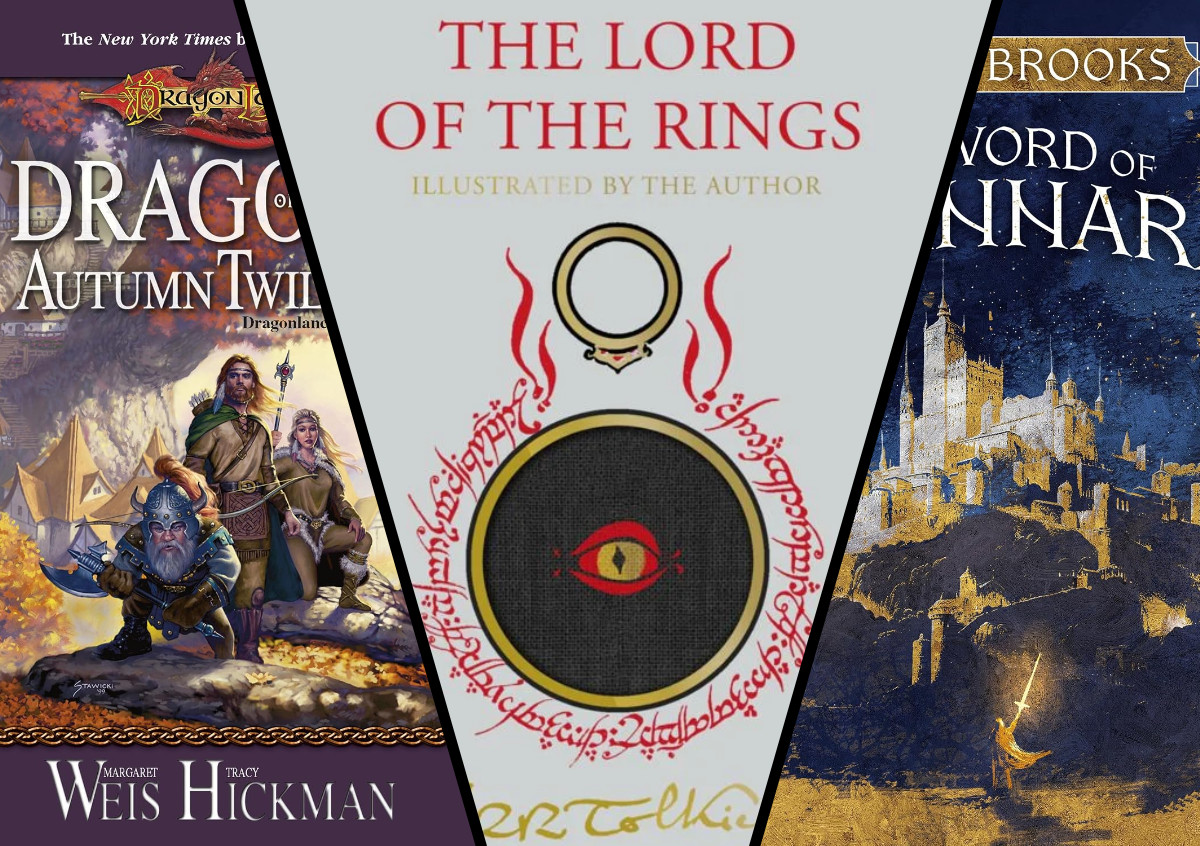
Terry Brooks books carry two headlines half a century apart, and both belong at the top of this page. The first is 1977: The Sword of Shannara became the first fantasy novel to hit the New York Times trade paperback bestseller list, the book Lester del Rey bet a brand-new imprint on, and the proof that Tolkien’s audience was a market and not a miracle.
The second is still unfolding. In March 2025, at eighty-one, Brooks announced his semi-retirement and named a successor to carry Shannara forward, the novelist Delilah S. Dawson. His last solo novel, Galaphile, appeared the same week, and Brona, the first volume under their joint byline, arrived this past August. Most guides to this shelf were written for a finished monument. This one covers a torch mid-pass.
The Shannara series holds its entries on my books like Lord of the Rings page and my classic fantasy list, and both of those entries spend their opening breath on the famous accusation, so this page does too, honestly, and then gets to the fifty-year story the accusation always overshadows: how a derivative debut built the market every book on my best fantasy books pillar was sold into, and what Brooks did with that market once he had it.
Fiction by René Rehn


The Short Version
There are two doors, and you pick by temperament. The Sword of Shannara, eyes open, if you want the historical experience and can forgive the apprenticeship. The Elfstones of Shannara, the consensus masterpiece of the early run, if you’d rather meet Brooks at full strength and circle back. Either way, read in publication order, not internal chronology, because the Shannara books play a very long game that only lands in the order it was dealt.
There are two other doors worth knowing about. Running with the Demon opens the Word and the Void trilogy, the contemporary dark fantasy many longtime readers consider his finest writing, and Magic Kingdom for Sale—Sold! opens Landover, his comic-fantasy lark, no homework required. And if you want to watch the succession happen in real time, Galaphile starts the arc that Delilah S. Dawson now carries.
Terry Brooks Books in Order
The table runs by first publication and covers the complete shelf, Shannara and everything beside it.
| Year | Title | Series or type | Notes |
| 1977 | The Sword of Shannara | Shannara, original trilogy 1 | First fantasy novel on the NYT trade paperback list |
| 1982 | The Elfstones of Shannara | Shannara, original trilogy 2 | The consensus pick of the early books |
| 1985 | The Wishsong of Shannara | Shannara, original trilogy 3 | |
| 1986 | Magic Kingdom for Sale—Sold! | Landover 1 | |
| 1987 | The Black Unicorn | Landover 2 | |
| 1988 | Wizard at Large | Landover 3 | |
| 1990 | The Scions of Shannara | Heritage of Shannara 1 | |
| 1991 | The Druid of Shannara | Heritage of Shannara 2 | |
| 1991 | Hook | Film novelization | |
| 1992 | The Elf Queen of Shannara | Heritage of Shannara 3 | |
| 1993 | The Talismans of Shannara | Heritage of Shannara 4 | |
| 1994 | The Tangle Box | Landover 4 | |
| 1995 | Witches’ Brew | Landover 5 | |
| 1996 | First King of Shannara | Shannara prequel | |
| 1997 | Running with the Demon | Word and Void 1 | The critical favorite |
| 1998 | A Knight of the Word | Word and Void 2 | |
| 1999 | Angel Fire East | Word and Void 3 | |
| 1999 | Star Wars Episode I: The Phantom Menace | Film novelization | |
| 2000 | Ilse Witch | Voyage of the Jerle Shannara 1 | |
| 2001 | Antrax | Voyage of the Jerle Shannara 2 | |
| 2002 | Morgawr | Voyage of the Jerle Shannara 3 | |
| 2003 | Jarka Ruus | High Druid of Shannara 1 | |
| 2003 | Sometimes the Magic Works | Nonfiction | Memoir and writing guide |
| 2004 | Tanequil | High Druid of Shannara 2 | |
| 2005 | Straken | High Druid of Shannara 3 | |
| 2006 | Armageddon’s Children | Genesis of Shannara 1 | Bridges Word and Void toward Shannara |
| 2007 | The Elves of Cintra | Genesis of Shannara 2 | |
| 2008 | The Gypsy Morph | Genesis of Shannara 3 | |
| 2009 | A Princess of Landover | Landover 6 | |
| 2010 | Bearers of the Black Staff | Legends of Shannara 1 | |
| 2011 | The Measure of the Magic | Legends of Shannara 2 | |
| 2012 | Wards of Faerie | Dark Legacy of Shannara 1 | |
| 2013 | Bloodfire Quest | Dark Legacy of Shannara 2 | |
| 2013 | Witch Wraith | Dark Legacy of Shannara 3 | |
| 2014 | The High Druid’s Blade | Defenders of Shannara 1 | |
| 2015 | The Darkling Child | Defenders of Shannara 2 | |
| 2016 | The Sorcerer’s Daughter | Defenders of Shannara 3 | |
| 2017 | The Black Elfstone | Fall of Shannara 1 | |
| 2018 | The Skaar Invasion | Fall of Shannara 2 | |
| 2018 | Street Freaks | Standalone science fiction | |
| 2019 | The Stiehl Assassin | Fall of Shannara 3 | |
| 2020 | The Last Druid | Fall of Shannara 4 | The chronological end of the Four Lands story |
| 2021 | Child of Light | Viridian Deep 1 | |
| 2021 | Small Magic | Collection | Short fiction, 1977-2020 |
| 2022 | Daughter of Darkness | Viridian Deep 2 | |
| 2023 | Sister of Starlit Seas | Viridian Deep 3 | |
| 2025 | Galaphile | First Druids of Shannara 1 | His last solo novel |
| 2026 | Brona | First Druids of Shannara 2 | With Delilah S. Dawson |
Where to Start With Terry Brooks
Elfstones if you want to love him first, Sword if you want to understand him first, and publication order afterward, trusting the long game the shelf spent fifty years laying. That is also close to official advice: the suggested reading order Brooks keeps for new readers simply follows publication, starting with The Sword of Shannara. The internal chronology of the Four Lands runs in a completely different sequence, and reading that way front-loads reveals the Shannara books were built to hide.
Readers who bounce off secondary-world fantasy have a different door. The Word and the Void trilogy is contemporary dark fantasy set in the American Midwest and Pacific Northwest, closer to Stephen King country than to Tolkien’s, and it stands completely on its own until the Genesis of Shannara books quietly connect it to everything else. Landover, meanwhile, asks nothing of you at all: six comic fantasy novels about a Chicago lawyer who buys a kingdom out of a catalog.
What I would not do is start with the handoff books. Galaphile sits at the deepest root of the internal chronology, but it was written for readers who already know what grew from that root, and half its pleasure is recognition.
Terry Brooks’s Life, Briefly
Terence Dean Brooks was born on January 8, 1944, in Sterling, Illinois, and the small-town Midwest of his childhood keeps surfacing in his fiction, most openly in the Word and the Void books. He took a degree in English literature at Hamilton College in 1966, then a law degree at Washington and Lee University, and it was in law school, in the late 1960s, that he started the manuscript that became The Sword of Shannara, rewriting it over roughly seven years while he finished his studies and went to work as an attorney.
The manuscript went first to DAW Books, whose editor Donald A. Wollheim passed it along to Judy-Lynn del Rey at Ballantine, which accepted it in November 1974. When it finally appeared in 1977, as a trade paperback and a Random House hardcover with a Brothers Hildebrandt cover, Lester del Rey had chosen it to launch the Del Rey Books imprint, and it sold about 125,000 copies in its first year. Brooks kept practicing law for years before writing took over entirely.
The career since is one of the most commercially consistent in the genre: twenty-three New York Times bestsellers and more than 25 million copies in print. He lives in Seattle with his wife, Judine, and in March 2025 he announced, with unusual candor, that he was stepping back from the primary writing of Shannara. That story gets its own section below, because the H1 of this page promised it.
The Original Trilogy (1977-1985)
Here is the 1977 story in full, because everything else on this page stands on it. Lester del Rey launched his fantasy imprint that year on two debuts: The Sword of Shannara, which answered Tolkien by imitation, and Stephen R. Donaldson’s Lord Foul’s Bane, which answered him by argument, and my Thomas Covenant guide tells that second story. Publishers at the time largely treated Tolkien as a one-off, lightning without a bottle. Sword’s sales settled the question, and the commercial genre, the whole epic fantasy tradition included, got green-lit on its receipts.
The three books that opened it all are three different arguments for Brooks, and each gets its full entry here.
The Sword of Shannara (1977)

The Sword of Shannara is the most argued-over debut in fantasy publishing, so take the famous accusation head-on: yes. Shea Ohmsford’s flight from his sleepy home, the mysterious mentor Allanon, the dark lord called the Warlock Lord, the fellowship on the road, the resemblance to a certain trilogy is structural and sustained. Brooks was open about writing in his hero’s shadow, critics from Lin Carter onward said so in print, and no serious reading of the book pretends otherwise.
Now the part the sneer leaves out. In 1977 there was no fantasy shelf. Del Rey put this book out and it sold like the future, roughly 125,000 copies in its first year and the first fantasy novel ever onto the Times trade paperback list. The derivative book proved the original wasn’t a fluke, which is the strangest and most important legacy in the genre’s business history, and writers like Gene Wolfe and Frank Herbert defended it on exactly those terms: the story moves.
As a novel it improves as it goes, the back half finding turns of its own, and as a foundation it holds up thousands of pages of what came after. Of all the Terry Brooks books, this is the one to read as a historical document, and it repays the visit.
The Elfstones of Shannara (1982)

The Elfstones of Shannara borrows nothing and breaks hearts on its own authority. The Ellcrys, the ancient tree whose existence seals an old demonic host outside the world, is dying, and its restoration demands a journey no one wants to name the cost of: Wil Ohmsford, healer’s hands and unreliable magic, escorting the elven girl Amberle toward a destiny the book unfolds with genuine cruelty and genuine grace. The Reaper, the demon sent to hunt them, remains one of the scariest things Brooks ever wrote.
By broad fan consensus this is the peak of the early Shannara books, the volume MTV reached for when The Shannara Chronicles adapted the series for television, and the right first Brooks for anyone who’d rather skip the apprentice work. The stakes are personal where Sword’s were borrowed, the ending has a sting readers still talk around carefully forty years later, and the whole book runs on a dread the debut never managed.
If you only ever read one of the Brooks books, the common verdict says it should be this one, and nothing on this page argues otherwise.
The Wishsong of Shannara (1985)

The Wishsong of Shannara closes the opening movement with the family gift turned inward. Brin Ohmsford has inherited magic in her voice, a wishsong that can reshape living things, and Allanon needs it to reach and destroy the Ildatch, the book of dark magic behind two wars. Her brother Jair, whose own version of the gift makes only illusions, follows against everyone’s instructions, and the novel splits into two quests that answer each other.
What lifts it is that the magic itself is the threat. Brin’s power grows more frightening the more she uses it, and the book treats that corruption seriously rather than as a plot toll. Readers tend to rank it just behind Elfstones in the early run, and the sibling pairing gives it a warmth the first two books don’t have. Garet Jax, the weapons master who attaches himself to Jair’s quest, became a fan favorite out of all proportion to his page count, which tells you how well the supporting cast works.
The Heritage of Shannara and the Prequel (1990-1996)
A generation later, Brooks returned to the Four Lands with a four-book series that longtime readers point to as the moment the world-building compounded into something self-sufficient, the Tolkien shadow fully outgrown. First King of Shannara followed as a prequel, closing the frame around the early books.
The Scions of Shannara (1990)

The Scions of Shannara opens the Heritage quartet three hundred years after Wishsong, in a Four Lands where a Federation government has outlawed magic and something called the Shadowen is sickening the land itself. A summons out of the druids’ past sets three descendants of the Ohmsford line on separate impossible quests, and the series braids them across four books: Par chasing the lost Sword of Shannara, Wren sent to find elves nobody believes exist, and the bitter recluse Walker Boh handed the heaviest task of all.
Read the quartet straight through in order: The Druid of Shannara (1991), The Elf Queen of Shannara (1992), and The Talismans of Shannara (1993) complete it, and the middle volumes are where the series’ real darkness lives. The consensus holds Heritage as the strongest sustained stretch of Shannara books Brooks wrote, grimmer and more politically textured than the original trilogy, and Scions is the right single purchase to test that claim on.
First King of Shannara (1996)

First King of Shannara steps back five hundred years to dramatize the history the debut novel only recounted: the druid Bremen, cast out by his own order for studying the wrong magic, racing the rise of the Warlock Lord and forging the Sword that would one day wait for Shea Ohmsford. It is the rare prequel with a real reason to exist, because the first book’s backstory was always its best material.
The book works best read after the original trilogy and Heritage, exactly where it fell in publication, when the names carry their full weight. Newcomers who start here get a competent epic and miss every echo. As a standalone it is mid-tier Brooks, well built and a little dutiful in the connective stretches, but the last hundred pages, where the history you already know arrives on schedule anyway, land with real tragic force. Completists of the Shannara books rate it higher than its quiet reputation suggests.
The Word and the Void (1997-1999)
In 1997 Brooks did the least expected thing on this page: he left the Four Lands entirely and wrote a contemporary dark fantasy trilogy set in the present-day United States, where Knights of the Word fight a secret war against demons of the Void over the future of an unsuspecting world. Critics and longtime readers alike tend to call these the best Terry Brooks books, full stop, and for once the deep-cut consensus and the casual consensus agree.
They also turn out not to be a detour. The Genesis of Shannara trilogy, a decade later, bridges this modern world toward the Four Lands, which recasts everything the early novels only winked at. That connection is the moment to say plainly what my other entries on this site also guard: the standard-issue fantasy furniture of the first books is hiding something, a long game Brooks plays across decades and dozens of volumes, and this page keeps the secret exactly the way the early books do.
Running with the Demon (1997)

Running with the Demon is the critical favorite on this shelf, and it earns the billing. Over a Fourth of July weekend in Hopewell, Illinois, a steel town bleeding out through a strike, fourteen-year-old Nest Freemark guards a magic she barely understands, and John Ross, a limping stranger who dreams the future as a Knight of the Word, arrives because a demon has come to tip the town over an edge nobody can see. The feeders, shadow creatures that swarm wherever human beings hurt each other, are among the most unsettling inventions in any of the Brooks books.
The Midwest grounding does something his epic fantasy never quite did: the stakes are a family, a town, a strike, and the horror grows out of ordinary American failure rather than ancient evil. Brooks grew up in a small Illinois town himself, and it shows in every bar, park, and picket line. The pacing saunters in the middle stretch, fair warning, but the last act hits like weather. Start here if secondary-world fantasy has never been your thing.
A Knight of the Word (1998)

A Knight of the Word moves the war to Seattle and turns it inward. John Ross has deserted his service after a failure too heavy to carry, convinced the Word’s war cost more than it saved, and he is trying to live as an ordinary man with a job, a relationship, and no prophetic dreams. The Void does not accept resignations. A demon begins closing on him in ways he has made himself unable to see, and Nest Freemark, now nineteen, is sent to reach him before it does.
It is the quietest of the three, a book about burnout and complicity wearing an urban fantasy coat, and readers who wanted the first book’s fireworks sometimes stall on it. Stay with it. The corporate and civic rot the demon works through is drawn with real anger, and the climax converts every slow chapter into momentum. The trilogy’s spine, what service costs and who pays it, is this book.
Angel Fire East (1999)

Angel Fire East brings the trilogy home to Hopewell for a winter ending. A gypsy morph, a rare wild magic that could become a weapon for either side of the secret war, has taken shape in the world, and John Ross reaches Nest Freemark’s door with it at Christmas, demons converging behind him. The series that opened on a blazing Fourth of July closes in snow, which is exactly the kind of structural rhyme this trilogy does quietly everywhere.
As a finale it chooses consequence over spectacle. The siege plotting is lean, the demon Findo Gask is a genuinely hateful piece of work, and the ending settles accounts without softening them. And the morph itself becomes the hinge on which the Genesis of Shannara books later swing, so readers planning the long route through the Shannara books should treat this volume as load-bearing. Taken simply as the close of the trilogy, many longtime readers call it the most satisfying ending Brooks has written.
The Widening World (2000-2011)
From 2000 on, Brooks ran the Four Lands forward through a sequence of shorter series, each set generations after the last, while two other projects, Genesis and Legends, worked backward to join the Word and the Void to Shannara. This is where publication order becomes law rather than advice. The reveals are built to detonate in sequence, and every one of these sub-series assumes you felt the previous charge go off.
Each series below gets one anchored entry on its first book, with the rest of the run named inside it. The table above has every volume and year.
Ilse Witch (2000)

Ilse Witch opens the Voyage of the Jerle Shannara trilogy with the series’ best premise in years: a half-drowned castaway carries a map to a distant island where something older than the Four Lands waits, and the Druid Walker assembles an airship expedition to chase it. Hunting them the whole way is the Ilse Witch, a young sorceress whose identity and reasons are the trilogy’s buried payload. The airships were new to Shannara, and the voyage structure, part sea story, part dungeon crawl, gives the book a pulp energy the nineties volumes had traded away.
What the trilogy is really doing, and what Antrax (2001) makes explicit before Morgawr (2002) closes the account, is pushing the series’ oldest question, what the old world left buried, further than any book before it. One warning: the three books are one story cut in thirds, so budget for all of them.
Jarka Ruus (2003)

Jarka Ruus begins the High Druid of Shannara trilogy twenty years on, with the druid order restored at Paranor and its leader, the most distrusted figure in the Four Lands, vanished overnight into a place the order’s own history is afraid to name. The disappearance is an inside job, the politics of the order curdle fast, and young Pen Ohmsford, the latest bearer of the family’s thinning magic, becomes the only person who can follow where the trail leads.
This is the most politically minded stretch of the Shannara books, closer to a conspiracy story than a quest, and its exiled-leader structure lets Brooks write his most morally complicated cast to date. Tanequil (2004) is the strange, sad heart of the trilogy, built around a bargain readers remember long after the plot details fade, and Straken (2005) pays everything off. Read Voyage first, non-negotiably: this trilogy’s emotional weight rests on it.
Armageddon’s Children (2006)

Armageddon’s Children is the bridge the long game was waiting for. In a collapsing near-future America, demons and their once-men armies are finishing off a civilization that barely noticed losing, and two Knights of the Word, Logan Tom and Angel Perez, each receive a mission that makes no sense until it does. Between them move the Ghosts, a tribe of orphaned kids surviving in a ruined Seattle, and a presence connected to the gypsy morph from Angel Fire East.
This is Brooks writing post-apocalypse, his grimmest register, and the Genesis of Shannara trilogy carries it through The Elves of Cintra (2007) and The Gypsy Morph (2008). What these books confirm about how the Word and the Void joins the Shannara books is the biggest single reveal on the shelf, and it lands only if you come to it in publication order with both earlier series read. Done right, it reframes every volume before it. Done early, it flattens them.
Bearers of the Black Staff (2010)

Bearers of the Black Staff opens the Legends of Shannara duology five centuries after Genesis, in a mountain valley that has sat sheltered behind protective mists for so long that the world outside has become rumor. Then the mists begin to fail. Sider Ament, the last bearer of a black staff of the Word’s old magic, is the only one who takes the change seriously, and the valley’s communities, human and otherwise, have to decide what they are willing to believe before what is outside decides for them.
It is a hinge story by design, the missing span between the ruined old world and the Four Lands of the classic Shannara books, and The Measure of the Magic (2011) completes it. As pure storytelling it is mid-list Brooks, compact and efficient rather than surprising. As architecture it is essential, and readers walking the full chronology bridge tend to be fonder of it than drop-in readers are.
The Road to the Last Druid (2012-2020)
The final decade of Brooks’s own run gathers speed toward a deliberate ending. The Dark Legacy and Defenders trilogies return to the classic Four Lands frame, and the Fall of Shannara quartet then does something series this size almost never attempt: it ends the story, on purpose, at the far end of the internal chronology.
Wards of Faerie (2012)

Wards of Faerie starts the Dark Legacy of Shannara trilogy with an archival bombshell: the elven druid Aphenglow Elessedil finds a centuries-old diary suggesting the lost Elfstones, all the colors beyond the blue ones every reader knows, might be recoverable. The druid order stakes its future on the search, and the hunt wakes enemies on every side of it.
This trilogy, completed by Bloodfire Quest and Witch Wraith (both 2013), is late-period Brooks at his most fan-facing, built on the deep lore of the earlier Shannara books and moving at airship speed. The body count is higher than the series’ reputation suggests, and the trilogy leans hard on cliffhangers between volumes, so have the sequels on hand. The common knock is familiarity, and it is familiar, but familiarity executed with this much momentum is most of what late-series readers are buying, and on that contract it delivers.
The High Druid’s Blade (2014)

The High Druid’s Blade opens the Defenders of Shannara run, and it loosens the format: three connected standalones instead of one serialized story, each built around Paxon Leah, a highlander who discovers the family sword carries real magic and signs on as the druid order’s protector. Against him, across the trilogy, stands Arcannen, a sorcerer villain with the patience of a chess player and the ethics of a loan shark.
These are the most accessible adult Shannara books since the originals, light on required homework and heavy on swordwork, and The Darkling Child (2015) and The Sorcerer’s Daughter (2016) each work on their own terms. The trade-off is weight: nothing here moves the larger story much, and readers invested in the big arc sometimes file the whole trilogy under pleasant. Taken as what it is, a character-scale adventure interlude before the finale, it reads fast and clean.
The Black Elfstone (2017)

The Black Elfstone begins the Fall of Shannara, the four-book conclusion Brooks announced as the chronological end of the Four Lands story. An army out of the far north, the Skaar, advances behind magic that lets it appear and vanish at will, the druid order answers with the worst internal politics in its history, and Drisker Arc, an Ard Rhys who walked away from Paranor, gets pulled back toward everything he quit. The dominoes are set with an old man’s patience, and you can feel the whole series leaning toward its exit.
The quartet runs through The Skaar Invasion (2018), The Stiehl Assassin (2019), and The Last Druid (2020), and it is one story: start here or not at all. Reception among longtime fans splits between gratitude that the ending exists and the usual arguments over who earned their endings, which after forty-plus Terry Brooks books is itself a kind of tribute. The chronology closes. The publishing, as the next section shows, did not.
The Handoff (2025 and Beyond)
The current chapter is the moving one, and it is the reason this page’s title ends where it does. Brooks began the manuscript that became Shannara while he was still in law school and carried the Four Lands through more than thirty novels and every fashion the genre cycled through. Then, in March 2025, in a letter posted on his own site and in an appearance at Emerald City Comic Con, he announced his semi-retirement, writing with a candor rare in any field that his stamina, focus and memory “are not what they once were.”
The arrangement he described is precise: he would “no longer be doing the primary writing,” and his new co-author would take that job on. The co-author is Delilah S. Dawson, a veteran of Star Wars: Phasma, Kill the Farm Boy, The Violence, and the Weird West novels she writes as Lila Bowen, a longtime friend of Brooks, and, his editor agreed, the right choice to continue Shannara. She was born in 1977, the year the Sword was published, which the universe did not have to arrange but did. Brooks stays on for ideas, direction, and oversight.
The Four Lands, in other words, are doing something almost no fantasy world their age has managed: continuing, on purpose, with the founder watching from the tower. However the succession reads a decade from now, this is what it looked like in its first eighteen months.
Galaphile (2025)

Galaphile, published on March 11, 2025, the same week as the announcement, is the last Shannara novel Brooks wrote alone, and he chose his exit with a historian’s instinct: the founding of the druid order itself, the deepest root in the legendarium. Galaphile Joss, an elven orphan stranded in the human world and trained by the recluse Cogline, a name longtime readers will sit up at, rises to build Paranor with the help of the King of the Silver River, trying to impose order on a lawless age, while a rival corrupted by an ancient evil gathers against everything he builds.
As an origin story it runs on recognition, watching institutions and places you know in their first form, and that is also its limit: newcomers get a solid founding-of-the-order epic, longtime readers of the Shannara books get the resonance it was written for. As a farewell to solo writing it could hardly be better chosen, the first druid’s story told by the first author, on his way out of the tower.
Brona (2026)

Brona, published on August 25, 2026, is the first novel under the joint Brooks-Dawson byline, and the title alone is a flare for anyone who remembers the history lessons in the very first book. The story picks up years after Galaphile, at a Paranor trying to hold the peace its founder built, as an evil he defeated but never destroyed comes back stronger and the next generation at the citadel gets drawn toward it.
If the title means what every reader of the first book will assume it means, the First Druids arc is circling the long prehistory of the threat the original trilogy was built on, though the publisher copy stops carefully short of saying so. The joint byline makes this the book where readers judge the succession itself, whether the Four Lands still sound like the Four Lands with a new hand on the primary pen, and that question will get argued in forums for years. As of October 2026 no third volume has an announced date, so this is the live edge of the whole fifty-year shelf.
Magic Kingdom of Landover (1986-2009)
Off to the side of everything sits Landover, six comic fantasy novels Brooks wrote between and around the epics, and the series where his sense of humor finally got a contract.
Magic Kingdom for Sale—Sold! (1986)

Magic Kingdom for Sale—Sold! runs on one of the great fantasy hooks: Ben Holiday, a Chicago trial lawyer hollowed out by grief after losing his wife, finds a fairy-tale kingdom listed for a million dollars in a luxury Christmas catalog and buys it. Landover turns out to be real, broke, politically collapsing, and sold to him by a seller with excellent reasons for wanting out, and the kingship comes with a court that includes a failed wizard, a talking dog scribe, and a dragon problem.
The comedy is gentle rather than Pratchett-sharp, and under it the book is sincerely about a man deciding whether to live again, which is what keeps the series read. Five sequels follow at the same easy weight, The Black Unicorn (1987), Wizard at Large (1988), The Tangle Box (1994), Witches’ Brew (1995), and A Princess of Landover (2009), and they are the Brooks books to hand someone who wants none of the homework and all of the charm.
Beyond the Four Lands
The rest of the shelf is smaller but worth knowing: two film novelizations, a late science fiction experiment, a non-Shannara trilogy, a memoir, and the collected short fiction. The completist tier, honestly reviewed.
Hook (1991)

Hook is the novelization of Steven Spielberg’s 1991 film, published that November, and the assignment is less random than it looks: a grown man who has forgotten he was ever magic gets dragged back to the world that made him, which is a very Brooks premise wearing studio clothes. Peter Banning, corporate lawyer, learns that he used to be Peter Pan, and has to earn the flying back after Captain Hook takes his children.
As a book it is exactly what film novelizations are, the movie in prose with a little more interiority, written fast and competently. Its real interest for readers of the Terry Brooks books is biographical: the lawyer-who-forgot-the-magic premise sits suspiciously close to Ben Holiday’s, and Brooks clearly understood the assignment from the inside. One for completists, found cheap and read in an evening.
Star Wars Episode I: The Phantom Menace (1999)

The Phantom Menace novelization, published in April 1999 ahead of the film, is the other work-for-hire on the shelf, and it is remembered mainly for one thing: Brooks got room to write scenes and background the film never shows, including more of Anakin’s life on Tatooine, which gives the book a texture the screenplay alone doesn’t have.
It reads like what it is, a professional doing careful work inside someone else’s universe, and nobody comes to a Terry Brooks guide for Star Wars. But as a document of the biggest franchise moment of its decade, with a fantasy veteran hired to give it novelistic weight, it has genuine curiosity value. Go in knowing exactly what it is.
Street Freaks (2018)

Street Freaks, from 2018, is the outlier experiment: a young adult science fiction thriller set in a near-future Los Angeles. Ash Collins, the sheltered son of a famous bioengineer, watches armed men storm his home and gets one instruction from his father: find Street Freaks, a crew of augmented teenage outcasts in the lawless Red Zone, street racers and vigilantes, who take him in while he pulls the thread of his father’s death.
Reception was lukewarm by Brooks standards: the action and the racing are fun, the ethics-of-enhancement material thinner than the setup promises, and the whole package aims younger than his usual crossover audience. It is the sound of a forty-year fantasy veteran stretching, which has its own interest, and readers who want Brooks momentum in a different genre will get it. Everyone else can safely leave it for last.
Child of Light (2021)

Child of Light opened Viridian Deep in 2021, the only fantasy series Brooks launched outside Shannara this century, and it runs first person, which after decades of third-person epic is a genuine change of air. Auris Afton Grieg, nineteen, has spent five years in a goblin prison without knowing why, and when a breakout goes wrong she is pulled from the wreckage by Harrow, a green-skinned Fae who insists, against all appearances, that she is one of his kind. The forested world of Viridian Deep, equal parts mysticism and ruined future, takes her in and distrusts her at once, and her buried past is the engine of the trilogy.
Reviewers liked Auris and the mystery and noted the familiar Brooks shape under the new skin. Daughter of Darkness (2022) and Sister of Starlit Seas (2023) complete the trilogy, which skews younger in feel. On this shelf of Terry Brooks books it is a minor, likable late experiment, and self-contained enough to sample freely.
Sometimes the Magic Works (2003)

Sometimes the Magic Works: Lessons from a Writing Life is the memoir, published by Del Rey in 2003, and it is really two books braided: practical writing advice, with Brooks firmly in the outline-first camp, and the story of the career itself, from the law student rewriting one manuscript for seven years to the phone calls that built Del Rey’s fantasy list. The chapters on the Sword years are the fullest account he has given of the bet this whole page stands on.
It is modest, funny about its own luck, and genuinely useful to working writers precisely because Brooks treats writing as a craft with habits rather than a visitation. Among author memoirs in the genre it sits in the practical tier rather than the confessional one. Readers who finish the novels wanting the voice behind them should pick it up, and writers should read it for the discipline.
Small Magic (2021)

Small Magic collects the short fiction, eleven stories spanning 1977 to 2020, and it was the first Terry Brooks collection ever published, which is its own small surprise after four decades. All three worlds are represented: Shannara, Landover, and the Word and the Void, with pieces that include Garet Jax’s childhood, the story of how Allanon first found Shea Ohmsford, an aging wing-rider at the end of his flying life, and Ben Holiday beside his daughter in Landover.
Brooks is a natural long-former, and some of these read like deleted scenes rather than free-standing stories, a fair caveat. But for readers already invested, the Garet Jax and Allanon material alone justifies the cover price, and the collection works as a sampler across every register he writes in. One book, one button, three worlds: the easiest completist purchase on the page.
Terry Brooks: Deep Dive and FAQ
What Runs Through Terry Brooks’s Books
The long game is the signature. No other major fantasy author has hidden a secret of this scale in plain sight across decades of publication, trusting readers to assemble it in the order it was dealt, and the patience of that trick is the single most underrated thing about the Shannara books. Alongside it runs continuity of blood: the Ohmsford line and its inherited, unreliable magic turn the series into a family saga wearing epic armor, where the cost of power compounds down the generations.
The second thread is the fallen old world. From the earliest books onward, Shannara is haunted by what came before it, and the Word and the Void and Genesis volumes turn that haunting into the series’ spine. Brooks’s futures and pasts are both ruins, and his real subject is what gets rebuilt and at what price.
The third is plain narrative decency. Brooks writes clean, propulsive, structurally traditional stories in which courage is real, institutions can be saved, and endings arrive. The epic fantasy tradition spent forty years getting darker around him and he declined to follow, which is exactly why the shelf still moves: he is the genre’s great gateway author, and gateways need to be standing where people can find them.
Prizes and Honors
Brooks received the World Fantasy Award for Life Achievement in 2017 and the Inkpot Award in 1997, with six Locus Award nominations across the career. The commercial honors are the louder ones: twenty-three New York Times bestsellers and more than 25 million copies in print. And the historical honor outranks everything on the mantel: The Sword of Shannara was the first fantasy novel to appear on the New York Times trade paperback bestseller list, in 1977, which is the receipt the entire modern fantasy category was approved on.
Which Terry Brooks Editions to Buy
Nearly everything is in print in the United States through Del Rey, in mass-market paperback, trade paperback, and ebook, and those are the copies most readers want. Omnibus editions of the original trilogy and the Heritage quartet turn up regularly in both print and ebook, and for a series this long they are the economical route. Small Magic gathers the short fiction in one volume, and there is also a 2008 graphic novel, The Dark Wraith of Shannara, for the curious.
Collectors have one obvious target: the 1977 first edition of The Sword of Shannara with the Brothers Hildebrandt cover art, from the brothers who had made their name illustrating Tolkien, a genuine piece of the genre’s business history. For the new books, Galaphile and Brona are current Random House Worlds hardcovers, easy to find everywhere.
Terry Brooks on Screen
The Shannara Chronicles premiered on MTV on January 5, 2016, adapting The Elfstones of Shannara rather than the first book, a choice Brooks himself has explained partly by Elfstones having the strong female roles the debut lacks. A second season aired in 2017 after the show moved to Spike, and the series was canceled in January 2018. The producers shopped it to other networks, and nothing has come of that since.
The show itself split the fanbase: handsome, young-skewing, and considerably soapier than the books. Before it, a film adaptation spent years in development, with director Mike Newell attached at one point, and never emerged. The adaptation ledger also runs the other direction, since Brooks spent the early nineties novelizing Hook for Spielberg and The Phantom Menace for Lucas, which makes him one of the few fantasy writers with more screen-to-page credits than page-to-screen ones.
Questions About Terry Brooks
What Order Should I Read the Shannara Books In?
Publication order, starting with The Sword of Shannara. That matches the suggested order Brooks keeps for new readers, and it protects the series’ long-game reveals, which internal chronology ruins. The chronological route, starting from the Word and the Void, is best saved for a reread.
What Is the Best Terry Brooks Book?
The Elfstones of Shannara is the broad fan consensus for the epic side, and Running with the Demon is the critical favorite overall. Between them they also mark the two doors into his work: classic secondary-world fantasy on one side, contemporary dark fantasy on the other.
Is the Shannara Series Finished?
Brooks’s own run reached its planned chronological ending with The Last Druid in 2020. The legendarium continues at the other end of the timeline: the First Druids of Shannara arc began with Galaphile in 2025 and continued with Brona in 2026, now with Delilah S. Dawson doing the primary writing.
Who Writes the Shannara Books Now?
Delilah S. Dawson, as co-author with Terry Brooks. Brooks announced the arrangement in March 2025, saying he would no longer do the primary writing but would stay involved with ideas, direction, and oversight. Brona, published in August 2026, is the first novel under the joint byline.
Do I Need to Read the Word and the Void Before Shannara?
No. Start with the Shannara books in publication order and read the Word and the Void trilogy where it falls, after First King of Shannara. The two series connect through the Genesis of Shannara trilogy, and that connection lands hardest if you let publication order spring it.
Is the Sword of Shannara Just a Lord of the Rings Copy?
The structural resemblance is real, sustained, and acknowledged. It is also the book that proved fantasy was a viable publishing category, as the first fantasy novel on the New York Times trade paperback list, and the series outgrew the debt within two volumes. Read it as history, Elfstones as literature.
Is There a Shannara TV Series?
There was. The Shannara Chronicles ran two seasons, premiering on MTV in January 2016 and moving to Spike for season two in 2017, before cancellation in January 2018. It adapted The Elfstones of Shannara and diverges freely from the books. No revival has been announced.
How Many Terry Brooks Books Are There?
Around fifty, counting everything. The Shannara legendarium alone runs to more than thirty novels including the Word and the Void trilogy, plus six Landover books, the Viridian Deep trilogy, two film novelizations, a story collection, and a writing memoir. The table above lists the complete shelf with years.
Where to Go Next
The natural companion is the other half of the 1977 bet: Stephen R. Donaldson’s Lord Foul’s Bane launched the same Del Rey list the same year by the opposite method, and my Thomas Covenant guide covers that harder, stranger shelf with the warning it requires. For the closest neighbor in spirit, big-hearted traditional epic sustained across dozens of volumes, the Raymond E. Feist guide walks the Riftwar the way this page walks Shannara, sub-series by sub-series.
And readers who came for the Tolkien lineage itself should work through the books like Lord of the Rings list, where the Sword’s whole family tree, imitators, answers, and heirs, stands in one place.