Terry Pratchett books come with one piece of advice nearly every fan agrees on and one problem nobody solves. The advice is not to start at the beginning. The Colour of Magic is the first Discworld novel and it is not the place to begin, because Pratchett hadn’t worked out what Discworld was yet. The early books are broad parodies of a fantasy genre that has since moved on, and readers who dutifully start with book one frequently bounce off the whole series before it becomes what it became.
The problem every reading-order guide has is that they’ll all tell you to start with a sub-series instead, and then hand you a neutral map of forty-one books with no opinion about which ones are actually great. That’s the gap this guide fills. Discworld is not forty-one equally good novels. It has a weak sub-series and a superb one, a slow start and a decade-long peak, and books that are genuinely among the best comic novels in English sitting next to ones that are merely fun. You deserve to know which is which before you commit.
So this guide is organized by sub-series, with every Discworld novel in its own entry, a recommended entry point for each strand, the consensus read on where that strand ranks, and the peak book named. Then comes the non-Discworld work, which is substantial and mostly overlooked. Discworld as a whole sits on my best fantasy series list and on my best fantasy books list. This is the full map.
Fiction by René Rehn


The Short Version
If you want one recommendation and no reading, start with Guards! Guards! It opens the strongest sub-series, it needs no prior knowledge, and it’s Pratchett doing everything he’s good at. If crime and the city don’t appeal, start with Mort for something shorter and stranger, or Small Gods, a standalone many consider his single best book. Whatever you do, don’t start with The Colour of Magic unless you specifically want to watch a great writer figure himself out in real time.
The rest is simpler than forty-one books make it look. Most Discworld novels stand alone, and the series runs in loose threads (the Wizards, the Witches, Death, the City Watch, Tiffany Aching, Moist von Lipwig) that are worth reading in order once you’ve picked one. The threads cross freely, and nothing breaks if you hop between them in publication order instead.
Terry Pratchett Books in Order
The table runs by first UK publication, with the Discworld numbers, the trilogies, the collaborations, the collections and the nonfiction all in one sequence.
| Year | Title | Series or type | Notes |
| 1971 | The Carpet People | Children’s novel | Rewritten 1992 |
| 1976 | The Dark Side of the Sun | Science fiction novel | |
| 1981 | Strata | Science fiction novel | A flat world before Discworld |
| 1983 | The Colour of Magic | Discworld 1, Wizards | |
| 1986 | The Light Fantastic | Discworld 2, Wizards | |
| 1987 | Equal Rites | Discworld 3, Witches | |
| 1987 | Mort | Discworld 4, Death | |
| 1988 | Sourcery | Discworld 5, Wizards | |
| 1988 | Wyrd Sisters | Discworld 6, Witches | |
| 1989 | Pyramids | Discworld 7, standalone | BSFA Award |
| 1989 | Guards! Guards! | Discworld 8, City Watch | |
| 1989 | Truckers | The Bromeliad, book 1 | |
| 1989 | The Unadulterated Cat | Humor, with Gray Jolliffe | |
| 1990 | Eric | Discworld 9, Wizards | Illustrated by Josh Kirby |
| 1990 | Moving Pictures | Discworld 10, Industrial Revolution | |
| 1990 | Good Omens | Novel, with Neil Gaiman | |
| 1990 | Diggers | The Bromeliad, book 2 | |
| 1990 | Wings | The Bromeliad, book 3 | |
| 1991 | Reaper Man | Discworld 11, Death | |
| 1991 | Witches Abroad | Discworld 12, Witches | |
| 1992 | Small Gods | Discworld 13, standalone | |
| 1992 | Lords and Ladies | Discworld 14, Witches | |
| 1992 | Only You Can Save Mankind | Johnny Maxwell, book 1 | |
| 1993 | Men at Arms | Discworld 15, City Watch | |
| 1993 | Johnny and the Dead | Johnny Maxwell, book 2 | |
| 1994 | Soul Music | Discworld 16, Death | |
| 1994 | Interesting Times | Discworld 17, Wizards | |
| 1995 | Maskerade | Discworld 18, Witches | |
| 1996 | Feet of Clay | Discworld 19, City Watch | |
| 1996 | Hogfather | Discworld 20, Death | |
| 1996 | Johnny and the Bomb | Johnny Maxwell, book 3 | |
| 1997 | Jingo | Discworld 21, City Watch | |
| 1998 | The Last Continent | Discworld 22, Wizards | |
| 1998 | Carpe Jugulum | Discworld 23, Witches | |
| 1999 | The Fifth Elephant | Discworld 24, City Watch | |
| 1999 | The Science of Discworld | Science, with Ian Stewart and Jack Cohen | Hugo finalist |
| 2000 | The Truth | Discworld 25, Industrial Revolution | |
| 2001 | Thief of Time | Discworld 26, Death | |
| 2001 | The Last Hero | Discworld 27, Wizards | Illustrated by Paul Kidby |
| 2001 | The Amazing Maurice and His Educated Rodents | Discworld 28, standalone | Carnegie Medal |
| 2002 | Night Watch | Discworld 29, City Watch | Prometheus Award |
| 2002 | The Science of Discworld II: The Globe | Science, with Stewart and Cohen | |
| 2003 | The Wee Free Men | Discworld 30, Tiffany Aching | Locus Award |
| 2003 | Monstrous Regiment | Discworld 31, standalone | |
| 2004 | A Hat Full of Sky | Discworld 32, Tiffany Aching | Locus and Mythopoeic Awards |
| 2004 | Going Postal | Discworld 33, Moist von Lipwig | |
| 2005 | Thud! | Discworld 34, City Watch | |
| 2005 | Where’s My Cow? | Discworld picture book | The book from Thud! |
| 2005 | The Science of Discworld III: Darwin’s Watch | Science, with Stewart and Cohen | |
| 2006 | Wintersmith | Discworld 35, Tiffany Aching | Locus Award |
| 2007 | Making Money | Discworld 36, Moist von Lipwig | Locus Award |
| 2008 | Nation | Young adult novel | Printz Honor |
| 2008 | The Folklore of Discworld | Nonfiction, with Jacqueline Simpson | |
| 2009 | Unseen Academicals | Discworld 37, Wizards | |
| 2010 | I Shall Wear Midnight | Discworld 38, Tiffany Aching | Andre Norton Award |
| 2011 | Snuff | Discworld 39, City Watch | |
| 2012 | The Long Earth | The Long Earth, book 1, with Stephen Baxter | |
| 2012 | Dodger | Young adult novel | |
| 2012 | A Blink of the Screen | Collected short fiction | |
| 2012 | The World of Poo | Discworld picture book | The book from Snuff |
| 2013 | The Long War | The Long Earth, book 2 | |
| 2013 | Raising Steam | Discworld 40, Moist von Lipwig | |
| 2013 | The Science of Discworld IV: Judgement Day | Science, with Stewart and Cohen | |
| 2014 | The Long Mars | The Long Earth, book 3 | |
| 2014 | Dragons at Crumbling Castle | Children’s stories | |
| 2014 | A Slip of the Keyboard | Collected nonfiction | |
| 2015 | The Long Utopia | The Long Earth, book 4 | |
| 2015 | The Shepherd’s Crown | Discworld 41, Tiffany Aching | Published after his death |
| 2016 | The Long Cosmos | The Long Earth, book 5 | |
| 2016 | The Witch’s Vacuum Cleaner | Children’s stories | |
| 2017 | Father Christmas’s Fake Beard | Children’s stories | |
| 2020 | The Time-Travelling Caveman | Children’s stories | |
| 2023 | A Stroke of the Pen | Short fiction | The lost newspaper stories |
Where to Start With Terry Pratchett
Most Terry Pratchett books stand alone, and that includes nearly all of Discworld. The series has a running cast and loose threads, and Transworld, his British publisher, groups thirty of the forty-one novels into five main sub-series: the Wizards, the Witches, Death, the City Watch and Tiffany Aching. The other eleven are the two illustrated Rincewind books, the three Moist von Lipwig books, two more novels about Ankh-Morpork meeting new technology, and four true standalones. Every novel explains enough for a newcomer, so the real question is which door suits you.
Readers who like crime and cities should start with Guards! Guards!, the first City Watch book. Readers who want ideas should start with Small Gods, the standalone most often recommended, and readers who want something short and strange should start with Mort. Going Postal is the most modern-feeling door, Hogfather is the seasonal one, and The Wee Free Men is the best start for younger readers and for adults who want the series’ warmth first. That warmth is why the Witches books also hold a place on my cozy fantasy books list.
Once a thread hooks you, read it in order, then branch out. Publication order works too, as long as you know the first two books are the roughest and the run from the late 1980s to the mid-2000s is the peak. Rincewind’s books are best saved until you already love the series, when the parody lands as affection rather than as your first impression of what Discworld is.
Terry Pratchett’s Life, Briefly
Terry Pratchett was born on April 28, 1948, in Beaconsfield, Buckinghamshire. His first story, “The Hades Business,” appeared in the magazine Science Fantasy in 1963, when he was fifteen, and two years later he left school to train as a reporter on the Bucks Free Press. He spent the next fifteen years in local journalism, at the Western Daily Press and the Bath Chronicle among others, and published his first novel, The Carpet People, with the independent publisher Colin Smythe in 1971.
Around 1980 he became press officer for the South West Region of the Central Electricity Generating Board, a patch that included several nuclear power stations. The Colour of Magic followed in 1983, and in 1987, after finishing Mort, he left the job to write full time. He became the UK’s best-selling author of the 1990s, and his books have since sold more than 100 million copies worldwide. He was appointed OBE in 1998 and knighted in 2009.
In December 2007 he announced that he had posterior cortical atrophy, a rare form of early-onset Alzheimer’s disease, which he called an “embuggerance.” He kept writing, dictating the later books to his assistant Rob Wilkins, gave nearly half a million pounds to the Alzheimer’s Research Trust, and argued for the right to an assisted death, most famously in his 2010 Richard Dimbleby Lecture. He died at home in Broad Chalke, Wiltshire, on March 12, 2015, aged sixty-six. The Shepherd’s Crown followed that August, and in 2017, as he had asked, his hard drive was crushed by a steamroller at the Great Dorset Steam Fair.
Rincewind and the Wizards
Rincewind is where Discworld began, and the consensus is that it’s the place to arrive last. He’s a failed wizard of Unseen University whose one real talent is running away, and his books stay closest to the series’ origins as a send-up of sword and sorcery and the fantasy shelf of the 1970s. Around him grows the faculty of Unseen University itself: the bellowing Archchancellor Mustrum Ridcully, the anxious young Ponder Stibbons and the Librarian, an orangutan who takes exception to the word “monkey.” By the later books the wizards are the series’ best ensemble comedy.
Read them in this order: The Colour of Magic and The Light Fantastic (one story in two volumes), Sourcery, Eric, Interesting Times, The Last Continent, The Last Hero and Unseen Academicals. Transworld’s own Wizards set counts six and leaves out the two illustrated novels, Eric and The Last Hero, but both are Rincewind stories, so this guide slots them in here. The strand improves markedly after the first three, and Interesting Times and Unseen Academicals are the ones fans tend to defend.
The Colour of Magic (1983)

The Colour of Magic is the first Discworld novel, the one every reading guide argues about, and the clearest case on the shelf for not starting at the beginning. It’s an episodic comedy in four parts, closer to a sketch show than a novel, and it reads as exactly what it was: a young writer having fun at the expense of the fantasy books he’d read.
Twoflower, the Disc’s first tourist, is an insurance clerk from the rich Agatean Empire who arrives in the city of Ankh-Morpork with a picture box, a chest of sapient pearwood that follows him around on hundreds of little legs, and no sense of danger at all. Rincewind, a wizard with exactly one spell lodged in his head and room for no others, is paid to keep him alive, and the pair bounce from a burning city to a mountain full of dragons to the very edge of the world.
The parody targets are easy to spot even now. Fritz Leiber’s Fafhrd and the Gray Mouser, who sit on my classic fantasy books list, turn up as Bravd and the Weasel, a Lovecraftian temple waits in the forest, and the dragons of the Wyrmberg exist only while someone imagines them hard enough. Where the book shines is the Luggage, the cosmology (four elephants on the back of a giant turtle swimming through space) and the occasional sentence that already sounds like the Pratchett to come.
The flaw is structure. There’s no real plot, the characters are thin, and many jokes depend on knowing the books being mocked. It also ends on a cliffhanger that only The Light Fantastic resolves. Read it after you love the series, as a fossil record of where the Terry Pratchett books came from, and it becomes oddly charming.
The Light Fantastic (1986)

The Light Fantastic is the direct sequel to The Colour of Magic and the first Discworld book with an actual plot, which makes it the better half of the opening pair. It picks up the cliffhanger at once. The spell lodged in Rincewind’s head is one of the eight great spells of the Octavo, the Creator’s own spellbook, and it has no intention of letting him die, which matters because the Disc is drifting toward a red star and the Octavo may be the only thing that can save it.
The book introduces Cohen the Barbarian, an eighty-seven-year-old hero with no teeth and every skill, and it turns the Librarian into an orangutan, a change he declines to have reversed. Together with The Colour of Magic it shows exactly what the early Discworld books were like: the comedy is still mostly parody, but the ideas start to sharpen, and the wizards’ scramble for the Octavo is the first sign of the Unseen University satire to come. Readers who finish The Colour of Magic should go straight on, since the two books work as one story.
Sourcery (1988)

The early Discworld formula starts to strain in Sourcery, the third Rincewind book. The premise is a good one: the eighth son of an eighth son is a wizard, and the eighth son of a wizard is a sourcerer, a source of magic rather than a user of it. When the boy Coin arrives at Unseen University with his dead father’s staff in his hand, the wizards discover they can have real power at last, and the Disc lurches toward a magical apocalypse.
Rincewind runs, naturally, joined by Conina, the daughter of Cohen the Barbarian, who has inherited her father’s reflexes and wants to be a hairdresser, and Nijel the Destroyer, a would-be barbarian who learned the trade from a book. There are good jokes about what wizards would do with unlimited power and why the old rules keep them weak. But the plot sprawls, and fans usually rank it among the weaker Discworld books. It’s one for completists working through the Wizards in order.
Eric (1990)

Eric is a short book and the first of the two illustrated Discworld books, published by Gollancz in a large format and fully illustrated by Josh Kirby. The title was styled as Faust Eric, and the running heads alternated between the two names, which tells you the target. Eric Thursley, a thirteen-year-old demonologist, summons a demon to grant his wishes and gets Rincewind instead, who can’t grant anything but finds the wishes coming true whenever he snaps his fingers.
Eric wants to rule the world, meet the most beautiful woman in history and live forever, and each wish goes wrong in a different corner of the Disc’s past: the empire of the Tezumen, the siege of Tsort (the Disc’s Troy) and a Hell whose new management has discovered that boredom hurts more than fire. It’s slight, quick and very funny in places. Later paperbacks dropped the illustrations, which costs it a lot, so look for an illustrated edition.
Interesting Times (1994)

Interesting Times sends Rincewind east, and it’s the book where the Wizards strand finally finds its footing. The title comes from the curse “may you live in interesting times,” and the Agatean Empire, the walled-off land Twoflower came from, is about to provide them. The Emperor is dying, the great families are circling, a very polite revolutionary movement calling itself the Red Army is putting up slogans, and someone in the Empire has sent for “the Great Wizzard,” which Unseen University reads as Rincewind.
Meanwhile Cohen the Barbarian and his Silver Horde, a band of ancient heroes, have come to steal the Empire itself. Pratchett’s satire of bureaucracy and of a revolution run by the overpolite is among the sharpest writing in the Discworld books, and Rincewind’s cowardice is played for warmth as well as laughs. Some readers find that the Agatean caricature has aged less well than the rest. Fans who’d written Rincewind off usually change their minds here.
The Last Continent (1998)

The Last Continent is Rincewind’s Australian adventure, and it’s the most purely silly of the later Discworld books about him. Rincewind turns up on XXXX, the Disc’s unfinished continent, a parched country where it hasn’t rained in living memory, meets a kangaroo who wants him to save the place, and keeps being mistaken for a folk hero. Back at Unseen University, the Librarian has fallen ill with a magical complaint that makes him change shape whenever he sneezes, and the senior wizards, hunting for a cure, accidentally land thousands of years in XXXX’s past.
Pratchett’s tour of Australian culture (beer, sheep, bush ballads, Mad Max and a famous harbor-side opera house among the targets) is affectionate and dense with references, and the wizards’ plot is a lovely ensemble farce. Many of the jokes depend on knowing the source, and readers far from Australia miss a lot. Rincewind loyalists will get the most out of it, and newcomers should start almost anywhere else.
The Last Hero (2001)

The Last Hero is the second of the illustrated Discworld books, fully illustrated by Paul Kidby in a large format, and the one where the pictures carry as much of the story as the text. Cohen the Barbarian, very old now and tired of a world with no room left for heroes, decides to return fire to the gods the way the first hero stole it, with a barrel of explosives, which would destroy the Disc as a side effect.
Ankh-Morpork’s answer, organized by Lord Vetinari, is a mission to the top of the world in a flying machine designed by Leonard of Quirm, who makes up its crew of three with Rincewind and Captain Carrot of the Watch, while the Librarian ends up aboard by accident. The heist structure gives it a cleaner shape than most Rincewind stories, and Kidby’s art, from the Silver Horde to the gods at play in Dunmanifestin, is a treat. As a story it’s slighter than its format suggests, and anyone reading the text alone loses half the book. It makes a fine gift for anyone who already loves the Disc.
Unseen Academicals (2009)
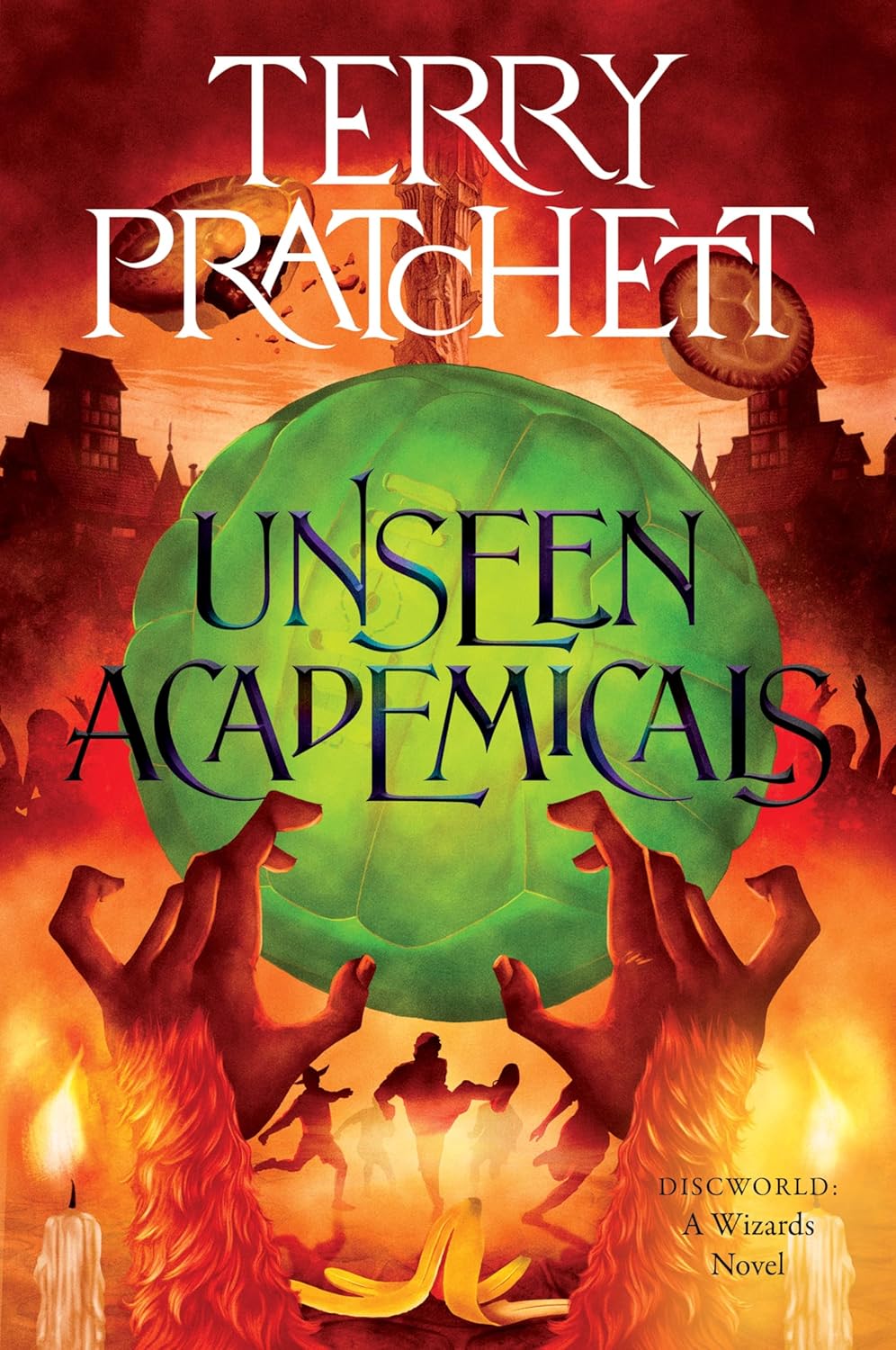
Unseen Academicals is the wizards’ own book, and the late Discworld novel that gives the faculty of Unseen University their biggest part. Archchancellor Ridcully learns that an old bequest paying for the wizards’ lavish dinners depends on the university fielding a football team, and the wizards, who have never knowingly exercised, have to learn the people’s game just as Ankh-Morpork’s violent street football is being turned into something with rules.
Around the match Pratchett builds one of the warmest Terry Pratchett books about class, an unexpectedly tender story about four people from below stairs: Glenda, who runs the university’s night kitchen, her beautiful and dreamy friend Juliet, a gifted street player named Trevor Likely, and the gentle, astonishingly well-read Mr. Nutt, whose origins are the book’s central mystery. Many readers find it runs long in the middle, and the football itself is the least interesting thing in it. Readers who love the wizards will find the ensemble at its best here.
The Witches
The Witches books are the sharpest character writing in Discworld, built around one of Pratchett’s greatest creations. Granny Weatherwax is a rural witch of terrifying competence and worse temper, and with the warm, much-married Nanny Ogg and a rotating third (first the romantic Magrat Garlick, later Agnes Nitt) she keeps the small mountain kingdom of Lancre in order. They work less through spells than through “headology,” psychology plus sheer force of will, and the books are about power exercised responsibly by people nobody thanks for it.
Read them in order: Equal Rites, Wyrd Sisters, Witches Abroad, Lords and Ladies, Maskerade and Carpe Jugulum. Equal Rites is the first Witches book, but Granny isn’t fully formed there and most readers find Wyrd Sisters the better door. After Carpe Jugulum the line passes to Tiffany Aching, whose five books are the true continuation of this strand, and Granny is a presence there too.
Equal Rites (1987)

Equal Rites is the first Witches novel and the book that introduces Granny Weatherwax, though not quite the Granny later books made famous. A dying wizard passes his staff to the eighth son of an eighth son, except that the baby turns out to be a girl, Eskarina Smith, and the Disc’s rules say women can’t be wizards. Granny, the witch of the Ramtops village of Bad Ass, takes the girl in hand, and when Esk’s power refuses to be ignored, the two set off for Ankh-Morpork to demand her place at Unseen University.
It’s an early Discworld book built around a real theme, sexism in magic, and the first to suggest what Pratchett could do with a small community and a stubborn woman. It’s also uneven, with a rushed final act, and Granny here is a sketch of the character who matters later. Readers working through the Witches in order should begin with it, while newcomers can safely open with Wyrd Sisters and come back for Esk.
Wyrd Sisters (1988)

Wyrd Sisters is the second Witches novel and the one most fans recommend as the way into the strand, because it’s where Granny Weatherwax, Nanny Ogg and Magrat Garlick first work as a coven. It’s also the moment the Discworld books stopped being only parody and started being comedy about people.
The story borrows from Macbeth and Hamlet. The king of Lancre is murdered by his cousin, Duke Felmet, whose wife is the brains of the operation, and the dead king’s infant son is smuggled away and hidden with a troupe of traveling players. The witches, who have a firm policy against meddling in politics, are dragged into the succession anyway, partly by the ghost of the murdered king and partly because the new regime is so bad that the land itself starts to object.
The coven is the reason to read it. Granny’s iron certainty, Nanny’s earthy good humor and Magrat’s wet romanticism play off each other perfectly, and the witches’ first visit to the theater (they can’t understand why everyone on stage is lying) is one of the best set pieces in early Discworld. Pratchett adds a melancholy Fool and the dwarf playwright Hwel, whose struggle to turn a murder into a play makes the book a sly study of how stories rewrite history.
The Shakespeare jokes come thick, and readers who don’t know the plays will miss some, though the comedy never depends on them. For a first taste of what the Witches can do, and one of the best early Terry Pratchett books in general, start here.
Witches Abroad (1991)

Witches Abroad sends the Lancre coven on a road trip, and it’s where Pratchett’s long argument about the power of stories takes center stage. Magrat inherits a fairy godmother’s wand along with a job: to stop a servant girl in the faraway city of Genua from marrying the prince, because someone powerful is forcing the whole country to live inside fairy tales. Granny and Nanny, who refuse to let Magrat go alone, come along whether she likes it or not.
The journey is a string of comic set pieces (Nanny discovering foreign food and drink, Granny cleaning out a riverboat card game, a wolf who has been pushed into the wrong story), and Genua, a New Orleans of the Disc with voodoo and a carnival of its own, is one of the series’ great settings. The road-trip half is episodic, but the payoff is strong, and the book’s idea that stories have a shape that wants to repeat runs through the rest of the Terry Pratchett books. It’s the natural next step after Wyrd Sisters.
Lords and Ladies (1992)

Lords and Ladies is the Witches book where the comedy turns cold, and many readers rank it as the best of the original six. It’s Midsummer in Lancre, Magrat is about to marry King Verence, and the crop circles are appearing again, because the elves want back in. Pratchett’s elves are not Tolkien’s. They’re beautiful, glamorous and utterly without pity, and the book is his sustained argument that people forget why their ancestors were afraid of them.
Granny Weatherwax faces a challenge from a coven of would-be witches led by a girl called Diamanda, and Archchancellor Ridcully, who once courted the young Esme Weatherwax, arrives for the wedding with the wizards in tow. The book borrows from A Midsummer Night’s Dream, right down to the village players rehearsing in the woods. The shift in tone unsettles readers who came only for jokes, and it helps to have read Witches Abroad first. Fans of the darker Discworld books often name it a favorite.
Maskerade (1995)

Maskerade is the Witches’ answer to The Phantom of the Opera, and it’s the lightest of the later Discworld books about the coven. With Magrat married and out of the coven, Granny and Nanny need a third, and their candidate, Agnes Nitt, has run off to Ankh-Morpork to sing at the Opera House, where a masked ghost is sending notes and people are starting to die. The two old witches follow her, partly to recruit her and partly because Nanny has written a scandalously successful cookbook and wants to know where the money went.
Agnes, a big girl with a magnificent voice and an inner thin girl called Perdita, is a lovely addition, and Pratchett has a great time with opera’s absurdities, from the management to the plots. Most readers find the mystery thin, though, and the book runs on its gags more than its stakes. Taken in order after Lords and Ladies, it’s a pleasant interlude before the darkness of Carpe Jugulum.
Carpe Jugulum (1998)
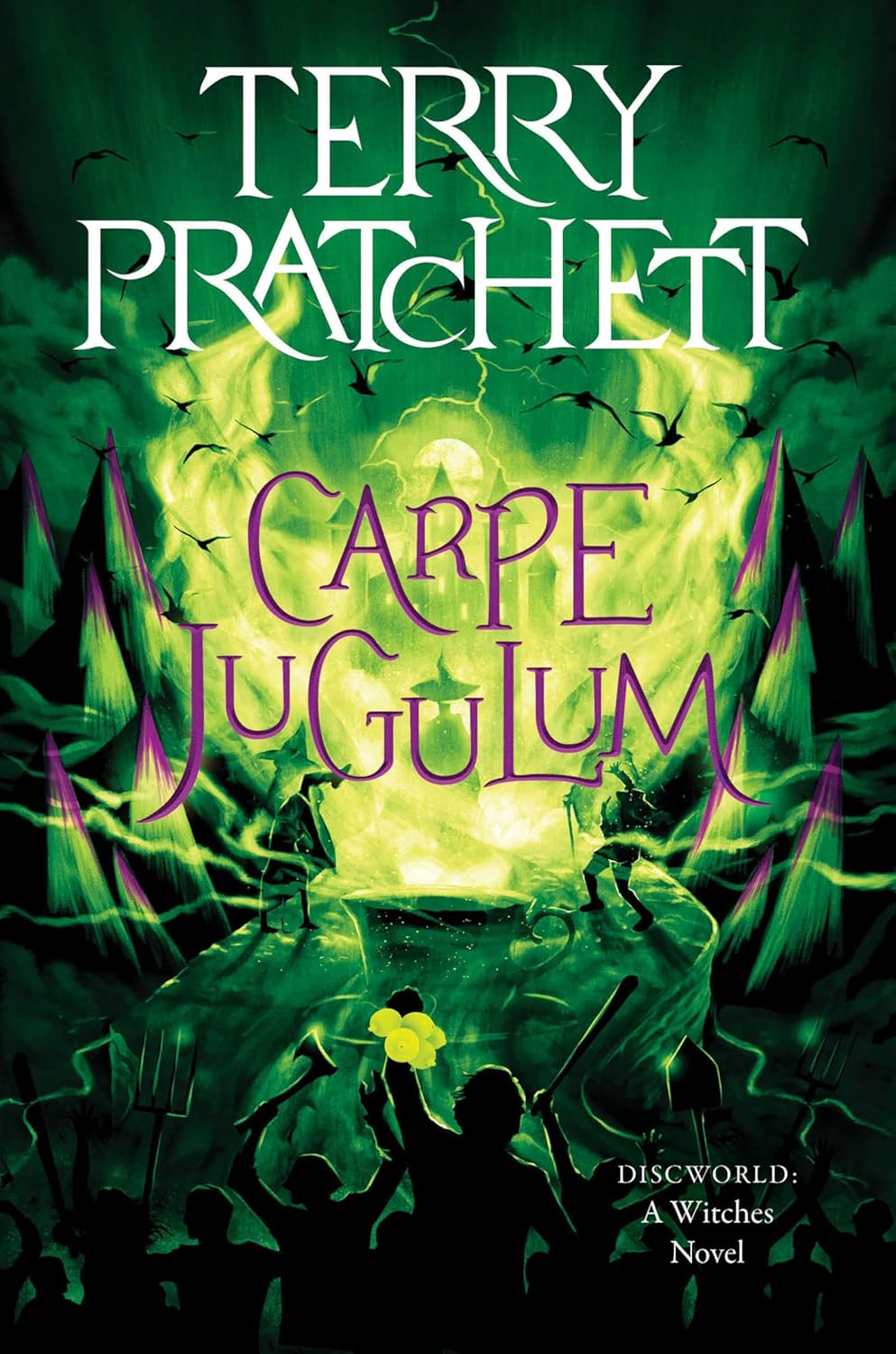
Carpe Jugulum closes the original Witches sequence with vampires, and it’s the darkest and most theological of the six. King Verence, eager to look modern, invites the Magpyrs, a family of fashionable vampires from Überwald who have trained themselves out of the old weaknesses, to his baby daughter’s naming ceremony. Once invited in, they intend to stay, and Lancre’s witches find that their guests can get inside minds as easily as houses.
The book pushes Agnes, Magrat and a young Omnian priest, Mightily Oats, to the front, and the long conversations between Granny Weatherwax and Oats about faith, sin and treating people as things are among the most serious pages in all the Terry Pratchett books. It also marks the first appearance of the Nac Mac Feegle, and it won the Lord Ruthven Award for vampire fiction in 2000. The book is overstuffed and the middle drags, but readers who want the Witches at their most grown-up will find them here.
Death
Death is a recurring presence across Discworld, an anthropomorphic personification who SPEAKS IN CAPITALS, rides a pale horse called Binky, is fascinated by humanity, and understands it better than it understands itself. His own sub-series is five books, and they’re where Pratchett’s warmth is most exposed. From Soul Music on, the strand also follows his granddaughter, Susan Sto Helit, a ferociously sensible governess and later teacher who would very much like her family to stay out of her life.
Read them in order: Mort, Reaper Man, Soul Music, Hogfather and Thief of Time. Mort is the entry point and one of the easiest, funniest books in the series. The strand peaks with Reaper Man and Hogfather, and taken together these are some of the most affecting books Pratchett wrote about what it means to be mortal.
Mort (1987)

Mort is the first Death novel and the fourth Discworld book, and it’s the one that shows Pratchett finding his voice in real time. It’s short, tightly built and very funny, and it’s still one of the best places to start the whole series.
Mortimer is a gangly farm boy whose father takes him to a hiring fair, where nobody wants him until Death rides up at midnight and offers him an apprenticeship. Mort learns the trade, collecting souls and keeping the great hall of hourglasses, while Death, freed from the daily round, goes looking for what humans see in life: fishing, dancing, getting drunk, and a job as a short-order cook. Then Mort, sent to collect the soul of a young princess, can’t bring himself to do it, and his act of kindness splits reality in two, with the old timeline slowly closing in on the new one.
The heart of the book is Death himself, the first time Pratchett made him a lead rather than a walk-on, as he tries to take a holiday and discovers that he doesn’t know how. Mort’s growing up is touching, and Ysabell, Death’s adopted daughter, and Albert, his manservant, round out a small, sharply drawn cast. The book also holds some of the best one-liners of the early series.
The early looseness shows in a few gags that stop the story, but next to what came before, it reads like a different writer. In the BBC’s Big Read poll of 2003, Mort was the highest-placed of all the Terry Pratchett books, at number 65, which says something about how many readers it has hooked.
Reaper Man (1991)

Reaper Man is the second Death novel and, for many readers, the one where Discworld first breaks their heart. The Auditors of Reality, gray cosmic bureaucrats who dislike anything with a personality, decide that Death has developed one and retire him. Handed an hourglass of his own, Death takes the name Bill Door and goes to work as a farmhand for Miss Flitworth, a flinty old woman on a remote farm, and discovers what it means to have time that runs out.
Meanwhile, with Death off duty, life force has nowhere to go. In Ankh-Morpork the dead stay up, among them the 130-year-old wizard Windle Poons, who finds himself attending a support group for the undead, and the city starts sprouting odd objects, snow globes first, that point to something much larger and hungrier. The wizards’ half is broad comedy, and some readers find the two halves sit awkwardly together.
The farm half is something else, and it’s the answer to anyone who thinks of the Terry Pratchett books as only funny. Bill Door’s harvest and his slow friendship with Miss Flitworth are among the most moving pages Pratchett wrote, and the book’s quiet argument about the value of a finite life gives it real weight.
Soul Music (1994)

Rock and roll reaches the Disc in Soul Music, the third Death novel, which also brings Susan Sto Helit, Death’s granddaughter, into the series as a lead. Death has gone missing, trying to forget, and teenage Susan, a pupil at the Quirm College for Young Ladies, discovers that the family job has fallen to her. Meanwhile a young harpist from Llamedos named Imp y Celyn buys a strange guitar in Ankh-Morpork, and Music With Rocks In sweeps the city, with the wizards of Unseen University among its first converts.
It’s the Discworld book for pop-culture fans, packed with music-history jokes (Imp’s name is a Buddy Holly pun, and the city’s first band runs through rock history in a few weeks), and the Susan chapters show Pratchett’s growing interest in rationality as a kind of courage. The music gags can feel like a checklist, and the plot is thin. Hogfather depends on knowing Susan, so this one should come first.
Hogfather (1996)

Hogfather is the fourth Death novel, a comedy about belief disguised as a Christmas story, and many fans’ choice for the most quietly profound of the Discworld books. It’s also the one many readers save for December.
On Hogswatchnight, the Disc’s midwinter, the Hogfather (a jolly, gift-bringing figure whose sleigh is pulled by four enormous boars) goes missing, because the Auditors have commissioned the Assassins’ Guild to remove him, and the Guild has sent Mr. Teatime, a polite young man who sees people as puzzles. Death, worried about what happens if nobody believes in the Hogfather by dawn, puts on the red suit and does the rounds himself, with a grumbling Albert as his helper. Susan, now a governess, sets out to find out what’s going on, while the wizards of Unseen University deal with a sudden outbreak of minor gods.
The book’s argument, delivered by Death in one of the great conversations in the series, is that humans have to learn to believe small lies like the Hogfather so that they can believe the big ones, such as justice and mercy. It’s funny all the way through and serious underneath, and Teatime is one of the creepiest villains Pratchett wrote.
The plot has a lot of moving parts, and the wizards’ subplot sprawls. Sky One adapted it as a two-part film in 2006, with Ian Richardson as the voice of Death and Michelle Dockery in the cast. With Soul Music behind you for Susan’s background, it makes a fine seasonal tradition, as plenty of Pratchett readers have found.
Thief of Time (2001)

Thief of Time is the fifth and last Death novel, the most ambitious of the Discworld books about him, and a book about time, perception and what makes a human life worth living. The Auditors, who hate the untidiness of life, commission a clockmaker named Jeremy Clockson to build a perfect glass clock, one that would stop time for good. Against them stand the History Monks, who keep time flowing in the right channels, in the shape of the unflappable sweeper Lu-Tze and his gifted, impatient apprentice Lobsang Ludd, along with Susan Sto Helit, now a schoolteacher who can step outside time when a lesson requires it.
The Auditors’ attempts to understand human beings produce some of the best comedy in Discworld, including a memorable scene in a chocolate shop. Some readers find the time logic hard going in the last third. It was the last Discworld novel to carry an original Josh Kirby cover, and it was picked as the launch title for the Discworld Graphic Novel Universe, a sign of how much pull it still has.
The City Watch
The City Watch books are the best sub-series in Discworld by most fans’ reckoning, and the strongest sustained run Pratchett wrote. They follow Sam Vimes, a cynical, alcoholic captain of Ankh-Morpork’s near-defunct night watch, as both he and the force around him are dragged into relevance across eight novels. What begins as a police procedural in a fantasy city becomes Pratchett’s deepest investigation of power, class, justice and the difference between law and what’s right. If the procedural side is what hooks you, the magic-and-police stories on my urban fantasy books list, Jim Butcher’s and Ben Aaronovitch’s among them, are its modern cousins.
Read them in order: Guards! Guards!, Men at Arms, Feet of Clay, Jingo, The Fifth Elephant, Night Watch, Thud! and Snuff. Order matters more here than anywhere else in Discworld, because the Watch grows from book to book (a dwarf, a troll, a werewolf, a golem, a vampire) and because Night Watch pays off everything the earlier books built. If you read only one sub-series, read this one.
Guards! Guards! (1989)

Guards! Guards! is the first City Watch novel and the door into Discworld that many reading guides hold open for newcomers, with good reason. It needs no prior knowledge, it introduces the series’ best cast, and it’s Pratchett doing everything he’s good at.
Captain Sam Vimes is a drunk who commands what’s left of Ankh-Morpork’s Night Watch: the cowardly Sergeant Colon, the barely human Corporal Nobbs, and a new recruit, Carrot, a very tall young man raised by dwarfs who has read the city’s law book and believes every word of it. Meanwhile a secret society of disgruntled nobodies, the Elucidated Brethren of the Ebon Night, summons a dragon to install a puppet king, and the Watch is all that stands in the way.
The book works as a fantasy send-up (the rightful heir, the dragon slain by the chosen one) and as a good thriller, but its real strength is Vimes, one of the great characters in British comic fiction, a man who hates the city and can’t stop protecting it. Lady Sybil Ramkin, who breeds swamp dragons, gives the book its warmth, and the Librarian, whose library has been robbed, is a magnificent ally. It’s also where Pratchett’s moral seriousness first sits fully under the jokes.
A few early-period gags drag, and the plot leans on coincidence in its last act, but those are small complaints about the obvious first Discworld book. The rest of the City Watch books build directly on it.
Men at Arms (1993)
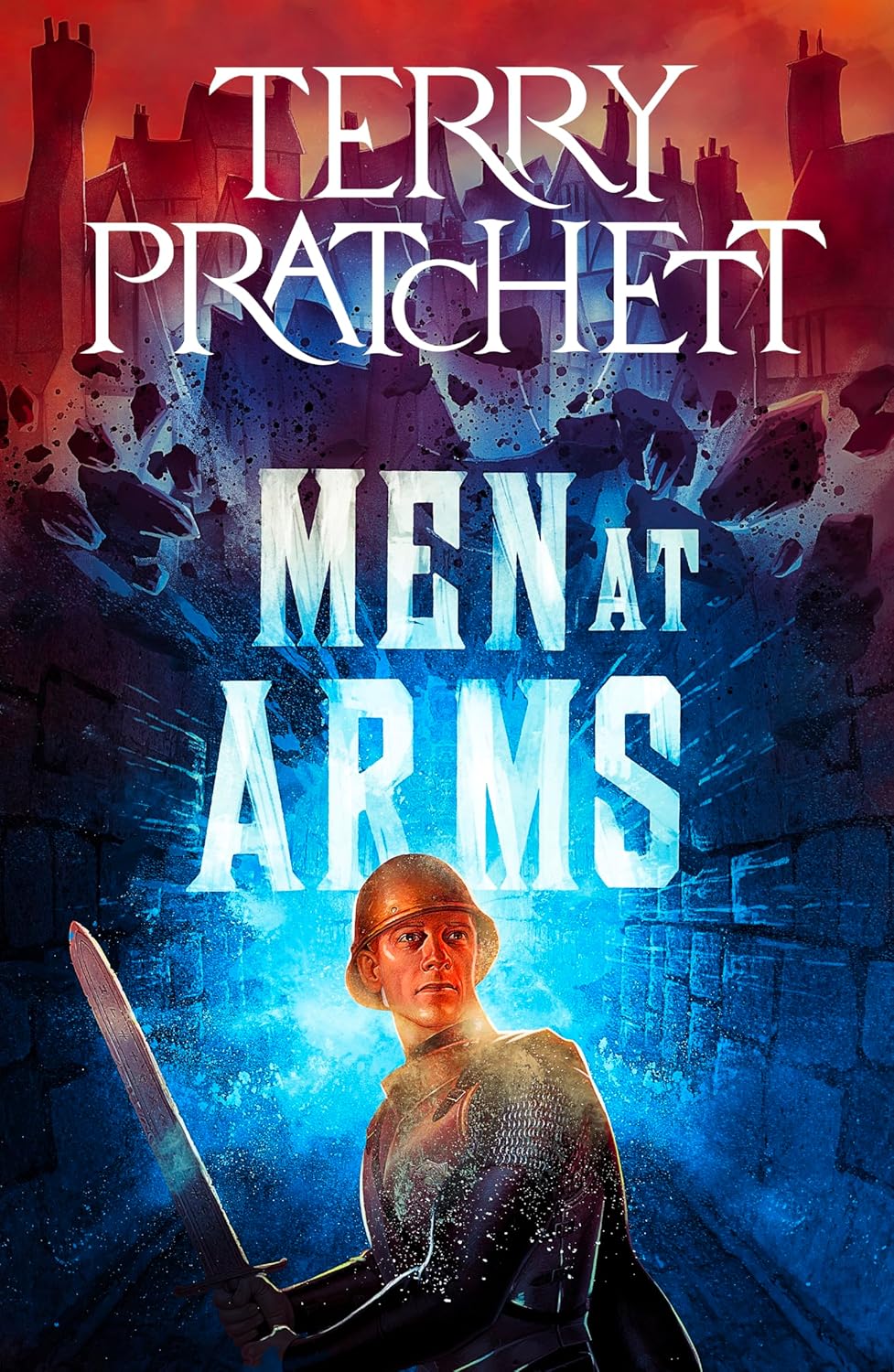
Men at Arms is the second City Watch novel and the one where the Watch starts to become a real police force, which makes it a favorite with readers who come to Discworld for Vimes. Captain Vimes is days from marrying Lady Sybil and retiring into wealth, Corporal Carrot is quietly the most popular man in Ankh-Morpork, and the Patrician has ordered the Watch to recruit from the city’s minorities: Detritus the troll, Cuddy the dwarf and Angua, who has a secret of her own. Then someone steals a strange new weapon from the Assassins’ Guild, the gonne, and people start dying.
It’s a real mystery with a real body count, a Discworld book that plays the detective story straight, and its argument that a weapon changes the person who holds it is the darkest idea in the early Watch books. The grudging friendship between Detritus and Cuddy is a highlight, and Vimes’s theory of boots (why being poor is expensive) is a passage readers still quote. The plot sometimes bends to make room for the bigger cast, but readers coming from Guards! Guards! should go straight on.
Feet of Clay (1996)

Feet of Clay is the third City Watch novel, a murder mystery that turns into one of the best Terry Pratchett books about freedom. Two old men are killed in Ankh-Morpork, the Patrician is being slowly poisoned, and the city’s golems, clay laborers who work without rest and have no rights at all, are behaving strangely. Commander Vimes, newly married and newly promoted, has to crack both cases while the heralds pester him to accept a coat of arms he doesn’t want.
The book introduces Cheery Littlebottom, the Watch’s forensic alchemist and a dwarf quietly deciding to live as a woman in a culture that recognizes no such thing, and it gives Dorfl the golem one of the great arcs in the series. The poisoning plot is ingenious, even if the mystery mechanics creak in places. For readers who like Discworld as detective fiction, this is the one to reach for.
Jingo (1997)

Jingo is Pratchett’s satire of war fever, and in this fourth City Watch novel Vimes becomes something like a statesman despite himself. An island called Leshp rises out of the sea between Ankh-Morpork and Klatch, both cities claim it, and within weeks the patriots are drumming up a war. Vimes, investigating an attempt on the life of a visiting Klatchian prince, follows the case all the way to the desert, while Lord Vetinari takes Colon and Nobbs on a secret mission of his own in Leonard of Quirm’s submarine.
The satire of jingoism and casual prejudice is pointed, and the book is as clear-eyed as anything in the Terry Pratchett books about how quickly ordinary people talk themselves into a war. Vetinari’s mission is the comic highlight. It’s also one of the busier Discworld books, and the plot rambles across too many locations. Anyone interested in Pratchett’s politics shouldn’t skip it.
The Fifth Elephant (1999)

The Fifth Elephant turns the fifth City Watch novel into a political thriller, taking Vimes out of Ankh-Morpork and into the dark forests and mines of Überwald. Vetinari sends him as ambassador to the coronation of the dwarfs’ new Low King, a posting Vimes hates on sight, just as the Scone of Stone, the ancient seat of dwarf kingship, goes missing and the region’s wealth of fat is in play. At the same time Angua leaves without warning to deal with her family in Überwald, and Carrot quits the Watch to follow her.
Pratchett builds a Ruritanian intrigue full of vampires, werewolves and dwarf politics, and Überwald becomes one of the most atmospheric places in the Discworld books. Lady Sybil, at her husband’s side as the ambassador’s wife, gets one of her best roles. The werewolf hunt in the snow is among the most frightening sequences in the series. The diplomacy runs slow in places, and the Carrot and Angua subplot can feel detached from the main story. It’s the Watch book for readers who want Vimes in a full-blown thriller.
Night Watch (2002)

Night Watch is the sixth City Watch novel, and the book widely regarded as the peak of the strand and, for many readers, of Discworld as a whole. It’s darker, angrier and more moving than anything around it, and it rewards having read the earlier Watch books first, which is the one real argument for reading this strand in order.
The story follows Commander Sam Vimes, chasing a murderer named Carcer across the roof of the Unseen University library during a magical storm, when both men are thrown thirty years into the past. Vimes lands in the Ankh-Morpork of his youth, weeks before a revolution, and finds that the sergeant who taught him everything he knows has been killed before the teaching could begin. To keep history on track, Vimes has to take the dead man’s place and train his own younger self, while Carcer makes himself useful to the secret police.
What makes it great is the anger. Pratchett’s portrait of a city under a paranoid ruler, with the Unmentionables torturing suspects in their cellars, is some of the most political writing in the series, and his account of what good policing is (keeping people alive, getting everyone home) is the moral core of the Watch books. The History Monks, the young Vimes and a heap of small, perfect details, from the lilac to the revolutionaries’ demand for a hard-boiled egg, make the past feel lived in.
The flaw, if it is one, is that the book is grim in stretches and leans on the reader’s knowledge of the cast. It won the Prometheus Award in 2003, and by most accounts it’s the title that tops more fan rankings of the Terry Pratchett books than any other. It’s the one to save until the earlier Watch books have done their work.
Thud! (2005)

Thud! is the seventh City Watch novel and the one most fans would hand someone as proof that the late Discworld books still had teeth. It’s a murder mystery, a story about inherited hatred and, unexpectedly, the series’ great book about fatherhood.
The anniversary of Koom Valley is approaching, the ancient battle that dwarfs and trolls both remember as the other side’s ambush. A dwarf agitator, Grag Hamcrusher, is found dead in Ankh-Morpork, the city’s dwarf and troll communities are a breath away from riot, and Vimes has to find the killer while deep-down dwarfs, a vampire recruit and a stolen painting complicate everything. Through all of it Vimes refuses to miss six o’clock, when he reads Where’s My Cow? to his infant son.
By this point the Watch is a real institution, the dwarf and troll cultures have depth, and Vimes’s fury at hatred handed down through generations gives the book its moral force. The six o’clock deadline turns a bedtime story into one of the most tense scenes in Discworld, and Where’s My Cow? was published as a real picture book the same year.
It’s a dense, sometimes grim book, and readers new to the Watch will miss the weight of the relationships. As the late capstone of the strand, it stands with the best of the Terry Pratchett books.
Snuff (2011)

Snuff sends Commander Vimes on holiday, which he regards as a punishment, and it’s the eighth and last City Watch novel. Lady Sybil takes him and their young son to her family’s country estate in the Shires, where Vimes, who can’t stop being a policeman, smells a crime within days: a goblin has been murdered, and the local gentry treat goblins as vermin.
Few of the Terry Pratchett books are as fierce about who counts as a person, and the goblins’ slow emergence into the light, embodied by Tears of the Mushroom, a goblin girl with a gift for the harp, is the heart of it. The country-house comedy works well, and Young Sam’s fascination with poo produced a spin-off, The World of Poo. On release Snuff sold 55,000 copies in three days, which made it the third-fastest-selling adult hardback novel since UK records began. Some readers feel the prose shows strain in places, and the plot wanders. It’s a last look at Vimes at full strength, and Watch readers shouldn’t miss it.
Tiffany Aching
The Tiffany Aching books were published for younger readers, and they’re among the best things Pratchett wrote, frequently the strand that makes adults cry. The five books follow Tiffany, a young witch on the Chalk, the sheep-country downs where her family keeps its flocks, from the age of nine to young womanhood, as she learns a trade that is mostly about doing the unglamorous, necessary work nobody else will: sitting with the dying, cleaning the neglected, holding a community together. Her companions are the Nac Mac Feegle, tiny blue violent Scottish pictsies who provide the comedy while Tiffany provides the weight.
Read them in order: The Wee Free Men, A Hat Full of Sky, Wintersmith, I Shall Wear Midnight and The Shepherd’s Crown. Don’t be put off by the young adult label. The strand continues the Witches books, four of the five won the Locus Award for best young adult book, and in places these are sharper than anything in the adult series.
The Wee Free Men (2003)

The Wee Free Men is the first Tiffany Aching novel and one of the best doors into Discworld for readers of any age. It was published for younger readers, but adults who pick it up tend to come away convinced it belongs among the finest Terry Pratchett books.
The story follows nine-year-old Tiffany, a farmer’s daughter on the Chalk who makes cheese, reads the dictionary for fun and thinks very clearly. When monsters start leaking into the world from Fairyland and the Queen of the Fairies steals her sticky little brother, Wentworth, Tiffany goes after him armed with a frying pan, a book of fairy tales and the help of the Nac Mac Feegle, a clan of six-inch, blue, kilted, fighting, drinking, stealing pictsies who decide she’s their new kelda.
What lifts it is Tiffany herself. She’s practical, skeptical and a little cold, and the book is honest about that. Her memories of Granny Aching, a shepherd whose silent authority still shapes the Chalk, give the story an emotional ground the fairy-tale plot never undercuts. The Feegles steal every scene they’re in (“Crivens!”), and the dream logic of Fairyland is genuinely eerie.
The Feegles’ Scots dialect takes some readers a few chapters to tune into, and the Fairyland middle wanders, but the book won the Locus Award for best young adult book in 2004. Hand it to a teenager as a way into Discworld, or read it yourself for the series’ heart without its sprawl.
A Hat Full of Sky (2004)

In A Hat Full of Sky, the second Tiffany Aching novel, the strand’s real subject, what a witch actually does all day, comes into focus. Eleven-year-old Tiffany leaves the Chalk to apprentice with Miss Level, a witch with one mind and two bodies, and learns that witchcraft is mostly nursing, tidying and listening. But a hiver, an ancient, bodiless thing that takes over the minds of the powerful, has found her, and both the Nac Mac Feegle and Granny Weatherwax come looking.
It’s the book where Granny and Tiffany meet properly, and their scenes become the strand’s spine. The status-conscious young witches of the mountains, who would rather wear the black and the jewelry than do the work, are drawn with real precision. The hiver is a fairly abstract villain, which leaves the middle a little airy, but the book took both the Locus Award for best young adult book and the Mythopoeic Award for children’s literature in 2005. Anyone following the Discworld books about witches should treat it as essential.
Wintersmith (2006)

Wintersmith is the third Tiffany Aching novel, a winter’s tale about growing up and about a god of the weather who falls in love. Thirteen-year-old Tiffany, now apprenticed to the very old and very fearsome Miss Treason, watches the Dark Morris, the dance that welcomes winter, and on impulse she steps into it. The Wintersmith, the spirit of winter, takes her for the Summer Lady and becomes besotted, which means extravagant wintry tributes and the real chance that spring never comes.
The book is funny and frosty, and Miss Treason, whose reputation is a carefully maintained piece of theater, is one of the best late creations in the Terry Pratchett books. It handles adolescence, crushes and the burden of being noticed without a lecture in sight. Some readers find the romance plot thinner than the earlier books, and the middle loses momentum. It took the Locus Award for best young adult book in 2007, the third Tiffany Aching novel to do so. Save it for when the nights draw in.
I Shall Wear Midnight (2010)

I Shall Wear Midnight is the fourth Tiffany Aching novel and the darkest, a book about the parts of a witch’s job nobody writes songs about. Teenage Tiffany is now the Chalk’s witch in her own right, and the work turns ugly when she has to deal with a case of brutal violence in a family and the community begins turning against witches in general. Behind the mood is the Cunning Man, the eyeless ghost of an ancient witch-hunter, who has been woken and wants her.
Pratchett takes Tiffany to Ankh-Morpork, where the City Watch makes an appearance, and the book is unflinching about rumor, mob hatred and the loneliness of being the person everyone calls in a crisis. It took the Andre Norton Award, presented in 2011. It’s heavier than the earlier Discworld books for younger readers, and its opening chapters may be too much for the youngest of them. Readers who started with The Wee Free Men get to see Tiffany fully grown up.
The Shepherd’s Crown (2015)

The Shepherd’s Crown is the fifth and final Tiffany Aching novel and the forty-first and last Discworld book, published in August 2015, five months after Pratchett’s death. It finds Tiffany working harder than ever as the Chalk’s witch while the elves, sensing a weakness in the world, gather to come back. A new recruit to witchcraft, Geoffrey, a gentle, educated young man who has left his father’s house, gives the book its most original thread.
Rob Wilkins, Pratchett’s assistant, writes in the afterword that the book was still not quite finished as Pratchett would have liked when he died, and many readers feel it: it’s shorter and less layered than the books around it. Amanda Craig, reviewing it for The Guardian, called it “not a perfect example of Pratchett’s genius” but a deeply moving book all the same, which is the fairest summary. Locus readers still gave it the 2016 Locus Award for best young adult book. Read it last, after the other Terry Pratchett books it says goodbye to.
Moist von Lipwig and the Industrial Revolution
These are the books about Ankh-Morpork meeting new technology, and the city that comes out of them is a different place from the one in The Colour of Magic: moving pictures in Moving Pictures, the printing press in The Truth, then the post office, the banks and the railway in the three Moist von Lipwig books. The Discworld Emporium files The Truth and the three Moist books under industrial revolution, and Moving Pictures, an earlier book about the city and a new invention, makes a natural opener for the strand.
Moist himself is a con man given the choice between execution and running Ankh-Morpork’s collapsed civic institutions. Pratchett uses him to write about modernity, infrastructure and how societies actually function, and it’s funnier than that makes it sound. Moving Pictures and The Truth stand alone. The Moist books should be read in order: Going Postal, Making Money and Raising Steam.
Moving Pictures (1990)
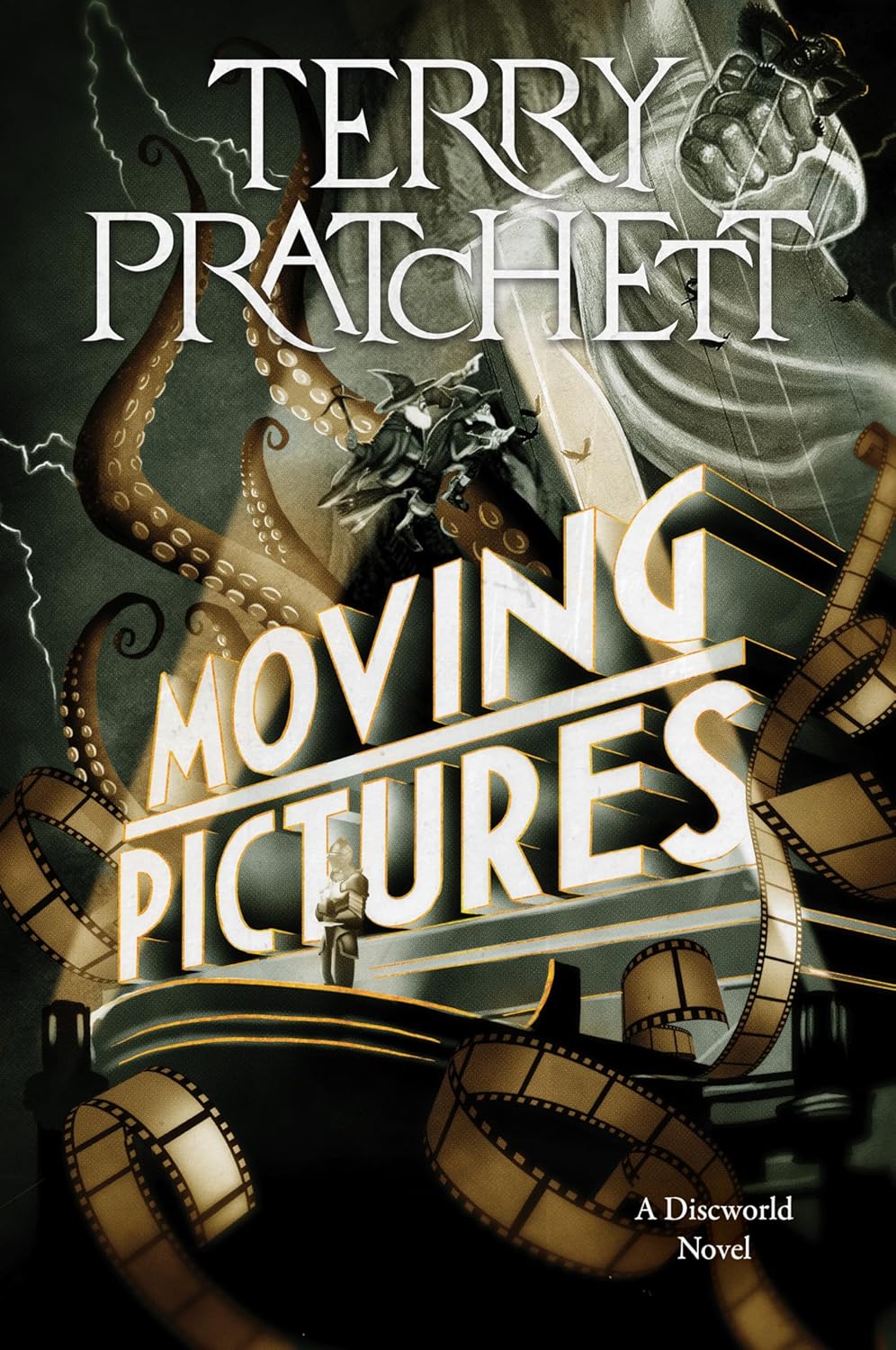
Moving Pictures is the tenth Discworld novel, Pratchett’s Hollywood satire, and the book that introduced Archchancellor Mustrum Ridcully and Gaspode the Wonder Dog, a talking mongrel with a grievance against the world. When the alchemists of Ankh-Morpork discover octo-cellulose and invent the clicks, the town of Holy Wood springs up on a lonely stretch of coast, and Victor Tugelbend, a student who works very hard at failing his exams, becomes its first star alongside Theda Withel, a would-be actress from a small town. But the hill at Holy Wood has a history, and the dreams the clicks unleash attract attention from the Dungeon Dimensions.
The film-history jokes come as thick as anywhere in the Terry Pratchett books, from the studio moguls to the first epic. The plot is a reworking of the earlier things-from-the-Dungeon-Dimensions stories, and the book loses steam near the end. The wizards and early Ankh-Morpork are at their liveliest here, and it makes a good warm-up for The Truth.
The Truth (2000)

The Truth is the twenty-fifth Discworld novel and Pratchett’s newspaper book, a standalone about the birth of the free press in Ankh-Morpork. William de Worde, the estranged son of an aristocrat, writes a modest newsletter for wealthy subscribers, until a group of dwarfs arrives with a movable-type printing press and The Ankh-Morpork Times is born. His first big story is a doozy: Lord Vetinari has apparently been caught attacking his own clerk, and William smells a setup.
The villains, Mr. Pin and Mr. Tulip, a pair of hired thugs (Mr. Tulip’s vocabulary consists largely of one censored word), are among the series’ best, and Sacharissa Cripslock, an engraver’s daughter who turns out to be a born reporter, is a delight. The book’s ideas about truth, rumor and what newspapers owe their readers have aged as well as anything in the Discworld books. The investigation drags a little in the middle, which hasn’t hurt its standing: it entered the Prometheus Hall of Fame in 2024. It pairs naturally with the Moist books that follow.
Going Postal (2004)

Going Postal is the first Moist von Lipwig novel and one of the cleanest doors into Discworld, a book so self-contained that it works for readers who’ve never heard of Ankh-Morpork. It’s quick, modern and one of the funniest late Terry Pratchett books.
The story follows Moist, a professional con man who goes to the gallows under a false name and wakes up in Lord Vetinari’s office facing a choice: take over the city’s derelict Post Office, or step through a door that opens onto a long drop. The Post Office is a ruin, stuffed to the ceiling with undelivered mail that has started to talk, staffed by an elderly junior postman and a teenager obsessed with pins, and threatened by the Grand Trunk Company, whose clacks towers carry messages across the continent and whose new owners are running the network into the ground for profit. Moist does what he does best: he lies, and the lies start to come true.
The engine of the book is Moist himself, a charming crook forced into honesty against his will, and Pratchett’s satire of asset-strippers and the people who run a public good as a cash machine. Adora Belle Dearheart, a chain-smoking campaigner for golem rights, is one of his great late heroines, and the clacks, with their codes and their dead operators’ names kept moving through the system, give the book its most haunting idea.
The plot resolves a little too easily. Going Postal would have been a Hugo finalist in 2005, but Pratchett withdrew it, and it was a Nebula finalist. Sky One adapted it in 2010. If you want a way into Discworld that feels like a modern novel, start here.
Making Money (2007)

Making Money, the second Moist von Lipwig novel, hands him the Royal Bank of Ankh-Morpork and the Mint. Bored by success at the Post Office, Moist is easy prey when Vetinari arranges for him to inherit control of the bank, whose chairman is a small dog named Mr. Fusspot, and whose owners, the Lavish family, would very much like it back. Moist decides that money should be made of paper rather than gold, and the city’s economics wobble accordingly.
Pratchett’s satire of banking and confidence (both kinds) is among the cleverest in the Discworld books, and the bank’s ferociously correct chief cashier, Mr. Bent, and the basement where an Igor helps run a water-driven model of the city’s economy are highlights. Most readers rank it below Going Postal, and the final act is busy, though it still won the Locus Award for best fantasy novel in 2008 and was a Nebula finalist. Readers who loved Moist in Going Postal should carry on.
Raising Steam (2013)

Raising Steam is the third Moist von Lipwig novel, the fortieth Discworld book, and the last of the adult novels in the series. Dick Simnel, a young engineer, builds a steam locomotive called Iron Girder, Ankh-Morpork falls in love with the railway overnight, and Vetinari puts Moist in charge of making it work, fast. Meanwhile a violent faction of hard-line dwarfs, the grags, sets out to stop a modern world it hates.
The book gathers almost the whole cast, Vimes included, for one last tour of a city transformed, and it’s full of affection for engineers and for trains. Many readers feel the effects of Pratchett’s illness here: the prose is plainer, the plot runs straight, and the jokes are fewer. He was dictating his books to Rob Wilkins by then. For anyone following the Terry Pratchett books to the end of Ankh-Morpork’s story, it’s a warm goodbye to the city.
The Standalones
Several Discworld books belong to no sub-series, and one of them is arguably the best thing Pratchett wrote. Two are set far from Ankh-Morpork in the Disc’s ancient lands (the Discworld Emporium files Pyramids and Small Gods together as its gods books), one was written for children, and one is a war novel. All four can be read with no other Discworld behind you.
That’s true of most of the series: Discworld has a running cast, but nearly every book is built to stand alone. If you want to sample Pratchett at his peak in a single book with no commitment, Small Gods is the answer.
Pyramids (1989)

Pyramids is the seventh Discworld novel, the first to stand outside every sub-series, and an early book that already shows Pratchett reaching beyond parody. Teppic, crown prince of Djelibeybi, a narrow river kingdom modeled on ancient Egypt, is training at the Assassins’ Guild in Ankh-Morpork when his father dies and the throne falls to him. Back home he finds a kingdom run by its high priest, Dios, a court that has done everything the same way for thousands of years, and a gigantic pyramid going up that bends time and space around it.
It’s one of the Discworld books most concerned with tradition and the dead weight of the past, with a mathematically gifted camel named You Bastard as the scene-stealer and the Assassins’ Guild exams as a highlight. The plot comes apart a little in its final third, though the book won the British Science Fiction Association’s novel award in 1990. Readers who enjoy history jokes should begin their tour of the standalones with it.
Small Gods (1992)

Small Gods is the thirteenth Discworld novel, a standalone philosophical comedy about belief, religion and power, and a book many readers consider Pratchett’s single finest. It needs zero prior knowledge, which makes it a legitimate starting point for the entire series.
Brutha is a slow, devout novice in the theocracy of Omnia who can’t read but remembers everything. The Great God Om, in whose name the Omnian church conquers, tortures and preaches, has tried to manifest himself in glory and found himself stuck in the body of a one-eyed tortoise, because almost none of his millions of followers actually believe in him anymore. They believe in the church. Brutha, the last true believer, is the only one who can hear him, and the two are swept into the plans of Vorbis, the head of the Quisition, a man of perfect certainty.
Pratchett’s theory of gods (that they’re made of belief, and shrink when it goes) drives the book and lets him write about faith, fundamentalism and institutions with real seriousness, while Brutha’s slow discovery of his own conscience is the most moving journey in early Discworld. The tortoise is also very funny, and the visit to the squabbling philosophers of Ephebe is a set piece. Andy Serkis reads it in the re-recorded audiobook.
The long trek across the desert slows the middle, and Vorbis’s cruelty makes some scenes hard going. It’s often the book recommended to readers who think they don’t like fantasy, and it’s the obvious answer when someone asks which of the Terry Pratchett books to read if they only read one.
The Amazing Maurice and His Educated Rodents (2001)

The Amazing Maurice and His Educated Rodents is the twenty-eighth Discworld novel and the first of the Discworld books written for children, a dark, funny twist on the Pied Piper of Hamelin. Maurice, a streetwise cat who has become intelligent, runs a scam with a band of rats who can suddenly think and talk and a stupid-looking kid with a pipe: the rats stage a plague in a town, the kid pipes them away, and everyone gets paid. In the town of Bad Blintz, the scam runs into a real horror under the streets.
It’s a children’s book only in the sense that its heroes are a cat, a boy and some rats. The rats, who name themselves after words on old tins and labels (Dangerous Beans, Peaches, Darktan), are working out ethics from scratch, and the cellars of Bad Blintz are genuinely frightening. It won the 2001 Carnegie Medal, the British librarians’ prize for the year’s best children’s book. Hand it to a ten-year-old with a taste for the macabre.
Monstrous Regiment (2003)

Monstrous Regiment is the thirty-first Discworld novel, a standalone war story and one of the strongest of the late Terry Pratchett books. Polly Perks, whose family runs an inn in the small, belligerent country of Borogravia, cuts her hair and enlists as a boy to find her brother, who went off to the endless war and hasn’t come back. Her squad of raw recruits, a vampire, a troll, an Igor and several others, marches under the cunning old Sergeant Jackrum toward a front that is not what the propaganda says.
The book is fierce about war and about a religion that forbids almost everything (Borogravia’s god, Nuggan, keeps adding to a list of Abominations that includes chocolate and the color blue), and it’s very funny about soldiering. Its central idea is handled with real wit, though some readers find the late surprises stack up too neatly. Vimes turns up in a role that suits him. It’s also one of the first titles announced for the Discworld graphic novel line, and a good choice for readers who don’t want to commit to a sub-series.
The Early Novels (1971-1981)
Before Discworld, Pratchett published three novels with Colin Smythe, the independent publisher who would also bring out the first two Discworld books. They’re apprentice work, and you can watch the Disc being assembled from spare parts: a world inside a carpet, a galaxy run on probability, and a flat Earth built by someone with a sense of humor. They’re for readers who already love the Terry Pratchett books and want to see where the voice came from.
The Carpet People (1971)

The Carpet People is Pratchett’s first novel, written when he was seventeen and published in 1971 with a cover he designed himself, and it’s a book he later went back to and substantially rewrote. The Munrung tribe, led by Glurk and his younger brother Snibril, live among the hairs of a vast carpet until the Fray, a destructive force nobody understands, sweeps their village away. The survivors journey across the Carpet, through the bureaucratic Dumii empire and the lands of King Brocando’s Deftmenes, while the mouls, a power-hungry species, close in.
The 1992 rewrite is the text most editions now carry, and its author’s note sums the book up neatly, crediting it to two writers, the teenager and the grown man, who happen to share a name. Next to the later Terry Pratchett books it reads like a Tolkien-shaped quest seen through the wrong end of a telescope, with the teenage writer’s seriousness about war, death and religion very much intact. The quest structure is a familiar one, which suits young readers ready for their first fantasy epic as well as completists.
The Dark Side of the Sun (1976)

The Dark Side of the Sun is Pratchett’s second novel and his first science fiction novel, a comic space adventure built on probability. Dom Sabalos lives in a galaxy where probability mathematics can predict almost anything, except where the Jokers, a vanished elder race, are concerned. His father’s prediction said Dom would be killed on the day he became chairman of the planet Widdershins, and when he survives against enormous odds, a hidden part of the message sends him looking for the Jokers’ lost homeworld, which lies, as the title promises, at the dark side of the sun.
With his tutor Hrsh-Hgn, the robot Isaac and a conspiracy on his heels, Dom tours a galaxy full of ideas that turn up again in the later Terry Pratchett books, and the characters even celebrate Hogswatch. The plotting is crowded and the jokes are less polished than they’d become. The critic Don D’Ammassa reads it, alongside Strata, as a spoof of parts of Larry Niven’s Ringworld, and it’s one for completists.
Strata (1981)

Strata is Pratchett’s third novel and the book where a flat world turns up in his fiction two years before The Colour of Magic. Kin Arad is a long-lived engineer for the Company, which builds habitable planets with machinery left behind by the vanished Spindle Kings, complete with artificial strata and fake fossils that bored employees sometimes turn into practical jokes. When evidence of a flat Earth surfaces somewhere out in space, she joins an expedition with Marco, a paranoid four-armed kung, and Silver, a bear-like shand, and finds a disc world under an artificial sky.
It’s the funniest and most inventive of the early Pratchett books, a science fiction comedy built on the idea that someone made the universe and might have been joking. Its plot and characters borrow openly from Larry Niven’s Ringworld, which readers of that book will spot at once. It sits right on the border my science fantasy books guide maps, and for anyone curious about the origins of Discworld it’s the missing link.
The Children’s and Young Adult Novels
Alongside Discworld, Pratchett wrote a shelf of books for younger readers, and adults consistently underrate them because they’re shelved for children. They shouldn’t. Two are trilogies, and the Bromeliad and the Johnny Maxwell books each get one entry here, on the first book, with the reading order inside. The two late standalones, Nation and Dodger, are historical novels in all but name, and Nation is the one Pratchett himself rated highest of everything he wrote.
Truckers (1989)

Truckers is the first book of the Bromeliad trilogy, a children’s story that’s quietly among the best Terry Pratchett books. The nomes are tiny people, a few inches tall, living unseen among humans. Masklin leads a ragged band of outdoor nomes off a motorway verge and into Arnold Bros, a department store whose nomes believe the Store is the entire universe, holding All Things Under One Roof. Then the Store’s own signs announce that it’s closing for demolition, and the nomes have to leave the only world they believe exists, which means learning to drive a truck.
It’s a story about faith, knowledge and confronting a world vastly larger than your assumptions, told with all of Pratchett’s later seriousness in miniature, and the Store nomes’ theology is a funny, clear-eyed satire of religion. The Thing, a small black cube the outdoor nomes carry everywhere, turns out to know far more than anyone. The later books are a little less tight than this one.
Read the three in order: Truckers, then Diggers (1990), in which the nomes try to survive a winter in an old quarry, then Wings (1990), in which Masklin’s party heads for an airport and a much bigger journey. The trilogy is also collected as The Bromeliad, and Cosgrove Hall made Truckers into a stop-motion series for Thames Television in 1992.
Only You Can Save Mankind (1992)

Only You Can Save Mankind is the first Johnny Maxwell novel, and its premise is one of Pratchett’s best: what happens when the enemy surrenders. Twelve-year-old Johnny, a kid in the ordinary town of Blackbury, is playing a pirated copy of a space shooter when the alien ScreeWee fleet offers its surrender, and he accepts. Then the ScreeWee vanish from everyone else’s copies, Johnny finds himself inside the game in his dreams, and with another player, a fierce girl called Kirsty who prefers to be called Sigourney, he has to get the aliens home.
The book is about violence as entertainment and about taking responsibility for something everyone else treats as a game, and it’s as sharp about childhood, class and how adults fail to notice what children understand as anything Pratchett wrote. It’s grounded where the nome books are fantastical, and it’s less famous than the other Terry Pratchett books for children, which it shouldn’t be.
Read the trilogy in order: Only You Can Save Mankind, then Johnny and the Dead (1993), in which Johnny finds he can see and talk to the dead in the town cemetery just as the council plans to sell it for offices, then Johnny and the Bomb (1996), a time-travel story that takes Johnny and his friends back to the Second World War. Johnny and the Dead became an ITV series in 1995, and Johnny and the Bomb a BBC series in 2006.
Nation (2008)

Nation is a standalone young adult novel set in an alternate nineteenth century, and the book Pratchett himself said he believed was the best he had ever written, or would write. It’s not Discworld and it’s not primarily a comedy, and it’s one of the most serious and moving Terry Pratchett books.
The story follows Mau, a boy on his way home from the island where he has spent a month becoming a man, when a tsunami sweeps across the Great Southern Pelagic Ocean and destroys his village and everyone in it. On the shore he finds the wreck of a British ship and its only survivor, Ermintrude Fanshaw, a well-brought-up girl who calls herself Daphne, whose father has just found himself next in line for the British throne after a pandemic killed the king and his next 137 heirs. With no shared language, the two start to rebuild, as survivors from other islands drift in.
Anger and tenderness drive it. Mau’s furious quarrel with the gods who let his people die is Pratchett’s most direct writing about faith and grief, while Daphne, all starch and good manners at first, is very funny as she adapts. The book is also about science and curiosity, and about building something worth having out of catastrophe.
The opening chapters are slow and bleak, and readers expecting Discworld jokes will be disoriented. It won the Los Angeles Times Book Prize for young adult literature, was a Michael L. Printz Honor Book, and was adapted for the National Theatre by Mark Ravenhill in 2009. If you want to see what Pratchett could do entirely outside Discworld, this is the one.
Dodger (2012)

Dodger is a standalone young adult novel set in Victorian London, and Pratchett’s love letter to the city’s underside. Dodger is a tosher, a scavenger who makes his living in the sewers, and when he rescues a battered young woman named Simplicity, two gentlemen take her in: a journalist named Charlie, who is Charles Dickens, and his friend Henry Mayhew. Dodger’s hunt for the people after her pulls him into high politics, and into the secret of her marriage to a German prince.
Pratchett has a lot of fun with real people. Dodger crosses paths with Benjamin Disraeli, the sewer engineer Joseph Bazalgette and a traumatized barber named Sweeney Todd, and the book is dedicated to Mayhew, whose reporting on the London poor supplies its texture. The plot is a little slight under all that period color, but it’s one of the most purely entertaining of the non-Discworld Terry Pratchett books. Dodger’s Guide to London followed in 2013.
The Collaborations
Pratchett collaborated more than his reputation suggests, and three of the partnerships produced books with their own followings: a comic apocalypse, a science series built on Discworld, and a five-book science fiction saga. In each case the co-author’s voice is strong, so these are the right books for testing how much of Pratchett’s appeal is his ideas and how much is his sentences.
Good Omens (1990)

Good Omens is the novel Pratchett co-wrote with Neil Gaiman, and probably the best known of the Terry Pratchett books outside Discworld. It’s a comedy about the end of the world, and the blend of two very different comic sensibilities works better than it has any right to.
The story follows an angel, Aziraphale, and a demon, Crowley, who have been stationed on Earth since the Garden of Eden, have grown rather fond of it, and have no wish to see it end. When the Antichrist is born, they agree to keep an eye on his upbringing so that neither side wins, but a mix-up at the hospital means they’ve been watching the wrong boy. The real one, Adam Young, is growing up in an English village with his gang of friends, and the Four Horsemen of the Apocalypse are already on their way, along with a witch-finder, a descendant of a prophetess whose predictions are uncannily accurate, and a great deal of traffic on the M25.
The joy of it is the double act at its center, the fussy, bookish angel and the cool, rule-bending demon, and the book’s habit of finding the apocalypse in the small print of English suburban life. The footnotes and the satire of Revelation are pure fun.
The plot sprawls across a large cast, and the Horsemen and the witch-finders get less room than they deserve. It’s the most accessible of the non-Discworld titles, a good test of whether this brand of humor is for you, and the book behind the Prime Video series.
The Science of Discworld (1999)

The Science of Discworld is the first of four Science of Discworld books Pratchett wrote with the popular-science writers Ian Stewart and Jack Cohen, and an original hybrid. One set of chapters is a Discworld story: an experiment at Unseen University goes wrong, the university’s thinking engine, Hex, diverts the excess magic into an empty space, the Dean twiddles it, and the wizards find they’ve accidentally made a universe with a small, round, magic-free planet in it. Rincewind is sent to investigate Roundworld, which is ours. The chapters in between are essays on the real science, from atoms and relativity to geology, evolution and dinosaurs.
The joke at its heart, a magical world studying a world with no magic, is a clever way to explain how science works, and Stewart and Cohen write with real flair. The essays date in places, and the story is slight. It was a Hugo finalist for best related book, and three sequels followed: The Globe (2002), Darwin’s Watch (2005) and Judgement Day (2013).
The Long Earth (2012)

The Long Earth is the first of five science fiction novels Pratchett wrote with Stephen Baxter, built on a single big idea. In 2015, plans for a simple device called a Stepper appear online, and anyone who builds one can step sideways into a parallel Earth, then another, and another, along a possibly infinite chain of worlds, none of which ever produced our species. The book follows Joshua Valienté, a natural stepper who needs no device, and Lobsang, an artificial intelligence who claims to be a reincarnated Tibetan motorcycle repairman, on an expedition deep into the Long Earth.
The ideas are as big as any in the Terry Pratchett books (what happens to economies, borders and crime when land is suddenly unlimited), and the travelogue of alternate Earths is full of wonder. Adam Roberts, reviewing it for The Guardian, found it “much more like a Baxter novel than a Pratchett one,” and that’s the honest warning. Read the series in order: The Long Earth, The Long War (2013), The Long Mars (2014), The Long Utopia (2015) and The Long Cosmos (2016). It’s for readers who’ve exhausted Discworld and want more of his thinking rather than more of his voice.
Short Fiction and Nonfiction
Pratchett wrote short fiction and journalism all his working life, and the best of it is gathered in four places: the collected short stories, the collected nonfiction, the four books of children’s stories, and a set of lost newspaper stories found after his death. They’re for readers who have finished the novels and want more of the voice.
A Blink of the Screen (2012)

A Blink of the Screen is Pratchett’s collected short fiction, thirty-two stories written between 1963 and 2010, with illustrations by Josh Kirby and a foreword by A. S. Byatt, and it’s the best way into the shorter work. The first half gathers the non-Discworld pieces, starting with “The Hades Business,” the story he published in Science Fantasy at fifteen, and running through comic science fiction, newspaper squibs and “The High Meggas,” a 1986 story that, by most accounts, seeded The Long Earth.
The second half is the Discworld short fiction, a generous bonus shelf for readers who know the Discworld books. “Troll Bridge” sends an aging Cohen the Barbarian out for one last fight with a troll and is often named among the best things Pratchett wrote at any length, and “The Sea and Little Fishes” pits Granny Weatherwax against the annual Witch Trials and against the novel experience of being nice. The earliest pieces are slight, as juvenilia tends to be, but the Discworld half alone is worth the price.
A Slip of the Keyboard (2014)

A Slip of the Keyboard is Pratchett’s collected nonfiction, published in 2014, and the closest thing he left to an autobiography. It gathers decades of speeches, essays and journalism, from early pieces on fantasy such as “Why Gandalf Never Married” (1985) to “The Orangutans Are Dying” (2000), “A Word About Hats” (2001) and his speech accepting the Carnegie Medal.
The pieces on illness are the angry ones. Essays such as “I’m Slipping Away a Bit at a Time … and All I Can Do Is Watch It Happen” (2008) and his 2010 Richard Dimbleby Lecture, “Shaking Hands with Death,” set out what living with Alzheimer’s was like and why he wanted the right to choose the time of his own death. Collections of occasional writing repeat themselves, and this one does too. It’s essential for anyone who wants to know the man behind the Terry Pratchett books, and the warmth and the anger are both his.
Dragons at Crumbling Castle (2014)

Dragons at Crumbling Castle is the first of four collections of Pratchett’s stories for children, published in September 2014 with illustrations by Mark Beech, and a lovely surprise for anyone who knows him only as a novelist. The title story first ran in the Bucks Free Press in 1966, when he was a young reporter on the paper, and by most accounts the rest date from the same years. They’re full of knights, dragons and wizards handled with the same deadpan logic as the novels.
They’re slighter than the full-length Terry Pratchett books, as newspaper stories for children have to be, and adults will read them for the voice rather than the plots. Three more collections in the same format followed after his death: The Witch’s Vacuum Cleaner (2016), Father Christmas’s Fake Beard (2017) and The Time-Travelling Caveman (2020). It makes a fine bedtime-story book, and the later three are more of the same good thing.
A Stroke of the Pen (2023)

A Stroke of the Pen is the posthumous collection nobody knew was possible: twenty stories Pratchett published in regional newspapers, most of them in the early 1970s and most under the pen name Patrick Kearns, his mother’s maiden name, which had gone unrecognized for decades. In 2022 a reader who had kept the clippings of one serial since he read it at fifteen worked out who had written it and contacted Colin Smythe, Pratchett’s first publisher, and two retired doctors and longtime fans, Pat and Jan Harkin, spent months searching newspaper archives for the rest. The book appeared in October 2023.
Several stories are set in Blackbury, the town Johnny Maxwell would later call home, and “The Quest for the Keys,” serialized in 1984, a year after The Colour of Magic, includes an early mention of Morpork. Reviewers praised the wit and invention but agreed the stories are not up to the later work, and Kirkus called it one for committed fans. That’s the right frame: it’s a fascinating footnote to the Terry Pratchett books rather than a place to start.
Terry Pratchett: Deep Dive and FAQ
What Runs Through Terry Pratchett’s Books
Anger runs through everything, though it took many readers a while to notice it under the jokes. Pratchett was furious about cruelty, about people who treat other people as things, and about the stories societies tell to justify both, and most of his best books are arguments in comic form: Small Gods on faith and power, Night Watch on policing, Hogfather on why humans need to believe in things that aren’t true, Snuff on who counts as a person. The footnotes and the puns are the delivery system, never the point.
The second thread is work. His heroes are people with jobs (witches who sit up with the dying, coppers who walk the beat, a con man who has to make the post arrive), and his great subject is responsibility, the unglamorous duty of doing the right thing when nobody is watching. Granny Weatherwax’s headology and Vimes’s boots are the same idea from two directions. The third is stories themselves, which on the Disc have real power and want to be told in a particular way, an idea that runs from Witches Abroad through Lords and Ladies to The Wee Free Men.
Pratchett spent thirty years being underestimated as “a funny fantasy writer,” and the thing the reading-order guides won’t tell you is that somewhere around the Watch books he quietly became one of the great English novelists, full stop.
Prizes and Honors
The Amazing Maurice and His Educated Rodents won the 2001 Carnegie Medal. On the genre side, Pyramids took the British Science Fiction Association’s novel award in 1990, Night Watch won the Prometheus Award in 2003, and Making Money won the Locus Award for best fantasy novel in 2008.
The Tiffany Aching books collected four Locus Awards for best young adult book, A Hat Full of Sky also took the Mythopoeic Award, and I Shall Wear Midnight won the Andre Norton Award. Nation won the Los Angeles Times Book Prize for young adult literature and was a Printz Honor Book. Pratchett withdrew Going Postal from the 2005 Hugo ballot, saying the stress would spoil his enjoyment of the convention, and The Science of Discworld was a Hugo finalist for best related book.
The public honors ran alongside. He was appointed OBE in 1998, knighted for services to literature in the 2009 New Year Honours, given the World Fantasy Award for Life Achievement in 2010, and awarded ten honorary doctorates, the first from the University of Warwick in 1999.
In the BBC’s Big Read poll of 2003 he had five novels in the top hundred, which only Charles Dickens matched, and fifteen in the top two hundred, more than any other author. His BBC documentary Terry Pratchett: Living with Alzheimer’s won a BAFTA. After his death he received the SFWA’s Kate Wilhelm Solstice Award in 2016 and was inducted into the Science Fiction Hall of Fame in 2017, and The Truth entered the Prometheus Hall of Fame in 2024.
Which Terry Pratchett Editions to Buy
Print Editions
In Britain the Discworld novels are published by Transworld, as Doubleday hardbacks and Corgi paperbacks, and the paperbacks come in two looks. The classic covers were painted by Josh Kirby until 2001 and by Paul Kidby after him, and they’re the editions most fans grew up with. Since 2022 the series has also been available in a newer livery designed by Leo Nickolls and based on Kidby’s character designs, which is the uniform set to buy if you want a matching shelf.
In the US, HarperCollins publishes the novels. Collectors should know the earlier history too: Colin Smythe published the first two Discworld books, and Gollancz published the hardbacks from Equal Rites through Jingo, plus The Last Hero in 2001, while Doubleday took over the regular novels in 1998.
For the two illustrated novels, the format matters. Buy Eric in an edition with Josh Kirby’s art, since later paperbacks dropped it, and The Last Hero in its large illustrated format, because the pictures are half the point. Special editions still appear, such as the clothbound hardback of Night Watch due on October 29, 2026, with a cover by Joe Bundock, who won the adult fiction category of the 2026 Penguin Cover Design Award.
Audiobooks, Companions and Graphic Novels
The Discworld audiobooks were re-recorded in full between 2021 and 2023 with a cast that treats the series as an event: Bill Nighy voices the footnotes, Peter Serafinowicz plays Death in every book, Indira Varma reads the Witches, Sian Clifford the Death books, Colin Morgan the Wizards and Andy Serkis Small Gods.
For reference, The Ultimate Discworld Companion (2021) is the encyclopedia, the four Mapps chart Ankh-Morpork, the Disc, Lancre and Death’s Domain, and The Folklore of Discworld (2008, with Jacqueline Simpson) traces the real myths behind the books. The Discworld Bestiary, a guide to the Disc’s creatures annotated by Rincewind and illustrated by Paul Kidby, was published on October 15, 2026, and Rob Wilkins’s Terry Pratchett: A Life with Footnotes (2022) is the official biography.
Graphic novels are coming too. The Discworld Graphic Novel Universe was announced in April 2025 with Thief of Time, adapted by Gary Chudleigh and illustrated by Rachael Stott, as its launch title. It was first due in April 2026, and Penguin now lists it for September 2027. Monstrous Regiment and a version of The Wee Free Men adapted by Pratchett’s daughter, the writer Rhianna Pratchett, were announced alongside it.
Terry Pratchett on Screen
Discworld on Screen
Discworld reached television through animation: Cosgrove Hall made Wyrd Sisters and Soul Music for Channel 4 in 1997, with Christopher Lee as the voice of Death. Live action came from Sky One, whose two-part films of Hogfather (2006), The Colour of Magic (2008, combining the first two novels) and Going Postal (2010) stick closely to the books, with Pratchett himself turning up in cameos. Hogfather has Ian Richardson as the voice of Death, The Colour of Magic has Jeremy Irons as the Patrician and Christopher Lee again as Death, and Going Postal has Charles Dance and Timothy West.
The Watch, from BBC America in 2021, was a loose reinvention of the City Watch with Richard Dormer as Vimes. It ran for a single season of eight episodes, fans objected to the changes in the characters, and Rhianna Pratchett said the show shared no DNA with her father’s Watch. A wider slate of Discworld series from Narrativia, the production company Pratchett founded, with Motive Pictures and Endeavor Content was announced in 2020, and nothing from it has reached the screen so far.
The Amazing Maurice became an animated feature in 2022, with Hugh Laurie as Maurice and a voice cast including Emilia Clarke, David Thewlis and Himesh Patel. A sequel, The Amazing Maurice: The Waters of Life, which appears to be an original story rather than an adaptation, was announced in 2024 with a 2027 release in view.
Good Omens and the Other Books on Screen
Good Omens became a Prime Video series in 2019, with Michael Sheen as Aziraphale and David Tennant as Crowley, and a second season followed in 2023. The story ended with a single 90-minute finale on May 13, 2026, so the series is now complete.
Truckers became a thirteen-part stop-motion series from Cosgrove Hall for Thames Television in 1992, Johnny and the Dead a four-part ITV series in 1995 with Brian Blessed in the cast, and Johnny and the Bomb a three-part BBC series in 2006 with George MacKay as Johnny and Zoë Wanamaker. On stage, Mark Ravenhill adapted Nation for the National Theatre in 2009, Only You Can Save Mankind became a musical at the Edinburgh Festival Fringe in 2004, and Stephen Briggs adapted many of the Discworld novels for the stage.
Questions About Terry Pratchett
What Order Should I Read the Discworld Books In?
There are two good answers. Publication order works, since most Discworld books stand alone, but it means starting with the two roughest. The better plan is to pick a thread and read it in order: the City Watch from Guards! Guards!, Death from Mort, the Witches from Wyrd Sisters, Tiffany Aching from The Wee Free Men, or Moist von Lipwig from Going Postal. Each thread’s section above lists its order.
How Many Discworld Books Are There?
There are forty-one Discworld novels, published between 1983 and 2015, from The Colour of Magic to The Shepherd’s Crown. The count includes the two illustrated novels, Eric and The Last Hero. Around them sit short stories, maps, companions, picture books such as Where’s My Cow? and the four Science of Discworld books, which aren’t counted as novels.
Where Should I Start With Terry Pratchett?
Guards! Guards! is the most common recommendation, because it opens the City Watch books and needs no background. Small Gods is the standalone most often suggested, Mort is the best short way in, Going Postal the most modern-feeling, and The Wee Free Men the best start for younger readers. The one book most fans advise against starting with is The Colour of Magic.
What Is the Best Terry Pratchett Book?
By most accounts, Night Watch is the answer long-time fans give most often, with Small Gods close behind and Going Postal, Hogfather, Thud! and The Wee Free Men all in the conversation. Outside Discworld, Pratchett himself said he believed Nation was the best book he had ever written.
Do I Have to Read Discworld in Order?
No. Nearly every Discworld novel is written to stand alone, with enough explanation that a newcomer can follow. Reading within a thread does pay off, especially in the City Watch books, where Night Watch and Thud! lean on everything before them, and in the Tiffany Aching books, which follow one girl growing up.
Are the Tiffany Aching Books Only for Kids?
No. They were published for younger readers, and Tiffany starts at nine, but adults read them as some of the best Terry Pratchett books, and four of the five won the Locus Award for best young adult book. The Wee Free Men is a fine first Discworld book at any age.
Is There a Discworld TV Series?
Not a lasting one. Sky One made three two-part films (Hogfather, The Colour of Magic and Going Postal) between 2006 and 2010, and BBC America’s The Watch ran for a single season in 2021. A wider slate of Discworld series was announced in 2020, but nothing from it has aired so far. Good Omens, which isn’t Discworld, finished its Prime Video run in May 2026.
What Was Terry Pratchett’s Last Book?
His last solo novel, and the last Discworld novel, is The Shepherd’s Crown, the final Tiffany Aching book, published in August 2015, five months after his death. The last Long Earth book, The Long Cosmos, followed in 2016, and posthumous collections have continued since, including A Stroke of the Pen (2023), twenty newspaper stories rediscovered after decades.
Where to Go Next
The closest kindred spirit is Diana Wynne Jones, who wrote funny, sharp, humane fantasy for younger readers that adults love just as much, and the Diana Wynne Jones books guide is the natural next shelf for anyone who loved Tiffany Aching or The Amazing Maurice. Readers who came for the City Watch should try Ben Aaronovitch’s Rivers of London series, a London police procedural with magic and plenty of jokes, mapped book by book in the Ben Aaronovitch books guide.
If the Witches’ warmth is what kept you reading, the cozy fantasy books list collects the gentler end of the genre, without Pratchett’s teeth. And if The Colour of Magic sent you looking for the books Pratchett was sending up, the classic fantasy books list has Leiber’s Fafhrd and the Gray Mouser, Conan, Elric and the rest of the sword-and-sorcery shelf his early novels parody.