Stories about crime, criminal organizations, and the underworld have always fascinated me. There is something uniquely compelling about crime manga, whether it’s the characters they follow, the brutality they depict, or the slow moral decay that unfolds over time.
This list covers a broad range of crime manga, from organized crime and yakuza stories to crime noir and series centered on morally gray protagonists trying to get ahead at any cost. Each manga here stands out for how it portrays crime or the underworld, and how contact with that world shapes, distorts, or ultimately destroys the lives of those involved.
Crime manga have a long tradition in manga, dating back to the postwar era, and they remain a favorite among manga fans. Part of their appeal lies in their variety. Some focus on law enforcement and the pursuit of justice, others on gangsters clawing their way upward, and still others on the hidden parts of society where crime flourishes. Many of these stories explore how relying on violence, corruption, or exploitation inevitably carries a cost.
Some series, like Ichi the Killer or Homunculus, use crime as a framework for deeply uncomfortable psychological exploration. Others, such as Ikigami or Freesia, examine systemic rot and how society can warp its people. Manga like Yamikin Ushijima-kun delve into Japan’s underbelly, portraying the people who live and operate within it. There are also crime stories centered on investigation and law enforcement, such as MPD Psycho or A Suffocatingly Lonely Death, which focus on twisted cases and the people tasked with uncovering the truth.
All of these manga stand out for their distinct portrayals of crime. Whether they follow criminals, investigators, or ordinary people pulled into the underworld, they show what happens when lives collide with the darker corners of society.
Mild spoiler warning: I focus primarily on each manga’s criminal elements, but I may reference occasional plot details to explain why a series belongs here.
With that said, here’s my list of the best crime manga (last updated: January 2026).
21. The Way of the Househusband
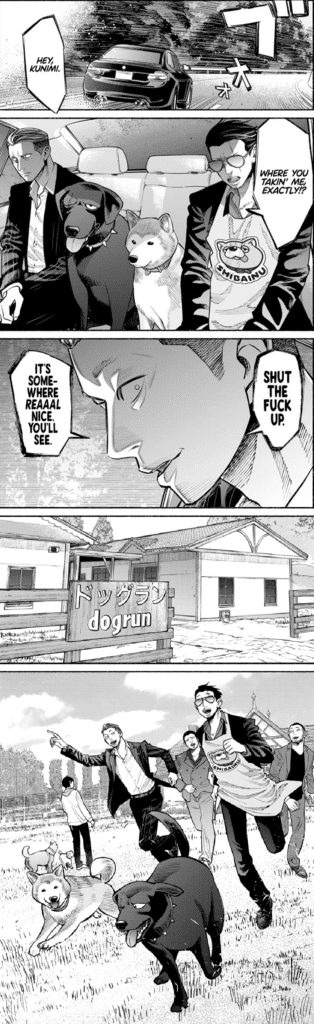
The Way of the Househusband is easily the most atypical entry on this list. It’s a pure comedy manga, yet it more than earns its place among crime manga. Rather than showing criminal activity, the series sticks to everyday domestic life, but frames it with the gravity, tension, and visual language of a brutal underworld drama or yakuza thriller.
At the center is Tatsu, once known as the infamous Immortal Tatsu, a legendary yakuza feared throughout the criminal world. Now retired, he has chosen a different life as a devoted househusband. While the core joke never changes, the execution remains consistently sharp. Neighborhood encounters feel like territorial confrontations, grocery shopping resembles nerve-racking negotiation, and even the most casual conversations carry the weight of Tatsu’s violent history, even when they’re about nothing more than discounts or cleaning supplies.
What makes the series stand out is its complete commitment to tone. The manga never undercuts its own premise or breaks character for cheap laughs. Everything is played straight, which allows the contrast between subject matter and presentation to work.
The artwork plays a major role in selling this idea. Dramatic composition, clean lines, and exaggerated facial expressions mirror the visual intensity of serious action and crime manga. Mundane tasks are framed with a sense of suspense that gives even the smallest moments real weight. The art never feels cluttered, and the clarity of the panels keeps the pacing tight and punchy.
The supporting cast reinforces this theme, since many of them share a past similar to Tatsu. Former yakuza trying to go straight still react to one another as if violence is about to erupt at any moment. Miku, Tatsu’s wife, and his old associate Masa provide both warmth and grounding without diluting the absurdity.
While The Way of the Househusband does not explore crime in the traditional sense, it offers a unique and hilarious perspective on criminal identity and life after the underworld. It’s a fun read that turns crime-manga intensity into deadpan humor, and it’s one of the most consistently enjoyable comedy series out there.
Genres: Comedy, Slice of Life
Status: Ongoing (Seinen)
20. Soil
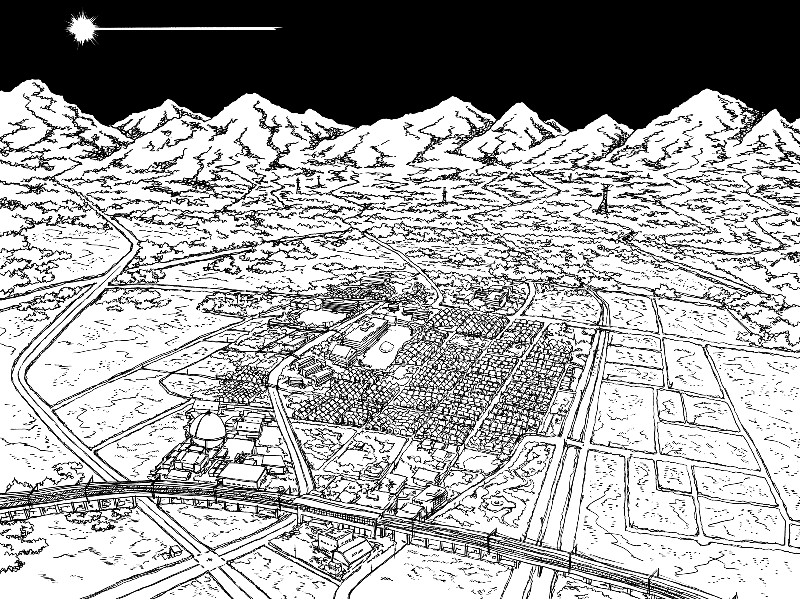
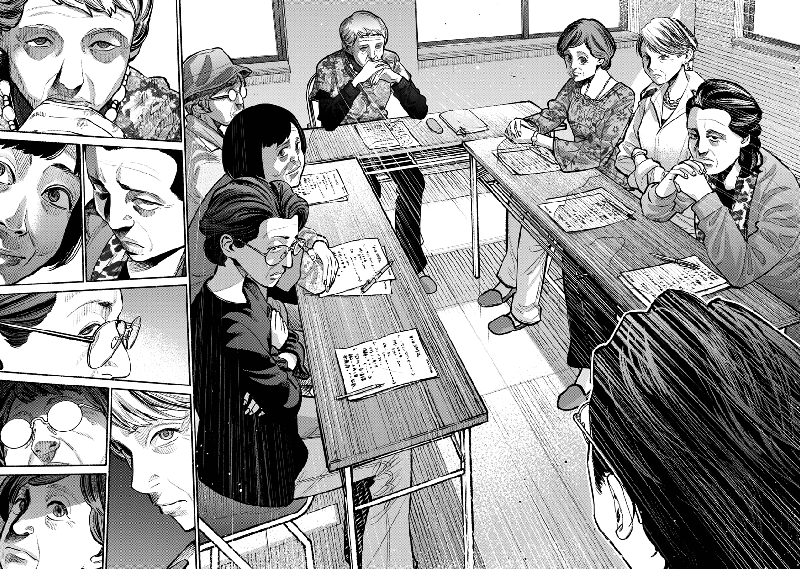
Soil is an outlier on this list, and one of the strangest crime manga you’re likely to encounter. It begins as a grounded investigation before it gradually sheds structure, logic, and even reality itself. This turns a crime story into an exploration of collapse at every level.
The premise is simple. In the newly built and pristine Soil New Town, an entire family vanishes without explanation. Two detectives are dispatched to look into the case. Yokoi is volatile, deeply unpleasant, and barely functional, while Onoda acts as his more stable counterpart. Early chapters stick to standard police work and interviews, but the unease builds quietly. The town appears clean and ordinary, but something feels wrong right from the start.
As the investigation continues, the town’s secrets start to surface. Over time, the case itself stops making sense as absurd details begin to pile up. Instead of answers, each new revelation introduces further distortion. Eventually, the town itself collapses under the weight of absurdity, warping the story from small-town mystery into cosmic surrealism.
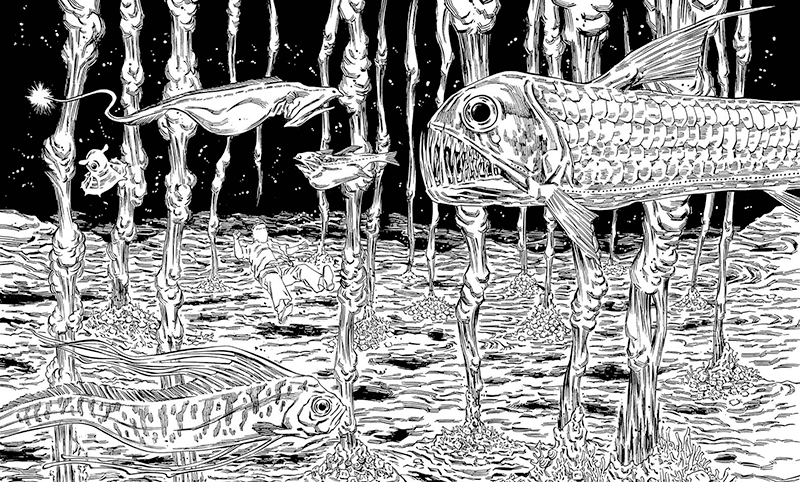
Atsushi Kaneko’s artwork reinforces that shift with precision. Early chapters use stiff, almost awkward compositions that feel intentionally restrained. As the story progresses, that restraint dissolves. Environments bend unnaturally, panel layouts become chaotic, and characters themselves turn into grotesque caricatures of themselves. This visual language mirrors the breakdown of reality, putting you in the same disoriented headspace as the series’ protagonists.
Characterization plays a major role in keeping the story unsettling. Yokoi, in particular, is difficult to sympathize with. He’s abrasive, impulsive, and morally compromised, yet impossible to look away from. Even worse are the inhabitants of Soil New Town. Portrayed as good, happy people early on, almost none of them are trustworthy, and all hide dark secrets of their own. While the disappearance is thought to be an isolated incident, it soon becomes clear that crime has infected almost the entirety of Soil New Town.
Soil ultimately abandons a clean resolution and leans completely into absurdity. The investigative framework disintegrates and is soon replaced by unanswered questions and surreal imagery. For some readers, this might feel too experimental. For others, it’s exactly what makes Soil so memorable. As a crime manga, Soil doesn’t offer justice or closure. It shows what happens when not only an investigation but any system meant to impose order and stability stops functioning.
Genres: Horror, Crime, Mystery, Psychological, Philosophical
Status: Completed (Seinen)
19. Prophecy (Yokokuhan)
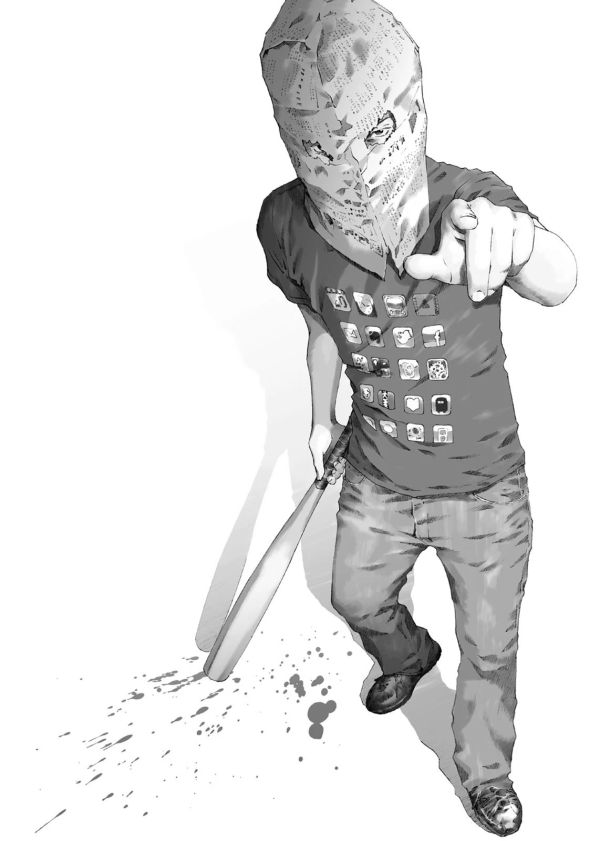
Prophecy is a compact, contemporary crime manga that uses the internet as both weapon and battleground. Rather than focusing on traditional organized crime, it centers on vigilantism shaped by social media, anonymity, and collective outrage. The result is a grounded, sometimes uncomfortable look at how quickly public frustration can be weaponized.
The story follows a masked figure known online as Shinbunshi, or Paperboy, who broadcasts his actions while exposing everyday acts of cruelty, corruption, and abuse that often go unpunished. His targets, however, aren’t criminal organizations, but ordinary people, institutions, and systems that benefit from apathy or power imbalances. As his popularity grows, so does the severity of his actions, drawing the attention of the Tokyo Police Department’s Cybercrime Division and its driven, pragmatic leader, Erika Yoshino. What unfolds is less a mystery than a prolonged pursuit, ultimately shedding light on Shinbunshi’s real motives.
What makes Prophecy stand out among crime manga is its focus on process and consequence. The narrative rarely relies on twists. Instead, it builds tension through escalation. Each act invites a public reaction, which in turn fuels the next step. Shinbunshi’s actions resonate because they address real problems, yet the methods he uses to enforce accountability mirror the ones he claims to oppose.

The police presence is intentionally restrained and often frustrating to follow. Law enforcement is portrayed as rigid and reactive, struggling to adapt to crime that spreads via social media, comments, and viral attention. This imbalance reinforces the manga’s core idea: systems built for physical crime falter when faced with digital mob mentality.
Visually, the manga maintains a clean, realistic style that supports its modern setting. Character designs avoid exaggeration, grounding the story in something that feels close to everyday life. Screens, message boards, and online commentary are integrated directly into panels, reinforcing how deeply digital space shapes perception and action.
Prophecy is not a masterpiece, but it does exactly what it sets out to do. It offers a focused examination of vigilante crime in the internet age, raising questions about responsibility and public anger. For readers interested in a crime manga that engages with modern social dynamics rather than traditional underworld hierarchies, this is a solid, thought-provoking read.
Genres: Crime, Psychological, Thriller
Status: Completed (Seinen)
18. MW
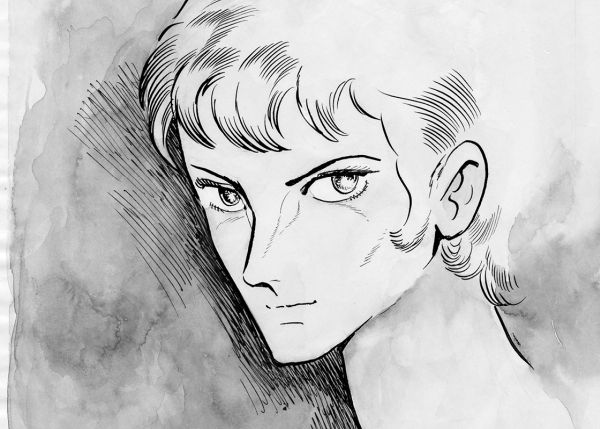
MW stands as one of the earliest and most unsettling examples of adult crime manga, and it still feels confrontational decades after its initial release. Created by Osamu Tezuka in the 1970s, during the period when more adult stories were starting to break into the medium, it’s a bleak, nihilistic, pulpy work that feels foundational, even if it’s rough around the edges.
At the center is a deeply toxic relationship between Garai, a Catholic priest consumed by guilt, and Michio Yuki, a brilliant, beautiful criminal whose actions grow increasingly extreme. Rather than positioning crime as something to be solved, MW treats it as an expression of systemic rot. Yuki is less a conventional antagonist and more a mastermind able to exploit the weaknesses of everyone around him. His manipulation of Garai is relentless, blurring the line between obsession, coercion, and complicity.
The power dynamic between the two men drives the story more than any specific criminal scheme. Garai represents faith, denial, and self-deception, clinging to morality while enabling harm. Yuki, by contrast, embodies pure amorality. He is charming, cruel, and disturbingly empty, committing atrocities with no hesitation or remorse. Their bond is intentionally uncomfortable, especially because the manga engages so openly with sexual violence and manipulation for its era. Their shared backstory pushes into controversial territory, and it may be upsetting.
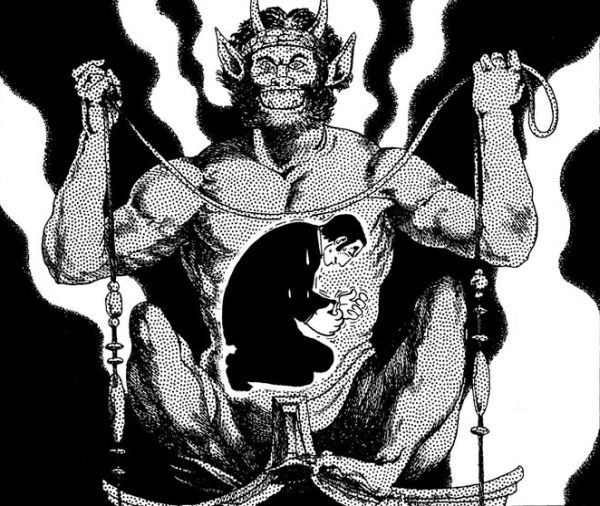
As a crime manga, MW is less interested in criminal procedures or investigation. Authority figures appear ineffective, systems are corrupt and indifferent, and violence escalates without ever offering catharsis. Yuki feels like a force of nature, almost unstoppable. His crimes feel inevitable and hollow, reinforcing the manga’s nihilistic worldview.
The artwork reflects the period it was created. Tezuka’s gekiga-influenced style gives many characters a cartoonish appearance that can clash with the disturbing subject matter. This dissonance can be jarring, especially during the story’s darkest moments. At the same time, his page composition remains strong, and the layered symbolism and visual metaphors add unexpected weight to key scenes.
MW is not without flaws. The pacing is slow, dialogue-heavy, and sometimes melodramatic. Yuki’s excesses and schemes often feel exaggerated to the point of unreality. Yet these qualities also contribute to its strange intensity. For readers interested in the roots of dark crime manga, and in seeing how far manga was willing to push its boundaries early on, MW remains a worthwhile read.
Genres: Crime, Psychological, Thriller
Status: Completed (Seinen)
17. Ikigami
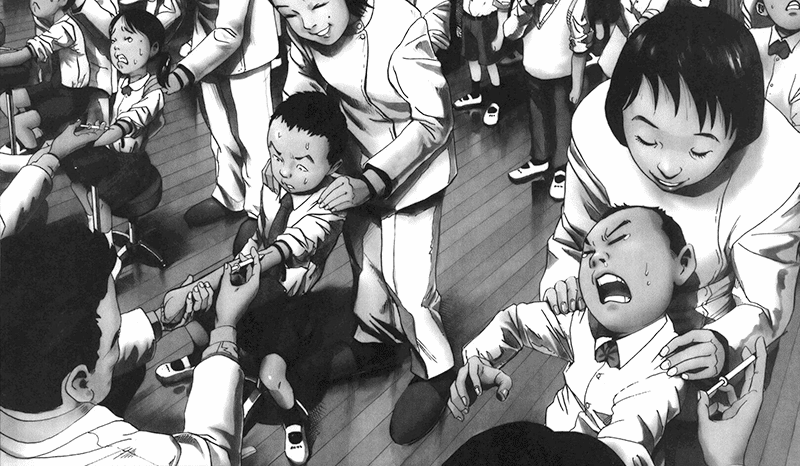
Ikigami approaches crime from an institutional angle rather than through criminals or investigators, which makes it one of the more unusual entries on this list. Instead of illegal acts committed in the shadows, it presents a society where the worst criminal is fully legalized and bureaucratic. The result is a restrained but deeply unsettling crime manga about power, obedience, and normalized violence.
The setting is a near-future Japan governed by the National Welfare Act, a law that mandates the random execution of a small number of young citizens each year. The stated purpose is social stability. Death is presented as a necessary sacrifice, without spectacle, and processed through paperwork. Kengo Fujimoto works as a government messenger tasked with delivering the official death notices, known as Ikigami, exactly twenty-four hours before the recipient’s death.
Rather than building a single escalating plot, it unfolds in self-contained vignettes focused on the notice recipients. Each vignette explores a different response to state violence. Some individuals attempt to reconcile with loved ones, others lash out, and some quietly collapse under the weight of the inevitable. Crime appears around the edges, but it’s rarely the focus. The real fault lies in the system itself, which treats human lives as nothing but an expendable tool.
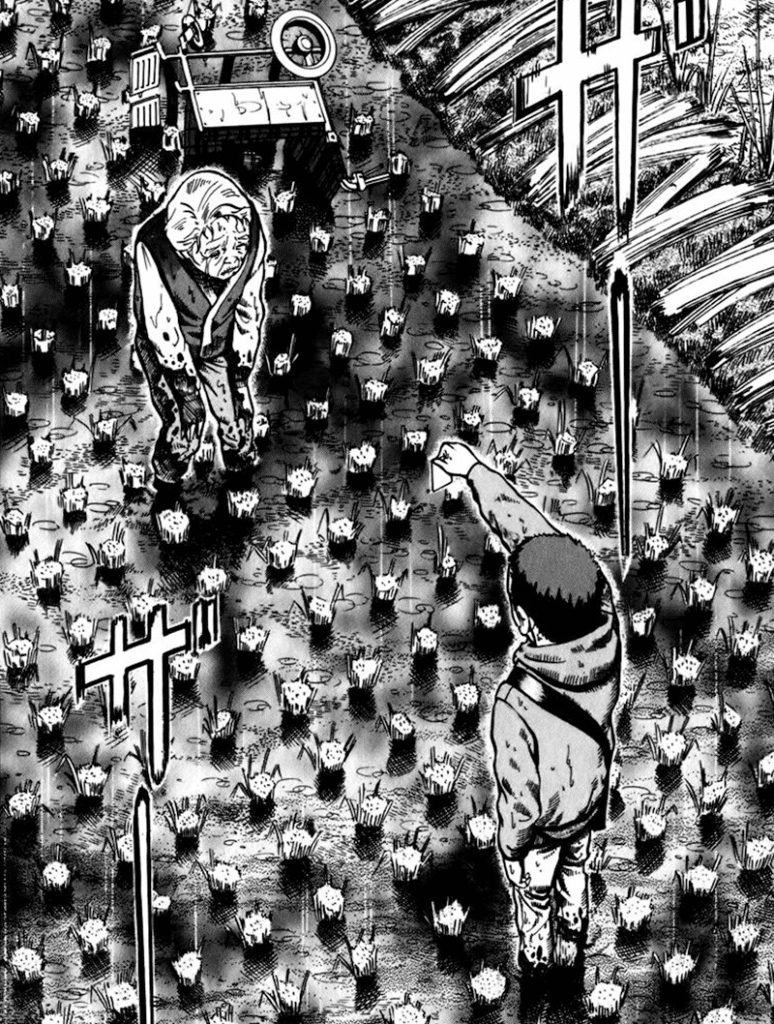
Fujimoto’s role places him in a morally compromised position. He’s not a villain, but he’s part of an inhuman system. His growing discomfort mirrors the reader’s, showing how institutions rely on ordinary people to function. Authority in Ikigami is impersonal. There’s no single antagonist to confront, only laws, procedures, and social pressure. This absence of a clear enemy reinforces the manga’s bleak atmosphere.
The artwork is grounded and realistic, favoring body language and facial expressions over dramatic escalation. This approach suits the material perfectly. The emotional impact comes from quiet moments rather than spectacle, allowing each story to linger in the reader’s mind. While attachment to some of the characters suffers due to the episodic structure, many leave a lasting impression through small, human details.
As a crime manga, Ikigami stands out for reframing crime as a policy rather than personal deviance. It examines how cruelty becomes acceptable when it’s the law and how societies rationalize violence in the name of order. If you’re drawn to stories about systemic abuse of power, moral compromise, and institutional decay, Ikigami will stay with you.
Genres: Crime, Psychological, Drama, Dystopian
Status: Completed (Seinen)
16. My Home Hero
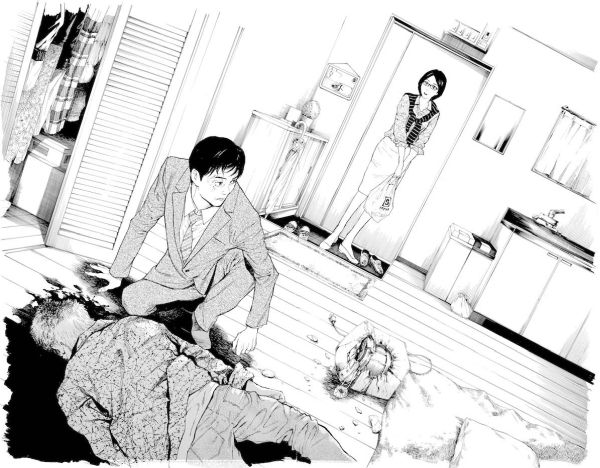
My Home Hero is a domestic crime thriller that turns an ordinary family into unwilling participants in organized crime. Its hook is simple and brutally effective: a normal salaryman discovers his daughter has been abused, uncovers her boyfriend’s ties to a syndicate, and makes a desperate choice he cannot undo. From there, it becomes sustained pressure: one bad decision forces another, and survival depends on keeping the story straight while dangerous people ask more and more questions.
What makes it stand out among crime manga is how grounded the initial conflict feels. Tetsuo is neither a professional killer nor a hardened underworld figure. He’s a father with a strong sense of responsibility, a sharp mind, and no real experience with violence or fighting. This creates constant tension between capability and panic. The early cat-and-mouse dynamic works because the criminals feel plausible, patient, and threatening, but also because Tetsuo’s wins rarely feel clean. Even when he stays ahead, it’s through improvisation, emotional strain, and, occasionally, pure luck, rather than competence.
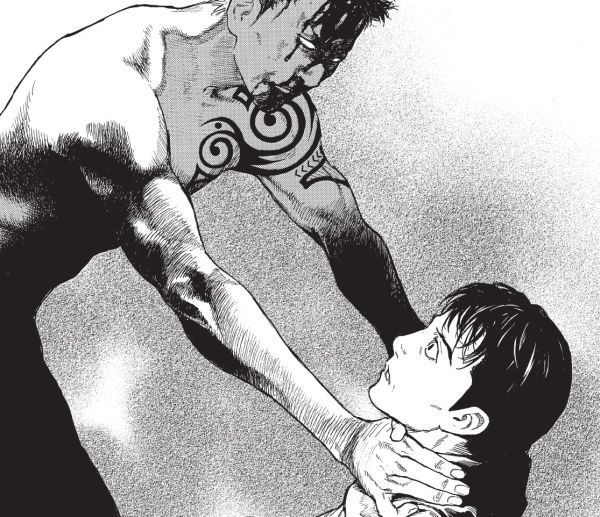
The moral tension is the series’ backbone. Tetsuo’s actions come from love and fear, but the narrative never lets him off the hook for what those actions require. The story also benefits from its focus on partnership. His wife, Kasen, is not a passive bystander. She becomes essential to the cover-up and the decisions that follow, which makes the family dynamic feel like a central part of a thriller rather than a mere background detail.
Structurally, the series is dialogue-heavy and detail-oriented, which suits the narrative. The suspense often comes from planning, interrogation, and small mistakes that could destroy everything. That said, this changes as the story expands. Later arcs become slower and more sprawling compared to the tighter, earlier ones, even if the core tension remains intact.
For readers who want a crime manga built around family, moral compromise, and sustained paranoia, My Home Hero delivers a tense, often exhausting ride that takes its premise seriously and commits to the consequences.
Genres: Crime, Thriller, Psychological, Drama
Status: Completed (Seinen)
15. Ouroboros
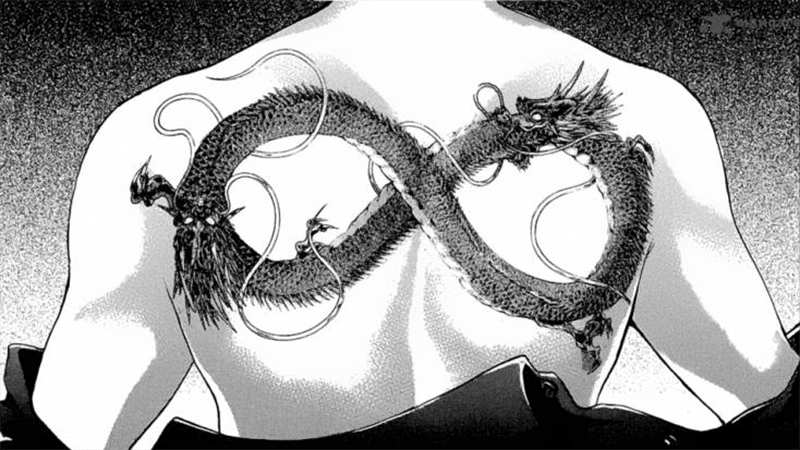
Ouroboros is a crime manga built on a simple but effective premise: one protagonist works inside the system as a Shinjuku police investigator, while the other is a member of the yakuza. That split perspective gives the series its identity. It’s not just about solving cases, but about how power operates in different layers of society, and how justice depends on who can get the right information first.
The story centers on Ryuzaki Ikuo and Danno Tatsuya, two men bound by a shared past. As children, they lived in an orphanage and were raised under the care of a woman who mattered deeply to both of them. When they witnessed her murder, their lives fractured, but they quickly formed a singular goal. They wanted the truth, and they wanted the person responsible. Because of that, one takes the police route; the other goes into the underworld. From here on out, the manga constantly plays with the friction between those roles.
Narratively, Ouroboros follows a more episodic rhythm, with casework and smaller investigations that establish the tone and the protagonists’ skill sets. This procedural approach is the manga’s true strength, not a weakness. It shows how both men navigate information, pressure, and influence, and it gradually builds credibility for the larger conspiracy the story is working toward. The overarching narrative tightens as clues accumulate and the scope widens. The mystery gains weight as it develops through steady exposure rather than sudden revelation.
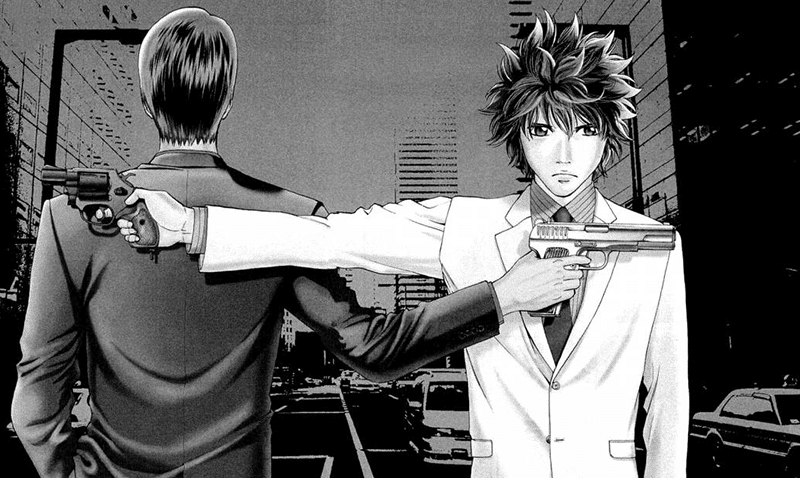
The strongest element is the partnership itself. Ryuzaki and Danno are complex, and their cooperation feels uneasy by design. They operate under different rules, with different risks, and with different tolerances for compromise. That moral tension gives the story momentum. It’s also where Ouroboros mirrors classic police-and-underworld narratives the most, blending institutional investigations with criminal access in a way that keeps the stakes personal.
The art supports the grounded atmosphere. It’s not flashy, but it’s clear, readable, and realistic in character design, which fits the tone of the police and yakuza material. The cast also helps to carry the story forward. Side characters are well written, even when the story keeps you unsure what side they’re really on.
The manga’s biggest fault is that the story can lean too heavily into twists later on, and a few push closer to melodrama than realism.
The mix of episodic casework and long-term conspiracy makes Ouroboros a compelling read for anyone who likes crime stories with both street-level grit and bigger institutional rot.
Genres: Crime, Mystery, Thriller, Drama
Status: Completed (Seinen)
14. Green Blood
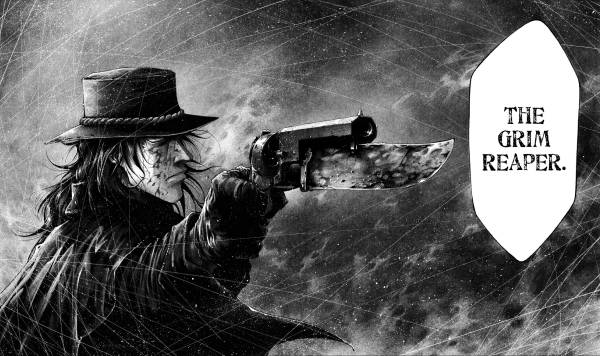
Green Blood is another atypical entry on this list, not because it drifts away from crime, but because of its setting. Instead of the familiar terrain of Japanese cities, neon lights, and yakuza hierarchies, it drops the reader into post-Civil War New York, where poverty and gang violence collide in the Five Points district. The shift in location gives the manga a distinct flavor, turning it into a hard-boiled crime saga filtered through a Western noir lens.
At its core, Green Blood is built around two brothers, Brad and Luke Burns, whose lives have been shaped by the same slums but who’ve taken entirely different paths. Luke dreams of escaping the district and building something stable, while Brad has already become part of its violent underbelly. As an assassin for the Grave Digger gang, Brad embodies the underworld, where survival depends on reputation, brutality, and the ability to pull the trigger first.
This is a crime manga at its most direct. Power is held by gangs and opportunists, while the law feels distant and irrelevant. The Five Points functions like a closed ecosystem, with immigrants and the poor caught between forces they cannot control.
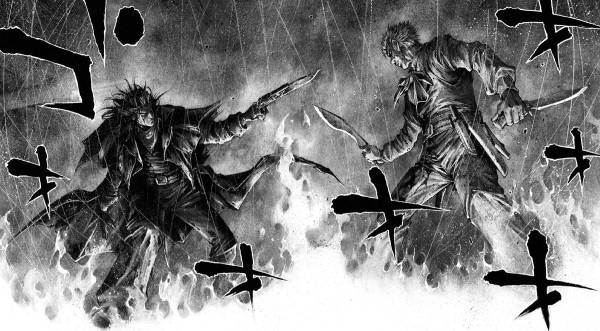
Green Blood also uses that environment to explore societal rot and the people stained by it. It’s especially interested in how far they will go to keep what little power they’ve managed to claim. This often results in bloody confrontations and shootouts where morality and allegiance don’t matter.
Masasumi Kakizaki’s artwork carries much of the atmosphere. The pages are dense with shadows and textures, evoking classic Western comics and old gangster films. Period details, from clothing to architecture to weapons, are handled with care, and the city feels alive and realistic rather than staged. Action scenes are choreographed with a cinematic clarity that makes the violence visceral without becoming messy. Even when the plot leans into familiar revenge tropes, the visual execution keeps it sharp.
Green Blood is not without limitations. Some side characters aren’t fully realized, and the story’s scope can feel too large for its five-volume run, especially as it approaches the finale. Still, the atmosphere is strong enough to carry those weaknesses. For readers who want a crime story defined by grit, brotherhood, and a sense of historical brutality, Green Blood offers a memorable detour from the usual settings, while staying firmly rooted in underworld drama.
Genres: Historical, Action, Crime, Drama
Status: Completed (Seinen)
13. A Suffocatingly Lonely Death
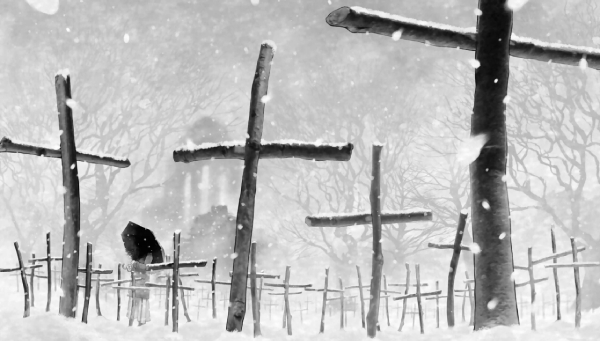
A Suffocatingly Lonely Death is one of the purest investigation-driven entries on this list. Where many crime stories split their attention between multiple arcs, underworld factions, or shifting settings, this series builds its momentum around a single, grotesque case and the people caught in its gravity.
The story opens with a horrific case involving the murder of multiple children in a mansion, pulling detective Jin Saeki into an investigation that immediately feels wrong. The case isn’t flashy or designed to impress. It’s a slow-burn mystery. Saeki follows leads that rarely paint a clear picture, and interviews people who are damaged by buried trauma. Suspicion soon falls on Juuzou Haikawa, the mansion’s owner, a man tied to the witnesses’ past. Yet it remains uncertain whether he’s guilty, unhinged, or was manipulated by other forces.
What sets the manga apart from other crime manga is its restraint. The horror is rooted in realism rather than flashy escalation, which makes the atmosphere heavier. The most disturbing moments involve small details, unsettling implications, and the sense that the truth is buried deeper than originally thought. The pacing is methodical, allowing dread to build through procedure, dialogue, and slow revelations.
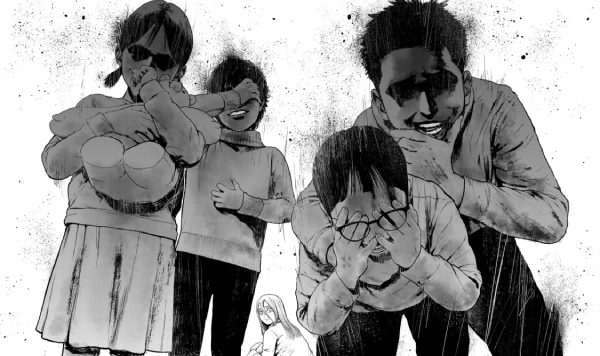
Character psychology is treated as evidence in itself. Saeki is not a detached genius solving a case from a distance. Instead, the deeper he digs, the more personally he becomes involved, first through the enigmatic Kanon Hazumin, and later his own brother’s connection to the case. At the same time, the manga’s scope slowly widens, as more characters and hints at a far deeper, overarching narrative are introduced.
Written by Hajime Inoryuu and illustrated by Shota Ito, the duo behind My Dearest Self With Malice Aforethought, the series carries a similar tension, but channeled through a slower, more grounded investigative structure. If you enjoy long-form mysteries where every answer adds more questions, and darkness comes from people, not monsters, A Suffocatingly Lonely Death is worth your time.
Genres: Crime, Mystery, Psychological
Status: Ongoing (Seinen)
12. Shinjuku Swan
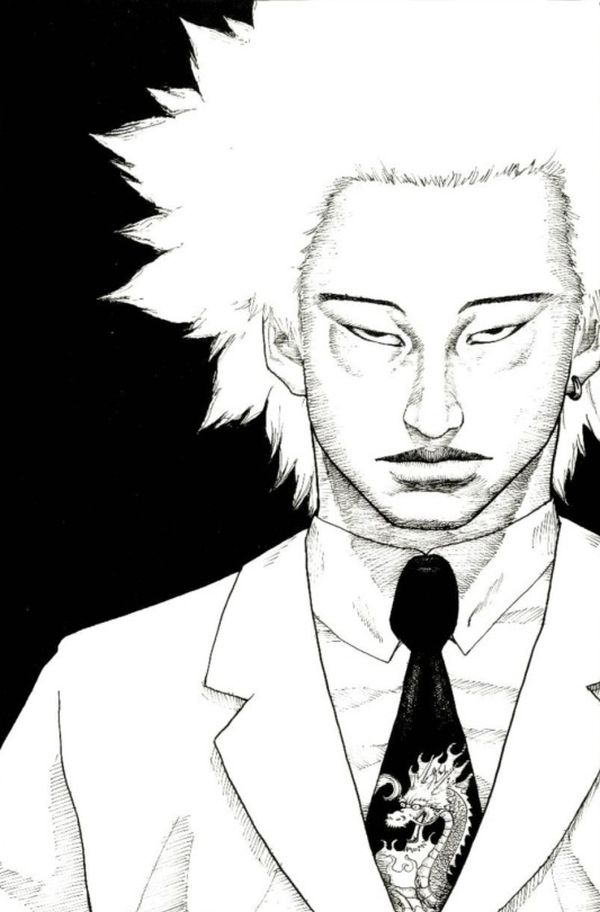
Shinjuku Swan is a crime manga set in a place other series rarely touch: the everyday workings of Tokyo’s nightlife. Instead of centering on detectives or yakuza bosses, it follows the people who profit from the gray zone between entertainment and exploitation, where money decides what’s permitted and violence functions as negotiation. Set in Kabukicho, the manga treats the red-light district as its own ecosystem, complete with rival factions, informal rules, and the constant threat of punishment for stepping out of line.
The protagonist, Tatsuhiko Shiratori, begins working as a scout for a talent agency, tasked with recruiting women for the adult entertainment industry. That premise alone makes the story uneasy in a way that’s different from other crime narratives. The series does not romanticize his work. It shows the manipulation, coercion, and predatory dynamics surrounding the business, and it makes clear that even legal operations can be deeply criminal in effect. Tatsuhiko is not a typical underworld operator, either. He enters this world with a stubborn sense of empathy and a naïve belief that he can protect people while still playing the game. The manga’s tension comes in large part from watching those ideals collide with a system designed to destroy them.
Power in Shinjuku is a volatile thing. Rival scouting companies fight for territory, hosts and agencies compete for influence, and the yakuza are an ever-present, final authority. Conflicts escalate through intimidation, bribery, betrayal, and shifting alliances, while victories are decided by resources and numbers. No group is clean, and even the characters who seem principled may be complicit, complicating any simple moral reading. This ambiguity is one of the series’ biggest strengths.
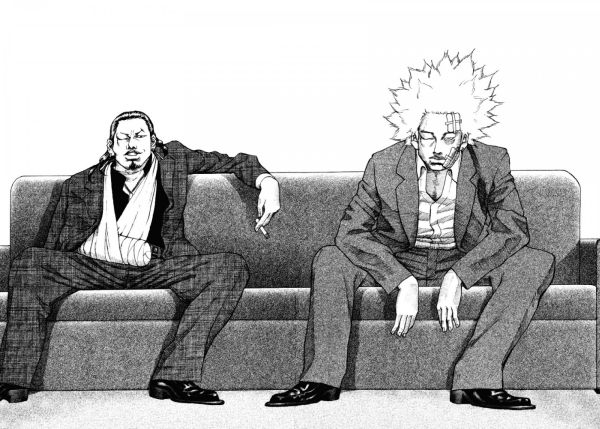
The cast is large, and the story grows more complex as it expands beyond its early arcs. Characters who initially appear one-dimensional gain nuance, and antagonists frequently become more unstable once their motivations surface. The writing shows characters through behavior and expression rather than exposition, which helps the series feel grounded even when the stakes rise.
Visually, the manga develops over time. Early chapters can look rough, but the artwork becomes increasingly detailed and consistent, especially in character design, clothing, and facial expressions. Wakui’s style captures weariness, calculation, and sudden violence with a realism that fits the setting. Most importantly, the series often emphasizes the aftermath of brutality rather than glamorizing the act itself.
For readers interested in crime manga that explore social decay through nightlife, exploitation, and territorial conflict, Shinjuku Swan offers a harsh, messy look at how the underworld functions when it’s embedded in everyday business.
Genres: Crime, Drama
Status: Completed (Seinen)
11. My Dearest Self With Malice Aforethought
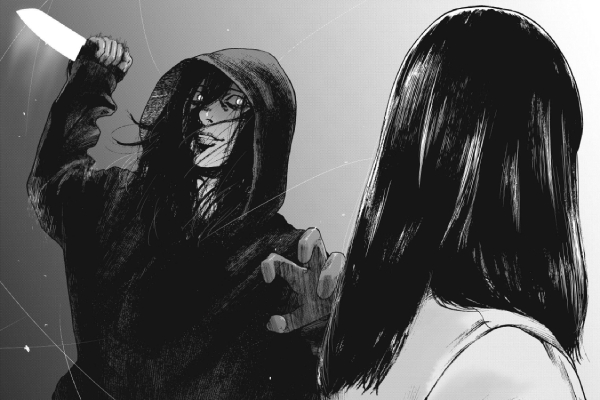
My Dearest Self With Malice Aforethought is a psychological thriller that treats identity as its primary weapon. Rather than focusing on gangs, police procedure, or underworld hierarchy, it builds tension through disorientation, misdirection, and the slow realization that the protagonist’s life may be a lie. It’s one of the darker entries on this list, not because it relies on graphic violence, but because it frames crime as something intimate, personal, and difficult to escape from.
Eiji Urashima appears to be an ordinary college student until his reality collapses overnight. He wakes up with no memory of the last few days, and the gap in time is a major mystery to him. A stranger claims to be his girlfriend, he’s made the acquaintance of dangerous people, and small details suggest terrible things happened while he was absent from his life. From there, the story escalates into a cascade of revelations involving hidden motifs, false identities, and buried secrets.
What makes the series stand out among other crime manga is its relentless pacing. The first half is razor-sharp, with each new revelation reshaping the narrative. This constantly forces readers to reassess what they know, and the sensation of certainty never lasts long. This approach makes the manga addictive, though it may overwhelm readers who prefer a more methodical structure.
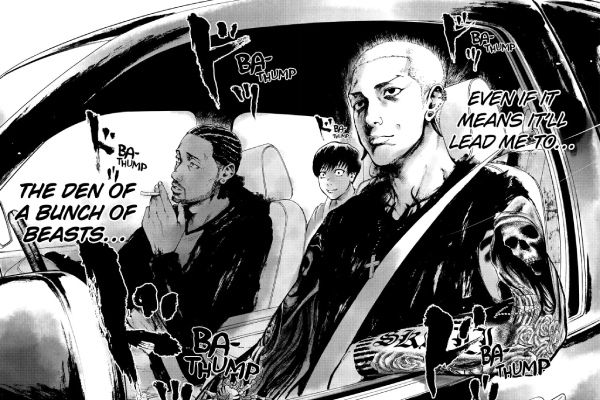
As the series progresses, the storytelling becomes more linear and resolution-focused. The chaos tightens into a clearer direction, giving themes and character arcs more room to solidify. Some of the electric tension of the earlier chapters fades, but the core mystery remains engaging, and the eventual payoff stands as a satisfying conclusion.
Shota Ito’s clean, realistic art style keeps the story grounded even as events become increasingly extreme. The setting feels tangible; the characters are expressive without exaggeration, and the paneling remains clear during moments that could easily become confusing. This clarity strengthens the psychological tension because it prevents the manga from slipping into theatrics. The tension here comes from plausibility, from the sense that the worst possibilities are not supernatural, but hidden within your own mind.
Written by Hajime Inoryuu and illustrated by Shota Ito, the series also serves as a stark contrast to their later work, A Suffocatingly Lonely Death. While that manga leans into procedurals and slow-burn tension, this one is twist-driven and aggressive, prioritizing momentum over restraint. For readers who want a fast-paced crime manga where secrets keep getting deeper rather than resolving quickly, My Dearest Self With Malice Aforethought is a grim, addictive read.
Genres: Crime, Psychological, Thriller, Mystery, Drama
Status: Completed (Seinen)
10. Smuggler

Smuggler is proof that a crime story doesn’t need dozens of chapters to leave a mark. In only a single volume, Manabe Shōhei delivers a tight, grimy thriller that feels cinematic without relying on elaborate twists or an extended narrative. It’s fast, violent, and oddly funny in the darkest places, built around underworld logic where small jobs turn fatal because everyone involved is already desperate.
The setup is immediate and gripping. Yosuke Kinuta, a failed actor buried under debt, has run out of respectable options. When he accepts work with a corpse disposal group, the decision isn’t framed as a moral fall from grace. It feels like a necessity, an ugly job taken because there are no alternatives left. This grounded motivation is important because Yosuke serves as the story’s anchor among a cast of hardened criminals and cold-blooded killers.
The underworld in Smuggler is not a distant backdrop. It’s an active setting driven by competing factions, volatile egos, and opportunism. Yosuke’s role places him in a conflict he doesn’t understand, and that becomes increasingly dangerous. What begins as routine quickly transforms into mob warfare. When two ruthless Chinese assassins appear, the story becomes even more chaotic and unpredictable. The tension spikes when Yosuke makes a mistake that could cost him his life.
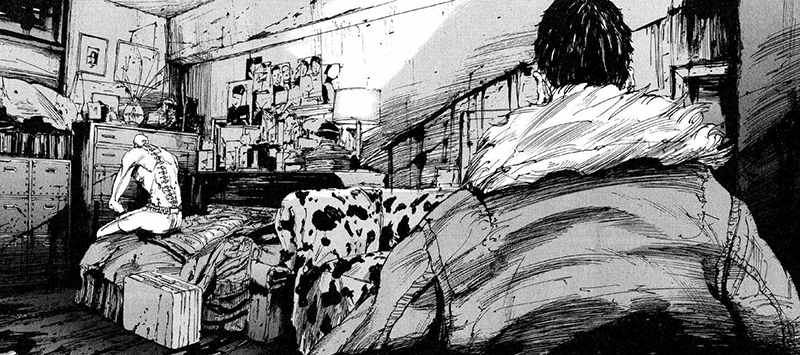
As a crime manga, Smuggler stands out through its character work. Manabe fills a short narrative with personalities that feel sharp and memorable, from hardened professionals who treat death like logistics to the assassins whose menace is inseparable from absurdity. There’s black humor threaded throughout, but it’s never used to soften the violence. It’s there to underline how warped these people are, and how normal brutality has become in their world.
Manabe’s art fits the tone perfectly. Faces look strikingly human but slightly grotesque, and the environments are detailed, dirty, and realistic. The paneling keeps the action clear and forceful, and the grounded visual style helps the more outrageous characters and moments to stand out even more.
Smuggler is the kind of manga you can finish in one sitting, but its key moments will linger long after. If you want a short crime manga with sharp pacing, morally compromised characters, and a strong finale, Smuggler delivers.
Genres: Crime, Thriller
Status: Completed (Seinen)
9. The Fable
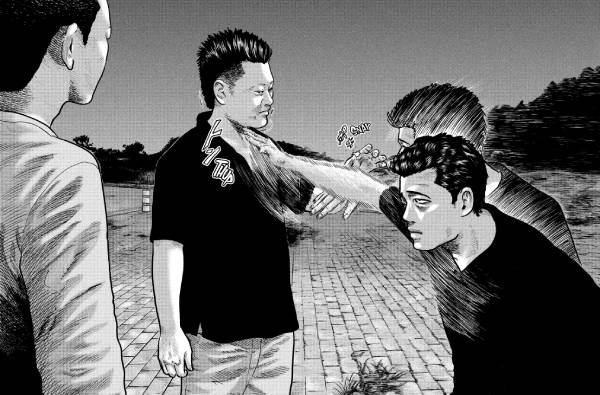
The Fable doesn’t revolve around crime so much as it lives in its aftermath. Its protagonist isn’t climbing the underworld or solving a case. Instead, he’s trying to survive a year without drawing attention, and that restraint becomes the story’s central theme.
Akira Saito, known in the criminal world as The Fable, is an infamous professional killer with a reputation that borders on myth. When his boss commands him to take a one-year sabbatical in Osaka, the rules are simple: don’t kill anyone. Akira and his partner, Youko, move under new identities and pretend to be siblings. The threat behind the order is obvious. If Akira breaks the rule, consequences will follow.
What makes the Fable stand out among crime manga is its tone and structure. Much of the story is about friction. Akira is hyper-competent, but socially alien. He can read danger instantly, yet struggles with basic human interaction, workplace etiquette, and the small negotiations of everyday life. The manga plays this contrast straight, creating a strange blend of deadpan comedy, slice-of-life routine, and sudden, sharply grounded violence. Humor comes from how sincerely Akira attempts to be normal, and how badly he fits the role.
At the same time, trouble doesn’t vanish just because he wants peace. Before long, tensions explode, and when violence hits, it lands heavier after the story’s long stretches of restraint.
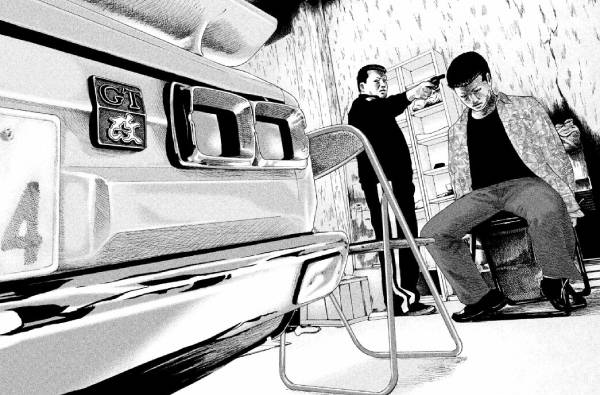
The series also offers a rare perspective on professional criminality. Akira isn’t romanticized as a stylish hitman. He feels like a sharpened tool, and the story explores what happens when a person built for violence is forced to exist without it. That psychological angle is understated but persistent, especially as Akira forms fragile connections with people who have no idea what he really is.
Katsuhisa Minami’s artwork reinforces the grounded atmosphere. The realism is striking, capturing Osaka streets, cramped apartments, and subtle facial expressions with a precision that makes both comedy and danger feel plausible. Characters look distinctly human, and the visual restraint suits a story that relies on awkward silence as much as action.
The supporting cast adds a lot to the experience. Youko adds volatility and humor, while the yakuza, local gangsters, and ordinary citizens create a social web that constantly threatens to expose Akira’s true nature. It’s a crime manga full of tension, absurdity, and a genuine sense of realism that stays funny and quietly unsettling without feeling forced.
Genres: Crime, Slice of Life, Dark Comedy
Status: Completed (Seinen)
8. Gannibal
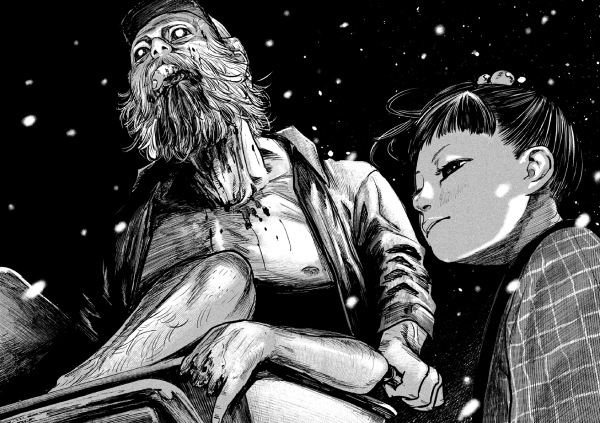
Gannibal is one of the more horror-leaning entries on this list, but it earns its place through how tightly it frames policing, dread, and the isolation of a closed community. It’s a rural noir crime manga that treats the countryside not as a refuge, but as a place where violence lies hidden behind tradition, politeness, and local authority.
The story follows Daigo Agawa, a police officer who transfers to a remote village with his wife and young daughter. On paper, it’s a quiet post, perfect for healing. In practice, it becomes a trap. The village operates by its own rules, and Daigo is an outsider in every way possible. His predecessor disappeared under suspicious circumstances, the residents are evasive, and the Goto family holds a level of influence that makes the police feel irrelevant. When a brutally maimed corpse appears, rumors and reality begin to blur, and Daigo is forced to consider a terrifying possibility that becomes harder and harder to dismiss.
What makes Gannibal stand out is its use of restraint. The manga is not driven by constant action. It’s driven by atmosphere, escalation, and the slow realization that institutional protection doesn’t exist here. Every conversation feels heavy with meaning. Every act of cooperation comes with a hidden cost. Daigo is surrounded by people who may be complicit, terrified, or both, and the lack of reliable allies turns routine investigation into something psychological and exhausting.
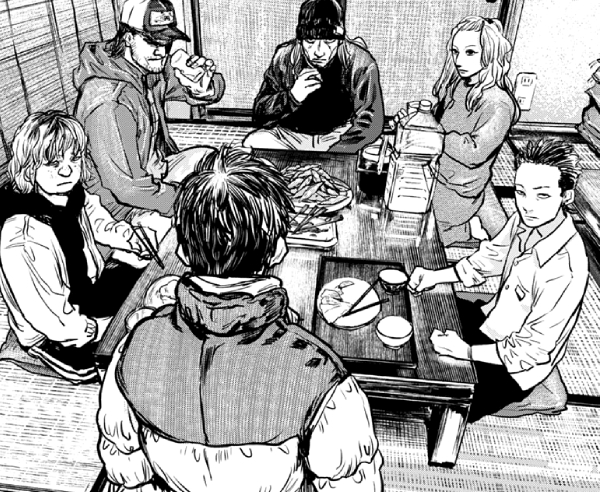
Masaaki Ninomiya’s artwork strengthens the realism. Faces are expressive and grounded, and the rural setting feels tangible rather than stylized. The violence, when it arrives, is shocking, but it’s not presented as spectacle. It has weight, and it leaves consequences. The contrast between scenic calm and human brutality makes the horror hit harder.
Daigo himself is not a clean hero. He’s flawed, stubborn, and sometimes reactive, which makes his fear and anger feel more credible. The Goto family, meanwhile, is not written as mere monsters. They are menacing, but they also feel like products of an environment where cruelty has become tradition.
Gannibal blends investigation with suffocating horror and social decay, delivering a tense, immersive descent into rural violence.
Genres: Crime, Mystery, Psychological, Horror
Status: Completed (Seinen)
7. Homunculus
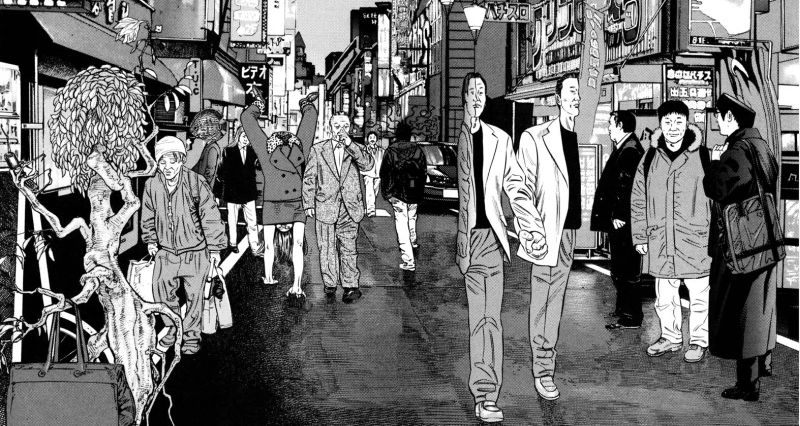
Homunculus is a borderline inclusion on this crime list, but it fits in a way that feels true to the genre’s darker edges. It’s primarily a psychological character study, yet it repeatedly brushes against exploitation, coercion, and the kind of moral decay that often sits beneath the surface of crime manga. Rather than presenting crime as a plot, it treats it as an environment that exposes what people will do when they believe no one is watching.
The story centers on Susumu Nakoshi, a man living in his car parked between a park full of the homeless and luxurious hotels. A medical student, Manabu Ito, approaches him with an offer: trepanation, a procedure that drills into the skull in the belief that it can expand consciousness. Nakoshi agrees after being promised payment, and the decision becomes the catalyst of everything that follows. Once the operation is over, he begins seeing grotesque distortions in the people around him, visions he comes to interpret as homunculi, manifestations of hidden selves, trauma, and self-deception.
What begins as a strange experiment quickly becomes an uncomfortable exploration of identity. Nakoshi’s ability reveals other people’s damaged selves, and the series repeatedly places him in situations where boundaries collapse. Some encounters drift into the criminal or predatory. Others slide into pure psychological horror, but the unifying threat is exploitation, both emotional and physical.
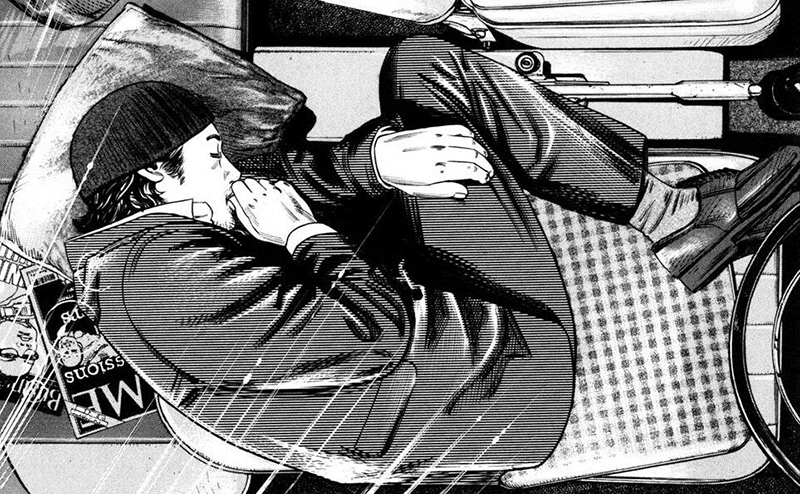
Hideo Yamamoto’s artwork is essential to the experience. Realistic character work is punctuated by surreal, often disturbing transformations that feel both symbolic and bodily. The homunculi designs are visual metaphors, but they are also viscerally grotesque, blurring the line between hallucination and reality. This ambiguity is intentional. The story never fully clarifies whether Nakoshi is accessing the truth or simply unraveling, and that uncertainty becomes part of the manga’s unsettling atmosphere.
Nakoshi and Ito are both compelling characters because neither is clearly sympathetic. They are both broken in their own way, and their interactions often reflect each other’s pain. This gives the manga more depth. As the series progresses, the narrative becomes increasingly surreal, culminating in a divisive ending that abandons neat explanations in favor of utter psychological collapse.
Homunculus won’t satisfy anyone looking for a traditional crime narrative. It’s unsettling, messy, and difficult to pin down, but as a crime manga overlapping with psychological horror, exploitation, and identity collapse, it’s one of the medium’s strangest descents.
Genres: Crime, Psychological, Horror, Philosophical, Drama
Status: Completed (Seinen)
6. MPD Psycho
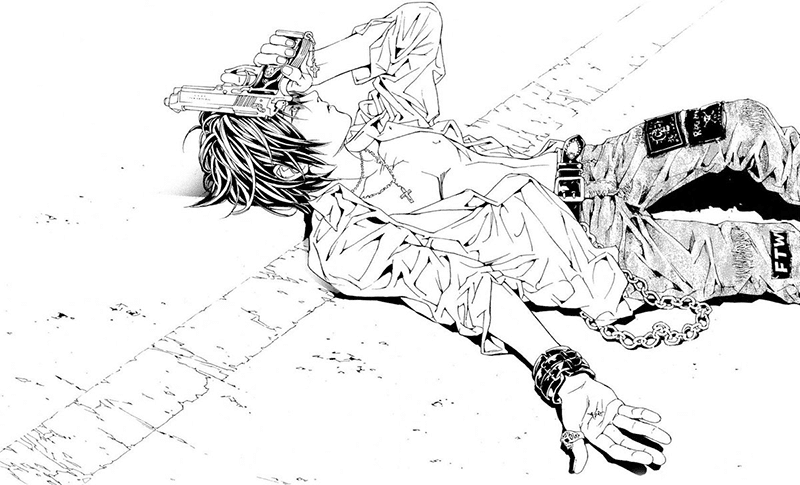
MPD Psycho is one of the most twisted crime manga on this list. It begins with brutal casework and gradually mutates into something far larger and more disturbing. It starts as a familiar detective narrative, which slowly transforms into a labyrinth of violence, identity fracture, and conspiracy. The result is neither comfortable nor clean.
The series follows Kazuhiko Amamiya, a man diagnosed with multiple personality disorder and working as a police detective. Early chapters often read like standalone investigations, each built around ritualistic crime scenes and grotesque murders. These cases aren’t presented as clever mysteries. They’re meant to feel contaminated. The violence is extreme, the motifs are often warped, and the atmosphere leans toward unhinged psychological horror.
Over time, the manga reveals these crimes are anything but isolated. A larger structure emerges, involving cult influences, manipulation, and experiments. The procedural framing dissolves as the story becomes more conspiracy-driven, and the reader is forced into a growing web of shifting motifs, characters, and organizations. This transition is where MPD Psycho becomes uniquely compelling, but also demanding. The narrative can be difficult to follow, especially as Amamiya’s identities shift and the distinction between personal trauma and manipulation dissolves.
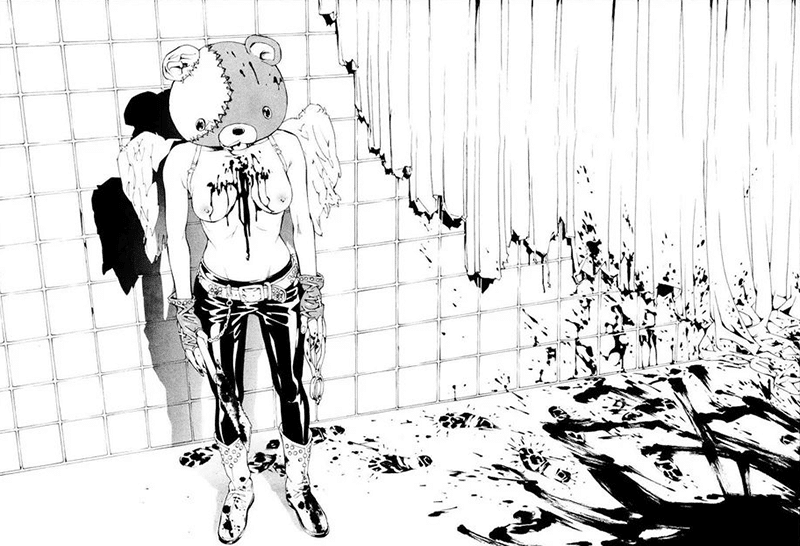
The art by Shou Tajima is central to the experience. The linework is clean and grounded. When the manga becomes graphic, it’s graphic with intention. Violence isn’t decoration. It’s there to show how dehumanizing the world of the story is, and it mirrors its main theme of the fragility of the self. The visual clarity also helps anchor a narrative that constantly threatens to shift into chaos.
All of this is held together by Amamiya himself. His fractured identity is not a gimmick, but a thematic anchor that reinforces the manga’s obsession with control, coercion, and the ways people can be shaped by trauma. The story repeatedly raises the question of who is acting and who is being acted upon, which gives even its most outlandish elements a psychological foundation.
MPD Psycho rewards patience. It’s dense, bleak, and often brutal, but it’s also relentlessly inventive. For readers who can tolerate graphic violence and want crime manga that push standard investigation into conspiracy, identity collapse, and the uglier side of human behavior, this is one of the most compelling in the medium.
Genres: Crime, Mystery, Psychological, Horror, Thriller
Status: Completed (Seinen)
5. Monster
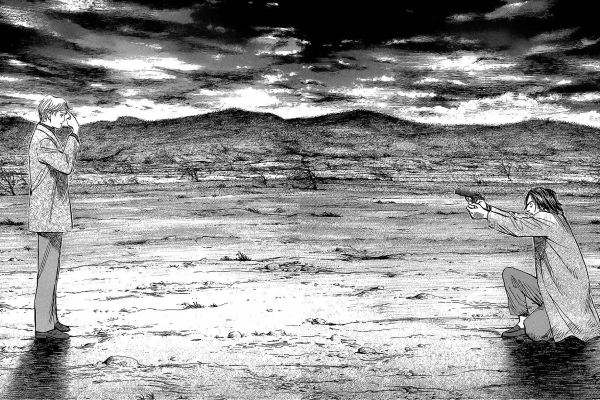
Monster is often called one of the greatest mystery thrillers in manga, but at its core it’s a crime story. The story revolves around a serial killer, institutional cover-ups, and a long pursuit that drags its protagonist through the darker corridors of post-Cold War Europe. It doesn’t focus on gangs or underworld hierarchy, but it belongs on a crime manga list because its narrative is shaped by violence and the systems that enable it.
The central figure is Dr. Kenzo Tenma, a Japanese neurosurgeon whose life derails after a single ethical decision. He chooses to save a young boy’s life instead of prioritizing that of an important politician, defying hospital pressure and paying for it professionally. Years later, the boy, Johan Liebert, resurfaces as a calculating killer, and Tenma is forced to confront the consequences of his compassion. The story becomes a manhunt that stretches across borders, with Tenma pursuing a person who functions less like a conventional villain and more like a moral catastrophe.
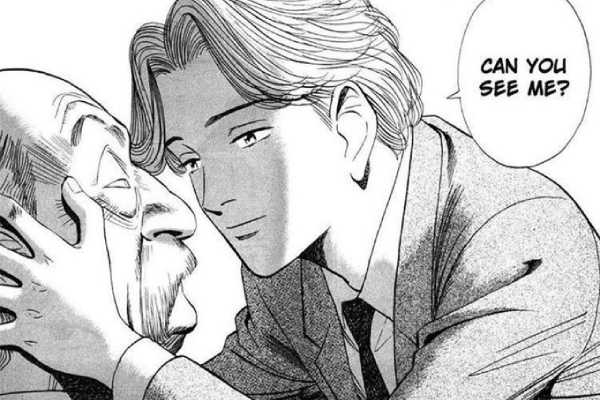
What makes Monster stand out among crime manga is its psychological focus. Johan is frightening not because he’s impulsive, but because he’s calm, intelligent, and persuasive. He does not rely on brute force. Instead, he manipulates people, isolates them, and nudges them toward their darker impulses as if testing how fragile the human mind really is. His crimes ripple outward, drawing civilians, police, and officials into situations where fear and self-interest override morality. The series treats evil as something that can be rational, socially contagious, and disturbingly ordinary once the right pressure is applied.
Tenma’s role adds a second layer of tension. He’s not a detective or a professional investigator. He’s a man guided by conscience, forced into choices that erode his certainty. The question driving the story is not whether he can catch Johan, but what justice looks like when you created the problem. Urasawa fills the narrative with morally compromised characters, many of whom operate within institutions that protect reputations rather than people. Police investigations, political maneuvering, and quiet corruption appear repeatedly, reinforcing the sense that crime is not only personal but also structural.

Urasawa’s artwork supports this realism. Character designs are grounded, expressions are subtle, and the pacing relies on slow dread rather than spectacle. Small conversations and empty spaces carry as much tension as overt violence, which makes each escalation feel earned. The story occasionally leans into coincidence, but its methodical structure and emotional weight keep it compelling throughout.
Monster is ultimately a crime manga about the fragility of empathy, moral decay, and the consequences of saving the wrong life. It’s one of manga’s defining thrillers.
Genres: Crime, Psychological, Mystery, Drama
Status: Completed (Seinen)
4. Freesia
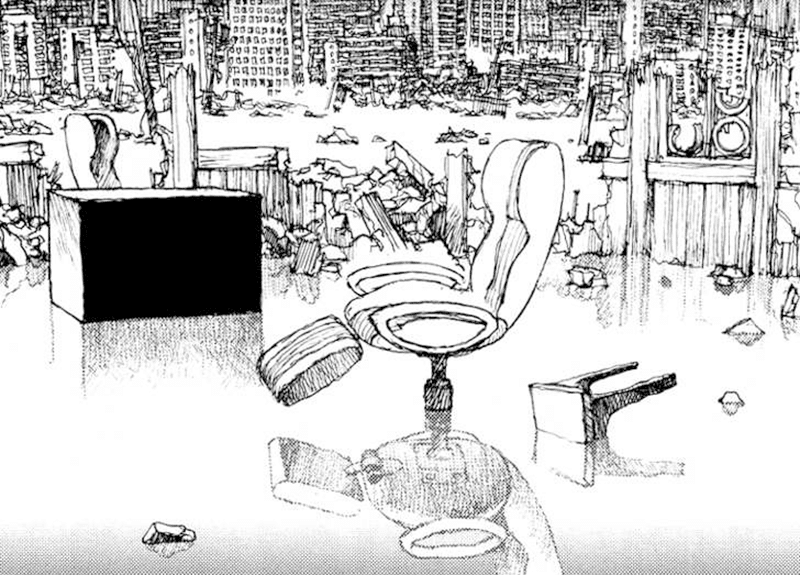
Freesia is a psychological crime manga where violence is police and sanity is collateral damage. Its premise sounds almost procedural, but the execution is anything but clean. Jiro Matsumoto builds a world where crime has become part of the legal system, and the result is not order, but a society that’s spiritually exhausted and morally compromised.
In this dystopian Japan, retaliatory killing is legal. If a loved one is murdered, the victim’s family can legally kill the perpetrator in return, either personally or by hiring a government-approved executioner. Kano works inside that system, carrying out state-sanctioned killings that are framed as justice, but operate like revenge on paperwork. The story is not interested in debating the law in abstract terms. Instead, it shows what the law does to people, and how it normalizes violence until everyone involved becomes numb, warped, or hollow.
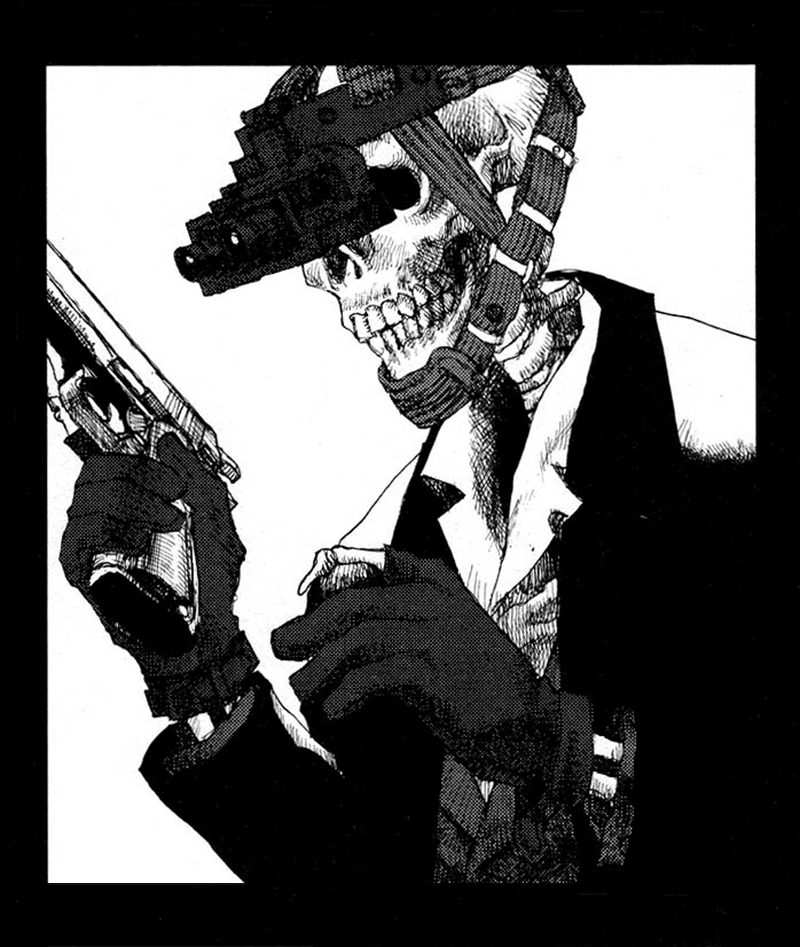
The setting is bleak and oppressive. War sits in the background as a constant condition rather than a plot point, and cruelty feels like routine. The atmosphere is reinforced by Matsumoto’s art, which is gritty, raw, and often deliberately ugly. Backgrounds can be intensely detailed, while faces are sometimes simplified to the point of eeriness, creating a visual dissonance that matches the story’s emotional instability. The manga’s reality also slips without warning. Scenes fracture, transitions feel abrupt, and the reader can never be fully certain what’s real and what’s filtered through damaged perception.
Kano’s mental state is the central reason for this. He experiences hallucinations, memory gaps, and a persistent sense that his mind cannot be trusted. This is what elevates Freesia. Instead of showing us Kano’s workings from an external perspective, Matsumoto pulls us into his fragmented consciousness, using confusion to showcase just how corrupted the world has become. Many other characters are similarly broken, not presented as exceptions but as the natural result of living in a society that has legalized murder as a coping mechanism.
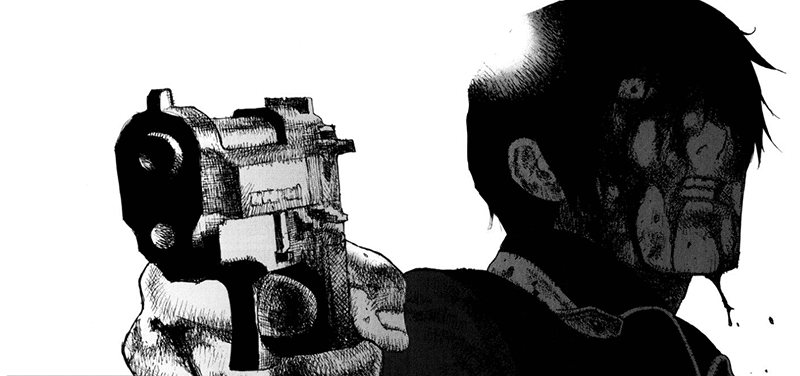
One of the manga’s strongest choices is its moral ambiguity. While Kano and his colleagues are legal killers, the story frequently humanizes their targets, and even those who deserve retaliation are rarely simple monsters. Each killing carries its own tragedy, often exposing how easily victimhood and guilt can overlap. That complexity keeps Freesia from becoming a simple revenge fantasy and turns it into a portrait of a deeply rotten society.
Freesia is not an easy read. It’s surreal, depressing, and psychologically abrasive. Still, it’s unforgettable, and it stands out among crime manga precisely because it refuses any form of catharsis. If you’re drawn to stories about institutional cruelty, moral decay, and fractured identity, Freesia offers a bleak, hypnotic experience unlike any other.
Genres: Crime, Psychological, Drama
Status: Completed (Seinen)
3. Sanctuary
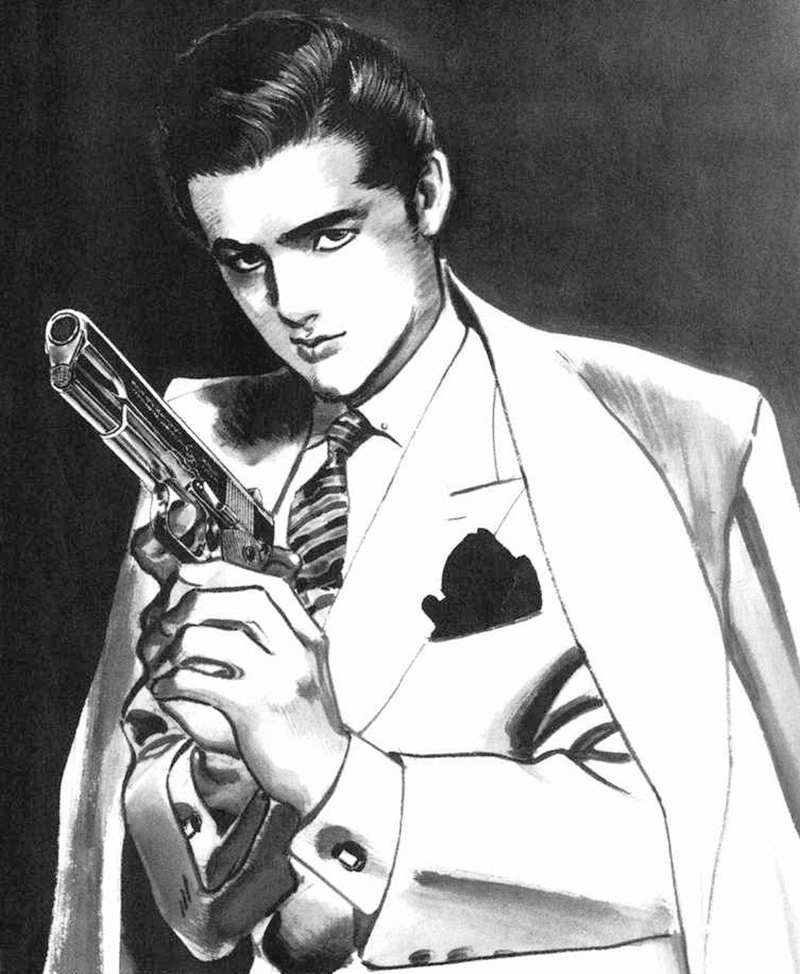
Sanctuary is one of the defining crime and political thrillers in manga because it treats power itself as the subject. The series is built around the idea that crime is not limited to the underworld, but also embedded in boardrooms, government offices, and the quiet bargains that decide who gets to rule. Buronson and Ryoichi Ikegami turn that thesis into a sweeping dual narrative that moves between yakuza brutality and political ambition with equal confidence.
Akira Houjou and Chiaki Asami are two childhood friends whose goal is to drag Japan out of regression and remake it into their own sanctuary. They take opposite paths to get there. Houjou works to consolidate control over the yakuza through alliance, intimidation, and decisive violence. Asami, meanwhile, enters the realm of politics, aiming for the seat of prime minister, climbing through elections, influence, and backroom manipulation. Together, they represent two sides of the same coin, one legal on paper, the other criminal by definition, but the manga shows that both operate through the same ruthless logic.
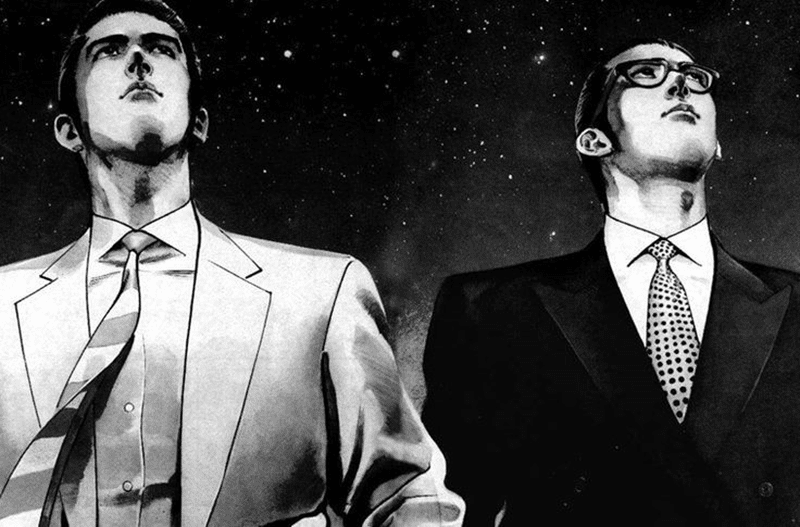
This dual structure is Sanctuary’s greatest strength. The underworld side provides turf wars, gang negotiations, and the yakuza’s role as an informal power structure that shapes what the law can actually enforce. The political side focuses on campaigns, media, and institutional leverage, showing how public legitimization is manufactured. The rhythm works because each half complements the other. Government decisions begin to look like organized crime conducted in suits, and yakuza leadership begins to resemble political governance conducted through fear.
The supporting cast adds weight to the conflict. Rivals are ambitious and dangerous, and the story is filled with schemers who understand that ideology often functions as justification rather than motive. Isaoka stands out as a particularly formidable opponent, a character who encompasses the series’ core message that pragmatism and cruelty can thrive in any institution when the stakes are high enough.
Ikegami’s art style is clean, bold, and sharply composed, making every conversation feel like a confrontation, and power plays feel physical even before violence arrives. Diet chambers, smoky bars, Tokyo nightlife, and office interiors are drawn with cinematic confidence, reinforcing the story’s obsession with status, dominance, and larger-than-life characters.
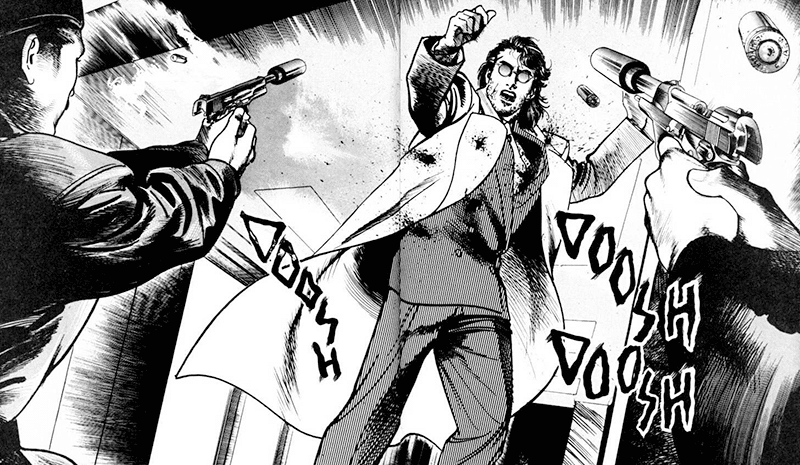
Despite its strengths, Sanctuary is not without flaws. The further the story goes, the more it leans into operatic escalation and power fantasy. Some developments stretch plausibility, but it gives the series a certain type of pulpy charm. It’s less interested in realism and more in momentum and mythmaking. Its most jarring flaw is its dated depiction of women, who are painted as sex objects or love interests.
As a crime manga, Sanctuary stands out because it shows power moving through every layer of society, from alleyways up to the parliament. For readers who want a sweeping story of schemes, corruption, and charismatic antiheroes, it remains a cornerstone of the genre.
Genres: Crime, Political Thriller
Status: Completed (Seinen)
2. Ichi the Killer
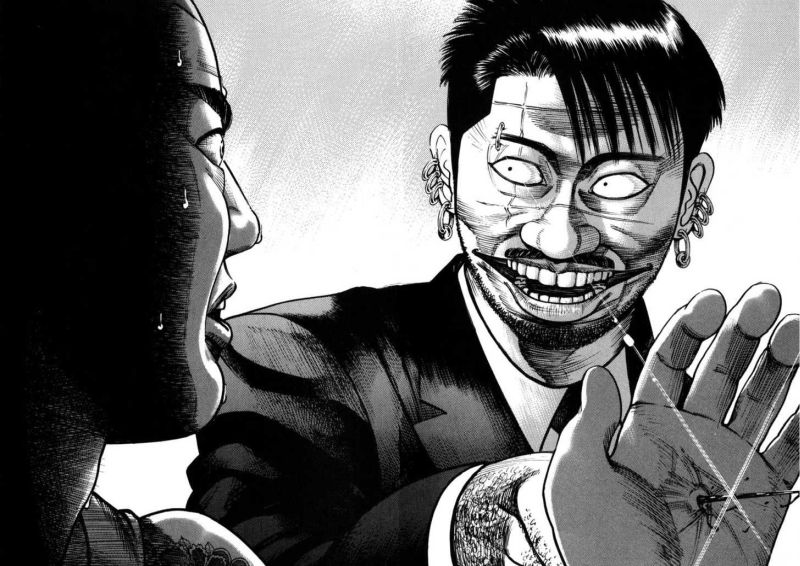
Ichi the Killer is one of the most infamous yakuza stories in manga, and it earns that reputation through how extreme it is. It’s a crime manga that doesn’t look away, presenting the underworld as a place populated by broken people who use violence as language, identity, and ritual. The content is graphic enough to repel many readers, but beneath that surface lies a bleak psychological portrait of trauma, sadism, and exploitation.
The narrative centers on two men who are equally disturbing, but for different reasons. Ichi is a traumatized killer whose brutality is overwhelming and seemingly uncontrollable, while Kakihara is a yakuza whose obsession with pain and cruelty borders on devotion. After Kakihara’s boss disappears, his search puts him in direct confrontation with Ichi, and the story becomes a collision of two equally broken minds. The yakuza structure functions as a framework, but the real conflict is internal. These characters are not fighting for money or territory in any conventional way. They’re chasing buried trauma, compulsion, and the next sensation that might make them feel alive.
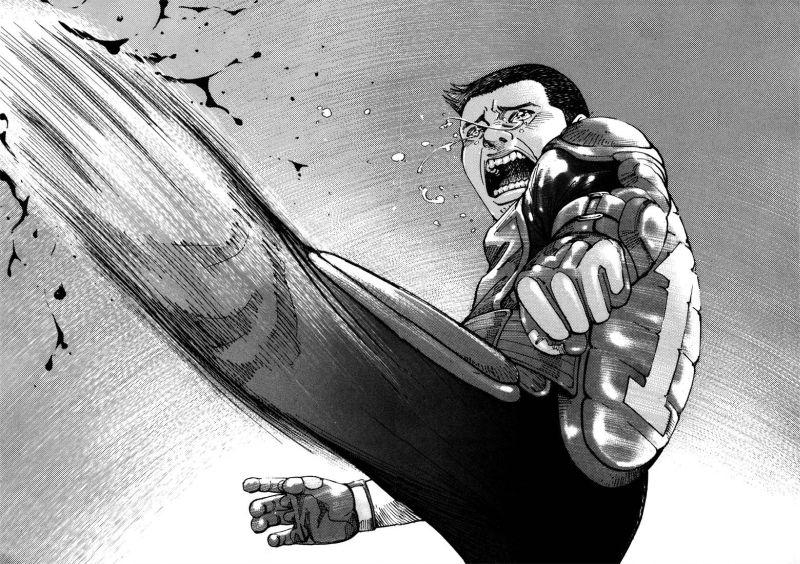
What separates Ichi the Killer from more typical crime narratives is how it ties violence to psychology. The manga is explicit about torture, sexual abuse, degradation, and humiliation, but rarely treats these as shock devices alone. Instead, it forces us to look into the darkest corner of human society, where domination is power.
Yamamoto’s art is defined by clean linework, realistic character designs, and grotesquely warped facial expressions. Violence is depicted in unflinching detail, and often so exaggerated it feels surreal. It’s compelling and difficult to stomach, but that’s exactly the point. It’s not meant to glamorize, but to nauseate, and to force the question of how people can commit these deeds.
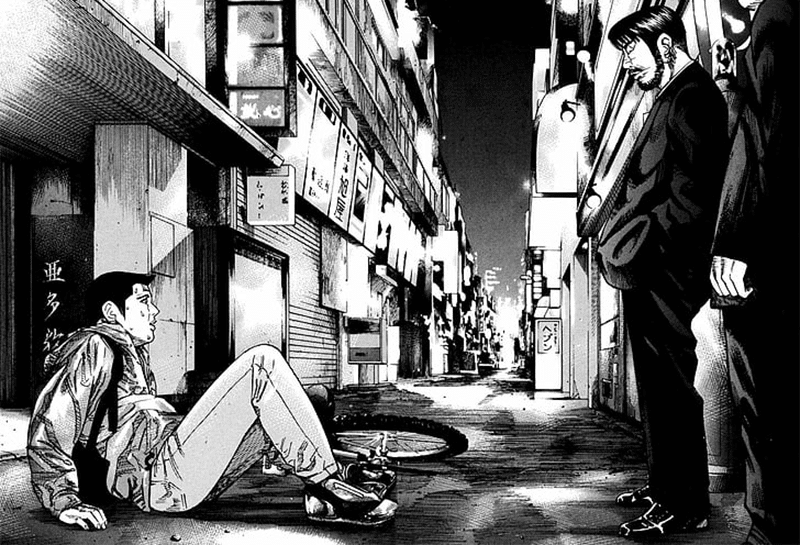
The story can be chaotic at times, and some plot elements remain messy or unexplained, but that disorder fits the material. Ichi the Killer is not tidy, and it doesn’t want to be. It’s an ugly, disturbing, and deliberately nihilistic story.
For readers who can tolerate the extreme content, Ichi the Killer offers a uniquely uncompromising look at yakuza violence and psychological ruin. It’s not a comfortable recommendation, but as a crime manga, it remains one of the genre’s most uncompromising works.
Genres: Crime, Psychological, Horror
Status: Completed (Seinen)
1. Yamikin Ushijima-kun
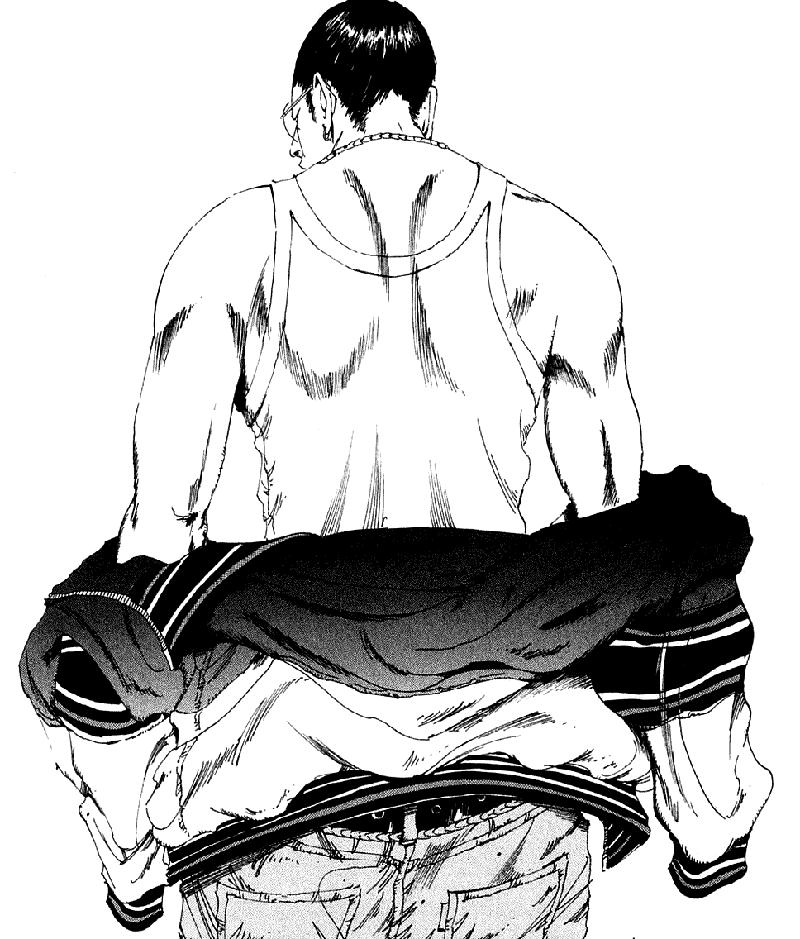
Manabe Shōhei’s Yamikin Ushijima-kun is my favorite crime manga, and it earns that place by being brutally honest about what crime looks like when it’s ordinary. There are no glamorous gangs, no stylized shootouts, and no comforting moral distance. Instead, it drops readers into the world of illegal moneylending and keeps the focus on the people who end up there, the predators who benefit, and the system that encourages them.
Kaoru Ushijima runs a loan shark business with terms that sound impossible: fifty percent interest due in ten days. The series makes it clear why anyone would accept that deal. Ushijima’s clients are not clever criminals chasing easy money. They are gamblers, addicts, exhausted workers, aimless young men, and people one bad decision away from total collapse. Debt is not treated as a mere number, but a chain that pulls people into worse and worse situations. It uses an episodic structure, showcasing different clients and how each one falls apart in a different way.
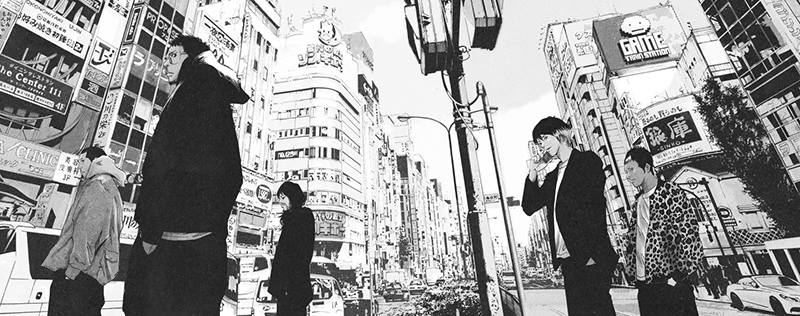
Ushijima himself is not a hero, and the manga does not ask you to pretend he is. He’s a professional predator preying on the weak, whose job it is to extract payment through intimidation, humiliation, and whatever other leverage works. The difference is that Ushijima is honest about what he does. His world is full of scammers, gangsters, pimps, and corporate sharks who operate with even less restraint, and that contrast becomes one of the series’ defining strengths. Over time, you may even find yourself rooting for Ushijima simply because he feels the least monstrous.
What sets Yamikin Ushijima-kun apart is its realism and its scope. It’s not only about loan repayment. It’s about the wider underworld that debt connects to, including organized crime, petty theft, prostitution, scams, and the quiet violence of social shame. The manga repeatedly shows how fast a life can unravel once someone is isolated, embarrassed, and short on options. Many arcs feel almost unbearably bleak, but that harshness is the point. The stories are not meant to comfort; they are meant to expose.
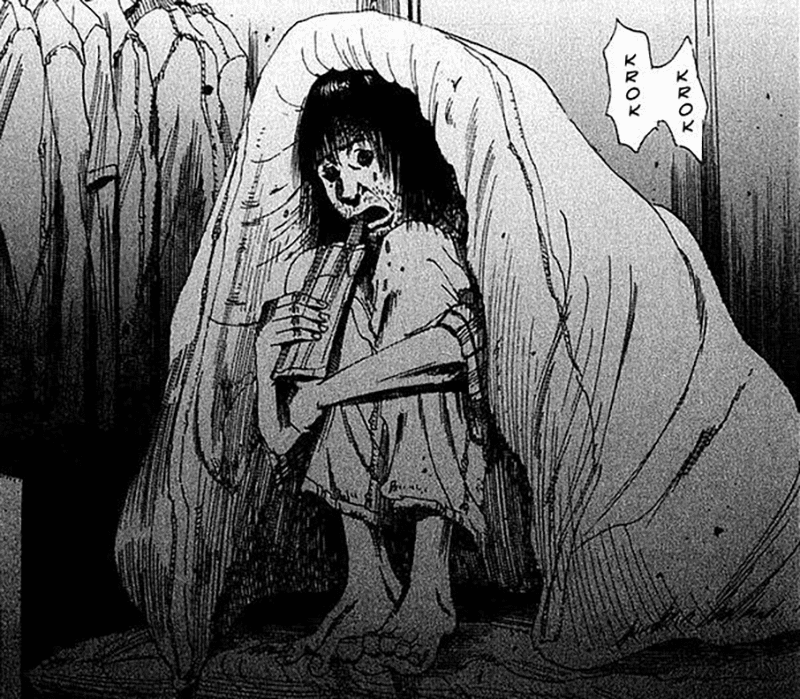
Manabe’s artwork reinforces the tone. Faces look like real people, often tired, crooked, or desperate, and the environment feels grimy and alive. The paneling is straightforward and functional, prioritizing clarity over style, which makes the violence and humiliation land harder. None of it feels theatrical; it feels possible.
As the manga progresses, it expands from short cautionary tales into longer arcs that track people’s downfall from beginning to end. These sections are where the series becomes genuinely unforgettable, because it shows not only what happens to people who cannot pay, but how they convince themselves that the next lie, the next scheme, or the next loan will fix everything.
Yamikin Ushijima-kun isn’t a pleasant read, but it’s one of the most uncompromising portraits of the Japanese underworld in manga. If you want a crime manga that feels grounded, bleak, and disturbingly plausible, it’s hard to top.
Genres: Crime, Psychological, Drama
Status: Completed (Seinen)