JoJo’s Bizarre Adventure has become one of the most popular manga of all time, thanks not only to its fantastic adaptation but also to Hirohiko Araki’s genius, creativity, and inventiveness. What started as a gothic 1980s battle shonen about vampires gradually transformed into one of the most unique series in manga.
One reason JoJo’s Bizarre Adventure is so beloved is that it isn’t one continuous story. It’s divided into nine main story arcs (Parts 1–9), each set in different time periods and locations. That constant reinvention is true across all JoJo parts, and it’s a big reason the series stays so fresh.
It’s easily one of the most creative series ever made, and it’s among my favorite manga of all time.
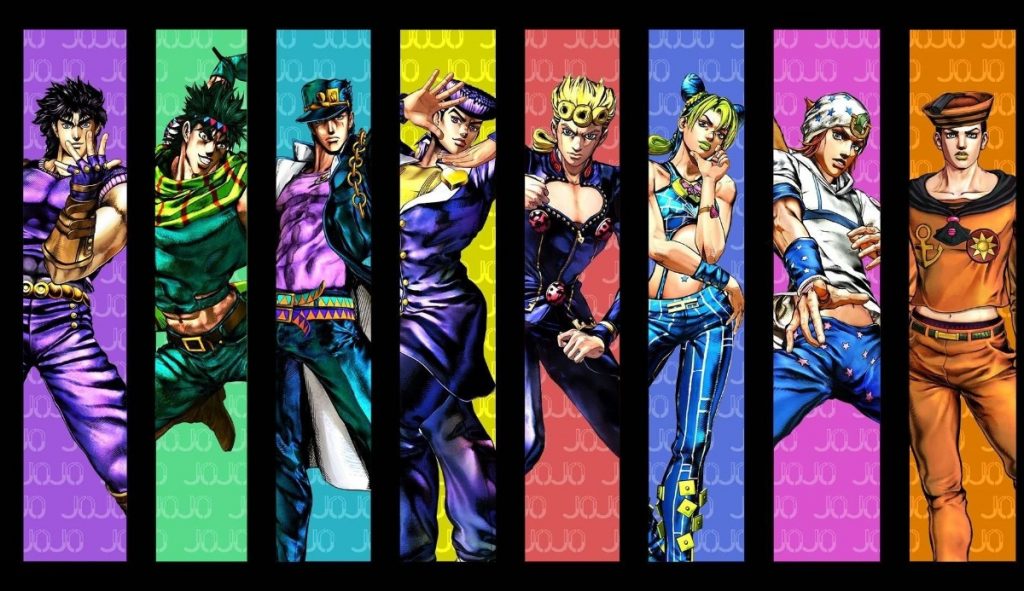
That said, some parts of JoJo’s Bizarre Adventure are better than others. Below, I rank all JoJo parts from weakest to strongest, based on how well each one lands in terms of characters, pacing, fights, and the electrifying weirdness that defines JoJo. If you want to see why Steel Ball Run is my pick for the best JoJo part, read on.
If you’re looking for a ranking of all JoJos, check out my article on the best JoJo protagonists.
Mild spoiler warning: I’ll avoid major plot beats, but some details are necessary to explain the ranking.
With that said, here are all JoJo parts ranked (last updated: February 2026).
9. Part 1 – Phantom Blood

Phantom Blood is the very first JoJo part. While it’s a classic in its own right, it’s also the weakest overall.
The first thing you notice is how much it feels like a product of its era. The style and art feel closer to other 1980s battle shonen manga than what JoJo later becomes, with the same heavily muscular character designs and a greater focus on straightforward man-to-man fights. In that sense, it’s reminiscent of Fist of the North Star.
Set in late 19th-century England, Phantom Blood follows Jonathan Joestar and his adoptive brother, Dio Brando, a charming and talented young man whose family has fallen into ruin. Dio isn’t just ambitious. He’s ruthless, and he never shies away from terrible deeds to reach his goal of taking the Joestar fortune. When that plan fails, he turns to a mysterious stone mask and becomes a vampire, forcing Jonathan into a fight that starts as revenge and quickly becomes a battle to stop something far worse.
On paper, it’s a great setup: drama, betrayal, and brutal clashes with vampires. In execution, though, Phantom Blood can feel bland and formulaic. Outside of its period setting, it doesn’t stand out among other manga of its time, especially when compared to the creativity and weirdness of later JoJo parts. Jonathan has the same issue. He’s an archetypal good guy, but he’s also fairly straightforward, and he doesn’t have the personality edge that later JoJos bring to the table.
The high point is easily Dio. He absolutely steals the show. Even as Jonathan’s pure-evil counterpart, his Machiavellian scheming makes him an incredibly entertaining villain. That’s why Phantom Blood ends up at the bottom of my JoJo parts ranked list.
8. Part 2 – Battle Tendency

Battle Tendency is the second part on my JoJo parts ranked list, and it follows Joseph Joestar, Jonathan’s grandson. This one might surprise some fans, since Part 2 is beloved by a lot of the community, but it never fully clicked for me.
This time, the story delves into the origin of the stone mask and introduces its creators as the main antagonists: the Pillar Men, a race of ancient superhumans.
Battle Tendency doesn’t reinvent the series so much as refine what Phantom Blood started. It hits many of the same basic beats, but it handles them better and makes the whole ride more entertaining. The biggest improvement is the protagonist. Joseph is a clear step up from Jonathan. He isn’t a hero in shining armor. He’s a cocky trickster who wins through ploys, tricks, and psychology, and that shift makes the fights much more interesting because they rely less on sheer force and more on him outsmarting the enemy.
The problem is that a lot of what surrounds Joseph feels weaker. Part 2’s supporting cast is pretty thin overall, and some of it can be complicated, like Stroheim, the Nazi character who’s weirdly prominent. The art style has improved, but it still has that classic 1980s look that doesn’t stand out much on its own.
The Pillar Men didn’t do much for me either. They have their motifs and ideals, but as antagonists they often feel like they exist primarily as superhumans to be defeated, rather than characters with the kind of personality and presence later JoJo villains bring.
And while Joseph is definitely an improvement over Jonathan, he can also be a little jarring. He’s cocky to the point of arrogance, and some of his ‘gotcha’ moments feel less like clever strategy and more like unrealistic cop-outs or straight-up deus ex machina.
So no, I don’t think Battle Tendency is bad, and I understand why it’s so popular. It just didn’t work for me the way it does for a lot of other JoJo fans.
7. Part 3 – Stardust Crusaders

Stardust Crusaders was the first big JoJo part, and the one that truly put the series on the map. Even today, it’s still arguably the most well-known part overall. The main character, Jotaro Kujo, has likewise become one of the most popular JoJos of all time, helped by the fact that he reappears in later parts.
Character-wise, Jotaro is a major step forward. He initially comes across as a hot-headed delinquent, but he can be surprisingly smart, and he ends up feeling like a well-rounded mix of Jonathan and Joseph. The supporting cast is also one of the best in the series. Joseph is great as always, and characters like Avdol, Kakyoin, and Polnareff all bring their own personalities and Stand abilities to the group, which makes both the team dynamics and the battles far more engaging than in earlier parts.
The premise is simple and instantly compelling: Dio is back. When Joseph learns this, he’s hell-bent on revenge, and he enlists Jotaro, who has recently developed a Stand. This is the single change that redefined JoJo forever. Stands are physical manifestations of a character’s life force that grant them superhuman abilities, and their importance to the series can’t be overstated. They became the defining power system from this point onward, and they’re what allowed Araki to create increasingly complex, creative battles.
Once Jotaro agrees to help, the story turns into a globe-spanning adventure, with the crew traveling from Japan to Egypt to defeat Dio once and for all. That journey gives Stardust Crusaders a great sense of scale and momentum, and its legacy is unmistakable.
Stardust Crusaders frequently appears high on JoJo parts ranked lists, but I’ve always felt it’s a bit overrated. The pacing is off, especially in the first half, and it takes a while to really get going. There are also a few plot points that could be cut without losing anything.
The art is another mixed bag. It’s a clear improvement over Phantom Blood and Battle Tendency, but it still feels old-fashioned, with the same emphasis on buff, muscular character designs. And while Stands are a fantastic addition, you can also tell Araki was still testing the waters. Here, they can be hit or miss, especially early on. Some fights feel gripping, others feel more like rough experiments.
Still, Stardust Crusaders is a fantastic JoJo part. The cast is strong, the adventure vibe is great, and it laid the groundwork for everything that followed. It’s just not as refined as the parts that came after it.
6. Part 9 – JOJOLands

The JOJOLands is the newest JoJo part, centering on Jodio Joestar, and it’s a testament to the fact that Araki can still reinvent the series more than three decades into its run. It feels strikingly modern, but it’s still purely JoJo in the way it escalates tension, twists expectations, and builds conflict around strange rules.
Set in Hawaii, Part 9 doesn’t revolve around a heroic quest but around money, ambition, and crime, and follows a cast that’s willing to break the law to get ahead. When they come upon a strange lava rock tied to wealth, they run into people who’d do anything to get their hands on it. It’s a simple hook, but it creates a central mystery that keeps the early arcs moving. This makes it likely it’ll eventually place higher on this JoJo parts ranked list.
Jodio is a great protagonist. He’s less righteous and more volatile and calculating, and he’s willing to escalate violence without hesitation. This gives the part an edge that earlier ones didn’t have. The supporting cast is equally strong, with a unique group of characters all with their own motivations and loyalties.
Araki’s art remains fashion-focused and expressive, and the Stands are as bizarre as ever. Still, as fresh and confident as The JOJOLands feels, it’s too early for me to make a full judgment yet.
5. Part 6 – Stone Ocean

Stone Ocean is the first part to feature a female JoJo, Jolyne Cujoh, the daughter of Jotaro Kujo. After being framed for a murder she didn’t commit, she’s sent to Green Dolphin Street Prison, only for her conviction to be revealed as part of a much bigger conspiracy tied to Dio’s legacy, orchestrated by one of his disciples: Father Enrico Pucci.
On the premise alone, the prison setting is a fascinating choice. The mystery surrounding Jolyne’s framing, the prison itself, and Pucci’s larger plan is handled well and keeps the part engaging.
Stone Ocean is also, in my opinion, the weirdest entry on my JoJo parts ranked list. It features some of the most bizarre Stands Araki has ever created, including Weather Report and Dragon’s Dream, which can genuinely be hard to wrap your head around at first. But that strangeness isn’t really a downside. If anything, it leads to some great, dynamic, and inventive JoJo fights that feel unlike anything in the earlier parts.
The cast is just as strange when compared to earlier parts, to the point that Stone Ocean’s crew can almost feel alien. For me, it’s a mixed bag. I really liked characters like Weather Report and Ermes Costello, but I can’t say the same for Emporio or Anasui, which made the ensemble feel less consistent than the better JoJo groups.
Even though I enjoyed Stone Ocean overall, I still had some issues with it. The first is the prison setting itself. It’s intriguing at the start, but over time it felt the story stagnated because it was so locked to one location. After coming straight from Part 5’s beautiful setting, it can feel a bit uninspired, like the part is suffering from same-location syndrome.
The other issue is the weirdness. Weird and bizarre ideas are obviously the point of JoJo, and I’m usually a big fan of that, but Stone Ocean occasionally takes it a bit too far. This is especially true of the ending, which I enjoyed for its boldness, but it’s also easy to see why it remains controversial among fans.
4. Part 8 – JoJolion

JoJolion is the most recently completed JoJo part.
This part returns to Morioh, but not the Morioh from Diamond Is Unbreakable. It’s set in the alternate universe continuity that Steel Ball Run introduced, and it follows a different version of Josuke Higashikata. The most interesting part is that this Josuke is entirely shrouded in mystery. He wakes up near a strange landmark that’s appearing all over town, with no memories of who he is, and the story follows him as he tries to regain his memories and identity. That amnesia angle makes him a genuinely unique protagonist, since he’s essentially a blank slate with no background.
JoJolion was also my first venture into JoJo by complete accident. I randomly picked a manga to read, and it happened to be JoJolion, which meant I was diving into Stands, JoJo logic, and the alternate universe with no context. Needless to say, it was weird as hell. I knew nothing about the series, so the whole experience felt like a fever dream in the best way. It also worked, because once I realized it was the eighth part of a much larger franchise, I went back and read the entire series from the beginning.
As for JoJolion itself, the art is absolutely fantastic, and it has the expressive, modern JoJo look that feels even more bizarre than a lot of what came before it. The Stand fights are easily the highlight. They’re consistently inventive and well-done, and a lot of them feel like Araki is fully in his element, building conflicts around strange rules and creative problem-solving.
The mystery is also engaging. JoJolion keeps you wondering what’s really going on, and as it unfolds, things only get stranger. That said, some later revelations didn’t land for me as strongly as the initial setup, and the amnesiac protagonist angle is also a mixed bag. At times, it felt like too much of the story was focused on Josuke trying to learn who he is, which made the plot feel more singular and intimate than some of the bigger, more exciting narratives in other parts.
My biggest issue, though, is the main antagonist, who ended up feeling almost unrelated to a large chunk of the story, and the way he only fully entered the picture in the final chapter made the overall arc feel less cohesive.
Overall, I still had a blast with JoJolion. It has brilliant Stand concepts, fantastic battles, and a strong-mystery-driven atmosphere, but it didn’t make it to the top of my JoJo parts ranked list.
3. Part 4 – Diamond Is Unbreakable

While Part 3 – Stardust Crusaders introduced Stands, Part 4 – Diamond Is Unbreakable is when JoJo truly became what it’s known for today by changing almost every prior convention.
The biggest shift is the setting. Instead of a globe-spanning quest to stop a megalomaniac villain, Diamond Is Unbreakable drops you into the small Japanese town of Morioh. Josuke Higashikata isn’t driven by revenge or a grand mission either. He’s a normal high schooler, and that change makes the story feel much more grounded, centering on the strange events, local mysteries, and creeping oddities in one town. The supporting cast fits that tone perfectly, too, since most of them are just regular people and students who get pulled into the increasingly bizarre events around them.
At first, the story revolves around Jotaro Kujo arriving in Morioh to track down the Bow and Arrow, an artifact capable of awakening Stands in others. Diamond Is Unbreakable truly shines in its second half, which is why it frequently appears at the top of JoJo parts ranked lists. That’s where the part reveals Yoshikage Kira, one of JoJo’s most beloved antagonists and a genuinely fascinating character. Kira isn’t trying to rule the world. He just wants to preserve his quiet, normal life while continuing his private pleasures of murder. That grounded motivation makes him even creepier than many larger-than-life JoJo villains, and it gives the whole part a steady, escalating tension.
Diamond Is Unbreakable is also a turning point visually. It starts out closer to Part 3’s look, then gradually shifts into the more effeminate, fashion-heavy, and bendy character designs that would dominate the series going forward.
Stands evolve just as dramatically. This is where they become more defined and, frankly, more interesting. Straightforward combat Stands take a step back, and you see weirder, more utilitarian abilities that turn fights into problems to solve rather than brute-force brawls.
Overall, Part 4 is one of the greatest JoJo parts for its intimate setting, the way it reshapes the series’ identity, and of course, for Yoshikage Kira.
2. Part 5 – Golden Wind

It was a tough choice picking the #2 spot among the best JoJo parts between Diamond Is Unbreakable and Golden Wind, but eventually Golden Wind pulled through.
Interestingly, this is a JoJo part that’s almost entirely removed from the rest of the series, apart from a few cameos. It centers on Giorno Giovanna, the illegitimate son of Dio, who plans on taking over the Neapolitan mafia and becoming a ‘Gang-Star’. That goal immediately puts him into conflict with other Stand users, and eventually with the boss of Passione itself, Diavolo, the very man Giorno intends to replace.
Giorno is a solid protagonist. He’s intelligent and calm, with a strong sense of pride and justice, and he has a clear ambition that drives the entire narrative. That said, he’s also frequently outshined by the people around him, and the most important of them is Bruno Bucciarati. Introduced as a minor antagonist, Bucciarati quickly becomes Giorno’s biggest ally and essentially steals the show. There’s a reason he’s often called the ‘true’ protagonist of Part 5.
The group that gathers around them is a ragtag bundle of misfits, each with their own quirks, motivations, goals, and, of course, Stands. They’re among the best ensembles in all of JoJo, and the character dynamics are a constant delight. Even when the story slows down, their chemistry keeps it entertaining.
Visually, Golden Wind is stunning. The art feels like the perfection of what Araki developed in Part 4, and the Italian setting has that Greco-Roman beauty that makes the whole arc feel stylish and larger-than-life.
The true high point, though, is the fights. The Stand abilities here are among the most creative, complex, and interesting in the entire series, and the battles are consistently dynamic and gripping.
What really makes them stand out is how often they’re team fights. A lot of the best encounters aren’t one-on-one. They’re two-on-two, or a shifting group struggle, which gives the action a tactical edge and makes it feel fresher than what came before.
My criticisms are minor, but they’re worth mentioning. The first is Diavolo. He looms over the story as an ever-present threat, constantly referenced and built up, but he doesn’t fully step into the spotlight until late in the arc. The second is that some Stand abilities can be genuinely hard to understand. Gold Experience is one example, and King Crimson is infamous for being one of the most confusing Stands in the series.
Even with those issues, Golden Wind is fantastic and deserves its high spot on this JoJo parts ranked list. It has an incredible cast, great character dynamics, and some of the most dynamic fights JoJo has ever delivered.
1. Part 7 – Steel Ball Run

Steel Ball Run is a fan favorite, and it’s easy to see why so many people consider it the peak of the series. It feels like a culmination of everything Araki created up to that point, and in my opinion, it’s still the best JoJo part.
In many ways, Steel Ball Run works as a soft reboot. It takes place in an alternate universe, complete with alternate versions of familiar names and ideas, but it’s also confident enough to stand entirely on its own.
The protagonist is Johnny Joestar, an alternate-universe version of Jonathan, and he’s introduced in a way that immediately sets this part apart. Johnny is a paraplegic former jockey who comes to watch a transcontinental horse race across the United States: the Steel Ball Run. Before the race begins, he meets Gyro Zeppeli, a mysterious competitor who wields steel balls as his weapon. After a duel where Gyro demonstrates his strange technique, the Spin, Johnny briefly regains the use of his legs, and the two team up to enter the race together.
The framing alone is brilliant. The race keeps the pacing high even before the main plot kicks in, because there’s always a tangible sense of movement, pressure, and competition. And once the stakes rise, it gets even better. The horse race isn’t just a race. There’s a deeper motive behind it, and that’s where the part’s main antagonist enters the story: Funny Valentine, the President of the United States, who has his own larger goal tied to what the race is really about.
Where Steel Ball Run stands out the most is the characters. Johnny and Gyro are both fantastic, and they’re easily the best duo in all of JoJo. Their dynamic carries the part emotionally and narratively, and watching their relationship evolve is one of the most satisfying arcs in the entire series. On top of that, the roster of other participants is strong in its own right, with standouts like Sandman and Diego Brando adding constant tension and unpredictability.
Visually, this is also Araki at his best. The art is outstanding, and it feels like he’s perfected his style into something that’s consistently expressive and beautiful.
Then there are the battles. The Stands here are among the best in the series, and they lead to brutal, high-stakes fights that feel tense and inventive rather than repetitive. Gyro’s Spin is also a great addition, and it works as a clear homage to Hamon from the first two parts, while still feeling fresh.
Overall, Steel Ball Run is peak JoJo, and it’s why it sits at the top of my JoJo parts ranked list.