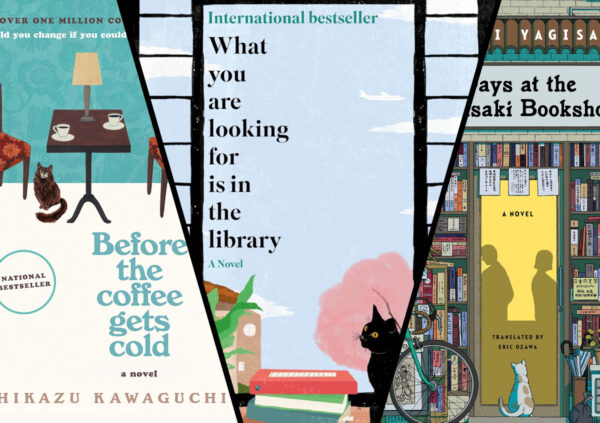
Michiko Aoyama arrived in English with one enormous hit and has been catching up ever since. What You Are Looking For Is in the Library sold in the millions, became a Time Book of the Year, and put her at the front of the Japanese healing fiction wave. What English readers are now getting, in a different order than Japanese readers did, is the rest of her work: a park with a hippo statue that heals people, a small Tokyo café with two books built around it, and a forest in moonlight.
This guide covers the Michiko Aoyama books available in English, the order they came in Japan, and one edition trap to avoid. Her place in the wider genre is on the Japanese healing fiction list. Aoyama is a writer I know from the record and from her reception rather than from reading her, and the notes below reflect that.
Where to Start
Start with What You Are Looking For Is in the Library. It’s the book that made her name, it’s short, and its five-story structure means you can read it in pieces.
After that, The Healing Hippo of Hinode Park is the closest thing to a follow-up in spirit, and Hot Chocolate on Thursday is where she began.
The Reporter Who Became a Bestseller
Aoyama was born in Aichi Prefecture in 1970. After university she spent two years in Australia, working as a reporter for a Japanese newspaper in Sydney, then returned to Tokyo and worked as a magazine editor before she wrote fiction. She lives in Yokohama.
That background shows in the books. The five people who walk into her library are described with the specificity of someone who has interviewed a lot of strangers about their jobs: the retail assistant who wants a skill, the mother demoted after maternity leave, the accountant with a dream of an antique shop, the manga artist who has stopped drawing, the salaryman with nothing to do on Monday morning.
She is also notably private. Readers looking for interviews find very few, which is unusual for an author at her sales level, and what comes through instead is a consistent set of preoccupations: kindness, small courage, and the value of institutions that ask nothing of you. On libraries she has said that being able to borrow books and take them home without money changing hands strikes her as a dream system.
Her Japanese career runs in a different order from the English one. Her debut, published here as Hot Chocolate on Thursday, won the Miyazaki Book Award in 2020. Then she took second place at the Japan Booksellers’ Award in consecutive years, in 2021 for What You Are Looking For Is in the Library and in 2022 for a novel that has not yet been translated.
What You Are Looking For Is in the Library
2021 · translated by Alison Watts · English 2023

Five people at crossroads in their lives make their way to the library inside the Hatori Community House, where they meet Sayuri Komachi, a large, still woman at the reference desk who asks each of them what they are looking for. She gives each a list of books on the subject they asked about, plus one recommendation that has nothing obvious to do with it, plus a small handmade felt object as a bonus. The unexpected book is the one that changes things.
Readers have had fun deciding what Komachi is. She reads her visitors too accurately to be an ordinary librarian, and reviewers have described her as a benevolent yokai, a spirit, or a goddess of the reference desk, which Aoyama never confirms or denies. The structure is five linked stories rather than a novel, and the characters cross each other’s lives in ways that only become clear later.
Robin Sloan gave it a warm review in the New York Times, and it is being translated into more than fifteen languages.
The Healing Hippo of Hinode Park
translated by Takami Nieda

At the foot of a five-story apartment block sits a children’s playground with a concrete hippo in it, called Kabahiko, and the neighborhood believes that if you touch the part of the hippo that corresponds to what hurts in you, it will help. The novel moves between the residents who come to it: a boy whose grades have slipped, adults carrying quieter troubles, people who half believe and come anyway.
It follows the same architecture as the library book, a fixed point in a neighborhood and a rotating cast of people who need something, and readers who wanted more of that will find it here. The hippo, unlike Komachi, says nothing at all, which puts more weight on the visitors and makes this the more melancholy of the two.
Hot Chocolate on Thursday
translated by E. Madison Shimoda

Her debut in Japan, published there as Cocoa on Thursdays, and the winner of the 2020 Miyazaki Book Award. It is set in and around the Marble Cafe, a tiny community café in Tokyo across a bridge near some cherry trees, where a woman writes in a notebook every Thursday and a young waiter makes her the same drink.
Reading the debut after the famous book is instructive, because the method is already fully formed: a small place, a handful of lives crossing in it, and the assumption that ordinary kindness is worth a novel. The stories chain together, one character’s minor appearance becoming the next chapter’s center, which is the trick she later used on the library.
Matcha on Monday
translated by E. Madison Shimoda

The companion volume to Hot Chocolate on Thursday, set around the same Marble Cafe, and the second half of what her English publisher treats as a pair. If the first book is about the people who pass through the café, this one turns to the ones who keep turning up.
Read them in order, Thursday then Monday, since the second assumes you have met the regulars.
Talking in a Moonlit Forest

The next Aoyama to arrive, announced in English for April 2027. Like her breakthrough it was shortlisted for the Japan Booksellers’ Award, and it moves her formula out of the café and the library and into stranger territory. It is the one to watch for if you have read the others and want to see where she is going.
One Edition to Avoid
There is a Penguin Readers Level 4 edition of What You Are Looking For Is in the Library, which is an abridged graded reader produced for English-language learners. It’s a perfectly good thing to be, but it isn’t the novel, and it turns up in the same search results at a similar price. Check that what you’re buying is the full translation by Alison Watts.
What Isn’t in English Yet
Aoyama has published more in Japan than the books available here, including the novel that took second place at the Japan Booksellers’ Award in 2022. Given how quickly her publishers have worked through the rest of her catalog, the gap is likely to close.
The Full English List at a Glance
Hot Chocolate on Thursday · Matcha on Monday · What You Are Looking For Is in the Library · The Healing Hippo of Hinode Park · Talking in a Moonlit Forest (April 2027)
Suggested order: the library book first, then the hippo, then the two café books in order, then Moonlit Forest when it lands.
Where to Go Next
The book most often shelved alongside hers is Before the Coffee Gets Cold, and the Toshikazu Kawaguchi guide covers that series. For the whole shelf of gentle Japanese fiction, and an honest account of what the label leaves out, see the Japanese healing fiction list. Readers who want the same warmth with more literary weight should try the Yoko Ogawa guide and The Housekeeper and the Professor.