There are two kinds of list of Japanese novels in English and they don’t overlap. The author index lives on my Japanese authors hub.
The first stops around 1970. Genji, Soseki, Kawabata, Tanizaki, Mishima, reverent and a bit dusty, written as though nothing has happened in Japanese fiction since the Nobel went to Kawabata in 1968. The second starts around 2016. Murata, Ogawa, Kawaguchi, the cats, the cafes, the recent translation boom, written as though pre-war Japan didn’t produce anything worth shelving. I read a lot of both while building this, and the strange thing is that neither type is wrong. They’re just each missing half the subject.
So this list does both halves. Thirty-seven Japanese novels, running from a thousand-year-old court romance to books translated in the last few years, in one sequence, with no wall down the middle.
The other thing almost nobody does is tell you which edition to buy, and with translated fiction that is not a detail. It’s the reason this list took as long as it did, and three things came out of checking that I hadn’t expected.
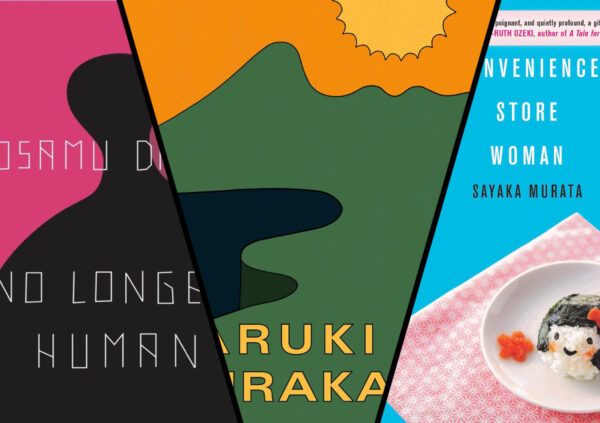
English editions of Japanese novels get quietly shortened. The Wind-Up Bird Chronicle is about sixty pages shorter in English than in Japanese, two whole chapters gone, because the contract capped the length. Hard-Boiled Wonderland lost around a hundred pages in its 1991 translation and only got them back in 2024. Fires on the Plain lost the passages where the narrator admits he is managing his own account, which is the one thing that book cannot spare. That’s sixty-seven years and three different publishers, and in none of the three cases is the reader told.
Books change their names. The Gossamer Years is also sold as The Kagero Diary. The Emissary is The Last Children of Tokyo. Hard-Boiled Wonderland is now End of the World and Hard-Boiled Wonderland. Breasts and Eggs is a translation of a different book’s title. The Housekeeper and the Professor is called The Professor’s Beloved Equation in Japanese, which is also the English title of the film, so anyone who watches it and goes looking for the novel is hunting a book that doesn’t exist. Search one title, miss the other.
And the pool of people doing this work is tiny. Stephen Snyder translated three books on this list. Ralph McCarthy carries both Ryu Murakami novels and Dazai. Philip Gabriel handles Kafka on the Shore near the top and a cat road-trip novel at the bottom. John Nathan translated Mishima at twenty-three and then left him for Oe. A handful of people have shaped most of what English readers think the Japanese novels of the last century look like.
The Tale of Genji exists in four English versions that are effectively four different books. No Longer Human has three, and they disagree about what the title even means. Where the choice matters, I’ve said so and made a recommendation.
A Few Notes on What’s Here
It isn’t ranked. The order runs toward the books I’d push hardest, and No Longer Human is last for a reason, but arguing about whether something should be at fourteen rather than nine is a poor use of anyone’s afternoon.
Novels, mostly. The Pillow Book, Basho and the classical miscellanies are extraordinary and they aren’t novels, so they aren’t here.
Two writers you might expect are missing. Kazuo Ishiguro and Ruth Ozeki both turn up on lists of Japanese novels regularly. Both write in English. Including them while the page’s whole promise is guidance on translation would be incoherent, so they’re out, and Ishiguro gets his own page instead.
I’m a horror writer by trade, ten years at it, which shapes what I notice: Abe’s sand, Ranpo’s bodies, the specific cruelty in Enchi. Some of the books below I’ve read repeatedly and say so. For the rest this is a map rather than a set of personal verdicts, assembled from the critical consensus and from checking the things other lists get wrong.
Start anywhere. If you want the single best entry point into Japanese novels and don’t want to think about it, that’s Kokoro, near the end.
The Travelling Cat Chronicles
Hiro Arikawa · translated by Philip Gabriel · 2012, English 2017

Every list of Japanese novels ends up with a cat on it eventually, and this is the one that turned the trend into an export industry. Nana is a stray who gets adopted by a young man named Satoru, and the two of them set out on a road trip across Japan, visiting Satoru’s old friends one by one. Nana narrates. He is not a sentimental animal. He is vain, sarcastic, and convinced of his own tactical superiority over every human he meets.
The road-trip structure does the heavy lifting, and it’s the tidiest piece of construction among the recent Japanese novels to break out in English. Each stop peels back another layer of Satoru’s history, and because Nana doesn’t understand what he’s seeing, the reader assembles the picture ahead of the narrator. Arikawa knows exactly what she’s doing with that gap. By the time the purpose of the journey becomes clear, the book has spent two hundred pages earning something it could have demanded in ten.
Critics have been split on whether the emotional payoff is honest or engineered, and the honest answer is probably both. What isn’t in dispute is Philip Gabriel’s translation, which keeps Nana’s voice dry rather than cute. That distinction is the whole book. A cuter Nana would sink it.
Start here if you want to know why the cozy end of contemporary Japanese fiction sells the way it does. It’s the most skillful version of a formula that a dozen weaker books have since copied.
Before the Coffee Gets Cold
Toshikazu Kawaguchi · translated by Geoffrey Trousselot · 2015, English 2019

A basement café in Tokyo keeps one seat that returns you to the past, under rules designed to disappoint: the chair holds you where you are, the present is fireproof, and the trip lasts only until your coffee cools. Four linked stories follow four customers who sit down anyway.
The premise sounds like a writing-prompt exercise, and among Japanese novels in translation it is structurally the thinnest thing to sell in these numbers. Kawaguchi staged it as a play in 2010, where it won the grand prize at the Suginami Drama Festival, and turned it into his first novel five years later. What reads as theater blocked into prose is exactly that, and the seams show: scenes are staged for a single set, the café is described the same way several times, and the prose does almost nothing that the dialogue isn’t already doing. Anyone coming from the literary end of Japanese novels will find it thin.
That said, ignoring this book would be dishonest. It sold in the millions, spawned a series, and built, more or less alone, the gentle low-stakes shelf that now fronts the category in English bookshops. Its rules are its point: you cannot change anything, so what would you say if the only thing you could change was yourself. That constraint is sharper than the writing around it.
Read it for the door it opened rather than the room behind it.
The Guest Cat
Takashi Hiraide · translated by Eric Selland · 2001, English 2014

The cat that came first. A married couple in their thirties rent a small guesthouse in a quiet Tokyo neighborhood, drifting apart in the polite, undramatic way that long marriages sometimes do. A cat from next door starts visiting. That’s the plot.
Hiraide is a poet, and not incidentally: he teaches poetics at Tama Art University and his collection For the Fighting Spirit of the Walnut won the Best Translated Book Award. It shows in a way that separates this from everything it later inspired. The book is interested in the geometry of the garden, the way light moves across a corridor, the specific route the cat takes through the property. Events happen at the edges: the economy sours, the landlord ages, the lease becomes uncertain. The couple barely discuss any of it. What holds the book together is attention rather than incident, and Selland’s translation preserves the odd formality of the sentences instead of smoothing them into English coziness.
It became an unlikely bestseller in the United States, and it’s fair to say it opened the door that the healing-fiction wave later walked through. It’s also better than almost all of it, because it never asks you to feel anything. It just describes, precisely, and lets the accumulation do the work.
Among contemporary Japanese novels, this is the one to hand someone who claims nothing ever happens in Japanese fiction. They’ll be right, and they’ll finish it anyway.
Battle Royale
Koushun Takami · translated by Yuji Oniki · 1999, English 2003

Forty-two ninth-graders are gassed on a school trip, wake up on an island with collars around their necks, and are told that only one of them goes home. Takami then writes all forty-two of them. That’s the thing people forget about this book: it isn’t a lean thriller, it’s a six-hundred-page ensemble novel that stops dead to give background to kids who will be dead four pages later.
That structural choice is either the book’s great flaw or its entire argument, depending on who you ask. The pacing suffers badly. It also means that when the deaths come they land as the loss of a specific person with a specific history rather than as a body count, which is precisely the trick that most of its imitators failed to copy.
The prose is functional at best, and Oniki’s original translation was widely criticized before the later revised edition tidied it up. Nobody reads Battle Royale for sentences. They read it for the machinery of a state that has decided its own children are the enemy, and for the queasy recognition that the students slot into their assigned roles with very little prompting.
It sits awkwardly among Japanese novels of any literary register, and it belongs on the list regardless. Its shadow covers a quarter-century of dystopian fiction, most of which never acknowledged the debt.
Buy the Nathan Collins retranslation, published as Battle Royale: Remastered. Three English texts exist: Oniki’s 2003, a 2009 revision that cleaned up translation problems, and Collins’s full 2014 retranslation, which reads better and adds a class roster and a map.
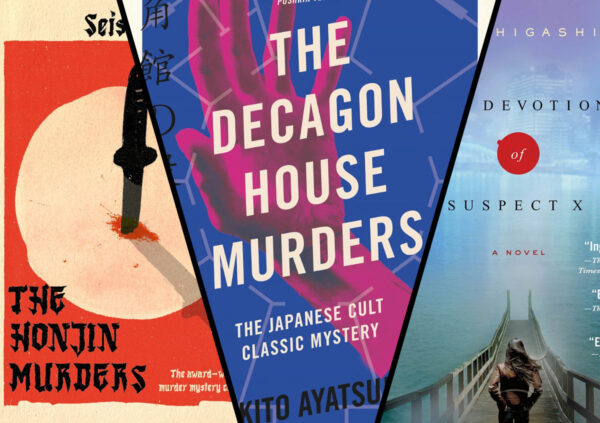
The Honjin Murders
Seishi Yokomizo · translated by Louise Heal Kawai · 1946, English 2019

A wedding night in a snowbound village. Screams from an annex, the sound of a koto, and by morning the newlyweds are dead inside a locked room with untouched snow all around it. Enter Kosuke Kindaichi, a scruffy, stammering young detective who looks like nobody’s idea of a great mind.
Yokomizo wrote this immediately after the war, and of the Japanese novels here it is the most delightedly aware of itself as a puzzle. Characters discuss locked-room mysteries by name. The narrator lists the Western novels the solution might resemble and rules them out one by one. This is honkaku, the Japanese fair-play school, and its founding principle is that the reader gets every clue the detective gets, presented openly, and is still expected to lose.
The solution is mechanically ingenious in a way that will either delight you or feel like a magic trick explained in too much detail. What lifts the book above its own cleverness is the setting: a rural family obsessed with bloodline and status in the exact year that both were being dismantled, with the murder rooted in that decay rather than decorating it.
It won the Mystery Writers of Japan Award in 1948 and still heads that organization’s own list of prize-winning titles available in English. Pushkin Vertigo’s translation program is the reason English readers can read this at all, and Kawai’s version keeps the period stiffness without making it a chore. If the honkaku tradition is new to you, this is the front door, and it’s the oldest of the Japanese novels here that still reads like a modern genre piece.
Tokyo Ueno Station
Yu Miri · translated by Morgan Giles · 2014, English 2019

Kazu is dead. He narrates anyway, drifting around the homeless encampment in Ueno Park where he spent the end of his life, unable to leave and unable to rest. He was born in 1933, the same year as the Emperor. His son was born the same day as the Crown Prince. The parallel is the whole novel: two lives running alongside each other, one of them ending in a cardboard shelter that gets cleared away whenever the imperial family passes through the park.
Yu Miri is a Zainichi Korean writer, born in Japan to Korean parents, and she writes about the country from a position of permanent partial exclusion that almost no other author of Japanese novels shares. Kazu built the venues for the 1964 Olympics. He worked in Fukushima. His labor is underneath everything Japan points at when it wants to show what it has achieved, and the book’s argument is that this is not a coincidence but a design.
The narration moves without warning between decades, overheard conversations, and lists of the things people leave behind. It’s disorienting on purpose. Giles’s translation won the National Book Award for translated literature in 2020, and the register she finds is remarkable: flat, exhausted, entirely without self-pity, which makes the anger underneath it much harder to dismiss.
Yu Miri won the Akutagawa Prize in 1997, and after the 2011 disaster she moved to Fukushima herself, where she opened a bookshop and a theater. Among recent Japanese novels this is one of the few that treats the country’s postwar prosperity as a crime scene rather than a backdrop.
The Emissary
Yoko Tawada · translated by Margaret Mitsutani · 2014, English 2018

Published in the UK as The Last Children of Tokyo. An unspecified catastrophe has left Japan sealed off from the world, and the generations have inverted: the old are robust and apparently unable to die, while children are born frail, unable to digest food, losing their teeth before they lose their childhoods. Yoshiro is over a hundred and cares for his great-grandson Mumei, who can barely walk.
It won the National Book Award for translated literature in 2018. Tawada writes in both Japanese and German and has spent a career pulling at the seams of language, which is what lifts this above the other dystopian Japanese novels it gets shelved beside. Words have been quarantined along with the country. Foreign loanwords are banned, so vocabulary keeps shifting underfoot, and Mitsutani’s translation has to perform that drift in English without the original’s specific mechanics. It’s one of the more impressive translation solutions in contemporary Japanese fiction, and it’s worth reading with that in mind.
The book refuses almost everything the genre expects. There’s no resistance movement to speak of, no revelation about the disaster, and the ending arrives sideways and stops. What it offers instead is Yoshiro’s tenderness toward a child he will certainly outlive, rendered without a drop of sentiment.
Read it if you want the strangest of the Japanese novels to come out of the post-Fukushima decade.
Territory of Light
Yuko Tsushima · translated by Geraldine Harcourt · 1978 to 1979, English 2018

Twelve chapters, one per month, following a young mother in the year after her husband leaves. She moves with her two-year-old daughter into a fourth-floor apartment full of windows, where light comes in from every direction and pools on the floors. Then she tries to hold a job, a child, and herself together, and does not entirely manage it.
What sets it apart from the enormous number of novels about single motherhood, Japanese novels included, is that Tsushima refuses to make her narrator good at it. The woman drinks. She sleeps through her daughter’s crying. She leaves the child alone, resents her, loves her, and reports all of it in the same even tone. There’s no arc toward competence and no redemption in the final chapter. Tsushima was Dazai’s daughter, and whatever else she inherited, the refusal to let a narrator off the hook came through intact.
It won the inaugural Noma Literary New Face Prize. Harcourt translated Tsushima for decades, was her friend, considered this her masterpiece, and finished it shortly before her own death. The translation went on to win the Lindsley and Masao Miyoshi Prize. The prose is plain to the point of severity, and the light of the title keeps returning as the one thing in the book that isn’t asking anything of anyone.
It went largely unnoticed in English for forty years. Its rediscovery is the best argument going for reading past the handful of Japanese novels that everyone already knows.
The Housekeeper and the Professor
Yoko Ogawa · translated by Stephen Snyder · 2003, English 2009

A brilliant mathematician has eighty minutes of short-term memory. Past that, everything resets. He pins notes to his suit so he can reconstruct who he is each morning, and the most important note tells him about the housekeeper who arrives every day, and whose son he nicknames Root because the top of his head is flat like a square root sign.
Ogawa is better known now for her colder work, and readers who arrive here from The Memory Police or Revenge are often startled. This is the warm one. The reset is never used for tragedy or for a twist. It’s a constraint the three of them live inside, and the novel’s quiet proposition is that a relationship rebuilt from scratch every morning is not obviously worth less than one that accumulates.
One thing sets it apart from every other of the Japanese novels here. Nobody in the book has a name. Not the Housekeeper, not the Professor, not the boy, who is only ever Root. In a novel about a man who cannot retain who anyone is, withholding every name is the argument rather than a flourish. The sister-in-law puts the whole triangle in one line: he can never remember the housekeeper, and can never forget her. The mathematics is real and load-bearing, which is rarer in Japanese novels than the number of professors in them suggests. Amicable numbers, perfect numbers, Euler’s identity: the Professor explains them because it’s the only thing left that he can still do well, and because a proof is the one kind of truth that doesn’t depend on remembering yesterday. Snyder, who has translated most of Ogawa’s work into English, keeps the register unhurried and slightly formal throughout.
It won the Yomiuri Prize and the booksellers’ Hon’ya Taisho. It’s the most accessible entry point to one of the essential careers in contemporary Japanese novels, and it’s nothing like the rest of it.
The Devotion of Suspect X
Keigo Higashino · translated by Alexander O. Smith · 2005, English 2011

You watch the murder happen in the first chapter. Yasuko and her teenage daughter Misato kill her abusive ex-husband in their apartment, and her neighbor Ishigami, a math teacher of terrifying ability and no social life whatsoever, knocks on the door and offers to handle everything. From there the book is not a whodunnit but a duel: Ishigami against Shunpei Kusanagi’s investigation, and behind that against Manabu Yukawa, the physicist who knew Ishigami at university and is the only person alive who can follow his reasoning.
Higashino’s structural gamble, and it has been copied across a decade of Japanese novels since, is that knowing the answer makes the book more tense rather than less, and it works because the question is never who but how much. How far Ishigami has gone. What he did, as opposed to what you watched him do. The final reveal reframes the entire novel in about two pages and is, by common consent, one of the great turns in modern crime fiction.
It took the 134th Naoki Prize and the Honkaku Mystery Award, and outsold every book in Japan bar one the year it appeared, which is rare for a crime novel anywhere. The prose is plain and the characterization outside the central three is thin. Higashino writes to a formula and has published enormously, which is exactly why this one gets recommended over the rest of his catalog. It’s the book where the formula and the material line up completely.
It’s also the most-read of all Japanese novels in translation in the crime category, and the reason a whole shelf of Japanese detective fiction now exists in English.
Audition
Ryu Murakami · translated by Ralph McCarthy · 1997, English 2009

Aoyama is a widower in his forties. A film-producer friend suggests a solution to his loneliness that only makes sense in the industry: stage auditions for a movie that will never be made, and use the process to find a wife. Thousands of applications arrive. Aoyama fixates on one, a former ballerina named Asami with a spotless application and almost no verifiable history.
What makes it work, and what separates it from the other Japanese novels here that get called horror, is how long it stays ordinary. Most of the novel is a middle-aged man’s interior monologue about dating, aging and his son, written with a naturalism Ryu Murakami rarely bothers with elsewhere. The dread accumulates through absence: the references that don’t check out, the studio that closed years ago, the people who can’t be found. By the time the reader understands what Aoyama has invited into his life, he’s already stopped listening to anyone who tries to warn him.
Takashi Miike’s 1999 film is the version most people know, and it made the last twenty minutes famous at the expense of everything before them. The novel is colder and more interested in Aoyama’s complicity, which is the point the film soft-pedals: he built a machine for selecting a woman based on nothing but presentation, and he got exactly what such a machine would produce.
I read it more than ten years ago, liked it, and landed somewhere in the middle. I won’t pretend to a considered verdict on the book against Miike’s film at this distance, because I’d be inventing one. That’s a modest recommendation rather than a strong one, and it’s the honest version.
It’s one of the few Japanese novels that earns a place on a general list and a horror list without changing shape between them.
The Waiting Years
Fumiko Enchi · translated by John Bester · 1957, English 1971

Tomo travels to Tokyo to buy a concubine for her husband. That’s the errand her marriage has assigned her: find a girl, assess her, negotiate the price, bring her home and install her in the household she runs. She is good at it. She does it more than once. The novel spans decades of this arrangement and never once lets her say what it costs.
Enchi’s method is restraint taken to the point of cruelty. Tomo’s interiority is available to the reader and to nobody in the book, and the gap between what she performs and what she holds is where the whole novel lives. Her husband Shirakawa is not a monster in any dramatic sense, which is worse. He’s a Meiji-era bureaucrat operating comfortably inside a system that grants him everything, and he never has to justify a thing.
It won the Noma Prize and took her the better part of eight years. Enchi was the daughter of a distinguished philologist, spent her career on the interior lives of women whom the historical record kept only as household fixtures, and also translated The Tale of Genji into modern Japanese. The woman who wrote the most unsparing book here about Meiji marriage had spent years inside the thousand-year-old novel about what the Heian court did to women. The final pages contain one of the great last gestures in modern Japanese fiction, and it works because Tomo has been silent for three hundred pages before it.
Among Japanese novels of the postwar decades this is the one most often left off English-language lists, and its absence is harder to justify than almost any other omission.
The Twilight Years
Sawako Ariyoshi · translated by Mildred Tahara · 1972, English 1984

Akiko works full time, keeps a household running, and has a husband who considers both of those things her business rather than his. Then her mother-in-law dies, and her father-in-law Shigezo, who has spent years treating Akiko with open contempt, turns out to be sliding into dementia. He no longer recognizes his own son. He does recognize Akiko. The care falls to her because there is nobody else and because nobody in the book can imagine an arrangement where it wouldn’t.
Ariyoshi published this in 1972, when Japan had barely begun to think about what an aging population would do to the people expected to absorb it. The novel sold in enormous numbers and is widely credited with forcing elder care into public debate there, which is a strange fate for a book this unsentimental. Shigezo is not softened into a wise old man. He wanders, he soils himself, he becomes frightened and then placid and then almost serene, and the novel tracks Akiko’s exhaustion and her flickers of something close to tenderness with equal attention and no interest in resolving them into a lesson.
The Japanese title, Kokotsu no Hito, is a euphemism that translates closer to a person in a state of rapture. Ariyoshi meant it plainly and cruelly at once, and the English title loses that entirely.
Donald Keene called it the closest representation of modern Japanese life he had read. It’s also out of print in English more often than not, which is the only reason it isn’t a fixture among the Japanese novels people recommend. As of this writing that means the used market. The Kodansha paperback is plentiful and cheap secondhand, and the button below will take you to it. Fifty years on, it’s read very differently and considerably harder than it did in 1972.
Japanese Tales of Mystery and Imagination
Edogawa Ranpo · translated by James B. Harris · stories from the 1920s and 1930s, English 1956

Say the pen name out loud. Edogawa Ranpo is a phonetic rendering of Edgar Allan Poe, which tells you both what Taro Hirai was aiming at and how much fun he was having. He effectively founded Japanese mystery fiction, and the prize awarded to new crime writers in Japan still carries his name.
This collection is the standard English gateway and it’s a strange, lopsided thing. “The Human Chair” is the famous one, a craftsman who builds himself into a piece of furniture so he can live inside it while people sit on him. “The Caterpillar” is a limbless veteran and the wife who cares for him, and it was suppressed by wartime censors for reasons that become obvious about two pages in. “The Hell of Mirrors” is a man’s obsession with reflective surfaces taken to its logical conclusion. Alongside these sit straight-faced deduction puzzles that could have run in a British magazine of the same era.
That range is the argument for reading him. Ranpo sits at the exact junction where Japanese mystery and Japanese horror separated, and he refused to pick a side, which is why both traditions claim him. The obsessive, body-focused strangeness in these stories runs directly into Junji Ito’s work decades later, and you can trace the line without squinting.
Ranpo sits under a great many of the Japanese novels further up this list. Harris’s translation, still the one most readers meet, was built aloud: the two men, each literate only in his own language, talked every story across over five years, and the stories survive the method easily.
I Am a Cat
Natsume Soseki · translated by Aiko Ito and Graeme Wilson · serialized 1905-06

Start with the title, because the joke dies in translation before you reach the second sentence. Wagahai wa Neko de Aru uses a register of self-reference so elevated it belongs to a nobleman: grandiloquent, self-important and absurd coming from a stray in a schoolteacher’s house. English gives you four flat words, and among the Japanese novels here no other title loses so much so fast. A cat with no name lives in the house of a dyspeptic schoolteacher and reports on the humans with total contempt. That’s the entire structure, sustained across a novel that Soseki kept extending because readers wouldn’t let him stop. It began as a single satirical sketch and grew into something closer to a serialized comic institution.
The joke is durable because the cat is a terrible judge of everything. He mistakes pretension for wisdom, misreads every social situation, and holds forth with enormous confidence about matters he has no access to. Meanwhile Soseki uses him to take apart the Meiji intelligentsia, a class of men performing Western sophistication while understanding very little of it, which is a target Soseki knew intimately from his own miserable years studying in London.
It is not a tightly built novel. Sections wander, running gags outstay their welcome, and the episodic origin shows badly in the back half. Readers who come to it after Kokoro often find the tonal distance startling, since almost nothing connects the ironist here to the man who wrote that book a decade later.
It remains one of the funniest Japanese novels ever written, and the fact that the humor survives both a century and a translation is the strongest recommendation available. On editions: Aiko Ito and Graeme Wilson’s version, from the 1970s, was for decades effectively the only one, and Nick Bradley published a new translation with Vintage in 2025. Be aware that Bradley translated volume one only, which leaves the older version as the sole route to the complete book.
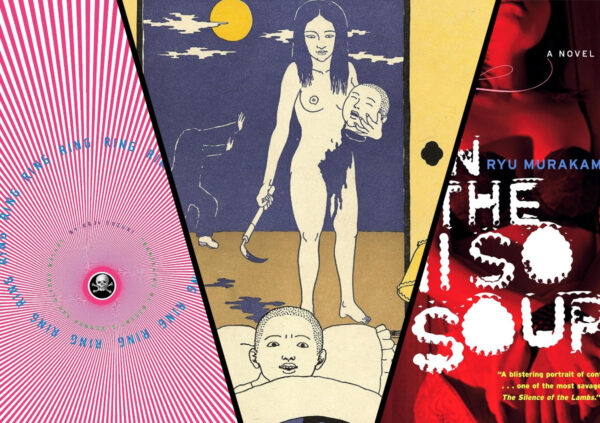
Ring
Koji Suzuki · translated by Robert B. Rohmer and Glynne Walley · 1991, English 2003

A journalist named Asakawa hears about four teenagers who died on the same night at the same hour. He traces them to a rental cabin, finds an unlabeled videotape, and watches it. At the end, a message tells him he has seven days.
Anyone arriving from Hideo Nakata’s 1998 film should know that the novel is a different animal. Asakawa is male, and his partner in the investigation is Ryuji Takayama, a nihilistic academic whose company is unpleasant. More importantly, Suzuki isn’t writing supernatural horror so much as an outbreak procedural. The tape behaves like a virus, the plot runs on epidemiology and information theory, and the sequels push that logic to places the films never attempted.
That’s the reason to read it rather than watch it again. The mechanism the novel proposes, that a curse is simply a self-replicating pattern that has found a good medium, is a colder and more modern idea than the ghost story the adaptations settled on. Suzuki’s prose is workmanlike and the translation is uneven in places, but the engine underneath is doing something the films left on the table.
Its influence on the wider genre is difficult to overstate. Most of what the West filed under J-horror for a decade traces back to this book, and it belongs among the Japanese novels that changed what came after them rather than the ones that were simply good.
A Personal Matter
Kenzaburo Oe · translated by John Nathan · 1964, English 1968

A man nicknamed Bird learns that his newborn son has a brain hernia and will, if he survives, be severely disabled. The doctors offer him an arrangement: dilute the baby’s milk, wait, and let the problem resolve itself. Bird takes the offer under consideration, then goes drinking, then goes to bed with an old girlfriend, then keeps considering it.
Oe wrote this shortly after his own son Hikari was born with a brain hernia, and the book’s refusal to let Bird be sympathetic is what gives it force. He is a coward and a fantasist, and the novel follows him through several days of increasingly squalid avoidance without ever suggesting that his distress excuses him. Whether the ending earns its turn has been argued over for sixty years, and the objection is a fair one.
Nathan’s translation is famously good and famously blunt, and Oe approved it. The prose is dense with grotesque physical imagery in a way that has nothing to do with the elegance most readers expect from Japanese literary fiction. Oe took the Nobel in 1994, and of his Japanese novels in English this is the one people mean when they say his name.
The postscript is not in the novel: Hikari Oe became a composer, and his father wrote about him for the rest of his career. Knowing that changes how the last chapter reads, though it’s worth reading it once without knowing.
Breasts and Eggs
Mieko Kawakami · translated by Sam Bett and David Boyd · 2019, English 2020

Two books in one binding. The first half follows Natsuko over a few days in Tokyo as her sister Makiko visits, fixated on getting breast augmentation, while Makiko’s twelve-year-old daughter Midoriko has stopped speaking to her mother entirely and communicates only through a notebook. The second half jumps a decade. Natsuko, now a published writer, single and with no interest in a partner, starts investigating sperm donation in a country whose fertility system has no category for her.
Kawakami was a singer-songwriter with three albums out before she published fiction, which is not the biography most literary careers start from. The seam between the two halves is visible in a way few Japanese novels would survive.
And the book you are holding is not the one that made her name. The novella called Breasts and Eggs won her the Akutagawa Prize in Japan and has never been translated into English at all. What English publishers put that title on is a separate 2019 novel, Natsu Monogatari, Summer Stories, which reworks the same characters at roughly four times the length. Japanese sources treat them as two different works. If you go hunting for the prizewinner, it does not exist in your language. Plenty of readers find the first section the better piece of writing and the second the more necessary one. What connects them is a directness about bodies, money and class that Japanese literary fiction had largely reserved for men, delivered in the voice of a woman from working-class Osaka who is very aware of how that voice is received in literary Tokyo.
It was a New York Times Notable Book of the Year and one of TIME’s Best 10 Books of 2020, and it made her the most-discussed Japanese novelist of her generation in English. Murakami championed her early, which she has since repaid by interviewing him and asking, on the record, about the way women function in his fiction.
If it lands, go to Heaven next. It was shortlisted for the 2022 International Booker Prize, it’s half the length, and a fair number of critics think it’s the better novel. The full guide to her four English books is on my Mieko Kawakami books page.
Silence
Shusaku Endo · translated by William Johnston · 1966, English 1969

Seventeenth-century Japan, with Christianity outlawed and its converts hunted. A young Portuguese Jesuit named Rodrigues sails in illegally, partly to minister to the hidden believers and partly to find out whether his old teacher Ferreira really renounced the faith under torture. He is captured. Then the authorities decline to torture him, and instead torture peasants in front of him, telling him it will stop the moment he steps on an image of Christ.
The title is the argument. Rodrigues prays constantly and hears nothing back, and Endo builds the entire book around the problem of a God who does not intervene while people are dying for the privilege of believing in him. Endo was himself a Japanese Catholic, raised by his mother and an aunt in Kobe and converted at eleven, and he spent his career on the question of whether a faith formed in Europe could take root in Japanese soil or whether something essential got lost on the journey.
The book was controversial with Japanese Catholics on publication, and readers still disagree sharply about whether its final movement is a betrayal of faith or the most serious defense of it in modern fiction. Shinoda filmed it in 1971 and Scorsese’s 2016 version was thirty years in the making, and neither can reproduce the interiority that makes the novel devastating.
Of all the Japanese novels dealing with the country’s relationship to the West, this is the one that refuses every easy position available to it.
Fires on the Plain
Shohei Ooka · translated by Ivan Morris · 1951, English 1957

Private Tamura has tuberculosis, which makes him useless to his unit on Leyte in the last months of 1944. His squad leader sends him to the field hospital. The hospital won’t take him because he has no food to contribute. He is told to go back, and then told to go away, and then he is simply walking, alone, through a collapsing occupation with a rifle and six potatoes.
One thing English readers should know going in. The scholar David Stahl has noted that Ivan Morris cut the passages in which the narrator admits he is shaping his own memoir. The whole moral weight of this book rests on whether you believe Tamura’s account of what he did and did not eat, and the Japanese text tells you he is managing the record while the English does not. Of all the Japanese novels here it is the one where a translator’s cuts do the most damage: you are reading a more reliable narrator than Ooka wrote. Ooka fought in the Philippines and was taken prisoner, and the novel’s authority comes from a refusal to make any of it meaningful. Tamura is not on a journey. He walks, he hides, he watches columns of Japanese soldiers get cut down from the air, and he becomes progressively less certain about what he is. The fires of the title burn in the distance across the fields and he never establishes what they are, which is the closest the book comes to a symbol and it declines to explain itself.
Then there is the meat. Tamura encounters other stragglers who have solved the food problem, and the novel moves into cannibalism with a calm that is far worse than horror would have been. Ooka was Catholic, and the book is structured around whether a man who has done what Tamura may have done can be said to have a soul left to damn. It offers no ruling.
It won the Yomiuri Prize. Of all the Japanese novels dealing with the war, this is the one that goes furthest and flinches least. It’s absent from essentially every English-language list, which says more about the lists than the book.
Rashomon and Other Stories
Ryunosuke Akutagawa · translated by Jay Rubin · stories from 1915-27

A word of warning on the title, because it trips up almost everyone. Kurosawa’s Rashomon takes its setting and title from the story “Rashomon” and its actual plot, the contradictory testimonies about a killing in a forest, from a different story called “In a Grove.” Both are here. Neither is what you’re expecting.
Akutagawa wrote well over a hundred stories in a career of about a dozen years, and the range is startling. Historical tales lifted from medieval collections and sharpened into something modern. “Hell Screen,” in which a painter is commissioned to depict hell and requires his patron to supply him with the real thing. “The Spider’s Thread,” a Buddhist parable of about four pages that does more than most novels manage. Then the late work, autobiographical and unraveling, written while his mental health collapsed. He died by suicide in 1927, at thirty-five.
He is the reason Japanese short fiction has the shape it has, and half the Japanese novels on this list are written by people who read him first. Japan’s most prestigious prize for new writers carries his name, and the writers on this list who came after him were all, in some measure, working in the space he cleared.
Jay Rubin’s Penguin selection is the one to buy. Older editions circulate widely and cheaply, but Rubin’s has a Murakami introduction and, more usefully, a translator who isn’t smoothing the strangeness out. For the story-by-story guide, my Ryunosuke Akutagawa books page goes deeper.
The Memory Police
Yoko Ogawa · translated by Stephen Snyder · 1994, English 2019

On an unnamed island, things disappear. Not physically at first: ribbons, birds, roses, ferries. One morning the population wakes knowing that a category of thing has gone, feels a brief collective grief, gathers up whatever remains of it and destroys it. Then they forget it existed. A small number of people are unable to forget, and the Memory Police exist to find them.
The narrator writes novels for a living, and when her editor turns out to be one of the immune she builds him a hiding place beneath her floorboards. Among the Japanese novels here it is the least interested in explaining itself. Ogawa never accounts for the mechanism, which frustrates some readers and is exactly the source of the book’s dread. There is no resistance to join and no truth to uncover. The disappearances continue, they begin to include parts of the body, and the novel follows that logic to a conclusion that is quiet and almost unbearable.
It was written in 1994 and reached English twenty-five years later, where it was immediately read as a book about surveillance states and disinformation. It was a National Book Award finalist for translated literature in 2019, the middle year of a remarkable run: Yoko Tawada’s The Emissary won the same prize in 2018 and Yu Miri’s Tokyo Ueno Station won it in 2020. Three consecutive years, three Japanese women, all three on this list. That reading isn’t wrong, but it undersells it. The better frame is loss itself, and the way people accommodate absence by forgetting what it was they had. Snyder’s translation is restrained to the point of blankness, which is the correct choice.
Shortlisted for the International Booker in 2020 as well, it’s now the most widely read of the Japanese novels sitting on the border between literary fiction and the fantastic.
Out
Natsuo Kirino · translated by Stephen Snyder · 1997, English 2003

Four women work the graveyard shift at a boxed-lunch factory in suburban Tokyo, assembling identical meals on a conveyor belt through the night. One of them, Yayoi, strangles her husband after he gambles away her savings and beats her once too often. She goes to Masako, the oldest and hardest of the four, and Masako agrees to help. The disposal of the body is described in full.
That sequence is what the book is known for, and it’s a mistake to read it as shock material. Kirino’s interest is in what these women are good at: careful, repetitive, physically demanding work performed at night for very little money by people nobody looks at. The dismemberment is another shift. The horror lands because they’re competent, and because competence is the only thing the world has ever asked of them.
From there it becomes a genuine crime novel, with debt, a loan shark, a casino owner, and a slow inversion in which the women stop being victims of their circumstances and start being something considerably more dangerous. Kirino refuses to reward any of it. Nobody escapes into a better life, and the ending has divided readers for twenty years.
It won the Mystery Writers of Japan Award and was the first Japanese crime novel most English-language readers encountered, and among the Japanese novels here it remains the one that hits hardest. Snyder’s translation is plain and cold, which suits a book with no interest in being liked, and it was a finalist for the Edgar Award for best mystery novel in 2004.
In the Miso Soup
Ryu Murakami · translated by Ralph McCarthy · 1997, English 2003

Kenji is twenty, and his job is guiding foreign tourists through Tokyo’s nightlife districts to the places they’re too embarrassed to find alone. Three days before New Year, he picks up an American client called Frank. Frank’s skin looks wrong. His stories don’t hold together. He knows things he shouldn’t and doesn’t know things he should. Kenji works this out early and takes the money anyway.
Ryu Murakami is the other Murakami, and this is the book that shows how far apart the two of them are. The novel is set almost entirely in hostess bars, peep shows and omiai clubs, and it’s fundamentally an argument about a society that has hollowed itself out and now sells the hollowness to visitors. Frank is the monster, but the book keeps insisting that Kenji’s customers, and Kenji, and the girls working the clubs, are all already somewhere on the same continuum.
There is one extended sequence in the middle that is among the most violent things in translated Japanese fiction, and it arrives without escalation. Worth knowing where it first appeared: the novel was serialized through 1997 in the Yomiuri Shimbun, the highest-circulation daily newspaper in Japan and arguably in the world. That passage ran in installments in a mass-market paper, and the book then won the Yomiuri Prize. Whether the social critique justifies it is the argument readers have about this book, and it’s a legitimate argument. What isn’t in dispute is the control of the pacing on either side of it.
Of the Japanese novels that work as literary fiction and as horror simultaneously, this is the one that commits hardest to both.
Convenience Store Woman
Sayaka Murata · translated by Ginny Tapley Takemori · 2016, English 2018

Keiko Furukura is thirty-six and has worked at the same Tokyo convenience store for eighteen years. She is very good at it. The store’s manual tells her when to speak, how to stand, what tone to greet customers in, and she has built an entire functioning self out of those instructions, borrowing speech patterns and opinions from her colleagues the way other people borrow clothes.
The pressure in this quietest of contemporary Japanese novels comes entirely from the people around her. Her sister, her old schoolfriends, her parents, all of them circling the same two questions: why isn’t she married, and why isn’t she doing something better. Nobody is cruel about it. That’s what makes it unbearable. The expectations are delivered as concern, repeatedly, by people who love her and cannot imagine a life that doesn’t run through marriage and a career, and Murata is merciless about how much violence sits inside ordinary well-meaning conversation.
Keiko’s solution, when it arrives in the form of a man named Shiraha, is worse than the problem and she knows it. He is a contemptible person with a theory about society that is roughly correct, and their arrangement is a transaction designed to satisfy everybody except the two people in it. What Murata does with the narration throughout is refuse to frame Keiko as deficient. The reader gets her reasoning from the inside, and it is consistently more coherent than anything the people managing her can offer.
Murata was still working convenience store shifts when this won the Akutagawa Prize, and it had sold over 660,000 copies in Japan before the English edition appeared, on the way to more than 1.5 million. Ginny Tapley Takemori’s translation won the Lindsley and Masao Miyoshi Prize. It’s the shortest of the essential contemporary Japanese novels and the one that has traveled furthest, and the reason is that the rigidity it describes is not remotely limited to Japan. Her stranger books are on my Sayaka Murata books page, with a warning attached.
The Wind-Up Bird Chronicle
Haruki Murakami · translated by Jay Rubin · 1994-95, English 1997

Toru Okada is unemployed and looking for his wife’s cat. Then he’s looking for his wife. In between he acquires a psychic, a teenage neighbor with a talent for uncomfortable questions, a malevolent brother-in-law who is becoming a public figure, and a war veteran with a very long story about Manchuria. At some point he climbs down a dry well and sits in the dark, and the novel goes with him.
The Manchuria material is why people call this Murakami’s most serious book and one of the essential postwar Japanese novels. The Nomonhan campaign and what Japan did and buried in the 1930s sit underneath the domestic mystery, and the argument is that the surface of ordinary Tokyo life is thin and there’s a great deal directly beneath it. When it works, nothing else in his catalog reaches as far.
A translation note that matters here more than anywhere else on this list. Rubin’s English version omits around sixty-one pages of the 1,379-page Japanese original, roughly four to five percent, including two full chapters from Book 2, part of a third, and a chapter from Book 3. Rubin translated the whole novel, then made the cuts himself rather than leave them to an editor, because the contract capped the English length. It’s the only English text available, so there’s no choice to make, but readers who find the book baggy in the third act are reacting to a structure that was rearranged after the fact. It is also not an isolated case. Fires on the Plain lost the passages that made its narrator unreliable, and Hard-Boiled Wonderland lost around a hundred pages until Jay Rubin restored them in 2024.
My own reservation is that structure. The individual pieces here are extraordinary, and Lieutenant Mamiya’s account of Manchukuo, including a scene of a man being skinned alive, is the most harrowing writing Murakami has ever done. May Kasahara is one of the best characters in his catalog. What I could never get past is that the book around those pieces doesn’t hold together. Toru’s search keeps receding until it works mainly as a frame for a run of loosely connected stories, and some of those stories are better than the novel containing them. It sits mid-pack for me. It stays on the list regardless, because leaving it off any account of Japanese novels would be indefensible.
The Makioka Sisters
Junichiro Tanizaki · translated by Edward Seidensticker · serialized 1943-48, English 1957

Four sisters from a declining Osaka merchant family, and a plot that consists almost entirely of trying to arrange a marriage for the third of them. Yukiko is shy, unhelpfully particular, and getting older. Candidates are proposed, investigated, and fall through. Meanwhile the youngest sister Taeko conducts her own life in ways the family cannot control, the eldest manages the household’s dignity, and the world outside the novel moves steadily toward 1941.
That last part is the trick. The war is almost never discussed and is everywhere, in flood reports and business decisions and the gradual disappearance of the life the Makiokas were built for. The military censors banned serialization on the grounds that it was frivolous and unhelpful to the war effort, and they were reading it correctly. A four-hundred-page novel about kimono selection and marriage negotiations, published while Japan was losing, is not a neutral act.
Tanizaki wrote it as an elegy for Osaka merchant culture, and of all the Japanese novels here it is the one whose slowness is most completely the method. Almost nothing happens, in enormous and absorbing detail, and the accumulation is the point. Readers who need incident should be warned.
Seidensticker’s translation is the standard and it’s very fine, though be aware the English title is his invention. The Japanese is Sasameyuki, a fine or thinly falling snow, which tells you considerably more about the book.
Kitchen
Banana Yoshimoto · translated by Megan Backus · 1988, English 1993

Mikage Sakurai’s grandmother dies and leaves her with no family at all. Unable to sleep anywhere else, she starts sleeping on the kitchen floor next to the refrigerator, because the hum is the only thing that helps. Then Yuichi, a boy who knew her grandmother from the flower shop, turns up and offers her a room in the apartment he shares with his mother Eriko.
The book made Yoshimoto a phenomenon in Japan while she was still in her early twenties, and the coverage at the time was not kind about why, since a young woman writing short, accessible fiction about grief was easy to file as a fad. Three decades later it’s still in print in more than twenty languages and the fad reading has not aged well. What holds up is the specificity of the grief: not the drama of loss but the logistics of it, the practical problem of where to sleep and what to eat and how to fill the hours.
It’s worth going in knowing that Eriko is a trans woman, that she was Yuichi’s father before transitioning, and that the novel’s handling of her is warm and completely unlike anything else being published in Japan in 1988. It’s also of its moment in its language and framing, and some of it lands awkwardly now. Reading it as a document of what was generous in 1988 rather than as a contemporary text is the fair approach.
One warning, because it is the only English text there is. Megan Backus’s translation was called dogged by the New Yorker on release and choppy by the New York Times, a 2026 reassessment in Metropolis argues the English falls well short of the Japanese, and there is an academic paper comparing the two line by line. Thirty-three years on, nobody has replaced it. Among Japanese novels in English it may be the most widely gifted, and its influence on the entire contemporary wave of quiet, interior, domestic fiction is direct. Her own catalog is mapped on my Banana Yoshimoto books page.
The Sailor Who Fell from Grace with the Sea
Yukio Mishima · translated by John Nathan · 1963, English 1965

Noboru is thirteen. He has found a gap in his bedroom wall through which he can watch his widowed mother’s bedroom, and what he sees there is Ryuji, a merchant sailor she has begun seeing. At first Noboru worships him: a man of the sea, unattached, glorious in the way that only someone who never comes ashore can be. Then Ryuji decides to marry Fusako, take a job in her shop, and stay.
Noboru belongs to a group of boys led by a figure known only as the chief, who has worked out a complete philosophy by the age of fourteen and holds that adults are hollow, that fathers are the worst thing in the world, and that a man who chooses comfort has committed an unforgivable act. What the boys do with a kitten early in the novel tells you what they are capable of and how the book intends to end.
John Nathan was twenty-three when he translated this, hired by Knopf to take Mishima over from Donald Keene while Mishima was openly campaigning for the Nobel. Nathan’s next major translation was Oe’s A Personal Matter, also on this list, and by most accounts choosing Oe ended the Mishima partnership. Mishima lost the 1968 Nobel to Kawabata, who is also here. Oe took it in 1994. Mishima’s obsessions are all on the surface here, compressed into fewer pages than almost any of the Japanese novels around it: the sea, the body, glory, and the belief that beauty is better burned than allowed to go stale. It’s the tightest and most controlled of his books available in English, which is why it gets recommended ahead of the Sea of Fertility tetralogy for readers arriving new.
Knowing how Mishima’s own life ended in 1970 makes the ending read differently, and it’s difficult to unknow. Nathan’s translation is superb. If you read only one Mishima among the Japanese novels here, read this one. The rest of him, tetralogy included, is on my Yukio Mishima books page.
Norwegian Wood
Haruki Murakami · translated by Jay Rubin · 1987, English 2000

Toru Watanabe hears the Beatles song on a plane at thirty-seven and is dropped straight back into 1969: Tokyo, university, the death of his best friend Kizuki, and Naoko, who was Kizuki’s girlfriend and is not recovering. Alongside her is Midori, alive in every way Naoko isn’t, and the novel spends its length on Toru caught between the two of them.
This is the outlier in his catalog and the reason a lot of readers who dislike Murakami still rate it above his other Japanese novels. No talking cats, no parallel worlds, no wells. It’s a realist campus novel about grief, depression and the way young people fail each other, and the student protests of the era play out in the background while nobody in the book quite manages to care about them. Murakami has said he wrote it to prove he could.
It sold in the millions in Japan and made him a celebrity, which he found intolerable enough to leave the country. It also handles mental illness and suicide directly and at length, which is worth knowing before recommending it to anyone.
Note for buyers: Rubin’s is the translation to get, and the difference is not cosmetic. Where Rubin nicknames a character Storm Trooper, Birnbaum has Kamikaze. An earlier Alfred Birnbaum version was published in Japan in the 1980s for Japanese readers studying English and occasionally surfaces secondhand. It is not the one you want.
It’s tender and precise, and it was unusually unsentimental about mental illness for its moment, though that handling hasn’t aged evenly. My reservation is how much weight the book puts on sex, which tips from candid into wearying more than once. Neither complaint moves it out of the top tier. It’s a real tear-jerker, it’s controlled to a degree he rarely matches again, and the last pages take you apart without ever raising their voice.
Black Rain
Masuji Ibuse · translated by John Bester · serialized 1965-66, English 1969

Shigematsu Shizuma is trying to arrange a marriage for his niece Yasuko, and it keeps falling through. Rumors have followed her: that she was in Hiroshima, that she was caught in the rain that fell afterwards, that whatever is in that rain is in her. To settle the matter he begins copying out his diary of the days after the bomb, and Yasuko’s, to prove she was nowhere near the city. The novel is largely those diaries.
Of all the Japanese novels dealing with the bomb, this is the one that refuses spectacle. Ibuse assembled it from real survivor accounts, medical records and interviews, and the effect of that method is a novel where the atrocity is almost entirely off-page and administrative. People queue. They look for relatives. They discuss the correct way to cremate a body when there is no fuel, worry about rice rations, note down the weather. The horror accumulates through the enormous gap between the register of the prose and what the prose is describing, and it is far more effective than any attempt at grandeur.
The marriage plot is the masterstroke. Yasuko’s real problem is not radiation sickness but the social machinery that has already decided what she is, and Ibuse understood that the bomb’s longest-running damage in Japan would be done by neighbors rather than by physics. It took the Noma Prize and the Order of Cultural Merit, and Ibuse, who was not in Hiroshima that day, built the whole thing out of other people’s diaries. Imamura filmed it in 1989, in black and white, and it’s very good and still smaller than the book.
Not one of the nine sources I checked while building this list includes it. Among Japanese novels it is a first-rank work of the twentieth century, and its absence from English-language recommendations is the single strangest gap in the whole field.
The Woman in the Dunes
Kobo Abe · translated by E. Dale Saunders · 1962, English 1964

An amateur entomologist takes a few days off to hunt for beetles in a stretch of coastal dunes, hoping to find a new species and get his name into the record permanently. He misses the last bus. Villagers offer him a bed for the night, in a house at the bottom of a sand pit, reached by rope ladder. In the morning the ladder is gone.
The house has one occupant, a widow, and one function: every night she shovels sand, because if she stops the pit fills and the houses further along the line go under. The man is now expected to shovel too. He tries escape, negotiation, violence, hunger strike, and reason, and the novel works through each attempt with the patience of a scientist running an experiment on himself.
Abe trained as a doctor and never practiced, and it shows in a clinical attention no other writer of Japanese novels quite matches. Sand gets everywhere. It’s in the food, the bedding, the skin, described with a physical specificity that makes reading it slightly unpleasant in a way the book fully intends. Underneath sits the obvious allegory about labor and social obligation, but the reason it outlasts its own allegory is the last few pages, where the question of what the man wants gets an answer nobody finds comfortable.
It won the Yomiuri Prize in 1962, and the first English edition carried illustrations by Machi Abe, the author’s wife. Teshigahara filmed it in 1964 with a Toru Takemitsu score and the result is one of the great literary adaptations. Read the book first. In 1972 the translator Kenneth Strong is reported to have named the five most famous works of Japanese literature in the West: The Makioka Sisters, Snow Country, Kokoro, The Temple of the Golden Pavilion, and this. Fifty years on it appears in one of the nine English-language lists I checked. That is not a book nobody discovered. That is a book that fell out of the conversation.
Kafka on the Shore
Haruki Murakami · translated by Philip Gabriel · 2002, English 2005

Two stories, alternating. A fifteen-year-old who calls himself Kafka Tamura runs away from his father’s house in Tokyo carrying a prophecy he intends to outrun. Meanwhile Nakata, an old man who lost his memory and his literacy in a wartime incident and can hold conversations with cats, sets off on a journey he cannot explain to anyone including himself. Fish fall from the sky. A man dressed as Johnnie Walker does something unforgivable. Colonel Sanders turns up as a pimp.
The two strands never meet in the way a reader expects them to, and Murakami has been open that the novel is not designed to resolve. He suggested readers work through it more than once, which is either an invitation or an excuse depending on your patience. The Oedipal machinery is deployed without embarrassment and the book’s sexual content includes material that a number of readers find indefensible rather than merely provocative.
What carries it is Nakata. He is the warmest thing Murakami has written, a man with nothing left but decency and an ability to talk to animals, and the stretch of road novel following him and the truck driver Hoshino is as good as anything in the catalog. It won the World Fantasy Award and it’s the book most often handed to people as their first Murakami, and for a great many readers their first Japanese novel of any kind, on the reasonable grounds that if this doesn’t land, none of it will.
This is Murakami at his most bewildering, which with him tends to be the same address as his best. Underneath the fish and the entrance stone it’s a coming-of-age novel about a boy learning to survive being himself, and that’s the thing holding the machinery together. It will leave you turned around after one reading. It’s also a masterpiece of magical realism and, for a lot of readers, simply the best thing he’s written.
If it lands and you want the deeper cut, Hard-Boiled Wonderland and the End of the World is my own favorite of his. Buy Jay Rubin’s 2024 translation rather than Alfred Birnbaum’s from 1991, because it restores roughly a hundred pages that the earlier version left out, at Murakami’s request. Be warned that it is published as End of the World and Hard-Boiled Wonderland, following the Japanese word order, so searching the familiar title will not find it. It’s also the least representative thing he’s written, closer to science fiction than to the dreamlike register most people come to him for, which is why it isn’t where I’d start anyone. All sixteen novels, that one at the top, are ranked on my Haruki Murakami books page.
Snow Country
Yasunari Kawabata · translated by Edward Seidensticker · serialized 1935-37, final version 1948, English 1956

A train comes out of a long tunnel into the snow country, and that’s the whole book announcing itself in one movement: a passage from one world into another that operates on different rules. Shimamura is a dilettante from Tokyo with inherited money, an interest in Western ballet he has never seen performed, and a wife and children he mentions rarely. He travels to a hot spring town in the mountains and takes up with Komako, a local geisha, across three visits.
Nothing much happens and everything is unbearable. Komako loves him, or is performing love with an intensity that has become indistinguishable from it, and drinks, and writes in her diaries, and waits. Shimamura registers all of it with the detached appreciation he brings to everything, and the book’s cruelty is that his detachment is the same faculty that lets him see her so precisely. He finds her wasted effort beautiful. That is the worst thing anyone says about her.
Kawabata built this most reworked of Japanese novels out of separately published pieces over more than a decade and kept revising it, and the seams give it a drifting, associative quality that plot summary destroys. The prose works by juxtaposition rather than statement, closer to linked verse than to Western realism, and Seidensticker’s translation is the reason English readers can feel that at all.
He was the first Japanese writer to take the Nobel, in 1968. Of the Japanese novels on this list this is the one that most rewards a second reading and the one most likely to lose you on the first.
Kokoro
Natsume Soseki · translated by Edwin McClellan · 1914

A student meets an older man at the beach in Kamakura and attaches himself to him. He calls him Sensei. Sensei is courteous, idle, married, and closed, and he visits a grave every month and won’t say whose. The student presses. Sensei tells him that one day he will explain everything, but not yet, and that when the time comes it will be in writing.
The last half of the novel is that letter, and it is the single greatest structural gamble in any of the Japanese novels here. Sensei writes about his student years, a boarding house, the landlady’s daughter, and a friend referred to only as K, who was more serious and more devout and more able than Sensei, and who wanted the same woman. What Sensei did about that, and what happened to K, is the thing he has been carrying for two decades.
Soseki set the ending against the death of the Meiji Emperor and General Nogi’s suicide following his lord, and that’s the argument: an entire moral order dying, and the people formed by it discovering they cannot live under whatever comes next. Sensei’s guilt is personal and it is also the guilt of a generation that got modernity and found the price attached to it afterwards.
It is the best-selling title in the history of Shinchosha, its publisher, ahead of No Longer Human at number two, and it’s required reading in Japanese schools, which usually kills a book and hasn’t touched this one. McClellan, born in Kobe to a Japanese mother and a British father, translated it partly to convince his supervisor that Soseki was worth a dissertation. On translations: his 1957 version is the classic and reads beautifully, while Meredith McKinney’s Penguin Classics edition is more current and slightly cooler. Either works. Among Japanese novels, this is the one I’d hand someone first.
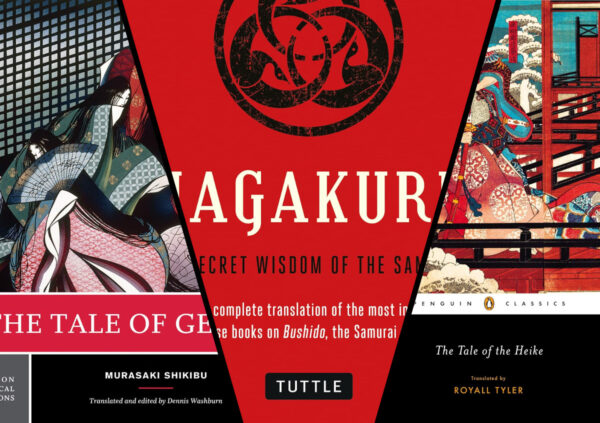
The Tale of Genji
Murasaki Shikibu · c. 1010 · translator depends entirely on which book you want

A thousand years old, fifty-four chapters, and written by a lady-in-waiting at the Heian court whose actual name nobody knows. Genji is the emperor’s son by a low-ranking consort, too beautiful and too gifted, removed from the line of succession, and the novel tracks his loves, his banishment, his restoration and the long fade after. Then Genji dies with thirteen chapters still to run, and the book passes to his supposed son and his grandson in a darker key that reads like another author’s work and probably isn’t.
Calling it the world’s first novel is a claim that gets argued about and it’s beside the point. What’s remarkable is how much of it works: characters who age and alter, a narrator unafraid of editorializing, and an unbroken attention to women whose perception outruns their power. Murasaki wrote for a court readership of a few dozen, every one of them known to her, and the thing somehow survives passage into a tongue and a millennium she never pictured.
The translation choice matters more with Genji than with any other book on this list, and the four English versions are effectively four different novels. I’ve broken all four down, Waley through Washburn, on my Japanese classics page. The short version: start with Washburn or Seidensticker, and come to Tyler once you want to know what the Heian court actually felt like.
Nobody finishes it quickly and plenty of readers never finish it at all. It sits at the root of the tradition every one of the Japanese novels above it grew out of.
No Longer Human
Osamu Dazai · translated by Donald Keene · 1948, English 1958

Three notebooks by a man named Oba Yozo, framed by a narrator who claims to have been given them. Yozo grows up unable to understand what other people are doing or why, and works out early that if he performs the clown continuously nobody will look closely enough to notice there’s nothing behind it. The notebooks follow that strategy through school, art college, alcohol, morphine, a series of women who love him, and a slow disappearance from his own life.
The Japanese title, Ningen Shikkaku, means something closer to disqualified as a human being. Keene’s English title is the famous one and it softens the original considerably. Dazai finished the book and died at thirty-eight. It was published about a month later. The temptation to read it as a suicide note is enormous and worth resisting, because Yozo is a constructed narrator and Dazai was a controlled writer performing a version of himself he had been refining for years. That’s the whole subject: the mask that becomes load-bearing.
It is the second best-selling novel in the history of its publisher, behind Kokoro, and it has found an entirely new readership through TikTok, anime and Bungo Stray Dogs. This is not a curiosity that survived. It’s one of the most widely read Japanese novels there has ever been, and the reason is that the loneliness in it is described so precisely that readers keep recognizing themselves in a man they would rather not resemble.
On translations. Keene’s 1958 version is the standard. Mark Gibeau’s 2018 A Shameful Life and Juliet Winters Carpenter’s 2024 translation are both available. The consensus is that Keene reads more smoothly and Gibeau sits closer to the shape of Dazai’s actual sentences, awkwardness included. Take Keene first for the prose, Gibeau if you want to argue about it afterwards. The full translation war, all four versions, is on my Osamu Dazai books page.
On the manga. Two adaptations count. Furuya’s 2009 centenary version moves Yozo into the present and trusts the performance itself to carry the dread, no monsters required, and it is the sharper reading. Ito’s 2017 take is the one everyone knows, six hundred pages with Dazai drawn in as a character, everything turned outward and visible in the usual Ito manner, and it stands as real Ito rather than homage. Furuya first.
That’s where this list ends, with a book about a man who could not convince himself he belonged to the same species as everyone else, written by someone who ran out of time to keep pretending otherwise.
Many of these novels, and a few close cousins from the same shelves, now have pages of their own, covering the history around them rather than the reading: Kokoro · I Am a Cat · Snow Country · The Makioka Sisters · The Temple of the Golden Pavilion · Silence · Woman in the Dunes · Kitchen · No Longer Human · The Tale of Genji · Breasts and Eggs · Convenience Store Woman · In the Miso Soup · Out · The Memory Police · Norwegian Wood · Kafka on the Shore · The Wind-Up Bird Chronicle · 1Q84 · Before the Coffee Gets Cold · Strange Pictures.