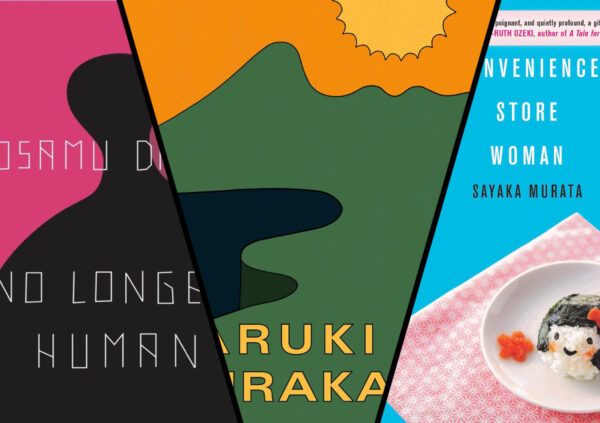
Convenience Store Woman has a slightly different title in Japanese. Sayaka Murata called it Konbini Ningen, which means Convenience Store Human, and the difference matters. Keiko Furukura doesn’t just work at the store. The store is the thing that taught her how to be a person the world will accept, and for eighteen years the manual has given her a script for being human that nothing else in her life ever did.
I read this one and really enjoyed it, and two things stayed with me: how clearly Keiko reads as neurodivergent, and how sharply the book shows marriage as something close to compulsory. The Sayaka Murata guide covers the plot, the prize, and what to read next, so this page is about those two threads, the title, the job Murata herself held while writing it, and how other readers have taken the book.
Eighteen Years, Both of Them
The most striking fact about this novel is not in it. Murata worked part-time as a convenience store clerk in Tokyo for eighteen years, until 2017, fitting shifts around her writing, and she was still doing it when the book won the Akutagawa Prize. Keiko has worked at her store for eighteen years too.
That parallel changes how the detail reads. The sounds of the store, the greeting shouted at every customer, the rhythm of restocking, the pride in a display that moves product, the particular exhaustion of the morning shift: none of it is research. It’s a second job, described by someone who kept doing it after she no longer needed the money.
The store in the novel is called Smile Mart, and one small detail carries the whole idea: across Keiko’s eighteen years the shop goes through eight managers and a constant churn of part-time staff, and she is the one permanent thing in it.
A Store That Makes Her Human
Keiko has never understood what other people expect of her, and as a child her logical responses to ordinary situations alarmed the adults around her. The convenience store fixes that. Its training manual tells her exactly how to greet customers, how to stand, and what tone to use, and she copies the speech and the style of the coworkers around her to fill in the rest. She notices, without judgment, that her colleagues do the same to each other.
The Japanese title names that transformation directly. Murata has described the store as becoming, for Keiko, something to believe in that was more precious than being normal, as important to her as a church. The English title keeps the job, while the Japanese one keeps the stranger idea of a woman who becomes human through a retail workplace. Reviewers have pointed out that even her name is doing work: written with the characters Murata chose, Keiko means something like blessed child, which is either a joke or a question depending on how you read the ending.
The Diagnosis the Book Never Makes
For me, Keiko’s differences are almost on the nose. The novel never names autism or any other condition, and nothing in it confirms a diagnosis, but I found it very hard to read her any other way.
Plenty of other readers have come to the same conclusion. Reviewers have pointed to her literal thinking and her careful mimicry of the people around her, one compared the book to The Curious Incident of the Dog in the Night-Time, and autistic readers and critics have written about recognizing themselves in Keiko. The word itself never appears on the page, and as one reviewer notes, it has never appeared in Murata’s interviews either.
There is a competing reading worth knowing about, and it comes mostly from critics reading the novel within Japanese literary traditions rather than through a diagnostic lens. On that account Keiko is not a portrait of a neurological difference at all, but a personification of what social roles do to people: she has simply absorbed the script she was handed more completely and more honestly than anyone around her. Murata has said she wanted to expose the oddness of the people who consider themselves normal, which supports it. Both readings can sit on the same book, and neither one makes the other wrong.
Marriage as the Default Setting
The other thing the book shows so well is how marriage works as a default that almost nobody questions. By thirty-six, Keiko is supposed to have married, and probably had children, and the people around her treat the fact that she hasn’t as a problem they need to solve. It doesn’t matter whether she wants any of it. What matters is that it’s what people do.
That pressure is what drives the story, and it’s what pushes Keiko toward the strange arrangement at its center. She goes along with the expectation, or feels she has to. Reviewers widely read this as the book’s central critique of Japanese society.
Shiraha, and Why He Divides Readers
The arrangement involves Shiraha, a new employee who is idle, resentful and relentlessly misogynistic, and who blames society for everything that has not happened to him.
He is a deliberate creation, the counter-example Keiko needs: another misfit, but one whose non-conformity is pure grievance. Not everyone thinks he works. A recurring complaint in reviews is that he is written so far over the top that he stops being a character and becomes a device, and several readers say his monologues are the hardest part of the book to sit through. Worth knowing before you start, since he takes up much of the second half.
What It Sold, and Where Else It Exists

The novel first appeared in the June 2016 issue of the magazine Bungakukai and came out as a book that July. It won the 155th Akutagawa Prize, has sold over 1.5 million copies in Japan, and has been translated into more than thirty languages.
Ginny Tapley Takemori’s English translation was published in 2018 by Grove Press in the US and Portobello in the UK, and it’s the only one. Reviewers consistently praise it for making Murata’s flat, ambiguous Japanese dialogue work in English without flattening it further. There’s an audiobook read by Nancy Wu, and in Japan the novel was adapted as a radio drama for NHK-FM.
Where to Go Next
Before picking up Murata’s next book, read the warning on the Sayaka Murata guide, because Earthlings is a very different experience. The guide suggests her story collection Life Ceremony as a better second step.
Readers struck by Keiko’s performance of normality should try Dazai’s No Longer Human, whose narrator hides behind clowning in much the same way. Mieko Kawakami writes just as pointedly about what’s expected of women, and her guide is the place to start, while our best Japanese novels ranking places Murata among her peers.