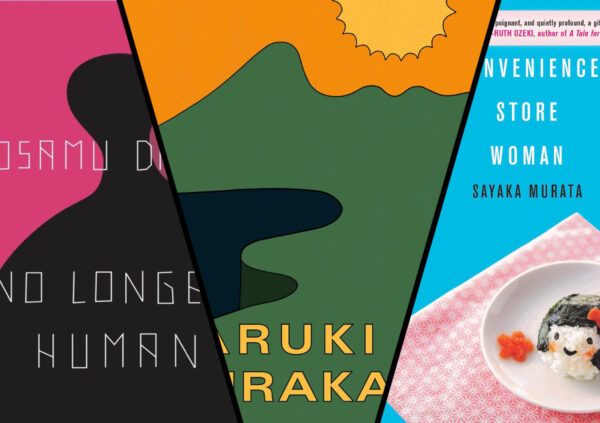
Convenience Store Woman was Sayaka Murata’s tenth novel in Japanese. It was the first anyone read in English.
That gap explains almost everything about how the Sayaka Murata books are understood outside Japan. English readers met a writer who appeared to arrive fully formed with a strange, funny, unsettling little book about a woman who works in a shop. In Japan she had already won four major literary prizes across thirteen years and was known as a writer of disturbing fiction. The full canon is ranked on my best Japanese novels list. The author index lives on my Japanese authors hub.
Four Sayaka Murata books exist in English. All four are translated by the same person. This runs through all four, sets the order, and delivers the warning about the second one that a lot of readers wish they had been given.
Start Here
Convenience Store Woman. Of the Sayaka Murata books it is the shortest, the most accessible, and the one that made her name. A hundred and sixty pages, and it does not prepare you for anything else she has written.
Then stop and read the warning below before you pick up Earthlings.
Convenience Store Woman
コンビニ人間 Konbini Ningen · 2016 · translated by Ginny Tapley Takemori · English 2018

Keiko Furukura has spent eighteen years behind the counter of the same Tokyo convenience store, and it is the one place her existence makes sense. The manual supplies a script for speaking, standing and greeting, and Keiko has assembled a workable self from it piece by piece, padding the gaps with mannerisms lifted from whoever works the shift beside her.
The pressure never comes from the store. It comes from everyone else: a sister, old schoolfriends, parents, each of them returning to the same pair of questions about marriage and a proper job. None of them mean harm, which is the trap. The concern arrives warm, keeps arriving, and issues from people whose love cannot picture a life shaped any other way.
Murata is merciless about how much force sits inside ordinary well-meaning conversation, and specifically about what happens to a woman who declines to marry and offers no reason. Keiko’s eventual solution, a man named Shiraha, makes things worse than the complaint it was meant to answer, and she signs up anyway with her eyes open.
What she does with the narration is the achievement. Keiko’s logic reaches you unfiltered and holds together better than any advice aimed at her. The book never frames her as deficient. It frames everyone else as unable to tolerate her.
It won the 155th Akutagawa Prize, sold over two million copies across forty countries, and she was still pulling shifts at the register when the prize landed.
My own take, having read it: I liked this one a lot. Keiko reads to me as neurodivergent, and although the book never puts a name to it and Murata has never done so in an interview either, it is almost on the nose. The other thing that stays with me is how completely the pressure to marry is treated as a given by everybody around her. She either goes along with it or has no peace, and the novel never pretends that is a free choice.
Earthlings
地球星人 Chikyū Seijin · 2018 · translated by Ginny Tapley Takemori · English 2020

Read this warning first. Her own translator has said plainly that not everyone who enjoyed Convenience Store Woman will like Earthlings, and she is being diplomatic. This is the book that ends the assumption that the Sayaka Murata books are quirky gentle social comedy.
Natsuki believes she is an alien. She has a plush hedgehog who tells her so, a cousin she has secretly married in a childhood ceremony, and a family that treats her as a nuisance to be managed. She is also being abused by a teacher, which the novel presents without cushioning of any kind.
In adulthood she is in a sexless marriage of convenience with a man who shares her contempt for what the two of them call the Factory: society understood as a machine for producing workers and babies. They go to the mountains. And then the last third of the book goes somewhere that readers describe in reviews using words normally reserved for horror fiction.
It is not a shock-value exercise. Every element in the ending is an argument the earlier chapters set up, and the logic is airtight, which is precisely what makes it so hard to take. The novel’s proposition is that if you genuinely refuse the terms society offers, and you refuse them completely rather than partially, you end up somewhere nobody wants to follow you.
Among the Sayaka Murata books this is the one people either consider her masterpiece or wish they had never opened. Both reactions are reasonable. Go in knowing it contains child sexual abuse, incest and cannibalism, and decide before rather than during.
Life Ceremony
生命式 Seimeishiki · 2019 · translated by Ginny Tapley Takemori · English 2022

Twelve short stories, and the best demonstration of what the Sayaka Murata books actually do.
The title story is set in a world where eating the dead at their funerals is normal and reproduction afterwards is encouraged, and it is written as a workplace comedy about a woman who finds the custom slightly embarrassing. Another follows a society where furniture is made from human remains and a woman’s late husband has been turned into a chandelier. Another is a straightforward story about a first date that turns on nothing supernatural at all and is somehow more disquieting than the cannibalism.
The collection is the clearest window on her method. Murata’s technique is not to invent horrifying worlds but to alter one social rule and then write the consequences in the flat, mildly bored register of someone describing a mildly awkward office situation. The reader supplies the horror. She just declines to notice it.
If Earthlings is too much and Convenience Store Woman was not enough, this is where to go.
Vanishing World
消滅世界 Shōmetsu Sekai · 2015 · translated by Ginny Tapley Takemori · English 2025

A Japan where sex between married couples has effectively disappeared, all children are conceived by artificial insemination, and people conduct their romantic lives with anime characters instead. Amane was conceived the old way, which makes her a source of embarrassment to herself.
Then she moves to an experimental city where the arrangement has been taken further still, and the final section is one of the more genuinely upsetting things in contemporary fiction.
The publication history matters here. This came out in Japan in 2015, before Convenience Store Woman, and reached English a decade later. So the book English readers received as her fourth is chronologically her second-most-recent-but-one, and it was written by a less internationally famous writer with nothing to lose. The Financial Times described it as a comedy whose darkness is almost indistinguishable from horror, which is about right.
Read it after Life Ceremony.
The Translator, and Why It Matters Here
Every English word of the Sayaka Murata books is Ginny Tapley Takemori. All four books, and the short stories.
That is unusual and it is worth understanding, because Murata’s effect depends entirely on register. Takemori has described the prose as flat and affectless, and explained that the non-emotional handling is what brings the oddness out, so keeping it flat in English is the whole job. A translator with more instinct for drama would destroy these books by improving them.
Takemori is British, lives in Ibaraki, and has also translated Ryu Murakami, Miyuki Miyabe and Izumi Kyoka. With Allison Markin Powell and Lucy North she founded Strong Women, Soft Power, a translators’ collective built to push back on how few Japanese women were reaching English, and Murata was one of the writers she championed before any publisher had signed her.
What Is Not in English
Six novels and a story collection, including the four that made her reputation in Japan.
Her debut Breastfeeding (2003) won the Gunzo Prize for New Writers. Silver Song (2008) won the Noma Literary Prize for New Writers. Of Bones, Of Body Heat, Of Whitening City (2012) won the Mishima Yukio Prize. There is also A Welcoming Door (2012), Birth Murders (2014), and the 2022 collection Faith, of which two stories have appeared individually in English.
So the writer English readers know from four Sayaka Murata books has published at least ten novels, and the three that established her in Japan are all unavailable.
The Full English List
Novels: Convenience Store Woman (2018) · Earthlings (2020) · Vanishing World (2025)
Stories: Life Ceremony (2022), plus A Clean Marriage in Granta 127 and several uncollected pieces
Recommended order: Convenience Store Woman, Life Ceremony, Vanishing World, Earthlings. That is not the publication order and it is the order that will do you least damage.
If you want to see where she sits among her contemporaries, several of whom appear alongside her, I have written about that over at the best Japanese novels.
Her breakthrough has its own page: Convenience Store Woman, on the eighteen years Murata spent working the same job and the two readings of Keiko.