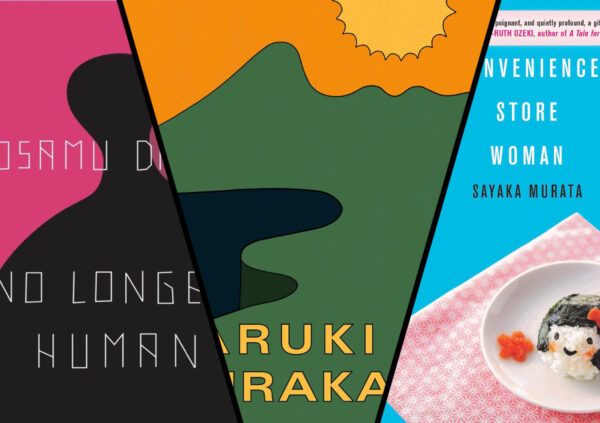
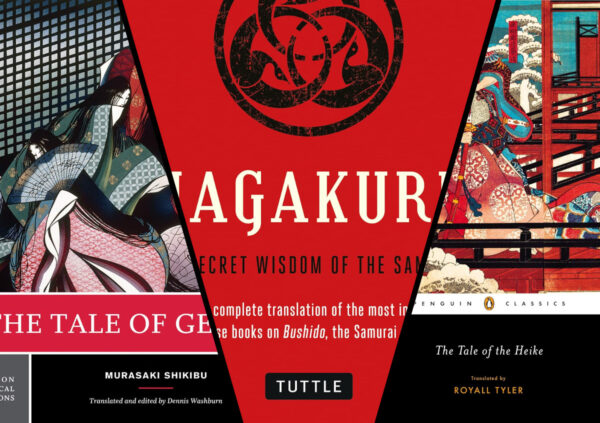
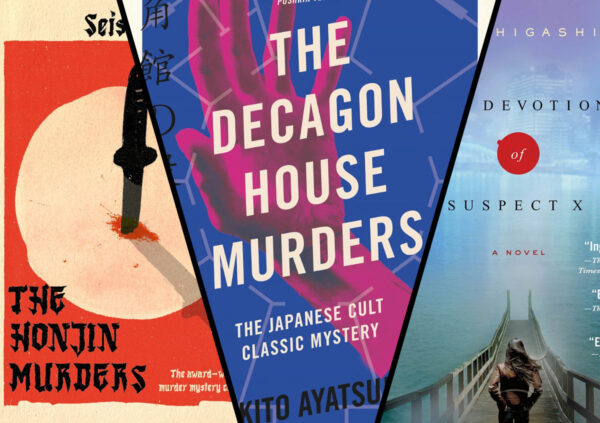
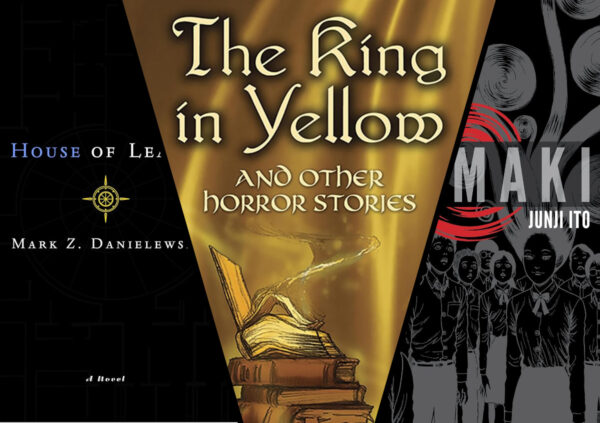
Japanese horror has a reputation problem in English, and the reputation is a videotape. Mention the genre and most people land somewhere around 1998: a cursed cassette, a girl with wet hair, a run of films that frightened a generation and got remade in Hollywood inside four years. None of that is wrong. It’s just about two hundred and twenty years short.
That’s the thing that pushed me to build this list. Every English-language roundup of Japanese horror books I read while researching this one began somewhere in the 1980s, as though the tradition showed up fully formed with a haunted apartment block and a tape that kills you in seven days.
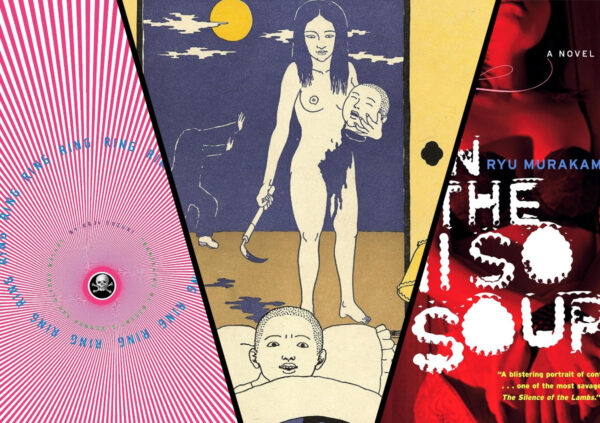
The oldest book on most of those lists was published in 1986. Meanwhile the collection at the bottom of this page came out in 1776 and already contains the returning dead who don’t know they’re dead, the woman whose rage outlives her body, and the boundary between dreaming and drowning treated as a place you can stand on. Read it after Ring and the four hundred years do very little.
So this list runs backward. It opens with the contemporary Japanese horror novels you’ll find face-out in any bookshop, works back through the J-horror wave that produced Ring and Parasite Eve, through the mid-century, and finishes with the three books the tradition grew out of. If you only want something to read tonight, start at the top. If you want to understand why Japanese horror does what it does, read it from the bottom up.
Fiction by René Rehn


What’s Here and What Isn’t.
Short fiction counts. Japanese horror is overwhelmingly a short-form tradition, and a list of Japanese horror books restricted to novels would miss most of it. Some of the best things below are collections.
Crime novels aren’t horror. Several titles turn up on lists of Japanese horror books that are straightforwardly detective fiction, and I’ve left them off. The border between the two is porous in Japan, more so than in English, and a few books here sit right on it. But Out and Confessions are crime, and pretending otherwise helps nobody.
One writer here wasn’t Japanese by birth, and I’ve explained why he’s on the list in his entry rather than hiding it. Two contemporary novels that borrow Japanese folklore from the outside are not on the list, for the same reason in reverse.
I write horror for a living and have done for about ten years, which is the lens all of this comes through. What follows isn’t a ranking. It’s a map of a tradition that English-language publishing has been picking at for a century without ever quite drawing the whole shape. For the tradition at full width, my list of the best Japanese novels is the companion page, and the wider horror shelf starts at my best horror books pillar.
Where the Wild Ladies Are
Aoko Matsuda · translated by Polly Barton · 2016, English 2020

Seventeen stories, each one taking a classical Japanese ghost tale and putting it down in contemporary Tokyo to see what it does there. The jealous woman whose hair turns to snakes now works in an office. The vengeful spirit from the rakugo tradition turns up as an aunt with opinions. A man takes a job at a company staffed entirely by the dead, and the job is fine. Better than his last one.
Matsuda’s trick is that she isn’t parodying the source material and she isn’t reverently updating it either. She’s noticed that the women in these stories were nearly all destroyed by the same things that grind down her contemporaries, and that the traditional versions treat their rage as the horror rather than as the reasonable response. So the ghosts here are funnier and considerably more comfortable than the living. Being dead has removed most of the constraints that were killing them.
It was a finalist for the 2021 World Fantasy Award, and Matsuda is a translator as well as a novelist: she has brought Carmen Maria Machado, Karen Russell and Amelia Gray into Japanese. A writer producing feminist retellings of classical Japanese ghost stories who also translates Her Body and Other Parties is running the same project in two directions. It sits at the far end of this list from the classical collections it draws on, which is the argument for reading it alongside them rather than instead of them. Polly Barton’s translation keeps the deadpan intact, and the deadpan is doing most of the work.
Buy the Tilted Axis edition, which is the one Japanese horror books rarely get: an edition built for tracing sources. It includes a full list of Matsuda’s source material with notes on the lesser-known originals, which means you can trace every story back to the tale it reworks, and on this list that is worth a great deal. Almost no English-language roundup of Japanese horror books includes it, presumably because it’s too cheerful to look like horror from a distance. Read the Akinari at the bottom of this list first and it becomes very obvious what she’s doing.
ZOO
Otsuichi · translated by Terry Gallagher · 2003, English 2009

Otsuichi is the pen name of Hirotaka Adachi, who won a national prize for his first story while still at school. Eleven stories here. A man receives a Polaroid every morning showing his girlfriend’s corpse in a further stage of decay. A boy raised in a windowless white room with a single food slot. Two children who keep their dead mother in the house. A salesman on a hijacked plane offering a euthanasia drug at a spectacular markup. The title story is the Polaroid one, and it is the best short horror story to come out of Japan in the last thirty years.
What separates Otsuichi from almost everyone else writing Japanese horror books is structural rather than tonal. He builds these things as puzzles, and the horror lands in the paragraph where the reader realizes the frame they’ve been reading inside is wrong. Several of these stories are technically mystery constructions running horror content, which is a very Japanese arrangement and traceable directly to Ranpo further down this list.
He also refuses the obvious register. There is real tenderness in a few of these, particularly the pieces about children, and the tenderness is what makes the cruelty land. “Seven Rooms” is unbearable for exactly that reason.
If you read one collection of Japanese horror stories, read this. It’s the strongest single-volume argument that the short form is where the genre lives.
Goth
Otsuichi · translated by Andrew Cunningham · 2002, English 2008

Six linked stories about two high school students, Morino and the unnamed narrator, who share an obsession with murder. Not with solving murders. With understanding them. Their town happens to produce a remarkable number of serial killers, and the pair keep finding themselves closer to the work than any reasonable person would arrange.
The title is misleading and the marketing has never helped. There is nothing subcultural about this. What the book is about is the narrator, who tells you in the first story that he is not like other people and then spends the rest of the collection demonstrating it while presenting himself as the sympathetic one. Morino is the strange girl everyone notices. He is the one nobody notices, and the structure of the book is a slow disclosure of which of them the reader should have been worried about.
It won the third Honkaku Mystery Award in 2003, which tells you how comfortably Japanese horror and Japanese detection share a border. Each story is a fair-play construction with a solution, and the solutions are worse than the mysteries.
Buy the Haikasoru edition rather than the older Tokyopop one. It carries the same Andrew Cunningham translation with light edits plus an extra story, Morino’s Souvenir Photo, and Tokyopop’s North American arm closed in 2011 so the older printing is secondhand only. Weaker than ZOO overall, and still one of the essential Japanese horror books of the 2000s. Read ZOO first, then this.
Another
Yukito Ayatsuji · translated by Karen McGillicuddy · 2009, English 2013

Koichi transfers into Class 3 at a middle school in a small town and notices immediately that something is wrong with the room. There is one more student in the class than the register accounts for, nobody will discuss it, and every year since 1972 the class has lost people. Accidents. Coincidences. A death a month, more or less, until March.
Ayatsuji is a founder of the Honkaku Mystery Writers Club of Japan and took the Mystery Writers of Japan Award in 1992; his debut, The Decagon House Murders, sits eighth on the Tozai Mystery Best 100. The mechanics here are built with that puzzle writer’s discipline. The curse has rules. The rules can be investigated. There is a countermeasure, and the students have worked out a version of it that requires a specific piece of cruelty performed on a specific person, which they carry out every year with the resignation of people doing paperwork.
That’s what lifts it above its premise and above most Japanese horror books built on a curse. The horror isn’t the deaths, which arrive on schedule and get increasingly baroque. The horror is a classroom of fourteen-year-olds who have institutionalised an atrocity because it works, and who explain it to the new boy the way you’d explain the fire drill.
The prose is plain and the cast is large enough to blur. It remains the most quietly upsetting of the contemporary Japanese horror novels in translation, and the anime adaptation drops the thing that makes it work.
Battle Royale
Koushun Takami · translated by Yuji Oniki (2003) and Nathan Collins (2014) · 1999

A class of forty-two fifteen-year-olds, an island, metal collars, three days, one survivor. It is the outlier among these Japanese horror books and the founding text of survival horror in prose. What separates it from everything it later inspired is that Takami refuses to treat any of them as a body count: the novel keeps stopping to give a history and an interior to a child who has four pages left.
I’ve read the novel, the manga and the film, and of all the Japanese horror books here this is the one where the adaptations matter most. The novel is the one that explains the world. The film is one of my favorite films, and it survives by cutting almost everything: the government, the mechanics of the program, and most of the forty-two. What you gain from the book is the full structure. What you pay is pacing.
Two complaints, and one of them turns out to be a defense. The prose never rises above serviceable, and the weapons arrive in brackets, a character carrying a handgun followed by a parenthetical make and model before the sentence resumes, which breaks the flow every time. Except that’s Takami, not the translator, and it survives the retranslation. The novel is narrated in the voice of the system processing these children, and an inventory is what that voice sounds like. Once you read it that way it stops being clumsy and starts being cold. The second complaint holds up less well: the endgame overreaches badly. By the time the final confrontation with Kiriyama arrives there are car chases and repeated shootouts, and forty-two schoolchildren have become an action film.
Overall average, but it belongs here without argument. Survival horror is horror, and among Japanese horror novels in prose this is where the category starts.
On editions. English has three: Oniki’s 2003, the patched 2009 that grew by fifty pages, and Collins’s 2014 Remastered, a full redo. Take the Collins; the complaints all attach to the first text, and Remastered throws in the roster and map you will end up wanting anyway.
Revenge
Yoko Ogawa · translated by Stephen Snyder · 1998, English 2013

Published in English as Revenge: Eleven Dark Tales, from a Japanese title that translates closer to silent corpses and indecent mourning. Eleven stories that turn out to be one story. A woman buys a strawberry shortcake for her dead son’s birthday. A landlady grows carrots shaped like hands. A museum of torture instruments has a curator with a very specific idea of what belongs in the collection. Each piece is self-contained, and each one contains a detail that reappears in another, until the collection closes like a hand.
Ogawa is a literary novelist, and no author on this list of Japanese horror books would be more surprised to find herself on it. Horror readers claim it anyway, correctly. Nothing supernatural happens. The violence is mostly offstage or in the past or implied by an object left in the wrong place, and the register never rises above the pleasant, level, faintly clinical voice she uses for everything. That gap is the whole effect. Somebody describes something unspeakable in the tone of a woman explaining a recipe.
The structural game is the reason to read it rather than her novels. Details migrate. A minor character in one story is the subject of the next. By the end the book has quietly proposed that all of this is happening in the same small town and that the town is far worse than any individual story suggested.
Among Japanese horror books it’s the volume for the reader who swears the genre isn’t for them. They won’t notice until it’s finished.
Audition
Ryu Murakami · translated by Ralph McCarthy · 1997, English 2009

Seven years widowed, and a friend in film production suggests something that only sounds reasonable if you work in film production: run casting sessions for a picture nobody intends to make, and treat the applicants as candidates for a wife. Thousands of women apply. Aoyama settles on one, a former dancer whose paperwork is immaculate and whose past nobody is able to confirm.
Structurally this is the most patient horror novel on the page, and the patience is the entire mechanism. For something like two thirds of its length nothing happens that could not happen in a domestic literary novel: a widower thinks about his age, his son, his loneliness, his prospects.
What Ryu Murakami is doing across those pages is building a list of absences. A dance studio that closed. A referee who cannot be located. A friend nobody has seen in years. Each one is a hole where a fact should be, and the horror is not that Aoyama fails to notice them. He notices all of them. He proceeds anyway.
That is why the ending works and why the film’s version of it does not quite. Miike made the last twenty minutes famous, and in doing so turned a book about a man overriding his own judgement into a book about what happens to him afterwards. The novel is the colder object.
Three out of five from me, and read well over a decade ago. Every conversation about this book turns into a comparison with the film, and I’m not going to manufacture one this long after the fact. What I can tell you is that I liked it, and that it hasn’t stayed with me the way the better Japanese horror books here have.
In the Miso Soup
Ryu Murakami · translated by Ralph McCarthy · 1997, English 2003

Kenji is twenty and sells his knowledge of Tokyo’s nightlife to foreigners who cannot navigate it alone. Over the last three days of December he is hired by an American who calls himself Frank, whose skin does not sit correctly on his face, whose account of himself changes between tellings, and who knows things a tourist could not and misses things a tourist could not miss. Kenji registers every one of these signals and takes the money.
The dread comes from one technique repeated: Kenji keeps explaining things. He is a guide by trade, so the novel gives him a job that requires him to narrate Tokyo’s nightlife to a foreigner, and the more he explains the worse it gets, because every explanation is a description of something being sold. Bars, clubs, women, districts, himself. Few Japanese horror books stay in one milieu this long or make it feel this transactional.
Frank is the threat and the book declines to let him be the only one. By the time the violence lands, the reader has spent a hundred and fifty pages being walked around a market.
One mid-book sequence stands with the most violent pages Japanese fiction has put into English, and nothing on either side of it warns you. Whether the social critique earns it is the argument people have about this book, and it’s a fair argument. The control of the pacing either side of it is not in dispute.
Of all the Japanese horror books here it is the least compromising, and the only book here that would be equally at home on a literary prize list and on a banned list.
Parasite Eve
Hideaki Sena · translated by Tyran Grillo · 1995, English 2005

A pharmacology researcher loses his wife in a car accident and consents to organ donation. He also, quietly, keeps some of her liver cells for his own laboratory work. The cells thrive. They thrive rather more than cells ought to, and what is driving them is not the woman he married but the mitochondria inside her, which have their own inheritance, their own agenda, and roughly two billion years of practice at surviving inside other organisms.
Sena was a working pharmacologist and the novel is unembarrassed about it. There are pages of genuine cell biology, and readers who want a ghost story will find them heavy going. Readers who want the horror to be structurally sound will find that the science is the horror: every cell in the reader’s body contains an organism that was once separate, that reproduces on its own schedule, and that has no particular loyalty to the arrangement.
It was the first ever winner of the Japan Horror Novel Award, which makes it foundational to the modern run of Japanese horror books in a literal sense. It arrived alongside Ring in the mid-nineties and belongs to the same moment, when Japanese horror books stopped being supernatural and started being biological and informational. There’s also a video game franchise considerably more famous than the book, which is why most readers have the sequence backwards.
Grief is the engine underneath all of it. The novel’s real proposition is that a man who cannot let his wife go will find a way, and that getting what he wants is the worst available outcome. That’s a Frankenstein, built out of a microbiology textbook.
The Summer of the Ubume
Natsuhiko Kyogoku · translated by Alexander O. Smith · 1994, English 2009

Kyogoku had never published anything. He wrote this, carried the manuscript to Kodansha himself, and it was taken, and the circumstances were unusual enough that the publisher created a prize in response, the Mephisto Award, which still honors new mystery and fantasy writers. The Kuonji family runs a clinic and is having an unusual run of trouble. A daughter has been pregnant for twenty months. Her husband vanished from a sealed room. Infants have been disappearing. Enter Kyogokudo, a secondhand bookseller and onmyoji, a practitioner of the yin-yang divination tradition rather than a Shinto priest, who is called in as an exorcist and who opens by explaining, at length, that he does not believe in ghosts and that ghosts are nonetheless real.
That paradox is the whole architecture. Kyogoku’s proposition is that yokai are not supernatural entities but shapes that human perception makes when it needs to explain something it can’t hold, and that a properly performed exorcism is therefore a psychological intervention with a real effect on a real problem. The book takes several hundred pages to work this out, much of it in conversation, and the digressions into Buddhist epistemology and quantum mechanics are not decorative.
It is also a locked-room mystery with a fair solution. Be careful with the credentials, because most write-ups garble them: the Mystery Writers of Japan Award went to the second book in the series, and Kyogoku’s Naoki Prize came later and for a different novel again. This is where it starts rather than the prizewinner itself. Kyogoku is the only writer working who has fused the yokai tradition with honkaku detection, and the Kyogokudo series runs to enormous length in Japanese with barely any of it in English.
Be warned that English-language readers are split on it, and the recurring complaint is fair: Kyogoku explains, then explains the explanation, and the final quarter is largely exposition. It is the most demanding of the Japanese horror books here and the one with the highest ceiling, and some readers find it exhausting before it pays out. Almost nobody writing about Japanese horror books in English has read it, and that is the reason to.
Ring
Koji Suzuki · translated by Robert B. Rohmer and Glynne Walley · 1991, English 2003

Four teenagers die in separate places at the same hour. A journalist works backwards to a rented cabin, an unmarked cassette, and a message at the end of it telling him how long he has.
Of all the Japanese horror books here this is the one to read as an engineering problem, because that is how it is built. The rules are stated. The clock is literal. Every stage of the investigation narrows what the thing can be, and Suzuki never asks you to be frightened of a ghost. He asks you to consider a mechanism: something that copies itself, needs a host, and has found a delivery system humans operate voluntarily. The word the book keeps circling is not haunting. It is transmission.
That is also why the sequels go into biology and information theory, and why readers who came for a ghost story give up on them. The investigator is not sympathetic either. Ryuji Takayama is deliberately unpleasant company and the book is better for refusing to soften him.
The prose is plain and the English is uneven in stretches. It does not matter, because the idea is carrying the book and the idea is a good one.
Its reach is easier to see from outside Japan than inside it. For roughly ten years Western studios treated Japanese horror as a single genre with a single set of moves, and those moves are largely this book’s, filtered through Nakata’s film and then through the American remake of it.
Afterwards: Dark Water for the short fiction, and Spiral and Loop if you want to watch Suzuki follow his own logic somewhere very few readers expected.
The Graveyard Apartment
Mariko Koike · translated by Deborah Boliver Boehm · 1986, English 2016

A young family buys into a new building at a price that seems too good, and it is, for the reason listed in the brochure: the site backs onto a graveyard, a temple and a crematorium. Misao, her husband Teppei and their small daughter move in anyway. So do the other residents. Then, one by one, the other residents move out.
What Koike does with this is patient in a way the premise doesn’t promise. The basement is wrong. The building is emptying. And the family cannot leave, not because anything is holding them but because they have no money, nowhere else to go, and a mortgage, which turns out to be a more effective trap than any haunting. By the final third they are the only people left above a basement they have stopped opening, and the horror has become entirely architectural.
There’s a second novel running underneath about Misao and Teppei’s marriage, which began as an affair and cost a woman her life, and the building appears to know it. Koike is a Naoki Prize winner who works across crime, horror and romance, and the domestic material is not filler. Few Japanese horror books are this good on the subject of money.
It is the most frequently cited of all Japanese horror novels in English-language roundups, and it deserves that. Nothing else on this list makes a car park feel this bad.
Masks
Fumiko Enchi · translated by Juliet Winters Carpenter · 1958, English 1983

Mieko Toganō is a poet, a widow, and the mother of a dead son. Two men are interested in her daughter-in-law Yasuko. Over the course of a short novel Mieko arranges matters between them with a patience that never once declares itself, and the reader spends the whole book slightly behind, aware that a plan is operating and unable to see its shape.
Enchi hangs the structure on Noh masks and on the Rokujō lady from The Tale of Genji, the woman whose jealousy leaves her body and kills without her knowledge or consent. The novel’s proposition is that this is not a supernatural event but an accurate description of what happens to a woman given no legitimate outlet for anything, and Mieko has stopped pretending otherwise. There is spirit possession in this book. Whether it is literal is deliberately unresolved.
It’s the most controlled of the Japanese horror books here. There is no gore, no ghost that anyone could photograph, and nothing that would announce itself as horror on a shelf. It’s also crueller than most of what surrounds it, because the malice is patient, maternal and entirely successful.
Enchi is barely present in English-language discussion of Japanese horror books, and Masks is the reason she should be. Pair it with The Waiting Years if you want the full range of what she was doing.
The Sea and Poison
Shusaku Endo · translated by Michael Gallagher · 1958, English 1972

A doctor in a provincial Japanese town is placidly incompetent and unbothered. The novel then goes back to Kyushu in the last year of the war and shows what he was part of: a university hospital where captured American airmen were subjected to surgical experiments, and where the physicians involved talked themselves into it not through fanaticism but through fatigue, hierarchy and a sense that nothing they did mattered.
Endo based it on the Kyushu University vivisection incident, and the horror is entirely a matter of ordinariness. Suguro, the young doctor at the center, does not want to be there and does not refuse. He watches. He assists once. And the novel’s question, which it never lets anyone answer comfortably, is whether the absence of enthusiasm constitutes any kind of innocence.
One thing about the translation is hard to improve on. Michael Gallagher, who brought it into English, was a Jesuit scholastic who spent three years teaching in Japan before he became a translator. A novel about Catholic doctors who assist at something unforgivable, rendered into English by a Jesuit. Endo was a Japanese Catholic and this is an earlier and colder book than Silence. Where Silence asks what a person owes God under torture, this asks whether a man who feels nothing can be guilty of anything, and it finds the answer that most of us would prefer not to.
It’s shelved as literary fiction and it is one of the most disturbing Japanese horror books available in English by any definition that matters. Nothing supernatural, no relief, and it happened.
Japanese Tales of Mystery and Imagination
Edogawa Ranpo · translated by James B. Harris · stories from the 1920s and 1930s, English 1956

Of the Japanese horror books on this page his is the oldest, and the name is a joke. Say it out loud: Taro Hirai chose a pen name that is Edgar Allan Poe pronounced in Japanese, which tells you both what he was aiming at and that he was not being solemn about it.
The collection is deliberately lopsided and that is the point of buying it rather than an anthology. Alongside the puzzle stories, which could have run in any British magazine of the period, sit three pieces that have nothing to do with detection at all: a man who has himself upholstered into furniture, a soldier reduced to a torso and the wife left tending him, and a voyeur whose relationship with reflective surfaces ends where it has to end. The censors banned the second one, and it takes about two pages to see why.
What he is writing about, over and over, is the body as a place you are stuck inside. Not death, not ghosts. Enclosure. A man who lives inside furniture. A veteran reduced to a torso. A voyeur who wants to occupy a field of vision without being visible in it.
Run that line forward and it arrives at Otsuichi’s structural cruelty, and then at Junji Ito, who has been redrawing that chair his entire career without needing to call it an adaptation.
One note on what to buy, and it comes with bad news. The Edogawa Rampo Reader, translated by Seth Jacobowitz, is not a rival version of this book: it holds entirely different stories plus ten of Ranpo’s essays, including one comparing Dickens and Poe and one called Confessions of Rampo. It was published by Kurodahan Press, who closed in March 2025, and their entire catalog is now out of print. Secondhand copies only, and they will not get cheaper. Harris is the one you can still buy, and it has the famous stories anyway. There’s a critical argument worth knowing: Japanese critics have historically been happier to file Ranpo under Gothic than they are with the canonised writers, on the grounds that he was pulp. He was pulp. He was also the foundation, and every one of the Japanese horror books after him is standing on it.
The story behind the translation is better than its reputation. James B. Harris spoke Japanese but could not read or write it. Ranpo could read English but could not write it. So the two worked through the stories in conversation across five years, Ranpo reading aloud, both arguing over how a passage should land, and Harris then writing it in English. Ranpo chose the selection himself. It may be the most closely author-supervised translation of any writer on this page.
Kwaidan
Lafcadio Hearn · 1904 · written in English, no translator

Hearn is the strangest figure in this whole tradition. Born in 1850, Greek by birth and Irish by upbringing, abandoned in childhood by his mother, his father and then his guardian in turn. Two decades as a journalist in the United States, where he was sacked for marrying a formerly enslaved woman. Then Japan, where he married Setsu Koizumi, took Japanese citizenship, and became a figure Japanese readers regard as a classic author in his own right.
The stories came from Setsu. She told them to him at night, having deliberately turned the lamp down, and by her own account he listened with a terrified air. That is where this book comes from: not a scholar collecting folklore but a nervous man being frightened by his wife in a dim room, then writing it down in English prose of real quality. Kwaidan means ghost story. It collects seventeen tales and three essays, and it handed the West the entire vocabulary of Japanese horror wholesale, which is why so many later Japanese horror books read as familiar before you have read a word of them. The headless rokurokubi. The flesh-eating jikininki. The faceless mujina. “Hoichi the Earless” and “Yuki-Onna” are here, and Kobayashi’s Oscar-nominated 1965 film takes its four episodes from this material.
A word on the boundary, because it’s fair to raise it. Hearn wrote in English and was not Japanese by birth. He is on this list, and the two contemporary novels in the harvest that borrow Japanese folklore from outside it are not, and the distinction is transmission. Hearn received these stories orally, inside a Japanese household, from the woman who knew them, and returned them to a Japanese readership that adopted him. That is participation in a tradition rather than use of a setting.
On editions. Kwaidan itself is the original and Tuttle’s illustrated edition adds woodblock prints and a foreword by Michael Dylan Foster. But the better first purchase is Penguin Classics’ Japanese Ghost Stories, edited by Paul Murray, which draws the best of the ghost material from Kwaidan, In Ghostly Japan, Shadowings and others into one volume with a substantial introduction. Buy the Penguin. Get the Tuttle Kwaidan second, for the pictures.
Japanese Gothic Tales
Izumi Kyoka · translated by Charles Shirō Inouye · stories 1895 to the 1920s, English 1996

Kyoka, 1873 to 1939, spent his career refusing the thing everyone else was doing. Meiji Japan was busy importing realism and Kyoka went the other way, into fantasy, romance and the supernatural, writing in a dense allusive style that his contemporaries considered old-fashioned and that Mishima later said pushed the Japanese language to its highest potential.
Four stories here, from four stages of his career. “The Surgery Room” is nine pages and does more damage than most novels. “The Holy Man of Mount Kōya” is the famous one, a monk lost in the mountains, a plague of leeches, and a woman who should not be living where she lives. “One Day in Spring” is the difficult one, seventy pages of drifting between characters and lifetimes with the internal logic of a Noh play. “Osen and Sokichi” is the shortest and the saddest, and Mizoguchi filmed it as a silent in 1934.
Here is the detail that explains why this book is missing from every English-language list of Japanese horror books. Japanese critics resist calling Kyoka Gothic, and the resistance is partly orthographic: goshikku is written in katakana, the script reserved for imported words, while kaiki shōsetsu, fiction of the strange, is written in kanji as a native term. Arguing about whether Kyoka is Gothic means arguing about which alphabet the category belongs in. The tradition has its own name for what he was doing, and it predates the English word by centuries.
Inouye’s translation is the only one and it’s superb. If you want more, his second collection, In Light of Shadows, follows. Of all the Japanese horror books on this list, this is the one that will be new to the most readers, and the one that most changes what the genre looks like from here.
Tales of Moonlight and Rain
Ueda Akinari · translated by Anthony H. Chambers · 1776

Nine tales, published in Osaka and Kyoto in 1776, and the foundation under every one of the Japanese horror books above them on this page.
What it establishes, and this is why it belongs at the foot of a horror list rather than in a chapter on the Edo period, is the rule set. The dead here operate under conditions. They keep appointments, they are tied to places, they can be reasoned with and they cannot be outrun. A wife’s jealousy keeps working after her death because nothing switched it off. A man’s appetite produces something with scales because that is what appetite does in this book.
Akinari assembled it by reworking Chinese and Japanese source tales into a deliberately archaic Japanese, which is exactly what Izumi Kyoka would do a century later and for exactly the same reason: distance makes the strange operable.
What is startling is how little of it feels early. The structural moves are all here: the returning dead who do not know they are dead, the woman whose rage outlives her body, the loyal spirit, the boundary between dreaming and drowning treated as a place you can stand. Read Ring and then read “The Kibitsu Cauldron” and the four-hundred-year gap does very little.
On editions. Three English translations exist. Anthony Chambers at Columbia is the current standard, in print, well annotated, and the one to buy. Leon Zolbrod’s 1974 version was long considered definitive and has been reissued, and it’s the one to chase if you want the more ornate rendering. Kengi Hamada’s is the oldest and hardest to find. One precision point most write-ups miss: Mizoguchi’s Ugetsu adapts two of these nine stories, not the collection.
Every list of Japanese horror books I checked while building this one began somewhere in the 1980s. This is where it begins, and it was already this good.
The Ones You Can’t Read Yet
A list of Japanese horror books like this one has three edges. Akinari is where it stops going backwards. The manga section below is where it stops being prose. This is the third one, and it’s the least satisfying: the books that exist, that belong on this page on merit, and that nobody has published in English.
Shiki, by Fuyumi Ono, is the one that hurts. Nineteen ninety-eight, two volumes, and it is a vampire novel about a village called Sotoba being consumed from the inside over one punishing summer. The doctor works the deaths as an epidemic for as long as he can stand to, because the alternative explanation is unbearable. Two things about it are worth knowing even if you can’t read it. It is dedicated to Stephen King’s ‘Salem’s Lot, which is a strange and lovely complication on a page arguing that this tradition runs from 1776 forward: here it reaches sideways, to Maine. And Sotoba is not a neutral village name. It comes from sotoba, the wooden markers set behind Buddhist graves. Ono named the place after the thing you plant over a corpse. There is a manga and a 2010 anime, neither currently available in English either.
Ono, incidentally, is married to Yukito Ayatsuji, whose Another is further up this page. Between them they account for two of the best Japanese horror novels of the last thirty years and you can only buy one.
Most of Natsuhiko Kyogoku is in the same position. The Kyogokudo series runs to nine novels and four spinoffs; The Summer of the Ubume is the only one in English, and the second book is the one that won the Mystery Writers of Japan Award.
And a great deal of Otsuichi and Edogawa Ranpo, two of the writers this page leans on hardest. Ranpo’s complete works run to thirty volumes in Japanese. What we have in English is two collections and a handful of novels.
The useful version of this complaint is to name the people fixing it, because most of the Japanese horror books above exist in English only because somebody decided they should. Haikasoru, Pushkin Vertigo and Vertical are between them responsible for a large share of everything on this page, most of it published in the last twenty years. If any of the books in this section turn up in English, it will probably be one of those three that does it.
And one cautionary note about how thin this all is. Kurodahan Press closed in March 2025 and its entire catalog went out of print with it. Founded in 2002 by three Westerners living in Japan, run out of Kyushu, it did more than anyone to start the current Edogawa Rampo revival and brought over a great deal of Japanese horror and weird fiction that nobody else would touch. When a publisher that small stops, books do not move to another list. They simply stop being available. The wall has moved a long way in twenty years, and it can move back.
Japanese Horror Manga
Manga might be the most popular medium horror has going right now. There are hundreds of horror manga in English and thousands in Japanese, an entire parallel tradition running alongside the books on this list, feeding off the same folklore and frequently doing it better. I’ve written about that separately, at length: the whole medium is over at the best horror manga, which is where to go if this is the direction you want to head.
It’s also the most divisive thing I could put on a list of Japanese horror books. Plenty of readers who came here for prose have no interest in comics, and that’s a completely reasonable position. So rather than pad this out, I’ve included exactly one, because leaving it out entirely would have been dishonest.
Uzumaki
Junji Ito · serialized 1998–1999 · Viz 3-in-1 deluxe omnibus

The coastal town of Kurouzu-cho falls under the curse of the spiral. That’s the premise, and Ito spends three volumes proving that a single shape, pursued without mercy, generates more dread than any monster could. Whirlpools in the river. Patterns in hair. Then bodies, pottery, weather, childbirth, and eventually the town itself twisted into a spiral-shaped maze.
The brilliance of it is conceptual. There is no antagonist. No monster, no villain, nothing with a plan. There is only the spiral, an idea made flesh, indifferent and inescapable, and the Lovecraftian point underneath is humanity’s total powerlessness in front of something that isn’t even paying attention. The artwork is the best of Ito’s career, stark black and white doing the claustrophobia, and his faces doing the rest: blank and dejected in one panel, distorted past recovery in the next.
It isn’t flawless and I’ve never pretended otherwise. The first two volumes are so episodic they read as an anthology, which makes it hard to invest in anyone and blunts the impact when they go. Kirie is too passive even by the standards of Ito’s protagonists, more a viewpoint than a person. And the ending reaches for a loose explanation of what the spiral is, which costs it some of the mystery that carried the earlier chapters. Horror usually works best when the unknown stays unknown.
None of that stops it being one of the greatest horror manga ever made, or the one thing on a list of Japanese horror books that earns its place without being a book at all. If you want the rest of him, I’ve ranked all of Junji Ito’s books and written up his forty best stories.