Every list of the best horror books contains the same twenty titles, and most of them stop there. The two deepest shelves branch off immediately: horror classics for the canon that still works, and gothic fiction for the root system underneath it.
Don’t get me wrong, that’s not a complaint about the twenty. They belong on any list of the best horror books ever written, and they’re on this one too, because Dracula and The Shining and The Haunting of Hill House didn’t become inescapable by accident. But a genre with two hundred years of history behind it has more than twenty good books in it, and the interesting question isn’t which ones are most famous. It’s which ones will actually do something to you, and what kind of something that is.
So here are 62 of the best horror books ever written, arranged by period, with a note on each about what it’s actually for. Some of them are frightening. Some are upsetting in a way that has nothing to do with fear. A few are historically enormous and, frankly, no longer work at all, and I’ve said so wherever that’s true.
Before we start, three things about how I put this list together.
I haven’t read all of these, and I’ve marked which ones I have. Where the verdict is mine, it says so, and where it’s the critical consensus, it says that instead. That distinction matters more than it should, because far too many horror lists are assembled from other horror lists.
You won’t find any romantasy or paranormal romance here. Those are large, successful categories, but they’re not this one. The test I use throughout is whether the romance is doing the work the horror should be doing.
And finally, this page is the top of a much larger set of guides. Everything below links down into deeper pages for its subgenre, its author, or both, so if a section grabs you, there’s somewhere to go from here.
Fiction by René Rehn


The Best Horror Books at a Glance
| Year | Title | Author |
| 1766 | Strange Tales from a Chinese Studio | Pu Songling |
| 1818 | Frankenstein | Mary Shelley |
| — | The Tales of Edgar Allan Poe | Edgar Allan Poe |
| 1835 | Viy | Nikolai Gogol |
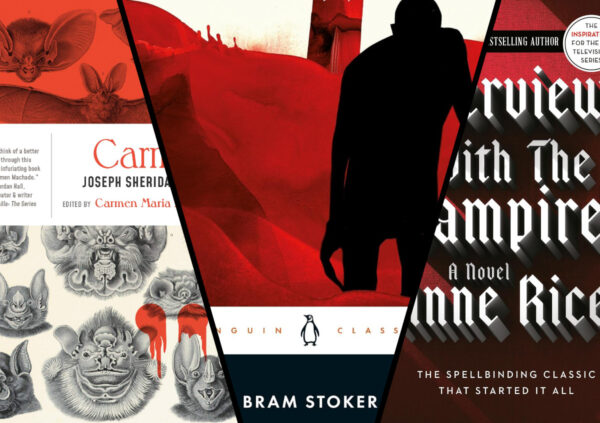
| 1872 | Carmilla | Sheridan Le Fanu |
| 1887 | The Horla | Guy de Maupassant |
| 1892 | The Yellow Wallpaper | Charlotte Perkins Gilman |
| 1894 | The Great God Pan | Arthur Machen |
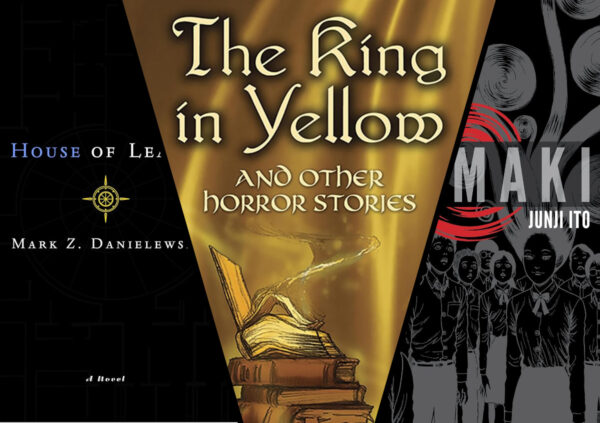
| 1895 | The King in Yellow | Robert W. Chambers |
| 1897 | Dracula | Bram Stoker |
| 1898 | The Turn of the Screw | Henry James |
| 1902 | The Monkey’s Paw | W. W. Jacobs |
| 1904 | Ghost Stories of an Antiquary | M. R. James |
| 1907 | The Willows | Algernon Blackwood |
| 1907 | The Feather Pillow | Horacio Quiroga |
| 1927 | The Colour Out of Space | H. P. Lovecraft |
| — | Japanese Tales of Mystery and Imagination | Edogawa Ranpo |
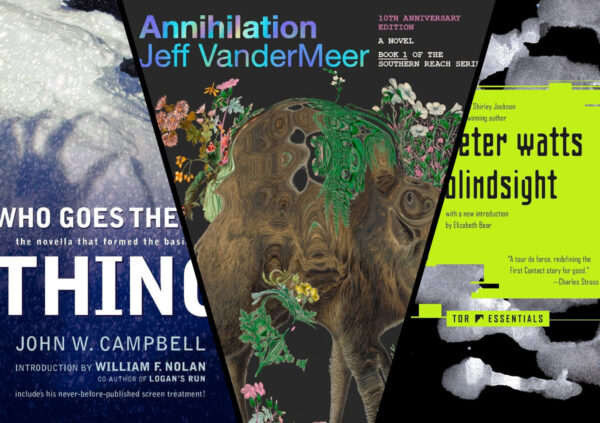
| 1938 | Who Goes There? | John W. Campbell |
| 1938 | Rebecca | Daphne du Maurier |
| 1954 | I Am Legend | Richard Matheson |
| 1955 | The Body Snatchers | Jack Finney |
| 1959 | The Haunting of Hill House | Shirley Jackson |
| 1959 | Psycho | Robert Bloch |
| 1962 | We Have Always Lived in the Castle | Shirley Jackson |
| 1962 | Something Wicked This Way Comes | Ray Bradbury |
| 1963 | The Collector | John Fowles |
| 1967 | Rosemary’s Baby | Ira Levin |
| 1971 | The Exorcist | William Peter Blatty |
| 1973 | Burnt Offerings | Robert Marasco |
| 1973 | Harvest Home | Thomas Tryon |
| 1975 | Salem’s Lot | Stephen King |
| 1976 | Interview with the Vampire | Anne Rice |
| 1977 | The Shining | Stephen King |
| 1978 | The House Next Door | Anne Rivers Siddons |
| 1979 | Ghost Story | Peter Straub |
| 1981 | The Elementals | Michael McDowell |
| 1981 | The Hunger | Whitley Strieber |
| 1981 | Scary Stories to Tell in the Dark | Alvin Schwartz |
| 1983 | Blackwater | Michael McDowell |
| 1983 | Pet Sematary | Stephen King |
| 1984 | Books of Blood | Clive Barker |
| 1985 | Perfume | Patrick Süskind |
| 1986 | It | Stephen King |
| 1987 | Misery | Stephen King |
| 1987 | Beloved | Toni Morrison |
| 1989 | The Girl Next Door | Jack Ketchum |
| 1991 | Boy’s Life | Robert McCammon |
| 1991 | The Cipher | Kathe Koja |
| 1991 | Ring | Koji Suzuki |
| 1992 | Goosebumps | R. L. Stine |
| 2000 | Perdido Street Station | China Miéville |
| 2000 | House of Leaves | Mark Z. Danielewski |
| 2004 | Let the Right One In | John Ajvide Lindqvist |
| 2006 | World War Z | Max Brooks |
| 2006 | Teatro Grottesco | Thomas Ligotti |
| 2007 | The Terror | Dan Simmons |
| 2009 | The Little Stranger | Sarah Waters |
| 2014 | The Troop | Nick Cutter |
| 2016 | The Fisherman | John Langan |
| 2017 | Tender Is the Flesh | Agustina Bazterrica |
| 2019 | Our Share of Night | Mariana Enriquez |
| 2020 | The Only Good Indians | Stephen Graham Jones |
| 2020 | Mexican Gothic | Silvia Moreno-Garcia |
| 2021 | The Last House on Needless Street | Catriona Ward |
The Foundations, 1764 to 1900
Everything on this list is standing on something in this section. These are the best horror books from the period when the genre’s machinery was still being invented.
Strange Tales from a Chinese Studio (1766)
聊齋誌異 (Liaozhai zhiyi) · 1766 · translated by John Minford · 2006

The oldest thing on this list by half a century, and the root system of every East Asian ghost story you have ever met.
Pu Songling spent some forty years collecting and writing these while repeatedly failing the imperial civil-service examinations, and died in 1715 with the collection still in manuscript. It was first printed in 1766, and it runs to nearly five hundred tales, the exact count shifting with the edition. Scholars meet fox-spirits who make better wives than the living. Ghost brides are courted, married and mourned. The dead sit examinations. And underneath it all runs forty years of quiet fury at the system that kept rejecting the man writing.
The famous horror piece is “The Painted Skin”: a scholar brings home a beautiful stranger, peers through her window one night, and sees a green-faced demon painting a human skin spread out on the bed, then shrugging it back on like a coat. It ends with a torn-out heart and a cure more disgusting than the haunting, and Minford calls it “one of the most widely read of all the Strange Tales.”
The film industry has never let go of this book. A Chinese Ghost Story came out of “Nie Xiaoqian” in 1987, the Painted Skin films have been arriving since 1965, and the whole ghost-romance wing of Chinese cinema is downstream of it.
Buy Minford’s Penguin Classics selection, 104 tales and the standard English edition. The free Victorian translation by Herbert Giles is on Gutenberg, with a warning: Giles cut anything connected with sex or blood, sometimes, as his modern translators put it, “the human body in any of its aspects.”
Frankenstein (1818)

Mary Shelley was eighteen years old when she started writing it, and two hundred years later, nobody has come up with a better monster.
Almost everything people think they know about this book comes from the films. There’s no lightning, no hunchbacked assistant, and no laboratory full of bubbling equipment. Victor assembles the creature over months of solitary work, refuses to explain how in his own account, and the animation itself takes about a paragraph. What follows isn’t a rampage either. The creature teaches himself to speak by watching a family through a gap in a wall, reads Milton and Goethe and Plutarch, and eventually comes back to argue his case in what might be the most articulate speech in the whole novel.
That’s the part that still works today. Victor’s crime isn’t building him. It’s looking at what he has made, deciding he doesn’t like the face, and walking out of the room, and then spending the rest of the book insisting he’s the injured party. Yes, the creature murders a child, but by then you’ve already heard him explain what the last two years of his existence were like, and the book refuses to make that arithmetic easy for you.
One practical note that genuinely matters here. There are two versions of this book. Shelley revised it heavily in 1831, softening Victor into a man overtaken by fate rather than a man who made choices, changing Elizabeth from his cousin into an orphan, and reworking Justine’s prison speech. Most cheap paperbacks print the 1831 version. Scholars generally prefer the 1818 text, and I’d say they’re right, because it’s simply the stronger book. Check the copyright page before you buy.
More on the Mary Shelley page.
Frankenstein has a page of its own, with the 1818 and 1831 texts compared side by side, and so does its strangest descendant: Frankenstein in Baghdad, Ahmed Saadawi’s monster stitched together from the dead of 2005.
The Tales of Edgar Allan Poe (1830s to 1840s)

I’ve read all of Poe, and the best of these stories are as good as anything horror has ever produced.
What he invented, and what almost nobody gives him credit for, is the unreliable narrator as a horror engine. “The Tell-Tale Heart,” “The Black Cat” and “The Cask of Amontillado” have no ghost, no monster and nothing supernatural in them at all. What they have instead is a man explaining, calmly and in perfect order, why what he did was entirely reasonable, and the horror lives in the gap between his composure and what he’s actually describing. That structure has become so standard by now that reading the originals feels almost disorienting.
“The Fall of the House of Usher” is the atmospheric one, and its opening paragraph is still the best-built page of dread in the English language. Roderick Usher’s condition, a hypersensitivity that makes light and sound unbearable to him, is doing something far more interesting than a standard haunting, and Poe treats the house and the family as the same organism throughout.
One thing worth knowing before you dive in: Poe is uneven, and the anthologies mostly won’t tell you which stories are which. The comic pieces are dire, quite a few of the tales are magazine filler, and the ratiocination stories are historically important without being remotely frightening. Out of roughly seventy stories, maybe a dozen are essential.
His poetry is a separate question altogether. “The Raven” is a genuine performance piece, and it reads far better aloud than it does on the page.
Full ranking at the best Poe short stories.
Viy (1835)

Three nights, one corpse, and the best monster entrance in nineteenth-century horror.
Khoma Brut, a philosophy student at the Kiev seminary, takes shelter for the night on the long walk home and gets ridden across the fields by the old woman of the house, who is a witch. He beats her nearly to death, and under his blows she turns into a beautiful young woman. Days later a rich Cossack officer sends for him: his dying daughter has asked, by name, for the student Khoma Brut to pray over her corpse for three nights. Khoma has never met her. He has, though.
Each night he locks himself into the church with the coffin and draws a circle around himself, and each night what gets into the church escalates, until on the third night the things of the dark give up on reaching him themselves and send for Viy, the iron-faced spirit whose eyelids hang all the way to the ground. “Raise my eyelids! I can’t see anything!” is the line, and the inner voice telling Khoma not to look while the lids go up is a voice readers have been disobeying right along with him for nearly two centuries.
The ending rescues nobody, and the church is abandoned afterwards with everything still inside, left for the weeds. Gogol’s own footnote calls Viy “a monstrous creation of popular fancy” and claims he told the tale almost exactly as he heard it.
The 1967 Soviet film, usually billed as the Soviet Union’s first horror film, is where the story’s modern iconography comes from, the chalk circle included, with Natalya Varley rising out of the coffin. The story itself is public domain, and the free translation to grab is Claud Field’s, where Khoma appears as Thomas Brutus, which takes some getting used to.
Carmilla (1872)

Carmilla came out twenty-five years before Dracula, and if you ask me, it’s the better piece of writing.
Laura lives with her father in an isolated schloss in Styria, in a part of Europe where the nearest neighbor is seven miles away and absolutely nothing happens. Then a carriage overturns on the road outside. The injured young woman inside is left with them to recover, because her mother has urgent business elsewhere and will return in three months. Her name is Carmilla, she sleeps until the afternoon, she refuses to discuss her family, and Laura is simply delighted to have her.
Le Fanu got there first on nearly everything Stoker later formalized. The staged accident that produces an invitation. The slow drain conducted over months rather than nights, so that the victim’s decline gets diagnosed as anemia and treated with rest. The household that fails to notice anything, because the alternative explanation is too absurd to consider. The village girls who died first and simply weren’t important enough to investigate.
And then there’s the thing Stoker never even attempted: the desire between the two women is right there on the page, explicit, reciprocated and rendered without apology, in 1872. Laura is unsettled by it and drawn to it and says so repeatedly. Modern readers arriving from a century of coded subtext are usually startled by just how little coding there is.
It runs to about a hundred pages, it’s free everywhere, and honestly, it’s a better introduction to Victorian vampire fiction than the famous one.
More on vampire books.
The Horla (1887)

A diary that opens on “What a glorious day!” and ends where it has to.
The narrator lives comfortably on the Seine near Rouen, and one May morning he salutes a beautiful white three-master coming up the river from Brazil. Then his nights go wrong. The water in his carafe is gone by morning, then the milk. He wraps the bottles in white muslin and ties them down with cord, and the water goes anyway.
Maupassant escalates it through three of the best set pieces in early horror: a monk at Mont Saint-Michel asking whether we see “the hundred thousandth part of all that exists,” a parlor mesmerism session in which the narrator’s hypnotized cousin reads a photograph hidden inside a plain card and arrives the next day begging to borrow five thousand francs she cannot explain, and the morning the narrator stands in front of his own mirror and is not in it, his reflection seeping back slowly, as if through mist. In the end he locks the thing in, burns the house down, remembers the servants too late, and the diary’s final sentence draws the only conclusion left.
Lovecraft, in Supernatural Horror in Literature, called it “perhaps without a peer in its particular department,” and it keeps being cited as an inspiration for “The Call of Cthulhu”: the invisible cohabitant that arrives by ship was his kind of idea.
One thing to get right: Maupassant wrote it in 1887, attempted suicide in January 1892, and died in an asylum in 1893, and the romantic reading that the story is the madness talking is Lovecraft’s, not the record’s. The prose is in complete control from the first entry to the last, which is exactly why it frightens.
It’s free everywhere and takes an hour.
The Yellow Wallpaper (1892)

At six thousand words, published in 1892, this is one of the shortest things on this list.
A woman has been brought to a rented country house for the summer to recover from what her husband, who happens to be a physician, calls a temporary nervous depression. She’s not permitted to work, to write, or to see her baby. Instead, she’s installed in an upstairs room with barred windows and a bed nailed to the floor, and she’s told repeatedly and affectionately that she’s getting better. The story is the journal she keeps in secret, and the wallpaper in that room slowly begins to occupy her.
What makes it work is the complete absence of villains. John is a good doctor by 1892’s standards, genuinely fond of his wife, prescribing with total confidence, and each new restriction arrives wrapped in affection. Her own agreement holds for most of the story, and that’s the real horror here, and the reason the piece has aged forward rather than back.
Charlotte Perkins Gilman was prescribed the rest cure herself, by Silas Weir Mitchell, the man who invented it. She wrote this story against him, sent him a copy, and later reported that he had changed his practice because of it, though the evidence for that claim is admittedly thin.
It’s free everywhere and it takes about half an hour to read.
The story has its own page: the room at the top of the house, why Gilman wrote it, and where to read it free.
The Great God Pan (1894)

I’ve read Machen, and this is the one that still lands.
Having assured a young woman the operation is trivial, a doctor opens her skull to give her sight of what he names the great god Pan. One paragraph covers the surgery. It leaves her an idiot, and months later a corpse. Jump forward twenty-three years: London’s wealthy men start taking their own lives after evenings with one particular woman, and a small circle of gentlemen assembles the truth piece by piece.
Direct description never once occurs, and that refusal is the whole engine. What you receive: part of a letter, a doctor’s case notes, what a servant says she witnessed in a garden, a man who cannot bring his sentence to its end. The single run at describing anything head-on, a deathbed record of a body in transition, dissolves into ellipsis. Machen held that English has no words for it, declined to pretend otherwise, and left the assembly to you.
That structure went wholesale into “The Call of Cthulhu”, a debt Lovecraft never denied. King reworked its ending for Revival and put Machen in the dedication, which says The Great God Pan has “haunted me all my life.” Few pieces of fiction in the genre have exerted quieter or wider influence.
It was received as degenerate back in 1894, which is worth knowing, because the offense was almost entirely about what the book implies rather than anything it actually says.
More on the Arthur Machen page.
The King in Yellow (1895)

Four stories you need, followed by Paris romance you may abandon guilt-free.
The cursed text begins with Chambers, and its descendants run from the Necronomicon to a videotape with a seven-day fuse. His King in Yellow is a two-act play whose first act harms nobody and whose second act unmakes every reader, and Europe’s attempts at suppression have all failed for the obvious reason: banning it is the advertisement.
The stroke of genius is how little gets quoted, a few lines at most: one stage direction, dialogue in fragments, a city’s name, Carcosa, a symbol’s name, the Yellow Sign, and that is the entire inventory. No summary appears anywhere in the collection. The play has no existence and admits no reconstruction, and everyone who has since tried writing it out has only shrunk it.
“The Repairer of Reputations” is the best of the four and one of the great unreliable narrator stories ever written. Hildred Castaigne has been in an asylum, has come out changed, and describes an America with legalized suicide and government Lethal Chambers in the public squares, a friend who keeps a register of ruined reputations, and his own claim to an imperial throne. Some of that is true within the story and some of it isn’t, and Chambers gives you just enough to sort out which is which.
“The Yellow Sign,” “In the Court of the Dragon” and “The Mask” complete the essential run.
More on the Robert W. Chambers page.
Dracula (1897)

The first third of this book is as good as gothic horror gets. The middle sags badly once the action reaches England, and the last act is a chase across Europe that reads like a travel itinerary.
That’s the honest verdict on a book everybody has an opinion about and far fewer people have actually finished. Jonathan Harker’s journey to the castle, the arrival, the three women, the Count crawling down the wall, the escape: those hundred pages are among the best the genre has ever produced, and they earn the book’s reputation all on their own.
What’s easy to forget is the form. The whole novel is assembled from documents, journals, letters, telegrams, newspaper cuttings, a ship’s log, and phonograph recordings, with no narrator anywhere in sight. Stoker was writing a thriller stuffed with the newest technology of 1897: typewriters, blood transfusion, shorthand, the Kodak camera. In its construction, the novel is far more modern than its reputation suggests.
And Dracula himself is offstage for most of it, which is exactly why he works so well. After Harker escapes, the Count only appears in glimpses, secondhand, through the effects he leaves behind. Stoker understood that the monster shrinks every time you look at him directly, a lesson the adaptations have never learned.
One more thing worth knowing: the cultural rulebook we all take for granted is Stoker’s invention rather than old folklore. He drafted or adapted nearly all of it himself, and his version took hold so completely that the older traditions now read as the deviation.
More on the Bram Stoker page.
Dracula has a page of its own as well: the Crew of Light, Dracula Daily, and the films.
The Turn of the Screw (1898)

A governess takes charge of two orphaned children at a remote country house called Bly. Her employer, their uncle, hires her on one condition: she is never to contact him about anything, whatever happens. Before long, she becomes convinced the children are being visited by two dead servants, and worse, that the children know.
James built the whole thing so that both readings hold completely and neither one can ever be closed. Either the ghosts are real and the governess is the only person who sees the danger, or there are no ghosts at all and the danger to the children is her own conviction. The text supports both without a single sentence that settles it, and more than a century of criticism hasn’t produced a winner. Everything ambiguous the genre has done since is downstream of this book.
The reason it works, rather than merely being clever, is that the governess narrates it herself, and she’s intelligent, self-aware and articulate about her own doubts. She raises the possibility that she’s imagining everything, considers it seriously, and rejects it, and you as the reader have to decide whether that’s evidence of her sanity or the exact opposite.
The prose is the barrier here, and it’s a real one. Late James is dense, the sentences double back on themselves, and the famous ambiguity is partly a function of syntax so tangled that you can’t always tell what’s actually being claimed. If you bounce off the first twenty pages, that’s the reason, and it’s a fair one.
More on the Henry James page.
The novella has its own page: the governess, the great debate, and which edition to read.
The Early Twentieth Century, 1900 to 1950
This is where the ghost story gets perfected and cosmic horror arrives. Several of the best horror books of any era were written in these fifty years, and remarkably, four of them are short stories.
Ghost Stories of an Antiquary (1904)

M. R. James is the best writer of short ghost stories in the English language, and this collection is where to start with him.
He was a Cambridge medievalist and a provost of Eton, and he wrote these stories to read aloud to friends at Christmas, which is exactly why they sound the way they do. The formula stays consistent enough that he described it himself: a placid, rather dry gentleman, usually a scholar, on holiday or doing research, finds something he should have left alone, and then something begins following him.
What separates James from every one of his imitators is how little he shows you. In “Oh, Whistle, and I’ll Come to You, My Lad,” a professor on a golfing holiday digs a bronze whistle out of a ruin, blows it, and afterwards has trouble with the spare bed in his room. The thing that eventually rises out of that bed is barely described at all, and the one detail you do get, linen, horribly crumpled, has outfrightened a century of fully rendered monsters. No history, no explanation, no motive.
“Count Magnus,” “The Ash-Tree,” “Lost Hearts” and “The Mezzotint” are the other stories from this collection that everybody names.
One seasonal note that’s genuinely useful: these were written for Christmas, and the BBC has been adapting them at Christmas since 1971. They really do read better in December, in a chair, than at any other time of year.
More on the M. R. James page.
The Willows (1907)

Two men take a canoe down the Danube in flood, camp on a sandy island in the middle of the river, and gradually work out that they should not be there.
That’s the whole plot. Nothing attacks them. Nothing is seen clearly at any point. What happens instead: island willows bending into the wind, a slit opening along the canoe hull, a paddle vanishing and reappearing, and forms out in the mist that could be columns going up. It’s the Swede who first states the operating rules, and the rules are the horror: noticing summoned this, so living through it demands not thinking of it, a command terror renders impossible.
Lovecraft called it the finest weird tale ever written, and he wasn’t being generous. It’s the purest example of the mode in English, because there’s no cult, no book, no entity with a name, and no explanation offered anywhere. There’s simply a place where the boundary is thin, and two men have camped on it by accident.
The Danube trip was Blackwood’s own, by the way, right down to the corpse he and his companion came upon, caught in the willow roots.
It takes ninety minutes, it’s free, and if it doesn’t work on you, then cosmic horror probably won’t either.
The Monkey’s Paw (1902)

It takes fifteen minutes to read, and it’s the most efficient piece of construction in the genre.
A sergeant-major back from India brings the White family a mummified monkey’s paw that grants three wishes to three men. He has already used his. He tells them the first owner’s third wish was for death. Then he throws it on the fire, and Mr. White pulls it out.
They wish for two hundred pounds to clear the mortgage, which is a deliberately small and sensible amount, and that restraint is precisely what makes the story work. The money arrives the next day, as compensation from the factory where their son Herbert has been killed in the machinery.
What everybody remembers is the second half. The mother, about a week later, realizes there are two wishes left. The father knows what is buried out there and what condition it was in, and he cannot say so out loud. There’s a knocking at the door, and it goes on, and the story ends on a man scrabbling for a paw in the dark while his wife works the bolts.
Jacobs never shows you anything. There’s no description of what’s outside, no confirmation that anything is, and the third wish happens entirely off the page. The reader supplies all of it, which is why the story has survived more than a hundred and twenty years of imitation.
It’s public domain, it’s four thousand words, and it’s the cleanest demonstration in English of horror by omission.
The Feather Pillow (1907)
1907 · translated by Margaret Sayers Peden · 1976

Four pages, one piece of furniture, and the most efficient horror story Latin America ever produced.
Alicia marries Jordán, who loves her and shows it like a man reading a bank statement, and the honeymoon house does the rest: white, silent, columns and marble, a palace with the heating off. Then she starts to fade. The doctors say anemia, severe and inexplicable, and order rest. She weakens, hallucinates, and dies in that bed.
Afterwards the servant, stripping the bed, notices stains on the pillow and calls Jordán, because the pillow is strangely heavy. He slits the case open, and the story spends its final paragraph on what is inside, and on the arithmetic that it had emptied Alicia in five days and five nights.
Quiroga closes with a naturalist’s note, perfectly deadpan: parasites of birds, tiny in their usual hosts, can reach enormous size in the right conditions, and human blood seems to suit them. It is not rare, he adds, to find them in feather pillows. Read it next to “The Monkey’s Paw” above: same decade, same economy, nastier sting.
Quiroga holds the Poe seat in Spanish American letters, the comparison every introduction to him reaches for, and he came by the darkness honestly, through a biography that reads like one of his own stories. More on the Horacio Quiroga page.
The Colour Out of Space (1927)

I’ve read all of Lovecraft, and this is the best of it. He thought so too.
West of Arkham, in hill country slated for flooding as a state reservoir, a meteorite comes down on a farm. Miskatonic sends scientists to take samples. Every test returns wrong readings, the rock dwindles day by day, and finally it is simply gone, having deposited something in the well.
A year then elapses under the story’s steady watch. Garden produce swells huge, turns bitter, goes uneaten. Apples pass inspection outside and fail it within. The animals drift out of their own shapes. A graying brittleness moves through the Gardners, taking the wife first, and Nahum’s only available answer is a lock on an upstairs door. The prose stays flat and agricultural throughout, and that’s exactly why it works.
Of all his stories, this one requires no Lovecraft at all: cult-free, grimoire-free, no pantheon, no Cthulhu, and its central presence goes unnamed because no word exists for a color off the spectrum. You can hand it to somebody who has never read a line of him.
It’s also the story where his prose is at its most controlled. The adjective-stacking that makes the rest of the catalog such hard work is almost entirely absent here.
Full ranking at the best Lovecraft stories.
Japanese Tales of Mystery and Imagination (1920s to 1930s)
Edogawa Ranpo · translated by James B. Harris · stories from the 1920s and 1930s, English 1956

The pen name is Edgar Allan Poe filtered through Japanese phonetics, which is the mission statement: Tarō Hirai set out to be Japan’s Poe and got close enough that the comparison stopped being a joke.
This is the collection that carried him into English in 1956, and its heart is three stories that have nothing to do with his detective fiction. “The Human Chair” (1925): a craftsman builds himself into an armchair to feel its sitters from the inside. “The Caterpillar” (1929): a decorated soldier comes home a limbless, voiceless torso, and the story belongs to his wife. “The Hell of Mirrors” (1926): a rich young obsessive commissions optical devices that should never have been built. The wartime censors eventually pulled “The Caterpillar” from a 1939 reprint, officially over what it might do to morale.
What unites them is confinement in flesh, bodies as boxes, and that obsession runs forward through the entire Japanese tradition, down to Junji Ito, who eventually drew the chair itself: his Human Chair adaptation is collected in Venus in the Blind Spot.
The translation story is unimprovable. Harris could speak Japanese but not read it, Ranpo could read English but not write it, so author and translator sat opposite each other for five years and argued every story into English line by line, with Ranpo choosing the contents himself.
More of him, and of everything downstream of him, on the Japanese horror list.
Who Goes There? (1938)

An Antarctic research station digs a body out of the ice, twenty million years old, and thaws it. The thing wakes up. It can absorb any living creature and reproduce it perfectly, right down to the memory and personality, and it has already been loose in the camp for some time before anybody works this out.
Campbell’s novella is where the paranoia plot starts, and it works because the premise is a biology rather than a monster: the Thing is a process wearing whoever it caught. That single fact produces the entire plot, including why behavior clears nobody, why the copy isn’t lying, and why the blood test feels discovered rather than contrived.
The men are also good, which is the part people usually forget. They’re professionals, they reason carefully, they argue like scientists, and the horror is that careful reasoning is exactly what this situation defeats.
Carpenter’s 1982 film is faithful to the spirit and changes the ending. The 1951 version throws out almost everything and turns the creature into a vegetable.
It’s worth knowing that a longer draft, Frozen Hell, was found in Campbell’s papers in 2018 and published the following year. It adds a slow opening, and most readers prefer the tighter original version.
More on sci-fi horror.
Rebecca (1938)

I’ve read this one, and it’s a much harder and stranger book than its reputation suggests.
An unnamed young woman working as a paid companion in Monte Carlo marries a wealthy widower after a fortnight and arrives at Manderley, his estate in Cornwall, only to find she’s living inside another woman’s life. Rebecca has been dead for a year. The notepaper still carries her hand, the rooms still hold her arrangement, the housekeeper still enforces her standards, and everybody the narrator meets is comparing her unfavorably and very politely.
For two hundred pages this reads as a novel about social humiliation, and du Maurier is absolutely merciless about it: the wrong dress, the wrong instructions to the staff, the wrong tone with the servants, all of it observed through a woman who is twenty-one and has no idea how to be a wife of that class.
Then something is found in the bay, and the book stops being what it was. The turn detonates everything that came before it, and on a reread, the entire first half becomes a different novel.
Two things worth knowing. Maxim shoots Rebecca in the book, which Hitchcock couldn’t film in 1940 and changed to an accident. And the narrator is never named, which isn’t a gimmick. It’s the whole point of her.
More on the Daphne du Maurier page.
The Mid-Century, 1950 to 1970
Horror moves indoors during these years, into apartments and marriages and the present tense, and the best horror books of the period are almost all domestic.
I Am Legend (1954)

Richard Matheson gave vampirism a bacillus, and in doing so, he invented the modern apocalypse.
Robert Neville is the last man in Los Angeles. Everyone else is dead or has become something else, and every night they gather outside his house and call his name. The days are what the book is really about: fortifying the windows, running the generator, stringing garlic, driving out to find supplies, and going house to house while they sleep, staking them, because it’s the only useful thing left he can do.
The bacteriological explanation is the hinge of the whole thing. Nobody had done it before. Matheson works out why the vampires react to garlic, to crosses, to mirrors and to sunlight, and derives all of it from a single organism with a life cycle. That move converted a folkloric monster into a disease, and everything from Romero’s ghouls to modern infection fiction is standing on it.
But the reason it’s on this list is the last page. Neville spends the entire novel assuming he’s a survivor holding out against monsters. The ending tells him what he has actually been to the people outside his door for three years, and the title stops being a boast.
Three film adaptations exist, and not one of them has kept that ending whole. The 1964 version comes closest and still flinches.
More on the Richard Matheson page.
I Am Legend’s own page covers Neville’s siege, the three films, and the edition that includes the stories.
The Haunting of Hill House (1959)

This is the best haunted house novel ever written, and honestly, the argument isn’t even close.
Dr. Montague rents Hill House for a summer to investigate it, and sends letters of invitation to people with a history of unexplained events. Three people come: Luke, whom the family sends along to keep an eye on its property, Theodora, who is quick and cruel and possibly telepathic, and Eleanor, who has spent eleven years nursing an invalid mother who has just died, who has no home of her own, and who steals her sister’s car to get there.
Almost nothing happens in this book. Cold in one particular spot on the landing. Pounding on the doors at night. Writing on a wall. That’s most of the incident right there.
What Jackson does instead is watch Eleanor, who arrives desperate to belong somewhere and gets treated with warmth for the first time in her adult life, and who is the focus of every single event. The novel never tells you whether the house is doing something to her or she’s doing it to the house, and it’s scrupulous about giving you no way to decide.
The house itself is built subtly wrong on purpose, nothing plumb, so doors drift shut on their own, a fact the first chapter files under carpentry and the rest of the book quietly leaves alone.
More on the Shirley Jackson page.
Hill House has its own page: Eleanor and the house, the 1963 film, and what the Netflix series changed.
Psycho (1959)

It’s short, it’s cold, and it’s considerably better than its reputation as merely the thing the film came from.
Mary Crane steals forty thousand dollars from her employer, drives north, gets caught in the rain, and stops at a motel off the main road that has lost its trade since the highway moved. The man behind the desk lives with his mother in the house up the slope.
The structural trick everybody credits to Hitchcock actually belongs to Bloch. Killing the apparent protagonist a third of the way in was in the novel first, and the film’s contribution was making you watch it happen rather than read about it afterwards.
Norman on the page is a different creature entirely. He’s middle-aged, overweight, unpleasant, an amateur occultist and a heavy drinker, and Bloch makes no attempt whatsoever to make him sympathetic. Perkins made him boyish and nervous and the culture kept that version, but the book is colder, and the psychology is harder to look away from.
Bloch drew on the Ed Gein case, which had broken in Wisconsin two years earlier, less than fifty miles from where he lived. He has said he knew almost none of the details at the time. What he kept was a single thought, that such a man could be somebody’s neighbor, and half a century of fiction has been drafting off that thought ever since.
More on the Robert Bloch page.
The Body Snatchers (1955)

A doctor in a small California town starts getting patients who tell him a relative has been replaced by an exact duplicate. The person looks right, sounds right, remembers everything, and is somehow not them. The patients know exactly how this sounds. They say so themselves.
Finney’s premise is the template for every paranoia story since, and what makes it hold up is that it declines to be about anything supernatural. The pods drift in on the wind, they’re not malicious, they have no plan beyond continuing, and there’s nothing in them to negotiate with, because there’s nobody in there. The horror is a biological process that just happens to require your death.
It’s also considerably gentler than the films. The 1956 version is a Cold War allegory whichever side you read it from, the 1978 remake is bleaker than anything in the book, and the novel itself has an ending that tends to surprise people who arrive expecting despair.
The one thing worth knowing before you buy: Finney revised it. The 1954 magazine serial, the 1955 novel and the 1978 reissue differ in places, and the version currently in print is generally the later text. None of the differences are large.
We Have Always Lived in the Castle (1962)

Jackson’s last novel, published three years before she died, is the one her readers have been quietly promoting above Hill House for two decades now.
Merricat Blackwood is eighteen. She lives with her older sister Constance and their invalid uncle Julian in a large house outside a village that hates them, six years after most of the family died of arsenic poisoning at dinner. Constance was tried and acquitted. Constance hasn’t left the property since. Merricat goes into the village twice a week for groceries and library books, gets spat at, and treats it as a fact of weather.
The whole thing is narrated by Merricat in a bright, orderly, entirely reasonable voice while she describes arrangements no reasonable person would ever make, and Jackson never once steps outside her to signal it. Buried objects, words that must not be said, days of the week with rules attached. It takes a while to work out what you’re actually being told.
Nothing supernatural occurs at any point. The threat is a village, and then a cousin who arrives wanting to be helpful about the money.
If Hill House is her most influential book, this is the one people press on each other. The last twenty pages are extraordinary.
The novel’s own page covers Merricat’s voice, the village, the 2018 film, and which edition to read.
Something Wicked This Way Comes (1962)

A carnival arrives in an Illinois town a week before Halloween, at three in the morning, and two thirteen-year-old boys watch it set up.
Will Halloway and Jim Nightshade were born two minutes apart on either side of midnight, which tells you most of what Bradbury is doing with them. Each turn of Mr. Dark’s carousel puts a year onto your life or takes one off, and the carnival trades in a single commodity: learning what every person in town most wants to become, then naming the price.
The best character is Will’s father. Charles Halloway is fifty-four, works as a janitor at the library, and is quietly convinced he has failed his son by being too old to be any use to him. He’s the one who has to face Mr. Dark in the end, and what he eventually works out about the carnival’s weakness is one of the best endings in horror.
Its subject is the particular misery of wishing yourself another age, rendered terrible both ways: a boy desperate for adulthood, a man who’d trade everything for youth, and machinery willing to oblige the pair of them.
Bradbury’s prose is either the reason to read him or the reason not to, and there’s really no middle position. The general agreement is that this is the most beautiful book on the list, and also that its plot is thin, and readers tend to hold both opinions at once.
Its own page covers Green Town, Mr. Dark, the Macbeth title, and the 1983 film.
Rosemary’s Baby (1967)

Rosemary and Guy Woodhouse take an apartment in the Bramford, an old Manhattan building with a reputation, against the advice of an older friend who knows its history. Their neighbors, the Castevets, are elderly, intrusive and relentlessly kind. Guy is a struggling actor. Then a part he was up for goes to him because the other man goes suddenly blind, and shortly afterwards, Rosemary is pregnant.
Levin’s achievement is that every alarming thing has a reasonable explanation, supplied immediately, by somebody who loves her. The pain is normal. The doctor is the best in the city and doesn’t believe in books about pregnancy. The drink Minnie brings over every morning is a herbal tonic. Rosemary raises objections throughout and gets talked out of every single one, kindly, by her husband.
That’s the real horror here, and it’s why the book still works on people who already know the ending. It’s a novel about a woman being managed, and the supernatural machinery is almost beside the point. The real transaction is a husband trading his wife for a career, and Guy is never anything other than plausible about it.
Two hundred and forty pages, not a wasted sentence in them, and Levin’s control of information comes close to perfect. Polanski’s film is faithful almost to the line.
More on the Ira Levin page.
The Collector (1963)

Frederick Clegg collects butterflies. He’s a council clerk in his twenties, socially invisible, and he has been watching an art student named Miranda Grey for two years. Then he wins a substantial sum on the football pools, buys an isolated house in Sussex with a cellar, fits it out, and takes her.
The first half is his account, and it’s the most disturbing thing in the book, because he is never cruel in any way he would recognize as cruelty. He’s attentive. He buys her clothes and records and art books. He asks nothing of her sexually and is offended by the mere suggestion. He’s hurt when she’s ungrateful, and says so, at length, reasonably. In his telling, this is a courtship that has hit a difficult patch.
The second half is Miranda’s diary covering the same weeks, and the effect of reading it after his account is that you realize just how much of her you had accepted at his valuation.
Fowles published it in 1963, and it invented the captivity novel outright. Everything since, from Misery to Room to a hundred lesser thrillers, is working with equipment he built. Nothing has bettered that first voice.
He was a schoolteacher when he wrote it. It was his first published novel.
The Boom, 1970 to 1990
This is where horror became an industry. The boom produced a great deal of filler and a remarkable number of the best horror books ever written, often from the same writers in the same year.
The Exorcist (1971)

This book is considerably better than its reputation as a shock artifact, and that reputation has done it real damage over the years.
Chris MacNeil is an actress filming in Georgetown. Her twelve-year-old daughter Regan starts behaving oddly, and Blatty then spends a very long section of the novel on the medical route: pediatricians, neurologists, a pneumoencephalogram described in detail, psychiatrists, an EEG. Every avenue is exhausted before anybody so much as says the word exorcism, and that patience is exactly why the possession lands so hard when it finally arrives.
The book’s real subject is Damien Karras, a Jesuit and a trained psychiatrist who has lost his faith and is being destroyed by guilt over his mother, who died alone in a New York tenement while he was elsewhere. Blatty said repeatedly that he intended the novel as an argument for the existence of God, on the logic that a genuine demon implies an order it belongs to. Regan is the mechanism. Karras is what the book is actually about.
It’s also funny in places, which nobody who has only seen the film expects. Lieutenant Kinderman’s scenes are genuinely comic, and that makes sense once you know Blatty had spent the previous decade writing comedy screenplays for Blake Edwards.
The story is based loosely on a 1949 case in Maryland that Blatty read about as a student at Georgetown. He wrote the screenplay too, and won the Academy Award for it.
More on the William Peter Blatty page.
The Exorcist’s own page covers Regan and Father Karras, the 1949 case behind it, and the films.
Burnt Offerings (1973)

The Rolfes are a Queens family who can’t afford a summer vacation, so when Marian finds an advertisement for a large country estate at nine hundred dollars for the whole season, they drive out to see it.
The house is enormous, decaying and beautiful. The elderly owners explain the one condition: their mother lives in a locked suite upstairs, she never comes out, and someone must leave a tray of food outside her door three times a day. She’s no trouble at all. Marian says yes before her husband has even finished thinking about it.
Then the house begins repairing itself. A cracked pane is whole one morning. The pool clears. The paint comes back. And each repair costs something, and the Rolfes are the only material available. Marian goes first, and she goes willingly, because Marasco is very good on how easily a woman with a hard life is seduced by a house that wants tending, and on how long her husband mistakes the change for happiness.
The set piece everybody remembers is the swimming pool, where Ben is playing with his son and the game turns.
Marasco taught Latin at a Jesuit school in Manhattan and had written a Broadway play before this. He published one more novel and then simply stopped. King credits this book alongside Hill House as the direct ancestor of The Shining.
More on haunted house books.
Harvest Home (1973)

This is the great neglected American folk horror novel, a New York Times bestseller that spent decades out of print.
Ned Constantine trades a New York agency job for full-time painting and an eighteenth-century house in Cornwall Coombe, Connecticut, a village running decades behind the century on purpose: hand-worked corn, no television, and a festival calendar the whole town keeps. The welcome is warm, and the family thrives on it. His wife brightens and his daughter’s asthma quiets down.
Tryon’s method here is patience. The first two hundred pages read as a pleasant novel about a man restoring a house and getting to know his neighbors, and the wrongness accumulates so slowly that you end up in Ned’s exact position: aware that something is off, unwilling to be the person who makes a scene about it.
What the village is actually doing is women’s business, which is the part later folk horror mostly dropped: visible offices for the men, real authority with the Widow Fortune, the knowledge handed down mother to daughter, and a Harvest Lord chosen young for a role he won’t outlive.
It was filmed by NBC in 1978, with Bette Davis as the Widow.
More on folk horror.
Salem’s Lot (1975)

King’s second novel is the one where he worked out what he was actually for.
The premise is a question: what would happen if Dracula came to a small town in Maine in 1975 instead of London in 1897? Ben Mears returns to Jerusalem’s Lot to write a book about the Marsten House, the derelict place on the hill that frightened him as a boy. Two men buy it and open an antiques shop in town, and only one of them is ever seen in daylight.
What makes it work is that King spends two hundred pages on the town before anything happens at all. The realtor cheating on his wife, the bus driver, the baby beaten by his mother, the man who keeps the dump, the priest who has stopped believing and drinks. He introduces dozens of people, gives each of them a life, and then works through them.
Barlow, the vampire, is barely characterized and appears rarely, which is the correct decision and exactly the one the adaptations keep undoing.
The town itself is the subject. Salem’s Lot was dying before the vampire ever arrived, of nothing more sinister than the mill closing and the young people leaving, and King’s argument is that Barlow only accelerated something already well underway.
More on the best Stephen King books.
Salem’s Lot’s own page covers the Marsten House, Jerusalem’s Lot, and the 1979 and 2024 adaptations.
Interview with the Vampire (1976)

Louis is interviewed in a San Francisco room by a boy with a tape recorder, and talks until morning: New Orleans in 1791, the plantation, Lestat, the decades of guilt about feeding, Paris. The confession structure was the innovation. Rice gave the vampire an interior life, and everything the paranormal shelf has done since is downstream of this book.
The reason it’s unkillable is Claudia, made a vampire at five and caught at five, physically, for sixty-five years while her mind matures completely. Rice wrote the novel in five weeks, the year after her own daughter died of leukemia at five, and said Claudia is that child. Once you know that, the middle of the book reads differently.
The honest warning is the prose, which is lush to the point of overripe, and the Paris act, which sags. The reviews in 1976 were rough, the New York Times’ included, and plenty of readers since have agreed with them while finishing the book anyway, which tells you something about what it does that reviews don’t measure.
By 2008 it had sold eight million copies. The 1994 film worked better than anyone expected, and the AMC series put out its third season this summer with a fourth on the way.
The novel has a page of its own: Louis, Lestat, Claudia, the films and the series. More on the Anne Rice page.
The Shining (1977)

Jack Torrance takes a job as winter caretaker at the Overlook, a resort hotel in the Colorado mountains that closes from October to May, and brings his wife Wendy and five-year-old son Danny along with him. Jack is a recovering alcoholic who lost a teaching post for hitting a student and once broke Danny’s arm. This is the last job he’s going to get.
The Overlook is the most complete haunted building in fiction because it’s a going concern. It has a season, a staff, an old ledger of guests, a boiler that must be bled twice a day, and a history of owners that includes the mob. It doesn’t have to overpower Jack. It offers him respect, authority, an audience and a drink, and then it agrees with him, and King is very precise about how little pressure that actually takes.
Danny’s ability is the mechanism the hotel needs, and the scenes where he understands more than he can articulate are the best writing in the book.
Read it even if you know the film by heart, because the book and the film part company over Jack himself. Kubrick starts him unsettling and lets inevitability do the rest. King writes a man in a genuine fight for his own footing, so the fall plays as tragedy, and the author’s long grudge against the movie begins exactly there.
The Shining’s own page sets the novel against Kubrick’s film, explains the final photograph, and says which edition to read.
The House Next Door (1978)

A young architect builds something beautiful on the last empty lot in an expensive Atlanta street, and it destroys three sets of owners in succession.
The house is brand new. That’s the whole radical move here. Every other haunted house in fiction runs on history, a murder, a burial ground, an old family, and Siddons throws all of it out, and the book works anyway.
What the house does is expose people. It doesn’t produce apparitions or noises. It takes the worst private fact about whoever lives in it and makes that fact public, at a party, in front of the neighbors, in the most humiliating available form. An affair. A pregnancy that ends. A man’s son and what he was doing. The weapon is social ruin, and on that street in 1978, social ruin is the more effective one.
Colquitt Kennedy narrates. She’s comfortable, well liked, childless by choice, and entirely invested in how the street looks, and the novel is really about a woman deciding whether her reputation is worth more than the truth.
Siddons never wrote another horror novel. This was her second book, and everything after it was mainstream Southern fiction. King wrote about it at length in Danse Macabre.
Ghost Story (1979)

Four elderly men in Milburn, New York, meet regularly to tell each other frightening stories, and call themselves the Chowder Society. A fifth member has recently died. What they never discuss is the thing they did fifty years earlier, when they were young men, and what happened to a woman named Eva Galli.
The first half is superb. Straub is writing about small-town New York in deep winter, about old men who have known each other their entire lives and cannot say the one thing that matters, and the ghost stories they tell each other are doing the work of confession without ever quite getting there.
The middle expands more than it needs to, and that’s the fair criticism of the book. The novel is long, it accumulates viewpoints, and it takes a considerable detour into a subplot about a boy and a novelist that some readers find essential and others find a stall.
Alma Mobley is one of the best entities in modern horror, and what she actually is stays deliberately unresolved. Straub gives her three names across three periods and refuses to say which one is original.
This is the book that proved horror could be literary in the seventies without becoming bloodless, and King has been generous about its influence on him ever since. The two of them went on to write The Talisman and Black House together, and a third Talisman novel, built on an idea Straub left behind, arrived in 2026.
More on the Peter Straub page.
The Elementals (1981)

Two families drive out to Beldame every summer, on the Alabama Gulf Coast, where three Victorian houses stand at the end of a spit of sand with no road, no telephone and no neighbors.
Two of the houses are theirs. The third belongs to nobody, has been empty for as long as anyone can remember, and is filling with sand. It has come in through the upper windows, filled the top floor, and is now most of the way down the staircase, and it is not stopping.
That image is why people press this book on each other, and McDowell is wonderfully patient with it. The sand does almost nothing for most of the novel. It’s simply there, described, present in the background of a book that is otherwise about a family in the aftermath of a funeral.
The other thing he does exceptionally well is make you like these people first. Luker and his thirteen-year-old daughter India speak as equals, profanity included, in a register no American novel of 1981 was giving fathers and daughters, and the front half of the book is honestly funny.
Michael McDowell thought he was writing disposable paperbacks. King’s verdict, that nobody in America wrote better ones, had this book as its exhibit.
More on southern gothic.
Blackwater (1983)

Six paperback volumes, released one a month through 1983, which amounts to serialization on the Victorian model dropped into the middle of the Reagan decade, and it worked.
Perdido, Alabama, from 1919 to the 1960s. After a flood, Oscar Caskey takes a boat through the drowned town and finds a young woman alone in a second-floor room of the Osceola Hotel, in a room that should have been underwater. Her name is Elinor Dammert. She has no explanation for being there and doesn’t offer one. He marries her.
What follows is four generations of a family saga about mill money, marriages, wills, land and a matriarchy consolidating power across half a century, and it’s a family saga first and a horror novel second. That’s exactly why it works. The supernatural material arrives rarely, and when it does, it lands like a struck match.
Elinor’s relationship with the Perdido River is never once discussed by anybody in the family, which might be the most Southern thing in the entire book.
The serial structure shows, and it’s a feature rather than a flaw. Every volume ends where a monthly installment has to end. The one-volume Valancourt edition carries an introduction by Nathan Ballingrud, and it is the first single-volume edition the saga ever got, after decades out of print.
Books of Blood (1984 to 1985)

Six volumes, published across two years, and they changed what horror short fiction was allowed to be.
Barker was thirty-one, working in theater in London, and almost entirely unknown. What arrived was thirty stories in which bodies open, merge, invert and become other things, described with the attention of somebody who has looked at anatomical drawings for pleasure. “The Midnight Meat Train,” “Dread,” “In the Hills, the Cities,” “Rawhead Rex” and “The Forbidden,” which became Candyman, are all in here.
The thing that separates him from every splatter writer who followed is the direction of travel: in Barker, the flesh opens outward, toward something, and his people keep saying yes to it, for reasons the reader can follow all the way down.
“In the Hills, the Cities” is the one to read first. Two English tourists in Yugoslavia stumble on a ritual in which two towns each assemble their entire population into a single enormous body, and the two giants wrestle. It is not like anything else you’ve read.
King’s line, that he had seen the future of horror and its name was Clive Barker, went on the American editions, and for once the blurb was accurate.
More on the Clive Barker page.
Books of Blood has its own page: the six volumes, the US titles, the key stories, and which edition to buy.
The Hunger (1981)

Miriam Blaylock is not undead, not supernatural, and not a vampire in any sense the folklore would recognize. She’s a member of a separate species, older than recorded history, that has always lived alongside us and is now nearly extinct.
She takes human companions, and she loves them. She can grant them a couple of centuries of life, and she does, and the transfusions work, and for centuries everything is fine. Then the process runs out. Over a few days, her companion ages catastrophically into something desiccated, conscious and immobile, and does not die.
Miriam keeps them. In steel chests, all of them, awake. She has been doing this for thousands of years, she cannot bring herself to end any of them, and she never tells the next one what’s coming.
That’s the whole book, and it’s why it belongs on this list rather than on a shelf of eighties vampire novels. The horror here is arithmetic. Miriam isn’t a predator in any interesting sense. She’s lonely at a scale that cannot be addressed, and every solution she finds makes the problem larger.
It was filmed in 1983 by Tony Scott, with Deneuve and Bowie, which is where most people know it from, and the film changes the ending completely.
Pet Sematary (1983)

This is the one King was frightened to publish, and he has said so repeatedly. He finished it, put it in a drawer, and only sent it out years later to settle a contract.
Louis Creed moves his family to rural Maine for a job at the university. Their new neighbor Jud Crandall shows them the pet cemetery in the woods behind the house, where local children have buried animals for generations. Beyond it, past a deadfall nobody should climb, lies older ground that the Micmac used and stopped using, and things buried there come back.
The cat comes back wrong. Everybody knows what’s going to happen next, and the book takes its time getting there, and the waiting is unbearable rather than tedious, because Louis is a doctor, a rational man, and you get to watch him assemble the reasoning that will let him do it.
What makes it the bleakest thing he has written is that it’s not really about a burial ground. It’s about a man who cannot accept a loss and is offered a mechanism, and the novel is entirely clear that he chooses.
The road, the trucks, and what happens on it are drawn from something that nearly happened to King’s own son. He has talked about that too.
Pet Sematary’s own page covers the burial ground beyond the deadfall, why King shelved it, and the films.
Misery (1987)

Paul Sheldon crashes his car in a Colorado blizzard and is pulled out of the wreck by Annie Wilkes, a former nurse who lives alone on an isolated farm. She’s his number one fan. She has read every book in his Misery Chastain series. And she has just finished Misery’s Child, in which he kills her favorite character off to free himself for the serious work.
There’s nothing supernatural in it, and the confinement is total: one room, a bed, two shattered legs, a typewriter with a missing letter, and a woman who is by turns maternal, girlish and entirely absent behind the eyes.
The best material is about writing itself. Paul survives by producing the book she wants, and the novel takes seriously the question of whether the thing he writes under coercion is any good, and arrives at a genuinely uncomfortable answer.
King has said in On Writing that Annie is cocaine, written from the depths of his own addiction, and that the novel is about a man kept alive and destroyed by the same thing. That’s hard to unsee afterwards.
Bates won the Oscar. The book is worse than the film, in exactly the way that matters.
Misery’s own page covers Annie and Paul, the novel inside the novel, the film and the play.
It (1986)

Seven children in Derry, Maine, in 1958, and the same seven as adults in 1985, called back by a phone call because the thing they thought they killed has started again.
It runs to over a thousand pages, and the length is genuinely doing something. King alternates the two timelines chapter by chapter, so the adults keep recovering memories at the exact moment the reader is given them, and Derry itself accumulates a history of massacres, fires and disappearances on a twenty-seven year cycle that everybody in town has quietly agreed not to notice.
The childhood material is the real triumph here. The summer of 1958, the barrens, the dam, the clubhouse, the specific misery of being eleven and hunted by a bully who is genuinely dangerous, all of it adds up to the best writing King has done about being a child, and the horror works because you believe in the friendship first.
Pennywise is the most recognizable creation in modern horror, and the clown is only one of its faces.
One thing to know before you start. There’s a scene near the end involving the children that has been widely and correctly criticized, King has been asked about it repeatedly, and his explanations haven’t satisfied anybody. It’s a few pages, it’s genuinely indefensible, and readers shouldn’t be ambushed by it.
It has a page of its own: Derry, the Losers’ Club, the films, and Welcome to Derry.
Perfume (1985)
1985 · translated by John E. Woods · 1986

Jean-Baptiste Grenouille is born under a fish stall in Paris in 1738, unwanted, and survives everything. He has two peculiarities. He has the most acute sense of smell any human has ever possessed, capable of distinguishing every ingredient in a room from the street outside. And he has no scent of his own, which means dogs ignore him and people find him faintly disturbing without ever being able to say why.
He becomes an apprentice perfumer, learns the trade properly, and then begins killing young women to capture what they smell of.
What makes it extraordinary is that Süskind gives Grenouille no interior life at all in any conventional sense. He has no conscience, no cruelty, no self-pity and no desire beyond the work, and the novel treats him as a natural force rather than a person, which turns out to be considerably more unsettling than a monster with motives.
The prose about smell is the reason it sold twenty million copies. Süskind writes odor the way most novelists write light, and eighteenth-century Paris arrives as an assault on the senses.
The final scene is one of the most astonishing things in modern fiction, and nobody who has read it ever forgets it. Do not let anyone tell you what happens.
More on serial killer books.
And for a serial killer narrated with this much style from another hemisphere entirely, My Sister, the Serial Killer, Oyinkan Braithwaite’s Lagos noir, has a page too.
Beloved (1987)
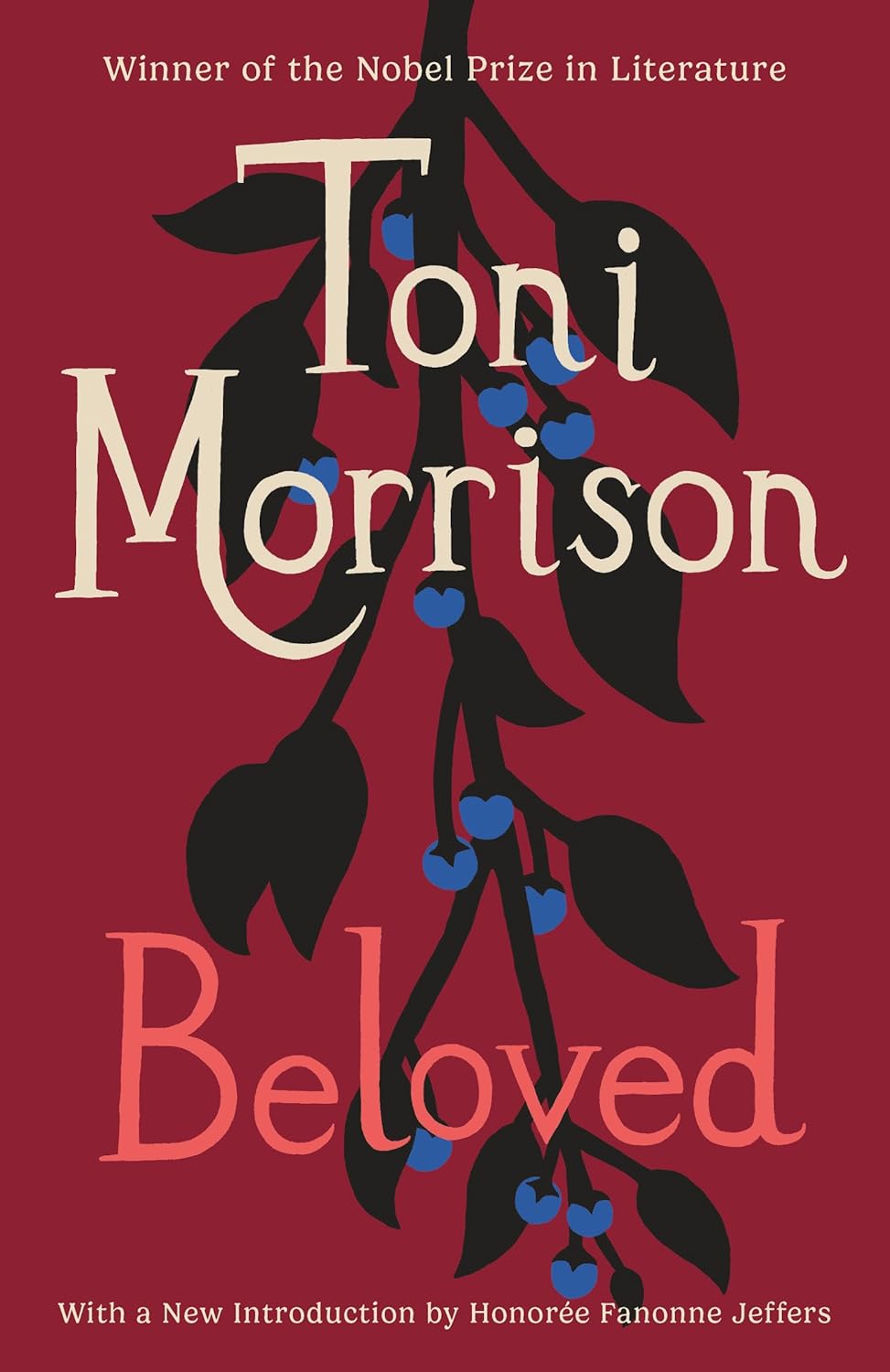
Ohio, 1873. Sethe lives at 124 Bluestone Road with her daughter Denver, and the house is haunted by something angry that breaks mirrors and leaves handprints in cake. Sethe’s two sons have already run. Then Paul D arrives, from the farm they were all enslaved on, and drives the presence out. And a few days later, a young woman is sitting on a stump outside, soaked, with new skin and no history, calling herself Beloved.
It’s a ghost story in the strictest sense. A specific dead person, a specific grievance, and a debt nobody can pay. All the gothic machinery is here, the house that will not release its occupants, the revenant, the unspeakable act in the past, and Morrison points every piece of it at American slavery, which is the one subject the form was built to handle and had spent a century avoiding.
What Sethe did is drawn from the case of Margaret Garner, who escaped from Kentucky in 1856 and was found with her children. Morrison read the newspaper account and did not embellish it.
The reason it disturbs rather than merely saddening is the structure. By the time you understand what happened in the woodshed, you also understand exactly why, and the novel refuses to let you hold both facts comfortably.
More on ghost books.
The Girl Next Door (1989)

Suburban America, 1958. Two orphaned sisters are boarded with a neighborhood family after their parents are killed, and over one summer, the aunt and her sons torture the elder girl in the basement, with the knowledge and eventually the participation of the local children.
David is twelve, next door, and decent in all the small ways, and he does not stop it. The narration comes from him decades later, and the true subject is the machinery of his not-stopping: the increments, the terror of exclusion, the child’s axiom that whatever an adult supervises must be sanctioned.
It’s based on the murder of Sylvia Likens in Indianapolis in 1965. She was sixteen. She was boarded with Gertrude Baniszewski along with her sister and tortured over three months by Baniszewski, her children, and the neighborhood children she let join in. The prosecuting attorney called it the worst crime in Indiana’s history.
Take the warning seriously. This involves prolonged torture and sexual humiliation of a teenage girl, described directly. King’s blurb said it “does not just promise terror, but actually delivers it.” If any doubt exists, believe the doubt.
More on the Jack Ketchum page.
The Nineties and After, 1990 to 2010
This is the period where the best horror books stopped being marketed as horror, and several of the strongest ones are shelved as literary fiction to this day.
Boy’s Life (1991)

Zephyr, Alabama, 1964. Cory Mackenson is twelve, he helps his father on the milk round, and one morning before dawn, a car comes out of the woods ahead of them and goes straight into Saxon’s Lake, which has no bottom. Cory’s father dives in and finds a man handcuffed to the steering wheel, beaten, with a wire around his neck.
That’s the plot, and it’s not really what the book is about. What follows is a year in the life of a boy in a small Southern town: the bicycle, the paper round, the monster in the river that the town holds a festival for, the Lady out past the edge of town, the bully, the dog, the summer, and a father slowly coming apart because he cannot stop seeing the dead man’s face.
It’s barely a horror novel, and it’s on this list because it’s the most loved book in the genre among people who actually read the genre. McCammon keeps the whole Southern gothic apparatus, the racial violence, the church, the secret, and refuses to be cynical about any of it.
It won both the Bram Stoker and the World Fantasy Award, which almost nothing ever does.
The Cipher (1991)

I’ve read this one, and the image is what stays with you.
Two artists going nowhere, Nicholas and Nakota, share a rotting apartment block, and in a hallway storage room the floor holds a hole: bottomless, draftless, silent, unaccountable. The Funhole, they name it. Objects go in first, then living creatures, and in the end Nicholas lowers his own hand.
The hand returns altered, wrong in particular documented ways, and Koja records each result at a level of precision most writers would refuse to attempt. Nicholas’s hand becomes the center of the book, and of a small scene of hangers-on who want access to it.
Squalor is what the book renders better than nearly anything else in print: the apartment, the drinking, cigarette burns, a relationship eating itself, and the unmistakable sense that decay claimed these two long before the supernatural arrived. Nineties horror produced few characters nastier than Nakota, and no explanation or redemption is ever offered for her.
My reservation is the length: more pages than the idea wants to carry, with a middle that circles. The imagery is worth the trip regardless.
More on the Kathe Koja page.
Ring (1991)
Koji Suzuki · translated by Robert B. Rohmer and Glynne Walley · 1991, English 2003

Four teenagers die on the same night, hearts stopped, faces wrong. Asakawa, a journalist and the uncle of one of them, works the connection back to a rental cabin and an unlabeled videotape whose closing message promises the viewer seven days.
Forget the films for a minute, because the book is a different machine. Asakawa is a man, there is no television to climb out of, and the novel runs as a procedural: hospital records, newspaper archives, a trip to an island to reconstruct the life of a dead psychic named Sadako Yamamura. Suzuki explains the curse, biologically and completely, which the films never dared, and the explanation is stranger than the mystery. The ending is about transmission, not hauntings, and it’s colder than anything the adaptations kept.
Kirkus opened its review with “You have seven days to live after reading this review.” The warning for horror readers runs the other way: this reads like a thriller wearing horror’s clothes, and the two sequels, Spiral and Loop, walk all the way out of the genre into science fiction, shedding readers as they go.
It was a phenomenon in Japan before the film existed, the films made it a global one, and the J-horror wave that followed starts here. Suzuki died in May 2026.
More on the Koji Suzuki page and the Japanese horror list.
Perdido Street Station (2000)

New Crobuzon is the best invented city in the genre, and it’s the reason to read this book.
The city is enormous, filthy, industrial and specific, with a militia, a corrupt parliament, a river, sentient species that are emphatically not elves and dwarves, khepri women with scarab heads, cactacae, amphibious vodyanoi, bird-like garuda, and the Remade, criminals punished by having their bodies surgically rebuilt with machinery or animal parts as a sentence. Miéville worked out the economy, the slums and the politics before he wrote a single line of plot.
I’ve read it, and the first third is a tour rather than a story, which is the honest warning. Isaac is a renegade scientist, a garuda arrives wanting his wings back, and for two hundred pages the novel wanders around showing you things.
Then the slake moths get loose, and it becomes superb. They feed on consciousness, they cannot be looked at because their wings hold the gaze, and the only things that can hunt them are creatures that do not think. Everything that meandering first third established starts paying off.
It’s filed as fantasy, and it’s really a horror novel with a city attached, and the last two hundred pages are as bleak as anything on this list.
More on the China Miéville page.
House of Leaves (2000)

I’ve read this one, and it’s far easier to describe what it does than what it is.
A family moves into a house in Virginia, and Will Navidson, a photojournalist, measures it and finds that the interior is a quarter of an inch larger than the exterior. Then a closet appears in a wall that has no room behind it. Then a hallway, black, cold, and extending far beyond the footprint of the house, then far beyond the property.
The expedition chapters are the best writing about interior space anybody has ever produced. They’re cold, procedural, and built almost entirely from measurements, rope lengths, battery life and sound. Nothing attacks anybody. The house simply does not agree with itself.
Around that sit two more layers: an academic study of a documentary that doesn’t exist, written by a blind man, and the annotations of Johnny Truant, who found the manuscript and is coming apart while he transcribes it.
The typography is the part people argue about. Text runs sideways, upside down, in single words per page, in columns that fight each other, and you physically rotate the book to keep reading. Some readers find all that a gimmick. It’s doing the same job the corridor is doing, and it works.
More on the Mark Z. Danielewski page.
A first-timer’s guide to House of Leaves covers the layers, the footnotes, and the full-color edition.
Let the Right One In (2004)
2004 · translated by Ebba Segerberg · 2007

Blackeberg, a concrete suburb of Stockholm, in the winter of 1981. Oskar is twelve, badly bullied, keeps a scrapbook of murders, and rehearses violence he will never commit. A child called Eli moves into the flat next door with an older man who kills people and drains them, badly, and gets caught doing it.
The novel is considerably more explicit than either film about what Eli is, and about what Håkan, the adult companion, actually wants, and that material is genuinely difficult. The Swedish film removes almost all of it. The American remake removes even more.
What makes it a great novel rather than merely a good horror one is that the friendship is not a romance, and the book knows it. Oskar is being groomed into a role, Håkan held it before him, and the ending is not a happy one, however it might look on the page. Lindqvist gives you everything you need to see that and simply declines to say it out loud.
The estate is the other achievement. Alcoholism, parents who aren’t coping, a public swimming pool, and the specific misery of a Swedish housing project in a winter that goes dark by three in the afternoon.
More on the John Ajvide Lindqvist page.
The novel’s own page covers Oskar and Eli, what the films leave out, and which edition to read.
World War Z (2006)

I’ve read this one, and the structure is the whole reason it works.
There’s no protagonist. An agent of the UN Postwar Commission spends years traveling and interviewing survivors, because the official report he produced was stripped of everything human, and the book is the material that got cut. Every chapter is somebody talking: a doctor in China who saw Patient Zero, a South African who designed a plan that saved millions by writing off most of the population, a Japanese teenager, a soldier, an arms dealer, a pilot, a submarine crew.
That format lets Brooks do something a conventional novel simply couldn’t, which is cover a global war at a global scale while keeping everything at eye level.
The Battle of Yonkers is the best sequence in the whole book. The US Army meets the horde north of New York with armor, artillery and air support, on live television, and loses catastrophically, and it’s narrated as an after-action interview by a soldier who was there and is still angry about it. There’s not a single jump scare in it.
The film shares a title with this book and nothing else. Brooks wrote a companion, The Zombie Survival Guide, first, and the novel assumes those rules.
More on the Max Brooks page.
Teatro Grottesco (2006)

Thomas Ligotti is the biggest name on this list most horror readers still haven’t read, and this collection is the standard door in.
Thirteen stories, and nothing in them works the way horror fiction is supposed to work. No protagonists to root for, no plots that resolve, no monsters with bodies. What Ligotti writes are testimonies: a man reporting his own corporate restructuring in memo language while the floor goes out from under the prose, a town whose manager is replaced by something that issues stranger and stranger directives, a red tower manufacturing things no market asked for, out on a plain nobody crosses.
The corporate material is the heart of it. Nobody has written the horror of employment better, the meetings, the memos, the demotions arriving without explanation, and he writes it from the inside, flat, patient and entirely without hope.
The honest warning: the register that makes three of these stories devastating can turn monotonous across thirteen in a row. Ration it.
The Washington Post called him “the best kept secret in contemporary horror fiction,” and the institutions eventually agreed: Penguin Classics took his first two collections in 2015, one of ten living authors in the imprint at the time. Read those next. Read this first.
More on the Thomas Ligotti page.
The Terror (2007)

HMS Erebus and HMS Terror sailed in 1845 to find the Northwest Passage and were never seen again. A hundred and twenty-nine men died. Simmons takes the documented facts, the two ships held fast in the ice northwest of King William Island from September 1846, and adds exactly one thing that isn’t in the record: something out on the floes that is hunting them.
The creature is the least of it, and that’s really the point of the book. What actually kills these men is the expedition itself: scurvy, lead leaching out of cheap solder and bad pipes, botulism from the underbid tins, cold past minus fifty, and above everything else, the chain of command, which keeps enforcing procedure while procedure does the killing. The Royal Navy’s confidence in itself is the deadliest thing on the ice.
Crozier carries the book: an Irish Catholic from Banbridge, twice passed over for Englishmen who will pass him over again, and when his whisky runs out a third of the way in, the novel quietly adds withdrawal to the list of things he’s surviving while two hundred men look to him.
AMC’s 2018 adaptation compresses it hard and holds up remarkably well.
And if ice, isolation and bad water are the draw, Cold Skin, Albert Sánchez Piñol’s lighthouse nightmare, has a page of its own.
The Little Stranger (2009)

Warwickshire, 1947. Dr. Faraday, a country GP of working-class origin, is called out to Hundreds Hall, the crumbling Georgian house where his mother once worked as a nursemaid, and becomes entangled with the family failing inside it: a widowed mother, a son disfigured and damaged in the war, and a daughter running an estate that cannot be run.
Then things start happening in the house. Marks on the walls, a fire, a dog, a bell that rings from a room nobody is in.
The great trick is that the haunting and the collapse of the British class system are the same event, and Waters never tells you which one is causing which. The Ayreses are being destroyed by death duties, taxation, the loss of their land and the arrival of the welfare state, and something is also moving in the house, and the novel firmly declines to separate the two.
The other trick is Faraday himself. He narrates the whole book, he’s decent, careful and helpful throughout, and he’s concealing nothing from the reader. He’s concealing it from himself, and every piece of evidence is sitting in plain view. Most people finish the book without noticing.
It was shortlisted for the Booker. Filmed in 2018, faithfully and without much success.
More on the Sarah Waters page.
The Modern Canon, 2010 Onwards
These are the best horror books of the last fifteen years, and the field is in better shape now than at any point since the eighties.
The Fisherman (2016)

I’ve read this, and no modern horror novel I know surpasses it.
Abe’s wife died young. A car accident took Dan’s wife along with both his children. Work throws the two men together, weekend fishing becomes their one functioning remedy, and Langan writes grief as a practical daily problem rather than a theme.
Then the name Dutchman’s Creek reaches Dan, and en route, rain hammering, they pull into a diner whose owner explains why no line ever goes into that water. His telling annexes the book’s whole middle: the Ashokan Reservoir works in the 1900s, a town under the flood, an occultist out of Germany called Rainer, and a compact concerning the return of the dead.
Withholding does the arguing. One mention of Rainer’s cult, zero explanation. Of the creature, the entire novel surrenders a single datum: how big it is. Explaining it fully would have killed it, and Langan plainly understood as much.
The frame is the other feat. Nested stories open easily and close badly, with the outer narrative usually left for dead once the inner one catches. Not here. The diner’s tale drives forward into Abe and Dan’s present and settles every debt the setup incurred, which is the hardest trick in the whole architecture.
More on the John Langan page.
The Troop (2014)

I read this and loved it, and it’s the modern survival horror novel everything else gets measured against.
Scoutmaster Tim Riggs takes five fourteen-year-olds to Falstaff Island off Prince Edward Island for a weekend, the way he has every year. On the first night, a man comes ashore from a stolen boat, starving, so thin it doesn’t make sense, and asks for food. Tim is a doctor. He tries to help. What’s inside the man is a modified parasite, and it is hungry in a way that stopped being his hunger some time ago.
Cutter’s smartest decision was making you like the boys first. Each of the five gets a real history before anything happens, so when the island turns, you’re watching people you know rather than roles being filled, and that’s why the book hurts rather than just disgusting you. One of them is already a problem before the parasite ever arrives, and that thread is the nastiest thing in the whole book.
The structure is the other thing worth knowing about. Between chapters, Cutter drops in transcripts, evidence and reports from the inquiry afterwards, so you understand the shape of what’s coming while the boys never will.
It’s relentless, it’s very specific about hunger, and it is not a book to eat during.
More on the Nick Cutter page.
Tender Is the Flesh (2017)
2017 · translated by Sarah Moses · 2020

A virus has made animal meat lethal, so the world legalized the obvious substitute, built the euphemisms to survive the arrangement, and moved on. Marcos runs day-to-day operations at a processing plant. The book walks you through his work week: licensing, grades of stock, breeding centers, the domestic market, hunting concessions. Vocal cords are removed, because the product shouldn’t sound like what it is.
The register is the horror. The Guardian said her “matter-of-fact staccato sentences are horribly effective,” and the flatness is the point: the question isn’t whether this could happen, it’s how quickly the language would adjust once it did.
It won Argentina’s Clarín Novel Prize in 2017 as Cadáver exquisito, crossed into English in 2020, and became one of the most passed-around horror novels of the decade, a USA Today bestseller with a BookTok afterlife that shows no sign of ending. Publishers Weekly’s verdict was that the execution leaves a bad taste, which may be the most accidentally accurate pan ever printed. The ending is the part people argue about, and it’s meant to be.
The novel has a page of its own. More on the Agustina Bazterrica page.
The Only Good Indians (2020)

Ten years ago, four young Blackfeet men drove into a part of the reservation reserved for elders, found a herd sheltering there, and shot into it. One of the elk was pregnant. They took what they could carry and left the rest, and they were caught, and they lost their hunting rights.
Now something is working through them, one at a time.
What lifts it above a revenge plot is that the entity is not folklore borrowed and repainted. She has an entirely coherent grievance, an entirely coherent method, and a set of priorities that make complete sense from the inside, and Jones gives her chapters of her own. She is not a metaphor for anything, and she is not wrong.
The men are the other reason it works. Lewis, Ricky, Gabe and Cassidy are drawn with real affection and real specificity, four people managing jobs, marriages, drink and the daily business of being Blackfeet on and off the reservation, and Jones is funny about them before anything happens.
The basketball sequence near the end is the passage everybody talks about, and it earns every bit of that.
The Stoker and the Shirley Jackson both went to it. Jones has written a great deal, and this is where to start with him.
More on the Stephen Graham Jones page.
Mexican Gothic (2020)

Noemí Taboada, a Mexico City socialite in the 1950s, gets a letter from her newlywed cousin that reads like it was written by someone else, or dictated by something else, and her father sends her to find out which. The answer lives at High Place, a fog-wrapped house in the mountains where the English Doyle family has sat on a silver mine since the previous century, among imported furniture, rotting wallpaper and a cemetery full of their own.
The machinery is deliberately classical, the governess gothic with the compass moved: the house is English, the rot is colonial, and the patriarch conducts eugenics lectures at the dinner table. Moreno-Garcia aims two hundred years of gothic apparatus straight at extraction colonialism, and the last third goes stranger than anything the setup promises, which is where the readership splits. The body horror arrives late and all at once.
Kirkus called it a “terrifying twist on classic gothic horror,” and the awards agreed in an unusually unanimous way: the Locus Award for best horror novel and the Goodreads Choice for horror in the same cycle, the critics and the crowd landing on the same book for once.
It also made Moreno-Garcia a fixture of the bestseller lists, and the title is a mission statement, not a label.
The novel has a page of its own. More on the Silvia Moreno-Garcia page.
Our Share of Night (2023)
2019 · translated by Megan McDowell · 2023

Juan Peterson is a medium. He works for the Order, a wealthy Argentine cult that uses him to open a channel to something they call the Darkness, and every ceremony damages him further. He has a heart condition, and he’s not going to survive many more of them. He also has a son, Gaspar, who has inherited the ability, and the Order intends to use him next.
Six hundred pages, running from the 1960s to the 1990s, and the book does several things at once. It’s a father trying to make his son useless to the people who want him. It’s a portrait of the Argentine dictatorship, in which perhaps thirty thousand people were disappeared and bodies were dropped into the Río de la Plata. And it’s a horror novel with some genuinely disturbing ritual sequences.
The argument tying it all together is that the Order’s power and the state’s power are the same power, and the sacrificed and the disappeared are the same people.
Two warnings before you pick it up. The ritual material is graphic. And the middle third takes a long detour through a different set of characters, which some readers find the best part of the book and others find a stall.
More on the Mariana Enriquez page.
The Last House on Needless Street (2021)

A boarded-up house at the end of a road beside a wood. A man named Ted who drinks, who is watched by the neighbors, and who was questioned years ago about a girl who disappeared from a lake. A cat called Olivia who narrates chapters and reads the Bible. A woman named Dee who has moved in nearby to find out what happened to her sister.
It’s impossible to describe this book usefully without ruining it, and every attempt so far has spoiled it for somebody. What can be said is that the structure is the most audacious thing in recent horror, that the disorientation of the opening act is completely engineered, and that the book pays off every cent of it.
Go in cold. Skip the reviews, don’t linger on the back cover, and treat anyone who starts a sentence with the cat as a hazard.
Ward holds three August Derleth Awards for best horror novel, a count nobody else has managed since the award took its current form, and this is the book that took her from a British genre reputation to a general readership. King’s blurb, “I’ve read it and was blown away,” is on the cover, and for once it isn’t doing marketing work.
Give it fifty pages before deciding you’re lost.
More on the Catriona Ward page.
Before the List: The Two Series a Lot of Horror Readers Met First
Two series sit outside the ranking, because they were written for children and ranking them against Beloved would be unfair to everyone. Leave them off, though, and this list pretends horror readers arrive fully formed. A great many arrived through a school library copy of one of these.
Scary Stories to Tell in the Dark (1981 to 1991)

Alvin Schwartz had spent years gathering folklore for young readers before he turned to the frightening kind, and the three books he made from it, in 1981, 1984 and 1991, are folk tales cut down to the bone. A page or two each, built to be read aloud, a good number of them ending on a shout. The sources are old ballads, campfire jump stories and urban legends that were already in circulation, and Schwartz listed every one of them in the notes at the back.
What made the books, though, was Stephen Gammell. His drawings, all wet ink and faces coming apart, did more to a generation of eight-year-olds than any of the text, which is why the 2011 reissue with gentler pictures by Brett Helquist caused an uproar and why HarperCollins brought Gammell’s art back in 2017. The American Library Association counted the series as the most challenged books of the 1990s.
Read them out loud, to someone young enough to jump. Buy an edition with the Gammell drawings.
The series has its own page: all three books, Gammell’s illustrations, the folklore and the bans.
Goosebumps (1992 onwards)

R. L. Stine’s series started in July 1992 with Welcome to Dead House, on a Scholastic contract for six books, and by the end of 1997 there were sixty-two of them, roughly one a month. At the height of it Scholastic was selling around four million copies a month, and the series has never really stopped, running on through Give Yourself Goosebumps, HorrorLand and SlappyWorld to the current House of Shivers, with more than 400 million copies sold by 2022.
The formula is the education. A twelve-year-old, a new house or a summer camp or something bought at a garage sale, a cliffhanger at the bottom of every chapter, and a last page that turns the whole thing over one more time. It’s horror reduced to its machinery, fast, funny and a bit gross, which is exactly why it works as somebody’s first horror book. Night of the Living Dummy and The Haunted Mask are good places to begin.
Start with one of the original sixty-two, and expect to finish it in an hour.
The Goosebumps page runs every series in order, the best books, and the box sets.
Where to Start, Depending on What You Want
Sixty-two of the best horror books is a lot to face at once, so here’s the shorter answer, sorted by what you’re actually looking for.
If you’ve never read horror properly, start with The Haunting of Hill House or Rebecca. Both are short, both are beautifully built, and neither will damage you.
If you want to be genuinely frightened, read I Am Legend, Pet Sematary or The Fisherman.
If you want the best-written, read Beloved, Perfume or The Little Stranger, none of which is marketed as horror, and all of which is.
If you want the historically important, read Frankenstein in the 1818 text, then The Great God Pan, then The Colour Out of Space. That’s the whole lineage in about three hundred pages.
If you want the modern canon, read The Only Good Indians, Our Share of Night and The Last House on Needless Street.
If you want something that will actually upset you, read The Girl Next Door, and read the warning above it first, because it is not a formality.
And if you want the one nobody has told you about, read The House Next Door or The Elementals, which are the two genuine finds among the best horror books of the last fifty years.
Questions About the Best Horror Books
What Is the Best Horror Book of All Time?
There’s no official answer, which is why this page runs by period instead of rank. The one I hand people most often is The Haunting of Hill House, the best haunted house novel ever written. The best-written books here are Beloved and Perfume, and the modern one I’d put against anything above it is The Fisherman.
What’s the Scariest Book on This List?
I Am Legend, Pet Sematary and The Fisherman are the three I name when somebody wants to be frightened rather than impressed. And “The Willows” has been frightening readers for over a century with nothing but wind, willows and two men on a sandbar.
Where Should a Complete Beginner Start With Horror?
The Haunting of Hill House or Rebecca. Both are short, both are beautifully built, and neither will damage you. If you want to know your appetite first, the Where to start section above sorts this list by what you’re actually looking for.
Is Dracula Still Worth Reading?
The first hundred pages are among the best the genre has ever produced, and the documentary construction is far more modern than the book’s reputation suggests. The middle sags and the ending reads like a travel itinerary. Read it for the castle, and know that the vampire rulebook is mostly Stoker’s own invention, not old folklore.
Where to Go Deeper
This page is the top of a much larger set. If a section of it grabbed you, the guides below go considerably further down.
By era: horror classics · gothic fiction · paperbacks from hell
By mode: folk horror · body horror · psychological horror · sci-fi horror · historical horror · religious horror · southern gothic · dark academia
By monster: vampires · zombies · ghosts · haunted houses · possession · monsters · serial killers · cannibals
By form: horror short stories · horror anthologies · ghost stories · disturbing books · witch trials
From the literature side of the site, one more: Cursed Bunny, Bora Chung’s ten stories in Anton Hur’s translation, with more Korean horror where that came from.
A note on support: this page mentions suicide. If you’re struggling, you don’t have to handle it alone. In the US you can call or text 988, the Suicide and Crisis Lifeline. Elsewhere, the International Association for Suicide Prevention keeps a directory of crisis centers at iasp.info.