Stephen King once asked who the scariest guy in America was and answered his own question with Jack Ketchum, and the quotation has been on the covers ever since.
He was Dallas Mayr, from New Jersey. He took the pen name from a Wild West outlaw. Before he wrote anything, he was Henry Miller’s literary agent, an actor, a teacher and a lumber salesman, and he didn’t publish a novel until he was thirty-four. Then he wrote Off Season, his publisher cut it to pieces, reviewers called it the worst thing they’d read, and American horror had a new problem.
What separates the Jack Ketchum books from the people who imitated him is that the brutality is always about something. That’s not a defense offered on his behalf, it’s visible on the page. His subject, across almost everything, is bystanders: how ordinary people get drawn one step at a time into participating in something they would have called unthinkable a month earlier, and how many chances there were for somebody to stop it.
He’s also, and this surprises people, capable of real gentleness. Red is a novel about an old man whose dog is killed, and it’s one of the most humane books in the genre.
He died in 2018, having won four Bram Stoker Awards and been named a World Horror Convention Grand Master. This is a guide to the Jack Ketchum books worth your time.
I haven’t read these. What follows is the critical consensus.
Fiction by René Rehn


The Short Version
Read The Girl Next Door if you want to understand why he matters, and read the warning below first, because it’s among the hardest books on this site.
Read Red if you want to know he could do something else, and it’s the one I’d actually recommend to most people.
Off Season is the historically important one, and it’s the least of the three.
The Essential
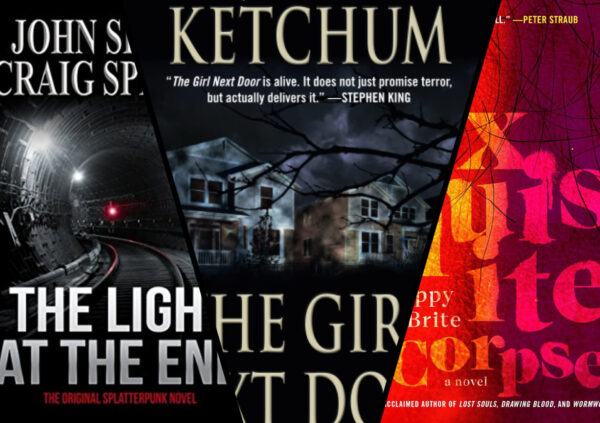
The Girl Next Door (1989)

It’s 1958 in the New Jersey suburbs, and two newly orphaned sisters have been placed with a family down the street. Over the course of one summer, Ruth Chandler and her boys make a project of the older girl down in the basement, and the neighborhood children know, and one by one they join in. The narrator is one of those children, telling you about it decades later.
It’s based closely on the murder of Sylvia Likens in Indiana in 1965, which was real, and which involved a woman named Gertrude Baniszewski and a number of neighborhood children.
The reason it isn’t gratuitous is the narrator. David is twelve, he’s not a monster, he does small kindnesses, and he doesn’t stop it. The book’s actual subject is the mechanism by which he doesn’t: the escalation in increments, the desire not to be excluded, the sense that an adult is in charge so it must be permitted. Everything that happens serves that argument.
King described it as the writer’s equivalent of being punched in the face, which is accurate.
Take the content warning seriously. This involves the prolonged torture and sexual humiliation of a teenage girl, described directly, and it is genuinely not for everyone. If you have any doubt, the answer is no, and no amount of literary merit changes that. Also on disturbing books.
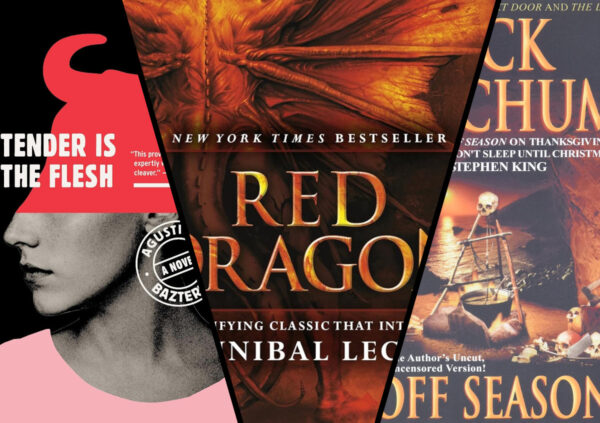
Off Season (1980)

A group of holidaymakers in an isolated house on the coast of Maine get attacked by a family of feral cannibals living in the caves nearby.
It effectively started American extreme horror six years before anyone coined a name for it. No supernatural element, no relief, and no argument beyond the argument that this is what it would be like. Ballantine gutted it before publication and then more or less disowned it.
Buy the restored edition, which is the version Ketchum actually wrote, and which has been available since 1999. Most modern printings carry the restored text, but it’s worth checking.
It draws on the Sawney Bean legend, and its sequels are Offspring (1991) and The Woman (2010), the last co-written with the director Lucky McKee.
Also on cannibal books and splatterpunk.
Red (1995)

Avery Ludlow is an old man fishing with his dog when three teenage boys arrive, rob him of what little he has, and shoot the dog for no reason at all.
He goes to the police. Then to the boys’ parents. Then to a lawyer, then to a local reporter, and nobody will act, because one of the fathers owns most of the town.
It’s a novel about the pursuit of a proportionate response, and Ketchum keeps it proportionate for a very long time. Av wants an apology and the cost of a dog. That’s the whole demand, and the escalation happens because every institution he approaches refuses him, rather than because he decides to escalate.
What he lost before the book starts gets disclosed slowly, and it’s why he can’t let this one go.
It’s quiet, controlled and completely unlike his reputation, and Av Ludlow is one of the best characters in horror fiction.
This is the Ketchum to recommend to somebody who doesn’t want to be brutalized, and it’s arguably his best. Filmed in 2008 with Brian Cox.
The Rest of the Novels
The Lost (2001)

Ray Pye is nineteen in the summer of 1965, wears crushed beer cans in his boots to look taller, and kills two girls camping in the woods for no reason he can articulate.
Nobody can prove it. Two cops know and can’t make a case, and one of them ruins his own career trying.
Then the novel jumps to 1969, and Ray is still in the same town, running dope, managing two young women who depend on him, and being watched by a policeman who never let it go.
What makes it work is that Ketchum spends four hundred pages on a nothing summer. Ray is small, vain, physically unimpressive and entirely mediocre, and the horror is that the town has simply absorbed him, and that the people around him have adjusted.
The last twenty pages deliver one of the most sustained stretches of violence in his catalog, and they arrive after an extraordinary amount of waiting.
Filmed in 2006. It’s the best of the non-Girl Next Door novels.
Cover (1987) and Stranglehold (1995)

The two that come closest to conventional thrillers, and both are better than they sound.
Cover follows a Vietnam veteran with severe post-traumatic stress living alone in the Maine woods and growing marijuana, who encounters a camping party and can’t distinguish them from the war. Ketchum wrote it in 1987, well before that material was common, and the veteran isn’t a monster and the novel never treats him as one. It’s genuinely sympathetic, and that’s what makes it hard.
Stranglehold, published in Britain as Only Child, is a custody novel. A woman leaves an abusive husband, the courts award him access, and the system then works methodically against her at every stage.
Nothing supernatural in either. Stranglehold is the angrier book, the family court material comes from cases Ketchum researched, and it’s the one people are least prepared for.
She Wakes (1989) and Joyride (1994)

Two from the middle of his career, and the two he was least satisfied with.
She Wakes is his only outright supernatural novel, set in Greece, involving a woman possessed by a Greek goddess and a group of travelers. Ketchum said in interviews that he was uncomfortable with it, that supernatural material wasn’t what he was built for, and the general reading agrees.
Joyride, published as Road Kill in Britain, is a serial killer novel. A man witnesses a couple commit a murder, decides they’re kindred spirits, and abducts them into a spree neither of them wants.
The premise is genuinely good, and the execution is the most conventional thing he wrote. It reads like a competent nineties thriller rather than like Ketchum.
Both are minor, and both are worth knowing about mainly to see the limits of what he could do.
Right to Life (1998)

Sara Foster goes to an abortion clinic and gets abducted in the parking lot by a couple who keep her in a basement cage for months.
The premise carries the whole intent, and Ketchum isn’t being coy about it. The couple are anti-abortion activists, they consider what they’re doing a rescue, and their plan is to keep her until she gives birth and then take the child.
That’s a political novel written as a captivity horror, and Ketchum’s position is unambiguous.
It’s short, under two hundred pages, and it’s one of the hardest things he wrote, because the abuse is prolonged and specific, and because the justification the couple offer themselves is completely coherent from inside.
It won the Bram Stoker Award for long fiction.
It’s not a book to recommend casually, and it’s doing something almost nothing else in the genre attempts, which is to take an actual political position and build the horror out of it.
The Short Fiction

He won four Bram Stoker Awards for short fiction, and it’s where his range runs widest.
“The Box” is the famous one, and it’s the best thing he wrote. A father on a train home before Christmas watches his young son ask a stranger what’s in the box on his lap, and the man shows him, and the boy stops eating. So does his sister. So does the other sister. And eventually, the wife, too. The novella is the father watching his family starve to death over months and never learning what was in the box.
That’s the whole story. Nothing gets explained, nothing gets threatened, and Ketchum never breaks it.
“Gone” is a woman waiting on Halloween for trick-or-treaters, years after her daughter was taken.
Peaceable Kingdom and The Girl Next Door and Other Stories are the collections.
“The Box” is in Peaceable Kingdom, and it’s the entry point to Ketchum for anybody who can’t face the novels.
Where to Start
Read Red. It’s the best introduction, it’s the best-written of his books, and it won’t send you away from him.
If you want the reputation, read The Girl Next Door, and go in having decided properly rather than casually.
Read Peaceable Kingdom if you’d rather test the voice in short form.
And approach the Jack Ketchum books generally knowing that the brutality is deliberate, that it’s aimed at something, and that this doesn’t make it easier to read.
Everything else worth reading is on my best horror books list. Where he sits among the genuinely upsetting is on my disturbing books list.