Most lists of horror classics are really lists of horror homework.
They give you the same twenty titles in publication order, with a paragraph of literary history each, and no indication of which ones will actually frighten you and which are important in the way that a museum exhibit is important. That’s a real disservice, because the gap is enormous. Some horror classics are two hundred years old and still land like a punch. Others you read out of duty and put down relieved.
So that’s the organising question here: which horror classics still work, and which are history. I’ll say plainly where a book has aged badly, and I’ll say plainly where one hasn’t aged at all.

Where the line falls. Everything on this page was published before 1970. That’s roughly where modern horror begins, with the paperback boom, and the books after it are a different conversation. There’s a separate guide to gothic fiction as a mode across the whole period, including the parts that aren’t horror at all.
Some of these I’ve read and some I haven’t. I’ve said which is which.
Fiction by René Rehn


The Nineteenth Century
The horror classics of this period are mostly doing one of two things: inventing a monster the culture then kept, or working out how to frighten a reader without showing them anything.
Frankenstein (1818)

The first horror novel that is still read for pleasure rather than for study, and the oldest thing on this page that needs no allowances made for it.
That is a real distinction. Most eighteenth-century gothic requires you to adjust: to tolerate the pacing, the verse interludes, the fainting. Frankenstein does not. The prose is direct, the structure is tight, and the arguments the creature makes are arguments a modern reader recognizes immediately.
It also established the shape of the genre’s central bargain, which almost every classic since has reused. Somebody acquires a capability they should not have. The acquisition is described briefly. Then the book spends its length on consequences that arrive slowly and cannot be reversed. Jekyll does it, Dorian Gray does it, and so do most of the twentieth-century entries on this list.
It came out of a wet summer at Villa Diodati in 1816, when Byron proposed that everyone present write a ghost story. Polidori’s contribution, The Vampyre, launched the literary vampire. Shelley’s launched everything else.
She was eighteen when she started it and twenty when it was published, anonymously, with a preface by her husband that led most reviewers to assume he had written it.
More on the Mary Shelley page.
The Tales of Edgar Allan Poe (1830s to 1840s)

The single most important body of short horror in English, and the reason the form exists in the shape it does.
Poe was writing for American magazines with hard length limits, and the compression is what made him. He is the writer who worked out that a horror story should produce one effect, that every sentence should serve it, and that the ending should arrive at the moment the effect peaks. He wrote that down, in a review of Hawthorne, and it became the theory of the short story generally rather than just the horror one.
His specific gift to the genre is the narrator you cannot trust. No ghost and no monster appear anywhere in “The Tell-Tale Heart,” “The Black Cat” or “The Cask of Amontillado.” They have a murderer walking you through his reasoning as if it were a household repair, and the dread lives in how level the voice stays.
The anthologies also never admit how uneven he is. Comic Poe is unreadable, a good third of the tales are filler, and the essential core comes to about a dozen stories, which happen to be as good as the form has ever been.
Full ranking on the best Poe short stories.
Carmilla (1872)

The first vampire novel worth reading, and it is a better book than the famous one that followed it.
Le Fanu published it in 1872 in a magazine he edited himself, twenty-six years before Dracula, and Stoker knew it well. The elements Stoker is credited with inventing are mostly here first: the aristocratic predator with an ancient lineage, the staged accident that gains an invitation, the drain conducted across months so that the decline is diagnosed as illness, the village girls who died before the story starts, and the expert who arrives to explain the rules.
What Le Fanu does that Stoker does not is keep it small. There is no crew of professionals, no chase across Europe and no plan. There is a girl in an isolated house who is delighted to have company for the first time in her life, and a guest who is killing her slowly.
It is also openly about desire between women, in 1872, reciprocated and stated on the page rather than coded.
It fits in an afternoon, costs nothing anywhere, and beats the famous one as a first Victorian vampire.
The Yellow Wallpaper (1892)

The shortest classic on this page and the one that has aged forward rather than back.
Gilman published it in 1892 and it was read at the time as a straightforward horror story about a woman going mad, which was the only available reading. What it obviously is now is an account of a woman being destroyed by medical care, and the shift is not a modern imposition. It is what she wrote it for.
She had been treated by Silas Weir Mitchell, who invented the rest cure and prescribed it to her: complete bed rest, no work, no writing, no intellectual stimulation, and as domestic a life as possible. The story was aimed squarely at Mitchell, and she mailed him a copy to make sure it landed.
The craft is the reason it survives rather than the politics. It is a journal, written in secret, and the entries get shorter and stranger as the summer goes on, so the reader tracks her deterioration through the prose itself rather than through anything she reports.
No character wishes her ill, and the story runs entirely on that.
Six thousand words, public domain, and it takes half an hour.
Strange Case of Dr Jekyll and Mr Hyde (1886)

A hundred and forty years of adaptation have made this the hardest classic on the page to read properly, because everybody arrives knowing the ending.
It was written as a mystery. Utterson, a London lawyer, is troubled by the will of an old friend, which leaves everything to a man nobody has met. He investigates. The reveal comes in the final chapter, in Jekyll’s own written statement, and Stevenson constructed the whole novella to arrive there.
Read it for what the culture has dropped instead. Jekyll is no divided saint. He is a man of position who has spent decades sitting on appetites he thinks beneath him, and the drug manufactures nothing; it uncorks what he already contains and hands it a deniable face. He likes it, and goes on dosing himself well past the point of understanding the price, until the changes stop waiting for the drug.
Stevenson wrote the first draft in three days, burned it after his wife criticised it, and rewrote it in three more.
Seventy pages, and it is genuinely well made rather than merely famous.
The Great God Pan (1894)

One of the two or three most influential horror stories in English and almost nobody outside the genre has read it.
Machen’s method is the reason it belongs on a page of classics. He assembles the novella out of a doctor’s account, letters, a fragment of a manuscript, a servant’s testimony and a list of suicides, and the reader has to fit them together. Direct description never happens. The single try at it, a dying witness recounting a body’s dissolution, collapses into ellipsis mid-sentence and goes silent.
“The Call of Cthulhu” runs on this chassis, by Lovecraft’s own admission. King lifted the title and the ending for Revival, and del Toro returns to it in interviews. Few texts in the genre carry more weight.
The plot: a doctor opens a young woman’s brain so her mind can reach what he names the great god Pan, and twenty-three years on, the bill comes due in London drawing rooms.
1894 called it degenerate, though the scandal attached to the implications, since the page itself states almost nothing.
More on the Arthur Machen page.
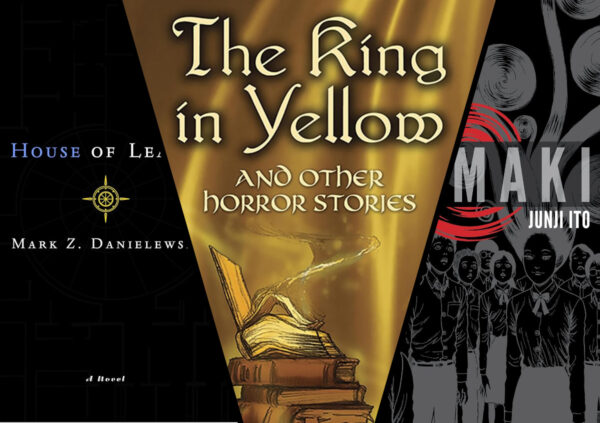
The King in Yellow (1895)

A collection where four stories are essential and the rest is Paris romance, and the four invented something the genre has used ever since.
The cursed text enters horror here. Within the stories sits a two-act play, also called The King in Yellow: act one entirely innocent, act two the ruin of any reader who finishes it, and every attempt at suppression only advertises it further.
What sustains the device is how little Chambers commits to paper: one stage direction, scattered dialogue, a handful of names, never a synopsis, leaving the play permanently unwritten, and every writer since who has tried to fill it in has only made it smaller.
A correction worth carrying: Carcosa and Hastur are not Chambers coinages. Bierce published both names first, in 1886 and 1891, and what Chambers did was lift them empty of their original senses, which is precisely what lets them resonate.
“The Repairer of Reputations” stands first among the four, and few unreliable narrators in the language rival its Hildred.
More on the Robert W. Chambers page.
Dracula (1897)

The most influential horror novel ever written and not the best one on this page, and both of those are worth saying plainly.
The opening movement, Harker alone in the castle and increasingly aware of what that means, is extraordinary. Then he escapes and the book becomes a different and much weaker thing.
What makes it a classic is the codification. Invitations, mirrors, home soil, running water, the brides’ pecking order: the checklist every vampire since has had to file against was mostly issued here, not inherited, and it has been compulsory ever since.
The form is the other reason. It is assembled entirely from journals, letters, telegrams, a ship’s log and phonograph cylinders, with no narrator anywhere, and it is stuffed with the newest technology of 1897.
Read it for the first hundred pages and Renfield, and know going in that the final act amounts to a timetabled pursuit across the continent.
Stoker came back to Egypt six years later with The Jewel of Seven Stars, and the whole mummy line, from Jane Loudon to Anne Rice, has its own page in the mummy horror guide.
The Turn of the Screw (1898)

The most argued-about story in the language, and the argument is the reason it is a classic.
A young governess takes charge of two orphans at an isolated estate under a single unusual term: their guardian is never to be contacted, about anything. In time she grows certain that two servants, both dead, both corrupting influences while alive, are returning for the children.
James built it so both readings hold completely. Take the ghosts as real and she is the lone adult who sees; take them as hers and the danger to the children is her certainty. No sentence anywhere settles it, and the criticism has never produced a winner.
What makes it work rather than merely being clever is that she gets there ahead of you, weighs her own reliability on the page, and acquits herself, leaving you to grade the acquittal.
Late James is the price of admission. The sentences double back constantly, and some of the ambiguity is syntax rather than strategy.
The Turn of the Century
The horror classics between 1890 and 1910 are where the short story overtakes the novel, and where the weird tale separates from the ghost story.
Ghost Stories of an Antiquary (1904)

The book that fixed the English ghost story in the shape it still has.
James, Cambridge medievalist and eventually provost of Eton, composed these for Christmas evenings, reading them aloud to gathered friends. He also wrote down his own rules, which is unusual and useful. The setting should be familiar and modern. The ghost should be malevolent rather than benign. And the reader should be introduced to the characters placidly before the ominous thing puts out a hand.
What separates him from every imitator is restraint. “Oh, Whistle” shows the method whole: the professor, the dug-up whistle, and a thing in the spare bed granted two sentences and a face of crumpled linen, which has been enough to frighten a century of readers.
“Count Magnus,” “Lost Hearts,” “The Ash-Tree” and “Casting the Runes” are the others everybody names.
The BBC’s Christmas adaptations have run since 1968, and December remains their native month.
The Monkey’s Paw (1902)

The most perfectly constructed short horror story in English and it is four thousand words long.
A paw with three wishes for each of three men enters an ordinary parlor, carried by a soldier home from India who will not say what his own wishes were, beyond that the first owner’s last was for death. Into the fire it goes, and out again in Mr. White’s hand.
The wish is the detail that makes it a classic. The Whites ask for exactly two hundred pounds, mortgage money, the least greedy sum available, and it arrives as compensation for Herbert, folded into the machinery at the works.
Then the second half, which everybody remembers. Ten days later the arithmetic occurs to the mother. The father, who identified the body, cannot make himself explain his objection. The knocking starts, and continues, and everything ends on whether a bolt or a wish moves first.
Jacobs keeps the door shut. Nothing outside is described, and the last wish is granted between the lines.
The Willows (1907)

Lovecraft ranked it above every other weird tale in existence, his own included, and the ranking holds.
The premise in full: a flooded Danube, a canoe carrying two men, and a night’s camp on a sand island midstream. No attack ever arrives, nothing resolves into clear sight, and the novella contains no monster, no cult, and not one line of explanation.
Everything that occurs is minor and adds up: willow branches bowing into the wind rather than with it, the canoe hull acquiring a clean cut, a paddle gone and then returned, pillar-shapes standing in the river mist. It’s the Swede who states the local law, and the law is the horror: attention drew this, so safety requires not thinking about it, a discipline terror makes impossible.
No purer specimen of cosmic horror exists in English, and it arrived twenty years before Lovecraft wrote a word of his.
Blackwood took that exact journey. The stretch of river was his own paddling, and the drowned man he and a companion freed from the willow roots traveled with him onto the page.
The House on the Borderland (1908)

Structurally a mess and it contains one of the most extraordinary passages in the genre.
On a fishing holiday in Ireland’s west, two men come upon a house in ruins at a chasm’s edge, and in the wreckage, a rotting manuscript: the record of the man who lived there, split into two halves that barely acknowledge each other.
Half one is a siege: pig-like creatures climbing from the pit beneath the foundations, the narrator answering with a rifle, and it genuinely frightens.
Then all of that gets dropped. Seated in his chair, the narrator feels time slip its gears, days streaming past, years, whole centuries, the sun bloating and dimming, the planets winking out, and his account runs through the solar system’s death and onward past it, on a 1908 copyright page.
That second half is why the book is a classic. No Victorian or Edwardian fiction attempted anything at that scale, and every deep-time sequence the genre has produced since descends from it directly.
The prose is difficult and the structure is broken, and it is worth every page.
The Beetle (1897)

Published in the same year as Dracula, outsold it comprehensively, went through fifteen editions before the First World War, and then vanished.
That is the reason to read it, and it is a genuinely instructive comparison. Marsh uses the same multi-narrator structure, the same premise of an ancient foreign predator arriving in London, and the same anxieties, and he got there first commercially.
What he does not have is a character. Dracula is an aristocrat with a castle, a costume and a set of rules. Marsh’s entity offers nothing to hold: name absent, body unfixed, mythology unestablished, and no feature an illustrator could render. By its own account it belongs to the Children of Isis; it mesmerizes, wears a beetle’s shape, and shifts sex between scenes in ways no observer can pin down.
That instability is the most interesting thing in the book and the reason academics have returned to it.
Marsh was Robert Aickman’s grandfather, and he had previously served a prison sentence for fraud under his real name.
Lovecraft

I’ve read all of him, so this is a verdict rather than a summary.
The Call of Cthulhu (1928) is the one to start with and it’s the template: a man assembling his dead uncle’s papers, a cult, a statue, a sunken city, and a narrator who works out what he’s found and wishes he hadn’t. The structure is inherited directly from Machen.
At the Mountains of Madness (1936) is the best long piece, an Antarctic expedition that finds a city and reads its history off the walls. It’s slow and it’s worth it.
The Colour Out of Space (1927) is the most frightening thing he wrote and the one that has aged best, because the horror is genuinely alien rather than a monster with tentacles.
The Shadow Over Innsmouth (1936) is the best-plotted, and the chase through the town at night is his only genuinely propulsive sequence.
On the racism, since it can’t be skipped: it is real, in several stories it is the engine rather than a flavoring, The Shadow Over Innsmouth most of all, and his letters outdo his fiction on this count. The claim that he renounced it late in life is one I would have liked to keep, and it does not check out; his politics moved left in the Depression, his racial views did not, and even S. T. Joshi, his most committed defender, says so flatly. The full argument, and the writers answering him from the other side, LaValle, Ruff, Emrys, live on the Lovecraftian fiction page.
The one-volume option is The Complete Fiction, which covers everything named above.
Full ranking on the best Lovecraft stories.
The Mid-Century
American horror classics take over here, and the settings move to motels, suburbs, apartment buildings and small towns.
Rebecca (1938)

The classic that removed the ghost and lost nothing, and the one most likely to surprise a reader who assumes it is a romance.
A young woman, never named, earning her keep as a rich widow’s companion, accepts a widower’s proposal inside two weeks, and Manderley receives her into an existence another woman still owns. Rebecca is a year dead and entirely in charge: her monogram on the stationery, her rooms dusted daily to her taste, her housekeeper enforcing her standards on the replacement.
For two hundred pages du Maurier deals exclusively in small social failures, each one witnessed, each one filed, all of them landing on a twenty-one-year-old with no training for the role she has married into.
Then the bay gives something up, and every page before it changes meaning.
Two facts to carry in. In the novel Maxim shoots Rebecca, a detail 1940 censorship forced Hitchcock to soften into an accident. And the narrator’s namelessness is her entire meaning, not a party trick.
More on the Daphne du Maurier page.
The October Country (1955)

The collection that made a generation of horror writers, and the one to reach for if you came to Bradbury through science fiction.
Nineteen stories, most of them drawn from his 1947 collection Dark Carnival, working in a register that had no name at the time and is now standard: small-town American unease rather than European gothic dread. No castles, no aristocrats, no curses. A jar at a carnival, a man who becomes frightened of his own skeleton, a mother convinced her newborn is trying to kill her.
“The Small Assassin” is the one people cite and the reason is that Bradbury takes her seriously. The story never suggests she is hysterical.
“The Jar” is the best of them. A man buys an exhibit from a carnival, brings it home, and the community around him decides collectively what is inside it, which turns out to matter more than the answer.
He was writing these at the same time as the Mars stories, which is the range worth noticing. King, Gaiman and half the writers on this site name him as the origin.
I Am Legend (1954)

After Dracula, no twentieth-century horror novel carries more consequence, and it does the whole job in a hundred and sixty pages.
Robert Neville holds the last defended house in Los Angeles, and the things his neighbors became spend every night on the lawn calling for him. Daylight is chores: planks, garlic, the generator, fuel runs, and the house-to-house staking that passes for a job.
Matheson’s move was clinical: one bacillus, one life cycle, and every folk rule, garlic, crosses, mirrors, sun, rederived as symptom. A monster left the church and entered epidemiology, and nobody had managed that before. Romero has said Night of the Living Dead came directly out of it, so the entire modern zombie genre is downstream of a vampire novel.
And the ending is the reason it is a classic rather than merely influential. Three films have tried it and none has kept it whole.
The Body Snatchers (1955)

The paranoia template, and it is considerably gentler than every adaptation.
Dr. Miles Bennell, a GP in Santa Mira, California, starts seeing patients who insist a spouse or an uncle is a flawless copy, right down to the memories, and who can hear how it sounds as they say it, which is why it works.
What Finney does that has been imitated ever since is keep the pods innocent of malice: windblown, planless, leaderless, with nobody inside to bargain with, a reproductive process that merely requires you gone.
Every generation has read a different politics into it. In 1955 it was communism, in 1978 it was conformity, and Finney denied all of it consistently and said he had written a thriller.
The novel’s ending is markedly more hopeful than the films, which surprises readers arriving from Kaufman’s 1978 version.
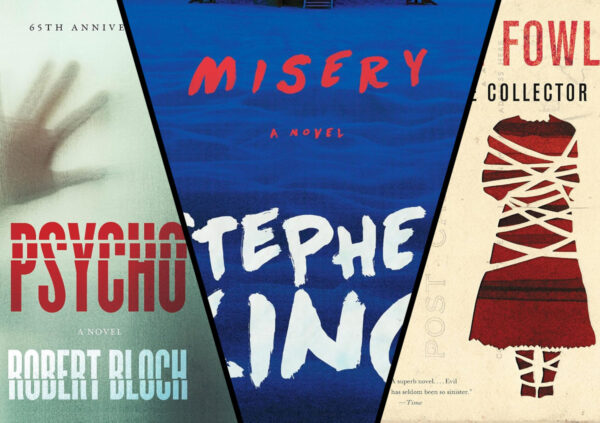
Psycho (1959)

The book that moved the monster out of the castle and put him behind a motel desk.
Bloch was forty miles from Plainfield when the Gein story broke two years earlier, and has said he knew little beyond the headline. What he took was the premise that such a man could live unnoticed next door, which is the founding sentence of the serial killer novel, and everything from The Silence of the Lambs onward stands on it.
Hitchcock gets the credit for killing the lead a third of the way in, but the corpse was Bloch’s first; the film only made you watch.
Bloch’s Norman is middle-aged, heavy, drunk and dabbling in the occult, with nothing of Perkins about him, and the page runs colder than the screen ever managed.
Under two hundred pages and it does not waste any of them.
The Haunting of Hill House (1959)

The most influential haunted house novel ever written, and nothing else is in the conversation.
Dr. Montague’s advertisement asks for people with a history of the unexplained, and the one who matters answers it by stealing her sister’s car: Eleanor, eleven years a sick mother’s nurse, newly unemployed by the death, owner of nothing.
The house’s entire repertoire is a cold patch on the landing, some hammering in the night, and one line of writing on a wall.
Jackson’s camera never leaves Eleanor, warmth’s first-ever recipient, and declines to rule on whether house works on woman or woman on house. The withholding is airtight.
The opening and closing paragraphs are the same words and are regularly called the best in American horror.
Something Wicked This Way Comes (1962)

Three in the morning, a week shy of Halloween, and a carnival train pulls into a small Illinois town while two boys of thirteen watch the tents rise.
One of them, Will Halloway, was born a minute before midnight; Jim Nightshade came a minute after, and that placement is Bradbury’s whole design for the pair. What Cooger and Dark’s Pandemonium Shadow Show unloads: a maze of mirrors, a proprietor inked head to foot who reads what every soul in town is missing, and a carousel whose fare is a year of life for every turn, payable in both directions.
But the novel’s center of gravity is Charles Halloway, Will’s father, fifty-four years old, mopping the library floors at night, quietly convinced he became old too soon to be any use to his boy. He is who ends up standing across from Mr. Dark, and the vulnerability he finally names in the enemy delivers one of the genre’s finest endings.
Underneath everything, Bradbury is writing about wanting to be older, wanting to be younger, and what a machine charges to grant either wish.
Bradbury’s prose decides everything: readers either come for it or leave over it, and no book on this page is more beautiful.
We Have Always Lived in the Castle (1962)

The final novel Jackson finished, and the one her readers have spent decades promoting over Hill House.
Eighteen-year-old Merricat, her sister Constance and their uncle Julian are what the arsenic left of the Blackwoods, six years on. Acquittal kept Constance out of prison and inside the grounds, and the village handles Merricat’s twice-weekly shopping runs with stares and spit, which she files under weather.
Not one supernatural event occurs. What threatens them is a village, and later a cousin whose helpfulness centers on the money.
What makes it a classic is the voice. Merricat’s narration stays neat, sunny and perfectly logical about buried teeth, banned words and charmed days, Jackson refuses you a single outside glance, and working out what you are actually being told takes exactly as long as she wants it to.
The final twenty pages justify every list this book appears on.
More on the Shirley Jackson page.
Rosemary’s Baby (1967)

The novel that brought horror indoors and into the present tense, and it did more to make the genre commercially respectable than anything since Dracula.
The Woodhouses take rooms in the Bramford over a friend’s objection and inherit elderly neighbors whose kindness has no off switch. Guy’s stalled acting career turns when a rival abruptly goes blind, and then Rosemary is expecting.
Levin’s trick is preemptive reassurance: each wrong note is resolved on arrival by someone devoted to her, the pain normal, the doctor eminent and hostile to books, Minnie’s morning drink only herbs, until objection itself starts to feel like ingratitude.
Underneath runs the plainest transaction in horror, a wife spent on a career, priced by a husband who stays plausible to the last.
Two hundred and forty pages that sold four million hardcovers and made the genre respectable at dinner parties again.
To Walk the Night (1937) and The Edge of Running Water (1939)

Two novels, published two years apart, and then their author stopped writing fiction entirely and ran Rutgers University Press for the rest of his life.
To Walk the Night opens with a professor burning to death in a locked observatory with nobody else present, and follows two young men, one of whom marries the dead man’s much younger widow. What she is, and where she came from, is the question, and Sloane never quite answers it in the terms the reader expects.
The Edge of Running Water concerns a physicist who has built a machine to contact his dead wife, in a house in coastal Maine, and the housekeeper and the townspeople who have worked out roughly what he is doing.
Both are science fiction wearing the clothes of a country-house mystery, and both are genuinely unsettling in a register nobody else was using in the late thirties.
Stephen King wrote the introduction to the NYRB omnibus of both, The Rim of Morning, which is the edition to buy.
They are the best argument on this page that the mid-century American uncanny had a strand nobody kept reading.
The One Written for Children
Scary Stories to Tell in the Dark (1981)

The youngest book on this page and the only one written for children, and it belongs here anyway. For a lot of American readers it was the first contact with the old material the rest of this list is built on: the ghost legend, the jump tale, the ballad of the corpse that won’t stay buried. Alvin Schwartz collected folklore by habit, and his three volumes, in 1981, 1984 and 1991, retell stories that were old long before he printed them, some reaching back to a medieval Russian chronicle. He kept them short and plain and gave every one a source note at the back.
Stephen Gammell’s ink drawings are half the book. When a 2011 reissue replaced them, readers revolted, and the original art came back in 2017.
Read the first volume aloud, and get an edition with Gammell’s pictures.
What to Skip
Two that appear on every list and that I’d only recommend to completists.
The Castle of Otranto (1764) is where the genre starts and it is not frightening, not trying to be, and largely absurd. Read about it. It’s covered on the gothic page.
The Mysteries of Udolpho (1794) was the most popular novel in Britain and runs to about seven hundred pages of dread that Radcliffe then explains away with natural causes. Historically enormous, and a very long way to go for that.
Where to Start
If you want the one that will actually get to you, read The Haunting of Hill House or I Am Legend.
To trace the descent, take Frankenstein in its 1818 text, The Great God Pan after it, and “The Call of Cthulhu” to close, in that order, and the full lineage runs perhaps three hundred pages.
If you have half an hour, read “The Yellow Wallpaper” or “The Monkey’s Paw”.
And if you’ve been told horror classics are stuffy, read Rebecca and then come back and tell me that.
My best horror books list ranks the rest of the genre. Mary Shelley is where the argument starts.