Splatterpunk was a joke that stuck.
At the Twelfth World Fantasy Convention in Providence, over the last weekend of October 1986, David J. Schow was at the bar. Cyberpunk had just acquired its name, a handful of horror writers had spent two or three years independently attacking the polite structures of the genre without knowing much about each other, and somebody made the obvious connection. John Skipp, who was there, has written the account: Schow said they would have to call this lot splatterpunks now, and everybody laughed.
Then it appeared in print in a fanzine the following year, and in Twilight Zone Magazine the year after that, and by 1990 there was an anthology with the word on the cover.
There is an irony in the setting that nobody mentions. The guests of honor at that convention were Ramsey Campbell and Charles L. Grant, and Grant was the editor of Shadows, the anthology series built on an explicit prohibition against gore, explicit violence and anything resolved too clearly. Splatterpunk got named at a convention honoring the man whose editorial position it existed to reject.
This page covers the movement, which ran from roughly 1980 to 1996 and then stopped. What carries the name now is a market category rather than a position, and that is a different page.
More on extreme horror for the modern scene.
Fiction by René Rehn


What It Was Actually Reacting Agains
The standard account is that splatterpunk was about gore, and that is the least interesting thing about it.
Horror in the early eighties had a dominant mode and it was the quiet one. Suggestion, implication, restraint, and a monster that worked better for never being described. Charles L. Grant enforced it editorially across eleven volumes of Shadows and rejected a great deal of good work for being too direct. That approach produced superb fiction and it had also, by about 1984, become an orthodoxy.
The writers who got labeled splatterpunk were not united by wanting more blood. They were united by a conviction that the restraint had become a way of not looking, and that a horror writer who declines to describe the wound is refusing the job.
Schow put it plainly afterwards. He said he made the term up to describe hyperintensive horror, the Clive Barker there-are-no-limits variety, back when it mattered.
Barker’s own formulation is the clearest statement the movement has, and he made it about his own work rather than about a movement. He said the horror he writes is interested in tearing away the veil, in confrontation with the image seen clearly, and that he is trying to see what the wound means, and the only way to do that is to look at the wound.
The punk half was not decoration either. These were writers with rock music in the prose, contempt for the establishment, an interest in transgression as a political act rather than a commercial one, and in several cases genuinely radical politics.
The Writers Who Are Called Splatterpunk and Refused the Name
This is the first thing to understand about the movement, because it applies to most of the famous names attached to it.
Clive Barker actively rejected both the splatterpunk and the gore labels while writing the work that everybody agrees epitomizes them. He has never used the term about himself.
Joe R. Lansdale appears on every list and has been consistently unimpressed by the exercise. His line on it is that the books which define a genre are in the eye of the beholder, which is a polite way of declining to participate.
Jack Ketchum never adopted it. He wrote the most-cited novel in the subgenre and described himself as a horror writer.
Even the people who did use it were not serious about it. Skipp’s own account calls it a dopey joke name, and he was one of the two writers most identified with it.
That leaves a movement whose most celebrated members would not join, which sounds like it should undermine the whole category and does not. The books exist, they came out within a decade of each other, they were doing recognizably the same thing, and the writers who disliked the label mostly disliked labels rather than disliking each other.
It is worth noting that the Splatterpunk Awards, founded in 2017, have given their lifetime achievement award to both Barker and Lansdale.
The Essential Books
I have not read the period. That is worth stating plainly on a page like this, because everybody writing about splatterpunk claims the canon and the canon is four books and a Wikipedia entry.
What follows is consensus register, and where I have a view it is about the movement rather than about the prose.
The Light at the End (1986)

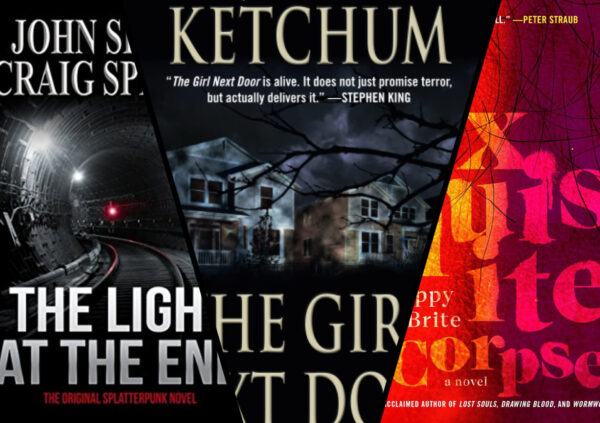
John Skipp and Craig Spector, published the same year the term was coined, and if one book is splatterpunk this is it.
A vampire in the New York subway system. Rudy Pasko is a punk who gets turned and treats it as an upgrade, and what he does with it is aimed at the city rather than at individuals, and the people who go after him are a bike messenger, a transit worker and a graffiti artist.
Everything the movement claimed for itself is in it. The violence is explicit and the novel does not cut away. The setting is contemporary and urban rather than gothic. The characters are young, broke and working, which almost nothing in eighties horror was. And the soundtrack is present in the prose in a way that reads as period-specific now and was new then.
Skipp and Spector wrote six novels together, edited the Book of the Dead anthologies that gave the modern zombie story its literary form, and split in the early nineties.
The Girl Next Door (1989)

Jack Ketchum, and by a wide margin no book in the subgenre gets cited more.
Sylvia Likens was sixteen. In 1965 she and her younger sister were boarded with a woman in Indianapolis for twenty dollars a week while their parents worked a carnival circuit, and over three months that woman, her own children, and neighborhood children who came to the house to take part, starved, beat, burned and branded her until she died in the basement. The prosecutor called it the worst crime ever committed in the state.
Ketchum moved it to 1958 New Jersey, changed the names, and invented very little else.
The movement-era argument is about the narrator. A twelve-year-old watches it happen, is never the one holding the iron, performs his small decencies, and tells nobody. The book anatomizes how that works: each step barely worse than the last, the terror of being cast out of the group, the child’s logic that whatever an adult allows must be allowable.
That is the splatterpunk case made in one book. A quiet treatment would have been a betrayal of the material.
More on disturbing books for the fuller treatment.
Off Season (1980)

Ketchum again, six years before the term existed, and it is where the movement’s line actually starts.
Vacationers take a week’s rental on the Maine coast, and out of the cave system nearby, a family comes down to collect them. Ketchum transplants the Sawney Bean legend to America, feral across generations, and once the siege starts, roughly a third in, it never lets up.
Why it matters to this page is what publishing did to it. The editorial board at Ballantine refused the manuscript as delivered and cut it deep before release; the trade press attacked even the reduced version; and by Ketchum’s own account the damage to his career lasted years. Only in 1999, when Overlook Connection issued the restored edition, did the complete text reach print.
Buy the restored edition. The cut version is a different and lesser book, and the cut itself is the movement’s whole problem in miniature: the work existed before there was a market willing to publish it.
Exquisite Corpse (1996)

Poppy Z. Brite, closing the bracket on the movement.
A staged death gets English serial killer Andrew Compton out of custody and across the Atlantic to New Orleans. There waits Jay Byrne, running the same private project on inherited wealth and better premises. Recognition is mutual.
There is no investigator and no procedural counterweight. The reader is inside the collaboration for the whole book with nothing to cut away to, which is the most complete application of the movement’s position that anybody attempted.
It is also the only queer thread in the canon, and the AIDS material running through the French Quarter of the early nineties is what the book is actually about.
Brite’s American publisher refused it on delivery and it appeared with a different house.
Published under the Brite byline, which is the name the book carries. He now publishes as Billy Martin.
More on the Poppy Z. Brite page.
Books of Blood (1984 to 1985)

Six volumes and thirty stories, arriving in Britain across a year and a half, from a thirty-two-year-old theater worker with no name anybody knew.
Barker rejected the label and wrote the thing that defined it, which is the central fact of this page.
What the collections did was demonstrate the range the movement was claiming. “In the Hills, the Cities” is two English tourists in Yugoslavia and two towns that assemble their entire populations into enormous bodies and wrestle. “Dread” has no supernatural content and is about a man testing what fear does to people. “The Midnight Meat Train” is the subway. “Rawhead Rex” is a monster in the English countryside and is the most conventional thing in the six volumes.
The point is that none of these is the same kind of story, and the connective tissue is a refusal to look away rather than a house style.
King’s line about having seen the future of horror is on the American covers since the first US edition and it has done the books no favors, because it framed them as a successor rather than as an argument.
The Nightrunners (1987)

Joe R. Lansdale, holding down the East Texas end of the movement.
A young couple move to the country after she is assaulted, to recover, and the boys responsible are coming after them, and one of them is driving a black 1966 Chevy that has something in it.
The supernatural element is thin and deliberately so. What the novel is doing is putting a violent crime and its aftermath in the same book and refusing to treat the aftermath as the quiet part, and Lansdale is writing about masculinity and rural Texas with a specificity nothing else on this list attempts.
He wrote it in the early eighties and could not sell it for years, which is the same story as Off Season.
More on Southern gothic.
The Cellar (1980)

Richard Laymon, the bridge from paperback horror into the movement.
The Beast House is a tourist attraction in a California town where a family was killed decades ago, and people who go in after dark do not come out. A woman on the run from her ex-husband arrives in town with her daughter at the same time as a man hired to destroy whatever is in the house.
Laymon is the most divisive writer in the canon and the divide is not about violence. It is about how the novel treats its women and about a sexual register that a great many readers find indefensible, and The Cellar is where that pattern is established.
It is on the page because it is genuinely foundational, because Laymon was enormous in Britain while being unpublishable in America for years, and because the Splatterpunk Awards Hall of Fame inducted him in the first cohort.
Go in aware of the objection.
The Anthology

Splatterpunks: Extreme Horror, edited by Paul M. Sammon in 1990, is the movement’s own document and it is part manifesto.
The fiction is Barker, Lansdale, Schow, Skipp and Spector, Richard Christian Matheson, Robert McCammon and others. The non-fiction is the reason to own it: Sammon includes essays and interviews arguing the case, and reprints the attacks, so you get the argument as it happened rather than summarized afterwards.
The position being defended is that horror had become polite and evasive, and that a body should be depicted as a body.
Splatterpunks II: Over the Edge followed in 1995 and is weaker, which tells its own story about where the movement was by then.
Both are out of print.
Why It Ended
It ran for about ten years and dissolved, and there is no single cause.
The label was never accepted by the people it described. A movement whose most famous members publicly decline the name has a structural problem, and by the early nineties the term was being used mainly by critics and marketers.
The market changed underneath it. The paperback horror boom collapsed around 1990 to 1993, distribution consolidated, the racks that had carried this material disappeared, and dozens of midlist horror writers lost their contracts within about three years. Splatterpunk did not survive that any better than the rest of the genre did.
The argument was won and stopped being interesting. By 1995 nobody was seriously defending the position that horror should not depict violence directly, so a movement organized around that claim had nothing left to push against.
And the writers dispersed. Skipp and Spector split. Barker moved into fantasy at enormous length. Lansdale went to crime fiction and won Edgars. Ketchum kept writing the same way and was quietly ignored. Brite stopped writing horror entirely and then stopped writing.
What followed was about twenty years with no name and no institutional presence, and then the label came back attached to a market category rather than to a position.
Where to Start
If you read one, read The Girl Next Door, with the warning taken seriously. It is the book the whole subgenre points at and it earns that.
If you want the movement itself rather than its best novel, read The Light at the End, because it is the one that has everything the manifesto claimed in it.
Tead Books of Blood, and start with volume one, if you want to know why Barker mattered.
If you want the literary end, Exquisite Corpse, and know what it contains.
And if you want the argument rather than the fiction, find a copy of the Sammon anthology and read the essays.
The one thing worth carrying away is that splatterpunk was not a genre of gore. It was a ten-year argument about whether horror is allowed to look directly at things, conducted by people who mostly refused the name, and it won.
The older end of the shelf is on my horror classics page. What the boom turned into is on my extreme horror list.