Southern gothic is what happened when the gothic crossed the Atlantic and found there were no ruined abbeys to work with.
So it used what was there instead. Decaying plantation houses, families whose money came from something nobody discusses, small towns where everyone knows and nobody says, and a landscape that is beautiful and hostile in roughly equal measure. The supernatural is optional. The rot is not.
The other thing that distinguishes it is the grotesque. Flannery O’Connor, who wrote the definitive version of this mode and was tired of being asked about it, said that anything coming out of the South was going to be called grotesque by northern readers unless it actually was grotesque, in which case they’d call it realistic. The joke has teeth. The deformities and obsessions in these books are not decoration, they’re the visible form of something the society has agreed not to look at.
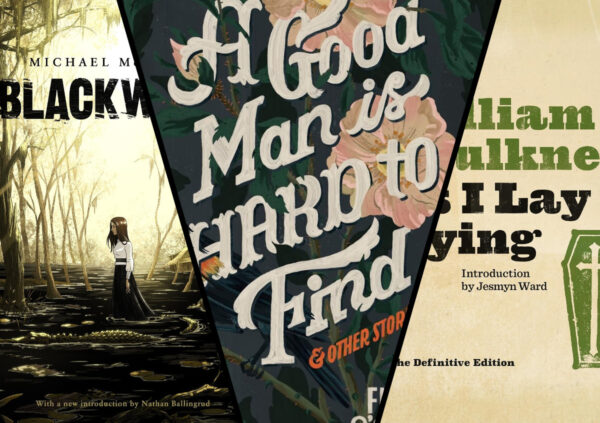
What makes this list different. Most southern gothic reading lists are built entirely from the literary canon and stop around 1970. That leaves out the best horror novelist the mode ever produced, and a whole branch of the tradition that has been running in paperback for fifty years. Both are here, and where the mode sits in the wider canon is mapped on the best horror books.
I haven’t read these. What follows is the critical consensus rather than my own verdict.
Fiction by René Rehn


The Canon
As I Lay Dying (1930)

The Bundren family carry their mother’s body across Mississippi in July to bury her in Jefferson, forty miles away, and the journey takes nine days.
That is the plot and it is enough. The coffin goes into a flooded river and comes out. The mules drown. Cash breaks his leg and they set it in cement, which does not work. Buzzards follow the wagon. By the end the smell precedes them into towns and people come out to object.
Faulkner tells it through fifteen narrators in fifty-nine short chapters, and none of them is reliable. Darl is the closest thing to a consciousness in the book and is committed to an asylum for it. Vardaman, who is small, produces the most famous chapter in American literature, which is five words long and concerns his mother and a fish.
What makes it Southern gothic rather than modernist experiment is what the family are actually doing. Anse wants new teeth. Dewey Dell wants an abortion. The funeral is a pretext, and everybody in the wagon knows it.
He wrote it in six weeks on night shifts at a power plant.
Sanctuary (1931)

Faulkner said he wrote it deliberately to make money, that it was a cheap idea concocted to sell, and it’s the nastiest thing he produced.
Temple Drake, a seventeen-year-old university student, ends up at a derelict plantation house used by bootleggers, and what happens to her there and afterwards in Memphis is the novel. Popeye is the man responsible, and he is impotent, physically slight, terrified of the dark, and the most purely evil figure in Faulkner.
The Southern gothic elements are all present and pushed further than anywhere else in his work: the decaying house, the corrupt legal system, the lynching, the brothel that functions as a family, and a community that closes ranks around a lie because the truth is more inconvenient.
The famous scene involves a corncob and the novel does not describe it, which is more effective than describing it would have been.
His publisher was appalled. Faulkner revised it substantially in proof at his own expense, and the original galleys have since been published separately as a different and colder book.
It was his first commercial success and paid for the ones that matter.
A Good Man Is Hard to Find (1955)

Ten stories, and O’Connor is the writer this whole tradition is measured against.
The title story is the one everybody reads. A family drive to Florida, the grandmother insists on a detour to see a house she remembers, the car goes off the road, and a man called The Misfit comes up the ditch with two others. The grandmother talks. She talks about Jesus and about being a good woman and about how she can tell he comes from nice people, and it does not help.
What makes O’Connor essential rather than merely dark is her theology, and it is genuinely alarming. She was a devout Catholic who believed grace arrives through violence, that people are only ever brought to God by being broken, and she wrote fiction on that principle without softening it. The Misfit’s line about the grandmother, that she would have been a good woman if somebody had been there to shoot her every minute of her life, is the collection’s thesis.
“Good Country People” and “A Circle in the Fire” are the other two to read first.
She had lupus, wrote most of this on crutches at her mother’s dairy farm, and died at thirty-nine.
Wise Blood (1952)

Hazel Motes gets off the train from the army with nothing but a violent conviction inside him, lands in a Tennessee city, and starts the Church Without Christ.
The doctrine fits in a sentence: no fall happened, so nothing needed redeeming, so there’s nothing to be saved from. He preaches it standing on the hood of his car outside movie houses, and his whole congregation amounts to a boy with a stolen gorilla suit, a preacher faking blindness, and a grifter who launches a competing church with a prophet on salary.
The novel is comic for long stretches and the comedy is the trap. Every character is grotesque and every one is treated seriously.
Then come the final thirty pages, as hard as anything in American fiction. What Hazel does to himself, first with quicklime, later with wire and with glass in his shoes, arrives without any framing of insanity. O’Connor holds that he has seen something true, and that this is what seeing it costs.
Her first novel, written over several years while she was already ill, and the purest statement of what she believed.
The Heart Is a Lonely Hunter (1940)

McCullers was twenty-three when it was published and she had written it at twenty-two, which remains difficult to accept while reading it.
A mill town in Georgia in the late thirties. John Singer is a deaf man whose only friend, also deaf, has been committed to an asylum. He takes a room in a boarding house and eats at the same café every day, and four people attach themselves to him: a teenage girl who wants to be a musician, a Black physician furious at his own community’s accommodation, a drunk labor organizer nobody will listen to, and the café’s owner.
Each of them talks to Singer for hours and believes he understands them perfectly. He does not. He is bored, lonely, and thinking about his friend the entire time.
That is the Southern gothic content and it is entirely psychological. No violence, no decaying mansion, no grotesque except the one everybody carries privately.
The Copeland material is the strongest and the most uncomfortable, and it was written by a white woman in Georgia in 1940.
The Ballad of the Sad Café (1951)

A hundred pages, and the strangest love story in American fiction.
Miss Amelia Evans is six foot two, runs a store and a still in a small Georgia town, and was married for ten days to Marvin Macy, who she threw out. Then a hunchbacked dwarf arrives claiming to be her cousin, and she takes him in, and dotes on him, and turns the store into a café because he likes company.
Then Marvin Macy comes back from the penitentiary, and Cousin Lymon falls in love with him.
It ends with a fistfight between Amelia and Macy in the café with the whole town watching, and McCullers stages it like a title bout.
Her thesis is stated directly in the middle of the story: that in any love there is a lover and a beloved, that they come from different countries, and that the beloved usually resents being loved because it exposes them. That paragraph is why the novella is taught.
The grotesque here is not decoration. Everybody in it is the wrong shape for what they want.
Other Voices, Other Rooms (1948)

Capote’s first novel, published when he was twenty-three, with an author photograph on the jacket that caused more comment than the book.
Joel Knox is thirteen. His mother is dead and he is sent to Skully’s Landing, a decaying plantation house in rural Alabama, to live with the father he has never met. His father is not there. What is there is a stepmother, a cousin called Randolph who wears makeup and does not leave the house, a servant, and a girl in the next farm who wants to be a boy.
The father, when Joel eventually finds him, is upstairs, paralyzed, able to communicate only by dropping red tennis balls down the staircase.
It is a coming-out novel written in 1948 and it never says so, and the Southern gothic apparatus is doing the work that plain statement could not: the house, the isolation, the family secret, the boy who cannot go back.
Capote called it a poetic explosion of suppressed emotion and later said he barely understood it while writing it. It is the most beautiful sentence-by-sentence book on this page.
Deliverance (1970)

Four Atlanta businessmen canoe a Georgia river before it is dammed and flooded, and two of them come back.
Dickey was a poet and it shows in the river writing, which is the best thing in the book. The rapids, the gorge, the cliff Ed climbs in the dark with a bow on his back, are rendered with a precision that has nothing to do with the plot.
The Southern gothic content is the confrontation between the men and the mountain people whose land is about to disappear under a lake, and the novel is genuinely uncomfortable about which side it is on. The famous scene is brief and Dickey does not linger, and what the book actually dwells on is the decision afterwards: whether to report it, and what a jury of local men would do with four Atlanta lawyers’ account of events.
Ed Gentry narrates and he is an advertising executive who discovers he is capable of things, and the horror is that he finds it clarifying.
Dickey wrote the screenplay and appears in the film as the sheriff. It was his first novel, at forty-seven.
The Horror Branch
This is the part other lists leave out, and it contains the best writer here.
The Elementals (1981)

Every summer the Savages and the McCrays decamp to Beldame, a sand spit off the Alabama Gulf where their two Victorians stand beside a third that answers to nobody, no road in, no telephone, no neighbors. The empty house is filling with sand: upper windows first, then the whole top floor, and by now it is taking the staircase.
The Southern gothic here is the family rather than the house. Two old Gulf Coast families, intermarried, holding property they cannot maintain, with money, servants and a set of arrangements nobody discusses, and a funeral at the start that establishes exactly how these people handle things.
The middle of the book belongs to Luker and his daughter India, thirteen, who swap profanity as equals across a gap no 1981 novel was writing between fathers and daughters, and the humor is real.
McDowell filed his own books under disposable. King’s line about the finest paperback-original writer in America was minted for him, with this novel as exhibit one.
Blackwater (1983)

McDowell’s masterpiece, and the most ambitious thing in southern gothic horror.
It arrived as six paperbacks, one per month across 1983, a serial run in the old Victorian style. The story runs from 1919 to the 1960s in Perdido, Alabama, following the wealthy Caskey family across four generations, and it begins when a flood recedes and a woman named Elinor Dammert is found in a hotel room on the second floor.
She marries into the family. She has a link to the river that nobody discusses. And the saga proceeds as a domestic family epic, in enormous and loving detail, with something patient and inhuman sitting at the center of it the entire time.
It was rescued from obscurity by Valancourt Books, reissued as a complete saga in 2017, and then found an enormous new readership in Europe after a French six-volume reissue in 2022. It is now the McDowell book people mean.
Cold Moon Over Babylon (1980)

McDowell’s second novel and the most straightforwardly frightening thing on this page.
A teenage girl is murdered in a small Florida town and her body goes into the river. Her killer is known to the reader almost immediately, which is the structural choice that shapes everything: this is not a mystery, it is a revenge story told from the point of view of somebody waiting to see how it will be taken.
The family are picked off one at a time. The deaths are inventive and McDowell stages them beautifully, and there is a sequence involving a body coming up out of the water that a great many readers report stopping for.
What makes it Southern gothic rather than a slasher is the town. Babylon is small, poor, dependent on one family’s money, and entirely unwilling to look at what the Redfield name protects. The banker is the horror before anything supernatural happens.
It is short, fast, and it demonstrates that McDowell could write a conventional genre novel superbly when he wanted to.
The Nightrunners (1987)

Lansdale’s second novel and the one that got him a reputation, and it sat unpublished for years because nobody would touch it.
A woman is raped by a gang of teenagers in a small East Texas town. Her attacker goes to prison and dies there. Months later, she and her husband go to a friend’s cabin in the woods to recover, and the dead boy’s friends come after her, driven by something that was riding him and is now riding them.
The supernatural rides in a black Chevrolet, and behind it stands the God of the Razor, Lansdale’s razor-toothed deity, kept almost entirely offstage, which is why it works.
What makes it Southern gothic is the specificity. Lansdale grew up in East Texas and writes the piney woods, the small towns, the diners and the poverty from inside, and his teenagers are recognizably the kind of boys who existed in those towns rather than horror-novel constructs.
It is genuinely brutal and it has a moral seriousness about the aftermath of assault that almost nothing else from 1987 does.
The Bottoms (2000)

Lansdale’s Edgar Award winner and the most conventionally literary thing he has written.
East Texas, 1933, during the Depression. Harry Collins is eleven. He and his sister find a body in the river bottoms, a Black woman, mutilated, tied to a tree. Their father is the local constable as well as a barber and a farmer, and he investigates, which nobody in the county wants him to do because the victim was Black and the sheriff has other priorities.
More bodies follow. The town decides a local Black man is responsible and forms accordingly.
What lifts it above a period thriller is that Lansdale is writing about a boy learning what the adults around him actually believe. The father is decent and the decency costs the family, and the novel is clear-eyed about how much courage was required and how little it achieved.
The Goat Man in the bottoms is the folklore element and Lansdale uses him exactly right.
It won the Edgar for Best Novel and is the best entry point to his work.
Boy’s Life (1991)

Zephyr, Alabama, 1964: twelve-year-old Cory rides the pre-dawn milk route with his father until the morning a car breaks from the woods ahead of them and slides into bottomless Saxon’s Lake, a beaten man cuffed to its wheel, wire at his throat.
The plot is almost beside the point. The book is a boy’s calendar year, bicycle and paper route, the town’s tame river monster and its festival, the four women out past the edge of things, a bully, a dog, one long summer, while a father quietly fails to stop seeing the drowned man’s face.
It is Southern gothic without the rot, which is why it belongs here rather than on a list of grotesques. McCammon keeps every piece of the apparatus, the secret-keeping town, the racial violence, the church, the river, and declines to turn cynical about a single one of them.
The Stoker and the World Fantasy rarely land on the same book. Here they did.
The Southern Book Club’s Guide to Slaying Vampires (2020)

Charleston, early nineties. A club of housewives meets to read true crime, the one genre that holds their attention.
Then James Harris moves into the neighborhood. His hours are odd, his charm is considerable, the husbands like him, and a few miles off, in a Black community the club’s social circle looks past, children begin dying.
The Southern content is the class machinery and Hendrix is precise about it. Garden parties, church, husbands with careers at the bank, wives who are expected to manage the household and nothing else. When Patricia raises what she has seen, the husbands close ranks, hers first, and the living-room scene where they settle her with a prescription is the worst thing in the book, no vampire required.
Very funny for a third of the novel, and then the rats arrive, and so do the pauses in people’s reading.
Hendrix has said the model was his mother’s book club. The dedication is to her.
The Modern
Contemporary Southern gothic, which has mostly turned to what the older canon left out.
Child of God (1973)

McCarthy’s third novel, a hundred and ninety pages, and the coldest thing on this page by a considerable distance.
Lester Ballard loses his family farm at auction in Sevier County, Tennessee, and moves into an abandoned cabin, then a cave. He is dispossessed, unwanted and increasingly alone, and the novel follows him downward through voyeurism into murder into necrophilia, keeping the bodies in the cave with him.
McCarthy narrates this without a single line of judgment, which is the whole method. The prose is beautiful, precise and entirely uninflected, and the title is doing the work: a child of God much like yourself perhaps, as the narration puts it early on.
Interleaved are short chapters of townspeople talking, which supply the county’s own account of Lester and make clear that everybody knew what he was becoming and nobody did anything.
It is genuinely difficult and it is not gratuitous. Nothing is dwelt on and nothing is staged for effect.
Based loosely on real events in Sevier County, and McCarthy did the research on the ground.
Bastard Out of Carolina (1992)

Ruth Anne Boatwright, called Bone, is born in Greenville County, South Carolina, to a fifteen-year-old mother, and her birth certificate is stamped illegitimate, which her family spends years trying to get changed.
Allison’s novel is Southern gothic with the grotesque removed and the poverty left in. The Boatwrights are a large, loud, hard-drinking, hard-fighting family who love each other and are held in contempt by the county, and Allison writes them with enormous affection and no romanticism whatsoever.
Then Anney marries Daddy Glen, and what he does to Bone across the novel is the reason it was a National Book Award finalist and the reason it is banned regularly.
The abuse is not sensationalized and it is not evaded, and the hardest material is not the violence but Anney’s choices, which the novel refuses to condemn or excuse.
It is largely autobiographical. Allison has said the difference between herself and Bone is that Bone got out earlier.
Her first novel, at forty-three, and one of the best American debuts of the nineties.
Serena (2008)

North Carolina, 1929. George Pemberton returns from Boston to his timber camp with a new wife, and is met at the station by the father of a girl he made pregnant. Serena watches her husband kill the man with a hunting knife on the platform, then walks over and gives the knife to the dead man’s daughter and tells her to sell it.
That is the first four pages.
Rash is writing about the destruction of the Appalachian forests and the fight over what became the Great Smoky Mountains National Park, and the Pembertons are logging as fast as they can before the government takes the land. The camp workers are maimed constantly, casually, in numbers, and Rash keeps a chorus of them commenting on events in the manner of a Greek play.
Serena herself is one of the great American villains: competent, unsentimental, better at the business than her husband, and entirely without a line she will not cross.
The Southern gothic here is extraction. The mountains are being stripped, the people are disposable, and the money leaves.
Sing, Unburied, Sing (2017)

Ward’s second National Book Award winner, and the ghost story on this page that is doing the most.
Jojo is thirteen and living in coastal Mississippi with his grandparents and his toddler sister, because his mother Leonie is an addict and his father Michael is in Parchman, the state penitentiary. Leonie drives the children north to collect Michael on his release, and the journey is the novel.
Two ghosts. Leonie sees her brother Given, killed years earlier by a white boy who served three years for it, but only when she is high. And Jojo picks up Richie, a twelve-year-old who died at Parchman decades ago when Jojo’s grandfather was imprisoned there, and who cannot leave until he understands what happened to him.
Parchman is what the whole novel is built to show. Ward uses it to connect convict leasing to the modern prison directly, across three generations of one family, and the ghosts are the mechanism for making that continuity literal rather than argued.
The scene where River finally tells Richie what happened is among the best things in recent American fiction.
Razorblade Tears (2021)

Ike Randolph and Buddy Lee Jefferson have two things in common. Both are ex-convicts trying to stay straight. And both had a gay son, married to the other’s, and both sons have been murdered, and neither father ever accepted them.
Cosby’s novel is a revenge thriller and it is on this page because it is doing what Southern gothic has always done, which is put a family secret and a community’s respectability in the same room and make somebody choose.
The two men are the reason it works. Ike is Black, runs a landscaping business, and has spent twenty years being careful. Buddy Lee is white, poor, drinks, and has spent twenty years not being careful at all. Their shame is identical and neither can say it, so they go looking for the killers instead, and Cosby is very good on the fact that the violence is easier than the conversation.
Virginia is rendered exactly: the trailers, the churches, the Confederate memorials, the money.
It won the Anthony and the Macavity and was a New York Times bestseller.
Where to Start
If you want the best single book, read A Good Man Is Hard to Find. Two hundred pages, ten stories, no weak ones.
If you want the novel, read As I Lay Dying or The Heart Is a Lonely Hunter, depending on whether you’d rather be impressed or moved.
If you’re here from horror rather than from literature, read The Elementals and then commit to Blackwater, which is the great undiscovered work of the whole tradition and is now finally in print.
And if you want to know that southern gothic is still being written rather than only studied, read Sing, Unburied, Sing.
For the wider tradition this grew out of, there’s a full guide to gothic fiction.
Everything else worth reading is on my best horror books list. The European original it mutated from is on my gothic fiction list.