Most lists of disturbing books are really lists of gross books, and those are not the same thing.
Gross is a stomach response. It’s loud, it’s immediate, and it’s gone by the following week. Disturbing is something else: it goes in somewhere less accessible, it doesn’t announce itself, and you find it again months later while doing something unrelated. A book can be extremely graphic and not disturbing at all. A book can contain almost no violence and follow you for years.

Which is why these disturbing books are not a list of extreme horror, and why they range well outside the genre. The books that actually do damage are scattered across literary fiction, crime, drama and horror, and what they have in common is not content. It’s that they’re right about something you’d rather they weren’t.
I’ve organized by what does the damage, because “how far can I go” is the wrong question and “what kind of thing gets to me” is the right one.
Several of these I’ve read. I’ve said which.
Fiction by René Rehn


Human Cruelty
The largest category and the hardest, because none of it requires anything supernatural.
The Girl Next Door (1989)

The most-cited disturbing book in English, and the case behind it is worse than the novel.
The real girl was Sylvia Likens, sixteen years old. Her parents followed carnival work, so in 1965 she and her younger sister went to board in Gertrude Baniszewski’s Indianapolis house at twenty dollars a week. Across three months, Baniszewski, her children, and neighborhood kids who dropped by to participate starved her, beat her, burned her, and branded her, and she died in that basement. In the prosecutor’s words, no worse crime had ever been committed in the state.
Ketchum relocated the events to New Jersey in 1958, renamed everyone, and beyond that invented almost nothing.
What makes the book function, and what makes it unbearable, is who tells it. Twelve-year-old David, decent in minor ways, watches without stopping any of it, and the novel takes his failure apart piece by piece: increments each a shade worse than the one before, the terror of exclusion from the group, a child’s reasoning that whatever an adult supervises must be allowed.
Take the warning seriously. If you have any doubt at all, the answer is no.
Blindness (1995)
1995 · translated by Giovanni Pontiero · 1997

A man goes blind at a traffic light, and it is not darkness he sees but a milky whiteness. Then his wife, his doctor, the doctor’s other patients, and eventually almost everybody. The government quarantines the first cases in a disused mental hospital, guarded by soldiers who will not come inside and who shoot anybody approaching the gate.
What follows in that building is the reason this is on the page. Saramago works through the practical consequences with total rigour: what happens to sanitation, to food distribution, to the dead, and then to the women, once a group with a gun takes control of the ward and sets its terms.
The doctor’s wife can see. She has pretended blindness to stay with her husband, and she is the only witness, and Saramago is unsparing about what that costs her.
The prose has no quotation marks, no names and few paragraph breaks, which takes about thirty pages to adjust to.
He won the Nobel three years later.
The Painted Bird (1965)

A small dark-haired boy is sent from a city to the countryside in Eastern Europe during the war, to be hidden, and his parents cannot be traced. He is taken for a Jew or a Gypsy by the peasants he passes among, and the novel is what they do to him across several years.
It is a sequence of episodes and each is worse. There is a miller with a spoon, there is a bottle, and there is a train. The title comes from a bird-catcher who paints a captured bird and releases it back to its flock, which then tears it apart for not being one of them.
The reason it is on this page rather than dismissed is the flatness. The boy narrates without appeal, without commentary and without any expectation that this is unusual, and Kosiński never once steps in.
It was presented as autobiographical and then extensively disputed. Investigations in the 1980s established that Kosiński’s own war was nothing like this, that his family were sheltered by Polish Catholics, and that the book is fiction. He killed himself in 1991.
Titus Andronicus (1594)

Shakespeare’s first tragedy, written around 1594 when he was in his twenties, and it is by a distance the most violent thing he produced.
A Roman general returns victorious with the Queen of the Goths and her sons as prisoners, and sacrifices her eldest to appease his own dead. Everything that follows is her answer.
The count is fourteen killings, six severed limbs, one rape, one live burial and one instance of cannibalism, most of it staged rather than reported. Lavinia is raped and has her hands cut off and her tongue cut out so she cannot name anybody, and she then spends most of the play onstage, mutilated and present, which is the most disturbing decision in it.
The final banquet is where it goes, and it goes there deliberately.
For two hundred years it was considered too crude to be his and was cut from editions. Peter Brook’s 1955 production with Olivier and Vivien Leigh made it respectable, and audiences fainted at it nightly.
Read it as the founding document of everything else on this page.
The Collector (1963)

Butterflies are what Frederick Clegg collects. A council clerk nobody notices, he has spent two years observing Miranda Grey, an art student he has never once addressed. A big pools win changes the arithmetic: a lonely Sussex property, a cellar beneath it, careful preparations, and then Miranda herself.
The disturbing quality is that his cruelty never registers as cruelty from inside. Gifts arrive, clothes, records, art books. Sex is neither asked nor wanted, and her one offer offends him. Ingratitude wounds him, and he explains the wound patiently, at length. On his page, this is devotion meeting bad luck.
Then the second half hands the same weeks to Miranda’s diary, which functions as an audit of everything his voice sold you.
Fowles taught school, published this first in 1963, and the whole captivity genre has been renting his equipment ever since.
Grief and Hopelessness
The books where nothing is inflicted by anyone and it’s worse.
Johnny Got His Gun (1938)

Joe Bonham wakes in a hospital bed and works out, slowly, across the first third of the novel, what has happened to him.
He has lost his arms, his legs, and his face, including his eyes, ears, nose, mouth and jaw. He is conscious, intelligent, and entirely intact mentally, and he cannot see, hear, speak, smell or move, and nobody in the hospital knows he is awake.
The disturbing content is the interior. Trumbo keeps you inside Joe’s head for the whole book while he tries to establish how much time has passed, using the vibration of footsteps and the changing warmth of the sun on his skin, and then works out how to communicate by tapping his head against the pillow in Morse.
What he asks for when they finally understand him is the last act, and the answer he gets is the reason the novel is on this list.
Trumbo published it in 1939, suppressed it himself during the war, and was later blacklisted. It became a rallying text during Vietnam. He filmed it himself in 1971.
A Little Life (2015)

Four friends leave a Massachusetts college for New York, and the novel gradually becomes entirely about one of them.
Jude St. Francis is a corporate litigator, brilliant, damaged, and physically in pain constantly, and Yanagihara discloses his history across seven hundred pages in fragments. What was done to him as a child, by a succession of adults, across more than a decade, is described directly rather than implied, and the disclosures keep arriving long after the reader assumes the worst is known.
The self-harm is also described directly, repeatedly, and in detail.
The disturbing quality is the structure rather than any single scene. The novel is designed so that every period of stability is followed by another revelation, and the accumulation is the effect, and there is no redemption arc anywhere in it.
It has been argued about more than any literary novel of the decade. Its defenders call it the truest thing written about surviving abuse. Its critics call it emotional pornography that tortures a character for effect.
Both readings are available and neither is stupid. Go in knowing that.
Beloved (1987)
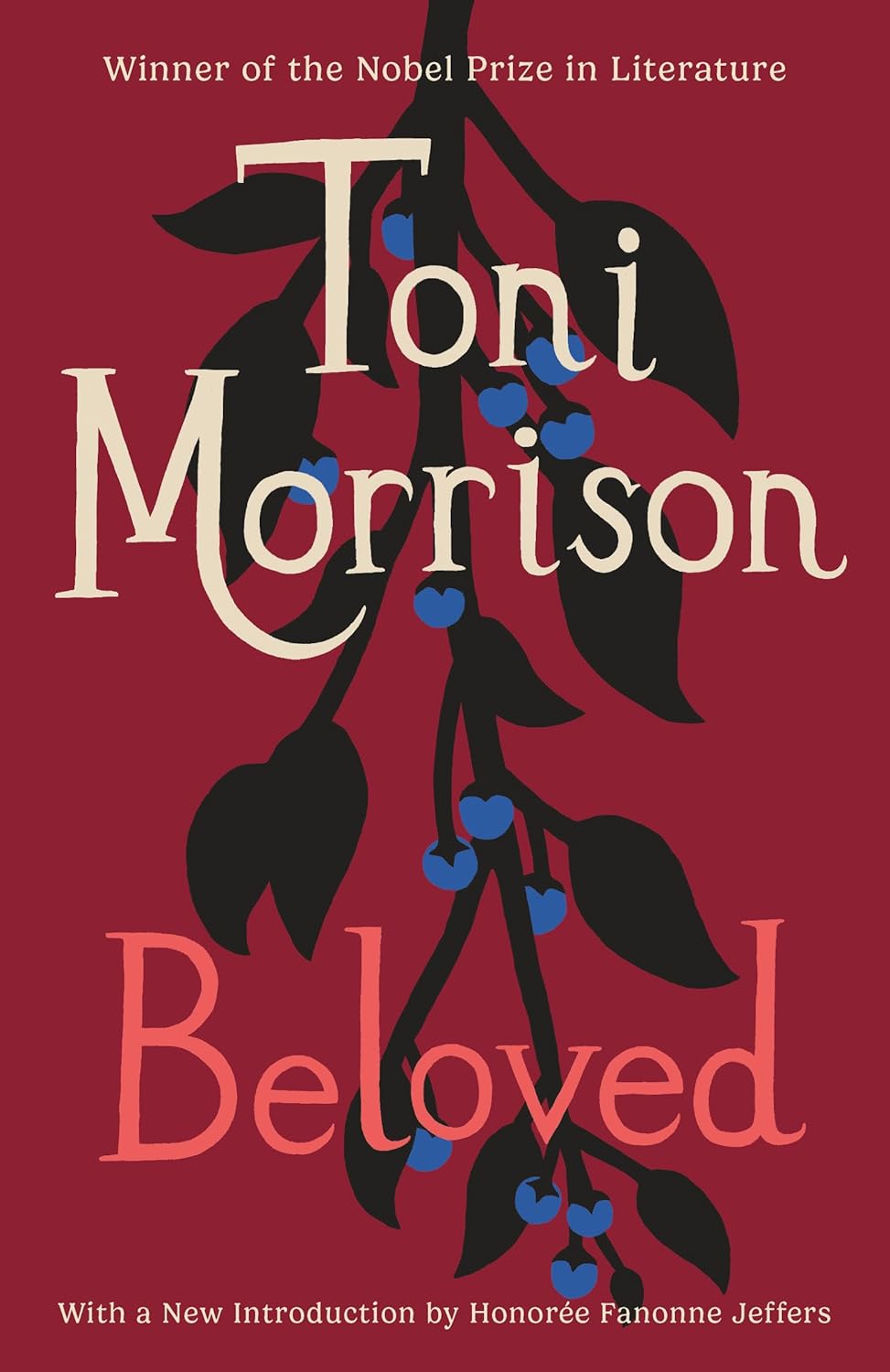
Bluestone Road, Ohio, 1873. Something furious occupies the house where Sethe and her daughter Denver live; her sons fled it years ago. Paul D, enslaved on the same farm they all escaped, turns up and expels the presence, and shortly after, out front on a stump, sits a young woman whose skin looks newly made, who offers no past, and whose name matches a headstone.
The disturbing content is what Sethe did in the woodshed when the slave catchers came, and Morrison withholds it for two hundred pages and then gives it plainly.
What outweighs any invented atrocity here is the source. Margaret Garner ran from Kentucky in 1856, was taken, and did what Sethe does, and Morrison built the scene from the press report without adding a line.
And the novel refuses resolution. Understanding arrives twinned, the what and the why landing together, and no arrangement of the two ever gets comfortable.
It won the Pulitzer, with Morrison’s Nobel following five years on.
The Road (2006)

A man and his son walk south through a country where everything is dead. The sun is obscured, nothing grows, there are no animals, and there will be no more food ever, only what is left in houses and cellars.
The disturbing content is not the violence, though there is some and it is bad. It is the arithmetic. McCarthy has constructed a world with no future in it at all, and the man knows this, and he is walking his son toward a coast that will be exactly the same as everywhere else because he cannot think of anything else to do.
The cellar is the sequence everyone cites, and it lands because a hundred pages of hunger have already been banked when the door opens.
The other thing is the revolver with two rounds, and then one, and what the man has been teaching the boy to do with it.
It won the Pulitzer. McCarthy said it came from a night in a Texas motel with his young son, looking out at the town and imagining it burning.
Requiem for a Dream (1978)

Four people in Brooklyn, one summer into autumn. Harry and his friend Tyrone are dealing heroin to build a stake. Marion, Harry’s girlfriend, wants to open a shop. And Sara, Harry’s mother, is invited onto a television show and starts taking diet pills to fit a red dress.
Selby’s structure is the horror. All four arcs run in parallel, all four are about wanting something reasonable, and all four end in the same chapter with each of them somewhere they cannot get back from. Sara’s is the worst, because hers is amphetamine prescribed by a doctor for weight loss, entirely legally, and nobody at any point does anything wrong.
The prose has no quotation marks, minimal punctuation, and slides between narration and interior voice without warning, which takes about twenty pages.
Selby was a merchant seaman who contracted tuberculosis, lost several ribs and a lung, and became addicted to the morphine he was given for it.
Aronofsky’s 1999 film is faithful and the book is worse.
The Quietly Wrong
The ones that never raise their voice, which is why they last.
We Have Always Lived in the Castle (1962)

At eighteen, Merricat Blackwood shares a house with her sister Constance and their invalid uncle Julian, and twice weekly she walks to the village for food and library books, collecting spit and stares on the way.
Six years back, arsenic in the sugar killed most of the Blackwoods at their own table. Constance stood trial and walked free. The cooking had been hers.
The disturbing content is the voice, bright, orderly and entirely reasonable while cataloguing a private security system: tokens buried along the boundary, words under prohibition, days that carry rules, all of it maintained rigorously and presented as plain good sense.
Jackson never steps outside her to signal any of it, and the reader works out what happened well before the novel says so, and then has to keep spending time with the person who did it and rather likes her.
Nothing supernatural occurs. The threat is a village, then a cousin with warm opinions about where the money should live, and what the village eventually does is the worst thing in the book.
More on the Shirley Jackson page.
The Vegetarian (2007)
2007 · translated by Deborah Smith · 2015

A dream Yeong-hye never fully relates makes her stop eating meat, and that’s the inciting incident in its entirety.
The disturbing content is everybody else’s response. Her husband finds it embarrassing and says so to the reader constantly, in the first section, which he narrates. Her father, who fought in Vietnam, pushes meat into her mouth before the assembled family at dinner, and answers her resistance with a blow. And finally, her brother-in-law develops a fixation on her body and puts what he does with it on film. Only her sister, narrating the third section, attempts understanding at all, and by then Yeong-hye is in a psychiatric hospital and the attempt comes far too late.
Han never gives Yeong-hye a section of her own. The novel is three accounts by people acting on her, which is the formal decision that makes it work and makes it unbearable.
No one, across three narrators and the whole novel, asks about the dream.
It took the International Booker in 2016; the Nobel came to Han in 2024.
The Elementals (1981)

It is the gentlest book on the page, which is why it sits in the beginner tier.
Every summer two families decamp to Beldame: three Victorian houses on an Alabama Gulf Coast spit, reachable by no road, connected to no telephone line. The families own two. Nobody has lived in the third within living memory, and sand owns it now, pouring in at the upper windows, advancing down the stairs.
What makes it unsettling rather than upsetting is the pace. For most of the book the sand just accumulates in the margins of a family’s mourning, unhurried and uncommented, until it isn’t.
The disturbing material, when it arrives, is a handful of images in the last fifty pages, and they are the kind that stay rather than the kind that assault.
Start here if the rest of this page has put you off. Nothing in it is gratuitous and the prose is genuinely good.
More on southern gothic.
Come Closer (2003)

Amanda has a good job in architecture, a husband she likes, and a new apartment, and then a tapping starts that only she can hear.
A memo she has no memory of writing reaches her boss. A cigarette finds her sleeping husband’s skin. The drinks multiply, then a stranger from a bar, and every incident comes with a plausible explanation that Amanda drafts for herself.
The disturbing part is the enjoyment. Permission is what the visitor deals in, permission for appetites already present, and Gran splits authorship of the wreckage between them rather than filing Amanda as victim.
The possession checklist she finds in a paperback gets ticked item by item, and the book declines to grade the quiz.
A hundred and seventy fast pages that serious horror readers hand each other like contraband.
More on possession books.
The Fifth Child (1988)

In the sixties, Harriet and David wed with a plan: many children, a big house. Four arrive inside six years. Their old-fashionedness is a deliberate stance, out of step with the decade, and each holiday packs the house with relatives.
Then comes Ben, who announces himself before birth, kicking bruises into her from inside, so that Harriet rides the pregnancy on sedatives. What arrives is oversized, hostile, and wrong in a register no doctor will commit to naming.
What disturbs is the family’s collective choice. Without discussion it becomes settled that Ben must go, a place is found for him, and when Harriet visits and sees what 1988 institutions actually were, she takes him back, at a price that consumes the marriage, the siblings, and the household itself.
No diagnosis appears, and no supernatural account either; Lessing leaves the reader standing precisely where the family stands.
There are no villains on offer, only accomplices, and Lessing’s hundred and thirty pages extend clemency to no one, Harriet included.
The Body
Where horror does its own version, and where I’ve actually read most of it.
Tender Is the Flesh (2020)
2017 · translated by Sarah Moses · 2020

I’ve read this one, and what makes it disturbing is not the premise but where it puts you.
Marcos is decent. He is grieving a dead infant, caring for a father with dementia, tolerating a marriage that has stopped, and he is competent and tired and reasonable throughout. You spend the book agreeing with him about small things. That is the trap, and the last section closes it, and the closing is what people actually mean when they say this book stayed with them.
My one complaint is how long the argument loiters in plain view before the ending cashes it. More on the Agustina Bazterrica page.
The Troop (2014)

I read this one and loved it, and it sits in the beginner tier here for a reason: it is relentless without being obscene.
The unpleasantness is physical and it does not let up. Cutter is specific about hunger, about what a body does when something inside it is eating faster than it can feed, and he stays on it for chapters at a time. There is no single shock image to brace for and get past. It is a sustained condition.
For what it’s worth, I came to it from a list of disturbing books where it sat in the beginner tier, and that placement is fair. It’s grim rather than punishing. More on the Nick Cutter page.
Survivor Type (1985)

I’ve read this one, and King’s own printed verdict, that it may have gone past where he should have stopped, is on the record.
Struck-off surgeon Richard Pine goes into the Pacific with a sinking ship and comes ashore on bare rock with two kilos of smuggled heroin and nothing edible. He keeps a diary.
The disturbing content is the arithmetic, on the page’s only entry where the cannibalism is autophagy. He is a surgeon. He has the training, he has the anesthetic, and the rock has nothing else on it.
The diary is what makes it unbearable rather than merely nasty. The entries open in a competent professional register and thin exactly as he does, down to a final page of repeated words, prose as case history.
It is in Skeleton Crew, it runs to about twenty pages, and it is one of very few short stories that regularly appears on lists like this one.
Haunted (2005)
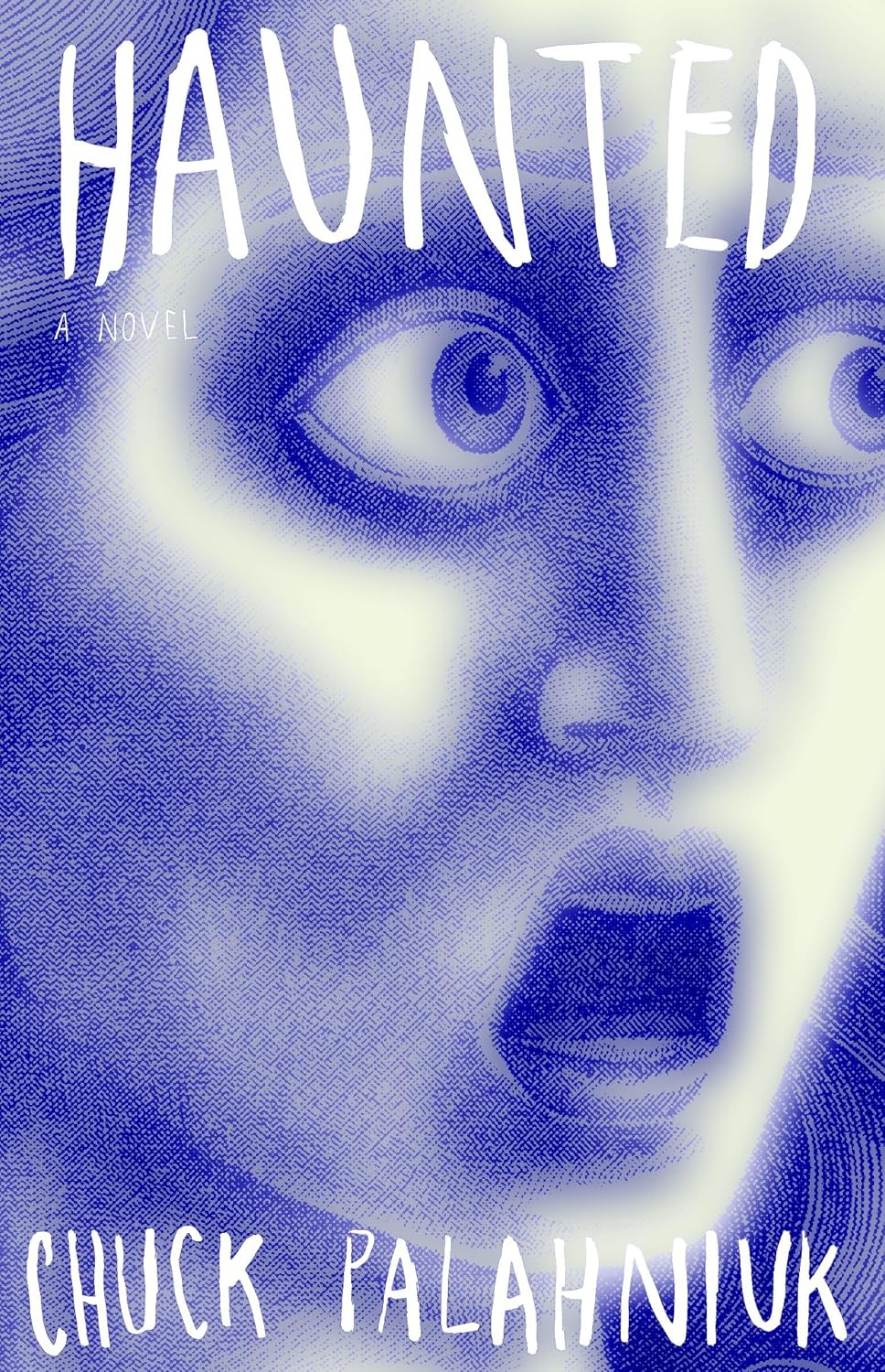
Seventeen writers take a sealed-doors residency to produce their masterpieces and discover within days that suffering is the product. So they set about manufacturing it, starving the larder, killing the heat, editing each other with violence, while the twenty-three stories they recite thread through the wreck.
“Guts” is the famous four pages, and Palahniuk’s tour readings dropped listeners in the aisles, seventy or so by his own count.
My verdict stands here as on the body horror page: front-loaded, with a back half that mistakes unpleasantness for escalation. The opening third is why it makes this list, and “Guts” runs free online if that is all you came for.
More on the Chuck Palahniuk page.
What isn’t here, and why
Most extreme horror. The small-press extreme scene produces a great deal of very graphic fiction and most of it is gross rather than disturbing, which is the distinction this page is built on. Some of it is genuinely good and it has its own guide at extreme horror. What I won’t do is pad this list with books whose only claim is a body count.
Sade. The 120 Days of Sodom is on every list like this and it isn’t on mine. It is a catalog of atrocity including extensive child abuse, and the philosophy it’s occasionally defended with is thin cover for what the book actually is. You can read about it.
Anything I’d only be listing to prove I’d read it. There’s a version of a disturbing books list that’s a competitive sport, and it produces recommendations nobody benefits from.
Where to Start
If you want to know whether this kind of thing is for you, start with The Troop or Tender Is the Flesh. Both are grim and neither will damage you.
If you want the genuinely great books, read Blindness and Beloved.
If you want the one that gets in quietly and stays, read The Elementals or Johnny Got His Gun.
And if you’re set on the hardest thing here, it’s The Girl Next Door, and I’d ask you to read the warning above first.
My best horror books list ranks the rest of the genre. Shirley Jackson did this without any gore at all, which is the harder trick.