Chuck Palahniuk is not a horror writer, which is awkward, because he wrote one of the most notorious pieces of short horror fiction of the last thirty years and a novel that people hand each other specifically to disturb them.
The category problem is real and worth stating up front. He’s a transgressive novelist. His subject is men and women hollowed out by consumer culture, support groups, corporate work and their own bodies, and his method is the short declarative sentence, the repeated refrain, the fact dropped in from a manual or a textbook. Horror is something several of his books arrive at rather than something he sets out to write. But three or four of them land squarely in the genre, one of his short stories has made people faint in public, and if you came to Chuck Palahniuk from horror rather than from Fight Club, you were probably sent by someone who wanted to see your face afterwards. horror books
So this is a guide for horror readers specifically. Which of his books are actually horror, which are worth your time, and what you’re in for.
Fiction by René Rehn


The Short Version
The Chuck Palahniuk books split between the satires that made his name and a handful of things that are straightforwardly horror, and most readers arrive for the wrong one.
Read Haunted if you want the horror. It’s the one with “Guts” in it, it’s a collection wrapped in a frame narrative, and it’s the Palahniuk book that belongs on a horror shelf without an argument.
Read Fight Club if you’ve seen the film and assume you know the story. You don’t. The ending is different in a way that changes what the book is about.
Everything else is optional, and the honest answer for most horror readers is that two books is enough.
The Essentials
Haunted (2005)
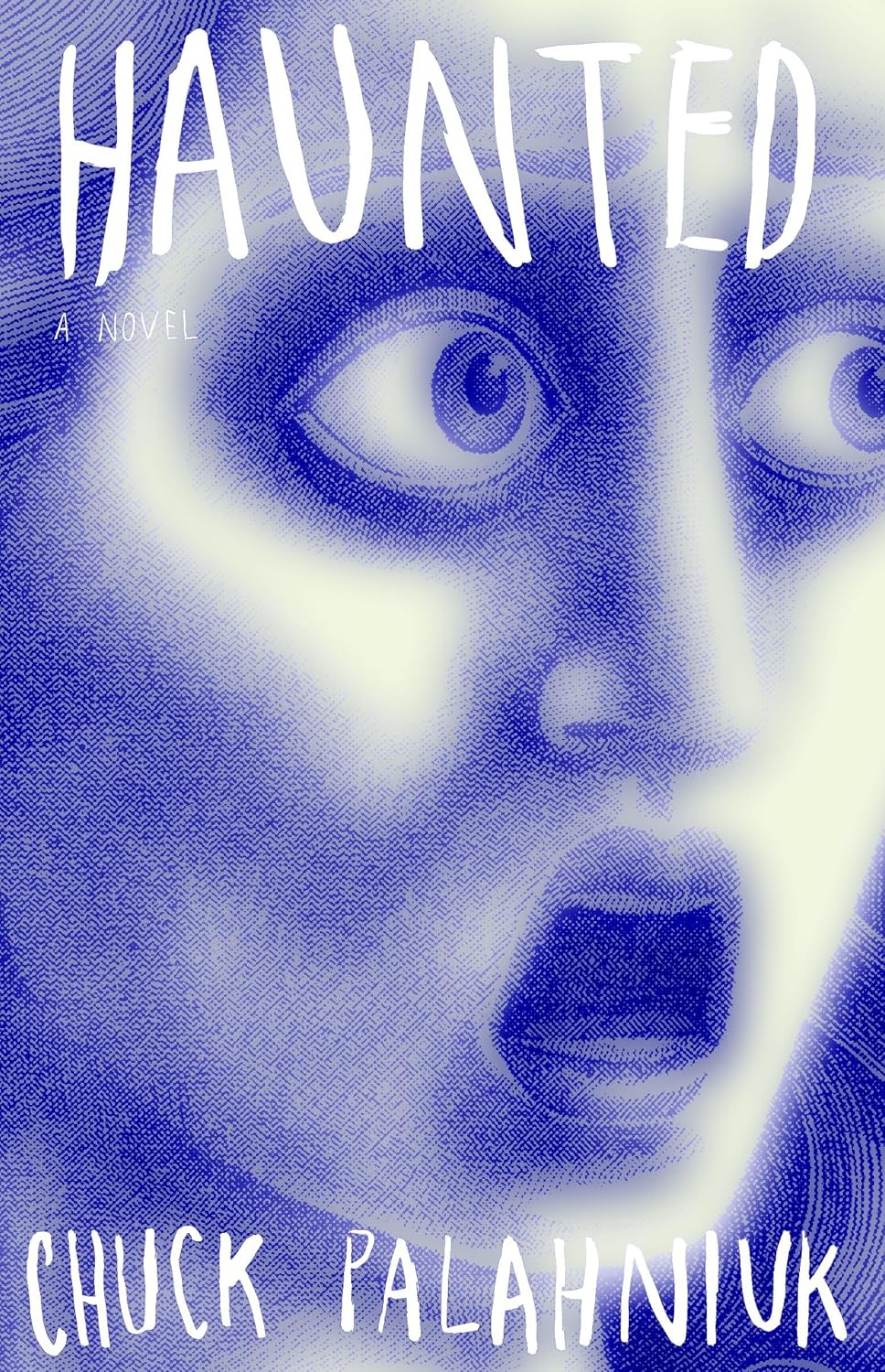
A short story collection wrapped in a framework narrative, and the most disturbing thing he’s written.
The frame: a group of would-be writers answer an advertisement for a three-month retreat, are sealed into a derelict theater, and set about sabotaging their own conditions so that the story of their suffering will be worth more when they get out. They destroy the food, the heat, and eventually each other. Between chapters, each of them tells a story.
Story quality varies enormously, and any honest guide has to say so. “Exodus” is the best thing in the book. “Guts” is the one everybody knows. “Punch Drunk” and “Swan Song” are among the weakest, and there are stretches where you can feel the collection padding itself out to reach a shape.
Then there’s the structural problem, which is the real criticism. The frame narrative escalates. The retreat gets worse, the self-mutilation gets more extreme, the writers get more grotesque. And as it escalates, you stop being fazed by it. The same thing happens to the stories: they begin to resemble each other closely enough that you can see the endings coming, and the shock, which is the whole engine, stops firing. Most of the book is disturbing for the sake of being disturbing, and by the last third that’s an exhausted position rather than a provocative one.
The verdict holds anyway. It’s an interesting read, and it’s still the right recommendation for someone who wants a book that will genuinely disturb them and stay lodged afterwards. Just know that it’s front-loaded.
A note on my own reading of it, since it’s relevant: I started this years ago, got as far as “The Nightmare Box”, put it down, and only finished it this year. That gap is not a coincidence. It’s a book that asks a lot and doesn’t always pay it back in the moment.
About “Guts”. It’s the story Chuck Palahniuk read aloud on tour, and people fainted. He kept count and put the number in the seventies. It’s a swimming pool story, it’s about four thousand words, and describing it further spoils the only thing it does. It works. It is also exactly the kind of thing the rest of the book keeps trying and failing to repeat.
Fight Club (1996)

The film is one of my favorite films, which makes this a compromised review and I’d rather say so than pretend otherwise. Fincher’s version is so complete, and so much better known, that reading the novel is partly an exercise in noticing what he changed.
He changed a lot, and the two most important changes both concern Tyler.
In the novel, Tyler is a killer. He blows up the narrator’s boss. He shoots Patrick Madden, the mayor’s son, dead at a hotel murder-mystery party, because Madden had been compiling a list of the fight clubs. That entire storyline is cut from the film. The film’s Tyler kills nobody, which is precisely why he stays charming and seductive and why audiences quote him. Fincher wanted you to like Tyler and not to miss him once he was gone, and cutting the murders is how you get there.
And the ending is better in the book, by a distance. The film blows up the skyline. The narrator, holding Marla’s hand, has effectively won: Project Mayhem succeeds, the credit records burn, the buildings come down.
In the novel the bomb does not go off. It fails. Tyler’s largest gesture, the culmination of everything, is impotent, and in a book preoccupied from page one with masculinity and emasculation, that is the sharpest possible refutation of the whole project. The narrator shoots himself in front of Marla, survives, and ends in a psychiatric hospital, believing he’s dead and in heaven, dreading the staff who keep sending him messages because they’re waiting for Tyler to come back.
In the film he wins. In the book he and Project Mayhem both lose. That’s not a small adjustment, and it means the two versions are arguing opposite things.
So: a middling verdict with the film sitting on the scale, and a book whose ending I’d defend against the film’s without hesitation. Horror readers should know it isn’t horror. It’s transgressive fiction with a violent center, and it’s here because it’s the door most people come through.
The Horror-Adjacent Novels
The Chuck Palahniuk books that a horror reader would recognize as horror, which is a smaller set than his reputation suggests.
Three of them do horror properly rather than adjacently, and they are the reason a horror reader should be on this page at all.
Palahniuk’s usual mode is transgressive satire with a violent premise, which is not the same thing. Fight Club has no supernatural element and is about masculinity and consumer culture. Choke is a con-man comedy. Survivor is about manufactured religion.
But Lullaby, Diary and The Invention of Sound are constructed as horror novels, with a supernatural or quasi-supernatural mechanism, an escalation, and a horror ending, and they are the three below.
The distinction matters because readers arrive at Palahniuk from Fight Club expecting one thing and from Haunted expecting another, and the catalog does not reward either expectation consistently.
If the horror is what you want, read the three in this section and then Haunted for the short fiction.
Lullaby (2002)

A journalist investigating sudden infant death syndrome finds the same book open at the same page in five houses where a child has died, and the page has an African culling song on it.
The song kills anybody it is directed at. It does not have to be spoken aloud. Once you know it, thinking it at somebody is enough, and forgetting it is not possible.
That premise is the best idea Palahniuk has had and the book is about the practical consequences. Carl Streator memorizes it by accident and immediately starts killing people who irritate him, in traffic, in restaurants, on airplanes, and he cannot stop doing it because irritation is involuntary.
He then teams up with a realtor who sells haunted houses repeatedly, and the road trip that follows is about destroying every remaining copy.
The running critique of noise pollution is where the satire sits, and it’s the weakest element.
It is his most genuinely horror novel and the one to start with.
Diary (2003)

Misty Wilmot is a hotel maid on Waytansea Island, a wealthy resort community off the New England coast, married to a contractor who has attempted suicide and is in a coma.
Her husband had been renovating houses for summer people and walling off rooms, and the owners keep coming to complain, and when the walls are opened there are messages written inside them in his handwriting, threatening the summer residents.
The novel is Misty’s diary, addressed to her comatose husband, and Palahniuk uses that second person throughout.
What the island wants from her is the plot and it involves her painting, which she stopped doing years ago and is being encouraged back into, and a pattern that has repeated every four generations.
The art-historical material about painters who went blind or mad producing their best work is real and Palahniuk uses it well.
It is his most conventionally gothic book and the closest he came to writing a haunted place rather than a haunted person.
The Invention of Sound (2020)

The other book here that’s straightforwardly horror, and the one most likely to actually get to you.
Mitzi Ives is a Foley artist who makes the screams Hollywood uses, working from her father’s methods, which is to say she sources them from people in genuine agony. Running alongside her is Gates Foster, an investigator hunting child abusers, who has spent seventeen years looking for his abducted daughter. The two lines converge on the question of who recorded Lucinda.
The central conceit is very good. Mitzi captures a scream so perfect that anyone who hears it is compelled to reproduce it, which turns a cinema into a casualty event. Reviewers generally read the book as a return to form after a weak stretch, closer to Choke and Haunted than to what came immediately before.
It is also brutal, and the child-abuse material is central rather than incidental. That’s a condition on the recommendation rather than a reason to leave it off.
Other Standouts
Survivor (1999)

Tender Branson is the last surviving member of the Creedish Death Cult, dictating his life into the flight recorder of a hijacked airliner he has emptied of passengers and is flying until the fuel runs out.
The novel is paginated backwards. It opens at chapter forty-seven, page two hundred and eighty-nine, and counts down to chapter one, page one, as the fuel gauge drops.
That is the best formal joke in his catalog and it is not just a joke, because the countdown creates real tension in a book that is otherwise a monologue.
The Creedish were a Waco-style sect who trained members as domestic servants and sent them out into the world with instructions to kill themselves when the church was raided. Tender was one of the servants. A media industry has since grown up around the survivors and he has been turned into a televangelist.
It is his sharpest satire, and Palahniuk has said the aviation material made it unpublishable in paperback for years after 2001.
Invisible Monsters (1999)

A former fashion model loses her lower jaw in a shooting on a freeway and cannot speak, and the novel is her account, written on notes, of the road trip that follows.
Her companion is Brandy Alexander, a transgender woman awaiting the final surgery, who renames her constantly and steals prescription drugs from open houses, and who is not who she says she is.
The prose instruction is the device. Every chapter opens with a photography direction, jump to a flashback, give me pity, flash, and the whole book is structured as a fashion shoot with the reader as the camera.
It is also non-linear on purpose and Palahniuk later published Invisible Monsters Remix, which reorders the chapters into the sequence he originally wanted and adds new material, with instructions telling you which chapter to jump to.
The original was rejected as too disturbing before Fight Club sold, and published afterwards.
It is his funniest book and the identity material has aged unevenly.
Choke (2001)

Victor Mancini is a medical school dropout who works as an Irish indentured servant at a colonial theme park and pays for his mother’s care home by deliberately choking in expensive restaurants.
The scheme is worked out properly. Whoever saves him feels permanently responsible for him afterwards, sends cards, and sends money, and he has a filing system with hundreds of names in it.
His mother has dementia and does not recognize him, so he impersonates her old associates in order to get answers about who his father was, and the answer she gives him involves a stolen relic and a claim about his conception that he half believes.
The sexual compulsion material is the other half and it is written as addiction rather than as comedy.
It was his third bestseller and the one that established he was not a one-book writer.
Filmed in 2008 with Sam Rockwell, which is the most watchable of the adaptations and much gentler.
Rant (2007)

An oral history, assembled from interviews with people who knew Buster Casey, called Rant, who died in a car crash and who may have started a rabies epidemic.
The form carries it, the same one Brooks used in World War Z, published a year earlier, arrived at independently. Dozens of voices, no narrator, and every account partial and self-serving.
Rant grew up in a rural town deliberately getting himself bitten by every venomous thing he could find, then moved to a city with a nighttime curfew for a social underclass, where the entertainment is Party Crashing, which is organized car collisions with rules.
Then the novel becomes about time travel, and the mechanism involves the epidemic, and readers divide entirely on whether the last third earns it.
It is his most ambitious book and his most divisive, and the world-building is more thorough than anything else he has done.
Two sequels were planned as a trilogy and never appeared.
The Rest of the Chuck Palahniuk Books
He has published over twenty books and the quality is uneven in a way worth stating.
Damned (2011) and Doomed (2013) follow a thirteen-year-old girl in Hell, narrated in a Judy Blume pastiche, and the joke does not sustain two novels.
Beautiful You (2014) is a satire about a sex toy that ends civilization and it is his weakest.
Adjustment Day (2018) is a political novel about an American collapse into ethnostates, and it is savage and messy and the most uncomfortable thing he has written.
Fugitives and Refugees (2003) is non-fiction, a walking guide to the strange side of Portland, and it is genuinely charming.
Consider This (2020) is his book on craft, and nothing he has published in a decade is more useful. The chapter on submerging the I, and the argument against thought verbs, has changed how a lot of people write.
Not Forever, But For Now (2023) and Shock Induction (2024) are the most recent novels.
Where the Chuck Palahniuk books actually sit for a horror reader
He belongs on the transgressive shelf rather than the horror one, next to Bret Easton Ellis, and his real relevance to horror is the technique rather than the subject. splatterpunk
The short declarative sentence, the chorus line repeated until it becomes menacing, the clinical fact inserted at the exact wrong moment: that’s a delivery system for disgust, and a generation of extreme horror writers took it. When you read modern small-press extreme horror and notice how much of it sounds like a manual with the horror smuggled into the specifications, this is one of the places that came from. disturbing books
The other thing worth saying is that “Guts” did something no book had managed in years. It made people physically pass out, in rooms, repeatedly, in public. Whatever you think of the rest of the catalog, that’s a real achievement in a genre that mostly aspires to it.
Where to Start
Start with Haunted. It’s the horror one, and the first third is as good as he gets.
If you’ve seen the film, read Fight Club for the last forty pages, which are a different book from the one you think you know.
If you want the third, take Lullaby on the consensus, or Diary on the strength of that premise. The Invention of Sound is the other genuine horror novel, and the one most likely to actually get to you.
And if you bounce off him, that’s a legitimate outcome. Chuck Palahniuk is a writer people either take completely or find unbearable, and the middle ground is thinly populated for a reason.
The canon it belongs to is on my horror classics page. Where Haunted sits among the genuinely upsetting is on my disturbing books list.