Dark academia is the newest name for a very old idea, which is that a place devoted to knowledge is an excellent place to hide a crime.
The aesthetic arrived on the internet around 2020 and brought a great deal of tweed with it. The books came first, by about two hundred years, and the good ones have almost nothing in common with the moodboards. What they share is a setting that isolates a small group of clever people, a body of learning that turns out to be dangerous, and a narrator who was there and is telling you about it afterwards, badly.
The problem with most dark academia lists is that they were assembled from the aesthetic rather than from the books. A huge share of what now carries the label is romance in a cardigan: campus love triangles, YA boarding schools, and fantasy series where the magic university exists mainly to supply a brooding love interest. That’s a real and popular thing and it isn’t this.
So this list is built the other way round. Novels that would have been considered serious before the tag existed, plus the small number of modern books that earn a place on the same terms. No romantasy, no YA, and nothing that’s here because the cover has candles on it.
I haven’t read these. What follows is the critical consensus rather than my own verdict.
Fiction by René Rehn


Before the Name Existed
The Name of the Rose (1980)

A Benedictine abbey in northern Italy in 1327, seven days, seven deaths, and a library nobody is allowed into.
William of Baskerville arrives to arbitrate a theological dispute about whether Christ owned his clothes, which sounds absurd and was a genuine political crisis with the Inquisition attached. Monks start dying, and William investigates with his novice Adso narrating, and the murders lead to the library: a labyrinth built to be impassable, holding books the abbey has decided nobody should read.
The dark academia content is the argument at the center. Jorge, the blind librarian, believes certain knowledge is dangerous and that suppressing it is an act of care, and the novel takes that position seriously enough to make him formidable rather than a crank.
Eco was a semiotician and the book is stuffed with material he did not simplify: Latin, scholastic philosophy, a hundred pages on Franciscan poverty. He said he wrote the first hundred pages as a penance, to filter out readers who wanted a thriller.
It sold fifty million copies anyway.
Brideshead Revisited (1945)

Not horror, not a thriller, and the book that supplies the aesthetic almost everything on this page is borrowing.
Charles Ryder arrives at Oxford in the 1920s, meets Sebastian Flyte carrying a teddy bear, and is absorbed into a family, a house and a religion he does not belong to. The first section, the summer at Brideshead, is the source image for the entire dark academia mood: the quadrangles, the plovers’ eggs, the drinking, the sense of having been admitted somewhere you cannot afford to leave.
What the aesthetic borrowers usually drop is the second half, which is about what happens to those people afterwards. Sebastian becomes an alcoholic in Morocco. Charles marries badly and stops painting. The house is requisitioned by the army and wrecked.
Waugh was writing in 1944 about a world he thought had ended, and the nostalgia is deliberately poisoned. He later said the book was suffused with a gluttony for food and wine that came from wartime rationing.
Read it for the Oxford chapters and stay for the reckoning.
Hangsaman (1951)

Jackson’s second novel, and the direct ancestor of every campus novel on this page.
Natalie Waite is seventeen and leaves home for a small women’s college. Her father is a minor writer who has trained her to think of herself as exceptional, and the novel opens with a garden party at which something happens to her that Jackson describes obliquely and never returns to.
At college she cannot make friends. She invents an interior world, attaches herself to a young faculty wife, and eventually to a girl called Tony who may or may not exist.
Everything the genre now does with the isolated brilliant student and the seductive coterie is here in 1951, and Jackson does it without a murder and without a secret society. The horror is that Natalie is alone and has been taught to interpret that as distinction.
It was partly drawn from the disappearance of Paula Jean Welden, a Bennington student who walked into the woods in 1946 and was never found. Jackson lived in Bennington.
The least read of her novels and the most quietly devastating.
A Separate Peace (1959)

A boarding school novel from 1959 that has been taught to American teenagers ever since, and it belongs here because it is the cleanest example of what this genre is actually about.
Gene and Finny are roommates at Devon, a New England prep school, in the summer of 1942. Finny is a natural athlete, effortlessly liked, and incapable of malice. Gene is the better student and is quietly certain that Finny is sabotaging him, which he is not.
They build a habit of jumping from a tree into the river. One afternoon Gene jounces the branch.
The rest of the novel is the consequence and Gene’s attempt to account for what he did, and Knowles never lets him arrive at a clean answer. The war is coming for all of them and the school is a temporary arrangement that everybody knows will end.
What makes it dark academia rather than a school story is the setting doing moral work: an enclosed, privileged, beautiful place where a boy discovers what he is capable of and cannot unlearn it.
Pale Fire (1962)

A thousand-line poem by a dead American poet, followed by a commentary from his neighbor, and the commentary is the novel.
Charles Kinbote has annotated John Shade’s last poem, and his notes have almost nothing to do with it. He believes the poem secretly encodes the story of Charles the Beloved, exiled king of a country called Zembla, and that he himself is that king, and he keeps steering every line back to it. Shade’s actual subject is his daughter’s suicide.
You can read it in any order and Nabokov invites you to, which is the joke and the structure.
It belongs on this page because Kinbote is the academic as horror: a man with an institutional position, a colleague’s manuscript in his possession, and a monomania he is using scholarship to launder. Every apparatus of legitimate criticism is present and all of it is in service of a delusion.
Whether Zembla exists, whether Kinbote is a Russian émigré professor called Botkin, and who actually shot Shade are still argued about.
The funniest novel on this page and the cruellest.
Possession (1990)

Byatt’s Booker winner, and the novel that made literary research feel like a thriller.
Roland Michell, an underemployed postdoctoral scholar, finds two draft letters in a library copy of a book owned by the Victorian poet Randolph Ash. They are to a woman who is not his wife. Roland steals them.
What follows is an academic chase: Roland and a Christabel LaMotte specialist named Maud Bailey tracking a hidden affair through archives, private collections and a Yorkshire hotel register, pursued by a wealthy American collector and a rival scholar with better funding.
Byatt writes the entire Victorian corpus herself. Ash’s poems, LaMotte’s poems, their letters, a fairy tale, a diary, every word invented and every word convincing, and that feat is what took the prize.
The dark academia content is the contrast between the two periods: the Victorians had passion and no vocabulary for it, and the modern academics have the vocabulary and are too damaged to use it.
It is long, it is demanding, and the interpolated poetry is where readers stall. Skim it on a first pass if you must.
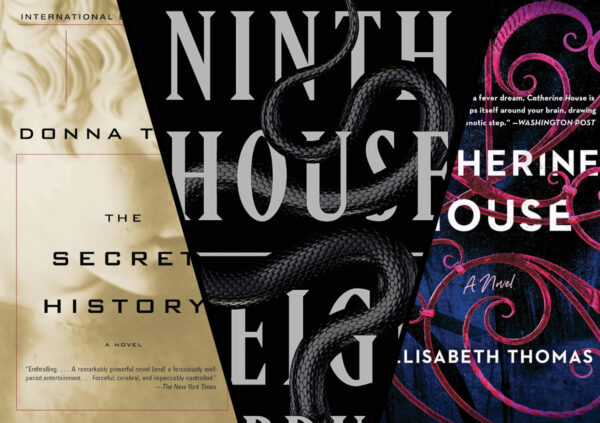
The Secret History (1992)

Donna Tartt’s first novel is the book this entire category is organized around, and it earns that position.
A group of six students at a small Vermont college study Ancient Greek with a tutor who teaches them privately and admits no outsiders. The novel opens by telling you that they killed one of their own and that his body was not found for some time. Everything after that is how they got there.
What makes it work is that it isn’t a mystery. You know who died and who did it from page one. The suspense is entirely about whether they’ll be caught and what it costs them, and Tartt spends four hundred pages on the aftermath rather than the act.
And the aesthetic is a trap. The book is frequently read as a romantic vision of beautiful young people in tweed reading Euripides, and it is scathing about exactly that. Richard, the narrator, lies about his background to belong, and the group’s pursuit of the sublime is presented plainly as vanity dressed as scholarship. It is not on their side.
Written when Tartt was in her twenties. She has published two novels since in thirty years.
After the Secret History
Never Let Me Go (2005)

Hailsham is an English boarding school with excellent grounds, dedicated teachers, and an unusual emphasis on art. The students produce work constantly and the best of it is taken away for a collection nobody has seen.
Kathy H narrates from thirty-one, looking back, and Ishiguro’s method is to let her tell you what her life was for in the same tone she uses for everything else, so the reader assembles it several chapters before she says it plainly.
The dark academia content is the school itself and what it is for. Hailsham is genuinely kind. The guardians care about the children. The art program exists for a reason that is, in its own terms, humane. And none of that changes the arrangement it was built to serve.
What the novel is finally about is that nobody rebels. There is no escape attempt, no uprising, and the one hope the students pursue turns out never to have existed.
It is the saddest book on this page and the quietest, and the horror is entirely institutional.
Special Topics in Calamity Physics (2006)

Blue van Meer has spent her adolescence moving between American college towns with her father, a charismatic political science professor who takes a one-year post, acquires a girlfriend he calls a June Bug, and moves on.
In her final year they settle at St. Gallway in North Carolina, and Blue is adopted by the Bluebloods, five students orbiting a film teacher called Hannah Schneider, who is glamorous, secretive, and holds Sunday dinners for them.
Then Hannah is found hanged in the woods on a camping trip.
Pessl narrates the whole thing through Blue, who has been raised entirely on her father’s reading list and cites a source for everything, so the novel is footnoted throughout with invented books. The chapters are named after works of literature and there is a final exam.
That could be unbearable and it mostly is not, because Blue’s erudition is a defense mechanism and the novel knows it.
It is long, the apparatus divides readers sharply, and the last hundred pages reframe the whole thing.
The Historian (2005)

A teenage girl finds a book in her father’s library, blank except for a woodcut of a dragon, and a packet of letters addressed to my dear and unfortunate successor.
Kostova’s novel is dark academia in its purest research form. Three generations of scholars, each of whom finds the same blank book, each of whom starts pulling at Ottoman archives, monastic records, folk songs and diplomatic correspondence, and each of whom attracts attention by doing so. Vlad Ţepeş, in this version, has been keeping up with the literature on himself.
The pleasure is the reading rather than the plot. Libraries in Istanbul, Budapest and Oxford, a monastery in Bulgaria, marginalia, provenance, footnotes, and a great deal of traveling through Cold War Eastern Europe on academic pretexts.
The criticism is fair: it is six hundred pages, the pace is deliberate, and the nested letters mean characters spend chapters reading rather than acting.
Kostova spent ten years on it and it was the fastest-selling hardcover debut in American publishing history when it appeared.
Vita Nostra (2007)
2007 · translated by Julia Meitov Hersey · 2018

The strangest book on this page and the one most likely to stay with you.
Sasha Samokhina is sixteen and on holiday with her mother when a man in dark glasses starts appearing wherever she goes. He gives her instructions. Swim at four in the morning. Run a particular route. When she does, she vomits gold coins, and he collects them.
Eventually she is told to enroll at the Institute of Special Technologies in a small town called Torpa, and the coins are her tuition.
The curriculum is the horror. The students are given textbooks containing text that is not language, and told to memorize passages that mean nothing, and they are graded, and failure has consequences for their families. The exercises change them physically. Nobody explains what the discipline is for until very late, and the explanation is not comforting.
It is a book about education as transformation taken absolutely literally, and it is far closer to metaphysical horror than to fantasy.
Enormous in Russia and Ukraine for a decade before the English translation.
The Likeness (2008)

The second Dublin Murder Squad novel and the most dark academia crime novel ever written, on a premise that should not work at all.
Cassie Maddox is called to a murder scene in a cottage outside Dublin. The dead girl is her double, and is carrying identification in a name Cassie invented years earlier for an undercover operation. So her old handler proposes that they announce the victim survived, and send Cassie back into the house she was living in.
The house is Whitethorn, inherited by one of five postgraduate students who have moved in together, cook together, share money, and have deliberately withdrawn from everybody outside it.
French runs Tartt’s exact play from inside a police procedural, where the seduction carries the argument. Cassie is supposed to be investigating these people and she does not want to leave.
The premise requires you to accept a physical double, which is the one thing readers refuse. Get past it and the book is extraordinary about the appeal of a closed group.
Bunny (2019)

Warren University’s fiction MFA pays Samantha Heather Mackey’s way in full, and her cohort consists of four women she cannot stand: they address each other as Bunny, dress identically, and complete one another’s sentences.
Then they invite her to a Smut Salon, and she goes.
The first half is workshop satire and it is vicious, right down to the feedback vocabulary and the way everybody praises work they have not read. Awad was in an MFA and it shows.
What the Bunnies actually do at their gatherings is not a metaphor. Around the midpoint the book stops being satire and becomes body horror, and it does not come back, and the prose gets stranger the further in it goes.
The dark academia content lies in the writing program as a sealed system turning out one specific type of person, with Awad arguing the aesthetic does the trapping.
Readers split hard on it, the grotesquerie is intentional, and until the laughing stops, nothing on this page is funnier.
Ninth House (2019)

Leigh Bardugo’s novel of a young woman with a violent past and no qualifications who is offered a place at Yale on one condition: she monitors the university’s eight secret societies, all of which practice real magic, on behalf of a ninth that polices them.
The magic is specific and unpleasant rather than decorative. The societies use it for market prediction, for political leverage and for medical prognostication that requires a body, and the novel is entirely clear that these are the mechanisms by which a certain class of American keeps winning. Alex Stern can see the dead without the elixir everyone else needs, which is why she’s useful and why nobody trusts her.
It won the Locus Award for Best Horror Novel, and Hell Bent followed in 2023 with a third book planned.
A warning worth taking seriously. It opens with sexual assault and returns to it, and it’s graphic about addiction and violence throughout. That’s the reason it lands here rather than on the aesthetic shelf, and it’s also the reason some readers put it down.
Plain Bad Heroines (2020)

Emily M. Danforth’s novel running two timelines: a girls’ boarding school in 1902 Rhode Island where two students died surrounded by wasps, and the modern film production making a movie about it.
Long, arch, extensively footnoted, and openly queer in both timelines. The general verdict: overstuffed, with 1902 sections good enough to justify the rest.
Catherine House (2020)

An elite college in rural Pennsylvania with a full scholarship, no tuition, and one condition: for three years students may not leave the grounds, contact anybody outside, or read a newspaper.
Ines arrives having done something in her past she will not describe, and she is not a scholar. She sleeps through classes, drinks, sleeps with people, and drifts, and Thomas keeps the novel in that register: the campus is beautiful, the food is good, the days are warm and blurred, and something is happening in the New Materials building that the best students are chosen for.
The atmosphere is the whole book, and readers divide entirely on whether that is enough. There is very little plot, the reveal is small, and the pace is deliberately narcotic.
If you want the aesthetic delivered at full strength with almost nothing else attached, this is the purest example on the page. If you want the mystery resolved satisfyingly, it is the wrong book.
Thomas has said she wanted to write about the appeal of surrendering to an institution.
Real Life (2020)

Wallace is a Black gay biochemistry postgraduate from Alabama at a Midwestern university, and the novel covers a single late-summer weekend.
His father has died recently and he has not told anybody. His nematode cultures have been contaminated, possibly deliberately, by a colleague. He has a difficult conversation with his advisor. He goes to a dinner with his friends, all white, and endures a series of remarks. He begins something with a man who has always said he is straight.
The dark academia content is the laboratory rather than the library, and Taylor writes the actual work with total precision because he did five years of biochemistry before he wrote fiction.
What makes it belong here is the institution. The department is liberal, well-meaning, and entirely structured so that Wallace absorbs cost after cost while everybody around him experiences the same events as unremarkable.
Booker shortlisted, and there is no supernatural element and no murder. It is the most realistic book on this page and among the most oppressive.
Piranesi (2020)

Alone in an endless house a man keeps residence: marble halls lined with statues, sea water claiming the lower floors, cloud occupying the upper. He keeps meticulous scientific journals of the tides, catalogs the statues, and fishes. He calls the house the World. Twice a week he meets the only other living person, whom he calls the Other, who is researching something and treats him as an assistant.
The dark academia content is the journals. Piranesi is a scholar, rigorously, and his notebooks are the novel: dated entries, numbered halls, careful observations of birds and tides, and a system of classification he invented himself.
Then he finds earlier entries in his own handwriting that he does not remember writing, and the index refers to journals he does not have.
What emerges about who he was and what the Other is doing is the horror, and it is entirely about academic ambition and what somebody was prepared to spend to get somewhere.
Clarke wrote it after fifteen years of chronic illness following Jonathan Strange, and it won the Women’s Prize.
Babel (2022)

Oxford, 1836, and the British Empire runs on silver bars engraved with word-pairs in two languages, where the meaning lost in translation is released as magic.
Robin Swift is taken from Canton as a child after his mother dies of cholera, raised by a professor, and trained for Babel, the Royal Institute of Translation, which produces the bars. The empire needs native speakers of languages it is currently conquering, which is why it collects children.
The dark academia is the argument rather than the aesthetic. Kuang was doing Chinese studies at Oxford while writing it and the novel is about the direct complicity of the institution: the scholarships, the archives, the languages studied because they are commercially useful, and the fact that the tower is beautiful and the students genuinely love it.
The subtitle is Or the Necessity of Violence, which tells you where it lands.
It is polemical and it is not subtle, and Kuang has been explicit that it was not meant to be. Readers who want the argument implied will find the footnotes heavy-handed. It won the Nebula and outsold everything else on this page.
If We Were Villains (2017)

Seven fourth-year acting students at a small conservatory in Illinois, who have spent four years cast in the same roles: the hero, the villain, the ingénue, the extra. Then one of them dies, and one of them goes to prison for it.
Oliver Marks narrates from the end of a ten-year sentence, telling the detective who arrested him what actually happened, which is the frame the whole novel hangs on.
The Shakespeare is not decoration. These students speak in quotation constantly, rehearse Julius Caesar and Macbeth alongside the events, and the roles they have been typecast in start determining what they are willing to do. Rio was an actor and the rehearsal material is the best-observed thing in the book.
It gets compared to The Secret History constantly and Rio has said she was working from it deliberately. The comparison is fair and the differences matter: this is warmer, the group actually love each other, and the crime is not planned.
The prose is more purple than Tartt’s and readers either enjoy that or do not.
The Cloisters (2022)

Ann Stilwell arrives in New York for a summer curatorial placement at the Met and is redirected to the Cloisters, the medieval branch up in Fort Tryon Park, where a small research team is working on Renaissance divination.
Patrick, who runs it, believes a genuine fifteenth-century tarot deck exists and that the cards worked. Rachel, the other assistant, is wealthy, charming and further into it than Ann realizes.
The dark academia here is the archive and the labor market. Ann has no money, no connections and a doctorate she cannot fund, and the novel is precise about how much of academic life is patronage and how vulnerable that makes a person who needs the position.
The garden, the collection, the manuscripts and the actual mechanics of provenance research are all done properly. Hays worked in museums.
The plot is a straightforward thriller and the reveals are visible in advance, which is the fair criticism. The setting and the professional detail are why it is here.
What Isn’t Here
A note, since the omissions are deliberate.
No YA boarding school fantasy. It’s a large and successful category and it is a different readership.
No romantasy. If the magic university’s main function is to supply a love interest with cheekbones, that’s a romance novel with a syllabus, and there are better lists for it.
Nothing included on aesthetic grounds. Candles, Latin and an autumn cover are not a genre. Several very popular recent titles are absent for this reason.
If that’s the version of dark academia you’re after, this isn’t the list. If you want the books the aesthetic was assembled from, it is.
Where to Start
The Secret History, obviously, and read it as the critique it is rather than the fantasy it gets mistaken for.
If you’ve read it, If We Were Villains is the closest thing to more of the same, and Bunny is the furthest thing from it.
If you want the best book on this page rather than the most representative, read The Name of the Rose or Pale Fire.
And if you want the one almost nobody has found, read Vita Nostra.
For the older tradition this grew out of, there’s a full guide to gothic fiction.
The whole shelf is ranked on my best horror books list. The older tradition it borrows from is on my gothic fiction list.