Stephen Graham Jones has won more awards in the last five years than most horror writers manage across a whole career, and he’s done it by picking up the genre’s cheapest forms on purpose.
The slasher. The werewolf novel. The vampire book. These are the shapes horror publishing treats as disposable, and Jones keeps reaching for them because they turn out to be exactly the right containers for what he’s actually writing about, which is Blackfeet history, inherited violence, and what a person owes to a past that was taken from them.
That’s the case the whole catalog makes, book after book. A slasher runs on the idea that somebody did something years ago, that the debt is still outstanding, and that nobody in town wants to talk about it. Jones noticed that this also happens to describe American history, and he has built four books on the observation.
He’s Blackfeet, he grew up in west Texas, he holds the Ivena Baldwin Professorship of English at Colorado Boulder, and he has published well over thirty books. This is a guide to the Stephen Graham Jones books worth starting with.
I haven’t read these. What follows is the critical consensus.
Fiction by René Rehn


The Short Version
Read The Only Good Indians. It’s the breakout, it’s the best entry point, and it’s the one that made everyone pay attention.
Then The Buffalo Hunter Hunter, which swept the awards in 2025 and 2026 and is probably his masterpiece.
Then My Heart Is a Chainsaw if the slasher material appeals, or Mongrels if it doesn’t.
The Essential
The Only Good Indians (2020)

The elders’ section of the reservation is closed to hunting, but ten years ago, four young men drove in anyway, found a herd of elk sheltering there from the season, and opened fire. One of the animals they killed was carrying a calf. They loaded what would fit in the truck and left the rest where it fell.
Now something is coming for them, one man at a time.
Elk Head Woman is the best creature recent horror has produced, because her entire design is grievance. She takes shapes, wears faces, slots herself into households, and Jones hands her chapters of her own, and nothing she says is wrong. All of this is for a calf that never got to be born.
The four men come through with real affection and real specificity too, four guys keeping jobs and marriages upright, keeping the drinking managed, living Blackfeet lives on the reservation and off it, and Jones is funny about them long before anything begins.
And then there’s the basketball. The late-book sequence on the court has become the thing readers quote at each other, and it deserves that completely.
It won the Bram Stoker and Shirley Jackson Awards. This is where to start.
Also on monster books and possession books.
The Buffalo Hunter Hunter (2025)

This is the most decorated horror novel in years. It won the Bram Stoker Award, the Nebula, the Locus Award for Horror, the British Fantasy Award and an Audie, and it was a finalist for the Los Angeles Times Book Prize.
In 2012, a worker finds a manuscript sealed inside the wall of a Montana parsonage. It turns out to be the diary of a Lutheran pastor named Arthur Beaucarne, and a descendant sets about transcribing it. What the diary records is a series of confessional visits from a Blackfeet man called Good Stab, who is telling the pastor the story of his life, and who is a vampire.
The history underneath it all is the Marias Massacre of 1870, in which US cavalry killed 217 Blackfeet, mostly women, children and the elderly, in the snow, at the wrong camp. Jones has taken the vampire, a European figure through and through, and used it to write about a killing the United States has never properly reckoned with.
The narration nests three layers deep, and the consensus is clear that this is the best of all the Stephen Graham Jones books.
Mongrels (2016)

A werewolf novel told across ten years by a boy who doesn’t yet know whether he is one.
He travels with his aunt Libby and his uncle Darren through the American South, moving whenever things go wrong, living in trailers and motels and cars, working the jobs that stay available to people with no documents and no fixed address.
The lycanthropy is written as poverty, and Jones is exact about the mechanics of it. You can’t keep a job because of the schedule. You can’t go to a hospital. Swallowing anything before you turn will kill you. Your clothes get destroyed every single time, so you steal clothes. You don’t get old.
Darren is the best character he has ever written, a man who is charming and useless, who loves the boy completely, and who cannot provide anything at all.
It’s a coming-of-age novel and a road novel, and the werewolf material is honestly the least of what it’s doing.
It won the Bram Stoker Award, and it’s his warmest book.
Mapping the Interior (2017)
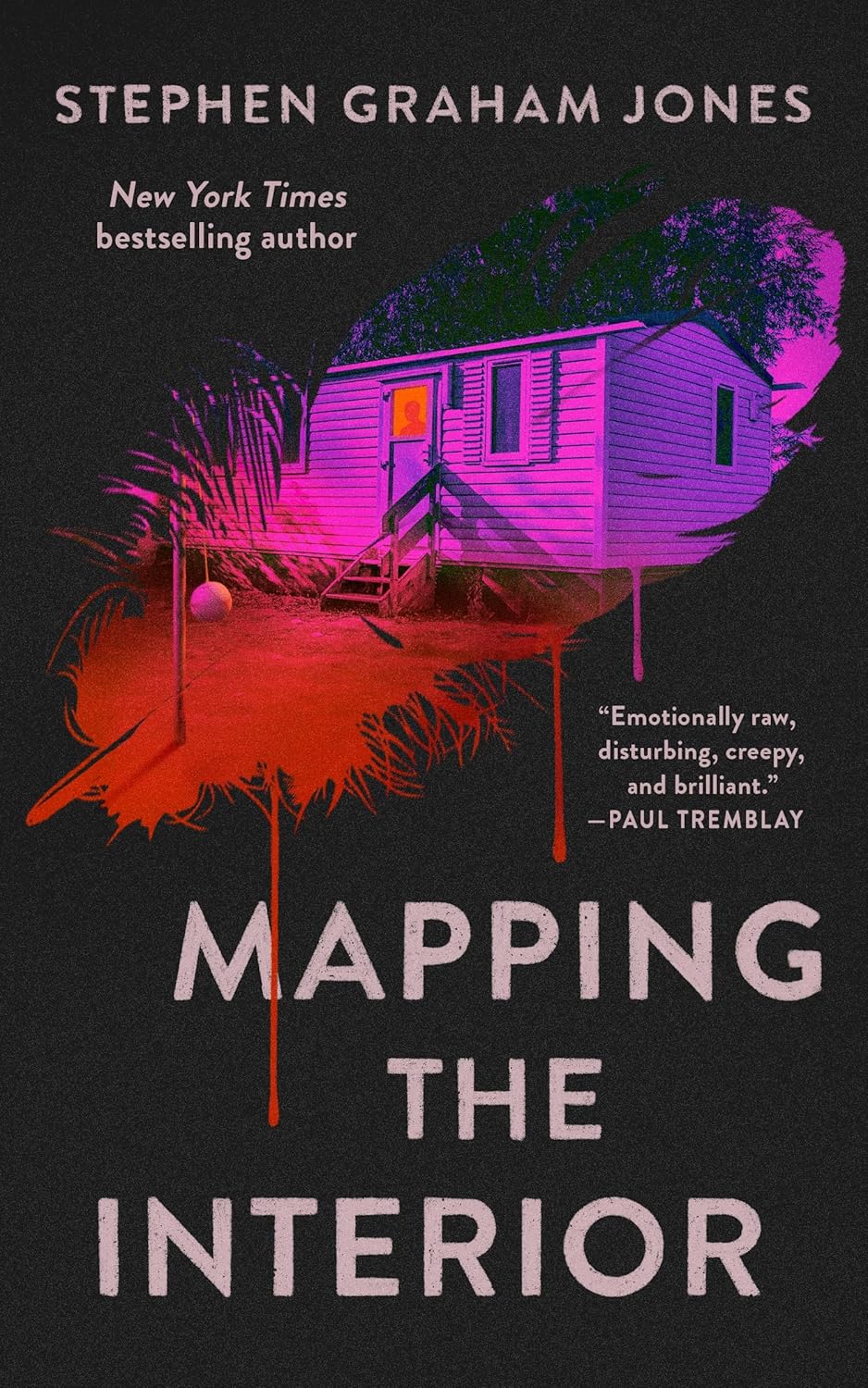
A hundred pages. Junior is twelve, living in a rented house off the reservation with his mother and his younger brother, who has seizures.
One night he wakes and sees his father crossing the hallway in full fancy dance regalia. His father drowned four years ago.
So Junior starts mapping. He measures the house, tracks where the figure appears, works out the pattern, and begins staying up to watch, and everything he’s doing is entirely rational, and the reason he’s doing it is that he wants his father back.
What his father turns out to want is what the novella is actually about, and it involves his brother.
Jones is writing about a boy who has been taught by everything around him that his family is disposable, and who will accept a very bad bargain rather than lose another piece of it.
It won the Bram Stoker Award for long fiction, and it’s the saddest thing he has written.
The Indian Lake Trilogy
These are the Stephen Graham Jones books that made him a bestseller, and together they form the only slasher trilogy that doubles as a sustained piece of film criticism.
Three novels about Jade Daniels, a half-Blackfeet teenager in Proofrock, Idaho, who is the only person in town who understands what’s happening, because she has watched every slasher film ever made.
My Heart Is a Chainsaw (2021)

Jade Daniels is seventeen, half Blackfeet, working as a janitor at her own high school in Proofrock, Idaho, and she has watched every slasher film ever made.
So when a body turns up in the lake, she doesn’t panic. She recognizes the pattern, identifies which subgenre she’s in, and starts looking for the final girl, because the theory says there has to be one, and Jade knows it isn’t her.
The slasher scholarship is the engine of the book, and it’s the real thing. Jade’s extra-credit essays on the form get printed between chapters, and they hold up as actual film criticism, and they’re also the only way she has of saying anything about her own life.
Her father is the reason she’s like this, and the novel discloses it slowly.
It’s a horror novel, a piece of genre criticism, and a book about a girl nobody has ever helped, and the last fifty pages are extraordinary.
Won the Bram Stoker Award.
Don’t Fear the Reaper (2023)

Four years after My Heart Is a Chainsaw, Jade Daniels comes back to Proofrock, released from prison, going by Jennifer now and trying hard not to be the person she was.
A serial killer called Dark Mill South escapes a prison transport in a blizzard that same day, and the town gets snowed in.
The slasher scholarship is still the engine, and Jones tightens it here. Jade’s chapters get interleaved with an academic paper another character has written about final girls, which means the theory is now being argued by two people who disagree.
Letha Mondragon is the other half of the book, and the relationship between the two women is the most emotionally direct thing Jones has written anywhere.
The body count runs considerably higher than the first novel, and the set pieces are better staged.
It’s the middle book of a trilogy, and it behaves like one, which is the fair criticism. Read it directly after the first.
The Angel of Indian Lake (2024)

The conclusion arrives four years after the second book, and it’s the longest of the three at around five hundred pages.
Jade is thirty-six now, teaching history at the high school in Proofrock, and the town has become a tourist destination because of everything that happened there. There are lake tours. There is merchandise.
Then it starts again.
What makes it the right ending is that Jones stops caring whether Jade’s slasher framework is correct and starts asking what believing in it has cost her. She has organized an entire life around a genre theory, the theory keeps being right, and being right about it has taken everything she had.
The horror turns genuinely supernatural here in a way the first two books resisted, and some readers count that as a break in the rules.
It won the Bram Stoker Award for best novel and completed the only slasher trilogy anybody has written that is also literary criticism.
The Rest
I Was a Teenage Slasher (2024)

Texas, 1989. Tolly Driver is seventeen, a nobody, and the novel is his own account, written decades later, of the summer he became the killer.
The inversion is the whole point, and it’s the one thing the slasher form had never properly done. The genre is built on a final girl and an unknowable masked figure, and Jones puts you inside the figure and makes him a frightened, decent, unpopular kid who doesn’t want any of it and cannot stop.
The rules apply to him too. He discovers what he’s capable of, works out that the pattern has a shape, and starts trying to protect the people he hasn’t reached yet.
Amber is the final girl, and she’s his best friend, and that relationship is the reason the whole thing works.
It’s his funniest book, which is not a sentence anybody expects about a slasher, and the Texas small-town detail is exact.
Standalone, no trilogy required.
Night of the Mannequins (2020)

A hundred and thirty pages, and the best short thing he has written.
Five teenagers who work at a cinema pull a prank with a mannequin they found in the woods years ago and used to call Manny. They put him in a seat during a screening.
Then one of them dies, and Sawyer, who narrates, works out that Manny has come back and is killing them one at a time, and decides the responsible thing to do is get ahead of it and protect their families.
The reader works out what’s actually happening several chapters before Sawyer says it, and Jones never once breaks the voice to confirm it.
That’s the whole book. A teenage boy reasoning his way, step by step, through a completely coherent chain of logic, to an entirely monstrous conclusion, in a cheerful conversational register.
It won the Bram Stoker Award for long fiction, and it reads in one sitting.
After the People Lights Have Gone Off (2014)

Fifteen stories, and it’s the collection that shows the range the novels don’t.
“Thirteen” is the standout: a boy who works at a run-down cinema, a projectionist, and a film that shows the audience something. It’s the most controlled thing in the book.
“Welcome to the Reptile House” and “Interstate Love Affair” both do the thing Jones does better than almost anybody, which is to plant a supernatural mechanism inside a completely ordinary rural or reservation setting and never explain the join.
The prose runs more experimental here than in the novels. Several stories withhold the basic situation until the last page, and one or two never resolve at all.
It was a Bram Stoker and Shirley Jackson Award finalist.
He has published well over a dozen collections, and this is the one to start with. The Ones That Got Away is the other.
The Last Final Girl (2012) and The Least of My Scars (2013)

Two from the small-press years, both since reissued, and both formally strange in ways the later books aren’t.
The Last Final Girl is written as a screenplay. Not framed as one, written as one, in present tense with camera directions and cuts, so the reader is watching a slasher rather than reading about one. A masked killer in a Michael Jackson mask attacks a Texas town, a final girl survives, and then the sequel starts up inside the same book.
The Least of My Scars is a serial killer novel narrated from inside an apartment. Billy Rae Dial never leaves it. Somebody is paying his rent and sending people to his door, and he kills them, and the arrangement has worked for years, right up until the deliveries stop.
It’s claustrophobic, told in a deteriorating voice, and it’s the nastiest thing he has published.
Both spent years out of print, and both are back.
Demon Theory (2006)

His most formally aggressive book, and almost nobody has read it.
It presents itself as the novelization of a film trilogy that doesn’t exist, with over five hundred footnotes cross-referencing horror films, some real and some invented, and the notes argue with the text and occasionally contradict it.
The story underneath follows a group of medical students at a house on Halloween where something happened years earlier, and it plays out three times across three acts with full slasher logic.
The footnotes are the book. They’re where the criticism happens, where the jokes live, and where the reader gradually works out that the citations to invented films are doing something the text won’t admit to.
It was published in 2006, before The Last Final Girl, and it establishes that the whole slasher-as-scholarship project was there from the very start.
It’s difficult, it’s the least accessible thing in his catalog, and readers who loved the Indian Lake trilogy should know where it all began.
Where to Start
Read The Only Good Indians. It’s the consensus entry point for good reason, and it works whether or not you care about the genre conversation.
If a four-hundred-page commitment is too much, read Mapping the Interior instead, which does the same things in a third of the length.
If you want the best book rather than the easiest, read The Buffalo Hunter Hunter.
And if you love slasher films, go straight to My Heart Is a Chainsaw, where you’ll get roughly twice as much out of it as anyone else.
The whole shelf is ranked on my best horror books list. The slasher trilogy is doing to my monster books list what the Indian Lake books do to the genre.