Search for vampire books and you will mostly be shown romance.
That’s not a complaint about romance, which is a fine genre with better lists than this one. It’s a practical problem: the vampire has spent twenty years as a love interest, and the result is that anyone looking for vampire books that actually frighten has to wade through several hundred brooding immortals first.
So these are the vampire books for horror readers. No romantasy, no paranormal romance, and nothing where the fangs are foreplay. The test is simple and I’ll state it once: a book comes off when the romance carries the load that belongs to the horror. Everything else stays, including books that are erotic, because the vampire has been erotic since 1872 and pretending otherwise would be a different kind of dishonesty.
What the good ones have in common is that the vampire wants something from you and is not going to ask.
Some of these I’ve read. I’ve said which.
Fiction by René Rehn


The origins
The Vampyre (1819)

The first vampire in English fiction and it came out of the same wet summer as Frankenstein.
Byron proposed the ghost story competition at Villa Diodati in 1816. Mary Shelley produced Frankenstein. Byron himself wrote a fragment and abandoned it, and his physician John Polidori took the fragment and finished it into this.
The invention is Lord Ruthven, and it changed the monster permanently. Before Polidori the vampire in European folklore was a peasant, a bloated corpse that came back to trouble its own village, and it was disgusting rather than seductive. Ruthven is an aristocrat. He is pale, cold, magnetic, moves in society, travels, and destroys the people who admire him.
He was also transparently modelled on Byron, whom Polidori had come to loathe, and the story was published under Byron’s name without permission, which both of them then had to deny.
Everything glamorous about the vampire starts here rather than with Stoker. Polidori killed himself at twenty-five, two years later.
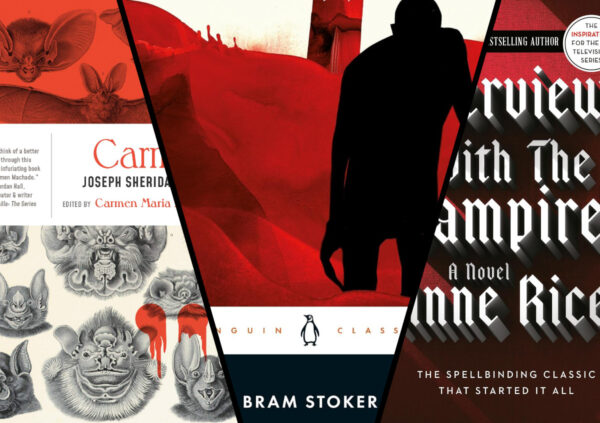
Carmilla (1872)

Twenty-six years before Dracula, and the better book.
In the Styrian countryside, seven miles from anybody, Laura keeps house with her father in a lonely schloss. Then a carriage wrecks at their gate, and its injured young passenger stays behind to heal, her mother pleading pressing business and promising to collect her in three months.
Le Fanu drafts the machinery Stoker later codified: an engineered carriage accident purchasing the invitation, a months-long drain the doctors file as anemia, prior victims in the village too poor to be investigated, and a 1698 portrait of an ancestress wearing Carmilla’s face.
Le Fanu also goes where Stoker never would. What runs between the two women is written out plainly, wanted on both sides, and Laura tells you again and again that it frightens her and pulls her at once.
The staking at the end is a legal proceeding conducted by an Imperial Commission, which is a detail nobody copies.
Dracula (1897)

The book that fixed the rules, and the thing to understand is how little of it is folklore.
Stoker invented or adapted nearly the whole modern package. No entry without invitation. No reflection. The soil from home. The inability to cross running water unaided. The shape-changing into bat, wolf and mist. The control over rats and dogs. The hierarchy of brides. Almost none of that appears in Eastern European vampire belief, which is largely about bloated corpses, plague and the wrong burial.
What he did take from folklore is the staking and the beheading, and even those he formalized.
The first four chapters are the best in the genre, and after the castle the book turns procedural. Everyone who has finished it knows the long middle, and the finale runs on a railway timetable.
Stoker keeps his Count mostly out of frame, having grasped the first law of monsters: visibility is depreciation.
Varney the Vampire (1845 to 1847)

Eight hundred and seventy-six thousand words across a hundred and nine weekly penny installments, 1845 to 1847, and no vampire novel ever written comes close to its length.
Nobody is entirely certain who wrote it. It is usually credited to James Malcolm Rymer or Thomas Peckett Prest, both of whom worked for the same publisher of penny dreadfuls, and it may be both.
It is where several things everybody attributes to Stoker actually originate. Varney has fangs and leaves two puncture marks. He has hypnotic power, he has superhuman strength, and he enters through a window at night. None of that is in the folklore and all of it is here first.
It is also incoherent. The continuity contradicts itself constantly because it was written to a weekly deadline and nobody was keeping notes, and Varney’s origin is given several incompatible explanations.
He is also, unexpectedly, sympathetic. He hates what he is and the serial ends with him throwing himself into Vesuvius.
The twentieth century
I Am Legend (1954)

The novel that made the vampire a disease, and after Dracula, no book on this page has mattered more.
In all of Los Angeles, one man remains: Robert Neville. The rest are corpses or something changed, and after dark they crowd his lawn shouting for him, none louder than Ben Cortman, who used to live down the street.
Matheson audits the folklore item by item and issues a pathology for each: garlic reads as allergy, stakes kill by blood loss, crosses touch only the ones who died Christian, which is the best line in the book, and mirrors torment a mind the disease has half-broken.
That converted the monster into an epidemiological problem and made the modern apocalypse novel possible, and Romero’s whole zombie line descends from it by his own testimony.
His calendar is maintenance: planks and garlic by day, the generator, supply runs, and the house-to-house staking of sleeping neighbors.
No film has yet had the nerve to keep the ending.
Salem’s Lot (1975)

King’s stated starting question was simple: drop Dracula into 1975 small-town Maine and watch. Ben Mears returns to write about the Marsten House, the ruin on the hill that terrified his childhood, and learns two antiques dealers have just taken it, one of whom conducts no business before sundown.
The first two hundred pages buy the horror on credit: a cheating realtor, a drinking priest who no longer believes, a beaten boy, the woman at the dump, two dozen lives laid in before the first bite, and then spent.
Barlow stays thin and scarce by design, a restraint every adaptation immediately regrets abandoning.
And the Lot was already failing, mill shut, young gone. King’s vampire just files the paperwork.
More on the best Stephen King books.
Interview with the Vampire (1976)

The novel that gave the vampire an interior life, and everything paranormal since is downstream of it whether it wants to be or not.
Louis is interviewed in a room in San Francisco by a boy with a tape recorder, and he tells the whole thing: New Orleans in 1791, the plantation, Lestat making him, the decades of guilt about feeding, Claudia, and Paris.
Claudia is the invention that still lands. She is made at five and remains five physically for sixty years while her mind matures completely, and Rice is unsparing about what that does to her and about what Louis and Lestat did in making her.
Rice wrote it in five weeks, the year after her daughter died of leukemia at five. She has said Claudia is that child, and once you know it the book is difficult to read any other way.
It sat unpublished for three years. The sequels turn the vampires into a mythology with a history and readers divide sharply on whether that was an improvement.
The Hunger (1981)

Nothing about Miriam Blaylock is undead, and nothing is supernatural. She belongs to another species entirely, one predating humanity, living quietly among us all along, and now down to almost nobody.
She chooses human companions, loves them genuinely, and her blood buys them centuries. The transfusions hold. For hundreds of years at a stretch, nothing goes wrong.
Then the gift expires, and in the space of days the companion collapses into age, a dried, aware, motionless thing, and death never comes for it.
She keeps every one. Boxed in the attic, conscious, the accumulation of six thousand years, because she cannot make herself end them, and the newest companion is never told what waits.
That’s the entire novel. The horror runs on arithmetic instead of predation, and what Miriam is isn’t evil, it’s loneliness at a magnitude nothing can answer.
Tony Scott’s 1983 film, Deneuve and Bowie starring, rewrote the ending entirely, and it’s how most people meet the story.
Fevre Dream (1982)

A Mississippi steamboat in 1857, and the best vampire novel almost nobody reads.
Abner Marsh has lost most of his fleet to an ice jam. A wealthy pale stranger named Joshua York offers to fund the fastest packet on the river in exchange for an equal partnership and no questions about the hours he keeps.
Martin’s vampires are a species with a biology, a history and a schism. York has developed a chemical substitute for blood and is trying to break his own kind of the habit of feeding on people. Damon Julian regards this as degeneracy and the argument between them is conducted like a religious dispute.
Marsh’s side of the book is pure rivercraft, races, wood stops, boiler risk, packet economics, researched to the rivet, and his hunger for speed is the most convincing thing in it.
And the year is load-bearing: predation and slavery share the same river, the same decade, and the text never once draws the line for you, which is why it works.
He wrote it in 1982, before Westeros.
They Thirst (1981)

The only vampire novel on this page that treats them as an invading army, and McCammon commits to it completely.
The whole of Los Angeles falls, not a chamber piece, not one neighborhood but the entire city taken street by street across eight hundred pages, the dead in the millions, a Hungarian castle arriving in crates for reassembly on a hill over the basin.
Prince Vulkan conducts it as a military campaign, monarch, strategy, logistics, while the pursuit falls to a detective, a priest, a boy, and one man who survived the original outbreak back in Hungary, tracing the spread outward from Hollywood.
The set pieces run at city scale, a dust storm rolling in to bury the basin, the freeways, and a cemetery sequence that stands as the decade’s best McCammon.
It is early work, it is over-long, and the prose is not what it would become in Boy’s Life.
It stands as the maximalist option, without any real twin in the subgenre, and McCammon has been ambivalent about it since.
Lost Souls (1992)

New Orleans and a small North Carolina town, and the vampires are a separate species that reproduces sexually, which almost nothing else in the subgenre does.
They are born rather than made. The birth kills the mother, because the infant eats its way out, and that fact is delivered early and matter-of-factly.
Nothing, Zillah and Molochai are teenagers with a van, and they drink, take drugs, drive, and feed, and Brite writes them as genuinely attractive company rather than as monsters with good cheekbones.
The novel’s actual subject is a fifteen-year-old runaway looking for people like himself, and the vampires are the only place he finds them.
Brite is enormously good at atmosphere: humidity, cheap bars, bad motels, the specific texture of the American Southeast in the early nineties.
It is explicit, it is queer without apology in 1992, and it was foundational for a generation of readers who saw nothing else like it on the shelf.
Published as Poppy Z. Brite, which is the byline these books carry.
The Delicate Dependency (1982)

One novel, published in 1982, out of print for thirty years, and quietly one of the best vampire books ever written.
London, 1897. Dr. John Gladstone is a physician researching a cure for smallpox when he runs down a beautiful young man in the street with his carriage. The young man is uninjured. He is also Dr. Gladstone’s introduction to a society of vampires who have been living among humanity for millennia and who are its actual intellectual history.
Talbot’s premise is that the great advances have come from them. They preserve knowledge, they cultivate genius, and they have been quietly steering civilization while feeding on it, and the delicate dependency of the title runs in both directions.
Then they take Gladstone’s daughter, and the novel becomes a pursuit across Europe.
It is enormous, ornate, genuinely intelligent, and it does something almost no vampire novel attempts, which is to make the immortals interesting for reasons other than sex or violence.
Valancourt reissued it and it deserved the rescue.
The modern wave
Let the Right One In (2004)

2004 · translated by Ebba Segerberg · 2007
Winter 1981, Blackeberg, all concrete, on Stockholm’s edge. Twelve-year-old Oskar, bullied past endurance, clips murder stories into a scrapbook and practices a revenge that will stay imaginary. Into the next apartment comes a child named Eli, accompanied by an older man whose job is killing people for their blood, a job he does poorly, until he’s caught at it.
No modern vampire is written with more physical conviction. Eli has an odor. Feeding is slow, wet work. Infection follows rules the book establishes and honors. And the matter of Eli’s age, which both films only gesture at, gets stated on the page outright, where it disturbs far more.
Its claim to major-novel status rests on the friendship never being the romance it resembles, and on the book’s full awareness of that. Before Oskar, the role belonged to Håkan. What’s happening is recruitment, and the ending, whatever its surface, is no happy one.
The housing estate does the rest: drinkers, parents out of their depth, the municipal pool, and darkness arriving at three in the afternoon.
The Historian (2005)

A girl finds a blank book in her father’s library, empty but for a central dragon woodcut, bundled with letters that open to my dear and unfortunate successor.
The same blank book has surfaced for three generations of scholars, each drawn into Ottoman archives, monastic registers, folk song and diplomatic paper, and each noticed for it. Kostova’s Vlad reads his own scholarship and keeps current.
The joy is the apparatus: Istanbul and Budapest reading rooms, a Bulgarian monastery, marginalia and provenance work, and Cold War trains ridden on academic visas.
The pacing complaint is earned: six hundred pages of nested correspondence in which people read for chapters at a stretch.
Ten years in the writing, a two-million-dollar advance, and the fastest-selling hardcover debut American publishing had seen.
Also on dark academia.
The Strain (2009)

Del Toro and Hogan take the vampire back to being a parasite, and the biology is the reason to read it.
A plane lands at JFK and goes dark on the taxiway. Everybody aboard is dead except four survivors, and the medical examiner who opens the first body finds organs that have already begun reorganizing themselves.
The mechanism is worked out properly. A capillary worm transmits it. The stinger is a muscular proboscis that fires from under the tongue and is six feet long. The digestive system simplifies. The genitals atrophy and drop off. The infected are driven to feed on their own families first, which del Toro has said is the detail he started from.
There is no seduction anywhere in it, which is precisely the exercise.
The prose is functional and the characters are types, and the plotting is entirely competent. It is a genre thriller executed by somebody who knows exactly what he wants the monster to be.
The Passage (2010)

A military project in Colorado infects twelve death row inmates with a virus derived from a South American bat, in order to produce soldiers who do not die, and it works, and then they get out.
Ninety-three years later North America is empty except for a few walled colonies running on failing lights.
The first third is the best of it and is genuinely superb. Amy is six, abandoned at a convent, and the FBI agent sent to collect her for the project decides not to hand her over, and the road sequence that follows is Cronin at his strongest.
Then the novel jumps a century and becomes a different book, and readers divide there. The colony material is competent post-apocalyptic fiction and it lacks the tension of the opening.
Cronin was a literary novelist with a PEN/Hemingway Award, and he has said his daughter asked him to write a book about a girl who saves the world.
Two sequels follow and the trilogy runs to about two thousand pages.
Certain Dark Things (2016)

Mexico City, in a version of the world where vampires are a known and legislated fact, and the city is one of the few places that has banned them entirely.
Atl is a Tlāhuihpochtli, a descendant of an Aztec vampire lineage, and she is on the run from a rival clan of European Necros who are taking over the northern drug trade. Domingo is a seventeen-year-old garbage picker who finds her in the metro.
The worldbuilding is what everyone cites. Moreno-Garcia populates the world with ten distinct vampire subspecies, separate biologies, diets, lifespans, cultures, and the European kind everybody knows are just one entry on the list, and far from the most interesting.
The narco parallel is exact and unsentimental, and the sanitation police, the clan politics and the geography of a divided Mexico City are all done properly.
It’s short, fast, closer to noir than to horror, and no vampire novel of the last twenty years out-invents it.
Anno Dracula (1992)

Van Helsing lost. Dracula married Queen Victoria, vampirism has become respectable, and half of London society is turning because it is now the thing to do.
Somebody is murdering vampire prostitutes in Whitechapel and the government is more concerned about the political embarrassment than about the deaths.
The game is the density of the cameos and it is genuine. Newman fills the novel with characters from Victorian fiction, penny dreadfuls, later horror and the historical record, arriving unannounced and unexplained, and there are hundreds. The annotated editions include a list you should not read first.
Underneath it is a serious alternative history about how quickly an establishment accommodates something monstrous when the alternative is losing position, and the newly turned working class are dying of bad blood in the slums while the aristocracy manage.
The identity Newman assigns to the Ripper is one of the better fictional solutions anybody has proposed.
Several sequels follow and none matches the first.
The Southern Book Club’s Guide to Slaying Vampires (2020)

Charleston in the early nineties, and James Harris moves into a respectable street.
He keeps unusual hours. He is charming and good with the husbands. And children start dying a few miles away in Six Mile, the Black community that nobody in the book club’s social circle considers their business.
The vampire content is deliberately unglamorous. Harris does not seduce anybody and does not transform into anything. What he does is establish himself socially, acquire financial control, and feed on people nobody will investigate, and the mechanism is class rather than mesmerism.
The worst scene needs nothing undead in it. Patricia reports what she has seen, the husbands convene, and she leaves her own living room with a prescription.
A third of comedy, then rats, then readers taking a break.
The model, by Hendrix’s account, was his mother’s book club, and the dedication page carries her name.
Also on southern gothic.
Where to start
Read Let the Right One In if you want the best modern one, and know it’s considerably nastier than the films.
Read I Am Legend if you want the most important, and Fevre Dream if you want the best-written.
If you want the origin, read Carmilla, since it takes an evening and it’s better than Dracula.
And for the one that never gets named anywhere else, it’s The Delicate Dependency.
A note on support: this page mentions suicide. If you’re struggling, you don’t have to handle it alone. In the US you can call or text 988, the Suicide and Crisis Lifeline. Elsewhere, the International Association for Suicide Prevention keeps a directory of crisis centers at iasp.info.
For the wider canon, see my horror classics page. When the vampire is played for laughs, my comedic horror list has it.