Historical horror has an advantage no other subgenre gets handed to it, which is that the past is genuinely worse than anything you can invent.
Put a haunting in the present and you have to work to make the reader feel trapped, because they have a phone, a car and antibiotics. Put it in 1348, or on a ship in the Arctic in 1847, or in a Mississippi county in 1922, and the trap builds itself. There is no help coming. The nearest doctor is three days away and will make it worse. Everyone already believes in the thing that’s after you, and knowing that hasn’t saved anybody.
The other thing the good historical horror books understand is that the supernatural is usually the smaller horror. In almost every book below, the historical circumstance is doing more damage than the monster, and the monster is what makes you notice.
Several of these I’ve read. I’ve said which.
The Medieval and Early Modern
Historical horror set before 1700, which is mostly about plague, the Inquisition, and what a village could do to a woman with land.
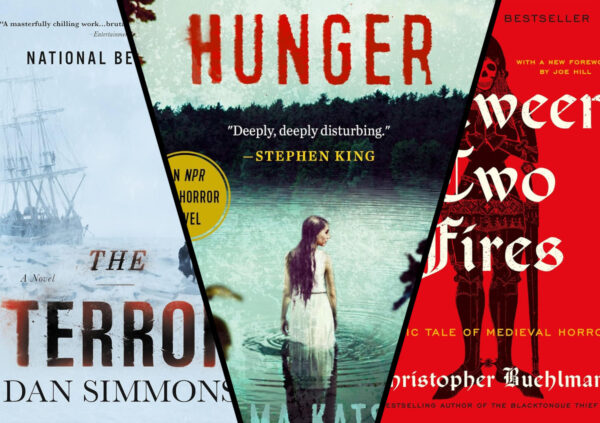
Between Two Fires (2012)

France, 1348. The plague has emptied the countryside, the roads are unsafe, and a disgraced knight who abandoned his order at Crécy is travelling north with an orphaned girl who says she speaks with angels.
The history is exact, and the book works because of it. Buehlman researched the period properly: the mortality rates, the abandoned villages, the collapse of the harvest, the flagellant processions, the pogroms against Jewish communities blamed for the wells. Everything the characters encounter on the road is documented, and the supernatural arrives into a landscape that was already apocalyptic.
The theology is the other half. There is a war in heaven and the wrong side is winning, and Buehlman writes the demons as embodied, numerous, specific and physically present. Thomas is a bad knight with a broken arm, and the girl’s faith is correct rather than touching, which is the harder choice and the one that makes the novel land.
It is genuinely grim, the road episodes are episodic by design, and the last hundred pages are extraordinary.
The Name of the Rose (1980)

1980 · translated by William Weaver · 1983
A Benedictine abbey in northern Italy, 1327, seven days and seven deaths, and a library nobody is permitted to enter.
The historical horror is that Eco was a medievalist and refused to simplify anything. The dispute William of Baskerville has come to arbitrate, whether Christ owned the clothes he wore, was a real theological crisis with the Inquisition attached and papal politics behind it, and the novel treats it as the life-or-death matter it was. The Fraticelli, the Dolcinites, the burnings, the papal court at Avignon are all real.
The first hundred pages, by his own account, were built as a filter against thriller readers, and the filter is real: untranslated Latin, extended scholastic argument, and a long runway before the plot properly starts.
The library labyrinth and the blind librarian Jorge are the horror, and the argument at the center, about whether some knowledge is too dangerous to permit, is given to Jorge and made formidable.
The book sold fifty million copies regardless.
Also on dark academia.
HEX (2016)

Black Spring is a small town in the Hudson Valley, and Katherine van Wyler has been walking through it since the seventeenth century with her eyes and mouth sewn shut.
The historical horror is the accommodation. Four hundred years of arrangement: a town council, a surveillance network, a phone app tracking her position, protocols taught to children, and a rule that nobody who moves in is ever permitted to leave. What was done to Katherine in the 1600s is the debt, and the app is the joke, four centuries of management reduced to a notification.
What she was accused of, and what the town did to her son, comes out late and reframes the whole system.
The Dutch original was set in a Netherlands village called Beek. Olde Heuvelt rewrote it wholesale for the American edition, changing the setting, the history and the ending, which almost no translated novel does.
The closing fifty pages earn their reputation, and the town outdoes its witch.
Also on folk horror.
Slewfoot (2021)

Connecticut, 1666, in the second generation of the Puritan settlement, and Brom has done the reading on what that actually meant.
Abitha lands from England as bought goods for a farmer whose decency outlasts his health by very little, leaving her a widow with a debt to her brother-in-law, a farm she has no legal standing to keep, and a village that has already decided what a woman alone represents.
The historical horror is the procedure rather than the witchcraft. The accusation, the examination, the searching of her body for marks, the testimony of neighbors with reasons, and the fact that the land is what everybody actually wants. All of it is drawn from the documented mechanics of colonial witch trials, twenty-six years before Salem.
Father, the thing waking in the woods, is a genuine pre-Christian survival, and Brom’s position is that the Puritans are the ones importing a cosmology into a landscape that already had one.
Brom paints for a living, filled the book with his own plates, and the hardback is the version to own.
The Nineteenth Century
Historical horror set in the 1800s, which is where the research usually shows most, because the period keeps such good records.
The Terror (2007)

In May 1845, HMS Erebus and HMS Terror left England for the Northwest Passage, and no European laid eyes on them again. The dead totaled a hundred and twenty-nine. To that documented record Simmons adds exactly one invention: out on the ice, something is hunting the crews.
Nearly every death belongs to history, which is the book’s whole case. Scurvy takes its share. Botulism arrives in tins a lowest-bid contractor sealed with lead solder. More lead rides the water system. Cold sinks past minus fifty. Deadliest of all is rank itself: procedure goes on being obeyed by officers even as procedure does the killing.
It works because of Crozier: Banbridge Irish, Catholic, twice denied command by English gentlemen certain to deny him again, whose whisky gives out a third of the way in, leaving a long stretch of the novel to a man in withdrawal responsible for keeping two hundred alive.
Adapted by AMC in 2018, shortened considerably, and very good.
Also on monster books.
The Hunger (2018)

1846, the westward trail, the Donner Party, and behind the wagon train, something keeping pace.
Katsu made one governing choice: no cannibalism set piece. Every reader opens the book knowing the lake camp’s history, and she declines to stage it, declines to linger. Her four hundred pages go instead to the chain of unremarkable choices that guaranteed the outcome: a shortcut taken, quarrels over pace, oxen lost, personalities grinding, whole days burned on standoffs no one would concede.
The historical work is thorough. The real party is here with the real names, Tamsen Donner, James Reed, Lewis Keseberg, and Katsu keeps to the documented timeline while inserting her supernatural element into the gaps.
What the thing on the trail actually is stays deliberately vague for most of the novel, and the reveal is less interesting than the deterioration around it, which several reviewers noted.
The group dynamics are the best material, arguing quietly that no monster was required.
Fevre Dream (1982)

A Mississippi steamboat in 1857, a captain who has lost his boat, and a wealthy pale passenger who offers to build him the fastest packet on the river in exchange for asking no questions about the hours he keeps.
The historical horror is the river itself. Martin researched steamboating exhaustively, the races, the wood-yards, the pilots, the boiler explosions, the economics of the packet trade, and Abner Marsh’s obsession with speed is the most convincing thing in the book.
And Martin gives his vampires a reformation: York, dosing his kind off human blood with a formula of his own, against Julian, for whom abstinence is heresy, the quarrel argued in a theological register.
The antebellum setting is doing deliberate work. Martin puts vampiric predation alongside slavery on the same river in the same decade without ever making the comparison explicit.
It stands with the best vampire fiction ever written, and Westeros has kept it invisible.
Also on vampire books.
Drood (2009)

London, the last five years of Charles Dickens’s life, narrated by Wilkie Collins.
The historical hook is real. Dickens was in the Staplehurst rail crash in June 1865, climbed back into the wreckage to help the dying, and was never the same afterwards. He died five years later to the day. He left The Mystery of Edwin Drood unfinished. Simmons takes those facts and supplies a figure called Drood whom Dickens claims to have met among the carriages.
Professional envy, sustained for eight hundred pages. The laudanum Collins takes suffices to put a green-skinned woman on his staircase; a whole career has kept him the room’s second novelist; Dickens he loves, and Dickens he would like dead, and none of the three escapes his own notice.
The voice either sells the book or ends your reading of it; middle ground does not exist. The Victorian London research is superb and the opium dens and the undercity are the best sequences.
The Alienist (1994)

New York, 1896. A newspaper illustrator, a criminal psychologist and the first woman employed by the police department investigate the murders of boy prostitutes, at the invitation of the new Police Commissioner, Theodore Roosevelt.
The historical horror is the method. Kreizler is an alienist, which is what a psychologist was called then, and the premise is that he attempts to build a picture of the killer from the evidence, which is an idea nobody had systematized in 1896. Carr shows the reasoning being invented, badly, against resistance from a department that considers it nonsense.
The research is the reason to read it. The tenements, the Lower East Side, the corruption, the political machinery, the food, the transport, Delmonico’s, and the specific business of being a boy sold in a New York brothel in the 1890s, which the novel does not soften.
Roosevelt is a real presence rather than a cameo, and his position as a reformer surrounded by a police force he cannot control is historically accurate.
Long, dense, and the procedural detail is the pleasure.
The Twentieth Century
Historical horror set within living memory or close to it, where the horror is frequently something a state or a community did legally.
1922 (2010)

Wilfred James farms a hundred acres in Nebraska in 1922 and his wife has inherited a hundred more, which she wants to sell to a hog-rendering company and move to Omaha. He does not.
So he recruits his fourteen-year-old son to help him kill her and put her down the old well.
The historical horror is the specificity of the period and the place. King is precise about the farming, the money, the isolation, the Depression that has not arrived yet but is coming, and about what happens to a boy in 1922 who has done that and has no way out of the county.
The rats are the supernatural element and King keeps them ambiguous, which is the right choice. Whether Arlette is coming back or Wilfred is disintegrating is left open, and the well produces both readings.
A novella from Full Dark, No Stars, about a hundred and thirty pages, and nothing King has written in twenty years is bleaker. Filmed by Netflix in 2017 with Thomas Jane, faithfully.
The Devil All the Time (2011)

Southern Ohio and West Virginia between the end of the Second World War and 1965, in a stretch of country Pollock knew because he worked in a paper mill there for thirty-two years.
Several storylines run in parallel and converge. A veteran who lost his faith praying over his dying wife. Their son. A pair of travelling murderers who photograph their victims. A corrupt sheriff. And a preacher with a spider-handling ministry who ruins a girl.
The historical horror is the poverty and the religion, and Pollock refuses to romanticize either. The revival tents, the mill towns, the dirt roads, the drinking, and a Pentecostalism that is genuinely believed and genuinely destructive.
There is no supernatural element anywhere in it, which is why it appears here rather than elsewhere on this site. The horror is entirely what these people do and what the period permitted.
Pollock published his first book at fifty-three. Filmed by Netflix in 2020 with a large cast and much of the ugliness sanded down.
Boy’s Life (1991)

Zephyr, Alabama, 1964, and the year is doing real work rather than supplying nostalgia.
Cory Mackenson, twelve, is on the dawn milk run with his father when a car noses out of the trees ahead and slides into Saxon’s Lake, and the man his father finds cuffed to the wheel has been beaten, and wired.
The historical horror is the town in that particular year. The Klan is present. The four Black women at the edge of town are treated as folklore by people who would not think of them as neighbors. The civil rights movement is happening elsewhere and arriving slowly. And the mill is closing.
McCammon runs the full apparatus, church, river monster, secret, racial violence, without one cynical sentence, and readers repay it by loving this book more than nearly anything else the genre owns.
Stoker and World Fantasy both, a double almost nobody manages.
Also on southern gothic.
Dark Matter (2010)

An Arctic expedition, 1937. Five men are meant to overwinter at Gruhuken in Spitsbergen, at seventy-nine degrees north, running scientific observations. Two leave. Then one more. Jack Miller is alone at the station with the dogs from October, in four months of continuous darkness.
The historical horror is the period detail and the isolation is genuine rather than contrived. Paver researched the equipment, the wireless procedures, the supply arrangements and the actual site, which has a documented and unpleasant history involving trappers, and she went to Spitsbergen herself.
The thing at Gruhuken is glimpsed at the edge of the lamplight and never explained, and Paver’s restraint is total. Jack’s journal is the whole novel and it is a slow, precise record of a man alone in the dark deciding whether he is imagining things.
It is a straightforward classical ghost story executed better than almost anything modern, and the dogs are what make the last section unbearable.
Short, and the best entry point to Paver for adults.
Wakenhyrst (2019)

Suffolk, 1913. Maud Stearne is sixteen and lives at Wake’s End, a manor on the edge of a fen, with a father who is a medieval historian, a mother who is pregnant almost continuously, and a household run on his rules.
Edmund Stearne finds a medieval painting, a doom, in the churchyard, and begins keeping a notebook, and Maud reads it.
The historical horror is the fen and the doom together. Paver did the reading on both: the drainage of the East Anglian fens, the folklore that survived there, and the medieval doom paintings that were whitewashed over at the Reformation and are still being uncovered. The one Edmund finds is the trigger and the notebook records his deterioration.
What the novel is actually about is Maud’s position. She is intelligent, uneducated by design, has no money and no standing, and is watching her father lose his mind while being legally in his power.
The framing is 1966, with Maud elderly, and the reveal about what she did is very well handled.
Lovecraft Country (2016)

1954, out of Chicago. Just home from Korea at twenty-two, Atticus Turner heads east in search of his vanished father, riding with his friend Letitia and his uncle George, publisher of The Safe Negro Travel Guide.
Driving is where the historical horror lives. Ruff names James Loewen’s Sundown Towns among his sources, and the research is visible on the page: counties no Black family could stop in past dark, fuel gauges weighed against remaining daylight, a sheriff escorting them to the county line as the sun goes down. Nothing supernatural happens in that sequence, and nothing in the book beats it.
George’s guide takes after the actual Negro Motorist Green Book, issued every year from 1936 to 1966, cataloging where eating and sleeping were safe.
Next to all that, the Order of the Ancient Dawn’s sorcerers rank as the smaller threat, a point the novel makes explicitly.
Eight connected stories stand where a continuous novel would, the format a residue of its television origins. HBO’s series departs from it substantially.
The Ballad of Black Tom (2016)

1924, Harlem. A guitar he can barely play hangs from Charles Thomas Tester’s shoulder as he works the errand routes of New York’s occult economy, transporting volumes he has the sense never to open.
What LaValle retells is “The Horror at Red Hook,” the most nakedly racist story in Lovecraft’s catalog, narrated this time from within the community the original targeted. One line of dedication holds the whole argument: for Lovecraft, with all my conflicted feelings.
The period detail is exact: 1924 Red Hook, tenement blocks, the immigrant neighborhoods that disgusted Lovecraft, and the particular logistics of being a Black man crossing Queens and Manhattan while a police detective develops an interest.
Structure does the heavy lifting: the first half belongs to Tommy, the second hands the narration to Detective Malone, Lovecraft’s original protagonist, and the same events replay across a police line’s two sides.
The finest sentence the corrective tradition has produced belongs to Tommy, weighing cosmic terror against the daily variety and finding the cosmic wanting. It took the Shirley Jackson and British Fantasy Awards.
Mexican Gothic (2020)

Mexico, 1950, and the period is the argument.
Noemí Taboada is a socialite in Mexico City, going to parties, wanting to study anthropology against her father’s wishes, in a country that has been independent for over a century and modern for a generation. Then she is sent to High Place in the mountains, where an English family have been sitting on a silver mine since the previous century and behaving as though nothing has changed.
The historical horror is the extraction. The Doyles came for the silver, the mine killed local workers in numbers nobody recorded, and the patriarch’s bloodline talk is nineteenth-century eugenics served with the soup.
Nothing in the house is local: shipped furniture, shipped wallpaper going soft in the mountain damp, a mausoleum for English dead, and the Doyles, the least assimilable import of all.
Her larger point lands through the period itself: the pile was colonial infrastructure from the start, and a century of gothic novels politely declined to book the cost. Then the closing act veers somewhere the opening two never signposted.
Also on gothic fiction.
The Devils of Loudun (1952)

The nonfiction anchor for this page, and the best account anybody has written of how these cases actually worked.
Loudun, France, 1634. The Ursuline convent reports a mass possession. The nuns convulse, blaspheme and name the parish priest Urbain Grandier as the cause. Public exorcisms are staged for paying audiences. Grandier is tortured, his legs crushed in the boot, and burned alive.
Huxley’s argument is that every element of it is explicable and none of it is fraudulent in a simple way. The nuns were enclosed, young, and largely there because their families had no dowry for them. The exorcists were performers with careers. And Cardinal Richelieu needed Grandier removed for entirely political reasons, because he had written against him and opposed the demolition of the town walls.
What makes it more than a debunking is that Huxley takes the nuns seriously as people rather than as symptoms, and Sister Jeanne des Anges is the most interesting figure in the book.
Ken Russell filmed it in 1971 and it remains partly censored.
Where to Start
Read Between Two Fires if you want the best horror novel here, and give it the first hundred pages.
If you want the historical detail to do the frightening, and clear a week for it, read The Terror.
Read Lovecraft Country or The Ballad of Black Tom if you want the subgenre doing something genuinely new with the tradition.
And read The Devils of Loudun if you’d rather find out that the real cases are stranger than the fiction.
The older end of the shelf is on my horror classics page. Where it overlaps with the old rural terrors is on my folk horror list.