The best monster fiction doesn’t show you the monster.
That sounds like a paradox on a page like this and it’s the single most reliable rule in the mode. What makes a creature work is not the description, it’s the proportion of it you’re never given. John Langan’s The Fisherman is the clearest recent example: you learn that the thing in the water is roughly the size of a mountain and you learn almost nothing else. Its cult is mentioned and never explained. Its history is gestured at. The best monster books all do some version of this. That withholding is where the mythic weight comes from, and a complete accounting would have collapsed it.
Every entry below either understands that or is interesting for failing to.
What’s on this page. The monster books covering creatures that don’t have a category of their own. Cryptids, sea creatures, wilderness predators, parasites, giants, folklore, and the werewolf, which gets a section rather than a page for reasons I’ll explain when we get there.
What isn’t. Vampires, zombies, demons, possession and ghosts all have their own guides, so they’re linked rather than repeated. And no monster romance. The test is simple and I’ll state it once: when romance starts pulling the weight that horror ought to pull, the book leaves the list. Nothing else disqualifies anything.
Two entries here are books I’ve read, and both say so.
Fiction by René Rehn


The Old Monsters
Beowulf

The first monster story in English, and Grendel is still one of the best-designed creatures in the tradition.
What is striking, reading it now, is how little you are told. He is descended from Cain, he is shaped roughly like a man, and he is enormous. Even worse, he cannot be cut by weapons. That is most of it, and the poem is far more interested in what he does at night in the hall than in what he looks like doing it.
The design decision that still works is his motive. Grendel attacks Heorot because he cannot bear the sound of celebration, and the poem is explicit about that. He is not hungry and he is not commanded. He hates the noise of people enjoying each other’s company.
His mother is the better monster and gets less attention, and the fight in the mere is the strangest passage in the poem.
Seamus Heaney’s translation is the one to get. It is readable, it is beautiful, and it does not smooth the strangeness out.
Grendel (1971)

Gardner retells Beowulf from inside the monster, across twelve chapters, one for each of the twelve years of the siege, and each corresponding to a sign of the zodiac.
Grendel narrates. He is intelligent, articulate, lonely and largely bored, and he attacks Hrothgar’s hall partly because he has nothing else to do and partly because the men there have invented a story about the world that he finds infuriating.
The Shaper is the argument. He is the poet in the hall who sings the Danes a history in which they are noble and Grendel is evil, and Grendel knows the history is false and is destroyed by how beautiful it is. He wants to believe it, but he cannot, because he was there.
The dragon, who appears in the middle and lectures him about the meaninglessness of everything, is where the philosophy sits, and Gardner was teaching Old English at the time.
It runs a hundred and seventy pages, and nobody has written a better monster-perspective novel.
Frankenstein (1818)

The most important monster in English and the one everybody misremembers.
He is not mute, not shambling, not green, and not stupid. A year spent observing a family through a gap in a wall teaches him language; Paradise Lost, Plutarch’s Lives and The Sorrows of Young Werther teach him to read; and the novel’s most articulate speech comes out of his mouth.
He is also physically superb: eight feet tall, faster than a man, able to survive on the ice, and Shelley is explicit that Victor selected the components for beauty and that the result is only monstrous because the proportions do not resolve.
The design principle is the one every good monster since has used. The horror is not what he does. It is that he is right about his own case, and Victor has no answer, and the reader has none either.
Take the 1818 text; 1831’s revision files Victor’s edges down, and the argument dulls with them.
More on the Mary Shelley page.
The Wilderness
The Ritual (2011)

Adam Nevill’s creature is one of the few in modern horror that survives being described, and it survives because he waits so long to do it.
Four university friends pushing forty, the friendship mostly expired, cut through primeval Swedish forest to spare a bad knee and some pride. The path goes, a carcass appears hung high and opened wrong, and then a house turns up whose attic is occupied.
What’s in the forest gets shown to you in pieces over about two hundred pages, and Nevill is disciplined about it. A shape at distance. A smell. The wrong number of limbs. By the time you see it properly you’ve already accepted it, which is the trick, and it’s why the reveal doesn’t deflate the way most do.
The first half is the best lost-in-the-woods writing anybody has done. The second half changes the book into something else entirely, and readers split hard on whether that’s a betrayal or the point.
The Only Good Indians (2020)

Ten years earlier, four young Blackfeet men drove onto ground reserved for the elders, found a herd taking shelter there, and shot into it. One of the elk carried a calf.
Elk Head Woman is the creature, and no monster in recent horror is built better, because everything in her build serves the grievance. An elk’s head on a woman’s body when she chooses, a human face when passing requires one, patience in unlimited supply, and a sequence through the four men that follows her own logic. Jones hands her whole chapters, and nothing she believes is incorrect.
What makes her more than a revenge device is the parenthood. She is doing this for a calf that was never born, and the novel’s argument about what she is owed is genuinely difficult.
Ask anybody about this book and the late basketball sequence is what they bring up.
It took home both the Bram Stoker and the Shirley Jackson Award. The men are drawn with real affection, which is why it hurts.
The Hunger (2018)

The Donner Party, 1846, with something following the wagon train west.
Katsu’s creature is the most restrained on this page. It is barely present, it is never fully described, and what it actually is has a coherent explanation rooted in Indigenous belief that arrives very late and is deliberately understated.
That restraint is the argument. The historical Donner Party needed no monster, and Katsu spends four hundred pages on the ordinary decisions that made the outcome inevitable: the shortcut, the arguments about pace, the lost oxen, the personalities, the days burned on a dispute nobody would concede.
So the creature functions as a thin extra pressure on a group that was already going to fail, and several readers find it superfluous for exactly that reason.
The documented people walk it under their own names, Tamsen Donner, James Reed, Keseberg, on the documented calendar.
It is a historical novel with a monster in the margins rather than a monster novel, and that is either its strength or its problem.
Devolution (2020)

Greenloop is a high-end eco-community six hours from Seattle, built for wealthy people who want wilderness with fibre internet and drone deliveries. Then Rainier erupts, the roads go, the deliveries stop, and something comes down out of the forest that has also been displaced.
Brooks does Sasquatch as an animal rather than a cryptid, and that is the whole achievement. His troop has a social structure, a hierarchy, a foraging range and a dominance display, and the escalation follows primate behavior rather than horror-movie logic. The interviews with a primatologist woven through the text make the case seriously.
The format is his usual: a journal recovered afterwards, framed by an investigator, with expert testimony interleaved.
The residents are the satire. Affluent, conflict-averse, committed to consensus, and completely unequipped, and Brooks is merciless about the specific uselessness of people who have outsourced every practical skill.
The last third is a siege and it is genuinely tense.
More on the Max Brooks page.
The Wendigo (1910)

A hunting party of five heads into the bush north of Rat Portage, and the wilderness takes one: Défago, their French-Canadian guide.
The creature barely appears at all. Its presence arrives as an odor Défago catches ahead of everyone, a huge snow-track whose shape will not stay fixed, a voice from over the treetops, and a man moving faster than legs allow, shrieking that his feet are on fire.
Everybody remembers one detail. Victims of the Wendigo travel through the air, and the speed burns their feet away, so that Défago’s scream about his burning feet stands as the most frightening line Blackwood wrote.
Plain statement required here: Blackwood wrote a wind spirit, a wilderness power, while the Algonquian original concerns cannibalism and its taboo at the core, and these are different things. The wendigo of current pop culture descends mostly from Blackwood’s version.
Ninety pages, costs nothing, and only one Blackwood story beats it.
The Deep
The Terror (2007)

The Tuunbaq is the least of what is killing these men and Simmons knows it, which is why it appears rarely and is never fully described.
Since September 1846, the ice above King William Island has held two Royal Navy ships fast. What is actually working through the crew is the expedition’s own supply chain and the latitude: scurvy, lead in the pipes, the underbid contractor’s tins, cold that retires thermometers.
The creature is the supernatural element in an otherwise documentary novel and its function is to remove the last margin. The men could possibly have walked out. They cannot walk out while something is taking them off the ice one at a time.
What it actually is, and its relationship to Lady Silence and to Inuit belief, is disclosed late and is more interesting than a monster.
As a creature design it withholds on purpose: enormous, white, on the ice, mostly heard.
Adapted by AMC in 2018.
The Fisherman (2016)

The best creature in modern horror, and you never see it.
One fact is issued, its size, and everything else is refused: anatomy, origin, motive, even a name anybody uses twice. What the book supplies instead is displacement, the sense of a whale surfacing rather than a monster entering.
Everything else on this page describes its creature. This one is the argument for not doing that.
Into the Drowning Deep (2017)

A research vessel returns to the Mariana Trench seven years after a previous expedition disappeared while filming a documentary about mermaids, and this time the crew includes armed security and a whale researcher who lost her sister on the first trip.
Grant’s mermaids are the best-designed creature on this page. They are deep-sea predators built from real abyssal biology: bioluminescent lures, transparent tissue, hinged jaws, hands with opposable thumbs, and a vocal apparatus capable of mimicry. They are also intelligent, they hunt cooperatively, and they learn from the ship.
The science is done properly and the crew are actual scientists rather than horror-movie types, which is what makes the escalation land.
There is also a deaf character and a scientific sign language subplot that is central to the plot rather than decorative.
It is a monster novel with the pacing of a thriller and the biology of a nature documentary, and the last hundred pages are relentless.
Rolling in the Deep is the novella prequel about the first expedition.
The Troop (2014)

I read this one and it stayed with me, and the monster is the reason it belongs here.
It is a worm. No intelligence, no motive, no presence, nothing to bargain with or understand, and it is more frightening than any of the designed creatures on this page precisely because there is nobody in there. The scariest thing in modern horror turns out to be appetite with no mind attached.
More on the Nick Cutter page.
The Werewolf, Which Gets a Section Rather Than a Page
There’s a reason for this, and it isn’t snobbery.
Search for werewolf books and what comes back is overwhelmingly paranormal romance, where the wolf is a love interest with abdominal muscles. The genuinely good werewolf horror amounts to about four titles, and padding that out to twenty would mean recommending books that aren’t horror at all.
So here are the four.
The Last Werewolf (2011) by Glen Duncan is the best of them. The last of his kind, two hundred years old, thoroughly bored of himself, hunted by an agency that wants the species finished. It’s funny, it’s filthy, and it’s genuinely well written.
Cycle of the Werewolf (1983) by Stephen King is a novella in twelve parts, one per month, illustrated by Bernie Wrightson. Slight, and the format makes it.
Sharp Teeth (2008) by Toby Barlow is a werewolf novel about dog catchers and gang warfare in Los Angeles, written in free verse. That should not work. It does.
The Wolfen (1978) by Whitley Strieber treats them as a separate intelligent species that has been predating on humans throughout history, which is the most interesting take anyone has had on the idea.
The Creature Feature
A note on the term, since people search for it separately.
A creature feature is the subset where the monster is the plot rather than the metaphor: something is loose, it is hunting, and the book is about surviving it. No ancestral guilt, no folklore, no argument. The pleasure is mechanical and there is nothing wrong with that.
Most of the books above qualify. If that’s specifically what you want, the purest examples here are The Ruins, Into the Drowning Deep, The Troop and The Ritual, and the three below.
Meg (1997)

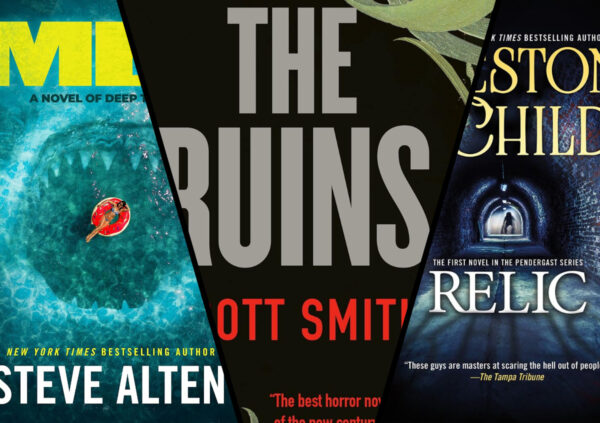
A seventy-foot Carcharodon megalodon comes up out of the Mariana Trench, and Alten is entirely unembarrassed about it.
The premise is that a thermal layer at the bottom of the trench has maintained a viable population since the Pliocene, sealed under a cold water barrier, and that Jonas Taylor saw one on a Navy dive seven years ago and was discredited for saying so.
The science is nonsense presented with total conviction, which is the correct register for this. Alten commits: the biology is explained, the depth is explained, the reason nobody has seen one is explained, and none of it holds up and none of it needs to.
What it does well is scale. The shark is the size of a bus, it eats whales, and Alten stages the attacks with genuine skill.
It took him seven years to sell and it spawned seven sequels and a film franchise.
Read it as the best possible version of exactly what it is, which is a monster book about a very large shark.
Relic (1995)

Something is killing people in the American Museum of Natural History, days before a major exhibition opens, and the administration would prefer this not to interfere with the gala.
The creature is the Mbwun, and Preston and Child do the work: it is the product of a plant from an Amazonian basin, a specific protein, a specific hormonal pathway, and a specific reason it is in New York rather than there. The forensic reasoning that gets the characters to it is the pleasure of the book.
The museum is the other reason it works. Preston worked at the American Museum of Natural History and the geography is real: the sub-basements, the storage, the tunnels, the Old Bones exhibit, and a building nobody has fully mapped.
Pendergast appears here for the first time and is a minor character in his own debut, which is worth knowing given that he now has twenty books.
The 1997 film keeps the title and throws out almost everything, including him.
Cujo (1981)
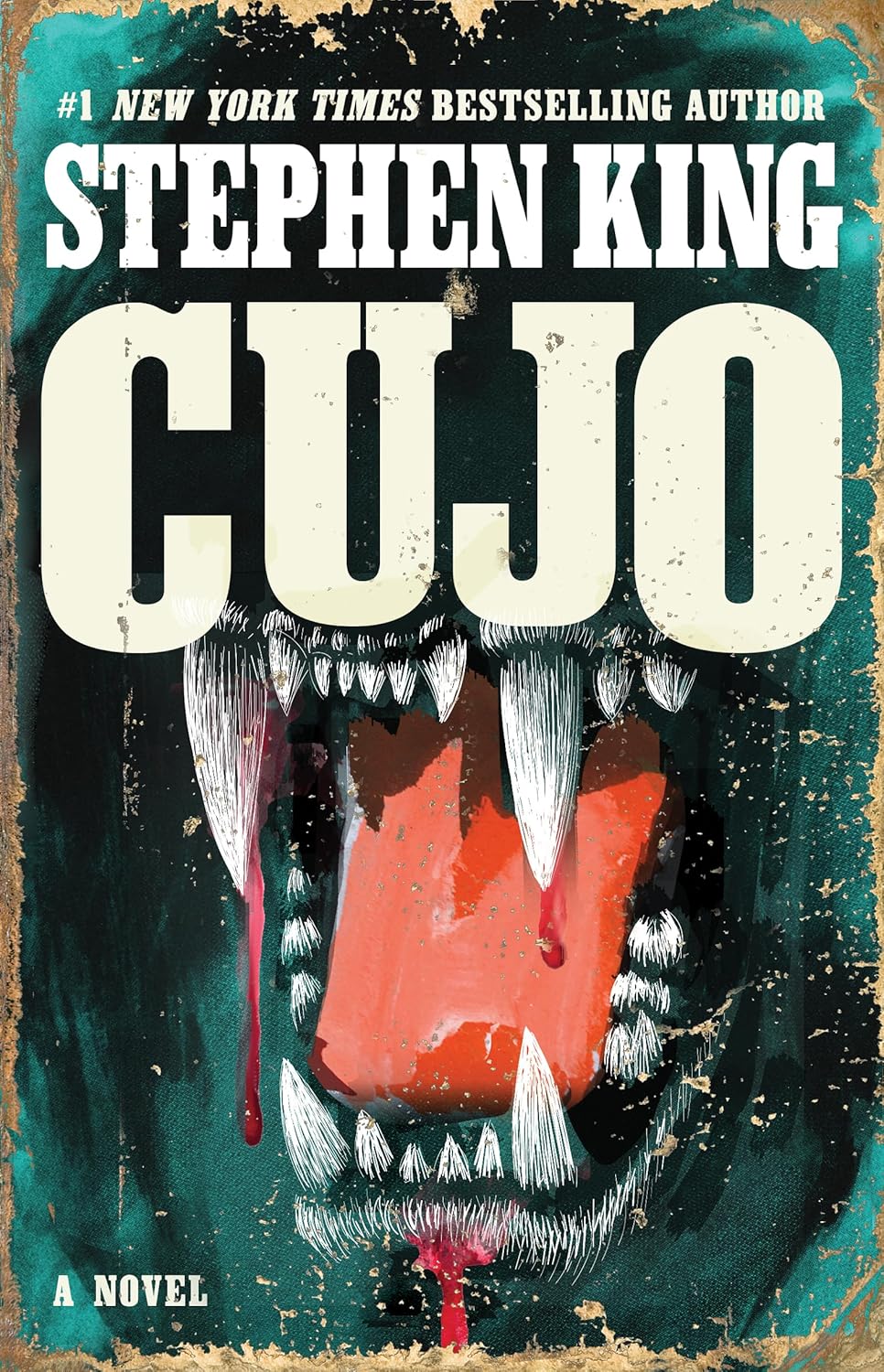
A two-hundred-pound Saint Bernard is bitten on the nose by a bat in a rabbit hole behind a farm in Castle Rock, and nothing supernatural happens in the entire novel.
That is what makes it belong here. Cujo is a good dog. King establishes that carefully and gives him interior chapters, and the horror is that he remains a good dog while the disease destroys him, and that he is confused and in pain and does not understand why he is doing this.
Donna Trenton and her four-year-old son are trapped in a Ford Pinto that will not start, in a yard, in a heatwave, for three days, and the novel is largely that.
King has said he does not remember writing it because of the cocaine, which is a well-documented and grim piece of context.
The ending is among the bleakest he has written and the film changed it, which King has been fine about and readers have not.
Won the British Fantasy Award.
More on the best Stephen King books.
One of Mine
Fuck Monsters (2023)

Full disclosure up front: this one’s mine, and it sits in the creature feature tier, nowhere loftier.
Dylan’s contract work is exterminating what comes through from elsewhere, work he does badly, between drinks, underneath a depression that’s winning.
What it brings to a monster list is quantity and range instead of a single designed creature. Pulp for fun, no literary claims, and that’s exactly what this section exists for.
The Unclassifiable
The Ruins (2006)

Four young tourists and a German they meet in Cancún take a day trip to an archaeological dig in the Yucatán jungle, looking for somebody’s brother, and the villagers at the bottom of the hill will not let them come back down.
The monster is a plant. That is the whole thing and Smith commits to it entirely. A creeping vine on an overgrown Mayan hill, which can move, can mimic sounds including human voices and mobile phone tones, can imitate a conversation it has heard, and which gets into wounds.
The villagers are not hostile. They are a containment protocol, and they have been maintaining it for generations, and they will shoot anybody who tries to leave the hill because that is the only thing that works.
The medical material in the second half is genuinely hard reading and the amputation sequence is the most-cited passage.
King called it the best horror novel of the new century, which is a stretch, though the nastiest it may well be.
Meddling Kids (2017)

Edgar Cantero’s novel about a group of teenage mystery-solvers, now adults and variously institutionalised, returning to the lake town where the case they closed was not the case they thought.
It’s Scooby-Doo crossed with Lovecraft, played mostly for comedy and then not, and the creature design in the last act is genuinely inventive.
At the Mountains of Madness (1936)

Two creature designs, and the second one is the reason the novella matters.
The Elder Things are the first: barrel-shaped, five-fold symmetrical, with wings and starfish heads, and the expedition dissects one and finds a fully functional biology. They built the city. And crucially, they are scientists and colonists rather than gods, and the murals hand you their entire civilization across hundreds of millions of years.
The shoggoths are the second, and they are the best thing Lovecraft invented. Protoplasmic, fifteen feet across, formed into whatever organs the task requires, and originally bred as tools. What they did to the Elder Things is the horror of the story, and the reveal is a piece of art history: the sculpture in the lower city is technically worse, and the reason it is worse is what Dyer works out.
It is written as an expedition report from first page to last, which is half the trick.
Save it for after “The Colour Out of Space”, once the prose has taught you its pace.
More on the best Lovecraft stories.
Where to Start
Read The Fisherman if you want the best of them, and pay attention to how little you’re told.
Read The Only Good Indians for the most original creature of the last decade, and The Ruins if you want to be genuinely upset. Both are among the best monster books of the century so far.
Read Grendel if you want to know what a monster is actually for.
And if the monster you came looking for was a vampire, a zombie or a ghost, those have their own guides: vampire books, zombie books and ghost books.
For the wider canon, see my horror classics page. Mary Shelley built the first one and nobody has improved on the argument.