Folk horror is the only branch of the genre where the monster is a community.
Not a creature, not a ghost, not a haunted building. A village, or a family, or a valley full of people who have quietly kept doing something the rest of the country stopped doing centuries ago, and who are perfectly happy about it until you turn up.
The term is relatively new even though the books are not. The director Piers Haggard used it about his own film in the early 2000s, and Mark Gatiss put it into general circulation in 2010 by grouping three British films together as a tradition. Since then the critic Adam Scovell has done the most to define it, and his formulation is the useful one: landscape, isolation, a skewed belief system, and then the happening, which is what the belief system requires.
That’s the shape. A place cut off enough to have gone its own way, a set of practices that make sense inside it and nowhere else, and an outsider who arrives too late to leave.
What isn’t here. Witches as romantic heroines, which is a large modern category and a different genre. And cosmic horror, which shares the ancient-survival idea and points it somewhere else entirely.
Some of these I’ve read. I’ve said which.
Fiction by René Rehn


The Ancestors
The White People (1899)

I’ve read Machen, and this is the founding text whether or not anyone called it that at the time.
The bulk of it is a girl’s diary. She writes about the games her nurse taught her, the ceremonies in the woods, the names of things, and she has no idea any of it is unusual. Neither, quite, do you, until the accumulation lands.
The opening name-drops are the whole tradition in embryo. Aklo letters, the Chian language, Mao games, the Dôls, White Ceremonies, Green Ceremonies. Nothing is explained. What you’re being shown is a complete system of practice that has been running quietly in the Welsh hills for a very long time, and that the modern world has no idea about.
The Shining Pyramid is the more explicit companion piece, with flint arrowheads arranged into shapes on a lawn and something that comes up out of a hollow in the hills. More on the Arthur Machen page.
The Lottery (1948)

Three thousand words in the New Yorker, June 1948, drawing a heavier mailbag than any piece in the magazine’s history.
A village of about three hundred gathers on a summer morning. The children collect stones. The men talk about tractors and taxes. Mr. Summers brings out the black box, which is shabby and has been replaced piecemeal over the years, and everybody agrees somebody ought to make a new one and nobody does. Names are called. Slips are drawn.
The folk horror is the procedure. Nobody in the story is a fanatic, nobody is coerced, and there is no cult and no belief system stated anywhere. There is a practice, it has always been done, other villages have given it up and are spoken of as foolish, and the only person who objects is the one holding the marked slip.
Old Man Warner is the whole argument. Seventy-seventh year, and his position is that the lottery is why there is corn.
Readers cancelled subscriptions and wrote asking where they could go and watch one. Jackson said the letters were mostly not outraged, they were curious.
More on the Shirley Jackson page.
Lolly Willowes (1926)

Laura Willowes is forty-seven, unmarried, and has spent twenty-eight years being useful to her brother’s family in London as an aunt. Then she announces she is moving to a village in the Chilterns called Great Mop, alone, on her own small income, and everybody is appalled.
The village is pleasant. She takes walks. And about two thirds of the way through the novel she discovers, without much fuss, that most of the villagers attend a sabbath, and that she has sold her soul, and that the Devil has been quietly arranging things for her since she arrived.
He appears as a gardener. He is entirely reasonable. The whole book aims at their hillside conversation near the end: Laura explaining that women turn witch because nothing else releases them from being at everyone’s disposal, Satan agreeing, and adding that he collects them.
This is folk horror as liberation rather than threat, twenty-five years before the term existed and forty before The Wicker Man, and it was Warner’s first novel.
Read it for the last thirty pages.
The 1970s
Harvest Home (1973)

Quitting a New York advertising career to paint, Ned Constantine puts his money into a house from the seventeen-hundreds in Cornwall Coombe, a Connecticut village that declined the twentieth century’s invitation.
No television. Corn planted and harvested by hand. A calendar of agricultural festivals the whole village turns out for, with names like Agnes Fair and Kindling Night. The villagers are warm and Ned’s family thrive: his wife is happier, his asthmatic daughter stops needing her inhaler.
The folk horror is the calendar. The rituals are not decoration, they are a working system, and the village has been running it continuously since the seventeenth century because it produces corn and the corn is why anybody stays.
Almost nothing since has managed what Tryon manages here: a true matriarchy. Men occupy the offices anyone can see while the Widow Fortune holds actual power, the knowledge moves woman to woman, and the Harvest Lord’s crown goes to a young man whose term ends with him.
Two hundred glacial pages set up the fifty that detonate, and the trade is deliberate. NBC filmed it in 1978 with Bette Davis in the Widow’s chair.
The Owl Service (1967)

Three teenagers in a Welsh valley find a dinner service in the attic with a pattern on it that can be read as owls or as flowers, and Alison starts tracing them onto paper and cutting them out.
Garner is retelling the fourth branch of the Mabinogi, in which Lleu is given a wife made out of flowers, Blodeuwedd, who takes a lover and conspires to kill him and is turned into an owl as punishment. The story has been recurring in the valley for generations, and each time it takes three young people and runs them through the same parts.
The folk horror is the compulsion. Nobody chooses. Alison, Roger and Gwyn slot into the roles and the valley pushes them, and the adults have all been through a version of it and will not discuss theirs.
Class and language are doing the real work. Gwyn is Welsh and local and his mother is the housekeeper. Roger is English and on holiday. The story keeps arranging itself around that and Garner is unsparing about it.
Marketed for children, taught in schools, and genuinely frightening.
The Green Man (1969)

Maurice Allington runs a coaching inn in Hertfordshire called the Green Man. He is fifty-three, drinks about a bottle of whisky a day, is planning to seduce his friend’s wife, and is not much interested in his own daughter.
He also starts seeing a seventeenth-century clergyman called Underhill who used to own the house, and who was tried for procuring the deaths of two people and acquitted, and who has left something in the woods.
The folk horror content is Underhill’s method. He raised a thing out of the trees and branches, a green man, and used it to kill, and it is still where he left it.
What makes the novel work is Maurice. Amis writes an alcoholic from the inside with total precision, and the reader spends the book unable to determine whether the ghost is real or the drinking is, which the novel eventually settles in a way that does not let Maurice off.
There is also a scene in which God turns up in person, in a suit, to explain the rules. Amis was a comic novelist and it shows.
Children of the Corn (1977)

King’s story runs to about eight thousand words and it invented the American variant of this whole subgenre.
Burt and Vicky are driving across Nebraska with a failing marriage, and they hit a boy on the road. He is already dead, his throat cut. They put him in the trunk and drive to the nearest town, Gatlin, to find a telephone.
Gatlin is empty of adults. The corn comes right to the edge of the road on all sides. The church has been converted, with the letters rearranged, and the parish register records births and deaths that stop abruptly for everybody over nineteen.
He Who Walks Behind the Rows is the entity and King keeps it almost entirely offstage, which is the correct decision and one the nine films that followed did not make.
What transplanted the English tradition to America was replacing the village with the failing farm town, and the ancient survival with a revival meeting that went wrong in 1964.
It is in Night Shift, where it sits alongside Jerusalem’s Lot at the top of the collection.
The Revival
The Loney (2014)

Two brothers and their mother travel with a small Catholic parish to a stretch of the Lancashire coast at Easter, as they have for years, to a shrine where they hope the elder brother Hanny, who does not speak, will be cured.
The Loney itself is the accomplishment everyone cites. A tidal spit between the mainland and an island, dangerous, with quicksand and a channel that fills fast, and a house called Moorings, and locals who do not want them there.
The folk horror is that the parish’s Catholicism and the older practice on the coast are in competition for the same ground, and Hurley presents them as commensurable. Father Bernard is decent and out of his depth. Mother’s faith is rigid and increasingly desperate. And there are people on the far side of the water who deal with things differently and get results.
What actually happened to Hanny is disclosed very late and reframes everything.
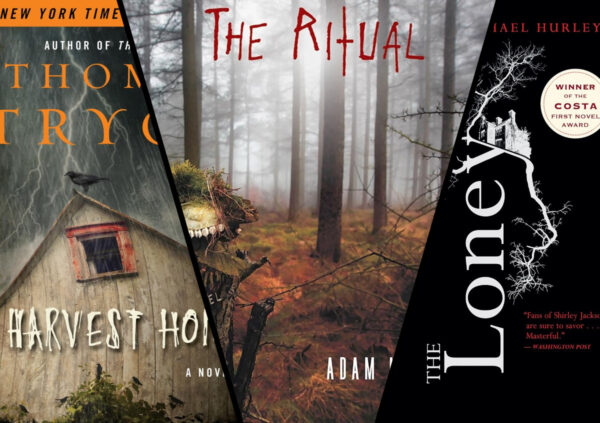
It won the Costa First Novel Award, which is not where you expect a folk horror debut to end up, and it did more than anything else to make the current revival commercially visible.
Devil’s Day (2017) and Starve Acre (2019)

Hurley’s second and third novels, and both are better than his celebrated first.
Devil’s Day takes place over a few days in a Lancashire sheep-farming valley where a man returns with his pregnant wife for his grandfather’s funeral, and stays for the Devil’s Day rituals: the annual gathering of the flock down from the moor, and the songs, and the practices that keep something out. The farming detail is exact and unsentimental, and Hurley is very good on how a family absorbs an outsider by giving her jobs.
Starve Acre is the better book. A Yorkshire couple lose their five-year-old son, and the mother becomes convinced he is still present, and the father starts digging in the field beside the house where an oak reportedly stood, a hanging tree, and finds bones which begin to reassemble.
Both are short, both are about grief and land, and Starve Acre has an ending that arrives quietly and does not console anybody. Filmed in 2023.
The Ritual (2011)

Late-thirties university friends, four of them, the friendship mostly expired, cut through ancient northern Swedish forest on account of one bad knee and a collective refusal to admit the hike has won.
They get lost. They find a carcass strung high in a clearing, opened in a way no predator manages. Eventually, they find a house, and in the attic of the house there is a figure made of bone and antler that somebody has been maintaining.
The folk horror is the second half, and it is why the book divides readers so completely. There are people living out there who have kept a practice going, and what they have kept is real and requires feeding, and Nevill lets you meet them rather than leaving them as an implication.
The opening half is peerless on being lost among trees: the wet, the fatigue, the bickering, the arithmetic of being outnumbered by forest.
The creature is among the very few in modern horror that can bear the showing, and what carries it is context: Nevill gives it a congregation, and a thing that is worshipped arrives pre-explained.
The Reddening (2019)
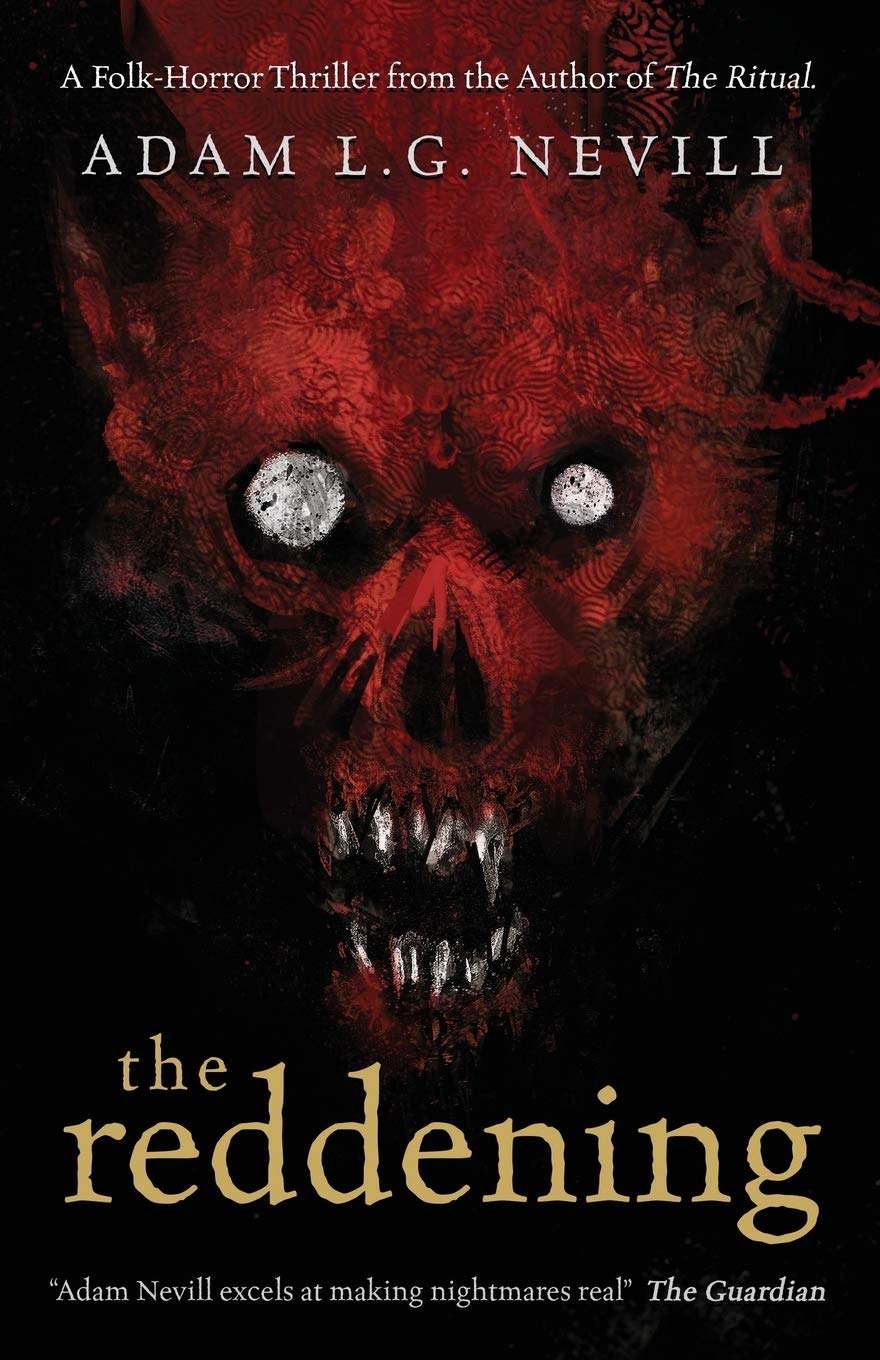
The most thoroughly researched book on this page, and the argument it makes is the strongest case for the whole subgenre.
Kat is a journalist in south Devon writing lifestyle copy. Helene is a former musician whose brother died locally in circumstances nobody explained. What connects them is a cave system near the coast where an excavation has turned up bone, a great deal of it, human and otherwise, going back sixty thousand years.
Nevill’s position holds the deep past literally, not metaphorically, present in the English landscape: a practice begun in the Paleolithic that simply never found a reason to stop. Not a revival, not a survival from the seventeenth century, but continuous occupation of the same ground by people doing the same thing.
The archaeology is real. Devon caves have produced some of the oldest human remains in northern Europe, and Nevill did the reading.
It is long, patient, and the depiction of the modern cult is the most convincing anybody has written: not robed fanatics but families, money, land, and a local network that closes.
Ghost Wall (2018)

Silvie is seventeen. Her father, a bus driver and amateur enthusiast for the Iron Age, has brought the family to Northumberland to join a university experimental archaeology course, living for two weeks as Britons did two thousand years ago: foraging, wearing tunics, sleeping in a roundhouse.
The students treat it as a lark and buy crisps in the village. Silvie’s father does not.
The folk horror is the ghost wall itself, a palisade topped with skulls that the Britons built to frighten the Romans, which the group construct as a project. And it means the bog bodies, her father’s constant subject, mostly young women, mostly killed by their own communities.
Moss is writing about domestic violence and nationalism at the same time and never says either word. The father’s obsession with authentic Britishness and his control of his wife and daughter are the same thing, and the novel makes the connection through the archaeology rather than through argument.
A hundred and thirty pages, and the last twenty are as tense as anything in modern British fiction.
HEX (2016)

A seventeenth-century witch walks the Hudson Valley town of Black Spring. Eyes sewn shut, mouth sewn shut, Katherine van Wyler turns up in kitchens and bedrooms and at the foot of beds, where she will stand for days.
The town has adapted. There is a council, a system of surveillance cameras, a phone app that tracks her position so residents can avoid her, and a rule that nobody who moves in may ever leave. Tourists are managed. Children are taught the protocols.
The folk horror is the accommodation rather than the witch. Four centuries of arrangement, quietly enforced, and the horror arrives when a group of teenagers decide to livestream her and the town’s response is not to stop them but to punish them, in the old way.
He wrote it first for a Dutch village and then rebuilt it from the ground up for the American edition, new setting, new history, new ending, a thing translated novels essentially never do.
The last fifty pages are genuinely nasty. Olde Heuvelt had already won a Hugo for a novelette; HEX is the book that made his name in English.
Slewfoot (2021)

Colonial Connecticut, 1666. Abitha arrives from England as a mail-order bride to a farmer who is decent and does not last long, and she is left alone with a debt to her brother-in-law and a farm she is not permitted to keep.
In the woods, something is waking. It has been called many things and does not remember most of them, and it does not know yet whether it is a protector or a slaughterer.
What Brom writes is genuine survival, no invented cult, with the theology handled carefully. It’s the Puritans who arrive carrying a cosmology into land that possessed its own, their God rendered real and cruel, while the thing in the woods turns first into what Abitha needs, then into what the village swears she has been all along.
It is unambiguously on the side of the accused, which after a hundred pages of Puritan procedure is a relief.
Brom is a painter first and the book is illustrated throughout with his own work, which is worth having in physical form.
Small Angels (2022)

A village in the west of England, a wood called Mockbeggar that nobody enters, and a family who have been keeping something in it for generations.
Chloe is getting married in the old church at Small Angels and has no idea about any of this. Kate has come home for the first time in ten years and does very well know, because she and her sisters grew up in the house at the edge of the wood, keeping the rules their grandmother set: never go in after dark, never take anything out, never listen to the singing.
Bissell’s structure alternates between the wedding preparations and the childhood, and the ghost at the center is a girl called Harry who was one of them.
What makes it work is that the wood is not malevolent so much as owed. There was a bargain, generations back, and the family have been paying it, and the payments have been getting harder.
It is a debut, the prose is genuinely good, and the ending is sadder than it is frightening.
The Critical Text

If the mode itself interests you, Adam Scovell’s Folk Horror: Hours Dreadful and Things Strange (2017) is the book that defined the field. It’s the source of the landscape-isolation-belief-happening chain, and it covers the films alongside the fiction.
Where to Start
Read “The Lottery” first. Fifteen minutes, and it’s the purest version of the idea anyone has managed.
Then Harvest Home, which is the great neglected novel of the mode, or Starve Acre if you’d rather have something short and modern.
For the one that gets under the skin, read The Reddening, patiently.
And if you want to see where the whole thing came from, read “The White People” and then “The Shining Pyramid”, in that order.
The older end of the shelf is on my horror classics page. Arthur Machen is where most of this starts.