Religious horror is the subgenre where the cosmology itself is the monster.
That’s the distinction worth having before you start, because it separates this shelf from possession, which is the neighboring one. A possession novel asks what’s inside this person and how do we get it out. A religious horror novel asks what kind of universe permits this, who’s running it, and whether the answer is worse than nothing at all. The Exorcist is both at once, which is why it’s the most famous book in either category, but most of the titles below are only one.
The best religious horror books are almost always written by people who take the theology seriously, believers and former believers in roughly equal number. That’s why the subgenre has a much higher hit rate than its reputation suggests: it’s very hard to write a frightening book about damnation if you think damnation is silly.
There’s a separate guide to possession books if the entity rather than the cosmos is what you’re after.
Some of these I’ve read. I’ve said which.
Fiction by René Rehn


The Ancestors
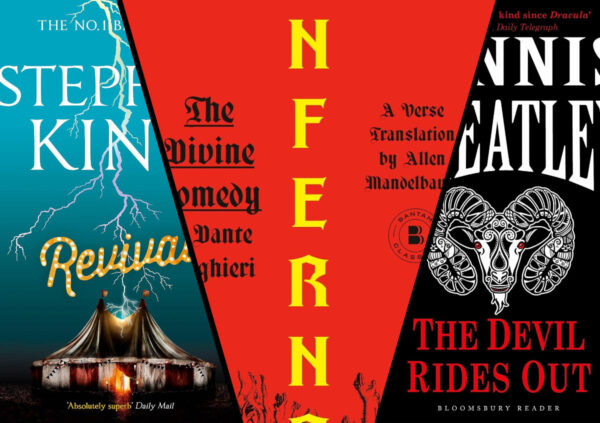
Inferno (c. 1320)

This is the foundational text for everything on this page, and the thing to understand about it is that Dante’s Hell is an administrative system.
It has nine circles, subdivisions, a filing procedure, and a monster at the entrance to each level who processes the arrivals. Minos wraps his tail around a soul the appropriate number of times to indicate its destination. Every punishment is a contrapasso, matched exactly to the sin: fortune-tellers walk with their heads twisted backwards because they tried to see forward, the violent boil in a river of blood, flatterers stand in excrement.
The religious horror is that all of it is just. Dante isn’t describing cruelty, he’s describing a correctly functioning machine, and the poem’s horror comes from that rather than from any of the imagery.
The bottom is the surprise. Hell’s lowest point isn’t fire but ice, a frozen lake with Satan waist-deep in it, weeping and beating three sets of wings, which is exactly what keeps it frozen.
Get a translation with real notes, because a third of the people in it were Dante’s political enemies, and you need somebody to tell you who.
Paradise Lost (1667)

This is the most influential depiction of Hell and its occupant in the English language, and almost everything on this page sits downstream of it.
Milton opens in Hell after the war in heaven is already lost, with the fallen angels lying on a lake of fire, and the first two books are the best thing in the poem: the debate in Pandemonium about what to do next, Satan volunteering to travel to the new world alone, and the passage through Chaos.
The religious horror is the argument Milton never intended to make. His Satan is magnificent, articulate, courageous and wrong, and generations of readers have found him more compelling than God, which Blake summarized by saying Milton was of the Devil’s party without knowing it.
The theology is serious, and Milton meant every word of it. He was a Puritan polemicist who had defended the execution of a king and gone blind, and he was writing to justify the ways of God to men.
Read Books I and II, and the temptation in Book IX. The middle is heavy going, and honestly, nobody will know.
Faith as the Subject
The Monstrance (1915)

A short story from 1915, about ten pages long, and one of the strangest things Machen ever wrote.
An officer on the Western Front, a hard, brutal man who has been in the fighting since the start, begins hearing a bell where there is no bell, and seeing a light he cannot account for. The religious horror is the reversal: what’s following him is not demonic, and its presence is unbearable to him precisely because it isn’t.
Machen was working as a journalist during the war and wrote a number of these, of which “The Bowmen” is the famous one, because it accidentally created the legend of the Angels of Mons. Readers took his invented story about phantom archers at Mons as reportage, it circulated as fact, and Machen spent years unsuccessfully insisting he had made it up.
“The Monstrance” is the better story, and almost nobody has read it.
You’ll find it in The Great God Pan and Other Horror Stories from Oxford World’s Classics, which is the best single Machen volume in print.
More on the Arthur Machen page.
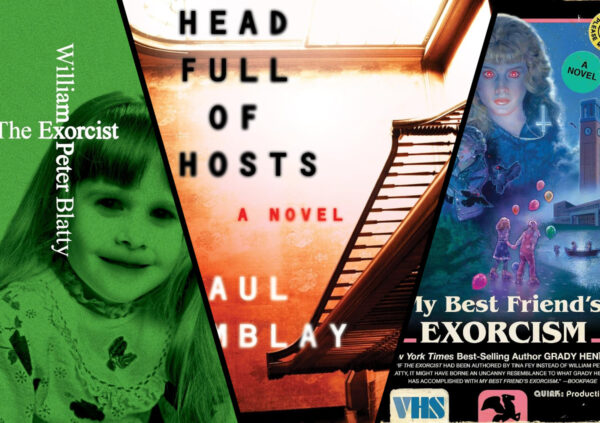
The Exorcist (1971)

Chris MacNeil has brought a film production to Georgetown, and partway through the shoot, her twelve-year-old daughter Regan stops being herself.
Blatty then burns through the entire medical establishment first: the pediatricians, the neurologists, the psychiatric consults, the pneumoencephalogram rendered in cold procedural detail, the suggested temporal lobe lesion. Only when every last test has failed does anybody reach for the word exorcism, and that patience is precisely why the possession lands the way it does.
The religious horror is Damien Karras. A Jesuit with psychiatric training and no faith left, he carries his mother’s death like an open wound: she died by herself, in a tenement he never got her out of, while he was away. Regan is the mechanism. Karras is the subject.
Blatty stated repeatedly, in print, that the novel was meant to argue God’s existence, his reasoning being that if one demon is real, then so is the order it deserted.
It’s based loosely on a documented 1949 case in Maryland that he read about as a Georgetown student. He wrote the screenplay himself and won the Academy Award for it.
Silence (1966)
1966 · translated by William Johnston · 1969

Two Portuguese Jesuits travel to Japan in the 1630s, during the persecution, to find their old teacher, who has reportedly apostatized under torture.
The religious horror is the fumie. Suspected Christians were made to step on a bronze image of Christ, and those who did were released, and Endō’s novel turns on Rodrigues being asked to do it. Not to save himself. To stop the torture of Japanese peasants who have already apostatized and are being hung upside down over a pit until he complies.
The argument the inquisitor Inoue makes is the strongest in the book, and it’s no caricature. His position is that Christianity cannot root in Japan, and that the missionaries are killing people over a doctrinal point.
And the silence of the title is God’s, which Endō was writing about as a Japanese Catholic, from a position of genuine faith and genuine doubt at once.
The book stayed controversial among Japanese Catholics for decades. Scorsese spent twenty-eight years trying to film it and finally did in 2016.
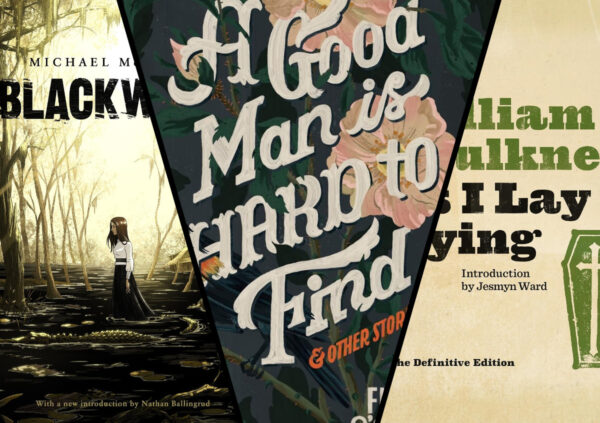
Wise Blood (1952)

Hazel Motes comes back from the war, arrives in a Tennessee city with no money, and founds the Church Without Christ.
His preaching goes like this: there was no fall, so there was nothing to redeem, so there is nothing to be saved from. He shouts it from the hood of a car outside cinemas. Nobody listens except a boy with a stolen gorilla suit, a blind preacher who isn’t blind, and a con man who sets up a rival church with a hired prophet.
The religious horror is O’Connor’s theology, and it has real teeth. Grace, in her fiction, travels by violence; salvation gets administered like an injury; and she never once softened the principle.
So the closing pages, quicklime, then glass and wire in the shoes, arrive without any framing of madness. The novel holds that Hazel has grasped something true and is settling the bill for it.
It was her first novel, years in the writing as the lupus advanced.
Also on southern gothic.
Revival (2014)

Charles Jacobs comes to a small Maine town as its new Methodist minister, young family in tow and a private fascination with electricity, and six-year-old Jamie Morton is one of the first people he meets.
Then a road accident takes Jacobs’s wife and son. The sermon he gives afterwards is the one the town never forgets: religion, he tells his congregation from the pulpit, is an insurance racket, and not one policyholder has ever returned to confirm the payout. The parish removes him.
Across the next fifty years, Jamie keeps crossing his path, first as a carnival act, then as a tent-revival healer, and finally as something with no name at all, and everywhere Jacobs goes, his electricity genuinely cures people, and quietly takes something in exchange.
The religious horror is King’s answer to what waits behind the door, and the answer is Machen’s. He has said outright that rereading The Great God Pan is what set this book off, and that his goal was the bleakest thing he could write.
The final twenty pages carry the most nihilistic ending anywhere in his catalog, and readers split between admiring the nerve and resenting the trick.
More on the best Stephen King books.
Hell as a Place
A Short Stay in Hell (2012)

I’ve read this one, and it’s the best idea on this page.
Soren Johansson is a devout Mormon who dies of brain cancer and discovers that the correct religion was Zoroastrianism. He gets assigned to a hell, and the terms are stated plainly: somewhere in it is a book containing the exact and complete story of his life, and when he finds it, he may leave.
The hell is a library, modeled openly on Borges. Its shelves contain every possible book that can be produced from the available characters at the available length. Not every book that has been written. Every book that could be.
The mathematics are the horror, and Peck actually does the arithmetic rather than gesturing at it. Almost every volume is gibberish. Of the ones that aren’t, most differ from each other by a single character. A book that is your life with one word wrong is indistinguishable from a hit until you’ve read far enough to find the error, and there are more near-misses than there are atoms in the observable universe. The library is finite, and that’s the cruelty of it. An infinite library would be hopeless in a way that is almost restful, and a finite one means the search is theoretically completable, so you cannot ever stop.
And Peck lets you sit with the timescale. Bodies regenerate. People fall from the shelves and come back. The residents organize, form societies, invent religions about the library, develop and abandon whole cultures, fall in love, and forget languages, across spans that make recorded human history a rounding error. The best material in the book is anthropological rather than infernal: what a population does with unlimited time and one task, and how many times it can rebuild civilization before the point of rebuilding stops being obvious.
It runs to about a hundred pages, which is exactly the right length for it.
My reservation is the humor. There’s a fair amount of it, it didn’t land for me, and it sits oddly against material this bleak. The idea is strong enough that it doesn’t much matter, and a reader who finds the comic register works will rate the book higher than I do.
It’s also, unavoidably, a book about faith by a believer. Peck is a Mormon and a biologist, and the novel is doing something considerably more serious than a thought experiment: it’s asking what devotion is worth when the god you were devoted to turns out not to have been the one in charge, and what a person even is once every part of their identity has been worn away by time.
God’s Demon (2007)

I’ve read this, and the imagery is the reason to buy it, which is not surprising, because Barlowe is a painter first and one of the best creature designers alive.
His Hell runs like a country. There’s a map to it, a working economy, a political order that hasn’t shifted since the fall, and cities whose bricks used to be people. The damned are the industrial base here, fired and shaped into building material, into implements, into furnishings, and Barlowe walks you through the production line step by step.
Sargatanas is a fallen general who has grown sick of all of it and is attempting something no demon has ever considered, which is to earn his way back to heaven by force of arms.
The religious horror is the question underneath the campaign: can a being who fell with his eyes open buy his way back, and what kind of God would have to be holding the ledger.
My reservation is that the story is thin and the characters are functional. The world is extraordinary, the plot moving through it is not, and that gap is the whole verdict. The Heart of Hell continues it.
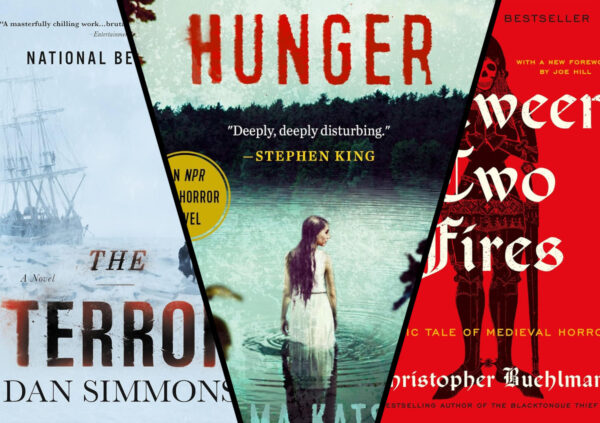
Between Two Fires (2021)

It’s 1348, the plague year, and a knight who broke and ran at Crécy is making his way north across a France that has mostly stopped burying its dead. An orphaned girl travels with him, and she says the angels talk to her.
The religious horror is that heaven’s war never actually finished, and at this particular moment, heaven is losing. Buehlman’s demons walk around in bodies, individually named and everywhere, and temptation isn’t their business. Governance is. France belongs to them for now, while whatever should be watching looks away.
The girl’s visions are written as true, never as poignant delusion, which is the braver call and the one the whole book stands on. Thomas doesn’t believe her for a second, and he follows her anyway.
The theology gets serious in the last act, and the confrontation is genuinely apocalyptic in the technical sense rather than the marketing one.
And the historical floor under it all is solid: death tolls, emptied villages, flagellant processions, the massacres of Jewish communities scapegoated over the wells, every piece documented. The supernatural arrives in a world already at its end.
Also on historical horror.
The End of the World, Arranged
A Canticle for Leibowitz (1959)

Six hundred years after a nuclear war, an order of monks in the American southwest preserves fragments of pre-war knowledge they cannot read: a shopping list, a circuit diagram, a blueprint. Their founder was an electrical engineer.
Three sections, separated by centuries: the discovery of the relics, the return of scholarship and a new secular power, and eventually spaceflight and a second nuclear crisis.
The religious horror is the argument the novel makes about the Church and time. The monks are frequently absurd, copying documents they don’t understand and illuminating a circuit diagram in gold leaf, and Miller’s position is that the absurdity is the argument, and that preservation without comprehension is exactly what carried Europe through the last collapse.
The final section, in which the Church must decide its position on euthanasia for radiation victims, is uncompromising, and it’s where the theology stops being decorative.
Miller flew fifty-three bombing missions in the war, including the destruction of the monastery at Monte Cassino, converted to Catholicism afterwards, and killed himself in 1996.
The Damnation Game (1985)

Barker’s debut takes the Faust story and declines to strip out the theology.
Marty Strauss gets released from prison into a bodyguard job, watching over Joseph Whitehead, a rich recluse who is plainly terrified of something. The Faust of it happened in Warsaw, 1945, among the rubble: a card game against a man called Mamoulian, a win, and a fortune built entirely on that win that has never once been paid for.
The religious horror is that Mamoulian is a creditor rather than a devil. He’s patient, reasonable and entitled, the terms were always clear, and Whitehead agreed to them freely. Nobody was deceived at any point, and the total absence of deception is what makes the arrangement so terrible.
Then there’s Breer. Mamoulian pulled him back from death and kept him on as staff, he’s the most repulsive creation in Barker’s whole catalog, and his chapters take real stamina.
Arriving right on the heels of the Books of Blood, it’s structurally the most conventional thing he’s written, and that’s exactly why some readers place it below Weaveworld while others call it his best.
More on the Clive Barker page.
Cults, Heresy and the Wrong God
The Devil Rides Out (1934)

The English occult thriller starts here, and so does an entire generation’s mental image of the black mass.
The Duke de Richleau and his friends learn that young Simon has been drawn into Mocata’s satanic circle, and they mount a rescue.
The religious horror is that Wheatley plays the mechanics completely straight. The pentacle night is the famous set piece: rules laid out beforehand, a circle chalked on the library floor, and long hours of things outside trying to talk, trick and terrify the party across a line they were warned never to cross. It works because the rules hold, and every disaster follows from somebody breaking one.
Wheatley moved fifty million copies across sixty-odd books after the wine business failed, and he spent the war inventing lies for Allied deception planners.
The uncomfortable part is how much of it Wheatley took seriously in his own life, and his occult non-fiction swallows nearly everything whole. The politics elsewhere in his catalog are worse still.
Song of Kali (1985)

Robert Luczak, a poetry editor, travels to Calcutta with his Indian wife and their seven-month-old daughter to recover a manuscript by a poet who has been dead for eight years and is apparently publishing again.
The religious horror is the Kapalikas, a cult devoted to Kali, and what they claim to have done. Simmons draws on real Tantric material and on the goddess as she actually appears in Hindu practice, which is considerably stranger than the Western version of her.
What the summaries always miss is where the book’s heart sits: this is a story about fatherhood wearing a cult story’s clothes. The turn, when it comes, happens at home, and the closing stretch follows a man reaching after something no reaching can recover.
And the fault line has to be named. Simmons visited Calcutta himself and has been open about loathing it, and the city in this novel actively rots whoever enters it. Four decades of criticism on that point is fair comment rather than squeamishness.
It won the World Fantasy Award, and he never repeated the formula.
Slewfoot (2021)

Colonial Connecticut, 1666, and Brom is unambiguous about which side the novel is on.
Abitha comes over from England as a bought bride, gets widowed inside a season, and inherits a debt to her brother-in-law along with a farm the law won’t let her hold. The village decides what a woman alone represents, and its machinery engages: charges, examinations, the hunt across her skin for marks, testimony from neighbors who stand to gain.
The religious horror is the Puritans’ God, presented as real and cruel, and their certainty as the imported thing. Father, waking in the woods, has been there far longer and doesn’t recognize their categories, and the novel’s argument is that they’re the colonists in a cosmology as much as in a country.
He becomes what Abitha needs, and then what the village insists she already is, and that transaction is the actual subject.
Brom’s day job is painting, his own plates fill the book, and a screen wastes them. Buy the physical object.
Also on witch trials books.
The Last Days of Jack Sparks (2016)

Jack Sparks debunks things for a living, bestselling books, a devoted following, a coke habit that fools nobody except Jack. Researching his next takedown, a book against the supernatural, he attends a village exorcism in Italy, and midway through the rite, he laughs.
The religious horror is what that laugh costs. The sacred, it turns out, keeps accounts. Soon there are videos on Jack’s YouTube channel with no upload history and no delete option, and whatever he mocked has begun a correspondence.
What you’re holding, the frame insists, is the manuscript Jack never finished, brought out after his death by his brother Alistair, whose corrective footnotes run underneath the whole text. Read those footnotes closely. They’re the finest thing here, and without them you have no way to calibrate Jack at all.
For most of its length it’s flat-out funny, with Jack as one of horror’s great comic monsters, a portrait of insufferability drawn from life.
Where it loses some readers is the finish, which trades the setup’s originality for something more familiar, and that’s a fair complaint.
One of Mine
New Haven (2024)

Full disclosure: I wrote this one, so treat the recommendation accordingly. It’s here because it belongs on the list rather than because I need the space.
A girl is found dead in New Haven, Minnesota, a small and devoutly religious town, and she is the pastor’s daughter. Ethan Miller, the only self-proclaimed atheist in the place, sets out to work out what happened, and enlists David Sullivan, a sheltered Christian boy who has never had a reason to doubt anything.
It’s a slow burn and a mystery before it’s anything else. What I was interested in is what a small isolated community will do to keep its picture of itself intact, and what happens to two boys on opposite sides of a faith divide when they start finding the same answers. The Christian imagery is load-bearing rather than decorative, and the doubt runs in both directions: Ethan’s certainty gets tested as hard as David’s.
If you want the sub-genre with the theology taken seriously and the pace kept low, it’s that kind of book. Some secrets are better left buried.
The nonfiction

Huxley’s The Devils of Loudun reconstructs the 1634 possessions at a French Ursuline convent, a case that finished with a priest at the stake. Nothing on this page is better written, and what interests Huxley is the machinery underneath: mass hysteria, sexual repression and political convenience.
Where to start
Start with The Exorcist, which is up to something far more interesting than frightening you.
Read Silence if you want the one that will genuinely disturb you, and know that it isn’t shelved as horror anywhere.
Read A Short Stay in Hell if you want the best idea, and it takes two hours.
And read Between Two Fires if you want demons on the page rather than in the argument.
If slow-burn religious horror mystery is what you’re after, New Haven is mine, and I’ve said my piece about it above.
My best horror books list ranks the rest of the genre. Where the faith becomes an invasion, my possession books list takes over.