In 1984 Stephen King handed Clive Barker a single sentence that trailed him ever after: the future of horror had a name, King said, and the name was Barker’s.
It was generous, it sold an enormous number of books, and it was also slightly the wrong shape. Barker wasn’t the future of horror. He was a fantasist who arrived at the horror shelf because that’s where the books about bodies were kept, and within five years he’d walked off it into something else entirely and taken a large readership with him.
The thing that actually distinguishes him is that he keeps siding with the monsters. In Cabal, the creatures living under the graveyard are the ones worth saving and the psychiatrist is the villain. The Cenobites in The Hellbound Heart are not evil, they’re a priesthood with an aesthetic, and the humans who summon them are the ones being greedy. Weaveworld hides an entire civilization inside a carpet and asks you to grieve for it. Barker’s imagination runs toward transformation as an invitation rather than a punishment, which is why his work is erotic in a way almost nothing else in the genre is, and why it makes some readers deeply uncomfortable in ways that have nothing to do with gore.
He also rejected the splatterpunk label while writing the book that defined it, describing his work instead as tearing away the veil to look at the wound underneath.
So: painter, filmmaker, novelist, and the only person in modern horror who could plausibly be described as a visionary rather than a craftsman. This is a guide to the Clive Barker books, which split into three fairly distinct careers. horror books
I haven’t read these. What follows is the critical consensus rather than my own verdict.
Fiction by René Rehn


The Short Version
Read Books of Blood. It’s the reason for the King quote, it won both the British and World Fantasy Awards, and it’s still the most influential horror collection since Poe.
Then The Hellbound Heart if you want the compressed nightmare, or Weaveworld if you want to see where he actually went.
Skip nothing on principle, but understand that the man who wrote Books of Blood spent most of his career not writing more of it. That changed in August 2026, and the last section on this page covers what is coming.
The Clive Barker books divide fairly cleanly into the horror, the fantasy, and the ones for younger readers, and a reader who arrives for one is frequently surprised by the others.
Books of Blood (1984 to 1985)

Six volumes, roughly thirty stories, published over eighteen months by a thirty-two-year-old Liverpudlian nobody had heard of. It took both the British Fantasy Award and the World Fantasy Award, and after it, horror short fiction had different permissions. No other entry in the Clive Barker books catalog has been as influential.
The stories are famous for their physicality. Bodies open, rearrange, merge and become other things, and Barker describes it with the attention of someone who paints. body horror But the consistent note in the criticism is that the gore is not the point and never was. These are stories about transcendence that happen to route through the flesh, and the most disturbing ones are disturbing because something in them is being offered rather than inflicted.
The standouts by general agreement: “In the Hills, the Cities”, in which two rival towns in Yugoslavia assemble their populations into two enormous human giants and make them fight, which is the single most-cited Barker story and one of the strangest things in the genre. “The Midnight Meat Train”. “Dread”, which has no supernatural content at all and is worse for it. “The Forbidden”, which became Candyman. “Rawhead Rex”, “Pig Blood Blues” and “Son of Celluloid”.
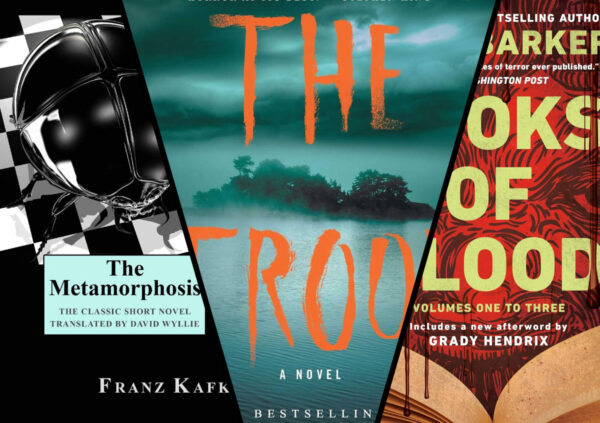
Modern editions bundle them as volumes 1 to 3 and 4 to 6, with a new afterword by Grady Hendrix on the first.
The Horror Novels
The Damnation Game (1985)

His first novel, published straight after the Books of Blood, and a Faust story with the theology left intact.
Marty Strauss is released from prison to work as bodyguard to Joseph Whitehead, an immensely wealthy recluse who is terrified of something and will not say what. In the ruins of Warsaw in 1945 Whitehead played cards with a man called Mamoulian and won, and what he won is everything he now has, and the debt has never been settled.
Mamoulian is the best thing in it. He is not a devil and does not claim to be. He is a creditor: patient, reasonable, entitled, and correct. Whitehead read the terms, understood them, and accepted freely, and that makes it considerably worse than trickery.
The most repulsive figure Barker ever created is Breer, dead once already, raised by Mamoulian and kept on as a servant. Across the whole novel he rots while he goes on functioning, and his chapters ask a strong stomach of the reader.
Structurally it’s his most conventional novel, and opinion splits on it for exactly that reason.
The Hellbound Heart (1986)

A hundred and thirty pages, and it produced the most recognizable horror franchise after Freddy and Jason.
Frank Cotton has exhausted every available pleasure and buys a puzzle box from a dealer in Düsseldorf on the understanding that solving it summons the Cenobites, who will show him something new. It does. They do. What he gets is not what he was expecting, and the novella’s argument is that he had no grounds for expecting anything else, because he asked for sensation without qualification and that is precisely what he received.
Then his brother’s wife Julia, who slept with Frank once before the wedding and has thought about nothing else since, finds what is left of him in an upstairs room and starts bringing him men.
The Cenobites are the invention, and the novella’s version is considerably stranger than the films: they are not demons, they are explorers, and their aesthetic is surgical rather than gothic.
Barker filmed it himself in 1987 as Hellraiser because he had seen two of his scripts ruined and decided to direct.
Cabal (1988)

A short novel, about two hundred pages, and the source of Nightbreed.
Boone is a young man with a psychiatric history whose therapist, Decker, has convinced him he is responsible for a series of murders. Decker committed them. Boone runs, hears about a place called Midian where the monsters live, finds it, and is admitted.
The inversion is the whole book, and no clearer statement of Barker’s position exists anywhere. The Nightbreed are the last of several species, hunted almost to extinction, hiding under a Canadian cemetery, and they are not evil. The humans are. Decker is a serial killer in a button-faced mask, and the police who eventually come for Midian are a lynch mob.
Barker filmed it himself in 1990 and the studio took it away from him and recut it. The Director’s Cut, restored in 2014, is the film he made.
The novella is the better version regardless, because it stays with Boone’s transformation rather than the siege.
Coldheart Canyon (2001)

A Hollywood novel and the closest Barker came to writing about the industry that had been adapting him for fifteen years.
Todd Pickett is a fading action star who has a facelift go wrong and hides in a Spanish-style mansion in a canyon above Los Angeles while he heals. The house belonged to Katya Lupi, a silent-era actress who has been living there since the 1920s and has not aged.
The reason is a room. It is tiled floor to ceiling with a hunt scene, made in Romania, brought over in pieces, and the world depicted in it is a real place that can be entered.
The ghosts are the dead of old Hollywood, still at the parties, and Barker is unsparing about what the industry did to them and continues to do.
It is long, it is uneven, and the satire is broader than his usual work. The Devil’s Country sections are extraordinary and the celebrity material dates it.
The Scarlet Gospels (2015)

Harry D’Amour against Pinhead, promised for two decades, and no book in his catalog disappoints more.
The premise is that the Cenobite, whom Barker names the Hell Priest and who is contemptuous of the Pinhead nickname, sets out to take over Hell, and D’Amour, the occult detective from The Last Illusion and Everville, follows him down.
The reason to read it is that it closes both characters off, deliberately. Barker has said he wanted to end them rather than leave them to other people.
The reasons not to are widely agreed. It was announced in the nineties, drafted at enormous length, cut by more than half, and delayed through his years of illness, and the seams show. The prose is flatter than his best, the Hell material is less inventive than The Hellbound Heart, and D’Amour is a thinner character than he was in 1989.
Read it only if you are invested.
The Fantasy Novels
This is where he actually went, and where his most committed readers say the real work is.
Weaveworld (1987)

His second major novel and the one that established the shape of everything that followed, which is fantasy with horror inside it rather than the reverse.
A carpet in a house in Liverpool contains a world. The Fugue is the last refuge of the Seerkind, a magical people who wove their entire country into it to hide from something called the Scourge, and it has been sitting rolled up in an ordinary house.
Cal Mooney sees it from a rooftop. Suzanna inherits the responsibility for it.
The pursuit is what makes it work. Immacolata is a Seerkind witch with two dead sisters who accompany her, and Shadwell is a salesman whose jacket shows anybody who looks into it the thing they most want, and he uses it to buy his way through the story. That jacket is one of Barker’s best inventions.
It is long and the middle sags and the imagination is relentless throughout.
Barker has said Liverpool is the real subject.
Imajica (1991)

His largest novel, over eight hundred pages, and the one he has repeatedly called his best.
Earth is the Fifth Dominion and it has been separated from the other four for two thousand years. Gentle is a forger, Judith is a woman with two versions of herself, and Pie’oh’pah is an assassin who is a shape-shifting creature with no fixed sex. The three of them travel through the Dominions toward the city of the Unbeheld.
The reconciliation of the Dominions carries the plot, and the theology carries the meaning. Barker is writing directly about God as a figure who can be met, argued with and held responsible, and the last section is genuinely blasphemous in a way almost nothing else in commercial fiction attempts.
The relationship between Gentle and Pie is the most sustained thing he wrote about desire, and it was published in 1991 by a mainstream house with no apparent negotiation about it.
It is demanding and enormously ambitious. Readers who love it consider it a major novel and they may be right.
The Great and Secret Show (1989) and Everville (1994)

The two Art books, meant to be a trilogy and never finished, which is the recurring problem with his later career.
A mail sorter in a Nebraska dead letter office reads other people’s correspondence for years, works out from the accumulated fragments that there is a sea called Quiddity behind reality that every human being visits three times in their life, and finds a way to reach it.
That premise is the best idea Barker had. Quiddity is visited on the night you are born, the night you first sleep beside somebody you love, and the night you die, and everybody has been there and nobody remembers.
The Great and Secret Show is the war between two men who found the way in. Everville takes it to a small Oregon town where the boundary is thin and brings back Harry D’Amour.
The third book was to be called The Third Book of the Art and does not exist.
Both are big, messy and inventive, and the Nebraska opening is superb.
Sacrament (1996) and Galilee (1998)

The two mid-career novels that are least like the rest of him.
Sacrament follows Will Rabjohns, a wildlife photographer who documents endangered species, who is mauled by a bear in Hudson Bay and lies in a coma revisiting a childhood encounter with two immortals, Jacob Steep and Rosa McGee, who go about the world extinguishing the last members of species deliberately.
It is his most personal book. Will is gay, the novel is set partly during the AIDS epidemic, and the extinction material and the epidemic material are the same argument. Barker has said it is the closest thing to autobiography he has written.
Galilee is a family saga, deliberately, about two dynasties in America: the Gearys, who are old money and mortal, and the Barbarossas, who are neither. It is closer to Anne Rice than to anything else in his catalog.
Both are divisive. Sacrament is the better novel and the one his serious readers defend.
The Books for Younger Readers
The Thief of Always (1992)

A children’s book, illustrated by Barker himself, and one of the two or three best things he has written.
Harvey Swick is ten and it is February and he is bored past endurance. A man called Rictus appears at his window and offers him the Holiday House, where it is Christmas every evening, Halloween every night, spring every morning and summer every afternoon, and where anything he asks for arrives.
He goes. It is wonderful. And it takes him about a hundred pages to work out what the house is charging.
The mechanism is the best thing Barker invented and it is genuinely upsetting once you see it, and children see it faster than adults do.
Mr. Hood is a villain in the proper tradition, and the fish in the lake are the image that stays.
It is short, it is not condescending, and it works completely for adults. Barker has said it is the book he is asked about most by people who read it young.
The Abarat series (2002 onwards)

A projected five-book fantasy sequence for younger readers, with over four hundred of Barker’s own oil paintings reproduced in the text, and it is unfinished.
Candy Quackenbush leaves Chickentown, Minnesota, and arrives in the Abarat, an archipelago of twenty-five islands where each island exists permanently at one hour of the day. Christmas Eve is an island. Three in the morning is an island. The Twenty-Fifth Hour is outside time.
The design is the reason to own them physically. Barker painted the world before he wrote it and the books are printed in full color on heavy stock, and the creatures are among the best things he has made in any medium.
Three volumes exist: Abarat, Days of Magic, Nights of War, and Absolute Midnight. The fourth has been announced repeatedly since 2011.
Disney bought the rights before publication and never made anything.
The unfinished state is the recurring frustration with late Barker, and it is worth knowing before you start.
The Silence, and the End of It
Worth knowing before you start anything unfinished, and it now has an ending.
In 2012 a dental procedure gave Barker toxic shock syndrome. He was in a coma, he nearly died, and his output has never recovered its old pace. The Scarlet Gospels in 2015 remains his most recent novel.
Since then the work has gone into art rather than fiction. Clive Barker’s Dark Worlds (Abrams, 2022) is a three-hundred-page illustrated monograph covering every medium he has worked in, assembled with his own input for his seventieth birthday, and further volumes of the Imaginer series continue to collect his paintings.
Two novels have been announced and neither has appeared. Deep Hill, originally titled Scarebaby, is a horror novel Barker has described as among the scariest things he has written and said was roughly half finished as of 2019. Kry Rising is the fourth Abarat book, from which he was reading passages at conventions over a decade ago.
Then in August 2026 he announced three finished books at once, which is covered below.
Library of the Dead (2026, publishing across 2027)
His return to short fiction, announced on August 18, 2026, and the first substantial new Barker horror in over a decade.
Three books: Fear Eternal, Pyres of Bedlam and Dark Descents, presented as a spiritual successor to the Books of Blood and containing new stories alongside rare and out-of-print short fiction, plus poetry and black-and-white illustrations he made himself. Edited by Phil and Sarah Stokes, who have been his archivists and collaborators for decades and who run his official site.
There is a detail worth having. Fear Eternal emerged from Black Is the Devil’s Rainbow, the short story collection Barker had been promising in various forms for years, so part of this has been in progress a long time.
And two of the three manuscripts are finished and in editing, which given the record above is the fact that matters.
The catch is distribution. It is a Kickstarter campaign from Clive Barker Ink and Ensata Press, published direct to backers across 2027, and no trade edition has been announced. If you want these you have to back the campaign or wait and hope.
The campaign also carries a Books of Blood remastered two-volume leather omnibus with new illustrations, which is the more tempting object for most people.
Where to Start
Books of Blood, volumes 1 to 3. It’s the reputation, it’s the influence, and it takes an evening or two.
If those work, the fork is temperamental. The Hellbound Heart for more of the same at novella length and higher intensity. Weaveworld if you’d rather follow where he actually went, which is the better answer for most people.
And The Thief of Always regardless, at any point. It’s a hundred and fifty pages and it’s the best-loved thing he ever wrote.
If you are already a reader, the news is Library of the Dead, which is the first substantial new short horror from him in decades and is only available direct.
One warning that applies across the Clive Barker books generally. He is explicit about sex and about the body in a way that catches people who arrived through the films, and he does not treat transformation as punishment, which is the thing that makes him worth reading and the thing that puts some readers off entirely.