Alone among horror’s branches, body horror asks you to believe in nothing.
No ghost, no curse, no ancient evil. Just the fact that you are a quantity of meat that can be opened, rearranged, invaded or made to do something you did not agree to, and that the thing doing the horrifying is you. Every other kind of horror asks you to accept a premise. This one only asks you to remember that you have a body.
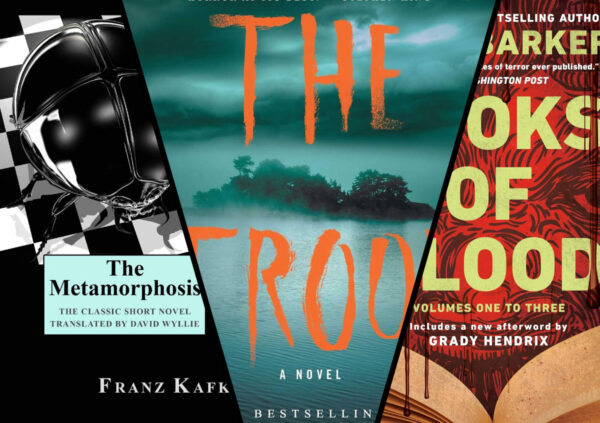
The term comes from film criticism, and Cronenberg is the reason most people know it, but the literature is older and in several cases better. What follows is the tradition in prose, from a man waking up as an insect through to the current wave.
One thing this page is not. Body horror shades into extreme horror, and the small-press end of that scene is a different reading experience with a different set of warnings attached. It’s covered separately on the extreme horror page. Everything here is horror you could hand to somebody without a long conversation first.
Several of these I’ve read. I’ve said which.
Fiction by René Rehn


The Ancestors
The Metamorphosis (1915)

It starts here, and the reason is that Kafka is interested in logistics rather than in the transformation.
Gregor Samsa wakes as an enormous insect and the change gets one sentence. Everything after it is practical. He cannot get off the bed because his legs are wrong and there are too many of them. He cannot open the door because he has no hands and has to learn to work the key with his mouth, which damages it. Then, he discovers that food he liked now disgusts him and that rotting vegetables do not. He finds he wants to hang from the ceiling, and does, and then falls.
The species is never specified. Kafka explicitly told his publisher not to put the insect on the cover, and the word he uses translates roughly as vermin rather than as any particular animal.
What makes it body horror rather than fable is that the family treat it as an inconvenience and then as an expense. Nobody screams for long. They rearrange the furniture, work out the finances, and get on with a reduced life around a locked room.
The apple his father throws is the detail that lands hardest.
The Colour Out of Space (1927)

Having read the whole of Lovecraft, I’ll say this is the one a body horror list actually needs.
It is a story about contamination working through a food chain, and Lovecraft describes every stage the way a farmer would. Something lands in a well on the Gardner place outside Arkham and the water carries it into the soil. The garden comes up oversized and inedible, gray under intact skins, the stock alters by increments the neighbors have no words for, and then the family follows the livestock.
Nabby breaks first, and Nahum’s answer is a locked door upstairs, there being no other answer available on the property. Thaddeus follows. What Nahum eventually finds in the cellar, and what happens when Ammi touches it, is the most upsetting passage Lovecraft wrote.
What makes it body horror rather than cosmic horror is the pacing. This takes a full year, it is domestic, and it is measured in crops and livestock and the state of a person’s skin.
Lovecraft called it his best work, and on that he was correct.
Also on cosmic horror.
More on the best Lovecraft stories.
Who Goes There? (1938)

At an Antarctic station, researchers cut a twenty-million-year-old body free of the ice and let it thaw.
The body horror here is the best-worked rule in the genre. The Thing is not a creature that transforms people, it is a creature that is transformation. Every cell of it is a complete organism, capable of absorbing and reproducing any living thing down to the memory and the personality. Cut a piece off and the piece is still it. Kill a man and what you have killed may have been the man.
That single rule generates everything. You cannot identify the infected by behavior, because a copy believes itself to be the original and behaves accordingly. You cannot trust a confession. And the blood test that eventually works is derived from the rule rather than invented to end the story.
The station crew are written as working scientists, careful arguers all, and the premise’s cruelty lies in careful argument being exactly what it eats.
Carpenter’s 1982 film honors the biology. Frozen Hell, a longer draft recovered from Campbell’s papers for 2019 publication, mostly demonstrates the original cut was correct.
The Fly (1957)

A short story from 1957, about six thousand words, and the source of two films that both improved on it.
André Delambre is a scientist working on matter transmission in his home laboratory. He transmits himself. A housefly is in the chamber. What arrives at the other end has the fly’s head and forelimb, and somewhere in the house there is a fly with a human head and a human arm, which his wife spends the story trying to catch.
Langelaan writes it as a confession by the wife, who has just crushed her husband in an industrial press at his own request, and the story is structured as a police inspector working out why a woman would do that and then being told.
The body horror is the arithmetic rather than the imagery. Two organisms went in and two came out, and both of them are wrong, and one of them is very small and cannot be found.
Cronenberg’s 1986 version throws out almost all of it and keeps only the transmission accident, replacing the swap with a slow fusion. It is the better film and this is the original idea.
The Eighties, When It Got Its Name
Books of Blood (1984 to 1985)

Six volumes across two years, and Barker did more to change what horror could do with a body than anybody since Poe.
The premise underneath all of it is that transformation is an invitation rather than a punishment. His characters are frequently improved by what happens to them, or at least released, and the horror is that you can see why they would consent. That one inversion divides him from the whole line of splatter writers behind him.
“The Body Politic” is the one to read for pure body horror: hands revolt against the bodies they are attached to, organize, and begin freeing each other at the wrist. It is funny for four pages and then it is not.
“Rawhead Rex” and “The Midnight Meat Train” are the other names, and “In the Hills, the Cities” is the strangest thing in the six volumes: two Yugoslav towns strap their entire populations into colossal walking bodies, and the giants meet.
Barker arrived out of London fringe theater, thirty-two years old and unknown.
More on the Clive Barker page.
Skeleton Crew and Night Shift (1978, 1985)

King’s two great collections, and between them they contain more first-rate body horror than most writers manage in a career.
“Survivor Type” is the one this page exists for. A disgraced surgeon is washed up on a bare Pacific islet with a quantity of heroin, no food and no prospect of rescue, and he keeps a diary. He is a surgeon, so he has the training, and the heroin means he has an anesthetic. The entries get shorter and the prose disintegrates at exactly the rate he does. In print, King has allowed that he possibly took it past where he should have.
“Gray Matter” is a man turning into something after drinking a bad can of beer, told by the men in the shop who have to go and check on him.
“The Raft,” “Quitters, Inc.,” “The Mangler” and “I Am the Doorway” are the others, and “I Am the Doorway” is the body horror one: an astronaut back from Venus who develops eyes in his hands that can see, and that want things.
The two collections together are the best value in the genre.
The Cipher (1991)

I’ve read this, and the imagery alone earns its place at the top of the page.
Nicholas and Nakota find a hole in the floor of a storage room in their apartment building. No bottom, no draft, no sound. They start lowering things into it on strings and filming the results, and what comes back out is the book.
The mouse comes back inverted and still alive. Then a hand goes in, briefly, and Nicholas spends the rest of the novel with a wound in his palm that will not close, will not stop producing fluid, and is doing something rather than merely being an injury. People start wanting access to it.
Koja renders it all at a precision level most writers would refuse, and the prose fractures in step with Nicholas, sentences deteriorating as he does.
And no book does squalor better: the burns, the bottles, the corroding flat, two people who were spoiling well before the hole ever found them.
The middle takes more laps than it strictly needs. The images repay every one of them.
The Modern Wave
The Troop (2014)

Two sittings is all this took me, and no purer parasite novel exists.
A weekend trip puts five scouts, all fourteen, and their scoutmaster on a speck of land off Prince Edward Island. Out of the water comes a starving man, thin past sense, begging for food, and the scoutmaster, a doctor named Tim, does what doctors do.
What is inside the man is a genetically modified worm, and Cutter is exact about the arithmetic. It eats faster than the host can feed it, so the host eats constantly and starves anyway, and the novel tracks the process through appetite, then weight, then behavior, then the visible shape of a person. There is a sequence involving a stomach that readers do not forget.
It hurts rather than merely disgusts because Cutter spends real pages on all five boys before the worm gets a line, so the island turns on people you already have opinions about.
The inquiry documents salted between the chapters hand you the ending’s shape early, which the boys never get, and the gap is where the dread lives.
Relentless, exact about appetite, and best read between meals.
More on the Nick Cutter page.
Tender Is the Flesh (2020)
2017 · translated by Sarah Moses · 2020

I’ve read it, and what earns the spot here is the slaughterhouse chapters, not the premise.
After a virus turned animal meat deadly, humanity legalized farming itself. The novel follows Marcos through his working days at a processing plant.
Bazterrica walks a body through the line in full clinical detail. The stunning, the bleeding, the scalding, the removal of the head, the sectioning, and she does it more than once and does not shorten it on the second pass. The method is that the book keeps going past the point where you assumed it would cut away, so you stop trusting it to spare you anything.
Vocabulary is what shifts it from dystopia into body horror. The word itself never appears. Stock are called heads, product, special meat, language performing the conversion of body into unit.
My reservation is that the argument sits on the surface for a long stretch before the last section closes it.
More on the Agustina Bazterrica page.
Annihilation (2014)

Area X is a coastline under quarantine for decades, and it does not behave; a survey team goes over its border anyway.
The body horror is the reason it belongs here rather than only on a cosmic horror list. The biologist narrating begins changing almost immediately after she inhales spores in the tower, and the change is not presented as an attack. She develops a brightness inside her. Her perception sharpens. She becomes less interested in leaving.
VanderMeer’s move is to refuse to say whether this is happening to her or for her. Every other body horror novel on this page treats transformation as violation. This one leaves open the possibility that the biologist is being improved, that she prefers it, and that her marriage and her career were the thing she was actually trying to escape.
The tower, a shaft into the earth lined with a living script that keeps growing its sentence just ahead of the reader, is the single best image the decade produced.
It took the Nebula and the Shirley Jackson. Garland’s film borrowed the premise and built something else entirely on it.
Under the Skin (2000)

A woman drives the A9 in the Scottish Highlands picking up male hitchhikers, and Faber withholds what she is for about a hundred pages.
The body horror runs in two directions, by design. What she does to the men is industrial and is described with total procedural calm, and it is genuinely difficult reading once you understand the facility she is delivering them to.
What has been done to her is worse. She has been surgically remade to pass as a human woman, and the surgery was extensive, painful and permanent, and it was done to her by her own species so that she could do this job. She is in constant discomfort. Her body does not work properly. She is also, in her own terms, disfigured, and the novel is quietly devastating about her relationship to how she looks.
Faber never uses the word alien and never explains the economics beyond what she knows.
Glazer’s 2013 film keeps the premise and discards the plot entirely, and the two work as separate objects.
Our Wives Under the Sea (2022)

Leah went down on a research submersible for a three-week mission. Six months later she came home to her wife Miri, and something about her is wrong.
The body horror is slow, domestic and entirely unspectacular, which is what makes it work. Leah spends longer and longer in the bath. She drinks a great deal of water. Her skin changes. She bleeds from places she should not, and then stops bleeding, and something else happens instead. Armfield gives it to you across months, in a flat, and the deterioration is measured in small household adjustments.
The novel alternates between Miri in the present and Leah’s account of the descent, and the submarine sections do the cosmic work while the flat does the physical.
What it is actually about is caring for somebody who is leaving by degrees while everybody around you asks how they are doing. Armfield has said the grief material came first and the sea came after.
No book on this page is gentler, and none is likelier to leave a reader crying, a sentence I never expected to write about body horror.
Haunted (2005)
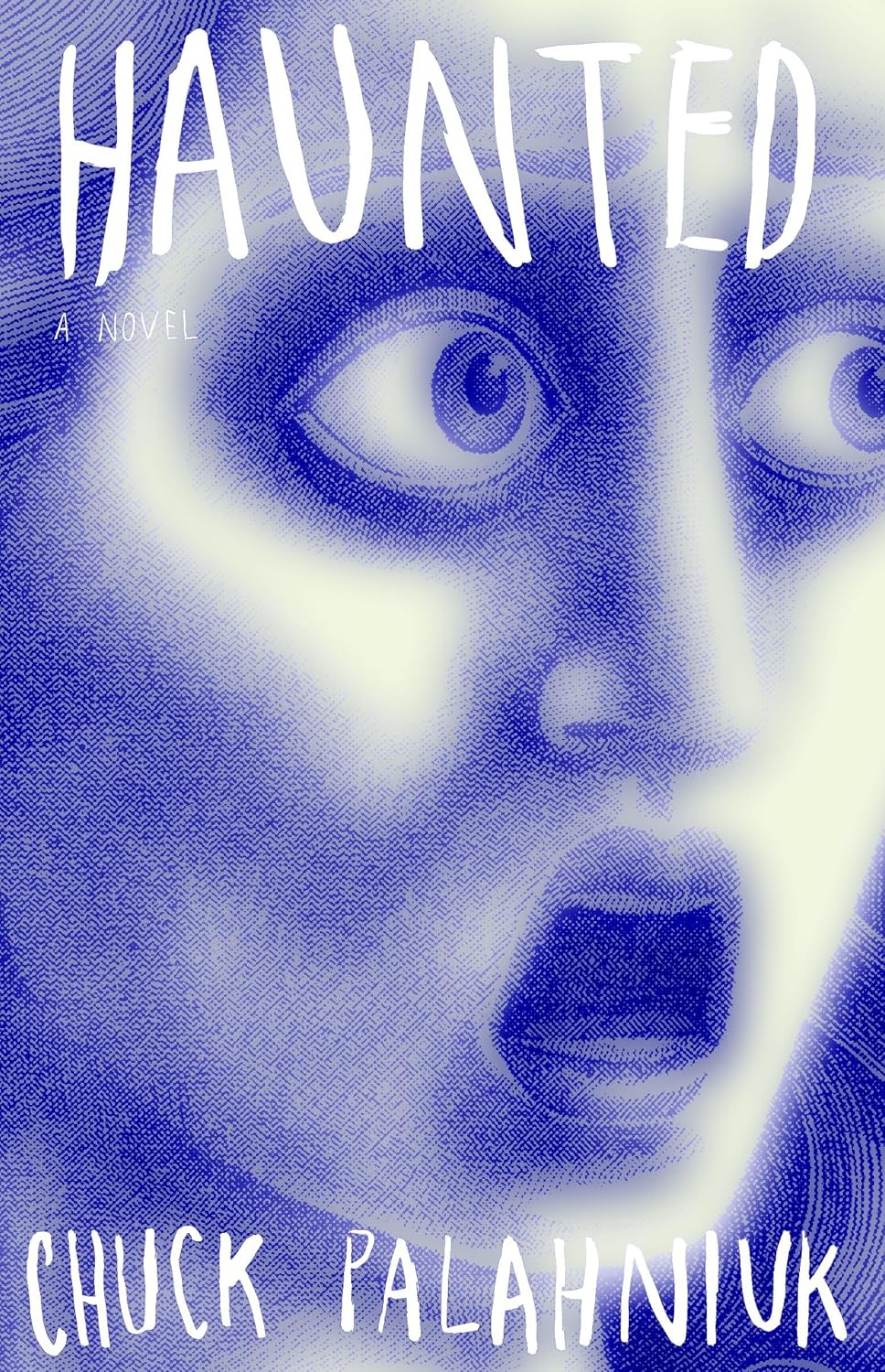
Palahniuk’s collection-inside-a-novel, and the most notorious short story in modern horror is in it.
Seventeen writers accept an invitation to a three-month residency in a derelict theater with the doors sealed. Within days they work out that the more they suffer the better the story will sell, so they begin sabotaging the food, the heating and each other, deliberately, in order to have something to tell afterwards. Each of them recites a story, and those are the twenty-three pieces interleaved through the novel.
“Guts” is the one people know. It is about three teenage boys and masturbation, and it is genuinely appalling in a way that is difficult to convey without spoiling the mechanics. Palahniuk read it aloud on tour and audiences fainted, reportedly around seventy people over the course of the tour, which he has talked about repeatedly.
I’ve read the book and the honest verdict is that it is front-loaded. The escalation stops landing about halfway and the second half is unpleasant for its own sake rather than in service of anything.
The first third earns its place here. The rest is a stunt that runs out of road.
More on the Chuck Palahniuk page.
Body Horror in Manga
Worth its own note, because this is one of the few areas where the comics tradition is arguably ahead of the prose one.
Junji Ito is the obvious name. Uzumaki is a town infected by a shape, and the transformations in it are more inventive than anything on this page. Gyo is worse and stranger. The visual form does something prose can’t here: it shows you the wrong body directly and gives you no distance from it.
There’s a full guide to body horror manga if that’s the direction you want.
Where to Start
Read The Metamorphosis if you want to understand the mode, and “Survivor Type” if you want to be got at quickly. Both are short.
Read Books of Blood for the version where transformation is an offer rather than a punishment, which is the thing that separates good body horror from gore.
Read The Troop if you want a novel that sustains it for four hundred pages, and Our Wives Under the Sea if you want to see the mode used for something tender.
And if you want this harder than anything on this page, that’s the extreme horror tradition, which is a separate conversation with a separate set of warnings.
The canon it belongs to is on my horror classics page. Where this stops being metaphor, my extreme horror list takes over.