Nobody buys an anthology for the writers. You buy it for the editor. That is the first rule of horror anthologies.
That sounds backwards and it’s the single most useful thing to know about this shelf. A horror anthology is one person’s argument about what the genre is, made by selection, and the good ones are coherent in a way that the tables of contents don’t reveal. David Hartwell thought horror was a form defined by three distinct traditions and built a book to prove it. Ellen Datlow has spent thirty-five years quietly setting the standard for what a good horror story looks like. Ann and Jeff VanderMeer decided the weird was a century-long tradition rather than a mood, assembled 750,000 words, and largely won the argument.
So this page is organized by editor, and I’ve said what each of them is actually arguing.
A note on scope. These are multi-author books. Single-author collections are a different purchase and mostly covered elsewhere on the site, though there’s a short section at the end pointing at the essential ones.
Some of these I own and have read through. Most I’ve read into rather than cover to cover, which is how anthologies work.
Fiction by René Rehn


The Essential Single Volumes
If you buy four books off this page, buy these.
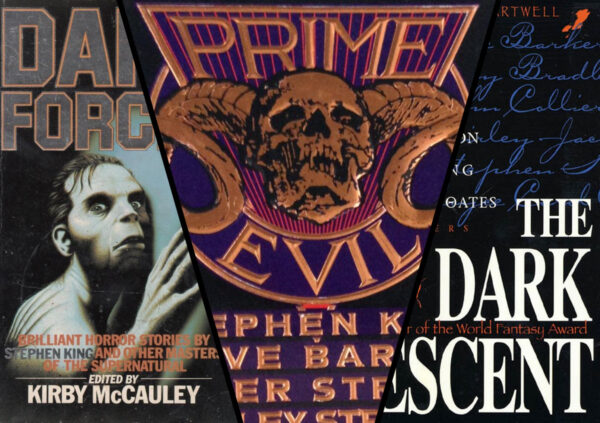
The Dark Descent (1987)

The best horror anthology ever assembled, and the reason is the argument rather than the contents.
Hartwell divides fifty-six stories into three sections representing what he considers the three distinct streams of the form. The moral allegorical, where evil is external and real and the story has a theology. The psychological metaphor, where the horror is generated inside a mind and may not be there at all. And the fantastic, where the reader is left unable to decide, which he takes from Todorov.
That structure is a genuine piece of criticism and it changes how you read everything else afterwards. Placing “The Yellow Wallpaper” and “The Beckoning Fair One” in the same category, or arguing that “Young Goodman Brown” and The Exorcist are doing the same thing, is a claim you can disagree with productively.
The contents run from Poe and Hawthorne to Ellison, Aickman, King, Campbell, Wolfe and Kafka.
It is nine hundred pages, it is in print, and if you buy one book on this page it should be this one.
The Weird (2011)

Eleven hundred and twenty-six pages holding a hundred and ten stories, with ambitions no other anthology in the field matches.
The case the VanderMeers build: the weird has been international from the start. Accordingly the book spans 1908 to 2010 with translations out of Poland, Japan, Nigeria, Argentina, France, Germany, Italy and beyond, set against the English-language line.
The value sits exactly there. Kubin and Grabiński, Jean Ray and Schulz, Bernanos, Cortázar, Tutuola, Abe, shelved beside Lovecraft and Blackwood and Aickman and Campbell and Ligotti, with several of the translated names making their English debut in these pages.
Chronological order, which means you watch the mode develop rather than being sorted into themes.
The framing essays, Moorcock’s Foreweird and Miéville’s Afterweird, are both worth reading, and the coinages tell you the register the whole project is pitched in.
Enormous, unwieldy, and without any real counterpart. Wrists prefer the ebook.
More on weird fiction.
The Oxford Book of English Ghost Stories (1986)

The best selection of the English ghost story as a distinct national form, edited by two people who knew exactly what they were doing.
Cox and Gilbert restrict themselves to English writers and to the period from around 1830 to 1950, and the discipline is what makes it work. This is not a general horror anthology with ghosts in it. It is a survey of one tradition, arranged chronologically, tracing how the form developed from the Victorian magazine story through to its exhaustion in the mid-twentieth century.
The obvious names are here, M. R. James, Le Fanu, Benson, Wharton, Onions, but the value is in the ones that are not. Amelia Edwards, Mrs. Riddell, Margery Lawrence, and a number of writers who published a handful of stories and vanished.
The editorial notes are brief and useful, and there is a proper bibliography.
Cox also wrote M. R. James: An Informal Portrait, which is the standard biography, so the Jamesian material here is chosen by somebody who had read everything.
Great Tales of Terror and the Supernatural (1944)

The anthology that taught most of the writers currently working, and it has been in print continuously since 1944.
Wise and Fraser assembled fifty-two stories in about eleven hundred pages, in two sections: tales of terror, which are the psychological and criminal ones, and tales of the supernatural.
The contents are the standard against which every later anthology has been measured. “The Monkey’s Paw,” “The Willows,” “Oh, Whistle,” “The Yellow Wallpaper,” “The Rats in the Walls,” “The Most Dangerous Game,” and Faulkner’s “A Rose for Emily” are all here, along with Balzac, Maupassant, Bierce, Wells, Kipling and Conrad.
It is the book King grew up on and has named repeatedly, and the same is true of a generation of others.
The one caveat is that its idea of contemporary stops in the early forties, so nothing after Lovecraft is represented. Buy it for the foundation and buy Hartwell for the argument.
Cheap, everywhere, and the paperback is a brick.
The Landmark Originals
Anthologies of new work, which is a different and much harder job than selecting.
Dark Forces (1980)

The most important original horror anthology ever published, and it arrived at exactly the right moment.
Kirby McCauley was a literary agent rather than an editor by trade, and he commissioned twenty-three new stories from the writers who were about to define the eighties boom. The advance was reportedly the largest ever paid for a horror anthology at that point, which is why he got the names.
The Mist is the reason to own it. King’s novella, about two hundred pages, debuted here, and nothing in his shorter work beats it: a supermarket, a fog bank, and people arguing about leaving while something outside gets on with it.
Around it are Ramsey Campbell, Karl Edward Wagner, Dennis Etchison, Robert Bloch, Gene Wolfe, Isaac Bashevis Singer and Joyce Carol Oates.
It won the World Fantasy Award, it proved horror could carry a hardcover anthology at literary prices, and everything in this section of the page followed from it.
Prime Evil (1988)

Douglas Winter’s answer to Dark Forces eight years later, and the theme is the argument.
Winter’s position, stated in the introduction, is that horror is not a genre at all but an emotion, and that treating it as a marketing category has been bad for it. So he commissioned thirteen original stories from writers who mostly did not accept the label, and the book is his case.
King’s “The Night Flier” is here and became a film. Straub’s “The Juniper Tree” is the best thing in the volume and it is a story about childhood sexual abuse with nothing supernatural in it whatsoever, which is Winter’s argument made in practice.
Clive Barker, Ramsey Campbell, Dennis Etchison, Charles L. Grant, Whitley Strieber, Thomas Ligotti and Paul Hazel round it out, and the Ligotti is one of his earliest appearances in a mainstream anthology.
Buy it for the Straub, which has never been anthologized as widely as it deserves.
Shadows (1978 to 1991)

Charles L. Grant edited eleven volumes between 1978 and 1991, and the series is where quiet horror was defined as a thing.
The editorial line was stated openly and policed: gore out, explicit violence out, detailed monsters out, clean resolutions out. Grant wanted implication doing dread’s work, suggestion and atmosphere above all, and plenty of good fiction went back to its authors for the crime of directness.
That gives the series a house style, which is either its strength or its limitation depending on your taste. At its best it produced some of the finest short horror of the period. At its weakest it produced stories where very little happens quietly.
Ramsey Campbell, Dennis Etchison, Steve Rasnic Tem, Karl Edward Wagner and Al Sarrantonio appeared repeatedly, and several careers started here.
The series took the World Fantasy Award more than once.
They are out of print and secondhand copies are cheap. The Best of Shadows gathers the highlights into one book, the sensible purchase.
Splatterpunks: Extreme Horror (1990)

The document of a movement that lasted about five years and changed the field permanently.
Paul Sammon assembled it in 1990, at the point when splatterpunk had a name, a set of practitioners and a great deal of hostility from the establishment, and the book is part anthology and part manifesto.
The fiction is Clive Barker, Joe R. Lansdale, David J. Schow, John Skipp and Craig Spector, Richard Christian Matheson, Robert McCammon and Rex Miller. Schow coined the term at a convention in 1986, apparently as a joke.
Own it for the non-fiction. Sammon packs in the essays and interviews making the case, then reprints the attacks on the movement, handing you the fight in real time instead of a retrospective summary. The stance: horror had gone polite and evasive, and a body on the page deserved depicting as a body.
Splatterpunks II followed in 1995 and is weaker.
Both are out of print and the movement’s own writers mostly disowned the label within a decade.
More on splatterpunk.
The Year’s Bests
The Best Horror of the Year (2009 onwards)

Ellen Datlow has been editing a year’s best in one form or another since 1988, and this series is the current one and the one that matters.
The reason it is the essential subscription rather than merely a good one is the summation. Every volume opens with an essay running to thirty or forty pages covering the year’s novels, collections, anthologies, magazines, small presses, awards, and the people who died. Read fifteen years of those in sequence and you have the best available history of the field.
The honorable mentions list at the back is the other half of the value, and it is usually longer than the table of contents.
Datlow’s taste is literary, favors the quiet and the strange over the visceral, and has been consistent for thirty-five years. She has won more World Fantasy Awards than anybody.
Volume sixteen and onward moved to Night Shade after a publisher change, and the numbering can confuse. If you only track one thing in the field, track this.
Best New Horror (1990 onwards)

Stephen Jones has been running the British year’s best since 1990, the useful counterweight to Datlow.
The selection leans British and leans toward the traditional. Ramsey Campbell, Kim Newman, Michael Marshall Smith, Christopher Fowler, Reggie Oliver and Joel Lane appear far more often here than in the American volumes, and a reader working only from Datlow would miss most of them.
Like hers, it opens with a long survey of the year, and the two summations together give you a genuinely complete picture because they cover different territory and disagree about what mattered.
Jones also compiles an obituary section that has become the field’s record of who died, and it is more thorough than anything else available.
Campbell co-edited the first five volumes.
The series has moved publishers repeatedly and volumes go in and out of print, which makes collecting it irritating. Buy whichever ones you find.
The Modern Themed Anthologies
Datlow also edits themed originals, and they’re the most reliable purchase in contemporary horror. A representative few.
When Things Get Dark (2021)

Eighteen original stories written in tribute to Shirley Jackson, edited by Ellen Datlow, and none of the modern themed anthologies comes close.
The reason it works is that the brief was interpreted loosely. Nobody was asked to write a Jackson pastiche. They were asked to write something in her spirit, which for most of the contributors meant domestic settings, unreliable women, communities that close ranks, and horror produced by social pressure rather than by anything supernatural.
Josh Malerman, Carmen Maria Machado, Paul Tremblay, Joyce Carol Oates, Elizabeth Hand, Cassandra Khaw, Stephen Graham Jones, Kelly Link and Laird Barron all appear, which is close to a roll call of who is worth reading now.
Machado’s contribution and Hand’s are the two people name most.
Won the Bram Stoker Award for anthology and the Shirley Jackson Award, which is a neat outcome.
If you want one volume representing the current state of the short form, this is it.
Screams from the Dark (2022)

Twenty-nine original monster stories, edited by Ellen Datlow, and the brief was deliberately old-fashioned.
Datlow asked for monsters, and the contributors mostly interpreted that as a challenge to invent rather than to reuse. There are very few vampires and almost no werewolves. What there is instead is a run of things that have no name and no established folklore, by design.
Joyce Carol Oates, Stephen Graham Jones, Brian Evenson, Kaaron Warren, Priya Sharma, Alison Littlewood, Terry Dowling and Gemma Files all contribute, and Evenson’s is the strangest thing in it.
The volume is unusually consistent, which is rare at this length, and the reason is that a narrow brief tends to produce better anthologies than a broad one.
Six hundred pages, and the best modern monster anthology almost by default, because almost nobody else is commissioning them.
Read it alongside When Things Get Dark to see the range of what Datlow does with a theme.
The Devil and the Deep (2018)

Fifteen original stories set at sea or under it, edited by Ellen Datlow, and the theme does most of the work.
The ocean is the oldest setting in horror and the most reliably effective, because everything about it is genuinely hostile: the pressure, the dark, the cold, the depth, and the fact that nobody is coming. Datlow’s contributors mostly resist the temptation to invent a creature and instead use the water itself.
Seanan McGuire, Christopher Golden, Stephen Graham Jones, Michael Marshall Smith, John Langan and Terry Dowling contribute, and Langan’s is the standout, which will surprise nobody who has read The Fisherman.
There is a wide range of period and register: whaling, submarines, cruise ships, oil platforms, a lighthouse.
A Shirley Jackson Award nominee for anthology, and the most focused of Datlow’s themed volumes.
Short by anthology standards and it does not have a weak entry, which at fifteen stories is a genuine achievement.
Out There Screaming (2023)

Twenty original stories by Black writers, edited by Jordan Peele with John Joseph Adams, and no horror anthology in years has sold more.
The stories are not thematically restricted and that is the editorial decision that makes it work. There is no requirement that the horror be about race, and several of the strongest pieces are cosmic, science fictional or entirely domestic.
N. K. Jemisin, Nnedi Okorafor, Tananarive Due, P. Djèlí Clark, Rebecca Roanhorse, Chesya Burke and Terence Taylor are among the contributors, and Due’s is the one most readers name.
Peele’s introduction is short and mostly gets out of the way.
It hit the New York Times bestseller list, which almost no anthology does, and it has done more than anything to demonstrate that the audience for original short horror is larger than publishers had assumed.
A companion to Never Whistle at Night, and the two together are the clearest picture of where the short form is going.
Never Whistle at Night (2023)

Twenty-six original stories by Indigenous writers from across North America, edited by Shane Hawk and Theodore C. Van Alst Jr.
The title comes from a widely shared warning across several Indigenous cultures, and the anthology’s premise is that the horror tradition has spent a century using Indigenous material as set dressing without asking anybody.
Stephen Graham Jones, Rebecca Roanhorse, Waubgeshig Rice, Cherie Dimaline, Darcie Little Badger, Tommy Orange and Morgan Talty contribute, and the range is wide: body horror, revenge, folklore, the residential schools, and a great deal of humor, which readers rarely expect.
Jones’s foreword makes the argument directly and is worth reading on its own.
Won the Shirley Jackson Award and the Bram Stoker Award for anthology, and it sold considerably better than anthologies usually do.
The variety is the pitch. Nothing in it reads like anything else in it, and the collective effect is a demonstration that Indigenous horror is not a subgenre with a house style.
The Single-Author Collections You Should Also Own
Different purchase, same shelf. Briefly, because these are covered properly elsewhere.
Books of Blood by Clive Barker, volumes one to three. The most influential horror collection since Poe. See the Clive Barker page.
Skeleton Crew by Stephen King, which is the best of his six and contains The Mist, “Survivor Type”, “The Jaunt” and “Gramma”. Full ranking at the Stephen King short story collections.
The Lottery and Other Stories by Shirley Jackson, which is rated higher by people who’ve read all of her than either famous novel.
Ghost Stories of an Antiquary by M. R. James, where some two hundred pages hold four or five of the finest ghost stories anyone has produced.
The October Country by Ray Bradbury, and The Bloody Chamber by Angela Carter.
Where to Start
Buy The Dark Descent. If you own one horror anthology it should be that one, and reading it in Hartwell’s order rather than dipping is worth the effort.
Then The Weird if you want the century-wide view, or the most recent Best Horror of the Year if you want to know what’s happening now.
If you want new fiction rather than reprints, When Things Get Dark and Never Whistle at Night are the two best original horror anthologies of recent years.
And if you can find a copy, Dark Forces is the historically important one.
The whole shelf is ranked on my best horror books list. The individual stories worth the price are on my horror short stories list.