Ira Levin wrote seven novels in forty-four years and three of them put phrases into the English language.
Nobody says a Straub or a Barker. People say a Stepford wife, and they say it without knowing where it came from. Rosemary’s Baby did the same thing to the idea of a pregnancy being managed by people who mean you harm, and The Boys from Brazil did it to cloned dictators.
The case for the Ira Levin books rests entirely on construction. Stephen King’s description is the one everybody quotes: Levin is the Swiss watchmaker of the suspense novel, and the rest of them look like cheap drugstore watchmakers by comparison. The books are short, nothing is wasted, and the plots are engineered so tightly that the reveals feel inevitable rather than clever.
He also wrote Deathtrap, which ran for four years on Broadway and is the longest-running comedy thriller in its history, so the precision was not confined to prose.
He died in 2007. The Ira Levin books make up a catalog small in number and high in quality, mapped out below.
I haven’t read these. What follows is the critical consensus.
Fiction by René Rehn


The Short Version
Read Rosemary’s Baby. It’s the best-constructed horror novel of the twentieth century and it takes an evening.
Then The Stepford Wives, which is a hundred and forty pages, and A Kiss Before Dying if you want the thriller.
The Essential
Rosemary’s Baby (1967)

The Bramford has a reputation, and Hutch spells it out for them, and the Woodhouses take the apartment anyway. The Castevets next door are elderly, overbearing and impossible to shake. Guy’s stalled acting career abruptly finds its feet. Then Rosemary is pregnant, in constant pain, and surrounded by people with soothing explanations.
The construction comes close to flawless, and it’s what the book gets studied for. Nothing Rosemary notices arrives without a benign reading attached, delivered on the spot by somebody devoted to her, and for two hundred pages you watch her being reasoned out of her own perceptions. The horror does not depend on the supernatural at all until the last few pages.
What the book is really about is the sale at its center: Guy converting his marriage into a career, early, calmly, and entirely off the page. That transaction is the novel, and it’s why the thing still works.
Polanski’s 1968 film is unusually faithful, almost line for line, which is worth knowing if you’ve seen it. Read it anyway for the interior.
Also on possession books and psychological horror books.
The Stepford Wives (1972)

A photographer moves with her family from Manhattan to a Connecticut commuter town and notices that the women there are all beautiful, docile, uninterested in anything but housework, and that the ones who aren’t become so within a few months.
It is a hundred and forty pages and it is a horror novel about the men’s association. The satire is not subtle and it doesn’t need to be. What makes it land is the same technique as Rosemary’s Baby: the protagonist is correct, everyone reasonable tells her she isn’t, and the reader watches the space around her close.
The phrase entering the language has slightly damaged the book, because people assume they know it. The ending is colder than the reputation.
A Kiss Before Dying (1953)

His first novel, written at twenty-three, and it won the Edgar Award for best first novel.
A young man is involved with the daughter of a copper magnate. She becomes pregnant. He needs the money and cannot afford a marriage that would be disinherited, so he arranges a solution.
The structural trick is the reason it is still taught. The first section is written so that the killer is never named, and Levin constructs it so the reader is inside his head without being told which of the men in the story he is. Then the second section switches to the dead girl’s sister investigating, and the third does something else again.
What is genuinely remarkable is the control. Levin was twenty-three, and the withholding is exact, and there is not a wasted paragraph in two hundred pages.
Filmed twice. He then spent fourteen years writing plays before Rosemary’s Baby.
The Others
The Boys from Brazil (1976)

Josef Mengele is alive in Paraguay and has convened a meeting of former SS officers. The order he gives is to kill ninety-four men in seven countries over two and a half years, all of them sixty-five years old, all of them civil servants.
Yakov Liebermann, an aging Nazi hunter modeled on Simon Wiesenthal, gets a phone call about it and cannot work out why anybody would want those particular men dead.
The answer is the premise and Levin builds to it properly. It involves cloning, which in 1976 was speculative rather than established, and the biology is handled with unusual care for a thriller.
What lifts it is the argument about determinism. Mengele’s plan requires reproducing not just a genome but a childhood, and the novel is genuinely interested in whether that is sufficient.
Liebermann is exhausted, underfunded and not believed, and that is the best thing in it.
Filmed in 1978 with Peck and Olivier.
This Perfect Day (1970)

His dystopia, the least read of his novels, and the one he reportedly considered his best.
A single computer called UniComp governs the entire world from beneath the Alps. Everybody is treated monthly. There is no war, no crime, no poverty and no want, and there is also no choice about work, partner, location or the date of your death, which is set at sixty-two.
Chip is a boy who notices that his grandfather remembers things differently, and who slowly stops taking the treatments.
The reason it is worth reading is that Levin is doing the same thing as in Rosemary’s Baby at civilizational scale. The system is benevolent, everybody administering it means well, every restriction is explained kindly, and the person objecting is treated as unwell.
It won the Prometheus Hall of Fame Award. The last act is the weakest part and the first two thirds are excellent.
Sliver (1991)
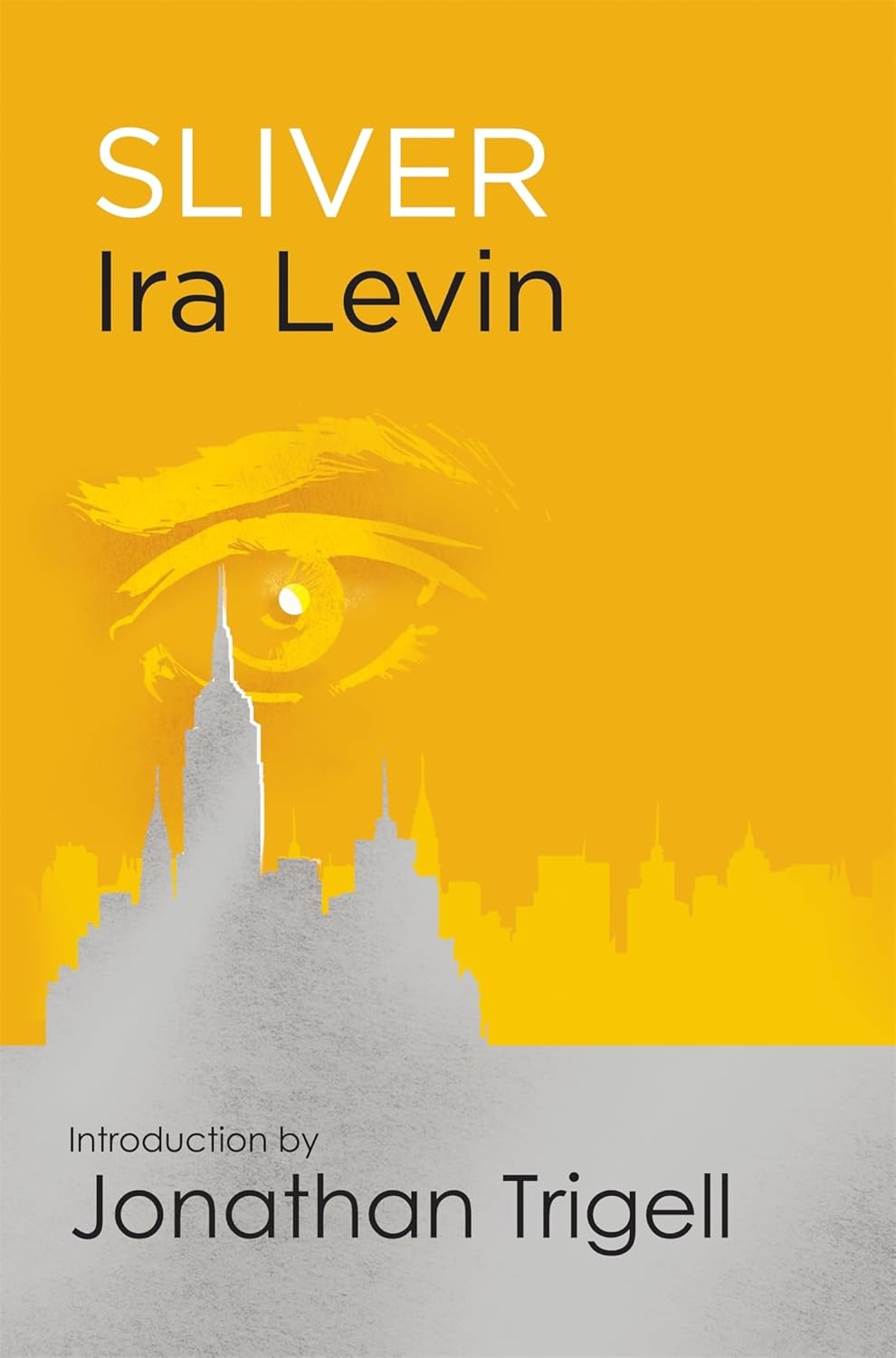
Kay Norris, a book editor in her late thirties, moves into a narrow Manhattan apartment building and begins a relationship with a younger man in the building.
He owns it. He has wired every unit with cameras and microphones and watches the tenants constantly from a room full of monitors, and he has been doing it for years, and people in the building have died.
The premise was ahead of itself in 1991 and the novel has been overtaken by its own subject, which is the fair criticism. What was a thriller conceit is now a description of ordinary life.
The execution is also thinner than his best. Kay’s decision-making in the last third strains, and Levin resolves it abruptly.
It is worth reading as the last time he did the thing he was good at, which is a woman correctly perceiving something and being managed out of acting on it.
Filmed in 1993 with Sharon Stone, badly.
Son of Rosemary (1997)

The sequel nobody wanted and the book that closed his career.
Rosemary wakes from a thirty-three-year coma in 1999. Her son Andy is now an adored global figure, universally beloved, leading a worldwide candle-lighting ceremony for the millennium, and she has to work out what he actually is.
The premise is not unpromising. A charismatic figure everybody loves and nobody questions is exactly the Levin subject, and there are stretches in the first half that work.
The ending is the problem and it is a genuine one. Levin resolves the entire novel with a device that a great many readers consider a betrayal of the original book, and the defense offered afterwards, that it was meant as a joke, does not repair it.
Read it only if you need to know, and know that a substantial share of Levin’s admirers pretend it does not exist.
The plays

He wrote for the stage for most of his career and one of them is still running somewhere.
Deathtrap (1978) is a two-act thriller about a playwright who has not had a hit in years and a former student who sends him a perfect manuscript. It ran for four years on Broadway, is the longest-running comedy thriller in Broadway history, and the first act contains a reversal that audiences reportedly gasped at nightly.
No Time for Sergeants (1955) was his first, adapted from a novel, and it made Andy Griffith a star.
Veronica’s Room (1973) is the one horror readers should look at. A young couple are persuaded to visit an old house and to help an elderly pair by impersonating a dead daughter for an hour, and it becomes something considerably worse.
Levin wrote seven plays. Deathtrap is the one to read and it is genuinely funny.
Where to Start
Read Rosemary’s Baby. It is short, it is perfectly built, and it is doing something more interesting than frightening you.
Then The Stepford Wives, which takes two hours and is angrier than you remember.
If you want the thriller rather than the horror, read A Kiss Before Dying and don’t read anything about it first.
And stop before Son of Rosemary, which is the one entry among the Ira Levin books that nobody defends.
For the wider canon, see my horror classics page. Rosemary’s Baby made the subgenre, and my possession books list has the rest of it.