Sci-fi horror is the only branch of the genre where the monster has a reason to exist.
That’s the real difference, and it matters. A ghost has no biology, and a demon has no ecology. But once you put the horror in a laboratory, or on a ship, or on another planet, it acquires constraints: it has to eat something, it has to reproduce somehow, it has to have come from somewhere. And it turns out that a creature with a plausible reason for doing this to you is considerably worse than one without.
The other thing sci-fi horror has that nothing else does is scale. Cosmic horror isn’t a subgenre of science fiction, but the two share the same central move: the discovery that the universe is not arranged for your benefit, was never asked, and doesn’t know you’re there.
This page covers the crossover in both directions, from horror novels that borrowed a premise to science fiction novels that turned out to be frightening.
Several of these I’ve read. I’ve said which.
Fiction by René Rehn


The Ancestors
Frankenstein (1818)

This is the book that made science the source of the horror rather than the past, and everything on this page descends from that single move.
Victor is a student at Ingolstadt working from chemistry, galvanism and anatomy, and the novel is careful to keep him inside the actual science of 1818. There’s no lightning and no laboratory full of equipment. There’s a young man who has read Agrippa and then read the modern chemists, who spends months in charnel houses and dissecting rooms collecting his materials, and who refuses in his own account to explain how he did it, because he doesn’t want anybody repeating the experiment.
The science fiction horror is the abdication. Victor’s failure isn’t the making. It’s the glance at the finished face, the exit from the room, and the long self-pitying aftermath from a man who never once files himself as the wrongdoer.
Take the 1818 text; the 1831 revision softens Victor into fate’s victim, which drains the whole argument.
Shelley started it at eighteen, after Byron proposed a ghost story competition at the Villa Diodati.
More on the Mary Shelley page.
The Island of Doctor Moreau (1896)

Edward Prendick gets shipwrecked and put ashore on a small island in the Pacific, where a disgraced English physiologist is conducting surgery.
Moreau isn’t making monsters. He’s taking animals and, through repeated operations without anesthetic, attempting to shape them into people, and he has been at it for years, and the results keep reverting. The Beast Folk recite the Law in chorus, and the questions in it, about not going on all fours and not sucking up drink, are the most disturbing thing in the whole book.
The science fiction horror is the vivisection debate, which was a live and furious controversy in 1896, and which Wells was writing directly into. Moreau’s defense of his work is coherent, delivered at length, and entirely without cruelty as he understands the word, which turns out to be worse than sadism.
What makes it hold up is the ending. Prendick gets home and cannot stop seeing the Beast Folk in ordinary Londoners on the street.
Wells trained under Huxley, and he knew exactly what he was writing about.
At the Mountains of Madness (1936)

A Miskatonic University expedition lands on the Antarctic ice and discovers peaks that dwarf the Himalayas, and past them, a stone city, empty, colossal, standing since before there was multicellular life anywhere on the planet.
The science fiction horror lives in the format: this is a scientist’s account, assembled to stop the next expedition from going. Dyer lays out everything they logged, the rock layers, the specimen dissections, the survey figures, and then the murals, carved records the team learns to read like a book, until they hold the whole rise and fall of the Elder Things spanning geologic ages.
And that recovered history is where the dread comes from. We turn out to be an accident, a by-product of somebody else’s biology program, and the beings who ran it were researchers themselves, brought down by troubles that never once involved us.
The shoggoth is one of the great inventions in the genre, and the reveal about who made the murals of what is the best thing Lovecraft ever did.
Del Toro has spent twenty years trying to get a film version made. Come to it after “The Colour Out of Space” and the prose goes down far easier.
Full ranking at the best Lovecraft stories.
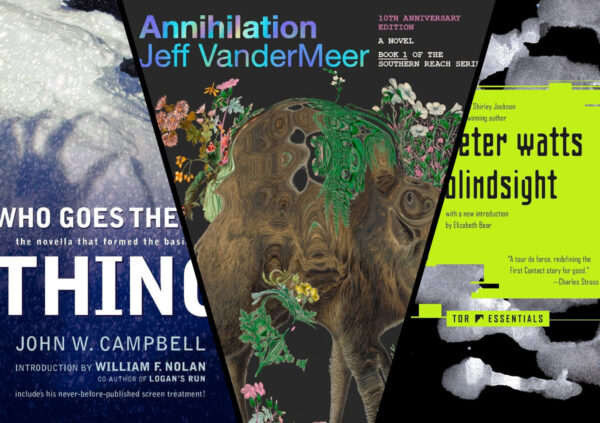
Who Goes There? (1938)

An Antarctic camp thaws something out of the ice that is twenty million years old, and it wakes up.
The science fiction horror is a single rule worked harder than the genre has ever worked any other: the Thing is transformation itself, any scrap of it a whole organism, and whatever it copies, it becomes, memory included, so the copy walks around sincerely being the man it ate. Behavior clears nobody. Confession means nothing. Even the blood test that finally works arrives as a consequence of the biology rather than a convenience of the plot, which is exactly why it satisfies.
Campbell staffs the camp with working scientists who argue like scientists, and the cruelty of the premise is that rigor is precisely what it consumes.
Carpenter’s 1982 film keeps the biology and swaps the ending. Frozen Hell, the longer draft that surfaced in Campbell’s papers in 2019, mostly vindicates the trim.
The Mid-Century
I Am Legend (1954)

Robert Neville is the last man in Los Angeles, and Matheson’s great move was giving vampirism a bacillus.
That single decision is why this book matters more than almost anything else on the page. He works out a microorganism with a life cycle, and then derives the entire folklore from it: the garlic is an allergen, the stake works because of the blood loss rather than the wood, the crosses only affect the ones who were Christian in life, the mirrors are a psychological artifact of the disease, and the sunlight destroys the bacillus directly. Nobody had done anything like that before.
The book lives in the daylight hours: lumber over glass, fuel for the generator, garlic on wire, supply runs, and the door-to-door staking that fills the afternoons because nothing else useful exists.
Romero named it as the direct ancestor of Night of the Living Dead, which hands the entire modern zombie tradition to a vampire novel.
The last page is the reason it’s a classic, and not one film version has kept it intact.
The Body Snatchers (1955)

Dr. Miles Bennell, a GP in Santa Mira, California, starts getting patients who insist a husband or an aunt is a perfect duplicate, memories included, and every one of them can hear exactly how that sounds, which is precisely why it works.
The science fiction horror is Finney’s refusal of malice: pods wind-sown, planless, leaderless, tenantless, with nothing inside to bargain with, and a reproductive cycle that happens to require the original gone as a matter of fact rather than intention.
Each era supplies its own reading, Red Scare first, conformity later, and Finney spent his whole life politely insisting he had written a thriller.
Three films, three endings, none of them the novel’s own, which runs gentler than any of them and routinely startles readers who came in through Kaufman.
Solaris (1961)
1961 · read it in the translation made directly from the Polish

Kris Kelvin docks at a research station hanging above a planet that is all ocean, one single living organism from pole to pole, and the crew he finds inside can barely function. Then his wife walks into his cabin. She has been dead for years. The ocean has assembled her out of Kelvin’s own memories, the shameful ones included, and she has no idea what she is.
Humanity has been studying this planet for more than a hundred years by the time the novel opens, and the study has produced entire libraries and not one confirmed fact. Kelvin spends some of the book’s best pages reading through that literature in the station library, generations of theories stacked on theories, and every last one of them turns out to be a mirror. The scientists were only ever describing themselves.
As hard science fiction, this is the most rigorous first-contact story ever written, and its rigor consists of denying the contact. Lem’s ocean isn’t hostile and isn’t friendly, because those are human categories, and nothing about it maps onto human categories at all. It’s simply busy, at planetary scale, with something no vocabulary we own can reach.
One practical warning: the old English edition came through French on its way to English, and it shows. Get the direct translation.
The Drowned World (1962)

The ice caps went decades ago, the temperatures climbed back toward the Triassic, and London is now a lagoon ringed with silt and giant ferns. Kerans works as a biologist on a survey unit cataloguing what grows there now, the survey is wrapping up, and the units are being pulled back north.
Kerans doesn’t want to go. And he’s not the only one.
Ballard’s idea is the strangest on this page: as the climate walks the planet back through its own deep past, the minds living on it are walking backwards too. The expedition members have started sharing dreams, old ones, from before the species, from something the base of the brain never forgot, and the book treats those dreams as marching orders rather than symptoms.
Not a single character fights it, and that’s what the novel is actually about. One by one they turn south, into the heat, toward the sun, on purpose, and Ballard writes each departure as an arrival.
It’s the least frightening book here and one of the strangest anywhere, and it founded climate fiction roughly fifty years ahead of schedule.
The Modern
Sci-fi horror since 2000 has largely moved from space to biology, and from invasion to infection.
Blindsight (2006)

Sixty-five thousand probes photograph the earth in a single coordinated instant and burn up on the way out. Somebody has taken our picture. A ship goes out to meet whatever did it.
Watts crews that ship with instruments rather than people, and the roster is the book’s first horror all by itself. There’s a linguist running four surgically split personalities in one skull. There’s a biologist fused so completely to his sensor array that unmediated reality no longer reaches him at all. And there’s a combat specialist, and a narrator whose childhood hemispherectomy left him able to observe everything and understand none of it, which is his job. Command belongs to a vampire, an extinct human predator brought back by paleogenetics, and Watts defends the idea with dozens of pages of appendix notes and a spoof conference talk that are half the fun.
The idea underneath is the scariest one hard science fiction has produced: that consciousness might be optional. Worse than optional, expensive. An evolutionary luxury item, recently acquired, metabolically costly, and slowing us down. What’s waiting out there at the edge of the solar system never bothered with it, and it outperforms us in every way for exactly that reason.
It’s dense, footnoted, and demands your full attention. Watts is a marine biologist by training, and every page reads like it.
You can read it legally for free on his own website, under a Creative Commons license.
Annihilation (2014)

Area X is a stretch of coastline that has been sealed behind an invisible border for decades. Eleven expeditions have gone in. Now the twelfth crosses over: four women, stripped of names, carrying only their functions. The biologist narrates.
They arrive equipped to survey, sample and record, and the equipment itself is the problem. Every reading they take comes back either mundane or impossible, with nothing in between, and the deeper structure of the expedition, the training, the hypnosis, the instructions, slowly reveals itself as one more thing Area X is using.
The image that stays is the tunnel the biologist keeps insisting on calling a tower. It spirals down into the earth, and along its walls runs a sentence written in a script of living organisms, and somewhere below them, the sentence is still being written.
A lungful of spores changes the biologist early, and VanderMeer refuses to write the change as damage. She grows sharper, brighter, less homesick by the day, and the life she left behind starts reading like the thing she was escaping all along.
It took home the Nebula and the Shirley Jackson Award. Garland’s film borrows the premise and almost nothing else.
The Troop (2014)

Five fourteen-year-old scouts and their scoutmaster are on a small island off Prince Edward Island for a weekend, the way they are every year, when a man comes ashore starving and asks for food.
The science fiction horror is the provenance. Cutter doesn’t leave the parasite as a natural organism. It was engineered, deliberately, in a lab, as a weight-loss product, and the man who came ashore was a test subject who got out. The inquiry sits right inside the book, transcripts, exhibits and testimony from afterward, interleaved so that the science and the corporate arithmetic arrive while the boys are still on the beach.
That structure is why the book is more than a survival story. You watch the arithmetic being explained by the people responsible for it.
The metabolic math never balances: the worm outconsumes anything its host can swallow, so feeding and starving become the same activity.
Five real boys get built before the first symptom appears, which is the cruelty of it, and the whole thing runs without mercy. Eat beforehand.
More on the Nick Cutter page.
The Deep (2015)

A plague called the ‘Gets is taking people’s memories, first the small things and then how to swallow, and a possible cure has turned up eight miles down in the Mariana Trench.
Luke Nelson gets flown out to a research station on the seabed because his brother Clayton, the scientist who found it, has stopped communicating and will only speak to him.
The science fiction horror is the pressure and the station itself. Cutter is exact about the engineering, the descent, the atmosphere mix, and the fact that the structure is being crushed continuously and holding. The isolation runs total in a way an Antarctic base never does, because there’s no leaving without a vehicle and a scheduled ascent.
What’s down there is never explained, deliberately, and that’s where readers divide. Long-time Cutter readers call it his most frightening book. Others call it a sequence of nightmares with the plot logic abandoned somewhere around the halfway mark.
Both are accurate. It’s nastier than The Troop and less controlled.
Bird Box (2014)

Something arrived, and looking at it makes people violently insane within minutes. So the survivors live blindfolded, with the windows painted over, and go outside with their eyes shut.
The science fiction horror is the constraint, and Malerman stays disciplined about it in a way almost nothing else in the genre manages. Every practical problem gets worked through: fetching water from a well by rope count, driving a car blind with a passenger listening, keeping birds in a box by the door as an alarm system, and raising two children who have been trained since birth to keep their eyes closed and to listen.
The novel alternates between the house in the early years and Malorie rowing twenty miles downriver with the children, blindfolded, four years later, and the river sections are among the tensest sequences in modern horror.
What the creatures are is never established and never seen, which is the correct decision.
The Netflix film is faithful in outline and drops most of what makes the book actually work, which is the procedure.
Borne (2017)

Mord is a bear the size of an office block, and he flies. He’s what remains when a biotech company collapses and its products outlive it, and the ruined city underneath him belongs to him now.
Rachel scavenges that city, and part of her trade is picking through Mord’s fur while he sleeps. One day she pulls out a lump of something, plant or animal, she can’t tell, that shifts color and shape in her hands. She takes it home, and it starts to learn. Talking comes first, then reading, then the question it can’t stop asking: am I a person? Rachel keeps answering yes, and keeps not being sure.
VanderMeer’s Company is what elevates the setting. Not a conspiracy, not a villain, just an industry that manufactured living things, went bankrupt, and walked away from the inventory, leaving the city as an ecology of abandoned commercial biology feeding on itself.
Borne himself might be the most likeable character VanderMeer has written, and for long stretches the novel is genuinely funny about him.
Then it asks what he eats. The answer reframes everything that came before, and the last act is where the horror finally shows up.
Tender Is the Flesh (2020)

I’ve read this one. A virus made animal meat lethal, so the farming of human beings was legalized, and Marcos runs daily operations at a processing plant.
The science fiction horror is that everything interesting sits downstream of the legislation rather than the virus. This is worldbuilding as the horror itself, and Bazterrica worked out how the industry would actually function: the licensing regime, the grades of stock, the breeding centers, the transition units, the domestic market for people who keep one at home, the hunting concessions for the wealthy, the government scientists, and the trade in organs.
There’s also a black market, and a religious movement, and a category of stock bred without vocal cords so that nobody has to hear anything.
It reads like a working supply chain because that’s what she built, and the plausibility is what makes it unbearable rather than absurd.
My reservation is the long stretch where the thesis idles in plain sight before the final section spends it. The ending is what people mean when they say it stayed with them.
More on the Agustina Bazterrica page.
The Girl With All the Gifts (2014)

Every morning, soldiers strap a child into a wheelchair at gunpoint, wheel her to a classroom, and return her to a cell afterwards. Melanie is ten years old, brilliant, affectionate, desperate to please her teacher Miss Justineau, and she is the thing the soldiers are afraid of.
The science fiction horror is the fungus, and Carey used a real one. Ophiocordyceps unilateralis infects ants, takes over their motor function, drives each ant to a specific height and humidity, and fruits from its head. Carey’s premise is that it jumped to humans, and that second-generation children like Melanie, infected from birth, retain their intelligence, and the biology gets worked through properly rather than gestured at.
The inversion is what makes the book. Everything the genre does with the horde gets turned around by making one of them the person you care about most, and the novel takes that all the way to an ending which is genuinely radical, and which almost no other book in the subgenre would have committed to.
Carey wrote the screenplay for the 2016 film himself.
Also on zombie books.
Where to Start
If you want the best novel, read Solaris, and get a good translation.
Read I Am Legend or The Troop, if you want to be frightened.
If you want the idea that will keep you up at night, read Blindsight, and take your time with it.
And if you want the one that shows where this whole tradition came from, read The Island of Doctor Moreau, which takes an evening and is angrier than you expect.
The whole shelf is ranked on my best horror books list. Mary Shelley wrote the first one of these too.