John Ajvide Lindqvist writes horror about Swedish suburbs, and the suburbs are doing at least half the work.
He was a street magician and a stand-up comedian in Stockholm before he wrote Let the Right One In, and the thing that novel established, which he has never abandoned, is a specific and very unglamorous setting: the concrete housing estates built in the sixties and seventies, the ones with a Konsum, a subway station and nothing else, in a winter where it’s night by mid-afternoon from November on.
What the John Ajvide Lindqvist books do better than almost anyone’s is refuse the consolation. His monsters are usually sad rather than terrifying, his protagonists are usually failing at something ordinary, and the endings don’t resolve into justice. Handling the Undead is a book about grief with zombies in it, and it isn’t interested in a single scare.
The John Ajvide Lindqvist books are also blunter than their adaptations. Every film made from him has softened the material, in several cases substantially, and readers who arrive from the screen are consistently unprepared for what’s on the page.
Everything is translated from Swedish, mostly by Ebba Segerberg or Marlaine Delargy.
I haven’t read these. What follows is the critical consensus.
Fiction by René Rehn


The Short Version
Read Let the Right One In. It’s his best, it’s a genuinely great novel, and it runs considerably harder than either film.
Then Handling the Undead, which is the strangest zombie novel anyone has written.
The Essential
Let the Right One In (2004)
2004 · translated by Ebba Segerberg · 2007

It’s 1981 in Blackeberg, a suburb on the Stockholm metro line. Twelve-year-old Oskar gets beaten at school, clips murder stories for a private scrapbook, and rehearses his revenge in his head. Then Eli moves into the apartment next door, a child who only appears after dark, in the company of a middle-aged man who kills people for their blood.
The novel goes much further than either film about what Eli actually is, and about the appetite that keeps Håkan in Eli’s service, and those pages are hard going. The Swedish film strips almost all of it out. The American remake strips out more.
What lifts it from good horror novel to great novel is that the relationship is nothing like a romance, and the novel never pretends otherwise. Oskar is being recruited, the way a predator recruits, into the position Håkan is aging out of, and however warm the final pages look, they aren’t. Lindqvist hands you every piece needed to see that and declines to say it out loud.
And then there’s the estate itself: the particular grayness of a Swedish housing project in winter, the alcoholism, the parents who aren’t coping, and a public swimming pool.
The general verdict calls it the best vampire novel of the century, and the general verdict is right.
Also on vampire books.
Handling the Undead (2005)
2005 · translated by Ebba Segerberg · 2009
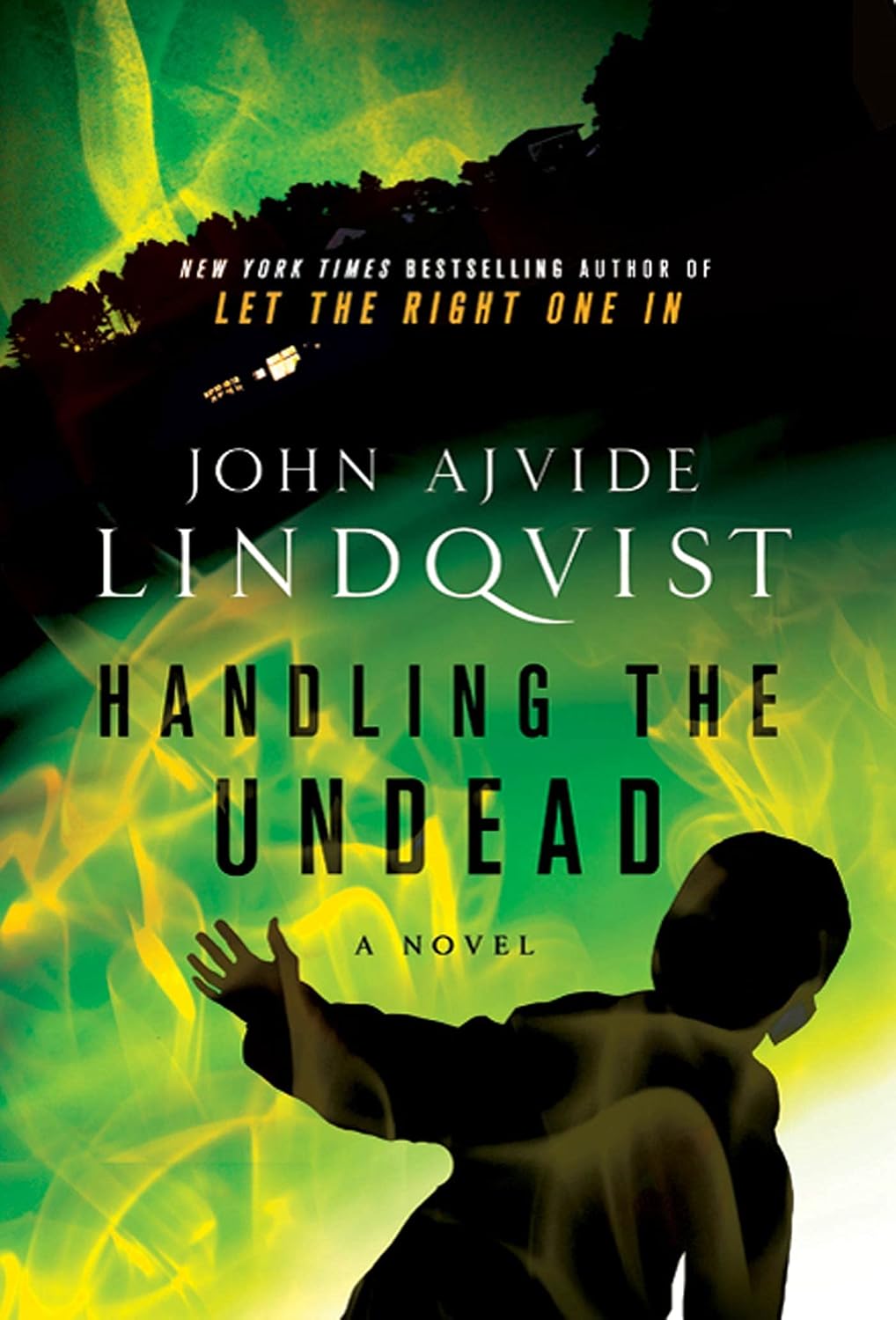
During a heatwave in Stockholm, the electrical field over the city does something, and everyone who has died in the last two months gets up.
They aren’t violent, aren’t hungry and aren’t hostile. They come home. The novel follows three families dealing with a husband, a grandfather and a small boy who are present and are not there, and the horror is entirely the question of what you owe a body that has your dead person’s face.
It’s a zombie novel built on the original Haitian idea, a person with the will removed, rather than the shambling corpse, and it’s the most humane book on this page. Slow, devastating, and it will not comfort you at the end.
Also on zombie books.
The Rest of the Novels
Harbour (2008)
2008 · translated by Marlaine Delargy · 2010

Anders takes his six-year-old daughter Maja across the ice to a lighthouse off the island of Domarö, and she disappears from a bare expanse of frozen sea with no cover and no tracks.
Two years later he comes back to the island, drinking heavily, and starts finding out what the community has arranged.
The sea is the antagonist, and Lindqvist commits to that entirely. It takes people. It has been taking them for generations. And the islanders have worked out an accommodation with it that involves knowing exactly when to look away, so everybody on Domarö is complicit, and nobody discusses it.
The insects are the image people remember, and there’s a sequence involving a possessed body that is the nastiest writing he has done.
The rough agreement on this one: his most atmospheric novel, his least disciplined, and the last hundred pages sprawl.
The island material comes from summers he spent in the Stockholm archipelago.
Little Star (2010)
2010 · translated by Marlaine Delargy · 2011

A failed musician finds a baby buried alive in a plastic bag in the forest, and takes her home and keeps her rather than reporting it, because when she cries, she sings.
Theres grows up in a cellar. Her adoptive father records her. And when she finally gets out into the world, she meets Teresa, a bullied teenager with a blog, and the two of them find each other online.
What follows is a school shooting told through a girl group. Lindqvist builds toward it slowly, through a talent show, an internet forum and a circle of girls who have all been humiliated in ways nobody took seriously, and the ending is one of the most upsetting things in modern horror.
It’s his angriest book, and it’s about the internet, about teenage girls, and about what happens when nobody is listening.
Most readers land in the same place on it: his best-constructed novel, and the hardest one to actually recommend.
I Am Behind You (2014) and the Places trilogy
I Am Behind You, I Always Find You and I Am the Tiger.

The premise is the best he has ever had. Four families at a caravan site wake to find the site unchanged and everything else gone: an endless mown field, a white sky, no horizon, no sun, no direction that leads anywhere.
The first book is the one to read. The trilogy’s explanations, when they eventually arrive, run weaker than the situation itself, which is the usual problem with a setup this good.
Let the Old Dreams Die (2006)
2006 and after · translated by Marlaine Delargy · 2013

Twelve stories, and two of them are the reason to buy it.
The title story is a sequel to Let the Right One In, told by a friend of the couple who was close to the original case and pieced together what happened to Oskar and Eli afterwards, and it’s the only closure that story has anywhere.
“Final Processing” is a sequel to Handling the Undead, following the reliving after the events of the novel, and it runs bleaker than the book did.
The rest range widely. “Border” is the standout, about a customs officer who can smell guilt and shame on people passing through, and who one day meets somebody she can’t read at all. Ali Abbasi filmed it in 2018, and it won at Cannes.
“Equinox” and “Substitute” are the other two people name.
If you’ve read the novels, buy this for the two sequels alone.
Where to Start
Read Let the Right One In, and go in knowing it’s harder than whichever film you’ve seen.
Then Handling the Undead if you want the one that will actually move you, and Harbour if you want the big one.
Approach Little Star last, if at all.
And if the short fiction appeals, Let the Old Dreams Die contains the sequel, which is the only part of the John Ajvide Lindqvist books that functions as fan service, and it’s genuinely good anyway.
The canon it belongs to is on my horror classics page. What he did to the vampire novel is measurable against my vampire books list.