Every list of Japanese classics you will find in English contains the same three books. The full canon is ranked on my best Japanese novels list. The author index lives on my Japanese authors hub.
The Tale of Genji, The Pillow Book, The Tale of the Heike. Then the page runs out. Some of them make it to four or five before the padding starts, and a surprising number solve the problem by quietly including Kafka on the Shore, which was published in 2002. I read ten of these while putting this together and the oldest book that appeared on more than two of them was written in 935.
There’s a lot missing from that picture. The whole Edo period, for a start, which is two hundred and sixty-five years and includes the entire literary explosion of the merchant classes, the birth of the Japanese ghost story, and the plays that Japan still considers its greatest. And the diaries, which is the stranger omission, because the Heian court diary is arguably Japan’s single most distinctive contribution to world literature. Women writing sustained, interior, first-person prose about their own lives, six hundred years before anyone in Europe attempted it. Four of them survive in English. They appear on almost no list of Japanese classics anywhere.
So this covers all of it, in order, from the eighth century to the end of the Edo period in 1868. Twenty Japanese classics, plus the ones that don’t fit and why.
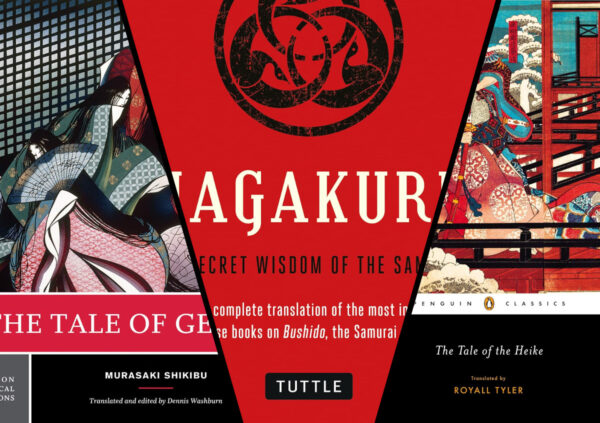
About that date. Classical Japanese literature conventionally ends when the Tokugawa shogunate does. That’s the line this article holds, which means Soseki, Akutagawa, Tanizaki’s novels and everything after them are somewhere else. It also means a few books people reasonably think of as Japanese classics don’t fit, and rather than pretend otherwise I’ve put them in a section at the end and explained why each one falls outside.
On translations, which matter here more than anywhere. The Japanese classics have been rendered into English repeatedly across a hundred and forty years, and the versions are not interchangeable. One translation of the Kojiki puts the sexually explicit passages into Latin. The standard Pillow Book paperback that most people end up with is abridged. Two of the books below are sold under different titles by different publishers, so you can buy one thinking you’re buying the other. Where the choice matters, I’ve said which one to get and why.
Nothing here requires you to start at the beginning. But if you want one place to begin and you’d rather not think about it, skip to The Pillow Book.
Ancient Japan
The Kojiki
Compiled 712 · translations by Chamberlain (1882), Philippi (1969), Heldt (2014)

The oldest surviving Japanese book, and the founding text of everything that follows it. The oldest of the Japanese classics exists because somebody memorised it. Emperor Tenmu commissioned a court attendant of extraordinary memory named Hieda no Are to learn the clan records and oral traditions by heart. Then Tenmu died and nothing happened for decades, until Empress Genmei ordered O no Yasumaro to write down whatever Are still carried. He delivered the finished text about four months later.
Are may also have been a woman. The title Are held was normally a man’s, but scholars including Kunio Yanagita have argued otherwise, partly because one early source places Are in a family that traced its descent from Ame-no-Uzume, the goddess whose dance lures Amaterasu back out of the cave. Which would mean the person carrying the whole Kojiki in her head was descended from a figure inside it, performing its most famous scene. It cannot be proved and it is too good to leave out.
It is where the Japanese classics begin. Commissioned by the imperial court, it runs from the creation of the islands through the age of the gods and into a genealogy of emperors, and its purpose was frankly political: to establish that the ruling family descended from the sun goddess Amaterasu and therefore ought to keep ruling.
What survives that purpose is the mythology, which is stranger and earthier than most national origin stories manage. Izanagi and Izanami create the islands, then Izanami dies in childbirth and her husband follows her into the underworld and looks at her when he was told not to. Amaterasu shuts herself in a cave and the world goes dark until the other gods lure her out with a dance obscene enough to make them all laugh. Susanoo gets himself expelled from heaven for behavior that includes flinging a flayed horse through the roof of his sister’s weaving hall, killing one of her attendants, which is what drives her into the cave in the first place. Ame-no-Uzume’s dance outside it was later claimed by Japanese playwrights as the origin of theater, which means the Edo stage at the bottom of this page traces itself to a scene near the top.
It is also, in long stretches, a list of names. Nobody should pretend the Kojiki is a page-turner, and among Japanese classics it is the one most often bought and least often finished.
On translations, and this matters more than it sounds. Basil Hall Chamberlain’s from 1882 is free everywhere because it’s out of copyright, and it is a punishing read: his footnotes run as long as the text, producing a 592-page brick, and he rendered the sexually explicit passages into Latin on Victorian principle, so the founding myth of Japan is partly illegible unless you did classics at school. Donald Philippi’s from 1969 is the scholar’s preference and you cannot buy it, because a legal dispute over his estate has blocked reprints and secondhand copies run to hundreds. Get Gustav Heldt’s, from 2014. Three hundred pages, and he translates every divine name etymologically from its kanji rather than transliterating, so the gods arrive with their meanings attached.
The Heian Court
The Tale of Genji
Murasaki Shikibu · c. 1010 · four English translations, and they are four different books

Fifty-four chapters, written by a lady-in-waiting whose actual name nobody knows, about the son of an emperor who is too beautiful and too gifted and removed from the succession. It follows his affairs, his exile, his return to power and his slow decline, and then he dies and there are still thirteen chapters left, which follow his nominal son and his grandson into a colder register that reads like a different writer. Whether it is one is open. Yosano Akiko, who made the first modern Japanese translation, thought Murasaki wrote only the first thirty-three chapters, and Royall Tyler reports computer analysis finding statistically significant stylistic differences between the last ten and everything before. The greatest work in the language may change hands two thirds of the way through and nobody can prove it.
Whether it’s the world’s first novel is a question people enjoy more than it deserves, and it is the one book in any list of Japanese classics that nobody argues about. The remarkable thing is how much of it functions as one: characters who change across decades, a narrator with opinions about her own material, and a sustained attention to the interior lives of women who had considerable perception and no power at all. Murasaki was writing for a readership of perhaps forty people who all knew each other, and it survived into a language and a century she could not have imagined.
Translations. Arthur Waley’s, from the 1920s and 30s, is gorgeous Edwardian prose and a substantial rewrite. He cut material including the whole of chapter thirty-eight, The Bell Cricket, for reasons nobody has established, leaving fifty-three, and he makes Murasaki sound like a contemporary of Virginia Woolf. Read it as literature in its own right. Edward Seidensticker’s from 1976 was the first complete English Genji, and it is faithful and plainer. Royall Tyler’s from 2001 keeps the Heian convention of naming characters by rank and title rather than personal name, which is what the original does and which will disorient you productively. Dennis Washburn’s from 2015 is the most readable, folding clarification into the text. Start with Washburn or Seidensticker. Come to Tyler when you want to know what it felt like.
Nobody finishes it quickly. Plenty never finish it at all. Every other book in this article grew out of it.
The Pillow Book
Sei Shonagon · c. 1002 · translated by Meredith McKinney

Lists. Things that make the heart beat faster. Things that should be short. Hateful things, which runs for pages and is the funniest thing written in Japan before the eighteenth century. Sei Shonagon is not her name, incidentally, any more than Murasaki Shikibu was: Sei is her family name and Shonagon a court post nobody has securely tied to her, and her own given name is lost. She came from a poetry dynasty, served the Empress Teishi, and was clever and merciless and entirely certain of her own taste, and she wrote down whatever she felt like across roughly three hundred entries with no organizing principle whatsoever.
It is not a diary and it is barely a book. The Japanese call the form zuihitsu, following the brush, and this is the founding example. Two more will turn up further down this page: Hojoki and Essays in Idleness are the other two of the three works conventionally held to define the genre, and all three are here. What zuihitsu means in practice is this: anecdotes, complaints, weather, poems, court gossip, and an unbroken confidence that her opinions are worth your time. She is snobbish about provincial accents, cruel about unattractive people, delighted by snow, and completely unembarrassed. A thousand years later the voice is intact, which is the thing that startles people.
Of all the Japanese classics this is the one that requires least adjustment from a modern reader. You can open it anywhere.
On editions, and there’s a trap here. The book has no settled shape. It circulated in hand copies for centuries and scribes reordered, added and cut, so the section count varies by textual tradition: Morris’s runs to 185, others to around three hundred. Ivan Morris translated it in 1967, and the Penguin paperback of his version, which is the copy most people find secondhand, is abridged. Meredith McKinney’s Penguin Classics translation from 2006 is complete, and it comes with diagrams of Kyoto and the Inner Palace and drawings of the costumes and curtains that half the entries depend on. Buy McKinney. Also avoid the cheap Tuttle edition, which is sold with anachronistic cover art and a subtitle describing Sei Shonagon as a courtesan, which she was not.
The Tale of the Bamboo Cutter
Anonymous · 10th century · translated by Donald Keene

An old bamboo cutter finds a tiny girl inside a stalk of bamboo. She grows into a woman of impossible beauty in three months, and every stalk he cuts from then on has gold in it, so the family becomes rich. Five noblemen and then the emperor himself want to marry her, and she sets each of them an impossible task: the Buddha’s stone begging bowl, a jeweled branch from Horai, a robe of fire-rat skins, a jewel from a dragon’s neck, a cowry born of a swallow. Then she tells her adoptive parents where she comes from, and the people of the moon come to collect her.
It’s short, it predates Genji, and it is the oldest of all the Japanese classics in prose. Murasaki herself calls it the ancestor of all tales. The five suitor episodes are comic set pieces, each nobleman failing in a way that exposes exactly what kind of fool he is, and then the tone changes completely in the final section and the book turns into one of the saddest things in the language. Kaguya-hime does not want to go. She has no choice. Her parents cannot follow.
Anyone who has seen Takahata’s The Tale of the Princess Kaguya knows the shape of it, and the film is faithful.
The edition to get is a genuine artifact. Donald Keene’s translation, published by Kodansha in 1998, appears alongside Yasunari Kawabata’s modernization of the classical Japanese and kirie paper-cut illustrations by Masayuki Miyata. A thousand-year-old anonymous tale, modernized by a Nobel laureate, translated by the leading Western scholar of the field, illustrated by a major contemporary artist, in one volume. It’s unfortunately out of print, so availability can vary.
The Tales of Ise
Anonymous · 10th century · translated by Helen Craig McCullough

One of the shortest Japanese classics by page count and one of the most quoted. A hundred and twenty-five episodes, most of them a paragraph long, each built around one or two poems. A man, generally understood to be the poet Ariwara no Narihira, does something, feels something, and writes a waka about it. That is the entire structure and it sustains a book.
The form is uta monogatari, the poem tale, and it works by compression. An episode gives you a situation in three sentences, then a poem that does the emotional work, then stops. There’s no continuous plot and the man ages unevenly across the collection, sometimes a youth and sometimes near death, because the episodes were gathered rather than composed as a sequence.
It ends on a death poem. The man falls ill, understands what is happening, and writes that he always knew he would walk this road but had no idea it would be today. A hundred and twenty-four episodes of love affairs, and then that. Its influence on later Japanese classics is difficult to overstate. Genji quotes it, Noh drama dramatizes it, and for eight hundred years an educated Japanese reader could be relied upon to catch an allusion to it, which means half the literature above and below this entry is talking to it whether you notice or not.
Narihira is one of the Thirty-six Immortals of Poetry, as is Ki no Tsurayuki of the Tosa Diary below, and thirty of the Ise poems ended up in the imperial anthology Tsurayuki compiled. McCullough’s Stanford translation is the standard and gives the poems room to breathe.
The Heian Diaries
The court diary is the form English-language lists of Japanese classics forget, and it is the one that has no real parallel anywhere else.
Scholars identify six major literary diaries from the mid-Heian period. All six are below or elsewhere on this page, and I have not seen that anywhere else in English.
Before you read them, one fact that frames everything else. Not one of the women who wrote these is known to us by her own name. The author of The Gossamer Years is recorded only as the mother of Michitsuna. The author of the Sarashina Diary is recorded only as the daughter of Takasue. Sei Shonagon is a family name attached to a court post nobody has securely tied to her. Murasaki Shikibu is a nickname joined to an office. Four of the finest writers of the period, and every one of them reaches us as somebody’s relative or somebody’s job title.
They also knew each other, and were related to each other. Takasue’s daughter was the niece of Michitsuna’s mother, so the Sarashina Diary and The Gossamer Years were written by aunt and niece. Takasue’s daughter was connected to Murasaki Shikibu through her stepmother. And Murasaki, in her own diary, has unkind things to say about both Sei Shonagon and Izumi Shikibu, who are also on this page. This is not a scattering of isolated voices. It is a small, interconnected, competitive world of women writing about their own lives, and the men of the period were writing official records in Chinese.
And two of them are arguing with each other across half a century. The Gossamer Years opens with its author explaining why she wrote it: she had looked at the old romances everyone was reading, found them masses of the rankest fabrication, and decided that the story of her own dreary life set down plainly might be worth more than any of them. Her niece wrote the Sarashina Diary, which is the story of a girl who wanted nothing in the world except those romances, got them, and spent her last years judging herself for it.
The aunt says fiction is a lie and a real unhappy life is worth more. The niece says she gave her life to fiction and it cost her everything. Both books are below. Read them in that order.
The Tosa Diary
Ki no Tsurayuki · 935 · translated by William N. Porter

The oldest thing in this section by seventy years, and the one that invented the form. Ki no Tsurayuki was a senior court poet, one of the compilers of the Kokinshu and one of the Thirty-six Poetry Immortals, and in 935 he sailed home to Kyoto after four years as governor of Tosa province. The journey took fifty-five days. He was seasick, frightened of pirates, and grieving.
Then he did something that changes everything. He wrote it anonymously, in kana, the phonetic script that was considered women’s writing, and in the voice of a woman in the governor’s party. Before this, nikki meant a dry official record kept by a man in Sino-Japanese. Tsurayuki took the word, wrote in the wrong alphabet, adopted the wrong gender, and produced the first Japanese diary that was literature.
Why he did it is not settled. The obvious reading is technical: kana was the script available for writing Japanese as it was spoken, and a woman’s voice was the license to use it. The likelier reading, and the one Japanese scholarship tends toward, is grief. His daughter had died in Tosa. A court lady traveling in the governor’s party can mourn a child openly on the page. The returning governor, writing as himself in Sino-Japanese, could not. So he became someone else in order to say it.
On that reading the genre was a side effect. A man found a way to write about his daughter and invented Japanese literary prose on the way past.
The form he invented is then the one the great Heian women used for every book that follows this one in this section. A male poet borrowed a woman’s voice, and the women took the result and wrote better than he did.
Among the Japanese classics it is the quiet foundation stone. It is also very good on its own terms, funny about bad poetry, honest about seasickness, and quietly devastating about the daughter who died in Tosa and is not coming back with them.
On translations. William N. Porter’s from 1912, in the Tuttle Classics series with facing Japanese text, is the only standalone volume and it is accurate and well annotated, but the English is stiff and he renders the whole thing in the third person, which loses the point. Earl Miner’s in Japanese Poetic Diaries and Helen Craig McCullough’s, published with her Kokin Wakashu, both read considerably better and both are buried inside larger scholarly books. Porter if you want the Tosa Diary as a book. McCullough if you want to read it well.
The Gossamer Years
The mother of Michitsuna · c. 974 · translated by Edward Seidensticker

I read this one for a straightforward reason: it’s a classic of Japanese literature and I wanted to have read it. What I got was less a book than a window. The insight into daily life at the Heian court is remarkable, and I would have understood a fraction of it without the annotations, which do a great deal of load-bearing work in the Seidensticker edition.
The diary belongs to a noblewoman known only as the mother of Michitsuna, and it concerns her marriage to Fujiwara no Kaneie, referred to throughout as the Prince. He is a powerful man with other wives and other houses. She waits. He visits, or increasingly doesn’t. The central subject across twenty years is a relationship failing slowly, recorded by someone with no power to change it and nothing to do but notice.
One thing worth knowing before you decide whether to read it. She tells you at the start exactly what she is doing: she had read the popular romances, judged them fabrications, and set out to write the un-romantic thing instead. No plot, no consolation, no shape. Just what it was like.
Here’s my honest position, and I think it is the book succeeding rather than failing. Beyond the historical insight, the content didn’t hold me. That’s partly the nature of the thing: it is a private diary, largely occupied with private grievances, and it was never built to entertain a stranger a thousand years later. It’s a document before it’s a reading experience. I’d recommend it warmly to anyone with an interest in classical Japanese or Asian literature, and particularly in the Heian period. I wouldn’t hand it to someone as a general recommendation, and I think most lists of Japanese classics that include it haven’t finished it.
One practical warning. The same book is sold as The Gossamer Years, in Seidensticker’s Tuttle translation, and as The Kagero Diary, in Sonja Arntzen’s much more heavily annotated 1997 scholarly edition. Search one title and you will not find the other. I read the Seidensticker and would tell you not to read it without the apparatus. If you want more of that, Arntzen’s goes considerably further.
The Diary of Lady Murasaki
Murasaki Shikibu · c. 1010 · translated by Richard Bowring

The author of The Tale of Genji, at work, in the room. It covers roughly two years at court around the birth of an imperial prince, and it is short, unfinished, and much stranger than its function as a Genji footnote suggests.
Two things make it essential reading among the Heian Japanese classics. The first is the observational cruelty. Murasaki records her colleagues with a novelist’s eye and no obligation to be kind, and her assessment of Sei Shonagon, whom she never names as a friend and clearly could not stand, is one of the great literary hatchet jobs: a woman pleased with herself, scattering Chinese characters about the place, whose showing off will not end well. Two of the most important writers in Japanese history were at the same court within a few years of each other, and one of them thought the other was insufferable. She goes after Izumi Shikibu in the same stretch, and Izumi is two entries below this one.
The second is the loneliness. Murasaki was a widow, unusually educated, and she describes concealing how much Chinese she could read because a woman displaying learning was a problem. The most celebrated writer of her age spent her days making herself smaller.
Bowring’s Penguin Classics translation is the standard and his introduction is useful on what the court was like.
The Izumi Shikibu Diary
Izumi Shikibu · c. 1003-07 · translated by Edwin A. Cranston

The sixth diary, and the one that closes the set.
Izumi Shikibu was the most scandalous poet of her generation and the best. She had been the lover of Prince Tametaka, who died. The diary opens a few months later, in the fourth month of 1003, when a page arrives with a message from Prince Atsumichi, and Atsumichi is Tametaka’s brother. What follows covers about nine months of an affair conducted almost entirely in poems, and there are around a hundred and forty-five of them in a book you can read in an afternoon.
It barely qualifies as a diary. Long stretches refer to Izumi in the third person, which has led to a century of argument about whether she wrote it at all or whether someone assembled it from her poems afterwards. The uncertainty suits it. This is a book about a woman who is aware she is a scandal, who reproaches herself for the affair in one poem and pursues it in the next, and who is a considerably better writer than the prince she is exchanging verses with.
Murasaki Shikibu, who knew her, wrote in her own diary that Izumi was careless and not a serious scholar of poetry, and then admitted she produced verses of real interest anyway. It reads exactly like one professional being unable to dismiss another.
On editions, and this one is awkward. Edwin Cranston’s 1969 Harvard translation is the scholarly standard and the one specialists recommend without hesitation. It is also long out of print and secondhand copies run into the hundreds. The affordable route is William de Lange’s 2019 revision of the 1920 Omori and Doi translation, which is a genuine improvement on the original and is what most readers will end up with.
As I Crossed a Bridge of Dreams
Lady Sarashina · c. 1060 · translated by Ivan Morris

Also known as the Sarashina Diary, and the most quietly heartbreaking of all the Japanese classics here.
She was born in the same year that The Tale of Genji began circulating as a finished manuscript, which turns out to be the fact her whole life is organized around.
It opens with a provincial girl who is obsessed with fiction. She has heard about Genji, she is stuck in the far east of the country where nobody has a copy, and her stepmother, who was connected to Murasaki Shikibu herself, tells her episodes from memory because there is no book to be had. She prays to a Buddha she has made herself for the chance to read the real thing. Eventually an aunt gives her the complete set and she describes lying down alone with the scrolls, screens pulled around her, happier than she believes an empress could be.
Then the rest of her life happens. Court service that doesn’t suit her, a marriage arranged without much reference to her, children, her husband’s death, and a slow drift into religious observance and regret. Late in the diary she looks back at the girl who wanted nothing but stories and judges her harshly for it, on the grounds that she should have been attending to her salvation instead.
The book is fifty years of a life told in about a hundred pages, and its argument, which it never states, is that the reading was the best part. Morris’s Penguin translation has been in print for half a century for good reason.
Medieval Japan
The Tale of the Heike
Anonymous, compiled 14th century · translated by Royall Tyler

The Genpei War, the Taira against the Minamoto, the end of the Heian aristocracy and the beginning of six centuries of warrior rule. Of the Japanese classics this is the one that was performed for hundreds of years before it was written down, chanted by blind monks with a biwa, which is why it moves the way it does: episodic, formulaic, built for the ear.
The famous opening states the argument before the story starts. The temple bells sound the impermanence of all things, the proud do not endure. Everything after that is illustration. Kiyomori dies burning with such rage that water poured on him boils. Yoshitsune wins every battle and is destroyed by his own brother. The child emperor Antoku, six years old, goes into the sea at Dan-no-ura in the arms of his grandmother, Kiyomori’s widow, and she tells him there is a capital beneath the waves. Almost nobody in these Japanese classics is spared, and the exception is the point. Kenreimon-in, Kiyomori’s daughter and Antoku’s mother, was pulled from the water at Dan-no-ura and lived. The book ends with her, a nun at Jakko-in, and with a second bell to answer the one it opened on.
On translations, and here you can see exactly what a translation choice does. Helen Craig McCullough’s from 1988 renders the opening with the sound of the Gion Shoja bells echoing the impermanence of all things. Royall Tyler’s from 2012 gives you the Jetavana Temple bells ringing the passing of all things. Same sentence, two different books: one keeping the Japanese name of the monastery, one restoring the Indian original. One echoing, one ringing. Tyler is the one to buy, set as oral performance with woodcuts, maps, character guides and genealogies, and McCullough is the closer-to-literal alternative if you want it.
Japan’s Iliad, more or less, and better paced.
Hojoki
Kamo no Chomei · 1212 · translated by Meredith McKinney

Ten pages, or thereabouts, and the shortest of the Japanese classics on this page.
Chomei was a court poet who failed to get the position he wanted, withdrew from Kyoto, and eventually built himself a hut ten feet square on a mountainside. Hojoki means an account of a ten-foot-square hut. It opens with the river that is always flowing and never the same water, moves through a catalog of five disasters he had lived through in the capital, the great fire, the whirlwind, the famine with bodies in the streets, the earthquake, and, sitting among them as though it were weather, the relocation of the capital to Fukuhara, and then arrives at the hut and the argument: that he has almost nothing and wants nothing, and that this is the only condition in which a person is safe.
Then, at the very end, he turns on himself. If detachment is the goal, he asks, why is he so attached to his little hut? Why does he take such pleasure in his solitude? The book closes on that question, unanswered, and refuses to let its author off.
A note for buyers: Hojoki and Essays in Idleness are sold together in one Penguin Classics volume, both translated by Meredith McKinney. You do not need to buy them separately and you should not try.
Essays in Idleness
Yoshida Kenko · c. 1330 · translated by Meredith McKinney
Two hundred and forty-three fragments, the last of the medieval Japanese classics, by a monk with an aristocratic past, a taste for gossip, and a settled conviction that everything good is already over. It is the second great work of zuihitsu, three hundred years after Sei Shonagon, and it reads like a man talking to himself in old age.
Kenko is best known for the aesthetic position that things are more beautiful for being incomplete or transient. Cherry blossom at its peak is less moving than blossom about to fall. A book with a worn cover is better than a pristine one. The moon behind cloud beats the moon in a clear sky. That idea, mono no aware pushed toward something more austere, ran straight into Japanese taste and never left.
There is a tradition, first recorded in the sixteenth century and unlike anything told about the other Japanese classics, that he never organized the book at all: that he wrote his thoughts on scraps of paper and pasted them to the walls of his cottage, and somebody assembled the thing from the walls after his death. Unprovable, and it fits. He’s also frequently petty, which is what makes him readable. There are passages on how irritating it is when guests overstay, on people who cannot tell a story properly, on the correct number of possessions. He disapproves of drinking and then describes a good drinking party with obvious relish.
Same Penguin volume as Hojoki. Among the Japanese classics this is the one to keep by the bed and read four or five sections at a time.
Edo Japan
Two hundred and sixty-five years of peace under the Tokugawa, a merchant class with money and nothing to spend it on, and cities full of theaters, brothels and bookshops. The literature that came out of it is commercial, vulgar, funny and extremely good, and it is almost completely absent from English-language lists of Japanese classics.
Tales of Moonlight and Rain
Ueda Akinari · 1776 · translated by Anthony H. Chambers

Of all the Japanese classics this is the one whose title does the most work. It means rain-moon tales, and it points at a belief: that uncanny things appear on cloudy rainy nights, and on mornings when the moon is still up. Nine supernatural tales follow, adapted from Chinese and Japanese sources, and this is the point where the Japanese classics turn into the Japanese ghost story as a literary form rather than a folk one.
The vengeful ghost of the emperor Sutoku holds court in the mountains in “Shiramine.” A dead man keeps an appointment in “The Chrysanthemum Vow.” A soldier comes home after seven years to a house and a wife who cannot both be there in “The Reed-Choked House.” “The Kibitsu Cauldron” is jealousy surviving death, and “A Serpent’s Lust” is desire that turns literally serpentine.
Chambers, whose translation is the one to buy, points out something about where these are set. Always a named province. All but one before 1603, so before the Tokugawa shogunate existed. And not one in Kyoto, Osaka or Edo, where nearly every reader lived. The strange is placed at deliberate distance in time, in geography and in politics, by a commoner writing for commoners at a moment when Japanese literacy rivaled Europe’s. The shock is how finished it already reads. Everything the later tradition leans on stands here already in 1776: dead who keep their appointments, jealousy that a funeral cannot switch off, dreams you can drown in.
Three translations exist. Chambers, from Columbia, is the annotated in-print standard and the purchase. Zolbrod’s 1974, definitive for decades, circulates in reissue. Hamada’s, the oldest, takes hunting. And since most write-ups get it wrong: Mizoguchi’s film takes just two of the nine, not the collection.
The Life of an Amorous Woman
Ihara Saikaku · 1686 · translated by Ivan Morris

The most disreputable of the Japanese classics, and one of the best. An old woman in a hut outside Kyoto tells two young men how she got there. She was a court attendant, then a lord’s concubine, then a courtesan of the highest rank, then a lower one, then a teacher, a seamstress, a bathhouse girl, a streetwalker, and finally this. It is a life told as a descent, and Saikaku narrates it without a shred of moralising.
Japanese scholars group this with The Tale of Genji and Akinari as the finest fiction in the traditional canon, and all three are on this page. He invented ukiyo-zoshi, tales of the floating world, and he wrote about people no Japanese literature had bothered with: merchants, prostitutes, shopkeepers, people whose problems were money. He had come from haikai poetry, where the competitive form was solo composition against the clock. In 1677 he produced sixteen hundred verses in a day and a night. Rivals beat it. So in 1684, at Sumiyoshi Shrine, he composed twenty-three thousand five hundred verses in twenty-four hours, which is roughly sixteen a minute, continuously, in public. The prose keeps that speed. Episodes arrive fast, land, and are gone.
The narrator is the reason it lasts. She is unsentimental about her own history, funny about her clients, clear-eyed about a market that valued her by the year, and she never once asks to be pitied. Mizoguchi filmed it as The Life of Oharu in 1952.
A buying note nobody makes. Morris’s volume contains this novella plus three other works, including the merchant-money books, which show a completely different Saikaku. But his version of Five Women Who Loved Love includes only three of the five stories. If you want that work whole, you need Wm. Theodore de Bary’s separate translation.
Hagakure
Yamamoto Tsunetomo · c. 1716 · translated by William Scott Wilson

Dictated by a retired samurai who had wanted to follow his lord in death and was prevented, then written down by a younger retainer named Tashiro Tsuramoto between 1709 and 1716, and circulated in secret. The prevention is the thing. The shogunate had restricted the practice, but Nabeshima Mitsushige had also personally forbidden it and made his dislike of it known while he lived. The man who produced the most famous statement in Japanese that the way of the warrior is found in dying was forbidden from dying by the one man he wanted to die for. Of all the Japanese classics this is the most quoted and the least read whole. It is the most famous statement of the warrior ethic ever produced in Japan and it was composed by a man with nothing left to apply it to, in a century when the samurai had become bureaucrats.
That gap is the whole book. Its most quoted line comes from a man who lived to sixty-one as a monk. Tsunetomo is nostalgic for a violence he never got to take part in, and the result swings between bracing counsel about decisiveness and passages of pure reactionary grumbling about how young men these days care too much about money.
Mishima wrote a book about it. Jarmusch built Ghost Dog around it. It has been picked up by people who would appall its author and read as career advice, which is funny given it opens by telling you to be prepared to die every morning before breakfast.
Two things nobody tells you. Hagakure runs to eleven books and roughly thirteen hundred passages, and essentially every English edition is a selection. You are reading an editor’s curation, whichever one you buy. And it was not a famous book for most of its life: it stayed a semi-private Saga clan document for two centuries, moving in hand copies among Nabeshima retainers, and only became a well-known text of bushido in the 1930s, when it was taught as one. Everything downstream of it, Mishima included, descends from that revival rather than from an unbroken tradition. Wilson’s is the famous one and the most readable. Alexander Bennett’s is more academic and more thorough.
The Book of Five Rings
Miyamoto Musashi · 1645 · translated by Alexander Bennett

Written in a cave by a man who claimed more than sixty duels and no defeats, in the last two years of his life, and it sells more copies than the rest of the Japanese classics combined. He was fifty-nine and already seriously ill when he began. Five sections named for the elements, Earth, Water, Fire, Wind and Void, on the practical business of killing people with a sword and, underneath that, on the mental posture required to do anything under pressure.
The martial content is specific and unromantic. Grip the sword like this. Do not favor a weapon. Attack the moment before your opponent has decided. Musashi’s contempt for schools that teach elaborate technique is total, and his position is that everything decorative is a way of avoiding the fight. There is also a lot about carpentry, which is not a digression.
Its second life as a business manual in the 1980s was ridiculous and is why so many bad editions exist. Ignore that. What is here is a dying man being extremely direct about how to pay attention. Worth knowing while you read it: Musashi was also a serious ink painter and calligrapher whose work hangs in Japanese museums, and he designed sword guards. The book’s contempt for anything decorative comes from an artist.
On translations. Victor Harris’s from 1974 is the classic and remains fine. Thomas Cleary’s for Shambhala is the accessible one and bundles Yagyu Munenori’s treatise on strategy. Alexander Bennett’s The Complete Musashi is built on what its publisher describes as a reconstruction of Musashi’s long-lost original manuscript, rather than the copies earlier versions worked from, and it includes his other writings in English for the first time. Bennett if you care which words Musashi wrote. Cleary for a first read.
Shank’s Mare
Jippensha Ikku · 1802 to 1822 · translated by Thomas Satchell · English 1929

Two idiots walk to Ise, and it is the funniest thing in the Japanese classics.
Yaji and Kita leave Edo to escape their debts and travel the Tokaido road on foot, and across twenty years of serialized installments they get drunk, con innkeepers, are conned in turn, fail with women, ruin ceremonies, and produce a running commentary of terrible puns. It was the most popular book of its century in Japan and it is essentially a road comedy.
The reason it belongs among the Japanese classics has nothing to do with dignity. It is the best surviving record of what ordinary travel looked like in Edo Japan: what things cost, what the inns were like, what people ate at each post station, what a religious pilgrimage looked like when undertaken by two men who were not remotely religious. Hiroshige’s Fifty-three Stations of the Tokaido shows you the road. Ikku tells you what happened on it.
The humor is broad, extremely scatological, and survives translation better than you’d expect. Two notes on the book itself, and they apply to more of the Japanese classics than you would think. Thomas Satchell translated the Tokaido volumes only, first in 1929 and reissued by Tuttle in 1960. Ikku kept the series running until 1822 and most of it has never appeared in English. And the Tuttle edition prints Hiroshige’s Tokaido prints through the text, so the road and the account of it arrive in the same volume.
Edo Theater
Two entries, and both are plays rather than prose. A list of Japanese classics that skipped the theater would be missing the form Japan itself considers central, so here they are, with that stated rather than hidden.
Four Major Plays of Chikamatsu
Chikamatsu Monzaemon · early 18th century · translated by Donald Keene

The Shakespeare of the Japanese classics, more or less, though the comparison flatters neither. Chikamatsu wrote for the puppet theater, which sounds like a limitation and turns out to be the opposite. Bunraku puppets are worked by three visible operators and narrated by a single chanter, and the form permitted a directness about ordinary lives that the kabuki stage of the period did not.
His subject was the double suicide. A merchant or a clerk falls in love with a courtesan he cannot afford to buy out of her contract, money goes wrong, honor goes wrong, and the two of them walk out at night to die together. The Love Suicides at Sonezaki and The Love Suicides at Amijima are both here, and both were based on real cases, sometimes staged within weeks. The plays were popular in a way few Japanese classics have ever been, and people copied them. By one count seventeen couples died the same way in the year after Sonezaki opened, and survivors of failed attempts were prosecuted. The shogunate banned love-suicide plays outright in 1723. Chikamatsu had written more than a dozen of them.
One thing a modern reader will miss: Tokubei is twenty-five and Ohatsu nineteen, and those are the unlucky years for a man and a woman in the yin-yang reckoning. Chikamatsu put both lovers in theirs, and his audience would have caught it instantly.
What lifts them above melodrama is the michiyuki, the journey to the death scene, written as sustained poetry, where two people walk through a real landscape naming what they are seeing for the last time.
Keene called Amijima Chikamatsu’s masterpiece, and he was in a position to know. Two Keene volumes exist and they are not the same book. Major Plays of Chikamatsu from 1961 contains eleven plays. Four Major Plays from 1998 contains four, with a preface, a substantial introduction and appendices. Start with the four, because the apparatus is what makes bunraku legible to someone who has never seen it, then go to the eleven for range.
Chushingura
Takeda Izumo, Miyoshi Shoraku and Namiki Senryu · 1748 · translated by Donald Keene

The full title is Kanadehon Chushingura, and kanadehon means a kana practice book, the copybook children used to learn the syllabary. There were forty-seven ronin and there are forty-seven kana, so the play leaned into the coincidence and gave each man one. Japan’s most performed drama, and one of the few Japanese classics everyone in the country can summarize, is named after a writing primer.
Keene’s verdict is that this is beyond doubt the most famous and popular work in the entire Japanese theatrical repertory, and of all the Japanese classics it has generated the most retellings: some thirty-four films in the twentieth century alone.
In 1701 a provincial lord named Asano drew a blade against a senior official inside Edo Castle and was ordered to disembowel himself the same day. His retainers became masterless. Two years later, forty-seven of them attacked the official’s mansion, killed him, and carried his head to their lord’s grave. Forty-six were ordered to commit seppuku and did. The forty-seventh had been sent ahead to Ako with the news and was pardoned, which is why you will see the number given both ways.
A play about it was staged within a fortnight of the executions and shut down immediately. This one came forty-five years later, in 1748, by which time the workaround had matured into a convention: relocate everything to the fourteenth century, change every name, and let the audience do the arithmetic. Everyone knew exactly what they were watching. Its three authors, working as a team, wrote the three greatest bunraku plays in consecutive years: Sugawara in 1746, Yoshitsune and the Thousand Cherry Trees in 1747, this in 1748. Takeda Izumo the second had succeeded Chikamatsu at the same Osaka theater.
Read it and the extraordinary hold this has on Japanese culture becomes legible: it is a play about people who do the correct thing at the cost of everything, in a period when almost nobody was being asked to.
The Exceptions
Three groups of books that people reasonably call Japanese classics and that fall outside a page bounded at 1868. Each fails the boundary for a different reason, so they’re separated rather than lumped together.
Written Later, but Belonging Here
Two essays, published in the twentieth century, about pre-modern Japanese aesthetics. They fail the boundary on date alone, and they’re read alongside the classical texts rather than alongside modern fiction.
The Book of Tea
Okakura Kakuzo · 1906

It was written to be read aloud in Isabella Stewart Gardner’s drawing room. Okakura was a close friend of Boston’s most famous art patron, and in the winter of 1905 he conducted a tea ceremony by candlelight at the Museum of Fine Arts, where he was the first Japanese curator of Chinese and Japanese art. Afterwards he gave her a copy of the newly published essay. When he died in 1913 she inscribed hers with the date of his death and of the memorial service she held for him, and handed copies to the mourners.
So unlike every other entry here, there is no translation question, because Okakura wrote these Japanese classics in English, for Americans, from inside the institution whose collection he was building. He was trying to explain Japanese aesthetics to a West that had recently decided Japan was interesting, and he chose to do it through the tea ceremony.
It is a short book with a wide argument: that teaism is a cult founded on the adoration of the beautiful among the sordid facts of everyday existence, and that the West had lost the ability to find significance in small things. There’s a genuine polemic underneath about the arrogance of Western attitudes toward Asia, and it lands harder now than it probably did in 1906.
It also connects to a case elsewhere in the Japanese tradition: a text written in English, by someone inside the culture, for outsiders. Those books are Japanese classics whatever language they arrived in.
In Praise of Shadows
Junichiro Tanizaki · 1933 · translated by Thomas J. Harper and Edward G. Seidensticker

An essay about darkness, and the closest thing the twentieth century produced to a manifesto for the Japanese classics. Tanizaki’s argument is that Japanese beauty was built for dim light: lacquerware designed to catch a candle flame, gold leaf on a screen in a shadowed room, the deliberate gloom of a temple interior, and that electric light had destroyed the conditions the whole tradition assumed.
He is at least half joking for stretches of it. The famous passage on toilets, comparing the modern porcelain fixture unfavorably with a wooden outhouse where you could hear rain on the leaves, is funnier than its reputation. But the argument is serious and architects have been citing it for ninety years.
On editions. The first complete English translation was Harper and Seidensticker’s for Leete’s Island Books in 1977, with a foreword by the architect Charles Moore, and it’s the text Vintage reprints. Gregory Starr published a new one in 2017 for Sora Books, and Michael Cronin’s arrived from Tuttle in 2026, too recently for anyone to have taken its measure. Harper and Seidensticker remains the standard.
A Note on the Poetry
Everything in this article is prose, and that’s a deliberate omission rather than an oversight.
Japanese poetry is central to the tradition and it sits behind half the Japanese classics above. The Kokin Wakashu, compiled around 905 and the first imperial anthology, sets the terms for five hundred years of literary taste. Basho’s The Narrow Road to the Deep North, from 1689, is a travel journal threaded with hokku and one of the most loved books in the language.
The reason they sit in a note rather than in the list is that reading them in translation is a different activity from reading translated prose, and it’s worth knowing that going in. Classical Japanese poetry works through devices that mostly cannot cross over. Kakekotoba are pivot-words that carry two meanings at once, so a single word functions in two clauses simultaneously. The 5-7-5 count is morae, not syllables, and English has no equivalent unit. Kigo, seasonal words, arrive carrying centuries of accumulated association that a footnote can explain but not reproduce. And honkadori, allusive variation, assumes you have the poem being alluded to by heart.
None of that makes translated Japanese poetry not worth reading. It makes it a different thing: a good translation gives you an argument about the poem rather than the poem. Go in expecting that and Basho is extraordinary. Go in expecting prose and you will wonder what the fuss is.
Modern Books People Call Classics
The other group is larger and simpler. Kokoro, Botchan, Rashomon, No Longer Human, Snow Country, The Makioka Sisters: books published between roughly 1900 and 1960 that are routinely described as Japanese classics and unquestionably are, in the ordinary sense of the word.
They fail this page’s boundary twice over, on date and on category. They belong to modern Japanese literature, they come out of a country that had rebuilt itself along Western lines, and their authors were reading Dostoevsky and Proust rather than Sei Shonagon. Treating them as continuous with the Kojiki does neither any favors.
They also deserve more room than a closing paragraph. I’ve written about all of them properly over on the best Japanese novels, which is the better place to start if that’s the century you’re after. Four of these works have pages of their own: The Tale of Genji · The Pillow Book · I Am a Cat · Kokoro.