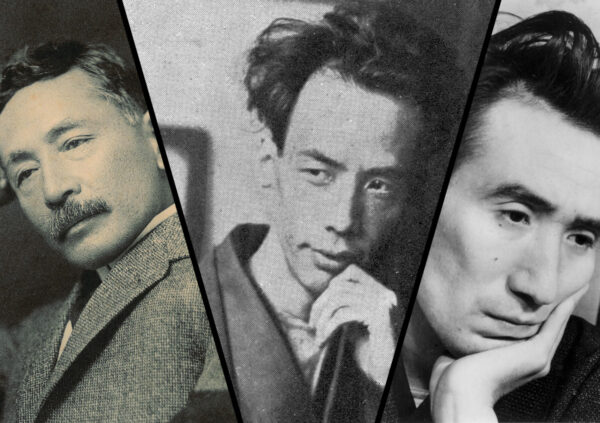
I Am a Cat began as a single comic story that Natsume Soseki never intended to continue. It was first read aloud at a gathering of writers in his own house, not by Soseki but by his editor, and it was that editor who gave the book its famous title. Around the same time, a stray kitten had found its way into the Natsume household. From those small beginnings came a sprawling satire that made Soseki’s name and opened the modern era of Japanese fiction.
The best Japanese novels list explains why the Japanese title is funnier than the English one and what the novel satirizes, and the Natsume Soseki guide places it among his other books. This page covers how the book was born, how it was received, and the choice between two very different translations. I’m relying here on the scholarship and reviews rather than my own reading.
A Story Read Aloud by Someone Else
In late 1904, Soseki was a lecturer in English literature who had never published fiction. Takahama Kyoshi, who edited the literary magazine Hototogisu, was worried about his friend’s state of mind and suggested he write something for the magazine as a kind of recreation.
The piece Soseki produced was presented at a reading group in his home, where younger writers, several of whom became his disciples, read their work aloud and critiqued one another, with Soseki’s wife Kyoko feeding everyone. According to his biographer John Nathan, Soseki was a clumsy reader, so Kyoshi read the story for him, and Soseki laughed along with everyone else at his own creation. Kyoshi wanted it for Hototogisu and suggested a number of changes, including the title. Soseki had called it Cat Chronicle. Kyoshi proposed I Am a Cat.
The Cat, the Professor, and the Author
The story appeared in the January 1905 issue of Hototogisu, not long after a stray kitten had wandered into Soseki’s household. The book’s narrator is likewise a stray, a nameless cat taken in by a schoolteacher named Kushami, and much of the comedy comes from the cat’s lofty contempt for the humans around him. He mocks people for caring about clothes when they were born naked, watches his master carry a fat book to bed and fall asleep instantly, and at one point pronounces the deity responsible for human variety incompetent. He is also, reliably, a cat: he gets his mouth stuck in a rice cake and loses a fight with a gang of rats.
Kushami himself is a parody of Soseki. The teacher’s stomach complaints, his pretensions, and his circle of talkative friends were meant to remind readers of the author and his own literary set. Reviewers have pointed out that the running joke about his digestion looks very different in hindsight, since stomach illness eventually killed him.
One legacy worth knowing: the cat’s grandiose first-person pronoun, wagahai, is why haughty cats in anime and manga still introduce themselves that way a century later.
A One-off That Readers Wouldn’t Let Him End
Readers loved the first story and wanted more, and Soseki obliged. What was meant to stand alone became a serial of ten installments running through 1905 and 1906, later published in three volumes in 1905, 1906, and 1907. The novel’s loose, episodic shape comes directly from that history, since it was written installment by installment in response to demand rather than planned as a whole.
Soseki, a scholar of English literature, drew on the eighteenth-century satirists he knew well, including Jonathan Swift and Laurence Sterne, and scholars have also placed the book in the tradition of the eighteenth-century British it-narrative, in which an object or animal narrates the follies of its owners.
What the Critics Thought, and Got Wrong
Here is the part that surprises people: Japanese critics of the day were cool on it while readers devoured it, and the book’s success saddled Soseki with a reputation he spent years shaking off.
He was taken for a comic novelist, and one critic went so far as to say he was incapable of writing a line that wasn’t funny. That produced the standard account of his career, in which a humorist gradually darkened into the author of Kokoro. Scholars now regard that as a misreading in both directions: the black comedy and the seriousness are both already here, and the later novels are full of irony rather than uniformly grave.
How Long It Is, and How to Read It
A practical warning. The complete three-volume novel runs to well over six hundred pages in English, it is extremely episodic, and it has almost no narrative running between chapters, which means there is no suspense to carry you. Readers who attempt all three volumes end to end often stall, and reviewers advise treating it as a book to dip into over weeks rather than a novel to finish.
Volume one is the tightest and the funniest. If the conversations between Kushami’s friends start to feel like padding, that reaction is common and not a sign you’re missing something.
Which Translation to Buy

This is the part that matters for buyers, and it’s a real choice rather than a formality.
The complete novel, all three volumes, exists in English only in the translation by Aiko Ito and Graeme Wilson, for decades the only option. Their solution to Soseki’s puns was to anglicize everything: Kushami becomes Mr Sneaze, his friends become Waverhouse, Avalon Coldmoon and Beauchamp Blowlamp, and the nouveau-riche neighbors, the Kanedas, become the Goldfields. One commentator described the result as reading like a quirky novel of Edwardian England, which is both the charm and the problem.
In 2025 Nick Bradley, author of The Cat and the City, published a new translation with Vintage. He keeps the Japanese names, and he says in his introduction that his aim was the Meiji reader’s experience rather than the Meiji reader’s words: where a joke could not survive intact, he reworked it so that a modern English reader laughs in the same place. Reviewers have welcomed its lively voice, and at least one who expected to prefer the original names admits to missing Beauchamp Blowlamp.
The catch is that his edition stops at the end of volume one. So: buy Ito and Wilson for the whole novel, buy Bradley for the best version of the opening third, and know that no complete modern translation exists yet.
Where to Go Next
The rest of Soseki’s novels, including Botchan, which he wrote in the same burst of creativity, are on the Natsume Soseki guide, and the novel that shows how far he traveled from this comedy is on the Kokoro page. For modern Japanese fiction with cats at its center, the Japanese healing fiction list is full of them.