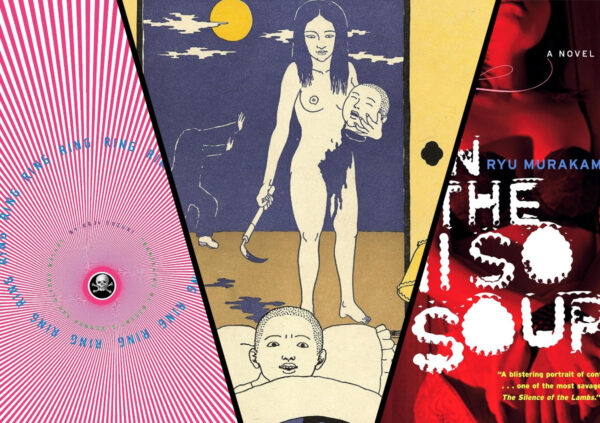
Asked on a trip to Britain who his favorite Japanese author was, Haruki Murakami named Ryu Murakami, who is no relation. In the Miso Soup is the book that answer usually sends people to, and it’s a strange recommendation to receive from the author of Kafka on the Shore, because the two writers have almost nothing in common except a surname and a decade.
Our ranking of the best Japanese novels covers the novel’s structure and how it was published, and the Ryu Murakami guide covers his other books. This page is about the Japan it came out of, how it has been read, what I made of it, and the film that keeps not arriving.
The Japan It Was Written In
The novel is set over three nights before New Year in Kabukicho, the Shinjuku district that is Japan’s best-known nightlife quarter, and it was written at a very specific moment. The bubble economy had burst, the long slump was underway, and the sex trade, the fuzoku industry, had swollen to well over a million people by the late 1990s as economic pressure pushed more women into it.
Running alongside that was a phenomenon the Japanese press could not stop writing about: enjo kosai, compensated dating, teenage girls meeting older men for money. It’s in the novel twice over, in the murders that have the district on edge, most of whose victims were girls involved in it, and in Kenji’s own girlfriend Jun, who is sixteen. Murakami had already written a novel on the subject, Topaz II, which the anime director Hideaki Anno filmed as Love & Pop, so this was not a writer reaching for a headline he did not understand.
Kenji himself is twenty, a high school graduate from Shizuoka Prefecture with no particular prospects, saving money in the hope of getting to America. That detail matters for how critics read the book, because the American he is guiding turns out to be the thing he is saving up for.
Serialized in the Biggest Newspaper in Japan
It first appeared in installments through 1997 in the Yomiuri Shimbun, which has the largest circulation of any newspaper in Japan and possibly in the world, and was then revised for publication as a book the same year.
That is worth sitting with. A story containing what this one contains ran in a mass-market daily paper, and the following year it won the Yomiuri Prize for Literature, an award that goes to writers already established as leaders in their field rather than to newcomers. The best Japanese novels list covers what that says about the gap between Japanese and English-language publishing.
The Company It Gets Kept In
Almost every English-language review reaches for the same comparisons. Frank gets described as a coarser Hannibal Lecter, and the novel gets shelved beside American Psycho and The Silence of the Lambs. Kirkus called it one of the most savage thrillers since the latter, and Ryu Murakami is routinely placed in the company of Bret Easton Ellis and Chuck Palahniuk.
It’s worth knowing where the horror framing came from, though: his publishers in both Japan and North America marketed the book as a psycho thriller. The label on the shelf is a sales decision, not a description of what the book is doing, which is also broadly my own view of it.
Critics also read Frank as a figure for America itself, an outsider arriving in a Japan that has hollowed itself out and finding a kind of home there. That’s the level the novel operates on beneath the thriller machinery, and it’s where the discussions of Buddhism, consumerism and redemption that run through the dialogue belong.
What I Thought of It
This is a recent read for me and I liked it a great deal. It’s sold as extreme horror, and that label undersells it badly. The Kabukicho of the novel is rendered with real specificity, the nightlife trade and the people working it, and Frank is so off from his first appearance that I spent much of the book doubting my own conclusion about him.
The part that stuck with me, though, is Kenji. He is not the decent young man caught up in something terrible that the setup implies. He’s alienated, he looks down on the people around him, and there’s a lot of hate in him. The violence in this book, and there is violence, is there to show the ugliness in people and in the district it’s set in, not for its own sake. It’s a damned good novel.
A practical note for anyone deciding whether to read it: one long sequence in the middle goes further than almost anything else you will find in Japanese fiction in English, and it lands with no build-up at all. If that is a hard no for you, this is not the book to start with.
The Translator
Ralph McCarthy’s translation is the only one, and he has done a good deal of Ryu Murakami, including 69. He has also translated two collections of stories by Osamu Dazai, which puts him on both sides of a long line in Japanese fiction about men who cannot live inside their own society.
The Film That Keeps Not Arriving
There is no film of In the Miso Soup, despite years of announcements. Wim Wenders was reported in 2008 to be developing an adaptation that never surfaced, and the long-gestating Coin Locker Babies project, with Michele Civetta directing and a screenplay worked on by Sean Lennon and Jordan Galland, never got off the ground either.
Miike did film Audition, which is how most Western viewers met Ryu Murakami’s work at all, and the gap between that adaptation’s success and the silence around everything else is one of the odder facts of his career abroad.
Which Copy

There’s one English edition, McCarthy’s, published by Kodansha International in 2003 and since reissued. It runs under two hundred pages in the UK printing and a little over in the US one, which makes it the shortest way into him.
Where to Go Next
If this one worked on you, the big Ryu Murakami is Coin Locker Babies.
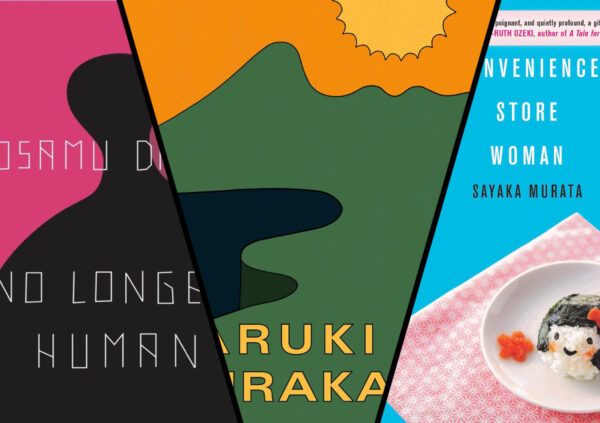
The Ryu Murakami guide covers the whole shelf, the Japanese horror books list places this novel among the country’s darkest fiction, and Dazai’s No Longer Human is the classic ancestor of its narrator’s alienation.