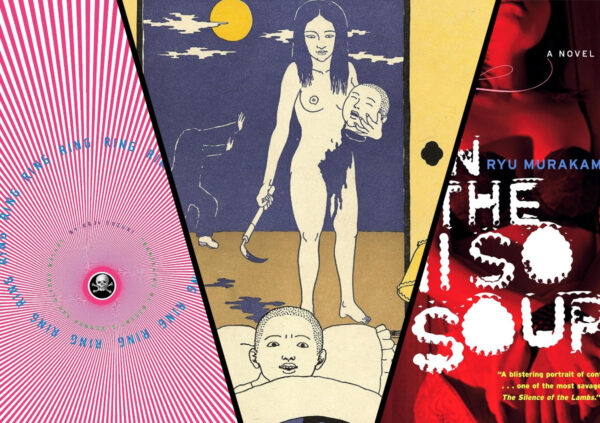
Ryu Murakami is no relation to Haruki, and his books could hardly be more different. Where Haruki’s narrators drift through quiet mysteries, Ryu’s characters are drug-addled teenagers, abandoned children, killers, and the lonely people who sell and buy pleasure in Tokyo’s nightlife districts. Japanese critics called him the bad boy of the country’s literature, and Western reviewers reach for the Beats, Bret Easton Ellis and Chuck Palahniuk. He writes about the emptiness under Japan’s prosperity with a directness, and sometimes a violence, that has kept him provocative for half a century.
This guide covers the Ryu Murakami books available in English and suggests where to start. Audition and In the Miso Soup each have entries in our rankings of Japanese novels and Japanese horror books. I’ve read In the Miso Soup and Audition, and those two entries carry my own take. The rest reflect the critical record.
Where to Start
In the Miso Soup is the natural place to start: short, gripping, and a clear statement of his central concerns. Audition is the other obvious entry point, especially if you know the film. Readers who want the big, sprawling Murakami should go to Coin Locker Babies.
Fair warning: several of these books contain extreme violence and sexual content, and that is part of how he makes his points about the society he’s describing.
The Drummer From Sasebo
He was born Ryunosuke Murakami in February 1952 in Sasebo, in Nagasaki prefecture, into a teacher’s family, and named after the protagonist of a novel by Nakazato Kaizan. Sasebo matters: it is a naval town with a large American base, and the collision between Japanese provincial life and imported American culture is in everything he writes.
His school years read like a first draft of 69. He helped form a rock band called Coelacanth, playing drums, tried the rugby club and found it brutal, moved to the school newspaper instead, and got himself suspended for taking part in the student protest movement, barricades included. He went to Tokyo to study at Musashino Art University, took a leave of absence, and by then had written a novel.
That novel was Almost Transparent Blue, which he wrote as a student and which won the Gunzo Prize for new writers and then, later the same year, the Akutagawa Prize, in 1976, when he was twenty-four. Some judges and critics called it decadent. Readers did not care: it sold around a million and a half copies within months of publication and over three and a half million by the mid-2000s, and journalists coined a label, the Transparent Tribe, for the disaffected youth it described.
He has never been only a novelist. Murakami also directed several films, including an adaptation of his own novel Topaz, released internationally as Tokyo Decadence, and earlier features in the 1980s. He hosted a late-night television talk show, founded a record label, and has a long-standing love of Cuban music. He married the keyboard player Tazuko Takahashi in 1976.
Almost Transparent Blue
1976 · translated by Nancy Andrew

A nineteen-year-old narrator named Ryu and his friends live near an American air base outside Tokyo, in a haze of drugs, group sex, rock music and casual violence, waiting for something that never arrives. The novel has almost no plot and is built from vivid, often hallucinatory images: a moth, a syringe, a bloodstain, a plane overhead.
It won the Akutagawa Prize and caused a sensation, and it remains the book that fixed his reputation. It’s short, raw, and an essential document of 1970s Japanese youth culture, written from inside rather than about. Readers who find it shapeless are not wrong. The shapelessness is the argument.
The book has been out of print, and second-hand copies can be costly and hard to track down.
Coin Locker Babies
1980 · translated by Stephen Snyder

Two boys, Kiku and Hashi, are abandoned as newborns in train station coin lockers, survive, grow up in an orphanage and then on a remote island, and set out into a lurid near-future Tokyo. Hashi becomes a pop star. Kiku becomes something much worse. The novel takes in a toxic quarantined district of the city, a drug that induces total destruction, and a pole vaulter’s obsession, and it is easily his most ambitious book.
It won the Noma prize for new writers and it is the Ryu Murakami that readers either call a masterpiece or abandon at page two hundred. It first appeared in English in 1995 and was later reissued by Pushkin Press. Takashi Miike spent years trying to film it, and despite a screenplay drafted with Jordan Galland the money never came together.
69
translated by Ralph McCarthy

A semi-autobiographical comic novel set in 1969, in which a high school student in a provincial Kyushu town, mostly in order to impress a girl, barricades his school, stages a protest, and plans a festival. The politics are real and the narrator’s grasp of them is not, which is the joke: revolution as a way of getting noticed.
It’s one of the lighter books in his English catalog and a useful contrast to the darker work, and it maps closely onto his own suspension from school in Sasebo. Readers who know only In the Miso Soup are usually surprised by how funny he can be.
Piercing
1994 · translated by Ralph McCarthy

A young Tokyo professional has a compulsion to stab his infant daughter with an ice pick. To protect her, he decides to kill someone else instead, and selects a woman from a sex club. She arrives with her own history of damage and her own plans for the evening, and the novel becomes a tense two-hander in which neither is what the other expected.
It’s short, it’s nasty, and it’s the most conventionally structured thriller he has written, which makes it the easiest of his violent books to recommend. It was adapted as an American film in 2018.
Popular Hits of the Showa Era
1994 · translated by Ralph McCarthy

A gang of aimless young men and a group of divorced middle-aged women, all of them named Midori, drift into an escalating war of revenge in a Tokyo suburb, with karaoke standards from the postwar decades running through the violence. It starts as farce and ends somewhere considerably darker, without ever changing tone.
It’s a savage black comedy about generations and gender in Japan’s lost decade, and the funniest thing he has published in English. It was filmed in Japan in 2003.
Audition
1997 · translated by Ralph McCarthy

A lonely widower in his forties agrees to a film producer friend’s plan to hold fake auditions for a movie in order to find himself a new wife, and he becomes infatuated with one quiet, delicate applicant whose references do not check out.
It’s been over a decade since I read it. I enjoyed it, though it didn’t end up among my favorites. It is best known for Takashi Miike’s 1999 film, the route by which most readers outside Japan first encountered him, and our Japanese novels ranking covers how the book differs from it.
In the Miso Soup
1997 · translated by Ralph McCarthy

Kenji, a young guide who shows foreign tourists around Tokyo’s sex industry, is hired for three nights by an American named Frank, whose strange behavior suggests he may be connected to a series of recent murders.
I read this one recently and enjoyed it a lot. It’s shelved as extreme horror, but it’s much better and much deeper than that label suggests. It’s full of Kabukicho nightlife, and Frank is so weird that I kept thinking maybe he wasn’t the killer after all. The book also makes clear that Kenji is far from a normal person himself: alienated, looking down on people, full of hate. The graphic violence isn’t there for its own sake. It’s how the book shows the ugly side of people, and of the nightlife district itself. It’s a damned good book.
It has its own In the Miso Soup page, and it also appears on the Japanese horror books list and, for readers coming from the harder end of the genre, the extreme horror list.
From the Fatherland, with Love
2005 · translated by Ralph McCarthy, Charles De Wolf, and Ginny Tapley Takemori

In a near future in which Japan’s economy has collapsed and the country has been left isolated, a small group of North Korean commandos seizes the city of Fukuoka, and the only people prepared to fight back are a band of young misfits and outcasts living in a derelict building. It runs to over six hundred pages in English and took three translators.
It’s a long political thriller on an epic scale, and the most overtly ideological thing he has written: the misfits are the point, and the functioning society that ignored them is the target.
The Full English List at a Glance
Almost Transparent Blue · Coin Locker Babies · 69 · Tokyo Decadence (stories) · Piercing · Popular Hits of the Showa Era · Audition · In the Miso Soup · From the Fatherland, with Love
Not in English: Ai to Gensou no Fascism, his 1987 novel about a secret society trying to remake Japan, and much of his essay and interview work.
Where to Go Next
For the Murakami readers usually mean, see the Haruki Murakami ranking. The rest of Japan’s darkest fiction is on the Japanese horror books list, and for another contemporary writer who looks hard at the underside of Japanese society, try the Natsuo Kirino guide.