Keigo Higashino has published more than eighty novels. Fewer than twenty are in English.
That gap is the entire reason this page exists. He is the best-selling crime writer in Japan and the most translated Japanese mystery novelist in the world, and what English readers have is a slice: two series that arrive out of order and incomplete, plus a handful of standalones that have nothing to do with either. The wider author map lives on my Japanese authors hub. The full canon is ranked on my best Japanese novels list.
This covers which Keigo Higashino books exist in English, which series to start with, where each English sequence actually lands in the Japanese one, and which books stand alone.
Start Here, Depending on What You Want
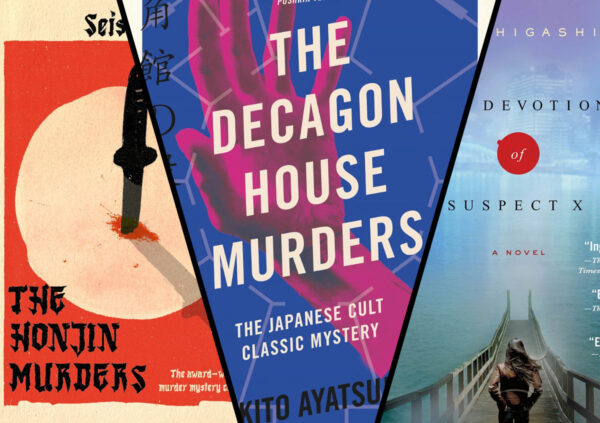
If you want the famous one: The Devotion of Suspect X. It is his most acclaimed novel, it won the Naoki Prize, and it stands entirely alone.
If you want a detective rather than a puzzle: Malice. It is the first Kaga novel in English and the one that shows what he does with motive rather than mechanism.
If you want something with no series attached: The Miracles of the Namiya General Store or Under the Midnight Sun.
Those three routes through the Keigo Higashino books do not overlap much. Higashino writes cold logic puzzles, patient human procedurals and sentimental fables, sometimes in the same decade, and readers who love one strand are frequently indifferent to another.
The Two Series, and Where English Readers Actually Land
This is the part almost every list of Keigo Higashino books gets wrong.
Detective Galileo
Manabu Yukawa is a physics professor who consults for the police, nicknamed Galileo, working alongside Detective Kusanagi. The cases turn on scientific method: what looks impossible has a mechanism, and Yukawa finds it.
Ten books in Japanese. Five in English.
The confusion here is worth clearing up, because sources contradict each other. The Devotion of Suspect X is the third Galileo book and the first Galileo novel. The two before it are short story collections that have never been translated. So when you read that Devotion is the first in the series, that is true of the novels and not true of the books, and both statements turn up in print.
English order, with dates: The Devotion of Suspect X (2011), Salvation of a Saint (2012), A Midsummer’s Equation (2016), Silent Parade (2021), Invisible Helix (2024). The first three are Alexander O. Smith, the last two Giles Murray.
Read them in that order. The cases are self-contained, but Yukawa and Kusanagi’s relationship develops across them and the later books assume you have met these people.
Detective Kaga
Kyoichiro Kaga is a Tokyo police detective who works by walking. He visits small shops, talks to neighbors, notices what people do rather than what they say, and assembles a case out of ordinary domestic detail. He is the opposite of Yukawa in method and the books are warmer for it.
Ten books in Japanese. Four in English.
And the four English books are not consecutive. Malice is the fourth Kaga novel in Japanese. The Final Curtain is the tenth. The English selection skips across the Japanese series rather than following it, so you are not entering late so much as sampling, and nothing on any cover says so.
English order, with dates: Malice (2014, Alexander O. Smith), Newcomer (2018), A Death in Tokyo (2022), The Final Curtain (2023), the last three all Giles Murray.
A title warning on the third one. A Death in Tokyo also circulates as Wings of the Kirin, which is a literal rendering of the Japanese title. Same book. If you own one, you do not need the other.
Read those four in order, because unlike Galileo they build. The Final Curtain in particular pays off material seeded across the earlier ones.
The Standalones
These Keigo Higashino books have no series continuity and can be read in any order, which makes them the safest place to start if the sequence problems above put you off. In English: Naoko, Under the Midnight Sun, The Name of the Game is Kidnapping, The Miracles of the Namiya General Store, and from 2026 The Keeper of the Camphor Tree and The Dark Magician.
Under the Midnight Sun, also published as Journey Under the Midnight Sun, is his epic: a plot spanning nearly twenty years, following two children from a 1973 murder into adulthood, with the investigation running in parallel. It is the longest thing he has written in English and probably the most ambitious.
Naoko is the strangest. A bus crash kills a man’s wife and injures their daughter, and when the girl wakes she speaks and behaves exactly like her late mother. He is then living with his wife inside his child’s body, and the novel is about what that does to a marriage and to a man. It is barely a crime novel at all.
The Miracles of the Namiya General Store is the sentimental one and by some distance his best-selling book in several markets. An abandoned shop where letters posted through the shutter receive answers from decades away. No murder, no detective, and a great many readers who came for the puzzles have found it their favorite.
What Is Not in English, and It Is Most of Him
Higashino has written more than eighty novels. English readers have access to somewhere around eighteen, and the number is moving.
Missing entirely: the first two Galileo short story collections, most of the Kaga sequence, the whole Masquerade Hotel series of four books, and dozens of standalones.
But the gap is closing faster than most lists suggest. Guilt, the first Detective Godai novel, landed in April 2026 and The Keeper of the Camphor Tree in June, with The Dark Magician and Laplace’s Witch scheduled before the year is out. Two series that were entirely absent from English a year ago now have a foothold. Any list of Keigo Higashino books that says Godai and Laplace’s Witch are untranslated is out of date, and that includes most of them.
This is not unusual for a Japanese crime writer, and it is unusually stark here because of the sheer volume. He is prolific in a way that translation schedules cannot match, and the selection English readers have was made by publishers picking the books most likely to travel rather than by any principle of sequence.
Practical consequence: do not try to read Keigo Higashino books in Japanese publication order. It cannot be done in English and attempting it will only make the gaps more annoying. Read each English series in its own order and treat the standalones as standalones.
The Translators
Worth knowing, because the English Keigo Higashino books are not the work of one hand.
Alexander O. Smith translated the early breakthroughs, including The Devotion of Suspect X, Salvation of a Saint and A Midsummer’s Equation, working with Elye Alexander and Joseph Reeder on some. Smith came out of video game localization, which is not the usual route into literary translation and which shows in the cleanness of the prose.
Giles Murray has carried most of the recent work, including the later Galileo books and the Kaga sequence.
The register shifts slightly between them. Smith is flatter and colder, Murray warmer. Neither is wrong for the material and it is worth knowing why the books feel a little different across the catalog.
What He Is Actually Doing
The reason the Keigo Higashino books work, and the reason he is the most translated Japanese crime writer alive, is that he keeps building novels around the least fashionable question in the genre.
Not who. Not how. Why.
The Devotion of Suspect X shows you the killing in the first chapter and spends three hundred pages on how far one man will go. Malice gives you the killer and a confession by the halfway point and then refuses to explain the motive, and the excavation of that motive is the entire book. Salvation of a Saint asks how a murder was committed by someone demonstrably hundreds of miles away, and the answer, when it comes, is about a year of patience rather than a trick.
That is a very specific inheritance. Seicho Matsumoto spent the 1950s and 60s arguing that Japanese detective fiction had become a parlor game and that motive mattered more than mechanism. Higashino is the writer who worked out how to have both: the puzzle constructed to Golden Age standards, and underneath it a reason for the crime that is quietly devastating.
He was an engineer at Nippon Denso when he won the Edogawa Rampo Prize in 1985, at twenty-seven, for a novel called After School, and quit to write full time on the strength of it. That prize is named for the man who invented Japanese detective fiction, which is a tidy piece of succession for a writer who would go on to sell more of it than anyone.
He was president of the Mystery Writers of Japan from 2009 to 2013, and The Devotion of Suspect X was a finalist for the Edgar Award, which is rare for a translated novel.
A note on the prose. Across the Keigo Higashino books it is plain, functional and occasionally flat, and the characterization outside the central figures is thin. That is a fair criticism and it comes up constantly. It is also, arguably, the point: these are novels built to be solved, and everything decorative has been removed. If you want sentences, this is not your writer. If you want to be outmaneuvered, he is the best in the world at it.
The Full English List at a Glance
Detective Galileo (5): The Devotion of Suspect X 2011 · Salvation of a Saint 2012 · A Midsummer’s Equation 2016 · Silent Parade 2021 · Invisible Helix 2024
Detective Kaga (4): Malice 2014 · Newcomer 2018 · A Death in Tokyo 2022, also sold as Wings of the Kirin · The Final Curtain 2023
Laplace’s Witch (1): Laplace’s Witch 2026
Detective Godai (1): Guilt 2026
Standalones: Naoko · Under the Midnight Sun · The Name of the Game is Kidnapping · The Miracles of the Namiya General Store · The Keeper of the Camphor Tree 2026 · The Dark Magician 2026
If you want to see how the puzzle tradition he now dominates was built, and by whom, I have written about that over at the best Japanese mystery novels.
The Devotion of Suspect X has its own page, on the five film versions across four countries and the mathematical problem the plot is built on.