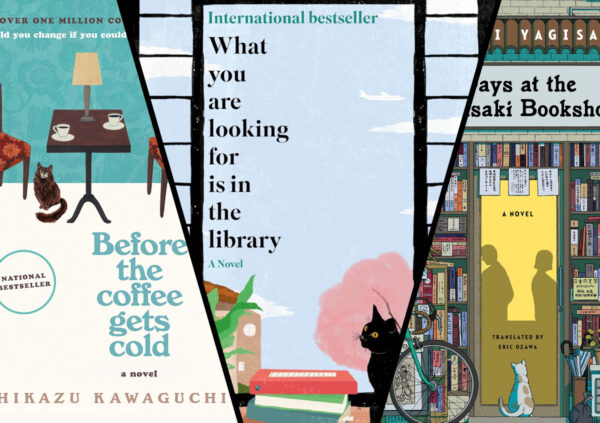
Before the Coffee Gets Cold is the book that started the current wave of gentle Japanese fiction in English, and it did not start as a book at all. Toshikazu Kawaguchi wrote it as a stage play for his own theater company, and the novel that followed has sold over a million copies, spawned five sequels, and been filmed under a title that sends readers looking for the wrong thing.
The Toshikazu Kawaguchi guide covers the series in order and where the sequels start to repeat themselves, while our Japanese healing fiction list sets it inside the genre it helped invent. Here the subject is the rules, the stage version that came first, the film, and the case for and against the book. Kawaguchi is an author I know through his reception rather than from reading him.
The Rules, Which Are the Whole Design
Down a Tokyo back alley, in a basement café that has been brewing for over a century, a single seat will send you into the past. The conditions attached to it remove every lever such a story normally pulls.
The present cannot be altered. The person you go to meet must have been to the café themselves. You have to stay in the seat. And you are back the moment the coffee goes cold.
Four visitors sit down anyway. One goes back to confront the man who walked out on her. Another goes to collect a letter from her husband, whose memory is being taken by Alzheimer’s. One goes to see her sister one last time. And the last goes to meet the daughter she never had the chance to know. None of them can alter a thing, which is the point: they travel for confirmation that their lives mattered to somebody, and the book argues that this is the more universal need.
It Was a Play First
Born in Osaka in 1971, Kawaguchi spent years in the theater before he wrote any fiction, producing, directing and writing for a group called Sonic Snail, with plays including COUPLE, Sunset Song and Family Time. He wrote Before the Coffee Gets Cold for his own company, 1110 Productions, and the stage version won the grand prize at the 10th Suginami Drama Festival.
He then adapted it himself, and the novel appeared in Japan in December 2015 under the title Kōhī ga Samenai Uchi ni, from Sunmark Publishing. It was nominated for the Japan Booksellers’ Award.
Once you know that, the book’s shape makes sense. It reads like four acts on a very small set: one room, a fixed cast of staff, four visitors in turn, and dialogue doing nearly all the work. Readers who come to it expecting description find it thin, because the original form did not need any. Readers who come for the conversations find them devastating.
One reader noticed something else the stage origin explains: nobody in the book has a smartphone. Everyone reads magazines and paper books, and the prices are low. The play dates from the early 2010s, and the novel never updated itself.
The Honest Case Against It, and for It
This is a divisive book, and not along the lines you might expect. The complaints are mostly about the prose: that the dialogue repeats itself, that emotions get stated rather than shown, that the writing clunks where the concept soars. One reviewer compared reading it to driving a beautiful old Italian car that makes alarming noises once you start the engine.
The defense is that the final section earns everything. Even readers who dislike parts of the novel tend to admit the last visit lands, and critics have praised how carefully Kawaguchi bends his own rules at the end without breaking them.
There’s also a question of timing. A book this gentle, published in English in 2019 and reaching a mass American readership in 2020, arrived exactly when a lot of readers wanted consolation, which is part of why it became shorthand for a whole category of book.
The Film, and the Title Problem
The 2018 Japanese adaptation was directed by Ayuko Tsukahara and stars Kasumi Arimura, and in English it is usually listed as Cafe Funiculi Funicula, a title taken from the café’s name rather than the book’s. Readers hunting for a film called Before the Coffee Gets Cold therefore often conclude there isn’t one.
It draws on the first two books rather than only the first, which is why some of it will be unfamiliar even if you’ve read the opening novel. Reviews were mixed: the Japan Times found it heavy-handed compared with the source.
An English-language television series was optioned in 2021 by SK Global and The Jackal Group, and nothing has been heard since.
Which Copy

Geoffrey Trousselot’s translation is the only one, and reviewers credit it with keeping the restraint and the plain rhythm of the original rather than warming it up. Trousselot was born in Hobart, Australia, in 1969, and has translated the whole series along with other Japanese nonfiction.
It appeared in the UK from Picador in September 2019 and in the US from Hanover Square Press in November 2020, so British and American readers met it a year apart, which is why publication dates differ depending on where you look.
Where to Go Next
The next book is Tales from the Cafe, and the Toshikazu Kawaguchi guide covers all six.
For the wider shelf this book created, see the Japanese healing fiction list, which is honest about which of these novels last. The Michiko Aoyama guide covers the writer most often shelved beside him, and for this kind of warmth with more literary muscle behind it, the Yoko Ogawa guide is the place to look.