Chinese fantasy novels are badly served in English, and the problem isn’t a shortage of material. It’s that almost every list covering them points at the same place: the web serials.
Search for Chinese fantasy and you’ll get Coiling Dragon, Against the Gods, I Shall Seal the Heavens, and a hundred more, most of them ongoing, most of them running past two thousand chapters, nearly all of them fan-translated at wildly varying quality. That’s a real phenomenon with a genuine readership and it is not what this list covers. A 2,900-chapter serial isn’t a novel you read, it’s a subscription you maintain, and the writing generally reflects the economics of being paid by the word.
What gets buried underneath that is a literary tradition running back five centuries, containing some of the most inventive fantasy ever written, most of which is now available in good English translations that almost nobody recommends.
So this list covers three things, kept separate because they’re genuinely different.
The classical canon: Ming and Qing dynasty novels that happen to be fantasy, and are foundational to everything after.
Wuxia: the martial-hero tradition, which is China’s closest equivalent to Western epic fantasy and is dominated by one writer whose cultural position is roughly Tolkien’s.
Chinese-inspired fantasy written in English: contemporary work by authors of Chinese heritage, drawing on the same mythology and history. Different category, clearly labeled, because calling it Chinese fantasy without qualification would be sloppy.
A note on translations, since for the classical section it determines everything. Where a complete translation exists, that’s what’s recommended here. Abridgements get a mention where they’re the standard entry point, but a book cut by seventy percent is a different book.
The Western canon these sit beside is mapped on my best fantasy books list.
Fiction by René Rehn


The Classical Canon
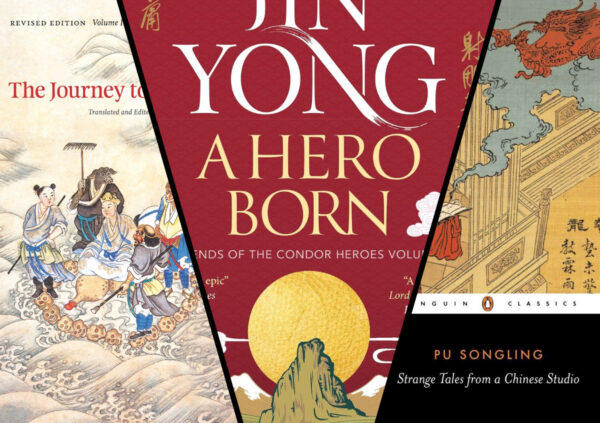
Journey to the West by Wu Cheng’en (16th century)

Recommended: Anthony C. Yu’s complete four-volume translation, revised 2012.
The greatest fantasy novel written before the twentieth century, and the ancestor of a genuinely enormous amount of modern culture.
A Tang dynasty monk travels west to India to retrieve Buddhist scriptures, escorted by three supernatural disciples: a pig demon, a river ogre, and Sun Wukong, the Monkey King, who is one of the great characters in world literature. Before the pilgrimage even begins, Monkey has been born from a stone, mastered immortality, stolen a weapon from the dragon king of the sea, erased his own name from the register of the dead, been given a fake job in Heaven to keep him quiet, worked out that it was fake, declared himself Great Sage Equal of Heaven, and been imprisoned under a mountain for five hundred years. That’s the opening act.
What follows is a hundred chapters of episodic demon-fighting that is by turns fantasy, comedy, religious allegory, and bureaucratic satire. The celestial administration in this book is a functioning civil service with paperwork, and the joke lands as well now as it did in 1592.
On editions: two complete English translations exist, Yu’s and W. J. F. Jenner’s. Yu’s is the scholarly standard, translates the verse properly, and comes with substantial apparatus, at the cost of four volumes and about 1,900 pages. Jenner’s is the more readable complete version if that length is daunting. Arthur Waley’s Monkey is the famous abridgement and the reason many English readers know the story at all, but it cuts most of the poetry and a great deal of the texture, so treat it as an introduction rather than the book.
Everything from Dragon Ball to Black Myth: Wukong descends from this.
Investiture of the Gods by Xu Zhonglin (16th century)

Recommended: with reservations. See the translation note below.
The mythological war epic that supplies half the Chinese pantheon, and the least-read great fantasy novel on this page.
It fictionalizes the fall of the Shang dynasty and the rise of the Zhou, roughly 1046 BC, as a conflict in which mortal armies are backed by Daoist immortals, and the dead are elevated into gods according to a divine register. The scale is enormous: a hundred chapters, hundreds of named characters, magical weapons with individual histories, and an escalating series of duels between practitioners whose powers come out of Daoist alchemical tradition.
Nezha, the child-god who dismembers himself to repay his parents and is reconstructed from lotus, appears here in his definitive form, and the Nezha films breaking Chinese box office records are drawing directly on this.
The translation situation is the worst of any book on this page and you should know it going in. Gu Zhizhong’s 1992 version, published as Creation of the Gods, was for decades the only complete English translation of the novel, and it has been out of print long enough that secondhand copies run to triple figures. It is also not a good translation: the poetry is largely stripped out, difficult passages are paraphrased or skipped, and the English reads more like a wire report than a novel. Scholars who work on the text say so plainly. The main alternative, Katherine Liang Chew’s Tales of the Teahouse Retold, is more readable and covers only the first forty-six chapters of a hundred.
A newer complete translation has appeared recently, which is worth investigating if you’re serious about this one, though it hasn’t accumulated the track record the others have.
Read it for the invention and the mythology rather than the prose, and accept that no English version currently does it justice. It’s the closest thing Chinese literature has to a systematic fantasy cosmology, and it deserves better than it has.
Strange Tales from a Chinese Studio by Pu Songling (18th century)

Recommended: John Minford’s Penguin selection, or Sondergard’s complete multi-volume edition.
Nearly five hundred short accounts of the uncanny, and the strangest, most beautiful thing on this page.
Scholars meet women who turn out to be fox spirits. Ghosts sit examinations. A painted wall becomes passable. A man’s soul leaves his body and returns changed. Pu Songling collected and rewrote folk material across decades while repeatedly failing the imperial examinations himself, and that frustration bleeds through the whole collection, which is unusually interested in scholars whose lives are going nowhere.
The register is what makes it exceptional. These are brief, often only two or three pages, and Pu Songling declines to explain anything. The supernatural arrives without warning, behaves according to rules nobody states, and departs. There’s rarely a moral, and where there is one it’s frequently ironic.
That places it much closer to weird fiction than to epic fantasy, and it belongs in that conversation as much as this one. If the fox spirits and the unexplained thresholds are what appeal, the tradition it sits inside is covered on my weird fiction pages, alongside the European writers doing comparable work a century and a half later.
Borges admired it and included Pu Songling in his personal library series. Among Chinese fantasy novels this is the one most likely to make a Western reader sit up.
The Water Margin by Shi Nai’an (14th century)

Recommended: Sidney Shapiro’s Outlaws of the Marsh, complete in four volumes.
The bandit epic, and a borderline inclusion worth explaining.
A hundred and eight outlaws, each the reincarnation of a demonic spirit released at the novel’s opening, gather at Liangshan Marsh in rebellion against a corrupt imperial court. Most of the book is straight historical adventure: heists, feuds, prison breaks, and some of the most famous single combats in Chinese literature.
The fantasy element is real but intermittent. The framing device is supernatural, several characters are Daoist magicians, and the final campaigns involve outright sorcery. For long stretches, though, this is a crime novel about men with grudges.
It’s here because it’s foundational, because the fantastical frame genuinely shapes the book, and because it’s the direct ancestor of the wuxia tradition in the next section. The jianghu, the outlaw underworld with its own code, starts here.
Shapiro’s translation is the standard. Be aware that Pearl S. Buck’s older version has a following and a lot of critics.
Wuxia
Wuxia means martial heroes, and the genre is China’s nearest equivalent to Western epic fantasy: invented histories, elaborate schools of martial technique that function precisely as magic systems do elsewhere, sworn brotherhoods, generational feuds, and a moral universe organized around obligation. It’s grounded in real martial arts and real history rather than in the immortality cultivation of xianxia, which is the distinction that matters when you’re picking what to read.
Legends of the Condor Heroes by Jin Yong (1957)

Recommended: the MacLehose translation, four volumes, complete.
The foundational wuxia novel and the entry point to the most-read Chinese novelist of the twentieth century.
Guo Jing is a slow, honest, unremarkable young man raised among Mongols on the steppe, unknowingly bound by a wager made before his birth between two masters who each took on a student to prove a point about teaching. He is the wrong kind of hero by every Western convention: not clever, not gifted, and not special. He simply works harder than anyone and refuses to break his word.
Huang Rong is the counterweight, and one of the great characters wuxia has produced: the daughter of a reclusive martial genius, quick where Guo Jing is slow, and considerably more dangerous.
Jin Yong’s standing is difficult to overstate. The Guardian called him the most widely read Chinese writer alive, shortly before his death in 2018, and comparisons to Tolkien, Rowling, and Martin turn up in almost every English review, which for once is not marketing.
On the translation: it appeared in four volumes between 2018 and 2021, translated by Anna Holmwood, Gigi Chang, and Shelly Bryant, and it’s the first official English version. It’s aimed at general readers rather than scholars, and there’s a live criticism worth knowing about, which is that some character names are anglicized inconsistently, so Huang Rong becomes Lotus Huang while Guo Jing stays as he is. Readers coming from the television adaptations find this jarring. It’s a real objection and it doesn’t spoil the book.
The Return of the Condor Heroes by Jin Yong (1959)

Recommended: the MacLehose translation, in progress. Volume one, A Past Unearthed, appeared in 2023.
The second part of the Condor trilogy, and the reason the first is worth starting.
Yang Guo is the son of a traitor, raised in disgrace, and he’s considerably more interesting than Guo Jing was: proud, wounded, reckless, and in love with his own martial teacher, which is a scandal the novel takes entirely seriously and builds its emotional weight on. It’s set during the Mongol conquest, and the Battle of Xiangyang gives it a historical spine the first book only gestured at.
Jin Yong’s method across the trilogy is to change protagonist and moral temperature completely each time, so the sequence works as the history of a world rather than a continuing adventure. Where Guo Jing succeeded through stubbornness and integrity, Yang Guo succeeds through defiance, and the novel is much less sure that this is admirable.
The practical warning: MacLehose has been publishing the whole trilogy as twelve volumes, four per novel, and the program is still running. The four volumes of Legends of the Condor Heroes are complete. Return began appearing in 2023 with A Past Unearthed, translated by Gigi Chang, and The Heaven Sword and Dragon Sabre, the third novel, is further out still. Check what’s currently in print before you commit, because starting a trilogy whose later volumes are mid-translation is its own kind of commitment.
The Deer and the Cauldron by Jin Yong (1969)

Recommended: John Minford’s three-volume translation.
Jin Yong’s last novel, his funniest, and a deliberate demolition of everything he’d spent twenty years building.
Wei Xiaobao is the son of a prostitute, illiterate, cowardly, physically unimpressive, and comprehensively dishonest. He is also the best-connected man in the Qing empire, having lied, flattered, and blundered his way into the confidence of the emperor, a rebel society, several martial schools, and seven wives. He never becomes a martial artist. He never really becomes a better person.
After a career of writing heroes defined by integrity and discipline, Jin Yong wrote a protagonist who succeeds entirely through charm and dishonesty, and it’s the most purely entertaining thing he produced.
Minford’s translation is excellent and complete, and this is the Jin Yong most accessible to a reader with no background in the genre.
The Eleventh Son by Gu Long (1973)

Recommended: Rebecca S. Tai’s translation, the only official English edition of any Gu Long novel.
The other major wuxia writer, and a completely different sensibility.
Where Jin Yong writes historical epics with enormous casts, Gu Long writes something closer to noir: shorter, faster, atmospheric, built on mood and sudden violence rather than intricate plotting. His swordsmen are lonely, often drunk, and frequently sick of the life. The duels are decided in a single stroke after pages of tension.
The Eleventh Son concerns a wandering swordsman, a legendary blade everyone wants, and a woman engaged to someone else. The plot matters less than the register.
The translation situation is stark. Gu Long wrote sixty-nine novels in a twenty-five year career before drinking himself to death at forty-eight, and this is the only one a mainstream publisher has brought into English. Tai’s version is well regarded by readers who know the Chinese, and her introduction on Gu Long’s style is worth the price on its own.
One thing that shapes the whole book: Gu Long deliberately avoided historical specificity, because a novel set in an identifiable dynasty could be read as commentary on the present and attract censors. The result is a story floating free of any particular era, which is part of why it feels closer to noir than to epic.
If the Condor books work for you and you want the version with less history and more melancholy, this is the only door currently open.
Chinese-Inspired Fantasy in English
A different category, and worth being precise about it. These are novels written in English by authors of Chinese heritage, drawing on Chinese history, mythology, and literary tradition. They aren’t translations and they aren’t part of the Chinese literary tradition proper, but the search that brings people to Chinese fantasy novels frequently wants them, and several are excellent.
The Poppy War by R. F. Kuang (2018)

Military fantasy built on the Second Sino-Japanese War, and the most brutal book in this section.
Rin tests into an elite military academy from nothing, discovers a talent for shamanism that lets her channel a god, and the trilogy follows her from student to war criminal without ever offering her a redemption. The shamanic magic runs on opium and costs sanity by the session, a power source indistinguishable from a habit.
Kuang works close to the twentieth-century record, including an atrocity chapter that transposes Nanjing, which is why none of it reads as invented cruelty.
Kuang was in her early twenties when it was published. It’s on my grimdark books list as well, where the argument about whether it belongs in that category is worth having.
Babel by R. F. Kuang (2022)

Kuang’s second appearance and her best-constructed novel.
Robin Swift is taken from Canton to London as a child and trained for Oxford’s Royal Institute of Translation, where silver bars are enchanted by pairs of words that don’t quite mean the same thing in two languages, and the gap between them produces power. The British Empire runs on this, which means it runs on the languages of the people it colonizes.
The premise is the best magic system idea of the last decade because it isn’t really a magic system. It’s an argument about extraction dressed as one.
It’s dark academia, it’s angry, and its footnotes are doing genuine work.
The Green Bone Saga by Fonda Lee (2017-21)

The gangster epic, and the best-structured trilogy in this section.
Kekon’s jade is the only substance on earth that grants trained wearers superhuman abilities, and two clans built the country on controlling it. The Kauls fight their rival across whole generations, with time-skips that let consequences land on characters who weren’t born when the decisions were made.
Lee has named The Godfather as her model, and the setting is a mid-century Asian island nation rather than anything medieval, which makes it the most distinctive world in modern fantasy.
It ends properly, which after Jin Yong’s translation-availability problems is worth stating.
She Who Became the Sun by Shelley Parker-Chan (2021)

Historical fantasy about the founding of the Ming dynasty, and the most literary book in this section.
Zhu Chongba dies in the famine. His sister takes his name, and the greatness fate promised him, and rides it out of a monastery, into a rebellion, and toward the Mandate of Heaven. Ambition here has a blast radius, and the parallel antagonist, the eunuch general Ouyang, burns inside a predicament every bit as impossible.
The historical grounding is real: Zhu Yuanzhang was a peasant who became emperor, and the novel’s alterations are deliberate rather than decorative.
What This List Leaves Out
Worth stating plainly, because the omissions are deliberate.
Web serials and cultivation fiction. Coiling Dragon, Against the Gods, Tales of Demons and Gods, and the enormous xuanhuan and xianxia catalogue on Wuxiaworld and Qidian. These are serialized, frequently unfinished, and translated at variable quality, and the form rewards volume over craft. If that’s what you’re after, those platforms are where to go and they don’t need my help being found.
Danmei and the romance-driven end of the market. Grandmaster of Demonic Cultivation and Heaven Official’s Blessing have large, devoted readerships and the romance is the engine rather than a thread. That’s a different genre with its own conventions, and it isn’t what this page covers.
Chinese science fiction, which is a genuinely major tradition and belongs elsewhere. Liu Cixin, Hao Jingfang, and Chen Qiufan are on my best science fiction books list.
If you’re starting from nothing: Journey to the West if you want the foundational text and have the patience for four volumes, The Deer and the Cauldron if you want the most fun anyone has had in this tradition, Strange Tales if you’d rather read something short and unsettling, and Babel if you want the modern end of it.