Arthurian legend books are less a genre than a fifteen-hundred-year argument that every generation reopens. There is no single King Arthur, there is a vast common inheritance, a boy who pulls a sword from a stone, a round table, a doomed queen, a grail, a betrayal, a promise to return, and each era rewrites it into its own anxieties: medieval chivalry, Victorian melancholy, twentieth-century pacifism, modern feminism, and now.
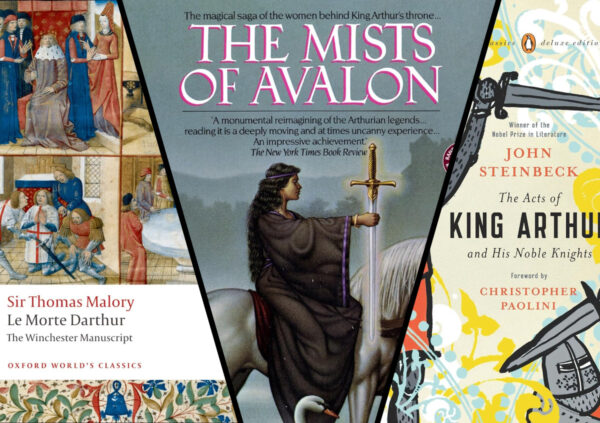
This page is a map through that inheritance, from the foundational texts to the retellings worth your time right now, organized the only way the material allows: by era, because an Arthur book is always partly a book about the moment that wrote it. The tradition sits at the headwaters of my best fantasy books canon, its modern summit covered in full on my Once and Future King page, and half the genre’s furniture, the wizard mentor, the destined heir, the fellowship, the fallen kingdom, was forged here first.
Fiction by René Rehn


The sources
Where it all comes from, and whether you should actually read them.
The two foundational texts are worth knowing even if you never finish them, and there is one honest back door into the bigger one.
Le Morte d’Arthur by Sir Thomas Malory (1485)

The great compilation, and the book that fixed the legend’s shape for everyone after. Malory, a knight with a long criminal record, wrote it in prison in the 1460s, pulling the sprawling French romances and the English poems into one continuous story that runs from Uther and the begetting of Arthur to the last battle and the queen in her nunnery. William Caxton printed it in 1485, and it remains the master-source every modern author on this page is either following or arguing with.
It is also, for most readers, a reference more than a read. The prose is Middle English, the structure is episodic to the point of shapelessness, and knights joust for forty pages at a stretch. That’s not a reason to skip it, it’s a reason to choose the right edition: Helen Cooper’s Oxford World’s Classics volume modernizes the spelling and trims the repetition, and it’s based on the Winchester Manuscript, the handwritten copy discovered in a college library in 1934 that’s closer to what Malory actually wrote than Caxton’s print.
Every list of Arthurian legend books descends from this one whether it admits it or not.
Sir Gawain and the Green Knight (fourteenth century)

The opposite proposition: short, strange, perfect. An anonymous poet of the late fourteenth century wrote a Christmas ghost story about honor and a beheading game. A green giant rides into Camelot at New Year and offers a bargain, any knight may strike him one blow with an axe, so long as he can return the blow in a year and a day. Gawain takes it, the stranger picks up his own severed head and rides off laughing, and the poem follows Gawain’s journey toward the return stroke through winter landscapes, a too-comfortable castle and three days of temptation.
It survives in a single manuscript, and it’s genuinely thrilling in a modern translation. Simon Armitage’s version prints the Middle English on the facing page and keeps the alliterative drive of the original, and the older Tolkien translation is still in print if you want the philologist’s Gawain, from the man who co-edited the standard scholarly text decades before. David Lowery’s 2021 film The Green Knight ran on the same nightmare logic, and readers it unsettled should go to the poem, which is stranger.
Start here. Admire Malory from a respectful distance until you’re ready.
The Acts of King Arthur and His Noble Knights by John Steinbeck (1976)

The friendly way into Malory, from the last writer you’d expect to find in a list of Arthurian legend books. Steinbeck loved the Morte all his life, called it the first book he ever owned, and in 1959 he moved to Somerset to translate the Winchester text into modern English. He worked at it for months, abandoned it unfinished, and never went back. It was published posthumously in 1976.
The result is lopsided in a fascinating way. The early tales are faithful, plain modernization, and then somewhere around the Lancelot material Steinbeck stops translating and starts writing, the psychology deepens, the landscape turns Californian, and you can watch a novelist take the story away from his source in real time. Then it simply stops.
The paperback includes an appendix of Steinbeck’s letters to his agent and editor about the project, and for anyone who writes, that appendix quietly steals the book.
The twentieth-century pillars
The modern classics that everything current is responding to.
Two mid-century masterpieces define modern Arthur, and between them they map the two roads every later author picks from: myth or history.
The Once and Future King by T. H. White (1958)

The hinge of the whole tradition. White took the legend from Malory and handed it to the modern reader, the boy called Wart, the backward-living Merlyn, the education by animals, and every Arthurian novel since has been written either toward this book or deliberately away from it. It remains the single best entry point to the tradition, which is why it holds down its own slot on my fantasy pillar.
This site covers it in full on its own Once and Future King page, the four books, the reading order question, The Book of Merlyn and all.
The Merlin Trilogy by Mary Stewart (1970-1979)

The other road. The Crystal Cave, The Hollow Hills and The Last Enchantment retell the legend through Merlin’s eyes as grounded historical fiction with only a shimmer of the uncanny, Arthur’s Britain rebuilt as a plausible post-Roman world of hill forts, Roman roads going to ruin and small kings fighting over the wreckage. Stewart’s Merlin is an engineer, a scholar and a solitary, and his gift of Sight arrives rarely enough that it lands like weather rather than magic.
Where White is elegiac and philosophical, Stewart is immersive and warm, and The Crystal Cave in particular, the story of Merlin’s strange boyhood, is one of the great openings in historical fiction. She added a fourth book, The Wicked Day, in 1983, which does the almost impossible: it makes Mordred sympathetic without cheating.
Between White and Stewart you have the two poles every book below sits between.
The historical Arthur
Strip out the magic, and find the war-leader underneath.
The most rewarding modern lane treats Arthur as history rather than fairy tale: the possible sixth-century British warlord who held the Saxons off for a generation, no wizards required, just a ruined post-Roman Britain and a man trying to hold it together.
The Warlord Chronicles by Bernard Cornwell (1995-1997)

The summit of the historical approach and, for many readers, the finest Arthurian retelling of the modern era full stop. Across The Winter King, Enemy of God and Excalibur, Cornwell builds a brutal, mud-and-blood, politically ferocious Dark Age Britain, narrated in old age by the warrior-turned-monk Derfel. Merlin is a canny old druid chasing gods that may or may not be real, Guinevere is a proud and fascinating figure rather than a symbol, and Arthur is a great and tragic man rather than a saint.
It is the Arthur book to hand a reader who thinks they don’t like Arthur books. The battle scenes are among the best Cornwell ever wrote, which is saying something, and the religious politics, old gods against arriving Christianity against sheer ambition, give the trilogy a spine most Arthurian legend books never find.
A television adaptation, The Winter King, ran for one season on MGM+ in 2023 before cancellation. The books are the version that lasts.
Sword at Sunset by Rosemary Sutcliff (1963)

The elegant elder of the lane, doing Cornwell’s job a generation before Cornwell. Sutcliff, best known for her Roman Britain novels for younger readers, wrote this one for adults: Artos the Bear, a Romano-British cavalry commander, tells his own life from his deathbed, the long campaign to hold civilization together after the legions left. There is no magic at all, only mist, horses and the weight of a doomed effort made anyway.
It grew out of her children’s sequence, picking up the world of The Lantern Bearers, but it stands completely alone, and its picture of a real, aching, archaeologically plausible Arthur was decades ahead of its time. The prose is more formal than Cornwell’s and the melancholy runs deeper.
Down the Long Wind by Gillian Bradshaw (1980-1982)

The deep cut of the historical shelf, and the trilogy for readers who finish Cornwell wanting more. Hawk of May, Kingdom of Summer and In Winter’s Shadow follow Gwalchmai, the figure who became Sir Gawain, from his childhood as Morgawse’s son through his service as Arthur’s rider. Bradshaw splits the difference between the lanes: her Britain is as researched and physical as Sutcliff’s, but the war between Light and Darkness is real, and Gwalchmai’s sword burns.
Each book hands the story to a new narrator, Gwalchmai, then a servant, then the queen herself, and the third volume is quietly one of the saddest Arthurian novels ever written. Long out of print, the trilogy came back in trade paperback and is worth the hunt.
The retellings that shifted the perspective
Camelot from the margins: the women, the losers, the left-out.
The defining modern move has been to retell the legend from the viewpoints Malory sidelined, and one book started that wave.
The Mists of Avalon by Marion Zimmer Bradley (1983)

The book that reimagined the entire saga through its women, Morgaine and the priestesses of Avalon and the queens, casting the Arthurian tragedy as the story of paganism’s defeat by Christianity. It became a genuine landmark, a bestseller for months, and the template for virtually every women-centered retelling since. Its influence on the Arthurian legend books that followed is impossible to overstate and impossible to ignore on a page like this.
It also has to be read with real awareness of its author. After Bradley’s death, serious and credibly documented allegations of abuse were made against her by those closest to her, and many readers now approach the book, or decline to, in that light. This site’s position is that the novel’s importance to the tradition is a matter of record and worth understanding, and that readers deserve to know what they are engaging with and to make their own informed choice. The details are a search away for anyone who wants them.
Held in that full context, its historical weight on the genre remains what it is.
Spear by Nicola Griffith (2022)

The best short book the tradition has produced in decades. Peretur is a girl raised in a cave by a strange, secretive mother, and when she leaves, taking a spear and a stolen name, she rides to Caer Leon to join the war band of Artos. Griffith builds her from the Welsh material underneath the later French romances, the figure who became Percival, and the result is luminous, queer and mythic in the oldest sense, a Grail story where the Grail is older and stranger than Christianity.
It’s novella length, the prose is the point, and it was shortlisted for the Nebula and World Fantasy awards. The early-medieval research runs deep, and it shows in the textures: food, weather, horses, the sound of Welsh names said right.
By Force Alone by Lavie Tidhar (2020)

The anti-romance. Tidhar retells Arthur as a London gangster clawing his way up through the protection rackets of a post-Roman ruin, the knights as goons, Merlin as something inhuman that feeds on power, the Grail as the ultimate score. It’s savage, profane and very funny, and underneath the pulp surface it’s a pointed satire on national myth-making, written, as Tidhar has said openly, against the nostalgic uses the legend gets put to.
Not the book for readers who came for chivalry. Exactly the book for readers who suspect chivalry was always a protection racket.
The current wave
Arthur, right now.
The legend is having one of its periodic surges, and the recent shelf is deep.
The Everlasting by Alix E. Harrow (2025)

The big one of the moment. Owen Mallory, a scholar shaped by war, is pulled back through time to Sir Una Everlasting, the knight whose legend built the nation of Dominion, and the novel runs on a loop structure that keeps rewriting what her story means and who it serves. It’s a book about how legends get made and who pays for them, which makes it the most directly Arthurian argument on the current shelf even with the names filed off.
Tor published it in October 2025, it won the 2026 Locus Award for Best Fantasy Novel and was a Hugo finalist, and a Netflix adaptation was announced in June 2026. Harrow was already a bestseller before it. This is the one that moved her up a weight class.
The Legendborn Cycle by Tracy Deonn (2020-2025)

The tradition’s current YA carrier, and the exception this site’s fantasy pages make for the category, because this is where the legend is actually moving. Bree Matthews, a Black sixteen-year-old in an early-college program at UNC Chapel Hill, stumbles into a secret society descended from Arthur’s knights, and the series’ real move is to run the Order’s inherited magic head-on into Southern history: whose bloodlines carry power, whose were enslaved by the families that carry it, and what the older, rootworking tradition on Bree’s side of the line can do.
Legendborn won the Coretta Scott King-John Steptoe Award for New Talent, Bloodmarked followed in 2022 and Oathbound in March 2025, the third of a planned four.
And the steady drumbeat of Morgan-and-Morgana novels continues, the priestess-sorceress remaining the figure modern authors most want to redeem, evidence that the wave Mists started forty years ago has never really receded. Whatever else is true, Arthur keeps returning, exactly as promised.
Where to actually start
By appetite, honestly. For the single best entry to the whole tradition, The Once and Future King. The version that will convert an Arthur skeptic is Cornwell’s The Winter King, no contest. For the medieval real thing in a form you’ll actually enjoy, Sir Gawain in a modern translation. For something short, radiant, and now, Griffith’s Spear. The best Arthurian legend books aren’t competing to tell the same story better. They’re each answering the question their own age asked of the same old material, which is why the legend never dies and never finishes. Fifteen centuries in, the sword is still in the stone, and every generation lines up to try its grip.