Joe Abercrombie books are easier to navigate than most epic fantasy of this scale, and the reputation that precedes them does him a slight disservice.
The navigation first, because it’s simple. Almost everything he’s written for adults takes place in one world, the First Law world, and it’s published close to internal-chronological order, so there’s no puzzle to solve. Read the original trilogy, then the three standalones, then the second trilogy, in that order, and you’ve read it correctly. The one wrinkle is a brand-new series set somewhere else entirely, which arrived in 2025 and which I’ll come to.
The reputation is the part worth pushing back on. Abercrombie is the writer most associated with grimdark, he publishes under the handle Lord Grimdark, and the shorthand for his work is “everyone is terrible and everything is bleak.” That shorthand is wrong, and it’s the reason a lot of people who’d love these books never pick them up. His novels aren’t nihilistic. They’re humanist, often very funny, and built on characters who make terrible choices for reasons you completely understand, then live with the consequences. The darkness is real, but it’s in service of people rather than instead of them, and missing that misses the whole appeal.
So this guide gives you the order, tells you honestly which books are the best, and explains what he’s actually doing, which is not what the label suggests. His role in defining the subgenre is on my grimdark books list, the trilogy has its spot on my best fantasy books list, and the First Law sits on my best fantasy series list. This is the guide to the author.
Fiction by René Rehn


The short version
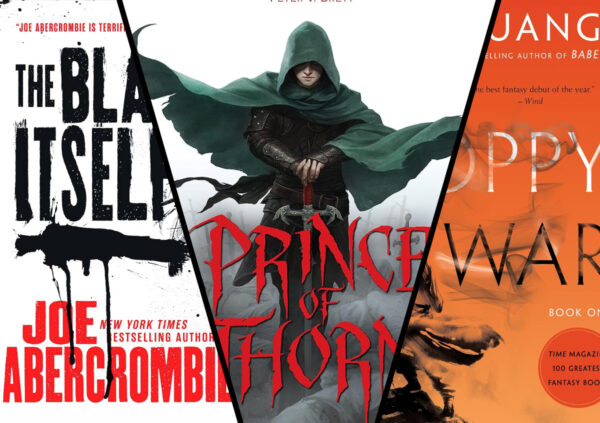
Start with The Blade Itself, the first book of the original First Law trilogy. Every reading-order guide agrees, and they’re right: the trilogy establishes the world, the characters, and the expectations that everything else he’s written then plays against. The standalones are technically standalone, but their best moments are payoffs to setups from the trilogy, and returning characters land far harder if you know their history.
The one alternative worth knowing: Best Served Cold has the fewest dependencies on the trilogy and can work as a test-drive if you want to sample him before committing. But the trilogy is the better door for almost everyone.
What Abercrombie is actually doing
Worth understanding up front, because it’s what separates him from his imitators.
The trick that made his name is subversion. The First Law trilogy assembles every piece of standard epic fantasy furniture, the noble barbarian, the wizard mentor, the young nobleman off to glory, the quest for an ancient weapon, and then spends three books demonstrating that the shape is a lie. The quest achieves nothing. The wizard has worse motives than the villain. Glory is squalor with better marketing. If you’ve read enough traditional fantasy to know what’s supposed to happen, watching Abercrombie refuse to deliver it is enormously satisfying.
The characters are why it works rather than just being clever. Sand dan Glokta, a torturer crippled by torture himself, narrating in bitter interior monologue, is one of the great creations in modern fantasy, and he’s sympathetic despite doing monstrous things for a living. Logen Ninefingers wants to be a better man and cannot stop being what he is. These are people, drawn with real interiority, and the violence lands because you care about who it happens to.
And he’s funny. The dialogue is genuinely, consistently funny, the humor running right alongside the brutality rather than relieving it, and it’s the thing the grimdark label most obscures. His prose is sharp, lean, and controlled, built for momentum and the perfectly-timed cruel joke.
The darkness is real and it’s earned. But a reader who comes expecting relentless misery finds instead a humane, witty, and surprisingly warm writer working in dark materials, and that gap is why his fans are as devoted as they are.
The First Law Trilogy
Start here. The Blade Itself, Before They Are Hanged, Last Argument of Kings.

The debut that announced him and the foundation everything else is built on.
The Blade Itself is the introduction, and it’s the slowest of the three by design: it spends its length assembling the cast and the world, letting you settle into what looks like a conventional epic before anything subverts. Some readers find the first book a slow burn for exactly this reason. It’s setup, and the payoff is enormous.
Before They Are Hanged and Last Argument of Kings accelerate hard, and the ending of the trilogy is one of the most talked-about in modern fantasy, precisely because it refuses every satisfaction the genre trained you to expect and is more honest for it.
This is where you meet Glokta, Logen, Jezal, and the magus Bayaz, characters the rest of the First Law world keeps circling back to for two decades. Read it first, and read it in order.
The Standalone Novels
Read after the trilogy. Best Served Cold, The Heroes, Red Country.

Three self-contained novels set in the same world, and the run where Abercrombie arguably got even better.
Best Served Cold is the consensus pick of the three and the best entry point after the trilogy. It’s a revenge story, often compared to Kill Bill: Monza Murcatto is betrayed and thrown off a balcony, survives, and works methodically through the seven men responsible. Abercrombie lets the revenge machine grind past the point of satisfaction into something queasier, which is the whole argument, and it reintroduces trilogy characters in ways that reward your history with them.
The Heroes is the one critics often rate highest. It’s a single battle told over three days from multiple viewpoints on both sides, and it’s one of the best war novels in the genre, an unflinching study of how combat actually chews up the people fighting it while the leaders spin it into legend afterwards.
Red Country is his Western, a frontier revenge story that brings back one of the trilogy’s major figures in a new register. It’s the least essential of the three and still very good.
Read them in publication order after the trilogy. Each stands alone as a plot, but each is richer for what you already know.
The Age of Madness Trilogy
Read last. A Little Hatred, The Trouble with Peace, The Wisdom of Crowds.

The second trilogy, set thirty years later, and his most structurally ambitious work.
The world has moved into an industrial revolution, with factories, labor unrest, and rising political radicalism, and the cast is largely the children of the original trilogy’s characters, navigating a world their parents shaped. Abercrombie uses the setting to write about revolution, class, and progress with more political sophistication than anything in the first trilogy.
It depends heavily on the original books and the standalones, referencing their events and characters throughout, so it genuinely has to come last. Read out of order, it spoils the trilogy and loses most of its resonance.
It’s a strong close to the First Law project and confirms he’s kept getting better rather than coasting.
The Short Fiction
Sharp Ends, read after the standalones.

Sharp Ends is the main collection of First Law short stories, ranging across the world’s history and featuring characters before, during, and after the events of the novels. It adds texture rather than essential plot, and the standout is the material on Shevedieh and Javre, a thief-and-warrior double act who are among his most purely entertaining creations.
Best read after the standalones, when you know enough of the world for the connections to land. Not required, and a genuine pleasure for anyone already invested.
Beyond the First Law
Two things sit outside the main world, one older and one brand new.
The Shattered Sea Trilogy (2014–15)

Half a King, Half the World, Half a War.
His young-adult fantasy, set in a Viking-influenced world entirely separate from the First Law. Half a King follows a young prince, born with a maimed hand and underestimated by everyone, betrayed and sold into slavery, who has to claw his way back.
It’s leaner and faster than his adult work, with the darkness dialled down for a younger audience but the plotting and the moral complexity intact. It’s genuinely good, and it’s the thing to hand a younger reader or anyone who finds the adult books too brutal. Adults who love the First Law often rate it more highly than they expect to.
The Devils (2025– )

Start with The Devils.
His first adult series outside the First Law world in a decade, and the beginning of something new.
Set in an alternate medieval Europe under threat of invasion by flesh-eating elves, it follows a band of monsters, a vampire, a werewolf, a necromancer, an immortal knight, an invisible elf, and a reluctant monk, employed by the Church to escort a street thief to Troy, where she’s the heir to the throne. It’s a road-trip caper with Abercrombie’s trademark grit and humor, and it leans harder into comedy and horror than the First Law does.
It was an instant number one Sunday Times bestseller, and James Cameron has bought the film rights with Abercrombie co-writing the script, so this is likely to become the entry point through which a lot of new readers arrive. The second book, The Heretics, is due in May 2027.
It also happens to be a genuinely good starting point for a new reader, since it’s self-contained and needs no prior knowledge of anything. If the First Law feels like too much of a commitment to begin with, this is a legitimate front door.
A note on where to actually start
The real answer: read The Blade Itself and commit to the original trilogy, because that’s the foundation and the standalones are so much better for it. If the slow-burn first book worries you, know that it’s setup for one of the best payoffs in the genre.
If you’d rather test the waters, Best Served Cold or The Devils both work as self-contained entry points, the first inside the main world and the second entirely outside it. And if the word grimdark has been putting you off, read the first fifty pages of anything he’s written and notice how funny it is. The bleakness is real, but it was never the point. The people were.