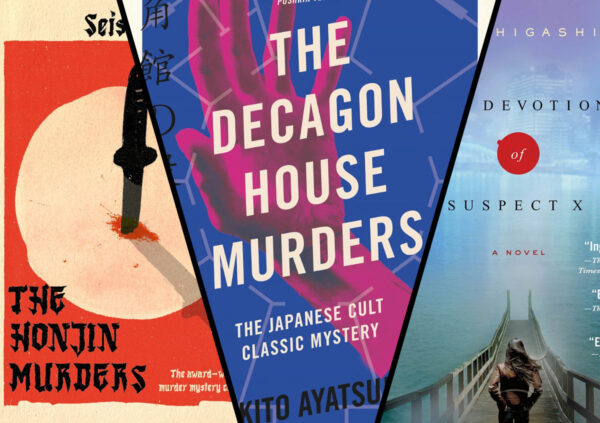
For more than thirty years The Decagon House Murders was considered unfilmable. The reason is the novel’s central trick, which depends on something that works on a printed page and falls apart the moment you put a camera in front of it. Then a manga adaptation found a way, and in 2024 a streaming drama followed. Yukito Ayatsuji’s 1987 debut has outlasted its own reputation as an impossible book.
Its mechanics and its place in the history of the form are covered in our ranking of Japanese mystery novels, and the Yukito Ayatsuji guide covers the series around it. This page is about the book’s journey out of Japanese and onto the screen. It follows the record, not my own reading.
The Setup
Seven students belonging to their university’s mystery club go by Ellery, Carr, Poe, Van Dine, Agatha, Leroux and Orczy rather than their own names, and they spend a week on an island where the owner of the property, his wife and two servants were killed half a year earlier. Their lodging has ten sides, and the novel itself calls it a decagonal trap. On their first morning, seven plates are waiting on the table, each with a role written on it, and one of the roles is victim.
The club is not invented from nothing. Ayatsuji wrote it as a member of the Kyoto University Mystery Club, whose alumni fill the ranks of Japanese crime fiction, and the club on the page is a thinly disguised version of that one, members included. Ho-Ling Wong’s English edition includes a postscript on the real club, which is worth reading afterward rather than before.
Why It Was Thought Impossible
The solution, when it lands, is a single line that reorganizes everything you have read. That solution is the problem for adapters. Without giving anything away, it relies on something prose can withhold and pictures struggle to, and the book acquired a reputation as a story that only worked in its original medium.
It is also why the novel gets described as clever rather than atmospheric. Everything in it is built to serve one reversal, which brings us to the honest part.
The Divided Reception
English-language reviewers do not agree about this book, and you should know that before buying it.
The enthusiasts are very enthusiastic. Bloggers who specialize in Golden Age detective fiction describe finishing it with their hearts racing, and several credit it with starting their interest in the form. It regularly appears near the top of lists of the best translated mysteries, and in Japan it sits eighth on the standard ranking of the hundred greatest mystery novels.
The sceptics have a specific complaint. One reviewer gave it two and a half stars, objecting that shin honkaku, the movement this novel launched, runs on robot-like characters, game-like settings, and a deliberate absence of literary interest, all in service of a puzzle. That is a fair description of the book. Whether it is a criticism depends entirely on what you want: if you read for people, this is not your novel, and if you read for mechanism, few books deliver more.
The Long Road Into English
The book waited twenty-eight years for an English translation. It came in 2015 from Locked Room International, the small press run by John Pugmire devoted to classic and impossible-crime fiction, in a translation by Ho-Ling Wong, who belongs to both the Kyoto club and the Honkaku Mystery Writers Club and is therefore inside the tradition he was carrying across.
Pushkin Press reissued that same translation under its Vertigo imprint in December 2020, which is when the book reached a mass readership. Reviewers of the translation note that some things inevitably flatten, particularly the senpai and kohai hierarchies among the students, but that the logic of the puzzle and the force of the revelation survive intact.
Much of what followed came after that first small-press edition opened the door: the three further Ayatsuji novels in English, the Yokomizo revival, and the broader wave of Japanese crime fiction in translation. One critic put its historical role more bluntly, crediting it with ending the dominance of the socially conscious crime novel in Japan, the mode Seicho Matsumoto had made standard.
The Manga Found a Way
The first successful adaptation was a comic. Hiro Kiyohara, who had already drawn the manga version of Ayatsuji’s horror novel Another, began serializing The Decagon House Murders in Kodansha’s Monthly Afternoon in August 2019, finishing in April 2022 across five volumes, with an English digital edition announced in 2021.
Kiyohara updated the setting and the character designs while keeping the plot intact.
Then Television Tried
In December 2023 a live-action version was announced, and Hulu Japan released it on 22 March 2024, in five episodes, directed by Akira Uchikata, with a young cast led by Ayumu Mochizuki and Neru Nagahama.
That two visual adaptations now exist doesn’t mean the book’s reputation was wrong. It means both had to solve a problem prose never had, which is a useful thing to think about while you’re reading.
Which Copy

Buy the Pushkin Vertigo edition of Wong’s translation, and don’t read the postscript first. The Ayatsuji guide explains where the book sits in the series and which volume the English sequence skips.
Where to Go Next
The next book in the series is The Mill House Murders, and the guide covers all four in English.
For the novel that planted the seed six years earlier, see The Tokyo Zodiac Murders, and the Seishi Yokomizo guide covers the writer whose locked rooms both books were built in tribute to.