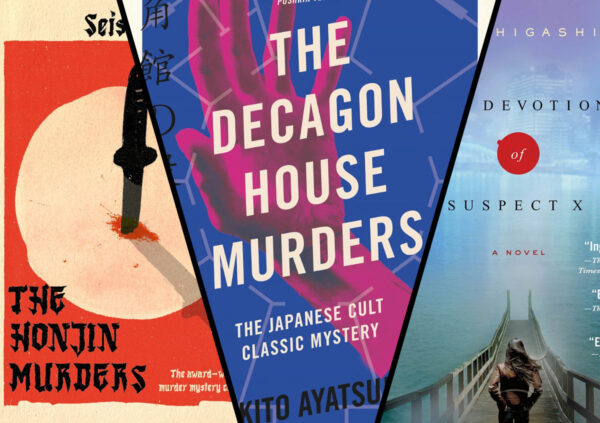
Seishi Yokomizo created Japan’s most famous fictional detective, Kosuke Kindaichi, a scruffy, stammering, badly dressed young man who solves baroque murders in cursed villages and decaying family estates. The series ran to 77 books, his whodunnits have sold some 55 million copies in Japan, and for most of the last century almost none of it existed in English. That has changed. Pushkin Vertigo has been translating the Kindaichi novels one by one since 2019, and English readers now have a real shelf of them.
This guide sorts out the Seishi Yokomizo books available in English, the order they were written in, and where to begin. For his role in the history of the Japanese detective novel, see the Japanese mystery novels list and the Japanese authors hub, which both discuss The Honjin Murders. My Kindaichi knowledge is secondhand, from reviewers and translators, since I haven’t read the series.
Where to Start
Start with The Honjin Murders, the first Kindaichi novel and a classic locked-room mystery. If you’d prefer the most famous story, begin with The Inugami Curse, which many fans consider his best and which has been filmed repeatedly in Japan.
The good news for anyone worried about order is that the novels are self-contained. Kindaichi’s earlier cases are occasionally mentioned, but reviewers note that later books don’t spoil the solutions of earlier ones, so you can read them in whatever order you find them.
The Pharmacist Who Read Conan Doyle
Yokomizo was born in Kobe in 1902 and spent his childhood reading detective stories: Conan Doyle, Maurice Leblanc’s Arsène Lupin, and everything the Japanese publishers of the day had translated. He trained for a different life, taking a pharmacy degree at Osaka Pharmaceutical College with the intention of running the family drugstore, and he was working at a bank when his first story appeared in the magazine Shin Seinen in 1921.
Shin Seinen was the home of Japanese detective fiction between the wars, and Yokomizo went to work there as an editor, which put him at the center of the genre before he had written any of the books he is remembered for. Then the war closed that world down: detective fiction was regarded as frivolous or worse, publication became almost impossible, and he was evacuated with tuberculosis he could not treat, since streptomycin was not available in Japan. By his own account he and his friends treated it as an open question which would finish him first, the illness or the hunger.
His great period began the moment the war ended. The Honjin Murders and The Butterfly Murder Case both appeared in 1946, and over the next three decades Kindaichi carried him to a level of popularity no Japanese crime writer had reached before. A Kadokawa reissue boom in the 1970s, along with Kon Ichikawa’s films, made him a bestseller all over again with a new generation. He died of colon cancer in December 1981, and a mystery prize established in his name still runs, alongside the Pushkin translations, as the working part of his legacy.
The Honjin Murders
1946 · translated by Louise Heal Kawai

On their wedding night in a snowbound village, a newly married couple is found murdered inside a sealed annex, with the snow outside undisturbed and a bloodied samurai sword driven upright into the garden. A koto sounds in the night. A three-fingered man has been seen around the village. Kindaichi’s first case is a tribute to the Western locked-room tradition, and its characters discuss Carr and Leroux while the puzzle closes around them.
It took the inaugural Mystery Writers of Japan Award two years later, and the Japanese mystery novels list discusses its mechanics and its importance. The The Honjin Murders page covers how Yokomizo came to write it, including the evacuated novelist who narrates it and how closely that narrator resembles the author.
Death on Gokumon Island
1947 to 1948 · translated by Louise Heal Kawai

Kindaichi travels to a remote island in the Seto Inland Sea to carry out the last request of a comrade who died on the repatriation ship home from the war: to warn the man’s family that his three half-sisters are in danger. He arrives to find a community run by feuding branches of one clan, a village of fishermen and former pirates who do not want him there, and then the killings begin, staged in ways that are grotesque even by this series’ standards.
It is the second Kindaichi novel, and Japanese readers have often ranked it among the best in the series. The setting does most of the work: an island with one boat, a family that has been quietly breaking for generations, and a detective who is the only person on it with no relatives.
Murder at the Black Cat Cafe
1947 · translated for Bryan Karetnyk

Tokyo in 1947, in the bombed-out entertainment district, where a cafe called the Black Cat sits inside a warren of bars known as the Pink Labyrinth. A body is found, and Kindaichi’s attention settles on the cafe’s madam, Oshima, whose past is deliberately obscure and whose relationship with the owner nobody will explain.
It is the one book in the English sequence set in the immediate ruins of the war rather than in a rural house, and it is the closest Yokomizo comes to the social texture of occupied Tokyo. The Pushkin edition also includes a bonus story, The Well Wheel Creaks.
The Village of Eight Graves
1949 to 1951 · translated by Bryan Karetnyk

A village in the mountains between Tottori and Okayama takes its name from a sixteenth-century legend: the inhabitants murdered eight fleeing samurai for their treasure, and the dying leader cursed the place. Centuries later, a young man named Tatsuya learns he is the heir to one of the village’s great houses, arrives to claim his inheritance, and finds a wave of poisonings following him from the moment he steps off the train.
Told largely from Tatsuya’s point of view rather than through Kindaichi, it has more of the texture of a gothic thriller than the other books, and the legend at its center gives it one of the strongest atmospheres in the series. Readers who want a puzzle above all will find it the loosest of the series. Readers who want dread will rank it first.
The Inugami Curse
1950 to 1951 · translated by Yumiko Yamazaki

When the patriarch of the wealthy Inugami family dies, his will is read to a household containing three mistresses, three unloved daughters, three grandsons, and Tamayo, the orphaned granddaughter of the man who made his fortune possible. The will names Tamayo heir on condition that she marry one of the three grandsons. The murders begin almost immediately, and one of the grandsons has returned from the war so disfigured that he wears a mask, an image that has become one of the most famous in Japanese popular culture.
The translation first appeared in English as The Inugami Clan in 2003 and was reissued under its current title by Pushkin Vertigo. Kon Ichikawa filmed it twice, in 1976 and again in 2006, and those films helped make Kindaichi a household name, with Koji Ishizaka’s scruffy performance fixing the detective’s image for a generation of Japanese viewers.
The Devil’s Flute Murders
1951 to 1953 · translated by Jim Rion

In 1947, a young woman asks Kindaichi to investigate the disappearance of her father, a former aristocrat and amateur flautist who vanished amid a scandal, and the case draws him into a household of decaying nobility where a recording of the man’s own composition keeps being heard. Reviewers have praised it as one of the strongest books in the series, and it is the one where Yokomizo’s habit of scoring a case to a piece of music pays off best.
Rion went on to translate the novels of Uketsu, whose Uketsu guide explains the connection, which makes him the through-line from the oldest Japanese mysteries in English to the newest.
The Little Sparrow Murders
1959 · translated by Bryan Karetnyk

An old friend invites Kindaichi to the remote mountain village of Onikobe, where a murder twenty years earlier was never solved. Almost as soon as he arrives, new victims are found posed in ways that echo the verses of a local children’s song, a device Yokomizo had used before and here pushes furthest.
It’s a later, more elaborate case that shows how he reworked his favorite ingredients, isolated communities, family secrets, and ritualized killings, across more than a decade. At over five hundred pages in English it is also the longest of the translations, and the one that most rewards patience with a village’s genealogy.
She Walks at Night
1948 to 1949 · translated by Jesse Kirkwood

The most recent addition to the English sequence and, despite arriving last, an early case: the third Kindaichi novel, from the same postwar burst that produced The Honjin Murders and Death on Gokumon Island. The title is literal, the case turns on sleepwalking, and the detective arrives into a household that has already decided what story it wants told.
It fills in the early Kindaichi rather than extending the late one, and at the pace Pushkin is working, more seem sure to follow.
Beyond Kindaichi
One other Yokomizo is worth knowing about even though it sits outside the series. His 1939 story The Death’s Head Stranger was called, by the scholar Mari Kotani, the first successful Japanese adaptation of Bram Stoker’s Dracula and the archetype of Japanese vampire literature. It belongs to the prewar Yokomizo, the editor and pulp writer, rather than the postwar puzzle-maker, and it is a reminder that the man who invented Japan’s coziest detective also wrote horror.
The Full English List at a Glance
In order of Japanese publication: The Honjin Murders · Murder at the Black Cat Cafe · Death on Gokumon Island · She Walks at Night · The Village of Eight Graves · The Inugami Curse · The Devil’s Flute Murders · The Little Sparrow Murders
Translators: Louise Heal Kawai, Yumiko Yamazaki, Bryan Karetnyk, Jim Rion and Jesse Kirkwood have all worked on the series for Pushkin Vertigo.
Given how steadily the translations have appeared, more Kindaichi novels seem likely to follow.
Where to Go Next
The writers who revived Yokomizo’s fair-play puzzle in the 1980s are covered in the Japanese mystery novels list, and the man who led that revival has his own Yukito Ayatsuji guide. The modern heir to his image-driven puzzles is on the Uketsu guide, and for a very different Japanese detective, the Keigo Higashino guide covers the Galileo and Kaga series.